


Prosumer installers and EPC firms in the Federation of Bosnia and Herzegovina can use this four-tool shortlist of proposal software. The deciding question is whether a tool can value exports at the FERK net billing rate. Aurora Solar has a fixed export rate field, and Energy Toolbase compares cash, loan, lease and PPA options.
A Federation quote needs exports at the retail tariff minus 10% under net billing, credit that lapses after the first quarter, and two daily tariff intervals in KM/kWh. The vendor pages we read never name Bosnia and Herzegovina, so choose by what you can type in. OpenSolar’s core app is free and takes a custom tariff. Aurora Solar takes a fixed export rate. Energy Toolbase compares cash, loan, lease and PPA (power purchase agreement) options. SurgePV pairs roof modeling with proposals, priced per user. No vendor lists a KM price on the pages we read.
This is a desk comparison of published vendor pages, checked October 2026, with no hands-on runs. SurgePV publishes this page and is one of the four tools on it. Vendor facts come from each vendor’s own site, and the net metering and billing facts come from the FERK rulebook cited below. The rules of Republika Srpska and Brčko District were not read, so check them separately.
Solargraf, listed on an earlier version, is not compared here: solargraf.com returned HTTP 403 to automated reads in October 2026.
Five checks drive the Federation tables: tariff entry, export-credit setting, local-language proposals, price in a published currency and free start.
Want to see SurgePV quote a Bosnia and Herzegovina project?
Book a guided demo and bring a real Bosnia and Herzegovina site. We walk through design, yield, finance and the proposal in one platform.
Book a Free DemoChecking cost first? See the SurgePV pricing page.
Best-For Picks for Bosnia and Herzegovina
- A fixed export rate: Aurora Solar. Its help article offers a “Fixed export rate” in “$ per kWh”, so check how it prints KM. It is the nearest match to net billing; ask whether it accepts retail minus 10%.
- Cash, loan, lease and PPA offers: Energy Toolbase. Its FAQ says the platform supports “cash purchases, power purchase agreements (PPAs), loans, and leases”. It has no published price and suits commercial prosumers above the household range; ask how annual credit resets are modeled.
- A custom tariff in a free core app: OpenSolar. Its tariff article lists flat, time-of-use, tiered and demand rates and several export-credit options. The core app is free; API Access and connectors are charged from 16 April 2026. That lets you try the two-interval tariff before paying.
- Roof model to BOM to proposal, one price per user: SurgePV. It lists roof modeling, shading, yield, financial modeling, bill of materials and proposals. No Bosnia and Herzegovina tariff or KM output is named, so ask whether it can show energy credit balances month by month.
Bosnia and Herzegovina Solar Proposal Software Comparison Table
The tools are in alphabetical order. This is not a ranking. Pick by the situation above. Prices checked October 2026 on each vendor’s own page.
| Tool | Best for | Price | Free or paid | Decisive scope fact |
|---|---|---|---|---|
| Aurora Solar | Fixed export rate, custom rates; retail minus 10% check | Basic $159 per user per month (monthly billing); $135 billed annually | Paid | Compensation policy: net billing or feed-in tariff |
| Energy Toolbase | Cash, loan, lease and PPA comparisons for FERK net billing | Not published (book a demo) | Paid | Works with partner design tools |
| OpenSolar | Custom tariff, free core app, FERK net billing | Core app free of charge; API Access and connectors charged from 16 April 2026 | Free core app, paid API and connectors | 13 proposal languages |
| SurgePV | Roof model to BOM and proposal, per user, one price | $1,899 per user per year (1 user), in US dollars | Paid, guided demo | BOM and proposal generation in scope |
Bosnia and Herzegovina Criteria Matrix
For the Federation, Documented means the vendor’s own page states the item. Partial means only some of it, or only other countries. Not stated means the pages we read in October 2026 are silent. No scores or weights apply.
| Tool | Tariff entry | Export-credit setting | Local-language proposals | Price in a published currency | Free start |
|---|---|---|---|---|---|
| Aurora Solar | Documented (custom rates, or Genability and Aurora rates) | Documented (fixed export rate; net billing or feed-in tariff) | Not stated | Partial (dollar figures; currency not named) | Not stated |
| Energy Toolbase | Partial (utility rates team described; Bosnia and Herzegovina not named) | Not stated | Not stated | Not published for ETB Developer | Not stated |
| OpenSolar | Documented (custom tariff) | Partial (several credit options; none named for Bosnia and Herzegovina) | Partial (13 proposal languages; see the entry) | Documented (core app free) | Documented |
| SurgePV | Partial (financial modeling; no tariff entry described) | Not stated | Not stated | Partial (USD only) | Not stated (guided demo) |
Two points stand out for Bosnia and Herzegovina. No vendor page we read names the country, and the tools split on whether you can type a two-interval tariff and an export rate yourself. A Not stated row may still work, so run one real Federation invoice through each vendor before you buy.
Tool Entries
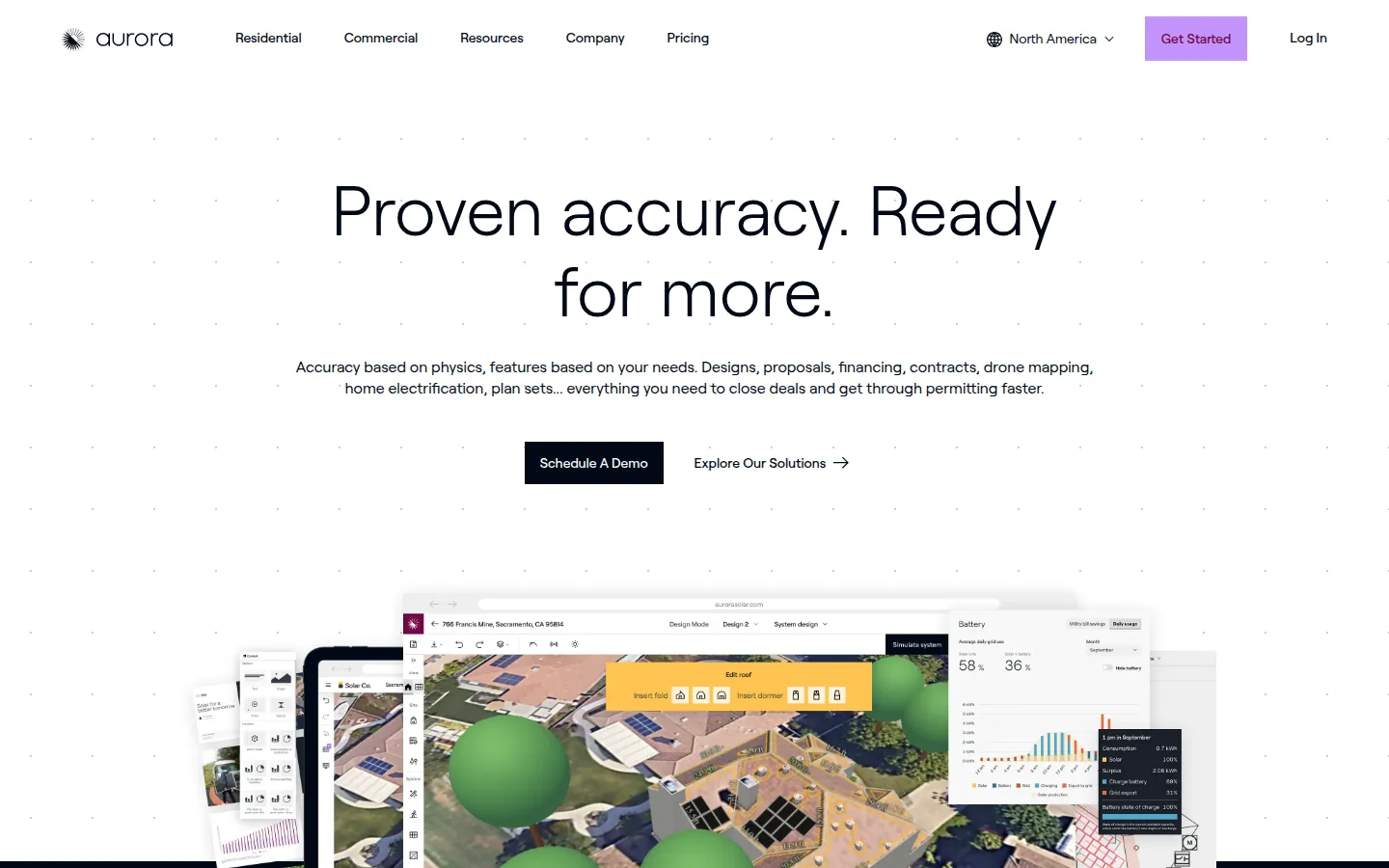
Aurora Solar
Federation quote check: Ask whether an export value can be set below the retail tariff.
Best for: Federation teams that want one fixed export rate, the nearest match to net billing, with a net billing or feed-in tariff switch in one design tool.
Not the right choice if: you need a KM price or a local-language proposal, since neither appears on the pages we read, or you want a free tool: the plans we read are paid, with a custom Enterprise tier.
What the vendor documents: all plans on the pricing page include 3D roof modeling, proposal templates, custom pricing methods and a utility rate database, and the page lets you “Configure your own rates or use rates from Genability and Aurora”. Web and PDF proposals and financing comparisons also appear, and Premium adds battery modeling and bankable shade reports. On feed-in tariffs, the help article reads “With Feed-in tariff, Aurora credits all the energy the system produces at a tariff rate”.
Price (checked October 2026): Basic $159 per user per month billed monthly, or $135 per user per month billed annually ($1,620 billed annually). Premium $259 per user per month, or $220 per user per month billed annually ($2,640 billed annually). Enterprise is custom, per project. The page shows a dollar sign and does not name the currency.
Limitations: the article’s export rate unit is “$ per kWh”, so check whether retail minus 10% can be entered in KM. The pricing page lists North America and Europe regions. Bosnia and Herzegovina is not named on the pages we read.
Vendor link: aurorasolar.com
Energy Toolbase
Federation quote check: Ask how a credit that cancels after the first quarter is handled.
Best for: Federation developers pitching commercial prosumers above the household range who want cash, loan, lease and PPA offers compared, or solar with storage.
Not the right choice if: you need a published price, since the pricing page asks you to book a demo, or a roof designer you can verify is built in. The ETB Developer page cites design-software partnerships, so ask how layouts reach it.
What the vendor documents: on the ETB Developer page you get proposals, quick financial analysis, lead management and “up-to-date utility rates”, with “120k+” utility rates tracked. The FAQ adds support for “cash purchases, power purchase agreements (PPAs), loans, and leases”, and the tool is web-based.
Price (checked October 2026): not published for ETB Developer. The pricing page says “Book 30 minutes” for a demo and pricing for your team size. Dollar figures on that page belong to its ETB Controller and ETB Monitor products.
Limitations: Bosnia and Herzegovina and KM output are not named on the pages we read, nor which countries the utility rates cover. Ask how annual credit resets are modeled.
Vendor link: energytoolbase.com

OpenSolar
Federation quote check: Ask whether two daily tariff intervals can be entered.
Best for: small Federation crews who want a free core app and will type both daily tariff intervals themselves.
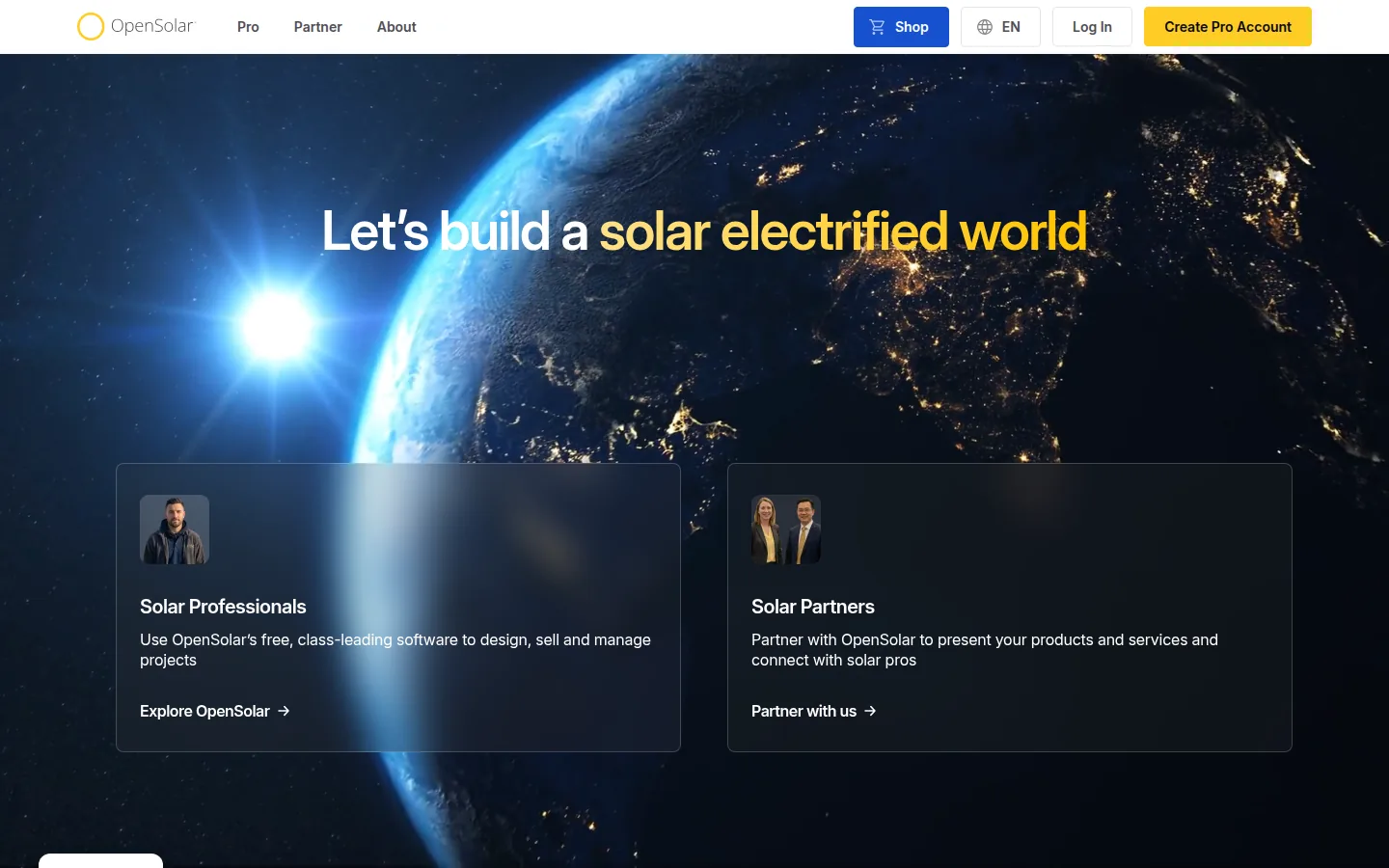
Not the right choice if: your clients need a proposal language outside the list below. The article says a template must be translated by hand. The language article lists English, Dutch, Swedish, Spanish, French, Norwegian, Thai, German, Polish, Portuguese, Italian, Danish and Finnish.
What the vendor documents: custom tariffs built from flat, time-of-use, tiered and demand rates, plus a menu of export credits: Net Billing, Net Billing with Credit Carryover, Buy All, Sell All and Net Energy Metering. The article never says which suits Bosnia and Herzegovina.
Price (checked October 2026): the core app is free of charge for solar professionals, per the vendor. From 16 April 2026 the vendor charges for API Access, a per-project fee, and for supported connectors, a flat monthly subscription. Source: its 16 February 2026 post and its API page.
Limitations: Bosnia and Herzegovina and KM output are not named on the pages we read.
Vendor link: opensolar.com
SurgePV
Federation quote check: Ask for a sample proposal in the local language with a credit balance line.
SurgePV is our product.
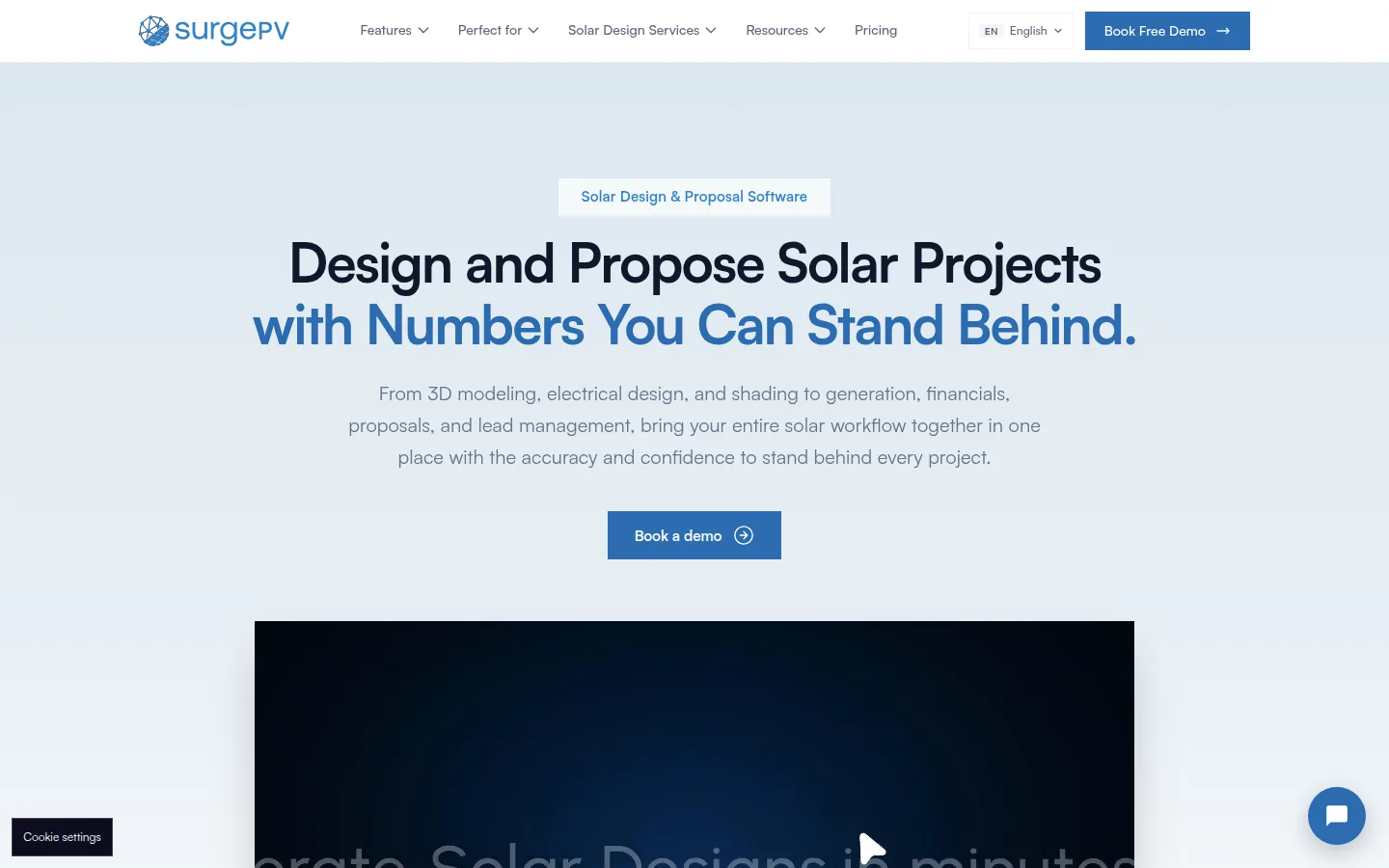
Best for: Federation teams wanting roof modeling, array layout, shading, yield, financial modeling, electrical workflow support, bill of materials and proposals in a single per-user product. Ask whether a proposal can show credit balances month by month. See solar proposal software for the product page.
Not the right choice if: you want a self-serve trial, since SurgePV offers a guided demo, or a KM price in writing before talking to sales. Outputs support design and paperwork; the responsible engineer, authority, lender or utility still approves.
What the vendor documents: the scope covers 3D roof modeling, array layout, shading analysis, energy-yield modeling, financial modeling, electrical workflow support, bill-of-materials output and proposal generation.
Price (checked October 2026): $1,899 per user per year for 1 user, $1,499 per user for 3 seats, $1,299 per user for 5 seats, in US dollars. Confirm any local-currency amount and taxes in a written quote.
Limitations: results depend on source data, assumptions and equipment models. The published SurgePV scope names no Bosnia and Herzegovina tariff, export-credit setting, local-language proposal or design size limit.
Vendor link: surgepv.com.
Net Metering or Net Billing: What the Quote Must Show
This section covers the Federation of Bosnia and Herzegovina only, under the rulebook of its regulator FERK. We did not read the rules of Republika Srpska or Brčko District, so check those separately. The money side of a prosumer plant is set in Articles 7 to 10 of the FERK rulebook (Službene novine FBiH 30/2024). Source: FERK, Pravilnik o proizvodnji električne energije za vlastite potrebe (proizvodnja prosumera), Službene novine FBiH 30/2024. Connection steps are on the overview page, and shared building plants are on the design page.
Two schemes. All prosumers can use net billing. Households with an approved connection capacity up to 10.8 kW can choose net metering or net billing. They may stay on net metering for 10 years, after which they have the right to net billing.
Net metering. The surplus delivered to the grid in a monthly billing period carries to the next period as an energy credit in kWh. The credit is used to reduce consumption when the customer uses more than they produce.
Net billing. The surplus is valued in money. The rulebook calculates the positive difference separately for the higher and the lower daily tariff intervals. That kWh is multiplied by the active energy tariff in KM/kWh, reduced by 10%, and the result is a monetary credit carried to the next period. A quote that values exports at the full retail tariff would differ from this rule.
Credit expiry. Energy and monetary credits are cancelled after the first quarter of the current year, and the customer has no right to payment for unused credit. Any remaining credit after the first quarter is taken by the supplier without compensation. A payback chart that shows credit accumulating indefinitely would not match this.
What the bill shows. The supplier must show the energy or monetary credit balance at the start and end of the month on the invoice, and uses the tariff rates valid for the billing period.
Who pays for the connection. A new building with a plant pays a connection fee under FERK’s methodology, and an existing customer pays a fee for changes to the connection. Put these on a separate quote line from equipment.
What to ask a proposal vendor. Can the export value be set to retail minus 10%? Can the model reset credits each year after the first quarter? Can it show two tariff intervals? Can the proposal be in the local language? None of the vendor pages we read states these, so run one real invoice through a trial.
How We Ordered These Tools
The Federation tools run alphabetically, with no ranking. Best-for picks come from the matrix.
- Tariff entry: the quote needs the higher and lower daily tariff for the client. We did not measure how any tool prices time-of-use or tiered rates.
- Export-credit setting: FERK values exports at the tariff minus 10%. We did not assess whether any tool can model it.
- Local-language proposals: clients read best in a familiar language. Translation quality was not assessed.
- Price in a published currency: a known currency shows the buyer’s real cost. Discounts and negotiated quotes were not assessed.
- Free start: a free plan lets a small crew try the flow. We did not assess its limits beyond what its page states.
Methodology and Disclosure
SurgePV is published by SurgePV, which is also one of the vendors on this list. Its entry draws on the same kind of source as the other three: public vendor pages, read in October 2026. For Bosnia and Herzegovina, the tariff, credit, currency and language questions are open for every vendor, SurgePV included. A silent page is marked Not stated.
Sources and Dates
Vendor pages were read in October and November 2026, and each entry above lists its vendor links and help articles. SurgePV facts come from its own pricing page and proposal software page.
- epbih.ba: FERK, Pravilnik o proizvodnji električne energije za vlastite potrebe (proizvodnja prosumera), Službene novine FBiH 30/2024 (read November 2026)
See SurgePV on your Bosnia and Herzegovina project
Book a guided demo and ask for the Bosnia and Herzegovina items you need in the quote.
Book a Free DemoMore Solar Software Guides to Compare
- Solar software in Bosnia and Herzegovina
- Solar design software for Bosnia and Herzegovina
- Best solar proposal software, all markets
- Aurora Solar alternatives
Frequently Asked Questions
Can a household choose between net metering and net billing in the Federation of BiH?
Yes, if its approved connection capacity is up to 10.8 kW. Net metering is available for 10 years, after which the customer has the right to net billing, per Article 7 of the FERK rulebook.
How are exports valued under net billing in the Federation of BiH?
Article 10 multiplies the surplus kWh by the active energy tariff in KM/kWh, reduced by 10%, separately for the higher and lower daily tariff intervals. The result is a monetary credit carried to the next period.
Do solar credits expire in the Federation of BiH?
Yes. Energy and monetary credits are cancelled after the first quarter of the current year, with no compensation for unused credit, per Article 8.
What should a Federation solar quote list besides equipment?
The connection fee for a new building, or the fee for changes to an existing connection, calculated under FERK’s connection-fee methodology.
How much does solar proposal software cost for Bosnia and Herzegovina installers?
No vendor on this page lists a Bosnia and Herzegovina price on the pages we read. Aurora Solar Basic is $159 per user per month billed monthly, or $135 per user per month billed annually. Energy Toolbase does not publish a price for ETB Developer. OpenSolar’s core app is free. SurgePV Individual is $1,899 per user per year. Ask each vendor for a written quote.
