

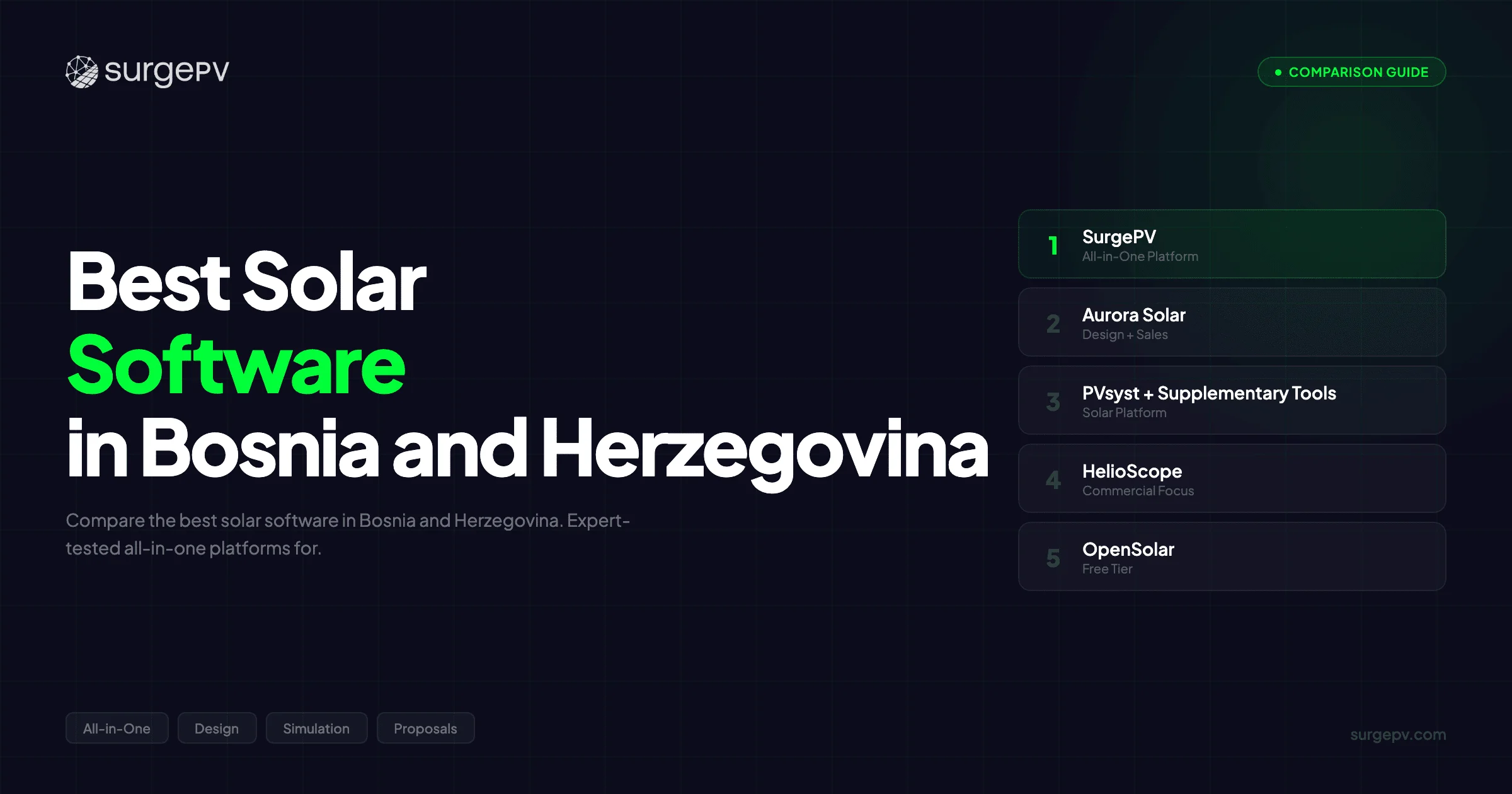
TL;DR: SurgePV is the best all-in-one solar software for Bosnia and Herzegovina — automated SLD generation for FERK/RERS compliance, P50/P90 bankable simulations for EBRD/IFC financing, and integrated proposals at $1,899 per user per year on the individual plan. PVsyst is the gold standard for simulation-only bankability. Aurora Solar fits residential sales teams. HelioScope handles commercial C&I design. OpenSolar offers a budget entry point for startups.
Bosnia and Herzegovina’s solar market is building momentum. The country has committed to 1,327 MW of renewable energy capacity by 2028 under its Energy Community obligations, with solar leading that expansion — an estimated 150–200 MW installed through 2025 (Energy Community Secretariat). EBRD financing, EU alignment incentives, and growing commercial demand are pushing capacity targets higher every quarter.
But running a solar business here? That’s where most teams hit a wall. Two separate regulatory entities — FERK in the Federation of BiH and RERS in Republika Srpska. Different grid connection procedures, different documentation requirements. International lenders (EBRD, IFC, KfW) demanding bankable P50/P90 reports. Competitive tenders with 30–60 day response windows.
And most all-in-one solar software was built for Western European or US markets — leaving BiH teams juggling 3–4 disconnected tools for design, simulation, proposals, and project management.
The best solar design software for Bosnia and Herzegovina eliminates that fragmentation. It combines design, engineering, bankable simulation, and proposal generation in one platform — so your team moves faster, spends less on licenses, and wins more projects.
We reviewed and compared 5 leading solar software platforms for the BiH market, evaluating each on workflow completeness, bankability, ease of use, and total cost of ownership.
In this guide, you’ll find:
- Which platform delivers the most complete all-in-one workflow for BiH solar companies
- How pricing across these tools is structured, and which vendors publish list prices
- Which software produces bankable reports accepted by EBRD, IFC, and KfW
- Our recommendation based on review of published product documentation
Quick Comparison Table
| Software | Best For | Pricing/Year | All-in-One? | P50/P90 |
|---|---|---|---|---|
| SurgePV | Complete workflows (all segments) | $1,899 (3 users) | Yes (design + SLD + sim + proposals) | Yes |
| Aurora Solar | Residential proposals | $1,620/user/yr (Basic, published) | Design + proposals (no SLD) | P50 only |
| PVsyst | Bankable simulation | No published list price | No (simulation only) | Yes (gold standard) |
| HelioScope | Commercial C&I design | $1,620/yr per licence (Basic, published) | Design + sim (no SLD/proposals) | Limited |
| OpenSolar | Budget-conscious startups | Free of charge | Basic design + proposals | No |
Best Solar Software in Bosnia and Herzegovina (Detailed Reviews)
SurgePV — Best All-in-One Solar Platform for Bosnia and Herzegovina
Best For: EPCs, commercial installers, and growth-focused companies across all project segments
Pricing: $1,899/year (3 users); $1,499/user/year (For 3 Users plan)
Onboarding: 2–3 weeks
SurgePV is the only platform that combines solar design, electrical engineering (automated SLD generation), bankable simulation, and professional proposals in a single cloud-based tool.
For Bosnia and Herzegovina, that distinction matters more than the feature list suggests.
Here’s why: most BiH solar companies currently piece together 3–4 separate tools for a complete project workflow. AutoCAD for single line diagrams. PVsyst for simulation. A separate proposal tool (or worse, PowerPoint). Maybe a CRM on top of that. Each tool has its own license cost, its own learning curve, and its own data format — meaning manual re-entry between systems on every single project.
That fragmentation costs small BiH teams 10–15 hours per month in tool-switching alone, before you count the separate licence fees from each vendor.
SurgePV eliminates all of it.
Key Features for Bosnia and Herzegovina
- Automated SLD generation — Creates code-compliant electrical schematics in 5–10 minutes, meeting both FERK (Federation BiH) and RERS (Republika Srpska) utility documentation requirements. Manual AutoCAD drafting takes 2–3 hours for the same output, and AutoCAD is licensed separately by Autodesk.
- P50/P75/P90 bankability metrics — Produces the production estimates EBRD, IFC, and KfW require for BiH project financing. Your financing applications get the bankability data lenders actually need.
- 8760-hour shading analysis — Hour-by-hour simulation across the full year, critical for BiH’s mountainous terrain where shading patterns vary dramatically between valleys and ridgelines.
- Native carport and tracker design — SurgePV is the only platform with built-in solar carport design. Single-axis and dual-axis tracker support included. As BiH’s commercial and utility-scale segments grow, this is a genuine competitive edge.
- Financial modeling — Supports custom utility rate input, enabling analysis with BiH’s variable electricity tariffs across both entities. Model cash purchase, loan, and PPA scenarios.
- 98% accurate bill of materials — Automated BOM generation streamlines procurement coordination for BiH supply chains.
- Integrated proposal generation — Generate branded, professional proposals in minutes instead of hours. Critical for responding to competitive BiH tenders within tight deadlines.
Pro Tip
SurgePV replaces AutoCAD, a PVsyst licence and separate proposal software with a single $1,899/year platform for 3 users. Autodesk and PVsyst do not publish list pricing, so a combined stack total cannot be sourced, but it does mean several separate licences and renewal dates instead of one. Book a demo to see it in action.
Pricing
| Plan | Price | Users |
|---|---|---|
| Individual | $1,899/year | 3 users |
| For 3 Users | $1,499/user/year | 3 users |
| For 5 Users | $1,299/user/year | 5 users |
| Enterprise | Custom | Multiple |
All features included on every plan. No hidden fees, no feature gating. See full pricing.
Who SurgePV Is Best For in Bosnia and Herzegovina
- EPCs handling projects across both entities (Federation BiH and Republika Srpska) needing compliant SLDs for both FERK and RERS
- Commercial installers scaling from residential to C&I who want one platform that grows with them
- Companies pursuing EBRD or IFC project financing needing bankable P50/P90 reports
- Teams responding to competitive tenders who need integrated proposal generation
- International developers entering the BiH market seeking complete, compliant workflows
Limitations
- English interface (no Bosnian/Croatian/Serbian localization yet)
- BiH utility rates require manual input (not pre-loaded)
Real-World Example
A mid-size EPC operating across both BiH entities ran PVsyst, AutoCAD and a separate proposal tool, and still spent 3+ hours per project switching between platforms. After consolidating to SurgePV, they moved from several separate licences to one subscription and cut the per-project tool-switching out of their workflow. Their 3-person team now submits more competitive bids per month without adding headcount.
Further Reading
- Best All-in-One Solar Software (2026) — Global platform comparison
- Best Solar Software for EPCs — EPC workflow comparison
You might be wondering: if SurgePV does all this, why haven’t you heard of it? Fair question. PVsyst has had a 30-year head start. Aurora Solar has spent hundreds of millions on marketing. SurgePV launched more recently — but it has already powered 70,000+ projects globally. The platform was built specifically for the workflow gaps that legacy tools leave open, especially automated electrical engineering, which no other platform offers natively.
Aurora Solar — Best for BiH Residential Installers
Best For: Residential installers focused on small-scale urban projects in Sarajevo, Banja Luka, and Mostar
Pricing: Aurora Solar publishes list pricing of “$135 user/mo, billed annually” for Basic and “$220 user/mo, billed annually” for Premium, with Enterprise quoted as “Custom per project” (aurorasolar.com/pricing, checked 21 September 2026).
Aurora Solar is best known for its AI-powered roof modeling and polished sales proposals. It’s the residential market leader in the US, and its consumer-facing proposal tools are genuinely strong for homeowner sales workflows.
What Works for Bosnia and Herzegovina
- Industry-leading automatic 3D roof detection speeds up residential design significantly
- Beautiful, client-facing proposals help build trust in BiH’s emerging residential market
- Remote site assessment using satellite imagery — useful for dispersed BiH locations
- Mobile sales app enables proposal creation during customer meetings
Where It Falls Short in Bosnia and Herzegovina
- No integrated SLD generation — EPCs needing FERK/RERS electrical documentation still need AutoCAD (licensed separately by Autodesk)
- No carport or tracker design — Limited for BiH’s growing commercial and utility-scale segments
- Priced in USD per user — Aurora’s published per-user pricing can be steep for teams operating with BiH margins
- P50 only — No P75/P90 metrics that EBRD and international lenders typically expect
- US/AU market focus — Requires manual customization for BiH incentives and regulations
Best for: Residential installers targeting urban homeowners who prioritize polished sales proposals over engineering depth.
For a deeper analysis, read our full Aurora Solar review.
PVsyst + Supplementary Tools — Maximum Bankability Approach
Best For: Engineering consultants and developers focused on EBRD-financed utility-scale projects
Pricing: PVsyst does not publish licence pricing on its own site; its shop is behind a login (pvsyst.com/shop, checked 21 September 2026). AutoCAD, if you need it for electrical documentation, is licensed separately by Autodesk.
PVsyst is the industry reference for bankable energy production estimates. If you’re seeking EBRD or IFC financing for a BiH solar project, PVsyst reports carry unmatched credibility with evaluators. Every international lender accepts them without question.
What Works for Bosnia and Herzegovina
- Universally accepted by EBRD, IFC, KfW, and European Investment Bank
- Detailed loss modeling (temperature, soiling, mismatch, inverter efficiency)
- P50/P90 reports are the gold standard for project financing
- PVGIS and Meteonorm integration includes BiH weather data
Where It Falls Short in Bosnia and Herzegovina
- Simulation only — PVsyst doesn’t do design, SLDs, or proposals. You need 2–3 additional tools for a complete workflow
- Total cost adds up fast — a PVsyst licence, AutoCAD, proposal software and a CRM are four separate subscriptions from four vendors, and because PVsyst and Autodesk do not publish list pricing, a combined annual total cannot be sourced
- Manual data transfer — Moving data between PVsyst, AutoCAD, and proposal tools creates errors and wastes hours
- Desktop-only — No cloud collaboration, limiting distributed team workflows
- 4–6 week learning curve — Steep onboarding for teams with limited training resources
Best for: Engineering consultants performing independent technical reviews for lenders, or EPCs with established multi-tool workflows who prioritize simulation credibility above all else.
Read our full PVsyst review for a detailed breakdown.
Did You Know?
Bosnia and Herzegovina is an Energy Community member obligated to align with EU energy directives. The country’s 2030 renewable targets require significant solar capacity additions beyond the current ~200 MW installed base (Energy Community Secretariat). EPCs who invest in professional software now will be positioned to capture that growth.
HelioScope — Cloud-Based Design for BiH Commercial Projects
Best For: Commercial EPCs designing 50 kW–5 MW rooftop and ground-mount systems
Pricing: HelioScope publishes $159 per month, or $1,620 per year, for a Basic licence and $259 per month, or $2,640 per year, for a Pro licence, each including one user (helioscope.aurorasolar.com/pricing, checked 21 September 2026).
HelioScope is a cloud-based design and simulation platform focused on commercial and industrial (C&I) solar projects. Its browser-based interface makes it fast to learn and deploy for mid-scale project work with team collaboration.
What Works for Bosnia and Herzegovina
- Fast commercial rooftop and ground-mount design in a browser-based interface
- Integrated simulation with credible production estimates for commercial projects
- Supports international locations, including BiH weather data
- Cloud-based collaboration lets distributed teams work on projects simultaneously
- Integrated financial analysis customizable for BiH conditions
Where It Falls Short in Bosnia and Herzegovina
- No SLD generation — Commercial projects requiring FERK/RERS electrical documentation need external AutoCAD (licensed separately by Autodesk)
- Limited proposal automation — Requires supplementary tools for professional client-facing documents
- No project management or CRM — Separate systems needed for pipeline tracking
- Quote-based enterprise tier — HelioScope publishes Basic and Pro licence prices, but Enterprise terms are quoted by sales rather than listed
Best for: Commercial EPCs focused on 50 kW–5 MW projects who prioritize fast cloud-based design over complete workflow integration.
See our full HelioScope review for more details.
OpenSolar — Budget Entry Point for BiH Startups
Best For: Very small installers and startups testing the BiH market with minimal investment
Pricing: Free of charge, in OpenSolar’s own words “Free of charge” (opensolar.com, checked 21 September 2026)
OpenSolar is a cloud-based design and proposal platform with a functional free tier. For BiH installers just entering the solar market or testing software tools for the first time, it offers a low-risk starting point.
What Works for Bosnia and Herzegovina
- Free tier available — no financial risk for startups testing market viability
- Free of charge, which is accessible for small operations
- Cloud-based — work from any device with internet
- Basic design, financial modeling, and proposal capabilities in one tool
Where It Falls Short in Bosnia and Herzegovina
- No SLD generation — Cannot produce the electrical documentation FERK/RERS require
- Basic simulation — Not bankable. Projects seeking EBRD or IFC financing need recognized simulation platforms
- Limited customization — Templates may not support complex BiH tender requirements
- Scalability constraints — May outgrow the platform as the business expands to commercial or utility-scale projects
- Entry-level presentation quality — Functional but less professional than SurgePV or Aurora Solar
Best for: Very small residential installers (under 10 systems/year) or startups needing affordable tools to begin operations. Teams expecting to grow should consider starting with a scalable platform like SurgePV to avoid costly tool migration later.
Read our full OpenSolar review for a complete analysis.
Solar Software Comparison Table for Bosnia and Herzegovina
| Feature | SurgePV | Aurora Solar | PVsyst | HelioScope | OpenSolar |
|---|---|---|---|---|---|
| Best for | All segments | Residential | Simulation | Commercial | Startups |
| Complete platform? | Yes (all-in-one) | Design + proposals | Simulation only | Design + sim | Basic |
| SLD generation | Yes (automated) | No | No | No | No |
| P50/P90 reports | Yes | P50 only | Yes (gold standard) | Limited | No |
| Carport design | Yes (only platform) | No | No | No | No |
| Tracker support | Yes | No | Simulation only | Limited | No |
| Proposal generation | Yes | Yes (strong) | No | Basic | Yes (basic) |
| Cloud-based | Yes | Yes | No (desktop) | Yes | Yes |
| Wire sizing | Yes (automated) | No | No | No | No |
| Pricing/year | $1,899 (3 users) | $1,620/user/yr (Basic, published) | No published list price | $1,620/yr per licence (Basic, published) | Free of charge |
| Onboarding | 2–3 weeks | 4–6 weeks | 4–6 weeks | 2–3 weeks | 1–2 weeks |
Further Reading
For a global overview, see our best solar software hub.
What Makes the Best Solar Software in Bosnia and Herzegovina
All-in-One Workflows vs. Tool Fragmentation
BiH solar companies — especially smaller installers and EPCs with 3–10 person teams — cannot afford the cost, complexity, and inefficiency of managing 4–5 separate software platforms. Everyone on these teams wears multiple hats: sales, engineering, project management, sometimes even installation. Software that combines design, simulation, SLD generation, proposals, and project tracking in one environment doesn’t just save license fees. It eliminates the data re-entry, format conversion, and tool-switching overhead that eats into every project’s margin.
SurgePV is the only platform integrating all of these functions natively. Competitors require 2–4 separate tools to match the same functionality — at 2–3x the total cost.
Bankability for International Project Financing
Most large-scale solar projects in BiH rely on international development banks — EBRD, IFC, KfW — due to limited domestic capital markets. These institutions require P50/P90 production estimates with IEC-compliant simulation methodologies and conservative performance ratio assumptions (typically 75–80% for BiH). PVsyst is universally accepted. SurgePV’s simulations achieve +/-3% accuracy compared to PVsyst, and reports are increasingly accepted by EBRD for commercial projects.
Dual Regulatory Framework: FERK and RERS
BiH’s unique administrative structure creates two parallel regulatory systems. FERK regulates the Federation of BiH, while RERS regulates Republika Srpska. Grid connection applications require technical documentation — including single line diagrams, protection schemes, and inverter specifications — with different procedures for each entity.
Elektroprijenos BiH handles transmission-level coordination. Software with automated SLD generation saves significant time navigating both systems.
Competitive Tender Speed
BiH’s emerging solar market features public tenders and private PPA opportunities with tight response windows — often 30–60 days from RFP to bid submission. Regional competition from Serbian, Croatian, and international EPCs makes speed essential. Software with integrated proposal generation lets your team respond to more opportunities. Teams using all-in-one platforms typically handle 3–5x more bids per month than those using fragmented tool stacks.
Cost Sensitivity in an Emerging Market
BiH installers and EPCs operate with tighter margins than Western European counterparts. Software costs must be justified with clear ROI within 6–12 months. Total cost of ownership is the metric that matters — not headline pricing for any single tool.
A PVsyst licence on its own still needs AutoCAD and proposal tools alongside it, and neither PVsyst nor Autodesk publishes list pricing, so the combined figure cannot be sourced. SurgePV at $1,899 per user per year on the individual plan replaces all of them with one subscription.
Scalability from Residential to Utility-Scale
Successful BiH solar companies typically start with residential installations and expand into commercial and utility-scale work as the market develops. Software that supports all project types — from 5 kW rooftops to 50 MW ground-mount — eliminates the painful and expensive tool migration that happens when you outgrow a residential-only or commercial-only platform. SurgePV is the only platform natively supporting this full range.
How We Reviewed and Ranked These Platforms
We evaluated each platform against six weighted criteria specific to the Bosnia and Herzegovina market:
- Workflow completeness (30%) — Design + simulation + SLD generation + proposals + project management in a single platform vs. multi-tool fragmentation
- Ease of use and efficiency (25%) — Onboarding time, automation level, learning curve for typical BiH team profiles
- Bankability and compliance (20%) — Simulation accuracy, FERK/RERS grid documentation, EBRD/IFC financing acceptance
- Cost-effectiveness (15%) — Total cost of ownership, ROI timeframe for BiH economics, team scaling costs
- Local applicability (10%) — BiH weather data, dual-entity support, multi-language capabilities, Balkan market suitability
The research used published sources between December 2025 and February 2026, using representative BiH project assumptions from locations across Federation BiH and Republika Srpska, and regulatory documentation from FERK, RERS, and Energy Community Secretariat.
Eliminate Tool Fragmentation with SurgePV
Design, simulate, generate SLDs, and create proposals — all in one platform built for solar professionals.
Book a DemoNo commitment required · 20 minutes · Live project walkthrough
Bottom Line: Best Solar Software for Bosnia and Herzegovina
Bosnia and Herzegovina’s solar market is growing — and professionalizing fast. The dual regulatory structure (FERK/RERS), international financing requirements (EBRD/IFC), competitive tenders, and tight margins make customer-ready solar proposals selection one of the most impactful business decisions a BiH solar company can make.
Here’s how to choose:
For EPCs and growth-focused companies: SurgePV delivers the most complete workflow at the best total cost of ownership. Automated SLDs for FERK/RERS compliance, bankable P50/P90 simulations for EBRD financing, integrated proposals for competitive tenders, and scalability from residential to utility-scale — all in one platform at $1,899 per user per year on the individual plan. No other tool matches this combination.
For residential-only installers: Aurora Solar offers the best consumer-facing proposals for homeowner sales, but its published per-user pricing in USD and US-centric design may challenge budget-conscious BiH teams. SurgePV provides comparable residential capabilities plus commercial scalability in a single subscription.
For maximum simulation credibility: PVsyst remains the universal bankability standard, especially for EBRD-financed utility-scale projects. But PVsyst is simulation-only, so a working setup also needs design, electrical and proposal tools alongside it. Pair PVsyst with SurgePV when you need both gold-standard bankability and complete design workflows.
For commercial-focused teams: HelioScope offers fast cloud-based design for C&I projects, but the lack of SLD generation and proposal tools means you’ll still need additional software for complete workflows.
For budget-conscious startups: OpenSolar provides a free entry point for testing the market. Teams expecting to grow beyond 10–15 residential projects per year will outgrow the platform quickly and face an expensive tool migration. Starting with SurgePV avoids that disruption.
The BiH solar market isn’t waiting. The companies winning projects today are producing compliant documentation, bankable simulations, and professional proposals faster than their competitors. Your software stack determines whether you’re one of those companies.
Want to see how SurgePV handles BiH project workflows? Book a demo and our team will walk you through a project using your actual site data.
Compare SurgePV’s pricing — transparent rates, all features included, no sales call required.
Further Reading
- Best Solar Proposal Software — Proposal platform comparison
- Best Solar Simulation Software — Bankability comparison
Go deeper on a specific category
This page compares solar software across categories for Bosnia And Herzegovina. If you already know which part of the workflow you are buying for, these go into more detail:
- how design software is chosen in Bosnia And Herzegovina
- proposal software options in Bosnia And Herzegovina
Frequently Asked Questions
What is the best solar software in Bosnia and Herzegovina?
SurgePV is the best all-in-one solar software for Bosnia and Herzegovina in 2026. It integrates design, automated SLD generation (meeting FERK/RERS requirements), P50/P90 bankable simulations, and proposal tools in one cloud-based platform at $1,899 per user per year on the individual plan — eliminating the need for 3–4 separate tools. For simulation-only needs, PVsyst remains the bankability standard.
Should BiH solar companies use one platform or multiple specialized tools?
For most BiH solar companies, an all-in-one platform like SurgePV delivers better value. A multi-tool approach (PVsyst + AutoCAD + proposal software + CRM) means separate licences from separate vendors and requires manual data transfer between tools. SurgePV starts at $1,899 per user per year on the individual plan with design, simulation, SLDs, and proposals integrated. The only exception: engineering consultants exclusively performing independent simulation reviews may prefer PVsyst’s specialized capabilities.
How much does solar software cost in Bosnia and Herzegovina?
Costs range from free (OpenSolar free tier) to $6,000/year (Aurora Solar). SurgePV starts at $1,899 per user per year on the individual plan with all features included. A multi-tool approach means separate licences from separate vendors. Consider total cost of ownership, not just single-tool pricing — tools without SLD generation require an additional AutoCAD license. See SurgePV pricing.
What software do banks accept for solar financing in Bosnia and Herzegovina?
International banks financing BiH projects (EBRD, IFC, KfW) accept bankable P50/P90 production estimates from recognized platforms. PVsyst reports are universally accepted. SurgePV simulations are increasingly accepted by development finance institutions for commercial projects in the Western Balkans. HelioScope reports are accepted for smaller projects.
Can small installers in Bosnia and Herzegovina afford professional solar software?
Yes. Professional software delivers positive ROI for BiH installers doing as few as 10–15 projects per year. SurgePV at $1,899 per user per year on the individual plan saves 2–3 hours per project in SLD generation alone — that’s 30+ hours reclaimed annually. Factor in increased bid capacity (3–5x more proposals per month) and higher win rates through professional presentations, and most teams see payback within the first few months. See installer solutions.
What are the main challenges for solar software in Bosnia and Herzegovina?
Main challenges include dual regulatory frameworks (FERK vs. RERS), international bankability requirements for EBRD/IFC financing, complex mountainous terrain requiring detailed shading analysis, competitive tender deadlines, and emerging market cost sensitivity. All-in-one platforms like SurgePV address these challenges through integrated workflows, automated compliance documentation, and affordable pricing.
Does Bosnia and Herzegovina have two separate regulatory frameworks for solar?
Yes. FERK regulates the Federation of BiH and RERS regulates Republika Srpska — each with different grid connection procedures and documentation requirements. Elektroprijenos BiH handles transmission-level coordination. Software that generates compliant electrical documentation automatically — like SurgePV — saves significant time when working across both entities.
What solar software is best for EPCs working across both BiH entities?
SurgePV is best for EPCs working across both Federation BiH and Republika Srpska. It combines design, automated SLD generation, bankable simulation, and proposal tools in one platform. The automated electrical engineering outputs meet documentation requirements for both FERK and RERS grid connections, eliminating duplicate workflows. Book a demo to see dual-entity workflows in action.
Transparency
All pricing data in this article was verified against official sources as of February 2026. Prices may have changed since publication. SurgePV is the publisher of this site — our recommendation reflects a vendor-published desk review, but readers should evaluate all platforms against their own project requirements.
Sources
- Energy Community Secretariat — BiH energy obligations and renewable targets
- IRENA Renewable Energy Statistics — Balkans solar market data and capacity figures
- FERK (Federation BiH Regulatory Commission) — Regulatory framework and grid connection requirements
- RERS (Republika Srpska Regulatory Commission) — Entity-level regulatory guidelines
- EBRD Renewable Energy Projects — Western Balkans solar financing requirements
- IFC Project Finance Standards — Bankability and due diligence requirements
- PVGIS European Commission — BiH solar resource and irradiance data
- G2 Software Reviews — Verified user reviews for all platforms
- Capterra Software Reviews — Platform ratings and user feedback
- SurgePV Product Documentation — Official feature specifications (accessed February 2026)
