

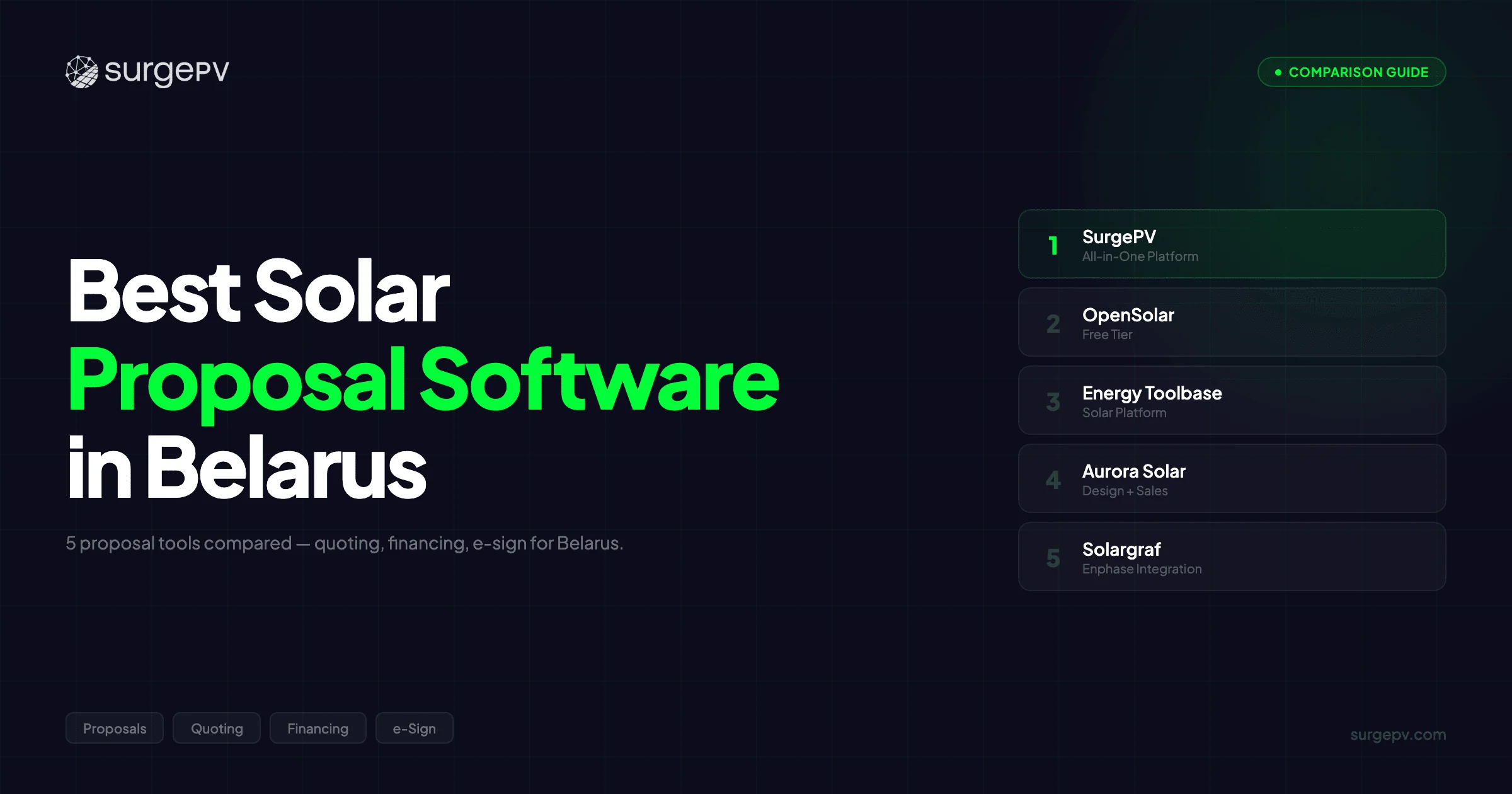
TL;DR: Belarus’s solar market is 70% government tenders, and winning them requires professional documentation assembled fast. SurgePV is the strongest option for EPCs - it generates tender-ready proposals directly from designs, cutting proposal time by 70% while covering LCOE, IRR, P50/P90, automated SLD, and BOM. OpenSolar suits commercial installers with sales pipelines. Energy Toolbase excels at storage financial modeling. Aurora Solar offers a polished all-in-one platform. Solargraf delivers speed for simple commercial quotes.
For solar project design, try solar PV design software that streamlines the entire workflow.
Belarus’s solar market is tender-driven. 70% of utility-scale and commercial projects are awarded through government procurement, and the remaining commercial contracts aren’t much easier - industrial clients expect professional documentation with clear financial modeling before they sign anything.
Here’s the problem: government tenders give you 2-4 weeks to submit 50-100 page proposals that include technical design, energy yield forecasts, single-line diagrams, GOST compliance documentation, and detailed financial modeling at BYN 0.18-0.22/kWh feed-in tariff rates. If you’re assembling that from PVsyst exports, AutoCAD drawings, and Excel spreadsheets, you’re burning 2-3 days per tender response. With low margins in this market, every hour matters.
The right customer-ready solar proposals doesn’t just make your documents look professional - it integrates with your design and simulation tools so data flows automatically, cutting proposal creation time by 70% while improving accuracy.
We reviewed and compared the top 5 solar proposal platforms for the Belarusian market, evaluating each on tender suitability, financial modeling, speed, and integration with design workflows.
In this guide, you’ll find:
- Which platform creates government tender proposals fastest
- How to model feed-in tariff economics for 10-15 year offtake agreements
- Which software produces the most professional tender-ready documentation
- Our recommendation for Belarus EPCs managing 10-15 tenders per year
Quick Comparison Table
| Software | Best For | Pricing/Year | Design Integration | Financial Modeling |
|---|---|---|---|---|
| SurgePV | Government tenders (end-to-end) | $1,899 (3 users) | Yes (native) | LCOE, IRR, payback |
| OpenSolar | Commercial sales + CRM | Free | Basic | Savings focus |
| Energy Toolbase | Solar + storage financials | Not published | No (separate) | Advanced |
| Aurora Solar | All-in-one sales platform | $159/user/mo, $135/user/mo billed annually (published) | Yes (native) | LCOE, IRR, payback |
| Solargraf | Fast commercial quotes | Not published | Basic | Basic |
Best Solar Proposal Software in Belarus (Detailed Reviews)
SurgePV - Best Integrated Proposal Platform for Belarus Tenders
Best For: EPCs bidding on government tenders and commercial contracts
Pricing: $1,899/year (3 users); $1,499/user/year (For 3 Users plan)
Onboarding: 2-3 weeks
SurgePV is a cloud-based solar design, simulation, and proposal platform built for EPCs and commercial installers. For Belarus tenders, SurgePV eliminates data re-entry by generating professional proposals directly from designs and simulations - reducing proposal creation time by 70% while maintaining government tender quality standards.
That integration is the difference between winning tenders and missing deadlines.
Most competing approaches force you to design in one tool, simulate in another, and then manually build proposals in Excel or Word. Every data transfer introduces errors. Every manual step adds hours. With SurgePV, your design, energy yield data, bill of materials, and electrical schematics flow directly into a proposal template - no copy-pasting, no version mismatches.
Key Features for Belarus Proposals
- Design-to-proposal integration - Generate tender-ready proposals directly from SurgePV designs. No data re-entry. Energy yield, BOM, SLD, and financial modeling populate automatically.
- Feed-in tariff financial modeling - Model 10-15 year offtake agreements at Belarus rates (BYN 0.18-0.22/kWh) with LCOE, IRR, and payback period calculations. Compare scenarios with different tariff assumptions.
- Automated bill of materials - Component lists with flexible USD/EUR import pricing for Chinese modules/inverters (Jinko, Trina, Huawei, Sungrow). 98% BOM accuracy eliminates manual spreadsheet errors.
- P50/P90 energy yield reports - Bankable simulations included in proposals for EBRD/IFC financing sections.
- Automated SLD generation - Single-line diagrams in 5-10 minutes for technical proposal sections, adaptable to GOST R 50571 standards.
- Professional formatting - Tender-ready outputs that impress government evaluation committees. Customizable templates for different tender types.
Pro Tip
SurgePV’s integrated workflow means your proposal data matches your design data - always. No more catching discrepancies between your energy yield report and your financial model at 11 PM before a tender deadline. Book a demo to see the workflow in action.
Pricing
| Plan | Price | Users |
|---|---|---|
| Individual | $1,899/year | 3 users |
| For 3 Users | $1,499/user/year | 3 users |
| For 5 Users | $1,299/user/year | 5 users |
| Enterprise | Custom | Multiple |
All features included on every plan - design, simulation, proposals, SLDs, financial modeling. No hidden fees. See full pricing.
Who SurgePV Is Best for in Belarus
- EPCs bidding on utility-scale government tenders (1-50 MW projects)
- Commercial installers pursuing industrial/commercial contracts
- Engineering consultancies preparing technical proposals for multiple clients
- Tender management teams coordinating government bids under tight deadlines
Limitations
- English interface (no Russian localization yet) - templates can be customized for Cyrillic outputs
- Not a full CRM - focused on technical and financial proposals, not lead management
- Belarus-specific tender templates require initial customization
Further Reading
- Best Solar Proposal Software (2026) - Global comparison across 10+ platforms
- OpenSolar Review - CRM and sales platform analysis
You might be wondering: can a design platform really produce tender-quality proposals? Fair question. Most design tools bolt on a basic PDF export and call it a proposal feature.
SurgePV was built differently - the proposal engine pulls live data from your design, so changes to your layout automatically update your energy yield, BOM, and financial projections. That’s a fundamentally different approach from exporting static data between separate tools.
OpenSolar - Best for Sales-Focused Commercial Installers
Best For: Commercial installers with strong sales pipeline
Pricing: Free. OpenSolar is free of charge (opensolar.com, checked 21 September 2026).
OpenSolar is a sales-focused proposal and CRM platform designed for residential and commercial solar installers. Its strength is the lead-to-close workflow - from initial customer contact through signed contract.
What Works for Belarus
- Fast commercial proposal generation for B2B industrial clients
- CRM integration for managing sales pipeline and customer relationships
- Customer-friendly formatting that highlights ROI and energy savings
- Affordable pricing compared to premium platforms
Where It Falls Short in Belarus
- Limited government tender features - Not built for 50-100 page tender documentation required by Belarusian procurement
- US/Australia market focus - Belarus-specific features (GOST, feed-in tariff, Belenergo) not built in
- No SLD generation - Electrical documentation requires separate tools
- Limited simulation depth - No P50/P90 bankable reports for EBRD/IFC financing
Best for: Commercial installers with strong B2B sales focus who prioritize CRM and customer management over government tender complexity.
Read our full OpenSolar review for details.
Energy Toolbase - Best for Solar + Storage Financial Modeling
Best For: Projects with battery storage requiring advanced financial analysis
Pricing: Not published. Energy Toolbase does not publish list pricing; it is quoted by sales.
Energy Toolbase excels at financial modeling for solar-plus-storage projects. If you’re proposing projects that combine PV with battery systems - a segment beginning to emerge in Belarus - its financial depth is unmatched.
What Works for Belarus
- Advanced financial modeling capabilities (LCOE, IRR, NPV, payback)
- Battery storage economics modeling for hybrid projects
- Custom utility rate modeling (adaptable for Belarus tariff structures)
- Professional financial report outputs
Where It Falls Short in Belarus
- US utility market focus - Belarus tariff structures require significant manual configuration
- No design integration - Requires separate design and simulation tools (data re-entry)
- Limited tender documentation - Financial focus only, not full technical proposals
- Separate line item - a financial modeling subscription on top of separate design tools, quoted by sales rather than list-priced
Best for: Projects with battery storage or sophisticated financial modeling needs where financial depth matters more than proposal speed.
See our full Energy Toolbase review for a complete analysis.
Did You Know?
Belarus’s feed-in tariff rates (BYN 0.18-0.22/kWh) support 10-15 year guaranteed purchase agreements, making accurate long-term financial modeling a requirement for every tender proposal - not an optional add-on.
Aurora Solar - Best All-in-One Sales Platform
Best For: Sales organizations wanting end-to-end platform
Pricing: Aurora Solar publishes list pricing of $159 per user per month for Basic, or $135 per user per month billed annually, and $259 per user per month for Premium, or $220 per user per month billed annually, with Enterprise quoted per project by sales (aurorasolar.com/pricing/, checked 21 September 2026).
Aurora Solar is the leading all-in-one platform for solar sales in the US market. Its design-to-proposal workflow produces polished, client-facing documents that help close deals.
What Works for Belarus
- Complete design + proposal workflow reduces data re-entry
- Beautiful customer-facing proposals with professional formatting
- CRM integrations (Salesforce, HubSpot) for pipeline management
- Financial modeling with customizable rate inputs
Where It Falls Short in Belarus
- US residential market focus - Government tender features for Belarus procurement are limited
- Per-seat pricing - billed per user per month, which scales with team size
- No Russian language support - English-only interface and outputs
- No SLD generation - Technical proposal sections need AutoCAD, licensed separately by Autodesk
- P50 only - No P75/P90 metrics for international lender financing sections
Best for: Sales-focused organizations wanting a complete design + CRM + proposal platform. Better suited for commercial B2B sales than government tenders.
For a deeper analysis, read our full Aurora Solar review.
Solargraf - Best for Fast Commercial Quotes
Best For: Commercial rooftop installers needing fast customer quotes
Pricing: Not published. Solargraf does not publish list pricing; it is quoted by sales.
Solargraf is a proposal and site assessment tool optimized for speed. If you need to turn around commercial rooftop quotes in hours rather than days, Solargraf gets the job done at an affordable price point.
What Works for Belarus
- Fast proposal generation - customer-ready quotes in under an hour
- Customer-friendly formatting with clear ROI presentation
- Site assessment integration with satellite/drone imagery
- Affordable pricing for smaller installers
Where It Falls Short in Belarus
- Limited utility-scale features - Not built for ground-mount projects that dominate Belarus (60% of market)
- No government tender capabilities - Cannot produce the 50-100 page documentation required for procurement
- Basic financial modeling - No feed-in tariff modeling for 10-15 year offtake agreements
- No SLD generation - Electrical documentation requires separate tools
Best for: Commercial rooftop installers who prioritize proposal speed for B2B sales over government tender complexity.
Read our full Solargraf review for more details.
Solar Proposal Software Comparison Table for Belarus
| Feature | SurgePV | OpenSolar | Energy Toolbase | Aurora Solar | Solargraf |
|---|---|---|---|---|---|
| Best for | Gov’t tenders | Commercial sales | Storage financials | Sales platform | Fast quotes |
| Design integration | Yes (native) | Basic | No | Yes (native) | Basic |
| SLD in proposals | Yes (automated) | No | No | No | No |
| P50/P90 reports | Yes | No | Basic | P50 only | No |
| Financial modeling | LCOE, IRR, payback | Savings focus | Advanced | LCOE, IRR, payback | Basic |
| BOM automation | Yes (98% accuracy) | Basic | No | Yes | Basic |
| CRM | No | Yes | No | Yes | Basic |
| Cloud-based | Yes | Yes | Yes | Yes | Yes |
| Published pricing | $1,899/yr (3 users) | Free | Not published | $159/user/mo, $135/user/mo billed annually (published) | Not published |
Further Reading
For a broader comparison beyond Belarus, see our guide to the best solar proposal software globally.
What Makes Solar Proposal Software Work in Belarus
Government Tender Documentation Requirements
70% of Belarus utility and commercial projects are awarded through government tenders requiring extensive documentation. Technical proposals must include system design, energy yield forecasts, electrical schematics, and grid interconnection plans. Financial proposals must cover cost breakdowns, feed-in tariff economics, and funding structures.
Compliance sections require GOST standards documentation and EAC equipment certifications. Software like SurgePV automates technical and financial content from designs, cutting proposal creation from days to hours.
Fast Proposal Generation for Competitive Bidding
Government tenders give you 2-4 weeks. Commercial B2B quotes expect 1-3 day turnaround. In both cases, speed wins.
Integrated platforms like SurgePV generate proposals from design data automatically - no manual data re-entry. That means 2-6 hours per tender proposal versus 2-3 days with separate tools. For EPCs managing 10-15 tenders per year, the time savings compound significantly.
Feed-in Tariff Financial Modeling
Belarus offers feed-in tariffs (BYN 0.18-0.22/kWh) for 10-15 year offtake agreements under Decree No. 209. Every tender proposal must include accurate long-term financial modeling - LCOE, IRR, payback period, and revenue projections. Software must support custom tariff inputs (not just US/Europe presets), BYN/USD/EUR currency flexibility, and escalation assumptions for multi-decade projections.
Technical Proposal Content
Government tenders evaluate technical capability at 40% of the total score. Proposals must include P50/P90 energy yield reports for 20-25 year operations, system design visualizations, single-line diagrams adaptable to GOST standards, equipment specifications with EAC certifications, and a detailed bill of materials. Integrated design-to-proposal platforms include all of this automatically.
Belenergo Grid Connection Documentation
Tender proposals for utility-scale and large commercial projects must include Belenergo grid connection plans - technical passports, protection relay settings, and SCADA integration proposals. Software that generates SLDs and grid documentation automatically strengthens technical proposal sections without additional engineering hours.
Multilingual and Currency Considerations
Russian-speaking market with Cyrillic documentation preferences for government submissions. Proposals often require financial modeling in BYN, USD, and EUR to account for import pricing of equipment and international financing structures. While most Western software uses English interfaces, outputs can be adapted for Russian-language tender submissions.
Belarus Government Tender Evaluation Criteria
| Criterion | Weight | What It Covers |
|---|---|---|
| Technical | 40% | Design + energy yield |
| Financial | 30% | Cost + tariff model |
| Experience | 20% | Past projects + references |
| Timeline | 10% | Delivery schedule |
Our Review Method Methodology
We evaluated each platform against five weighted criteria specific to the Belarusian proposal market:
- Speed and efficiency (30%) - Time-to-proposal benchmarks, automation level, template customization speed
- Proposal quality and professionalism (25%) - Formatting, technical content depth, financial modeling accuracy
- Belarus applicability (20%) - Government tender features, feed-in tariff modeling, GOST documentation support
- Integration and workflow (15%) - Design tool integration, simulation data import, collaboration features
- Pricing and value (10%) - Cost vs. features, ROI for typical Belarus EPC managing 10-15 tenders/year
The research used published sources between January and February 2026 with Belarus tender context and documentation requirements from the Belarus Ministry of Energy and Belenergo.
Win More Belarus Tenders with SurgePV
Integrated design-to-proposal workflows with automated financial modeling and tender-ready documentation.
Book a DemoAutomated proposal generation · Feed-in tariff modeling · P50/P90 included
Bottom Line: Best Solar Proposal Software for Belarus
Belarus’s tender-driven solar market demands proposal software that can produce professional documentation under tight deadlines. The tools that win government contracts aren’t the ones with the fanciest interfaces - they’re the ones that produce accurate, complete proposals fastest.
Here’s how to choose:
For EPCs bidding on government tenders: SurgePV offers the fastest design-to-proposal workflow with professional tender documentation, accurate financial modeling (feed-in tariff, LCOE, IRR), and automated technical content (energy yield, BOM, SLD). The design, yield model and tender document are produced in one platform rather than handed between separate tools, at $1,899 per user per year on the individual plan.
For commercial installers with sales focus: OpenSolar provides strong CRM integration and customer-facing proposals for B2B commercial sales, but limited government tender complexity.
For projects with battery storage: Energy Toolbase excels at storage economics and advanced financial modeling, but US utility focus and separate design tools add cost and complexity for Belarus tenders.
For all-in-one sales platforms: Aurora Solar offers complete design + proposal + CRM, but its per-seat pricing and US market focus may not suit Belarus government workflows.
For fast commercial rooftop quotes: Solargraf provides speed and customer-friendly proposals at an affordable price, but lacks utility-scale tender capabilities.
The EPCs winning Belarusian tenders today are the ones who submit professional, accurate proposals before their competitors - not the ones still copying data between PVsyst, AutoCAD, and Excel at midnight before the deadline. Your proposal tool is a revenue driver, not just a document generator.
Want to see how SurgePV handles Belarus tender proposals? Book a demo and we’ll walk through a real tender scenario using your project data.
Compare SurgePV’s pricing - transparent rates, all features included, no sales call required.
Further Reading
- Best Solar Proposal Software (2026) - Global comparison across 10+ platforms
- OpenSolar Review - CRM and sales platform analysis
Which Software Is Right for Your Use Case?
| Your Situation | Recommended Software | Why It Fits |
|---|---|---|
| Commercial installer (5-20 projects/month) | SurgePV, Aurora Solar | Balance between design accuracy and proposal speed; integrated workflow reduces tool-switching and manual calculations |
| Residential-focused installer | SurgePV, Aurora Solar, OpenSolar | Fast proposals with professional templates; SurgePV offers integrated workflow, Aurora offers aesthetics, OpenSolar offers affordability |
| Battery storage specialist | SurgePV, Energy Toolbase | Advanced battery sizing, self-consumption modeling, and financial analysis for storage projects |
| Small team (1-3 people) | SurgePV, OpenSolar | All-in-one platforms reduce software stack complexity and training time |
| Budget-conscious startups | OpenSolar, Solargraf | Low-cost entry points for teams with limited project volume |
When You May Not Need Advanced Solar Software
Not every solar project in Belarus requires comprehensive design and simulation platforms. Consider simpler alternatives if:
- Small residential projects with standard layouts - Basic design tools or manufacturer calculators may suffice for simple rooftop arrays under 10 kW with no shading or complexity.
- Engineering is outsourced - If your company uses external engineering services, you may only need proposal and CRM tools rather than full design platforms with electrical documentation.
- Very limited project volume - Teams handling fewer than 5-10 projects per year may find that manual workflows and spreadsheet modeling are more cost-effective than software subscriptions.
- Non-technical sales teams - Sales-focused companies without in-house engineers may only require proposal generation tools rather than technical design software.
However, most EPCs, developers, and medium-to-large installers in Belarus benefit from integrated platforms that reduce manual work and improve accuracy. At 20+ proposals per month, the time savings from automated workflows typically pay for software costs within the first month.
Frequently Asked Questions
What is the best solar proposal software in Belarus?
SurgePV is the best solar proposal software for Belarus government tenders and commercial contracts. It integrates design, simulation, and professional proposal generation in one workflow, reducing proposal creation time by 70% compared to separate tools like PVsyst plus AutoCAD plus Excel.
How do I create proposals for Belarus government tenders?
Belarus government tender proposals require technical sections (system design, energy yield, electrical schematics, grid plan), financial sections (cost breakdown, feed-in tariff economics at BYN 0.18-0.22/kWh, funding structure), and compliance documentation (GOST standards, EAC certifications, environmental permits). Tools like SurgePV automate technical and financial content from designs to meet 2-4 week tender deadlines.
Can proposal software handle Belarus feed-in tariff calculations?
Yes. SurgePV, Energy Toolbase, and Aurora Solar support customizable feed-in tariff modeling. Belarus rates (BYN 0.18-0.22/kWh) can be input for 10-15 year offtake agreement financial modeling, including LCOE, IRR, and payback period calculations.
What should a solar tender proposal include in Belarus?
Belarus solar tender proposals must include an executive summary, technical proposal (design, energy yield, SLDs, grid plan), financial proposal (cost breakdown, tariff economics, funding structure), compliance documentation (GOST standards, EAC certifications), and a detailed bill of materials with equipment specifications and warranties.
Do proposal tools support Russian language for Belarus clients?
Most Western proposal software (SurgePV, Aurora, OpenSolar) offers English interfaces. PVsyst includes Russian language support. Belarus EPCs typically use English software with Russian documentation adaptation. The key consideration is the ability to export proposal PDFs with Cyrillic content for government submissions.
How fast can I generate proposals for competitive bidding?
Integrated platforms like SurgePV generate professional tender proposals in 2-6 hours versus 2-3 days with separate tools. This speed matters for Belarus’s 2-4 week government tender deadlines. Speed depends on integration: design-to-proposal platforms automate technical content (energy yield, BOM, SLD) and financial modeling, while standalone tools require manual data entry.
How much does solar proposal software cost?
Pricing varies and several vendors do not publish list prices. OpenSolar is free of charge (opensolar.com, checked 21 September 2026). Solargraf and Energy Toolbase do not publish list pricing. Aurora Solar publishes $159 per user per month for Basic, or $135 per user per month billed annually, and $259 per user per month for Premium, or $220 per user per month billed annually, with Enterprise quoted per project by sales (aurorasolar.com/pricing/, checked 21 September 2026). SurgePV starts at $1,899 per user per year on the individual plan with integrated design, simulation, and proposals included. See SurgePV pricing.
What’s the difference between commercial and government tender proposals in Belarus?
Government tender proposals are 50-100 pages with formal evaluation criteria (technical 40%, financial 30%, experience 20%, timeline 10%) and 2-4 week deadlines. Commercial B2B proposals are 10-20 pages focused on ROI, energy savings, and payback period with 1-3 day turnaround. Government tenders require bankable energy yield, GOST compliance, and detailed documentation; commercial proposals prioritize speed and customer-facing clarity.
Transparency
All pricing data in this article was verified against official sources as of February 2026. Prices may have changed since publication. We include SurgePV in our comparisons because We reviewed documented support for it - but every rating reflects honest analysis against documented Belarus market requirements.
Sources
- Belarus Ministry of Energy - Feed-in tariff policy and Decree No. 209
- EBRD Belarus Energy Reports - Solar financing and tender requirements
- IEA PVPS National Survey Reports - Belarus solar market data and growth projections
- GOST Standards Database - Compliance documentation requirements
- G2 Solar Software Reviews - User reviews and ratings for proposal tools
- Capterra Solar Software Reviews - Software comparisons and user feedback
- SurgePV Product Documentation - Official proposal feature specifications (accessed February 2026)
