

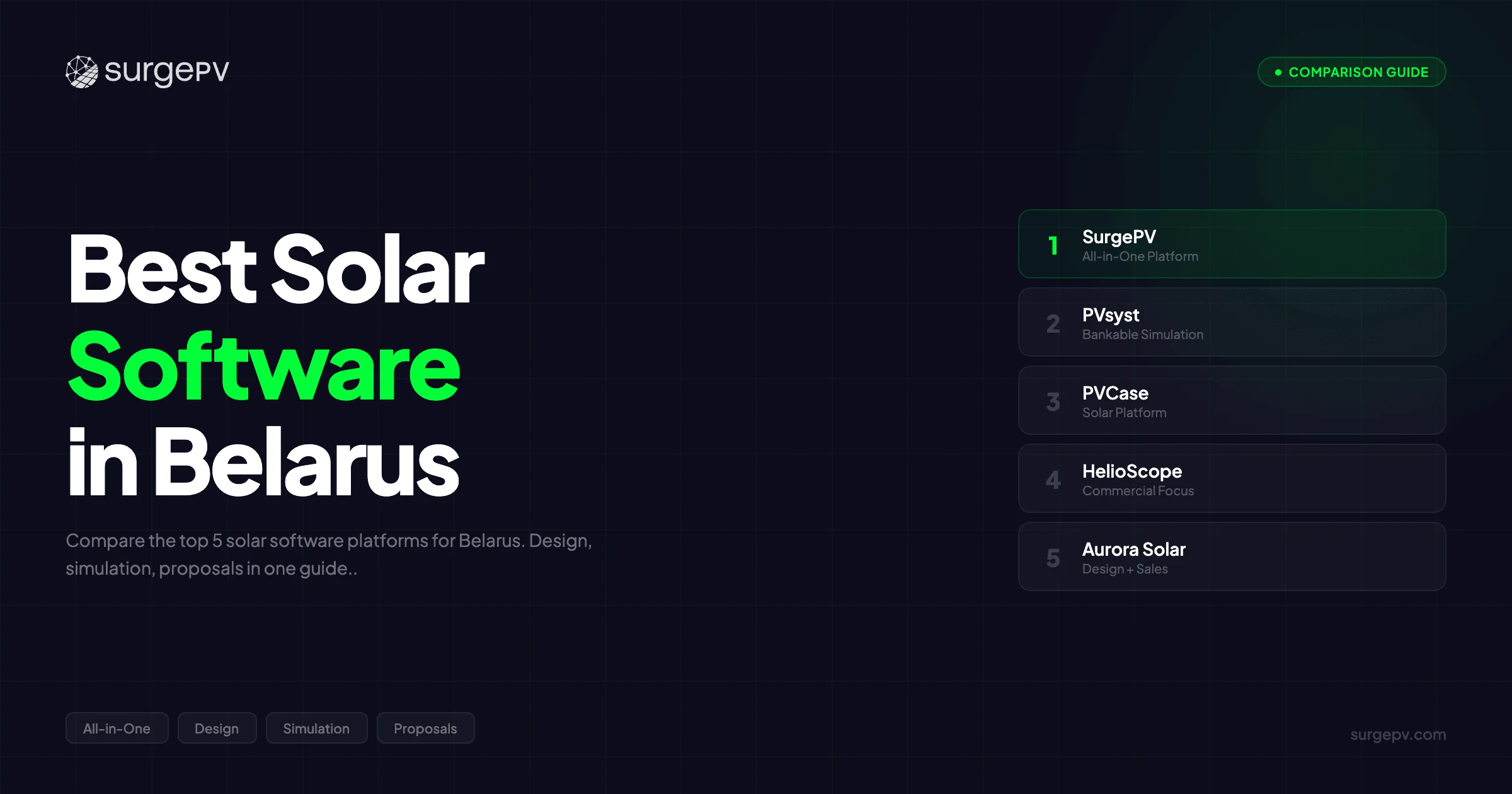
TL;DR: SurgePV is the best all-in-one platform for Belarus EPCs — design, simulation, and tender-ready proposals in one workflow instead of separate simulation, CAD, and spreadsheet tools. PVsyst remains the gold standard for EBRD/IFC bankability reports. PVCase handles utility-scale terrain design, HelioScope covers commercial C&I, and Aurora Solar suits sales-focused organizations — but at premium pricing with limited Belarus-specific features.
If you’re building solar in Belarus, you already know the tooling problem. 220 MW installed capacity, 40-60 MW added every year, and a market dominated by government tenders with 2-4 week deadlines (IEA PVPS National Survey Reports). But most EPCs are still running three or four separate tools — PVsyst for simulation, AutoCAD for design, Excel for proposals, email for collaboration.
That stack worked when Belarus had a handful of solar projects. It doesn’t work when you’re competing for 10-15 tenders per year.
The real cost isn’t the software licenses. It’s the 2-3 days of engineering time per project spent re-entering data between tools. It’s the errors that slip through when your energy yield numbers in the proposal don’t match your simulation. And it’s the tenders you miss because your team simply couldn’t assemble the documentation fast enough.
If you’re choosing all-in-one solar software for Belarus operations, you need tools that handle GOST electrical standards, produce bankable P50/P90 reports accepted by EBRD and IFC, generate Belenergo-ready electrical documentation, and model feed-in tariff economics accurately — ideally without requiring three separate licenses and a week of training per tool.
We reviewed and compared the top 5 solar software platforms for Belarus across every major category — design, simulation, proposals, and all-in-one — evaluating each on Belarus-specific workflows, regulatory compliance, and total cost of ownership.
In this guide, you’ll learn:
- Which platform delivers the best all-in-one workflow for Belarus EPCs
- How to choose between integrated platforms and specialized tools
- What each software costs and where the hidden expenses are
- Our recommendation by company type (EPC, commercial installer, developer, consultancy)
Quick Comparison: Best Solar Software for Belarus
| Software | Best For | Pricing/Year | Category | Belarus Suitability |
|---|---|---|---|---|
| SurgePV | All-in-one (design + sim + proposals) | $1,899 (3 users) | All-in-One | High |
| PVsyst | Bankability simulations | Not published | Simulation | High (bankability) |
| PVCase | Utility-scale ground-mount design | Not published | Design | Utility-scale only |
| HelioScope | Commercial design + simulation | $159/mo Basic, $259/mo Pro (list) | Design + Simulation | Commercial focus |
| Aurora Solar | Sales-focused all-in-one | $159/user/mo list ($1,620/user/yr annual) | All-in-One (Sales) | US residential focus |
Understanding Solar Software Categories for Belarus
Before looking at individual tools, it helps to understand what each category does — and why Belarus EPCs often need multiple categories covered.
All-in-One Platforms
Complete workflows (design + simulation + proposals) in one platform. Best for EPCs and installers wanting a consolidated software stack that eliminates data re-entry between tools. For Belarus’s tender-driven market, all-in-one platforms are the fastest path from project inquiry to submitted bid.
Simulation Software
Energy yield modeling and bankability analysis. Required for feed-in tariff applications and EBRD/IFC financing. PVsyst is the gold standard here — universally accepted by international lenders.
Design Software
Layout design, electrical engineering, 3D modeling. The foundation of every project. Utility-scale projects (60% of the Belarus market) need terrain modeling and tracker layout. Commercial rooftop needs shading analysis and structural load calculations.
Proposal Software
Sales quotes, tender documentation, financial modeling. With 70% of Belarus projects awarded through government tenders, proposal quality directly determines win rates.
Best Solar Software in Belarus (Detailed Reviews)
Pro Tip
SurgePV covers simulation, CAD-level design, and proposals in a single $1,899/year subscription for 3 users, so there is one tool to license and learn instead of three. PVsyst does not publish list pricing publicly, so compare your own quotes. Book a demo to see the complete Belarus workflow.
SurgePV — Best All-in-One Platform for Belarus
Best For: EPCs and commercial installers needing complete workflows
Pricing: $1,899/year (3 users); $1,499/user/year (For 3 Users plan)
Category: All-in-One (Design + Simulation + Proposals)
SurgePV is an end-to-end cloud solar design software platform that consolidates the traditional PVsyst + AutoCAD + Excel workflow into a single cloud-based tool.
For Belarus’s tender-driven market, that consolidation solves the core problem: speed.
The traditional Belarus EPC workflow looks like this: design in AutoCAD (4-6 hours), export to PVsyst for simulation (2-3 hours), manually build the proposal in Excel and Word (4-8 hours), then format and review (2-3 hours). Total: 2-3 days per tender bid. Multiply that by 10-15 tenders per year, and you’ve got a full-time engineering position dedicated to data re-entry and formatting.
SurgePV runs design, simulation, and proposal generation from the same data model. No exports. No re-entry. A complete tender bid in 4-8 hours.
Key Features for Belarus
- Complete workflow integration — Design, simulate, and generate proposals from one platform. Energy yield data flows directly into proposals without manual transfer, eliminating discrepancies between simulation numbers and tender documentation.
- Automated SLD generation — Creates electrical schematics in 5-10 minutes, adaptable to GOST R 50571 standards for Belenergo submissions. Manual AutoCAD drafting takes 2-3 hours for the same output.
- P50/P75/P90 bankability — Production estimates within +/-3% of PVsyst accuracy. Growing acceptance by EBRD, IFC, and progressive Belarus lenders (Belarusbank, Priorbank) for early-stage and tender-phase financing.
- 8760-hour shading analysis — Hour-by-hour simulation across the full year, critical for Belarus’s continental climate with a 5:1 summer-to-winter production ratio and significant snow losses.
- Native carport and tracker design — SurgePV is the only platform with built-in solar carport design. Single-axis and dual-axis tracker support included — relevant for Belarus’s growing utility-scale segment where trackers boost yield by 15-25%.
- Financial modeling — Feed-in tariff analysis with custom inputs (BYN 0.18-0.22/kWh over 10-15 year offtake agreements). LCOE, IRR, and payback calculations for tender financial sections.
- Automated BOM generation — 98% accurate component lists with import pricing flexibility (USD/EUR) for Chinese modules (Jinko, Trina, Longi) and inverters (Huawei, Sungrow) dominating the Belarus market.
Pricing
| Plan | Price | Users |
|---|---|---|
| Individual | $1,899/year | 3 users |
| For 3 Users | $1,499/user/year | 3 users |
| For 5 Users | $1,299/user/year | 5 users |
| Enterprise | Custom | Multiple |
All features included on every plan. No hidden fees, no feature gating. See full pricing.
Who SurgePV Is Best for in Belarus
- EPCs bidding on utility-scale government tenders (1-50 MW) who need fast, professional documentation
- Commercial installers targeting industrial rooftop systems (100 kW-1 MW)
- Engineering consultancies preparing bankable P50/P90 reports for EBRD/IFC financing
- International developers entering the Belarus market who want to eliminate multi-tool dependency
Limitations
- English interface (no Russian localization yet)
- GOST electrical standards require manual adaptation of SLD outputs
- Belarus feed-in tariff rates require manual input (not pre-loaded)
- Simulation depth less granular than PVsyst for complex due diligence edge cases
Further Reading
For design-focused comparisons, see best solar design software. For an all-in-one global comparison, see best all-in-one solar software.
PVsyst has had a 30-year head start in simulation, and Aurora Solar has spent hundreds of millions on US market awareness. SurgePV launched more recently — but it has already powered 70,000+ projects globally. The platform was purpose-built for the workflow gaps legacy tools leave open, especially the design-to-proposal integration and automated electrical engineering that no other platform offers natively.
PVsyst — Best Simulation Software for Belarus Bankability
Best For: Engineers needing EBRD/IFC-accepted bankability reports
Pricing: Not published plus AutoCAD (licensed separately) for complete workflow
Category: Simulation
PVsyst is the global reference for bankable energy production estimates. If you’re seeking project financing from EBRD, IFC, or progressive Belarus lenders, PVsyst reports carry unmatched credibility. No other simulation tool has the same universal acceptance among international financiers.
What Works for Belarus
- Universally accepted by EBRD, IFC, and progressive Belarus lenders for P50/P90 bankability
- Includes TMY weather data files for major Belarus cities (Minsk, Gomel, Vitebsk, Grodno, Brest)
- Detailed loss modeling for Belarus’s continental climate (temperature coefficients, snow losses, soiling)
- Russian language interface available
Where It Falls Short in Belarus
- Simulation-only — No design tools. You need AutoCAD or PVCase for layout, and neither publishes list pricing
- No SLD generation — Electrical documentation requires external CAD tools
- No proposal generation — Cannot produce tender-ready documents for government procurement
- Desktop-only — No cloud collaboration, limiting distributed team workflows
Best for: Final due diligence and lender submissions where PVsyst reports are explicitly required. Pair with SurgePV or AutoCAD for design and proposals.
Read our full PVsyst review for a detailed breakdown.
Did You Know?
Belarus’s government targets continued renewable energy growth, with 40-60 MW of new solar capacity added annually. Feed-in tariff mechanisms and energy independence goals continue to drive new project development through 2030 (IEA PVPS Reports).
PVCase — Best Utility-Scale Design Software for Belarus
Best For: Utility-scale EPCs designing projects above 1 MW ground-mount
Pricing: Not published; PVcase quotes by sales.
Category: Design (Utility-Scale)
PVCase is an AutoCAD plugin built specifically for utility-scale solar design. Its terrain modeling, grading tools, and tracker layout capabilities make it the standard for large ground-mount projects — and ground-mount dominates the Belarus market at 60% of installed capacity.
What Works for Belarus
- Excellent terrain modeling for Belarus ground-mount projects (flat and rolling agricultural land)
- Strong electrical documentation (cable schedules, protection schemes) for Belenergo grid applications
- BIM integration with Revit and Civil 3D for engineering firms
- Optimized for projects above 1 MW — the dominant segment in Belarus
Where It Falls Short in Belarus
- Requires AutoCAD — a separately licensed Autodesk seat plus a PVCase licence, neither of which is published as a list price
- 6-8 week onboarding — Steep learning curve requiring CAD expertise
- No simulation — Need PVsyst (pricing not published) separately for bankability
- No proposal generation — Cannot create tender-ready documents
- Overkill for commercial rooftop — Not practical for projects under 500 kW
Best for: Utility-scale EPCs designing ground-mount projects above 1 MW where terrain optimization justifies the cost and learning curve.
Read our full PVCase review for a detailed analysis.
HelioScope — Best Commercial Solar Platform for Belarus
Best For: Commercial EPCs designing industrial rooftop systems
Pricing: $159/month or $1,620/year per licence for Basic, $259/month or $2,640/year per licence for Pro (helioscope.aurorasolar.com/pricing, checked 21 September 2026); Enterprise custom.
Category: Design + Simulation
HelioScope is a cloud-based design and simulation platform focused on commercial and industrial (C&I) solar projects. Its browser-based CAD tools make it fast to learn and fast to use for mid-scale rooftop work — a growing segment in Belarus as industrial facilities look to cut energy costs.
What Works for Belarus
- Fast commercial rooftop design in a browser-based interface
- Integrated simulation with credible production estimates
- Supports Belarusian locations via Meteonorm weather data integration
- Team collaboration through cloud-based project sharing
Where It Falls Short in Belarus
- No SLD generation — Commercial projects requiring Belenergo electrical documentation need external tools
- North America focus — Belarus-specific features (GOST codes, feed-in tariff) not built in
- Contact-for-pricing — Typically $2,400-4,800/year, but not transparent
- Limited utility-scale features — Not optimized for ground-mount projects that dominate Belarus (60%)
- No proposal generation — Cannot create tender-ready documents
Best for: Commercial EPCs designing industrial rooftop systems (100 kW-1 MW) who prioritize design speed over tender documentation depth.
See our full HelioScope review for more details.
Aurora Solar — Best Sales-Focused Platform for Belarus
Best For: Sales organizations wanting design + CRM + proposals
Pricing: $159/user/month, or $135/user/month billed annually ($1,620/user/year), for Basic and $259/user/month, or $220/user/month billed annually ($2,640/user/year), for Premium (aurorasolar.com/pricing, checked 21 September 2026); Enterprise quoted per project.
Category: All-in-One (Sales-Focused)
Aurora Solar is the market leader in the US residential solar segment, offering a complete sales platform with design, proposals, and CRM in one tool. Its AI-powered roof modeling and polished customer-facing proposals are best-in-class for residential and small commercial sales workflows.
What Works for Belarus
- Complete sales workflow from design to close (design, proposals, CRM)
- Professional, customer-facing proposals for commercial clients
- CRM integration (Salesforce, HubSpot) for pipeline management
- Large component database
Where It Falls Short in Belarus
- US residential focus — Government tender features and utility-scale capabilities are limited
- Premium pricing — $3,600-6,000/year is steep for Belarusian budgets without tender-specific features
- No GOST-adaptable outputs — Electrical documentation follows US/IEC standards only
- P50 only — No P75/P90 metrics that international lenders require
- No Russian language support — English-only interface
Best for: Sales-focused installers targeting commercial rooftop projects who prioritize proposals and CRM over government tender documentation.
For a deeper analysis, read our full Aurora Solar review.
Full Comparison Table: Solar Software for Belarus
| Feature | SurgePV | PVsyst | PVCase | HelioScope | Aurora Solar |
|---|---|---|---|---|---|
| Category | All-in-One | Simulation | Design (utility) | Design + Sim | All-in-One (sales) |
| Design tools | Yes (full) | No | Yes (AutoCAD) | Yes (cloud) | Yes (cloud) |
| Simulation | P50/P75/P90 | Gold standard | No (via PVsyst) | Limited P50/P90 | P50 only |
| Proposals | Yes (tender-ready) | No | No | Basic | Yes (sales) |
| SLD generation | Yes (automated) | No | Yes (AutoCAD) | No | No |
| Financial modeling | LCOE, IRR, payback | Basic | No | Basic | Standard |
| Carport design | Yes (only platform) | No | No | No | No |
| Cloud-based | Yes | No (desktop) | No (AutoCAD) | Yes | Yes |
| Pricing/year | $1,899 (3 users) | $625-1,250 | $3,800-5,800 | $2,400-4,800 | $3,600-6,000 |
| Onboarding | 2-3 weeks | 4-6 weeks | 6-8 weeks | 2-3 weeks | 4-6 weeks |
Further Reading
For a broader comparison beyond Belarus, see our guide to the best solar software globally. For simulation-specific comparisons, see best solar simulation software.
Traditional vs. Modern Software Workflows for Belarus EPCs
Traditional Workflow (PVsyst + AutoCAD + Excel)
Design in AutoCAD or PVCase (4-6 hours). Export to PVsyst for simulation (2-3 hours). Manually build proposals in Excel/Word (4-8 hours). Format and review (2-3 hours). Total: 2-3 days per tender bid.
Advantages: specialized tools, maximum PVsyst bankability credibility. Disadvantages: slow, data re-entry errors, several subscriptions to license and renew, high training investment.
Modern Workflow (Integrated Platform)
Design, simulate, and generate proposals in one platform — SurgePV or similar. Total: 4-8 hours per tender bid, with no re-entry of the design between tools.
Advantages: speed, no data re-entry, lower total cost, cloud-based, easier training. Disadvantages: simulation depth less granular than PVsyst for complex due diligence, growing (not universal) lender acceptance.
Hybrid Workflow (Best of Both)
Use SurgePV for fast design, simulation, and proposal generation (4-8 hours). Run PVsyst for final bankability due diligence on financed projects (2-3 hours). Total: 6-11 hours with maximum credibility.
This is what we recommend for Belarus EPCs handling both government tenders and EBRD/IFC-financed projects.
How to Choose Solar Software by Company Type in Belarus
EPCs (Utility-Scale Tenders)
Primary need: Fast, professional tender proposals with bankable simulations.
Recommended: SurgePV (all-in-one workflow) for speed. Add PVsyst for final bankability on EBRD/IFC-financed projects.
Why: Government tenders require speed (2-4 weeks) + quality (evaluation committees) + bankability (lender financing). SurgePV covers all three. PVsyst adds maximum lender confidence for high-value financing rounds.
Commercial Installers (B2B Sales)
Primary need: Fast quotes and professional commercial proposals.
Recommended: SurgePV (design + proposals) for technical depth. Aurora Solar if CRM integration is the top priority.
Why: Commercial sales require 1-3 day turnaround, professional formatting, and ROI modeling. SurgePV handles this while also covering utility-scale work. Aurora Solar offers the best CRM but at premium pricing.
Engineering Consultancies
Primary need: Detailed technical analysis and compliance documentation.
Recommended: SurgePV (all workflows) + PVsyst (final bankability). Add PVCase for utility-scale terrain optimization on complex sites.
Why: Multiple client projects require flexible tools, deep technical capability, and lender-accepted outputs.
International Developers
Primary need: Feasibility studies, site selection, financial modeling.
Recommended: SurgePV (fast feasibility) for early-stage. PVsyst (bankability) for final due diligence.
Why: Development stage requires speed (many sites evaluated), then rigor (final design/financing). SurgePV’s cloud platform works from any location without Belarus-specific installations.
Streamline Your Belarus Solar Workflows with SurgePV
Replace PVsyst + AutoCAD + Excel with one integrated platform. Design, simulate, and generate tender proposals without moving data between tools.
Book a DemoNo commitment required · 20 minutes · Live project walkthrough
Why Most Solar Software Fails in Belarus
GOST Standards Compliance
Belarus follows GOST electrical codes (Russian/EAC standards), not IEC or NEC. Single line diagrams must follow GOST symbology, and protection devices must meet EAC certification requirements. Few Western tools support GOST natively, but SurgePV’s automated SLD generation provides adaptable outputs that engineers can modify for Belenergo submissions — still saving 2+ hours versus manual drafting.
Belenergo Grid Connection
Every solar installation connects through Belenergo, the state utility. Grid connection applications require technical passports, protection and control relay settings, and SCADA integration plans for large projects. For systems above 100 kW, formal grid impact studies are required, and approval timelines run 6-12 months (Belarus Ministry of Energy).
Extreme Continental Climate
Temperature extremes from -30°C in winter to +35°C in summer. Annual irradiance is moderate (900-1,050 kWh/m2/year) with a 5:1 summer-to-winter production ratio. Snow loads range from 1.2-1.8 kN/m2. Your software needs accurate TMY data — from Meteonorm or PVGIS — and must account for snow cover losses, temperature coefficient impacts, and bifacial albedo gains from snow.
Import-Dependent Component Market
Belarus relies on imported equipment — primarily Chinese modules and inverters with EAC/GOST certification. Software needs flexible component databases supporting USD/EUR pricing rather than BYN-only cost structures. SurgePV’s BOM automation handles this with 98% accuracy.
Our Review Method Methodology
We evaluated each platform against five weighted criteria specific to the Belarusian market:
- Workflow completeness (30%) — How many stages (design, simulation, proposals) the platform covers natively, eliminating data re-entry
- Belarus applicability (25%) — GOST adaptability, Belenergo compliance, feed-in tariff modeling, Belarus weather data, government tender support
- Simulation and accuracy (20%) — P50/P90 capabilities, shading analysis precision, loss modeling for continental climate, lender acceptance
- Ease of use (15%) — Onboarding time, interface design, learning curve for Belarusian engineering teams
- Pricing value (10%) — Total cost of ownership (including required companion tools), team size scalability, ROI for typical Belarus EPC
The research used published sources between January and February 2026, using real project parameters and regulatory documentation from the Belarus Ministry of Energy and Belenergo.
Transparency Note
SurgePV publishes this content. We are transparent about this relationship. This comparison acknowledges PVsyst as the undisputed gold standard for bankable simulation and recognizes that each tool has genuine strengths for specific use cases. We present SurgePV as the strongest all-in-one workflow platform for Belarus’s tender-driven market. See our editorial standards.
Bottom Line: Best Solar Software for Belarus
Belarus’s solar market is growing steadily — but the regulatory environment (GOST standards, Belenergo grid approvals, government tenders, feed-in tariff applications) makes solar software selection more important than in simpler markets. The wrong stack costs you tenders, financing delays, and engineering hours.
For most Belarus EPCs and commercial installers: SurgePV delivers the most complete workflow. Design, simulation, automated SLDs, financial modeling, and tender-ready proposals — all in one platform at $1,899 per user per year on the individual plan, replacing the traditional multi-tool workflow.
For final due diligence and EBRD/IFC financing: PVsyst remains essential for maximum lender confidence. Pair it with SurgePV for the complete design + proposal workflow.
For utility-scale terrain optimization (10+ MW): PVCase plus AutoCAD delivers the deepest terrain modeling and civil engineering integration, though PVCase quotes by sales and 6-8 week onboarding is a significant investment.
For commercial design speed: HelioScope offers fast cloud-based design and simulation for C&I projects, though limited proposal and utility-scale features constrain its use in Belarus’s dominant market segment.
For sales-focused organizations: Aurora Solar offers the best CRM integration and customer-facing proposals, but premium pricing and US residential focus may not justify the cost for Belarus government tender workflows.
The EPCs winning government tenders today are the ones producing professional documentation and bankable simulations faster than their competitors — not the ones still switching between three separate tools. Your software stack is a competitive weapon, not a back-office expense.
Want to see how SurgePV handles Belarusian project workflows? Book a demo and our team will walk you through a project using your actual site data. Compare pricing — transparent rates, all features included.
Further Reading
For EPC-focused comparisons, see best solar software for EPCs. For simulation bankability comparisons, see best solar simulation software. For European market comparisons, see best solar design software Germany.
Go deeper on a specific category
This page compares solar software across categories for Belarus. If you already know which part of the workflow you are buying for, these go into more detail:
Frequently Asked Questions
What is the best solar software in Belarus?
SurgePV is the best all-in-one solar software for Belarus in 2026. It combines design, simulation, and proposals in one platform — shortening tender response time compared with PVsyst + AutoCAD + Excel workflows. Pricing starts at $1,899 per user per year on the individual plan with all features included. For simulation-only needs, PVsyst remains the bankability standard.
Do I need separate design, simulation, and proposal software in Belarus?
No. Modern all-in-one platforms like SurgePV integrate design, simulation, and proposals in one workflow, eliminating data re-entry and removing the data re-entry between separate tools. For maximum lender confidence on EBRD/IFC-financed projects, EPCs can combine SurgePV for speed with PVsyst for final bankability reports.
What software do Belarus EPCs use for government tenders?
Belarus EPCs commonly use PVsyst for bankability studies, AutoCAD or PVCase for layout design, and Excel for proposals. Integrated platforms like SurgePV are gaining adoption for faster tender response with professional government tender documentation. HelioScope is used for commercial C&I design.
Can solar software handle Belarus feed-in tariff calculations?
Yes. Software like SurgePV supports customizable feed-in tariff modeling. Belarus rates (BYN 0.18-0.22/kWh) can be input for 10-15 year offtake agreement financial modeling, including LCOE calculations, IRR projections, and payback period analysis.
Which simulation software do Belarus lenders accept?
EBRD, IFC, and progressive Belarus lenders universally accept PVsyst for bankable P50/P90 simulations. SurgePV and HelioScope are gaining growing acceptance for early-stage financing and government tender submissions meeting IEC standards. Bankability requires Monte Carlo uncertainty analysis, validated weather data, and industry-standard loss modeling.
How much does solar software cost for Belarus operations?
SurgePV starts at $1,899 per user per year on the individual plan with design, simulation, and proposals included. See SurgePV pricing. PVsyst, PVCase and Autodesk do not publish list pricing, so a PVsyst, AutoCAD and Excel stack has to be quoted tool by tool, and it adds hours of data re-entry per project.
Do solar software tools support Russian language for Belarus?
Most Western solar software (SurgePV, HelioScope, Aurora Solar) offers English interfaces, while PVsyst includes Russian language support. Belarus engineers are proficient in technical English. The key consideration is the ability to export Cyrillic documentation for Belenergo submissions and government tenders.
What compliance requirements must solar software meet in Belarus?
Belarus solar software must support GOST electrical standards (GOST R 50571), Belenergo grid codes (50 Hz, voltage regulation), STB fire safety codes, and energy production forecasts (P50/P90) for feed-in tariff applications. Compliance documentation includes technical passports, grid impact studies for projects over 100 kW, single-line diagrams, and grounding calculations.
Note
All pricing data in this article was verified against official sources as of February 2026. Prices may have changed since publication.
Sources
- IEA PVPS National Survey Reports — Belarus solar market statistics and growth data
- Belarus Ministry of Energy — Renewable energy policy, Decree No. 209, and feed-in tariff regulations
- EBRD Belarus Energy Reports — Solar financing and market development data
- PVGIS (European Commission) — Belarus solar irradiation and weather data
- GOST Standards Database — GOST R 50571 electrical safety standards
- Meteonorm — Belarus TMY weather data validation
- G2 Solar Software Reviews — User reviews and ratings across platforms
- SurgePV Product Documentation — Official feature specifications (accessed February 2026)
