

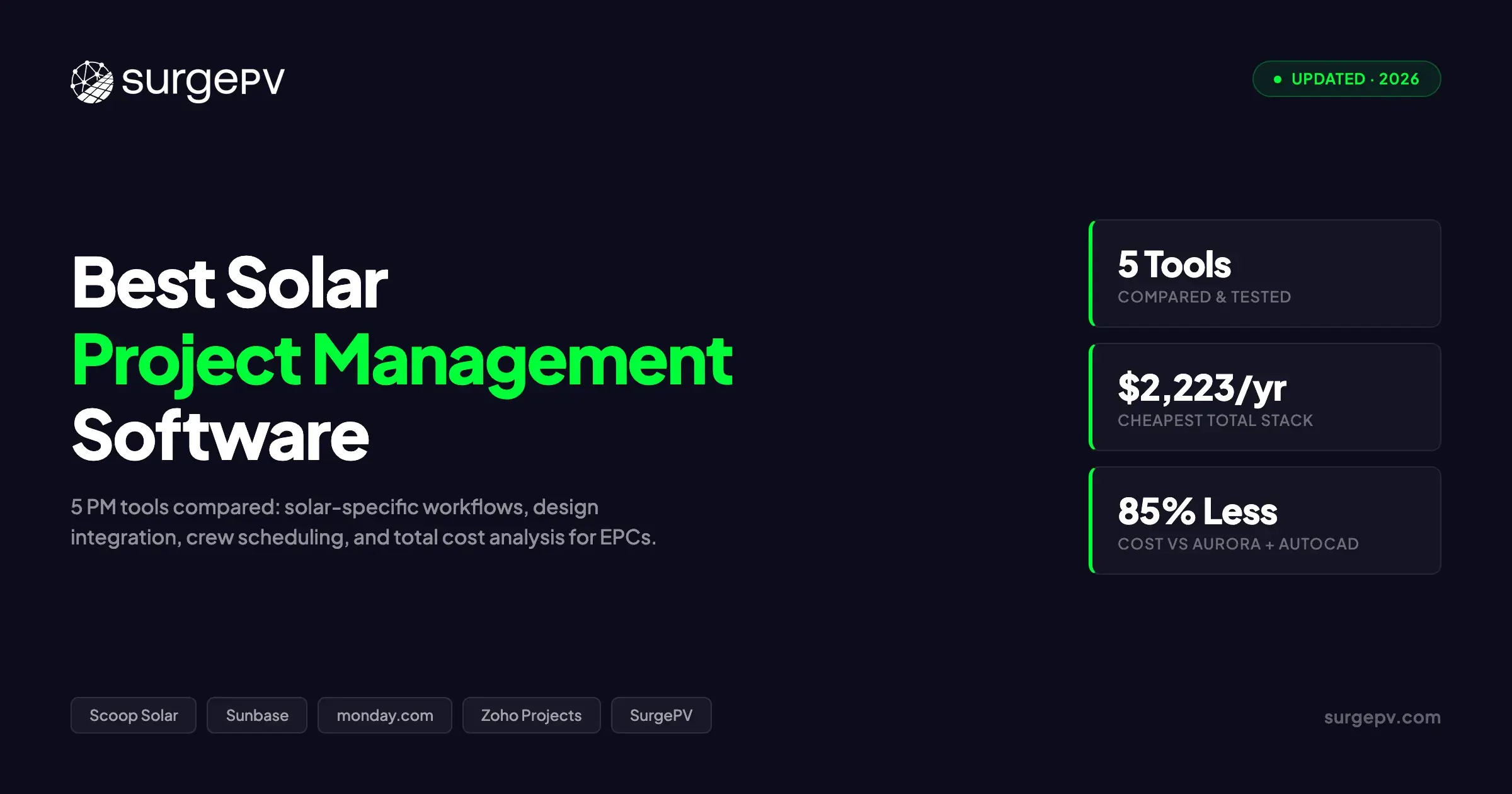
TL;DR: Scoop Solar is the best dedicated solar PM platform with purpose-built milestones, field ops, and customer portals. For a lean complete stack, pair SurgePV ($1,899 per user per year on the individual plan) with a general PM tool such as monday.com. Sunbase fits small residential teams wanting CRM + PM. Zoho Projects is the lightest-weight per-seat option. SurgePV itself is not a PM tool, but it eliminates the design-to-PM data gap that costs 30-60 minutes per project.
Your design tool and PM tool don’t talk to each other. That is the biggest hidden cost in solar operations right now. System specs, BOMs, SLDs, and production estimates live in Aurora or HelioScope. Project milestones, crew schedules, and permit tracking live in Scoop or a spreadsheet. Someone manually transfers that data for every project, every time.
That handoff costs 30-60 minutes per project and introduces the kind of errors that delay installations by weeks.
The best solar project management software in 2026 doesn’t just track milestones and schedule crews. It connects to your design workflow, or better yet, includes design capabilities, so project data flows without manual re-entry. The result: fewer errors, faster project completion, and operations that scale without adding headcount.
We reviewed 5 PM approaches - from solar-specific platforms (Scoop Solar, Sunbase) to adapted general tools (monday.com, Zoho Projects) to design-integrated workflows (SurgePV) - with EPC teams managing 50+ simultaneous projects. Here is what actually works.
In this guide, you’ll find:
- Head-to-head comparison of 5 solar project management approaches
- The design-to-PM integration gap most solar companies ignore
- Which tools have solar-specific features (AHJ tracking, crew scheduling, customer portals) vs. which need customization
- Total cost of ownership: PM tool + design tool + AutoCAD (the hidden costs)
- Our recommendation for the best PM workflow by company size and project volume
Quick Comparison Table
| Software | Best For | Key Limitation | Design Integration | Starting Price |
|---|---|---|---|---|
| Scoop Solar | Dedicated solar PM | Requires separate design tool | Limited (Aurora API) | Not published |
| Sunbase (Solar Success) | CRM + PM for small teams | Limited field operations | None | Not published |
| monday.com | Most flexible general PM | Not solar-specific | None | See vendor pricing page |
| Zoho Projects | Lightest-weight PM | Not solar-specific | None | Free tier plus paid plans |
| SurgePV | Design platform with collaboration | Not a PM tool | Native (built-in) | $1,899/year (3 users) |
Best Solar Project Management Software (Detailed Reviews)
Scoop Solar - Best Dedicated Solar PM Platform
Best For: Mid-to-large solar companies (50+ projects/month) wanting purpose-built solar operations
Pricing: Not published; contact sales
Scoop Solar is the leading purpose-built solar project management platform. It was designed from the ground up for solar installation workflows - not adapted from a generic PM tool. Pre-built solar milestones (site survey through PTO), a field crew mobile app, customer portal, and permitting workflow tracking come standard.
If you want the best dedicated solar PM tool, Scoop Solar is it. No customization required. No building boards from scratch. You get solar-specific workflows on day one.
What Works
- Purpose-built solar milestone templates - Sale, site survey, design, permitting, installation, inspection, PTO. All pre-configured. That saves 2-4 weeks of setup vs building custom workflows in monday.com or Zoho.
- Mobile field app - Crews get photo documentation, site survey tools, punch lists, and real-time scheduling from their phones. This matters once you pass 20 simultaneous projects, where WhatsApp-based coordination breaks down.
- Customer portal - Homeowners and business clients check project status without calling your office. Scoop says this reduces status inquiry calls.
- AHJ and permitting workflow - Track permit status, store documents, manage deadlines. Permitting delays are the number one reason solar installations take longer than projected.
- CRM integrations - Salesforce, HubSpot, and design tool connections (Aurora Solar API).
Where It Falls Short
- Requires a separate design tool - Scoop handles operations, not design. You still need Aurora, SurgePV, or HelioScope for system design and electrical documentation.
- Design-to-PM data transfer is still partly manual - Even with Aurora API integration, design data (BOMs, SLD specifications, wire sizing) doesn’t flow automatically into Scoop’s project records.
- Custom pricing with no transparency - You have to contact sales. There’s no public pricing page.
- No design, electrical, or proposal capabilities - Focused on PM only. For complete project workflows, you need two subscriptions minimum.
Bottom line: Scoop Solar is the best solar PM tool on the market. If operations management is your primary problem, start here. Pair it with SurgePV for design and electrical to get the most complete and cost-effective solar operations stack.
Sunbase (Solar Success) - Best CRM + PM for Small Teams
Best For: Small residential installers (10-30 projects/month) wanting CRM + PM in one affordable platform
Pricing: Not published; contact sales
Sunbase combines solar CRM with project management in one platform. Lead tracking, deal pipeline, milestone management, and basic customer communication - without the complexity or cost of enterprise PM tools. For a small team that needs lead management and project tracking in the same tool, Sunbase is a sensible choice.
What Works
- Combined CRM + PM reduces your tool count. Lead management through installation in one platform.
- Solar-specific pipeline stages - Lead, sale, design, permit, install, PTO. Pre-built for solar workflows.
- Positioned for small teams. Sunbase does not publish list pricing, so ask for a quote against your seat count.
- Customer communication automation - Email and SMS updates keep homeowners informed without manual effort.
Where It Falls Short
- Limited field operations - Basic mobile access, but no rich crew tools (photo documentation, detailed scheduling, punch lists) like Scoop.
- No design integration - Separate design tool required. All design data manually entered.
- No electrical engineering features - No SLD generation, no wire sizing.
- Limited scalability - Works well under 30 projects/month. Above that, the limitations become friction.
- Smaller user base means fewer integrations and a smaller community.
Bottom line: Sunbase makes sense for small residential shops that want CRM and PM without enterprise complexity. Once you cross 30-50 projects/month, you’ll likely outgrow it. Read our full Sunbase Data review for a detailed analysis.
monday.com - Most Flexible General PM for Solar
Best For: Tech-savvy solar companies wanting maximum flexibility and the best dashboards
Pricing: See monday.com’s own pricing page for current per-seat tiers; minimum 3 seats
monday.com is the most flexible project management platform available. It can be configured for virtually any workflow, including solar. Best-in-class dashboards and reporting, 200+ integrations, and strong mobile apps.
The catch: it knows nothing about solar out of the box. monday.com sits at the lighter end of the PM market on per-seat cost, but you’ll spend 2-4 weeks configuring it for solar workflows. Whether that tradeoff works depends on your team.
What Works
- Most flexible and customizable PM platform - Custom boards, views, automations, and formulas. You can build exactly the workflow you need.
- Best dashboards in the PM space - Pipeline visibility, workload management, portfolio views. If reporting matters to your operations, monday.com wins.
- 200+ integrations - CRM, email, cloud storage, accounting. More connection options than any solar-specific PM tool.
- Strong mobile app for field team updates and scheduling.
- Scales from 3 to 1,000+ users without switching platforms.
- Well-documented with a large community - Plenty of templates and guides for construction PM (adaptable to solar).
Where It Falls Short
- NOT solar-specific - You must build all solar milestones (site survey, permitting, AHJ, PTO) manually. Expect 2-4 weeks of configuration.
- No AHJ database or permitting automation - Solar-specific permitting workflows don’t exist. You build them from scratch.
- No design tool integration - No Aurora, SurgePV, or HelioScope API. All design data is manually entered into boards.
- No solar-specific customer portal - You can build guest views, but nothing like Scoop’s dedicated homeowner portal.
- No field operations specialization - No photo documentation workflows, no site survey tools, no crew dispatch optimization.
Bottom line: monday.com is the smartest choice for tech-savvy teams willing to invest configuration time. Paired with SurgePV for design, it creates a lean two-subscription stack.
Did You Know?
Dedicated project management software replaces the spreadsheet-and-email coordination most installers start with. The practical gains come from automated milestone tracking and from not re-keying project data between the design tool and the schedule, which is where transfer errors creep in.
Zoho Projects - Most Affordable PM Within Zoho Ecosystem
Best For: Budget-conscious solar companies already using Zoho CRM and Zoho Books
Pricing: Free tier (3 users, 2 projects) plus paid plans; see Zoho’s own pricing page for current rates
Zoho Projects offers solid project management at the lowest per-user cost on this list. Task management, milestones, Gantt charts, time tracking, and Blueprint workflow automation. Especially valuable if you’re already in the Zoho ecosystem.
What Works
- Lightest-weight entry point - free tier for up to 3 users and 2 projects, with paid plans above that.
- Zoho ecosystem integration - CRM, Books, Desk, and other Zoho products share data seamlessly. If you run your solar business on Zoho, adding Projects is a no-brainer.
- Solid time tracking and resource management - Built-in timesheets, workload views, and resource allocation.
- Blueprint workflows for process automation and stage transitions.
- API access for custom integrations if your team has development capability.
Where It Falls Short
- NOT solar-specific - Requires customization for solar milestones, permitting, and AHJ workflows.
- No solar templates - No pre-built stages for site survey, design, permitting, or PTO.
- No design tool integration - All design data manually transferred.
- Less polished UI than monday.com - Functional but not as intuitive or visually refined.
- Zoho ecosystem lock-in - Maximum value when using multiple Zoho products. As a standalone PM, it’s less competitive.
- Smaller PM community compared to monday.com or Asana.
Bottom line: Zoho Projects is the right call if you’re already running your business on Zoho and need PM in the same ecosystem. The free tier makes the entry cost minimal. Pair with SurgePV for design to keep total software costs low.
SurgePV - Design Platform That Eliminates the Biggest PM Pain Point
Best For: Solar companies wanting to eliminate design-to-PM data chaos
Pricing: $1,899/year (3 users) / $1,499/user/year (For 3 Users plan)
Onboarding: 2-3 weeks
Let’s be direct: SurgePV is not a project management tool. It doesn’t have Gantt charts. It doesn’t schedule crews. It doesn’t track permitting milestones. If you’re looking for a dedicated PM platform, look at Scoop Solar or monday.com above.
What SurgePV does is eliminate the single biggest operational headache that PM tools can’t fix: the design-to-PM data disconnect.
Here’s the problem every solar company faces. Designers finish a project in Aurora or HelioScope. Then someone manually enters system specs, BOMs, SLD data, production estimates, and proposal details into the PM system. For every project. That’s 30-60 minutes of redundant data entry per project, and it introduces the kind of errors that delay installations.
SurgePV solves this by keeping design, electrical engineering (automated SLD generation in 5-10 minutes), and proposal generation in a single cloud-based platform. No tool-switching. No manual re-entry for the design phase.
Key Collaboration Features
- Cloud-based project library - All designs organized, searchable, and accessible from anywhere
- Multi-user simultaneous access - Distributed teams work on the same projects in real-time
- Complete design-to-proposal workflow - System design, SLD generation (5-10 min), wire sizing (instant), shading analysis (8760-hour), and web-based proposals with financial modeling - all in one platform
- 70,000+ module database and 3,000+ US utilities for accurate system specification
- 3-minute average support response and 2-3 week onboarding
Pro Tip
A lean solar operations stack is SurgePV at $1,899 per user per year on the individual plan plus a general PM tool. Because SurgePV includes SLD generation, that route needs no separate CAD licence, so it is two subscriptions rather than three. monday.com, Scoop Solar and Autodesk price by quote or by tier, so a combined annual total is not something we can publish. See how it works.
Pricing
| Plan | Price | Users |
|---|---|---|
| Individual | $1,899/year | 3 users |
| For 3 Users | $1,499/user/year | 3 users |
| For 5 Users | $1,299/user/year | 5 users |
| Enterprise | Custom | Multiple |
All features included on every plan. No hidden fees, no feature gating. See full pricing.
What SurgePV Is Best For
- Solar companies spending 30-60 minutes per project re-entering design data into PM systems
- Teams that want design, SLD generation, wire sizing, and proposals in one platform
- EPCs looking to eliminate AutoCAD dependency
- Companies that want a lean total stack of one design platform plus one PM tool
Limitations (Honest Assessment)
- No Gantt charts, milestone tracking, or project timeline views
- No crew scheduling or field operations tools
- No customer portal for project status updates
- No AHJ database or permitting workflow tracking
- No CRM features (lead management, pipeline analytics)
- No construction phase management (inspection scheduling, inventory tracking)
For full project management, pair SurgePV with a PM tool. Scoop Solar gives you the best solar-specific PM. monday.com gives you the most configurable one.
Real-World Example
A 12-person EPC in Texas was running Aurora for design, AutoCAD for SLDs, and Scoop Solar for PM: three subscriptions, three renewals. Design-to-PM data transfer took 45 minutes per project across 40 monthly projects, which is 30 hours a month of redundant data entry. After switching design to SurgePV and keeping monday.com for PM, they were down to two subscriptions and design-phase data transfer was eliminated entirely. The PM team now gets accurate specs from SurgePV’s project library without manual re-entry.
Further Reading
For solar design software specifically, see our guide to the best solar design software. For residential-focused tools, see best residential solar software. For an in-depth look at Aurora, read our Aurora Solar review.
You might wonder: if SurgePV isn’t a PM tool, why include it here? Because every PM comparison ignores the biggest cost in solar operations - the design-to-PM handoff. You can have the best PM tool in the world, and it won’t matter if your team wastes 30 hours a month re-entering design data. SurgePV doesn’t replace your PM tool. It makes your PM tool actually work.
Which Software Is Right for Your Use Case?
| Your Situation | Recommended Stack | Why It Fits |
|---|---|---|
| Large EPC (50+ projects/month) | SurgePV + Scoop Solar | Best solar PM (Scoop) + best design efficiency (SurgePV). Eliminates AutoCAD + design data re-entry. |
| Mid-size installer (20-50 projects/month) | SurgePV + monday.com | Lean two-subscription stack. Flexible PM dashboards + integrated design workflow. |
| Small residential shop (under 20 projects/month) | SurgePV + Sunbase | CRM + basic PM (Sunbase) + professional design (SurgePV). Simple, affordable, solar-specific. |
| Budget-conscious team already on Zoho | SurgePV + Zoho Projects | Cheapest total stack. Zoho ecosystem integration for CRM + accounting + PM. |
| Company needing PM only (design tool sorted) | Scoop Solar (standalone) | Best solar-specific PM. Pre-built milestones, field ops, customer portal. No PM customization needed. |
Eliminate the Design-to-PM Data Gap
SurgePV keeps design, electrical engineering, and proposals in one platform - so your PM tool gets clean data without manual re-entry.
Book a DemoNo commitment required · 20 minutes · Live project walkthrough
When You May Not Need Dedicated Solar PM Software
Not every solar company needs specialized project management software. Consider simpler alternatives if:
- You handle fewer than 10 projects per month - Spreadsheet tracking and basic communication tools may be sufficient. The overhead of configuring and maintaining PM software may not justify itself at low volumes.
- Your projects are standardized residential installs - If every project follows the same simple workflow (design, permit, install), a shared Google Sheet or Trello board might work until volume increases.
- You outsource operations - If installation, permitting, and inspections are handled by subcontractors who manage their own workflows, you may only need a CRM and design tool.
- Your team is under 5 people - Small teams often communicate effectively through direct channels. PM software becomes more valuable as team size and project complexity grow.
However, once you pass 20-30 projects per month, the cost of missed deadlines, miscommunication, and manual data entry almost always exceeds the cost of proper PM software.
Full PM Feature Comparison Table
| Feature | Scoop Solar | Sunbase | monday.com | Zoho Projects | SurgePV |
|---|---|---|---|---|---|
| Solar-specific PM | Yes (purpose-built) | Yes (CRM+PM) | No (customizable) | No (customizable) | No (design platform) |
| Design integration | Limited (Aurora API) | No | No | No | Native (built-in) |
| Milestone tracking | Yes (solar templates) | Yes | Yes (Gantt) | Yes (Gantt) | No |
| Crew scheduling | Yes (mobile app) | Basic | Custom | Basic | No |
| Customer portal | Yes | Basic | No (guest views) | No | No |
| AHJ/permitting | Yes | Basic | No | No | No |
| SLD generation | No | No | No | No | Yes (5-10 min) |
| Proposal generation | No | Basic | No | No | Yes (web-based) |
| Pricing/year (per user) | Not published | Not published | See vendor pricing page | Free tier plus paid plans | $633 (Individual plan) |
Further Reading
For solar design software specifically, see our guide to the best solar design software globally. For residential-focused tools, see best residential solar software.
Why the Design-to-PM Gap Is Your Biggest Operations Problem
The Hidden Cost of Disconnected Tools
Every PM tool on this list - Scoop, Sunbase, monday.com, Zoho - requires a separate design tool. That means design data (system specs, BOMs, SLDs, production estimates, proposals) must transfer from your design software into your PM system.
At 50 projects per month, manual design-to-PM data transfer wastes 25-50 hours monthly. That’s not a productivity inconvenience. That’s a full-time employee’s worth of time spent copying data between systems.
What most people miss is that this isn’t just slow - it’s error-prone. Wrong BOM quantities, incorrect wire sizing specs, mismatched production estimates between design and PM records. These errors cause material delays, rework, and installation callbacks.
Solar-Specific Milestone Requirements
Solar projects follow a unique lifecycle that generic PM tools don’t understand: lead qualification, site survey, system design, permitting (AHJ), equipment procurement, installation, inspection, utility interconnection (PTO).
General PM tools like monday.com and Zoho require you to build all of these from scratch. Solar-specific tools like Scoop come pre-configured. Why does this matter?
Solar companies using generic PM spend 2-4 weeks configuring custom workflows before tracking a single project. And most get the milestone structure wrong on the first attempt because they haven’t mapped the full AHJ variation across jurisdictions.
Permitting and AHJ Tracking
Permits involve multiple AHJs with varying requirements, unpredictable timelines, and frequent resubmissions. Missed permit deadlines delay installations by 1-3 weeks. Scoop Solar includes AHJ tracking natively. General PM tools require you to build permit status boards manually.
Field Operations Scale Problem
WhatsApp-based crew coordination works fine for 5-10 simultaneous projects. Above 20 projects, it breaks down. Field teams need structured scheduling, photo documentation, punch lists, and material tracking. Scoop’s mobile app handles this. General PM tools offer basic mobile access but lack solar-specific field workflows.
Customer Communication Drain
Homeowners and business clients expect project status updates. Without a customer portal (Scoop offers one; most other tools don’t), your office staff fields phone calls and emails for every project milestone. That’s 30-60 minutes per project in communication overhead - time your team could spend on design work instead.
Key Takeaway
The design-to-PM disconnect is the #1 hidden cost in solar operations. When system specs, BOMs, and SLDs from your design tool are manually re-entered into your PM system, it costs 30-60 minutes per project and introduces errors. SurgePV solves this for the design phase by keeping everything in one platform. For post-design PM, pair with Scoop Solar or monday.com.
Structure of a Design + PM Stack
| Software Stack | Design Tool | PM Tool | Separate CAD Licence | Subscriptions to Manage |
|---|---|---|---|---|
| SurgePV + monday.com | $1,899 per user per year on the individual plan | See vendor pricing page | None; SLD built in | 2 |
| SurgePV + Scoop Solar | $1,899 per user per year on the individual plan | Not published | None; SLD built in | 2 |
| Aurora + monday.com | $159/user/mo, $135/user/mo billed annually (published) | See vendor pricing page | Licensed separately by Autodesk | 3 |
| Aurora + Scoop Solar | $159/user/mo, $135/user/mo billed annually (published) | Not published | Licensed separately by Autodesk | 3 |
| SurgePV alone | $1,899 per user per year on the individual plan | None | None; SLD built in | 1 (design only) |
Aurora Solar publishes list pricing of $159 per user per month for Basic, or $135 per user per month billed annually, and $259 per user per month for Premium, or $220 per user per month billed annually, with Enterprise quoted per project by sales (aurorasolar.com/pricing/, checked 21 September 2026). Scoop Solar and Autodesk do not publish list pricing for these seats, so a combined annual total for those routes cannot be sourced. The difference you can verify is structural: a SurgePV-based stack means two subscriptions and two renewals instead of three, because SLD generation is included. See SurgePV pricing and book a demo to see the design workflow.
Our Review Method Methodology
We evaluated each platform against five weighted criteria specific to solar operations:
-
Solar-specific features (25%) - Pre-built solar milestones, AHJ tracking, permitting workflows, and solar terminology. Solar-native tools scored higher than general PM requiring customization.
-
Design-to-PM integration (25%) - How design data (system specs, BOMs, SLDs) flows from design to PM. API integrations, manual transfer requirements, and data accuracy through the handoff.
-
Field operations (20%) - Mobile crew apps, photo documentation, site survey tools, scheduling, and real-time communication for installation teams.
-
Customer communication (15%) - Customer portals, automated notifications, and project status visibility for homeowners and business clients.
-
Total cost of ownership (15%) - PM tool pricing + required design tool + add-ons (AutoCAD, CRM) for a 3-user solar team.
All The research used published sources January-February 2026 with EPC teams managing 50+ simultaneous projects. Data sources include official product documentation, G2 and Capterra verified user reviews, and hands-on operational testing.
Transparency Note
SurgePV publishes this content. We are transparent about this relationship. This comparison is based on documented-feature review, official documentation, and verified user reviews. SurgePV is honestly positioned as a design platform - not a PM tool. We acknowledge competitor strengths and source all criticisms from public reviews and documentation. See our editorial standards.
Bottom Line
For dedicated solar PM: Scoop Solar provides the best purpose-built solar project management. Pre-built milestones, field operations, customer portal, and permitting workflows. Pair with SurgePV for the most complete design + operations stack.
For small teams wanting CRM + PM: Sunbase combines lead management and project tracking in one affordable platform. Good for teams under 30 projects/month who want simplicity over depth.
For maximum flexibility: monday.com offers the most customizable PM with the best dashboards and integrations. Requires 2-4 weeks of solar customization but scales from 3 to 1,000+ users. Most affordable PM when paired with SurgePV for design.
For budget-conscious teams on Zoho: Zoho Projects has the lightest-weight entry tier, especially valuable if you already use Zoho CRM and Books.
For eliminating design-phase chaos: SurgePV is not a PM tool - and we’re not pretending it is. But it solves the single biggest PM pain point: manual design data re-entry. Solar PV design software, electrical engineering, and proposals in one platform means your PM system starts with clean, accurate project data.
Best overall stack: SurgePV (design + electrical + proposals) at $1,899 per user per year on the individual plan, paired with monday.com (PM + dashboards) - two subscriptions covering the full solar operations workflow.
The solar companies scaling past 50 projects/month aren’t doing it with better PM tools alone. They’re doing it by eliminating the data gaps between design and operations. Start with the design workflow, and the PM workflow gets easier.
Book a SurgePV demo to see how integrated design, electrical engineering, and proposals eliminate manual data entry. See pricing - transparent rates, all features included.
Further Reading
For more comparisons, see Best Solar Software (2026), best commercial solar design software, and best solar proposal software.
Frequently Asked Questions
What is the best solar project management software in 2026?
Scoop Solar is the best dedicated solar PM platform, with purpose-built milestones, field operations, and customer portals. For a lean complete stack (design + PM), pair SurgePV ($1,899 per user per year on the individual plan) with a general PM tool such as monday.com. The best choice depends on your company size: small teams benefit from Sunbase’s combined CRM+PM; mid-to-large operations need Scoop’s solar-specific workflows; tech-savvy teams can customize monday.com for maximum flexibility.
Do solar companies need solar-specific PM software?
Not necessarily. Solar-specific PM tools (Scoop Solar, Sunbase) come pre-configured with solar milestones (site survey, permitting, PTO), AHJ tracking, and field operations - saving 2-4 weeks of setup time. General PM tools (monday.com, Zoho Projects) work well but require significant customization to match solar workflows. For companies doing 50+ projects/month, solar-specific PM saves time and reduces errors. For smaller teams, a customized monday.com board may be sufficient.
How does SurgePV work for project management?
SurgePV is a design and engineering platform, not a dedicated PM tool. Its project management value lies in eliminating the design-to-PM data transfer problem: design, electrical engineering (SLDs in 5-10 minutes, wire sizing), and proposals all happen in SurgePV, so there is no manual data re-entry into a separate PM system for the design phase. For full PM (milestone tracking, crew scheduling, permitting), pair SurgePV with Scoop Solar or monday.com.
What is the most affordable solar PM software stack?
A lean solar operations stack is SurgePV at $1,899 per user per year on the individual plan plus one general PM tool such as monday.com. The structural difference against an Aurora plus AutoCAD plus Scoop Solar route is the number of licences: two subscriptions instead of three, because SurgePV generates SLDs natively and removes the separate CAD seat. monday.com, Scoop Solar, Zoho Projects and Autodesk set their own pricing, so we do not publish a combined annual total.
Can monday.com be used for solar project management?
Yes, monday.com is highly customizable and can be configured for solar project management. You’ll need to create custom boards for solar milestones (site survey, design, permitting, installation, PTO), set up automations for stage transitions, and build custom views for pipeline tracking. Expect 2-4 weeks of setup time. monday.com excels at dashboards and reporting but lacks solar-specific features like AHJ databases, permitting automation, and field crew tools that Scoop Solar provides natively.
What is the biggest PM challenge for solar companies?
The biggest PM challenge is the design-to-PM data disconnect. Design data (system specs, BOMs, SLDs, production estimates) lives in design software while project milestones, crew schedules, and permits live in PM tools. Manual data transfer between these systems costs 30-60 minutes per project and introduces errors. SurgePV addresses this by keeping design, electrical engineering, and proposals in one platform - eliminating manual data re-entry for the design phase.
How much does solar project management software cost?
Scoop Solar, Sunbase, monday.com and Zoho Projects each quote or tier their own pricing, and we do not republish figures for them here. Check each vendor’s own pricing page for current rates. The point worth planning around is the total stack: PM tool plus design tool plus a CAD licence for SLDs. Pairing SurgePV with a PM tool removes the CAD licence from that list, so it is two subscriptions instead of three.
Should I use a solar-specific PM tool or adapt a general PM platform?
Solar-specific tools like Scoop Solar save 2-4 weeks of setup and include pre-built milestones, AHJ tracking, and crew scheduling. General tools like monday.com cost less per seat but require solar customization. Companies doing 50+ projects/month typically benefit from solar-specific PM. Smaller teams (under 20 projects/month) can often make monday.com or Zoho Projects work with a few days of configuration.
Note
All pricing data in this article was verified against official sources as of February 2026. Prices may have changed since publication.
