Pros
Cons
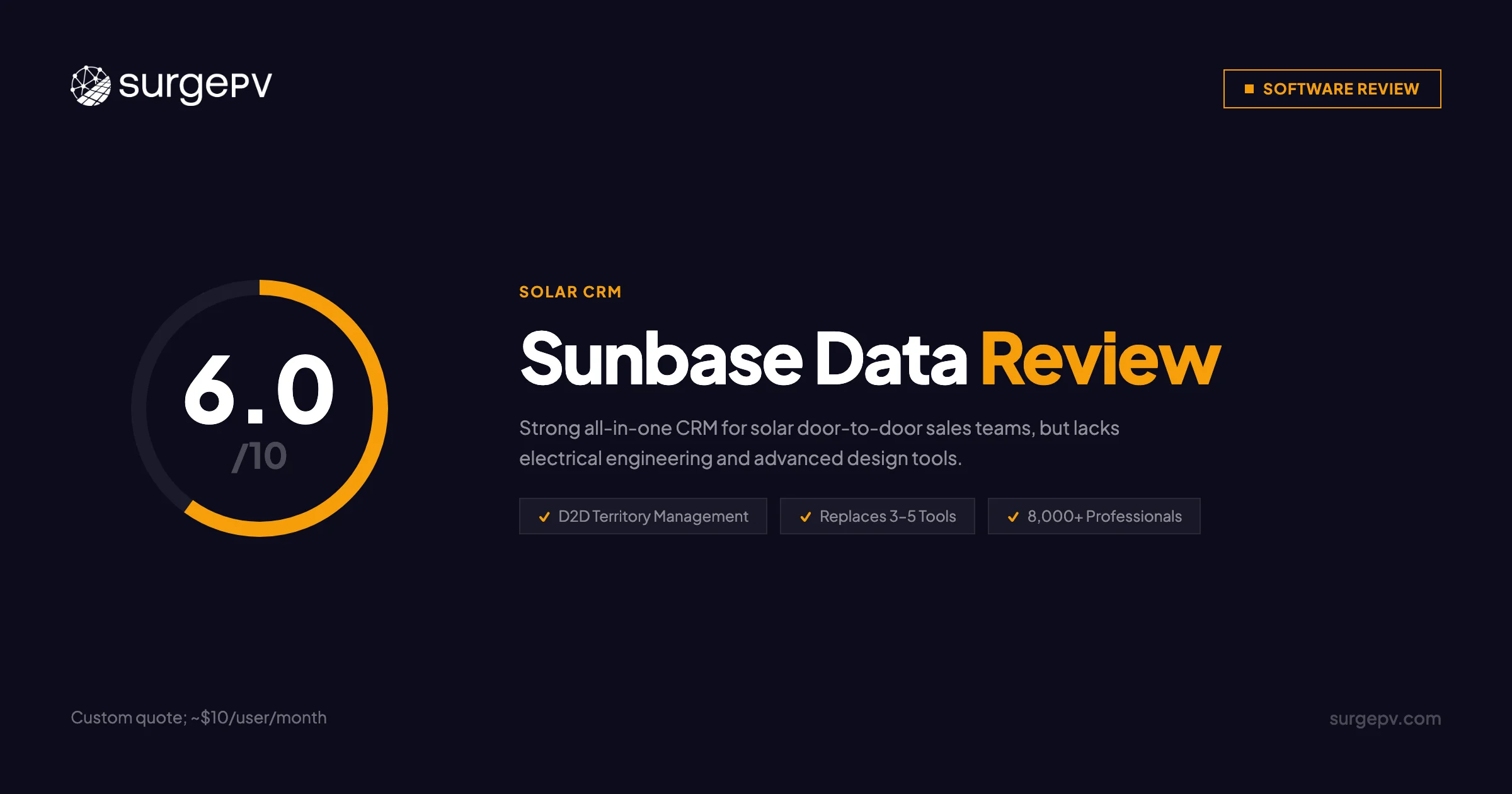
TL;DR: Sunbase Data is an all-in-one solar CRM and field sales platform built for door-to-door and residential teams — not an electrical engineering tool. Pricing requires a custom quote; one customer reported $85K in annual savings from consolidating their tool stack. Reviews are polarized: long-term users praise the platform’s breadth, while others cite a steep technical setup and inconsistent support. For residential solar companies running field sales operations, Sunbase delivers real operational value. For commercial EPCs needing complete electrical documentation — SLDs, wire sizing, NEC compliance — SurgePV — the leading solar design software — handles the full commercial workflow without AutoCAD.
Author: Keyur Rakholiya Title: Contributing Writer, SurgePV | MD & CEO, Heaven Green Energy Limited Expertise: 1+ GW solar projects delivered, 20+ design software platforms tested, 10+ years EPC operations Published: 2026-03-08 Last Updated: 2026-03-08 Review Methodology: Official Sunbase Data documentation, verified user reviews from Capterra, Trustindex, and SourceForge, comparison of published product information against SurgePV
Who This Review Is For
This Sunbase Data review is for:
- Solar companies evaluating an all-in-one CRM + proposal + field sales platform
- Door-to-door solar sales teams needing territory management and GPS tracking
- Small to mid-size installers looking to consolidate 3–5 disconnected tools
- Teams comparing Sunbase vs. Aurora Solar, SurgePV, or OpenSolar
Who should skip this review:
- Commercial EPCs needing electrical engineering tools (SLD, wire sizing, NEC compliance)
- Utility-scale designers — Sunbase is not built for large commercial optimization
- Teams needing advanced shading simulation or bankable P75/P90 metrics
What Is Sunbase Data?
Sunbase Data is a cloud-based business management platform built specifically for solar, roofing, and construction companies. The company was founded in 2013 in Orlando, FL by Jared Dubin (Founder/CTO) and Joshua Dubin (Co-Founder). Lance Vernon serves as CRO. The company is bootstrapped — no external funding — and has grown to 51 employees with 27% year-over-year growth.
Company at a Glance
| Detail | Info |
|---|---|
| Founded | 2013 |
| Headquarters | Orlando, FL |
| Team Size | 51 employees (2025) |
| Revenue | $5.6M (2025, Getlatka) |
| Users | 8,000+ professionals |
| Markets | 10+ countries (US, Canada, India, LATAM, Australia, EU) |
| Funding | Bootstrapped |
Core Value Proposition
Sunbase’s pitch is consolidation: replace 3–5 disconnected tools with a single industry-specific platform. The company targets solar installation companies with 5–500 employees running field sales or door-to-door canvassing operations. Secondary markets include roofing and construction contractors.
One customer — Michigan Solar Solutions — has used the platform for 5+ years. Another reported $85K in annual savings, with $50K attributed to replacing HubSpot. Those are the most concrete proof points available, and they’re worth taking seriously.
What Sunbase Data Is Not
Sunbase is a CRM and business management platform. It is not a technical solar design tool. Aurora Solar acknowledged as more advanced for 3D modeling — a comparison Sunbase itself does not dispute. If your priority is electrical engineering accuracy, bankable simulation data, or commercial structural design, you need a different platform.
Sunbase Data Pricing & License Cost
Sunbase Data Pricing 2026
Sunbase Data does not publish pricing publicly. All plans require contacting the sales team for a custom quote.
| Detail | Info |
|---|---|
| Pricing Model | Custom quote (contact sales) |
| Free Version | None |
| Free Trial | Yes — no credit card required |
| Entry Estimate | Approximately $10/user/month (estimated, per available market data) |
| Contact | (407) 617-6776 / sales@sunbasedata.com |
The lack of public pricing is a real drawback. It means you cannot evaluate cost without entering a sales process. It also makes TCO comparisons approximate.
Total Cost of Ownership
| Workflow | Annual Cost |
|---|---|
| Sunbase Data (estimated entry) | ~$120–$240/user/year |
| Sunbase + AutoCAD (for electrical docs) | ~$2,120–$2,240/user/year |
| SurgePV (all-in-one, electrical included) | From $1,499/user/year |
| Aurora Solar + HubSpot CRM | ~$7,000–$9,000/year |
Hidden Costs to Ask About
Sunbase pricing is opaque. Before signing, ask specifically about: onboarding fees, premium support tiers, per-module add-on costs, and whether integrations (QuickBooks, DocuSign) are included or extra. One user reported $85K in savings — verify what their starting tool stack cost was to contextualize that claim.
Is Sunbase Data Free? Free Trial
Sunbase Data does not offer a free tier or freemium plan. A free trial is available with no credit card required — this is a genuine advantage for teams wanting to evaluate before committing to a sales conversation.
To start a trial, contact Sunbase directly via the website or call (407) 617-6776.
Sunbase Construction CRM Features & Capabilities
1. Solar CRM
The CRM is Sunbase’s strongest module. It is built specifically for solar and construction field operations, not a generic CRM adapted post-sale.
Key CRM capabilities:
- Lead capture, tracking, and pipeline management
- Customizable fields without code (some advanced configurations require technical skills)
- Automated email follow-up sequences
- Integrated telephone dialer
- Task management and appointment scheduling
- Lead source cost analysis — tracks which acquisition channels deliver ROI
The built-in dialer and lead source tracking are genuinely useful for residential solar teams managing high-volume outbound operations.
2. Door-to-Door Sales & Canvassing Tools
This is where Sunbase differentiates most clearly from design-first platforms.
| Feature | Description |
|---|---|
| Territory management | GPS-based area assignment per rep |
| Route optimization | Intelligent knocking route sequencing |
| Timed knocking sessions | Track time spent per session |
| Live manager tracking | Real-time visibility on field rep locations |
| Offline mobile access | Works without internet connection |
| Historical playback | Mileage calculation and route review |
| Commission algorithms | Automated commission calculation |
No other solar design platform in this category offers this depth of door-to-door tooling. For solar companies with field canvassing teams, this is a genuine operational differentiator.
3. Solar Proposal Software
Sunbase generates customized proposals in minutes. Key features:
- Interactive web-based presentations
- White-label branding with company logo and colors
- Multiple financing options (cash, loan, lease, PPA)
- Real-time utility database integration
- DocuSign e-signature integration
- PDF and shareable web link outputs
The proposal engine is solid for residential use. For commercial proposals requiring permit-ready electrical documentation and detailed engineering calculations, you need a different tool. SurgePV’s solar proposal software generates proposals backed by complete electrical engineering outputs.
4. Solar Design Software ⚠️ Basic
Sunbase offers AI-generated 3D design modeling with roof measurements, PV Watts production estimates, and remote site evaluation. However, Sunbase itself acknowledges that Aurora Solar’s 3D modeling is more advanced.
What is available:
- AI-generated roof measurements
- PV Watts production estimates
- Basic pitch, azimuth, and panel direction factors
- Remote site evaluations
What is not available:
- Advanced shading analysis beyond basics
- Bankable P50/P75/P90 production metrics
- SLD generation
- Wire sizing or voltage drop analysis
- NEC Article 690 compliance outputs
- Carport, tracker, or East-West racking design
Design Accuracy Warning
Sunbase does not publish shading accuracy data. For bankable projects requiring financier approval, unquantified production estimates may require independent third-party validation. SurgePV publishes ±3% accuracy vs. PVSyst — the standard financiers and lenders expect.
5. Project Management
Full project tracking from design to installation:
- Task assignments per team member
- Appointment scheduling with calendar sync
- Work orders with permits and photo attachments
- Visual job boards (kanban-style)
- Multi-location support
- No Gantt charts — a gap for complex multi-phase projects
6. Mobile Apps (iOS & Android)
Full-featured apps for iOS (iOS 13.0+) and Android with:
- Offline access — works without internet connection
- GPS tracking and lead capture in the field
- Invoice creation from mobile
- Work orders with photo documentation
- Real-time sync when connectivity returns
The offline capability is important. Field sales teams often work in areas with inconsistent mobile coverage. Sunbase’s offline mode is a practical advantage over web-only platforms.
7. Dashboard & Reporting
- Real-time KPI tracking with customizable dashboards
- Interactive data visualizations with drill-down
- Predictive analytics (AI-powered, added 2025–2026)
- Lead conversion rate tracking
- Proposal turnaround metrics
- Job profitability analysis
8. Additional Modules
Inventory & Asset Management: GPS, RFID, and barcode tracking; automated ordering; maintenance scheduling.
Financial Management: Invoicing, payment tracking, multiple financing options, budget management.
Employee Management: GPS tracking, performance monitoring, time tracking, training programs.
Document Management: Secure cloud storage on Amazon S3, field-accessible document repository.
Sunbase API & Integrations
Native integrations:
- QuickBooks (financial)
- DocuSign (e-signature)
- Email marketing platforms
- Business intelligence tools (Excel, Power BI)
- Website and lead form capture
API: Exists for custom integrations, but documentation is limited and described by Sunbase as “work in progress.” Verify capabilities directly before planning custom integration work.
Pro Tip
If you plan to build a custom integration with Sunbase via their API, get specific documentation and timeline commitments from their team before signing. The API exists but is not yet enterprise-grade in terms of documentation completeness.
Need Complete Electrical Engineering — Not Just CRM?
SurgePV combines solar design, automated SLD generation, wire sizing, and proposals in one platform. No AutoCAD required.
Book a DemoNo commitment required · 20 minutes · Live project walkthrough
User Reviews & Feedback
Sunbase Data has limited presence on G2 and TrustRadius. Most reviews appear on Capterra, Trustindex, and SourceForge. Experiences are highly polarized.
Top Praised Features
| Rank | Feature | Source |
|---|---|---|
| 1 | All-in-one platform value | Capterra, Trustindex |
| 2 | Door-to-door sales tools | Capterra |
| 3 | Customer support (when responsive) | Trustindex |
| 4 | Cost savings vs. tool stack | Verified testimonial ($85K/year) |
| 5 | Customizability | Capterra |
Top Criticisms
| Rank | Issue | Source | Severity |
|---|---|---|---|
| 1 | Complex setup — requires programming skills | Capterra | ⚠️ HIGH |
| 2 | Inconsistent support response times | Multiple sources | ⚠️ HIGH |
| 3 | CRM didn’t work as promised | Individual user (12 months) | ⚠️ HIGH |
| 4 | Simple requests taking months to resolve | Capterra | Medium |
| 5 | No advanced simulation data | Market analysis | Medium |
Direct User Quotes
“By far better than any other CRM…I have tried.” — Trustindex reviewer
“Not simple to set up without computer programming skills.” — Capterra reviewer
“Best support team I’ve ever worked with — tickets resolved in under 3 business days.” — Sunbase customer testimonial
“Simple feature requests took months to resolve.” — Capterra reviewer
The pattern here is clear: users who invest in setup and have technical resources to configure the platform tend to be satisfied long-term. Users who expect a ready-out-of-the-box experience frequently hit friction.
Pros & Cons
✅ Pros
1. Door-to-Door Sales Tooling ⭐ UNIQUE ADVANTAGE
No major solar design platform offers Sunbase’s depth of canvassing and territory management tooling. GPS-based territory assignment, route optimization, live manager tracking, and timed knocking sessions address a specific operational need that Aurora, SurgePV, and OpenSolar do not cover natively.
2. Genuine All-in-One Consolidation
One customer documented $85K in annual savings, with $50K from replacing HubSpot alone. That figure points to real cost consolidation value for companies currently running multiple tools. Eight thousand professionals and 13 years of operation suggests the platform delivers enough to retain customers long-term.
3. Offline Mobile Access
The iOS and Android apps work without internet — a practical requirement for field teams in areas with poor coverage. This is not a common feature among solar software platforms and represents a real operational advantage for field-heavy teams.
4. QuickBooks + DocuSign Out of the Box
Both integrations are included, covering the two most common financial and e-signature workflows for small to mid-size solar companies without additional fees.
5. Free Trial, No Credit Card
A no-friction trial is more useful than a scheduled demo. You can evaluate the platform’s core functionality before entering a sales process.
⚠️ Cons
1. No Electrical Engineering ⚠️ CRITICAL
Sunbase does not generate SLDs, wire sizing calculations, voltage drop analysis, or NEC Article 690 compliant outputs. For any commercial project requiring permit-ready electrical documentation, teams must use AutoCAD or supplemental software — adding $2,000/year and 2–3 hours of manual work per project.
2. Basic Solar Design
Sunbase acknowledges Aurora Solar’s 3D modeling is more advanced. Production estimates rely on PV Watts without advanced simulation options. No bankable P50/P75/P90 metrics. For EPCs presenting to financiers, this is a real limitation.
3. Pricing Opacity
No public pricing means every evaluation requires a sales conversation. For teams comparing multiple platforms, this adds friction and time. It also makes TCO comparisons approximate until you receive an actual quote.
4. Steep Technical Setup
Multiple reviews flag setup complexity. “Not simple without programming skills” is a direct quote from a user. For small teams without dedicated IT, this means either a longer onboarding timeline or underutilizing the platform’s configurability.
5. Inconsistent Support
Support quality ranges from “best I’ve ever experienced” to “months for simple requests.” This variance is the most concerning pattern in the review data. A CRM platform’s reliability matters more than its feature list if the tool is running field operations day-to-day.
6. Incomplete Documentation
Official documentation is acknowledged as “work in progress.” For a 13-year-old bootstrapped company, this is a notable gap. Teams relying on self-service documentation will find it insufficient for complex configuration needs.
Sunbase Construction CRM Reviews: Ratings Summary
Based on available review data across Capterra, Trustindex, and SourceForge:
| Platform | Data Available |
|---|---|
| Capterra | Reviews available; mixed scores |
| Trustindex | Positive testimonials featured |
| SourceForge | Limited coverage |
| G2 | Limited presence |
| TrustRadius | Limited presence |
The limited G2 and TrustRadius presence is itself a data point. Platforms with strong enterprise adoption tend to have substantial G2 review volume. Sunbase’s limited presence there reflects its primary SMB and residential installer audience.
Sunbase Data vs SurgePV
Both platforms serve solar companies, but they address different needs. Sunbase is a CRM-first field operations platform. SurgePV is an engineering-first design and electrical documentation platform.
Feature Comparison
| Feature | Sunbase Data | SurgePV | Winner |
|---|---|---|---|
| Solar CRM | Native, full-featured | Integrates with existing CRM | Sunbase |
| Door-to-door sales tools | GPS, routes, live tracking | Not available | Sunbase |
| Solar design (3D) | Basic (PV Watts) | Advanced AI-powered | SurgePV |
| SLD generation | No | Yes — 5–10 min automated | SurgePV |
| Wire sizing | No | Yes — automated | SurgePV |
| Voltage drop analysis | No | Yes | SurgePV |
| NEC 690 compliance | No | Yes | SurgePV |
| Carport design | No | Yes (only platform) | SurgePV |
| Tracker design | No | Yes | SurgePV |
| Bankable P50/P75/P90 | No | Yes | SurgePV |
| Shading accuracy | Not disclosed | ±3% vs PVSyst | SurgePV |
| Proposal generation | Yes | Yes | Tie |
| Mobile offline access | Yes (iOS + Android) | Limited | Sunbase |
| Project management | Full PM module | Focused on design workflow | Sunbase |
| Public pricing | No | Yes | SurgePV |
| Free trial | Yes | Demo-based | Sunbase |
Workflow Time: 100 kW Commercial Project
| Step | Sunbase Data Stack | SurgePV |
|---|---|---|
| Roof design | 30 min (basic) | 20 min (AI-powered) |
| Shading simulation | Limited — no advanced analysis | Included |
| SLD generation | 2–3 hours (AutoCAD, manual) | 5–10 min (automated) |
| Proposal generation | 20–30 min | 15–20 min |
| Total | 3–4 hours | 45–60 min |
| External tools needed | AutoCAD (licensed separately by Autodesk) | None |
Annual Cost Comparison
| Scenario | Annual Cost |
|---|---|
| Sunbase Data (estimated) | Custom quote (~$120–$240/user/year) |
| Sunbase + AutoCAD (commercial work) | ~$2,120–$2,240/user/year |
| SurgePV (all-in-one, 3 users) | From $1,499/user/year |
| Aurora Solar + HubSpot | ~$7,000–$9,000/year |
The cost comparison is harder to make precisely because Sunbase doesn’t publish pricing. But the structural conclusion holds: if you need electrical engineering, adding AutoCAD to Sunbase erases the pricing advantage.
Sunbase Data Alternatives
Aurora Solar — The benchmark for advanced 3D solar design and residential proposal workflows. Better design accuracy than Sunbase; lacks native CRM and door-to-door tools. Best for residential installers prioritizing design quality. See the Aurora Solar review for detail.
Arka360 — Built-in CRM similar to Sunbase, with stronger solar design capabilities and transparent pricing. Stronger India market support. Best for India-focused or dual-market (India + US) installers wanting design + CRM without separate tools. See the Arka360 review for comparison.
OpenSolar — Free cloud-based platform covering basic design and proposals. No CRM, no electrical engineering, no door-to-door tools. Best for price-constrained teams with simple residential workflows. Limited scalability for growing operations.
SurgePV — Engineering-first platform covering advanced solar design, automated SLD generation, wire sizing, voltage drop, and NEC compliance in one tool. Integrates with existing CRMs rather than replacing them. Best for commercial EPCs and teams needing complete electrical documentation without AutoCAD. See PV design software overview.
HelioScope — Strong technical simulation tool with bankable production metrics. No CRM, limited proposal tools. Best for engineers needing simulation depth; pairs with a separate CRM. See the HelioScope review for detail.
HubSpot + Aurora Solar combo — What Sunbase positions itself against. Aurora for design, HubSpot for CRM. The Sunbase value proposition is replacing this stack with one tool. Valid trade-off for teams wanting consolidation; costs more and requires managing two platforms separately.
Who Should Use Sunbase Data?
Best Fit for Sunbase Data
1. Door-to-Door Solar Sales Companies If your primary acquisition model is field canvassing, Sunbase is the strongest purpose-built option available. The GPS territory management, route optimization, live rep tracking, and commission algorithms address real operational problems that generic CRMs and solar design platforms ignore.
2. Small to Mid-Size Installers Consolidating Tools Teams currently paying for separate CRM (HubSpot, Salesforce), proposal software, project management, and scheduling tools. The $85K savings testimonial represents a real consolidation scenario. If your tool stack is fragmented and expensive, Sunbase’s all-in-one model warrants a serious evaluation.
3. Residential-Focused Operations Companies where 80%+ of projects are residential rooftop. Sunbase’s solar design limitations matter less at residential scale, where PV Watts estimates and basic 3D models are often sufficient. Complex electrical documentation is a much smaller part of the workflow.
4. Teams with Technical Resources for Setup Companies that have a dedicated ops or IT person to configure the platform. Sunbase is highly customizable — but that customizability requires technical skill to access. Teams willing to invest 4–6 weeks in proper setup tend to extract much more value than teams expecting an out-of-the-box ready tool.
Who Should Choose SurgePV Instead
Commercial EPCs (100 kW+) Any project requiring SLD generation, wire sizing, voltage drop calculations, or NEC Article 690 compliance needs a platform built for electrical engineering. Sunbase cannot produce these outputs. At scale, adding AutoCAD to Sunbase costs $2,000/year and 2–3 hours per project in manual work.
Teams Designing Commercial Structures Carport solar, solar trackers, or East-West racking. Sunbase does not support these project types. SurgePV’s solar designing handles all commercial structure types natively.
Teams Needing Bankable Simulation Data P50/P75/P90 production metrics for project finance or lender requirements. Sunbase relies on PV Watts estimates without the simulation depth that financiers expect on projects above $500K.
Operations with Existing CRM Systems If you already have Salesforce, HubSpot, or Zoho running your pipeline, paying for Sunbase’s built-in CRM duplicates a cost you’ve already paid. SurgePV integrates with your existing CRM rather than replacing it.
Frequently Asked Questions
What is Sunbase Data used for?
Sunbase Data is used by solar, roofing, and construction companies to manage CRM, proposals, project tracking, and door-to-door field sales in a single platform. It is not primarily a technical solar design or electrical engineering tool — it is a business operations platform built around field sales workflows.
Is Sunbase Data good for commercial solar?
Limited. Sunbase is better suited for residential and light commercial projects under 100 kW. Commercial EPCs needing electrical documentation — SLDs, wire sizing, NEC compliance outputs — must use supplemental software like AutoCAD alongside Sunbase, adding significant cost and manual work.
What makes Sunbase Data different from Aurora Solar?
Sunbase focuses on CRM, business operations, and door-to-door sales. Aurora Solar focuses on advanced 3D solar design and residential proposals. Sunbase itself acknowledges Aurora’s design modeling is more advanced. For a complete comparison see the Aurora Solar review.
Does Sunbase Data work internationally?
Sunbase operates in 10+ countries including the US, Canada, India, LATAM, Australia, and EU markets. India localization with multilingual support is being added in 2026. Geographic coverage is broader than some competitors, but the US remains the primary market focus.
Can I import my existing data into Sunbase Data?
Yes. Sunbase provides CSV importers for data migration during onboarding. The company also offers concierge onboarding support. The quality of the migration experience depends on the complexity of your existing data structure.
How long does it take to set up Sunbase Data?
Sunbase requires a meaningful setup investment. Multiple reviews flag that configuration requires technical skills. Expect 4–6 weeks minimum for a team of 10+ to complete setup, training, and workflow configuration. Teams without technical resources will need to rely on Sunbase’s onboarding support.
Does Sunbase Data generate electrical documentation for permits?
No. Sunbase does not generate SLDs, wire sizing calculations, or permit-ready electrical documentation. For permits requiring electrical drawings, teams need to use AutoCAD or another electrical design tool in addition to Sunbase.
Final Verdict
Sunbase Data Executive Summary
Strengths:
- Native CRM built for solar field operations
- Unmatched door-to-door sales tooling in the category
- Genuine all-in-one value at the right scale
- Offline mobile apps for field teams
- 13 years in business, 8,000+ users, bootstrapped profitability
Limitations:
- No electrical engineering (no SLD, wire sizing, NEC compliance)
- Basic solar design — acknowledged weaker than Aurora
- Pricing opacity adds friction to the evaluation process
- Steep technical setup curve
- Inconsistent support experiences
- Incomplete documentation
The Decision Framework
Choose Sunbase Data when:
- Field canvassing is your primary sales model
- You’re consolidating 3–5 disparate tools into one platform
- 80%+ residential project mix, light commercial at most
- You have technical resources to configure the platform properly
- You want to replace a HubSpot + Aurora combo with something solar-specific
Choose SurgePV when:
- You design commercial projects requiring permit-ready electrical documentation
- You need SLD generation, wire sizing, or NEC Article 690 compliance outputs
- You’re designing carports, trackers, or East-West racking
- You have an existing CRM and need engineering software — not another CRM
- You need bankable P50/P75/P90 production metrics for project finance
Value Analysis
Sunbase Data delivers real value to its target customer: a residential solar company with door-to-door sales reps, a growing project pipeline, and too many disconnected tools. The $85K savings testimonial is credible — those savings come from real consolidation of CRM, project management, and field sales tools into one system.
Where the value proposition breaks down is at the edges: technical setup complexity makes it inaccessible to non-technical teams, and the absence of electrical engineering makes it unsuitable for commercial EPCs. The pricing opacity compounds both issues by making comparison shopping harder.
Annual TCO comparison:
| Option | Software | AutoCAD | Onboarding Est. | Total |
|---|---|---|---|---|
| Sunbase Data (residential) | Custom (~$240/user) | $0 | Included | ~$240/user/year |
| Sunbase + AutoCAD (commercial) | Custom (~$240/user) | $2,000 | Included | ~$2,240/user/year |
| SurgePV all-in-one (commercial) | From $1,499/user | $0 | Included | From $1,499/user/year |
For residential teams with field sales ops, Sunbase is worth evaluating seriously. For commercial EPCs, SurgePV’s generation and financial tool plus complete electrical outputs remove the need for AutoCAD entirely.
Take the Next Step
See how SurgePV’s complete electrical engineering compares to Sunbase Data for your project types.
- Book a demo — see SurgePV handling a commercial project from design to SLD in one tool
- Compare platforms — detailed comparisons across the solar software category
- SurgePV pricing — transparent, public pricing with no “contact sales” required
- PV proposal software — see how proposals connect to electrical documentation
Switching from Sunbase? SurgePV provides dedicated onboarding support and integrates with your existing CRM — so you keep your pipeline data and replace only the tools that aren’t working.
Related Resources
Platform Comparisons:
- Arka360 Review — detailed comparison with another CRM-first solar platform
- Aurora Solar Review — advanced design capabilities vs. Sunbase’s basic modeling
Feature Deep Dives:
- Solar Designing — complete solar design tools capabilities overview
- Solar Proposals — proposal generation connected to engineering
- Shadow Analysis — shading analysis vs. Sunbase’s basic PV Watts estimates
- Solar yield and financial analysis — bankable production and ROI modeling
Best Solar Software Rankings:
- See our best solar CRM software rankings.
Educational Resources:
- Best Solar Software — complete platform comparison guide
- Solar Installers — software guide for installation companies
- Commercial Solar — commercial project software requirements
This Sunbase Data review was written by Keyur Rakholiya, Contributing Writer at SurgePV and MD & CEO of Heaven Green Energy Limited, using the cited public sources. All Sunbase Data information is sourced from official Sunbase Data documentation (sunbasedata.com), verified user reviews on Capterra, Trustindex, and SourceForge, and Crunchbase/Getlatka company data. We disclose that SurgePV publishes this review and disclose our company affiliation transparently.
Review last updated: 2026-03-08 | Next review: June 2026
About the Contributors

Co-Founder · SurgePV
Nirav Dhanani is identified by SurgePV as a company co-founder. His SurgePV author page lists only role information that can be tied to the public profile below; credentials, project totals, conversion results, and market-expansion claims are not asserted without retained evidence.

Editorial contributor · SurgePV
Rainer Neumann is credited as an editorial contributor on SurgePV content. This profile does not assert engineering credentials, project totals, software-testing experience, education, speaking engagements, or media citations because independent verification evidence is not retained in the publication record.
