


This page is for installers and EPC teams in Portugal choosing solar design and proposal software. Short answer: for studies with sub-hourly weather data and a Portuguese screen, pick PVsyst; for 3D design, a circuit diagram and a quotation presentation in Portuguese, pick PV*SOL premium.
Do you design self-consumption systems in Portugal? Portuguese rules call them UPAC, short for Unidade de Produção para Autoconsumo. A UPAC is a system that makes renewable electricity for use on your own premises. The rules count energy in 15-minute periods. PVsyst documents sub-hourly weather import and simulation. PVsyst and PV*SOL both list Portuguese as a program language. HelioScope lists a single line diagram (SLD, a simple drawing of how the system is wired) on every plan. OpenSolar’s core app is free and lists Portuguese among its proposal languages, but the vendor charges for API Access and connectors from 16 April 2026. Aurora Solar documents an SLD editor for Europe. SurgePV lists roof modeling, shading, yield, financial modeling, bill of materials and proposals in one product, priced per user. None of the vendor pages we read describe the Portuguese self-consumption rules, so confirm that before you buy.
This is a desk comparison of what each vendor publishes, checked October 2026. We have not run side-by-side tests. Tool facts come from each vendor’s own site. Local rules come from DGEG (the energy and geology directorate), ERSE (the energy services regulator) and E-REDES (E-REDES - Distribuição de Eletricidade, S.A.), linked below. This page covers software in general. For other lists, see solar design software in Portugal and solar proposal software in Portugal.
Criteria used: 15-minute self-consumption and surplus modeling, Portuguese language, tariff and euro set-up, size range against the 30 kW and 1 MW bands, diagram output.
Want to see SurgePV on a Portugal project?
Book a guided demo and bring a real Portugal site. We walk through design, yield, finance and the proposal in one platform.
Book a Free DemoChecking cost first? See the SurgePV pricing page.
Best-For Picks for Portugal
- Studies with sub-hourly weather data and a Portuguese screen: PVsyst. Its product page lists sub-hourly simulation and Portuguese among 12 program languages. It runs only under Windows and does not make proposals.
- 3D design, a circuit diagram and a quotation presentation in Portuguese: PV*SOL premium. Its product page lists a Portuguese program and a feed-in tariff database. It also lists an automatic circuit diagram and a customer presentation for quotations. Of the pages we read, it is the only one with a euro price, shown plus VAT.
- Single line diagram on every plan, with room for systems above 1 MW: HelioScope. Its pricing page lists single-line diagrams on all plans. Basic designs up to 1.25 MW (DC), and Pro up to 5 MW.
- A free core app with Portuguese proposals: OpenSolar. The core app is free. Its help article lists Portuguese among 13 languages. You must translate the proposal template by hand.
- Roof model to bill of materials and proposal in one product, priced per user: SurgePV. It lists roof modeling, shading, yield and financial modeling. It also lists bill of materials (BOM, the parts list) and proposals. Ask in a demo for Portuguese outputs and tariff set-up. Its pricing page and published scope do not state them.
Portugal Solar Software Comparison Table
Listed alphabetically. This is not a ranking; pick by the situation above. Prices checked October 2026 on each vendor’s own page. Each price keeps the currency the vendor shows.
| Tool | Best for | Price | Free or paid | Decisive scope fact |
|---|---|---|---|---|
| Aurora Solar | Residential design and web proposals | $159 per user per month, or $135 per user per month billed annually (Basic); no euro price | Paid | SLD editor “only available in Europe”; energy estimates are P50 |
| HelioScope | Commercial rooftops with SLD on every plan | $159 USD per license per month, or $1,620 USD per license per year (Basic); no euro price | Paid; 14-day free trial per help center | Basic designs up to 1.25 MW (DC); Pro 5 MW; Enterprise 30 MW |
| OpenSolar | Free core app, Portuguese proposal option | Core app free; API Access and connectors charged from 16 April 2026 | Free core app, paid API and connectors | Recommends 3D designs under 500 kW; users have modeled up to 5 MW |
| PV*SOL premium | 3D design, circuit diagram, Portuguese program | EUR 845.00 plus VAT per year (named user) | Paid; free trial version | Windows 10 or 11 (64 bit); 3D up to 7,500 mounted or 10,000 roof-parallel modules |
| PVsyst | Sub-hourly yield study, Portuguese program | CHF 700 per year (PVsyst 8 Professional); no euro price | Paid; one-month free trial per product page | Runs only under Windows; no proposal output stated |
| SurgePV | Roof model to BOM and proposal, per seat | $1,899 per user per year (1 user); no euro price published | Paid, guided demo | BOM and proposal generation in scope; no Portuguese output stated |
Portugal Criteria Matrix
Cells read Documented when the vendor’s own pages state it. They read Partial when the pages state only part of it or state it for other countries. They read Not stated when the pages we read in October 2026 do not mention it. There are no scores or weights.
| Tool | 15-minute self-consumption and surplus | Portuguese language | Tariff and euro set-up | Size range | Diagram output |
|---|---|---|---|---|---|
| Aurora Solar | Partial (help article “Hourly Production Data Export”; 15-minute balance not stated) | Not stated (site menu lists Europe in English, plus Germany, Spain, France and the UK) | Partial (custom utility rates; prices shown with “$”; euro not named) | Not stated | Documented (SLD editor “only available in Europe”) |
| HelioScope | Partial (“8760 production report”; 15-minute balance not stated) | Partial (report languages include Portuguese; program language not stated) | Partial (Utility Rate Editor on Pro; default currency “USD, EUR, etc.”) | Documented (1.25 MW, 5 MW, 30 MW DC) | Documented (all plans) |
| OpenSolar | Partial (PVWatts v6 at hourly resolution; 15-minute balance not stated) | Partial (Portuguese among 13 proposal languages; template translated by hand) | Partial (custom tariff with Country field and compensation mechanism; euro not stated) | Partial (3D under 500 kW recommended) | Partial (templates for AU, NZ, US, CA, UK, FR, DE, IT, ES and IN; Portugal not listed) |
| PV*SOL premium | Not stated | Documented (program available in Portuguese; reports in 24 languages) | Partial (feed-in tariff database; 20-year financial analysis; Portuguese tariffs not named) | Documented (3D up to 7,500 mounted or 10,000 roof-parallel modules) | Documented (automatic circuit diagram) |
| PVsyst | Partial (sub-hourly weather import and simulation; Portuguese rules not stated) | Documented (program available in Portuguese) | Documented (feed-in tariff and self-consumption economics; euro not read) | Not stated | Partial (editor “still work in progress”; no storage) |
| SurgePV | Not stated | Not stated | Partial (financial modeling; no Portuguese tariff stated) | Not stated | Partial (electrical workflow support; no diagram output named) |
Two things stand out. No vendor page we read states the 15-minute balance that Portuguese rules use. The tools differ most on language, on euro pricing and on where each one stops on project size. A tool that is Not stated on a row may still do it, so ask for it in a demo.
Tool Entries
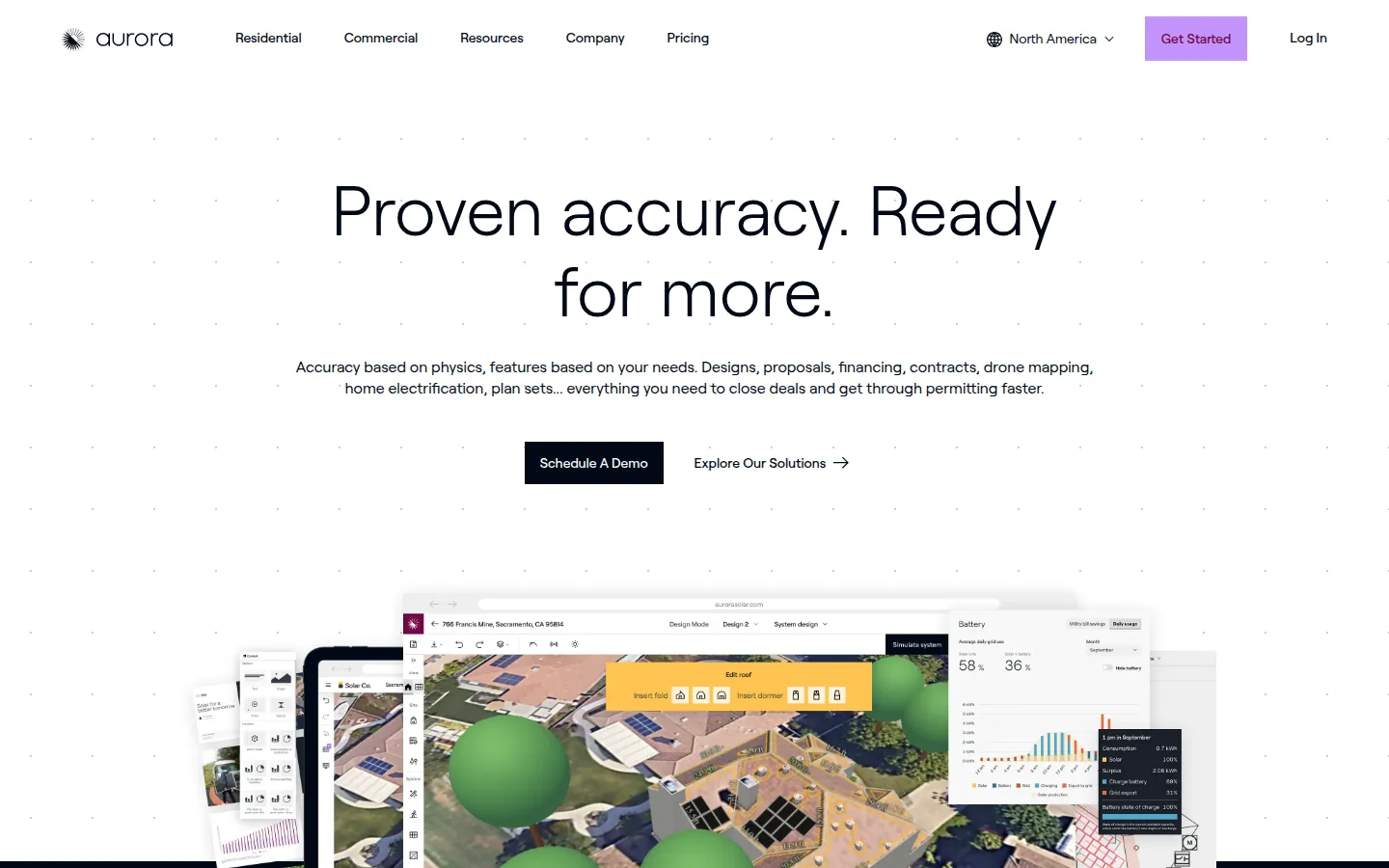
Aurora Solar
Best for: residential installers that want 3D roof modeling and web and PDF proposals with financing options. Aurora’s pricing page says Basic gives “all the essential tools for residential design and sales”.
Not the right choice if: you need a euro price or a Portuguese screen. The pricing page shows “$” and the pages we read do not list Portuguese. It is also not right if you need P90 values for lenders. Aurora’s help article says it “does not natively output P90 for solar energy production”.
What the vendor documents: the pricing page feature list names 3D roof modeling and trees, automated panel placement and stringing, and web and PDF proposals. It names integrated and custom financing and a utility rate database, “Custom and integrated”. The plan summary says Premium adds LIDAR-assisted modeling, bankable shade reports and battery storage modeling. A help article describes a single line diagram editor and says it is “only available in Europe”. Aurora’s European site says projects were designed in more than 150 countries.
Price (checked October 2026): the page for North America shows “$” with no currency named. Basic is $159 per user per month, or $135 per user per month billed annually ($1,620 per year). Premium is $259 per user per month, or $220 per user per month billed annually ($2,640 per year). Basic and Premium list 1 user and 50 projects per month. Enterprise is custom pricing. No euro price is published.
Limitations: energy estimates are P50 values from typical-year weather data, per a help article. The pages we read do not describe Portuguese tariffs or the 15-minute balance.
Vendor link: aurorasolar.com
HelioScope
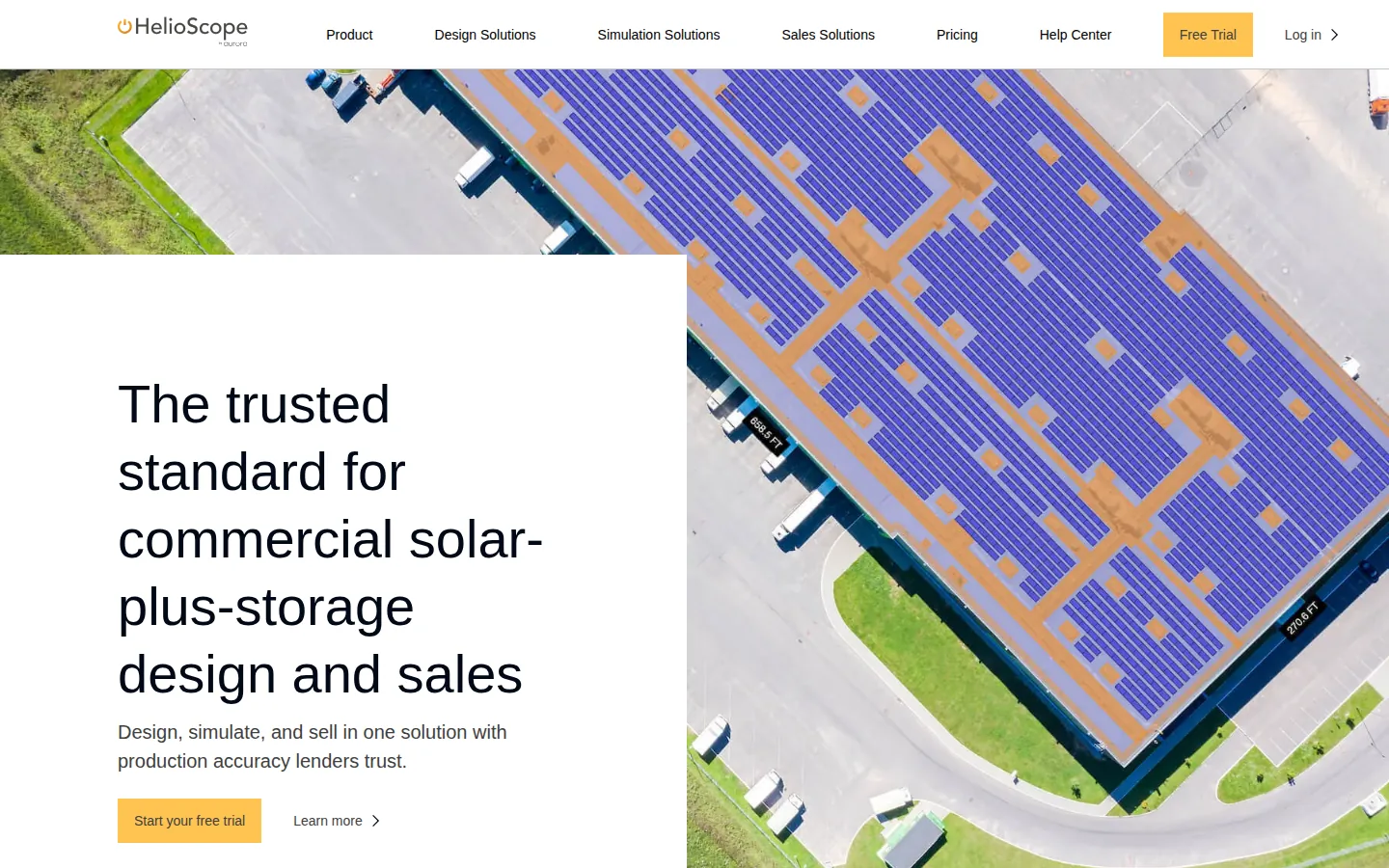
Best for: commercial rooftop and carport designers who want a single line diagram and CAD export on every plan. The design ceiling is 1.25 MW (DC) on Basic.
Not the right choice if: you need a euro price list. The pricing page shows US dollars. It is also not right if you want a free tool or financial tools on the entry plan. Those start at Pro. HelioScope is an Aurora Inc. company, per its footer, but has its own pricing.
What the vendor documents: on its pricing page, all plans list rooftop, carport and ground-mount layout and storage design. They also list CAD export, single-line diagrams, an 8760 production report, shade reports and “Global weather coverage”. Pro adds a Utility Rate Editor, financial analysis tools, customizable reports and sales proposals, and P90, P95 and P99 values. Enterprise adds single-axis trackers and export to PVsyst. A help article lists report languages: Spanish, German, Dutch, Portuguese, Turkish and American English. The account settings article lets you set a default currency for financial data (“USD, EUR, etc.”).
Price (checked October 2026): Basic $159 USD per license per month, or $1,620 USD per license per year. Pro $259 USD per month, or $2,640 USD per year. Enterprise is custom per project. A license includes 1 user on Basic and Pro. The help center documents a 14-day free trial, one per customer. No euro price is published.
Limitations: Basic designs up to 1.25 MW (DC), Pro 5 MW and Enterprise 30 MW. The pages we read do not describe Portuguese tariffs or the 15-minute balance.
Vendor link: helioscope.aurorasolar.com
OpenSolar
Best for: small teams that want a core app the vendor describes as free and a Portuguese proposal option.
Not the right choice if: your approving engineer expects a single line diagram from a template for Portugal. OpenSolar’s help article lists templates for AU, NZ, US, CA, UK, FR, DE, IT, ES and IN. It is also not right if you want a ready-made Portuguese proposal. The proposal language article says you need a template that has been translated by hand.
What the vendor documents: a custom tariff with a Country field and flat, time-of-use, tiered and demand rates. The tariff also has a compensation mechanism. It can be net billing, net billing with credit carryover, buy all sell all, or net energy metering. OpenSolar recommends sending the customer’s bill to its support team to build the tariff. Output uses PVWatts version 6 at hourly resolution or the System Advisor Model with 3D shading, per its help article.
Price (checked October 2026): the core app is free of charge for solar professionals, per the vendor (free page). From 16 April 2026 the vendor charges for API Access, a per-project fee. It also charges for supported connectors, a flat monthly subscription. Source: its 16 February 2026 post and its API page. We did not compare those fees. Optional paid Enterprise Services: Support US$500 per month, Customize US$1,350 per month, Enterprise custom.
Limitations: its commercial design article recommends keeping 3D designs under 500 kW. It also says users have modeled systems up to 5 MW by simplifying settings. The pages we read do not mention Portugal.
Vendor link: opensolar.com
PV*SOL premium
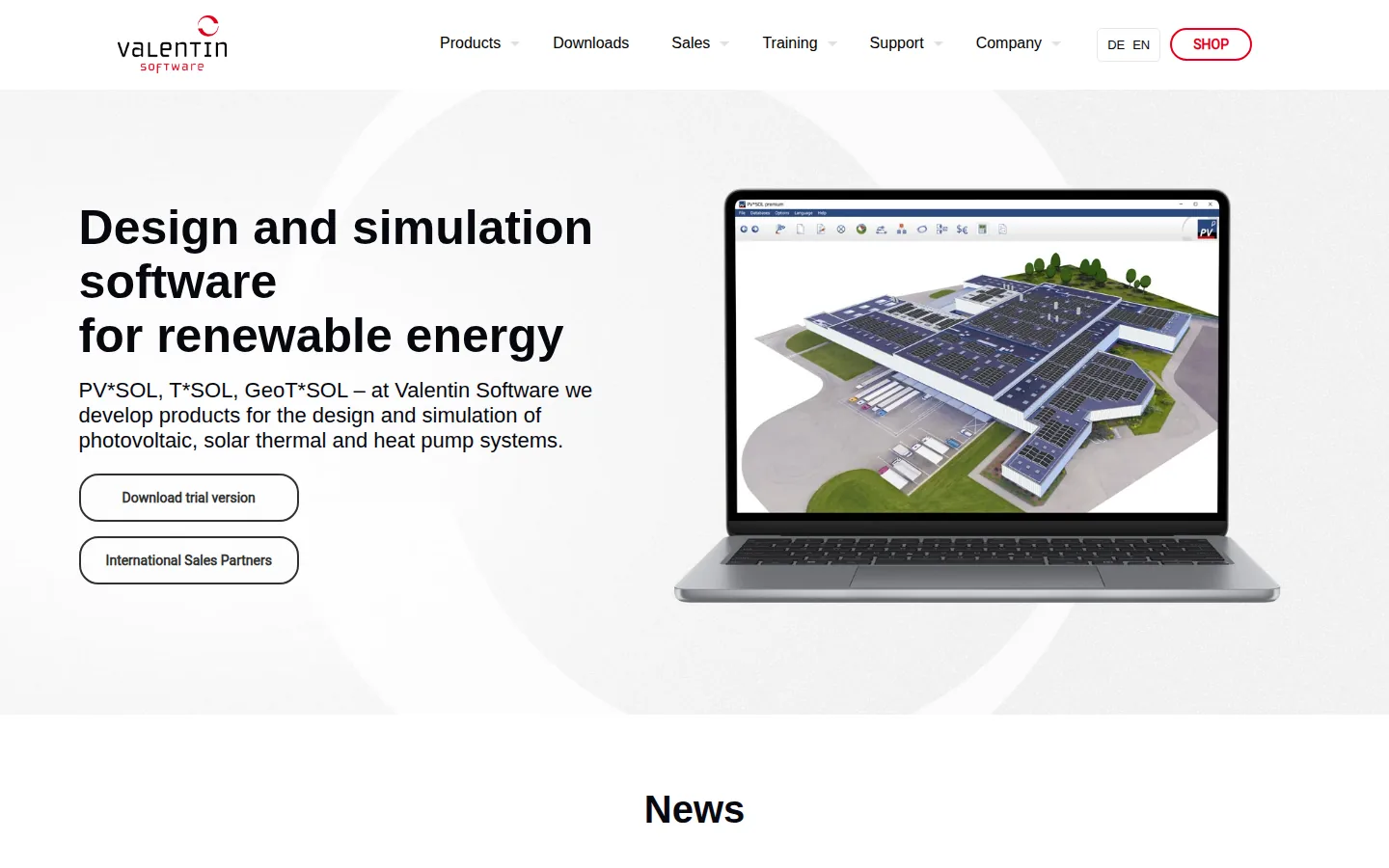
Best for: installers and planners who want 3D design with shading, an automatic circuit diagram and a customer presentation. The program is available in Portuguese.
Not the right choice if: you work on a Mac or in a browser. The system requirements list Windows 10 or 11 (64 bit) and an internet connection. It is also not right if you need a price without VAT, or a monthly plan. The shop sells a one-year named-user license.
What the vendor documents: 3D visualization with shading analysis, up to 7,500 mounted modules or 10,000 roof-parallel modules. It lists an automatically generated circuit diagram with safety devices. It lists a database of current feed-in tariffs and a 20-year financial analysis. It lists weather data from Meteonorm 9, PVGIS, Solcast and SolarAnywhere. It also lists a customer presentation for quotations. The program is available in German, English, Spanish, French, Italian, Polish, Czech, Portuguese and Turkish. Project reports are available in 24 languages.
Price (checked October 2026): EUR 845.00 plus VAT for a one-year named-user license. One user can use it on any number of devices, but not at the same time. The vendor offers a free trial version.
Limitations: the pages we read do not name Portuguese tariffs, a 15-minute balance or a design size limit beyond the module counts above.
Vendor link: valentin-software.com
PVsyst
Best for: yield studies where you want weather data from a choice of providers, sub-hourly data, or a Portuguese program screen.
Not the right choice if: you need proposals, bills of materials or a roof model from the same tool. It is also not right if you work on a Mac or in a browser. The requirements page says it runs only under Windows.
What the vendor documents: on its product page, sub-hourly simulation with data from Meteonorm 9 or import tools. It lists weather data from Meteonorm 9, NASA-Power, PVGIS, Solcast and others. It lists 12 program languages including Portuguese. It has an economic evaluation with feed-in tariff and self-consumption pages. It also has a single line diagram editor.
Price (checked October 2026): CHF 700 per year for PVsyst 8 Professional. Discounts are 5% off for 2 to 4 licenses, 15% for 5 to 9 and 20% for 10 or more. No euro price is published (CHF). The product page lists a one-month free trial.
Limitations: the single line diagram feature is described as “still work in progress”. It covers strings, inverters and transformers, and does not include storage. The vendor pages we read do not say whether a simulation can match the Portuguese 15-minute balance.
Vendor link: pvsyst.com
SurgePV
SurgePV is our product.
Best for: teams that want roof modeling, array layout, shading analysis and energy-yield modeling. They also want financial modeling, electrical workflow support, bill-of-materials output and proposal generation in one product, priced per user. They should confirm the Portuguese outputs in a demo. See solar design software for the product page.
Not the right choice if: you want a self-serve trial (SurgePV offers a guided demo). It is also not for you if you need a euro price in writing before talking to sales. The pricing page lists US dollars per user per year. It is also not for you if you need a Portuguese program screen or a Portuguese tariff set-up that the vendor states. SurgePV’s published scope does not state them. Outputs support design and documentation but do not replace approval by the responsible engineer, authority, lender or utility. SurgePV’s published product scope does not list a CRM. Monitoring and ERP are outside its scope.
What the vendor documents: 3D roof modeling, array layout, shading analysis, energy-yield modeling, financial modeling, electrical workflow support, bill-of-materials output and proposal generation.
Price (checked October 2026): in US dollars, $1,899 per user per year for 1 user. It is $1,499 per user for 3 seats and $1,299 per user for 5 seats. Confirm any euro amount and taxes in a written quote.
Limitations: results depend on source data, assumptions and equipment models. The pricing page and published scope do not state a Portuguese drawing format, a 15-minute balance, or a design size limit.
Vendor link: surgepv.com.
Portugal Rules That Shape the Choice
Which law applies. DGEG says UPAC production is regulated by Decreto-Lei 15/2022 of 14 January. ERSE says in its Self-Consumption Regulation (Regulation 2/2023) that this law incorporated and repealed the earlier regime of Decreto-Lei 162/2019. Older pages, including earlier versions of this one, cite the 2019 law.
Registration depends on size. E-REDES lists the bands in its self-consumption FAQ. A UPAC up to 30 kW needs a prior notification. E-REDES also lists an exemption for very small systems that do not inject surplus. A UPAC above 30 kW and up to 1 MW needs prior registration and an operating certificate. A UPAC above 1 MW needs a production and operating license. DGEG’s registration page splits the portal steps at 30 kW. Systems up to 30 kW use “Nova MCP” (prior notification). Systems above 30 kW use “Nova UPAC” (registration).
The process. E-REDES says you register on the DGEG portal first. You need the point of delivery code and the tax number (NIF) from your electricity contract. E-REDES then checks if your request is feasible. It checks the meter and replaces it at no cost if needed. Above 4 kW, a totalizing meter measures what you inject. Above 30 kW, the installation must be certified by DGEG after an inspection by DGEG or another accredited body. A technician in charge handles the request, and DGEG publishes a list of accredited technicians (E-REDES guide).
15-minute balance. ERSE’s regulation defines the energy balance as the difference between consumption and injection in each 15-minute period. It also counts shared energy in 15-minute periods. E-REDES calls this the fourth-hour balance. It means that what you make in a 15-minute period must be used in that period. What you do not use goes to the grid.
What happens to surplus. E-REDES says you can store surplus in batteries or inject it into the public grid (RESP). You can also sell it to a retailer.
Protection above 250 kW. E-REDES says self-consumption installations with a connection power above 250 kW cannot skip the interconnection and earth-fault protection.
Tariffs and charges. ERSE sets the grid tariffs. Its tariffs page is the place to start. DGEG’s legal framework page also lists Despacho 1177/2024. It sets the conditions for an exemption from certain charges (CIEG) on self-consumption carried through the public grid.
Incentives. The Fundo Ambiental (Environmental Fund) Vale Eficiência second phase lists solar PV for self-consumption as an eligible measure for economically vulnerable households. Each voucher is EUR 1,300 plus VAT. The program page mentions vouchers “until 2025”, so confirm whether a call is open.
Language and currency. DGEG’s pages are in Portuguese. E-REDES has pages in Portuguese and English. Of the vendor pages we read, only PV*SOL shows a euro price.
Regulator pointers. DGEG (dgeg.gov.pt) describes itself as a central state body that defines, carries out and evaluates public policy on energy and geological resources. ERSE (erse.pt) issued the Self-Consumption Regulation. E-REDES (e-redes.pt, legal name E-REDES - Distribuição de Eletricidade, S.A.) handles the grid steps for your connection, such as the feasibility check and the meter.
How We Ordered These Tools
SurgePV publishes this page and is a vendor on this list. Its entry uses the same vendor-page sources and template as every other tool here.
We did not rank these tools. They are listed alphabetically, and the best-for picks come from the matrix above.
- 15-minute self-consumption and surplus: the Portuguese rules balance energy every 15 minutes. We did not assess whether any tool’s calculation matches the rules.
- Portuguese language: a Portuguese customer or technician reads the output. We did not assess translation quality.
- Tariff and euro set-up: the tariff changes the savings a customer sees. We did not assess whether any tariff data is current.
- Size range: the 30 kW and 1 MW bands change the registration steps, so a tool’s ceiling matters. We did not assess speed on large designs.
- Diagram output: installers often ask for a diagram. The pages we read name no Portuguese rule that requires a particular diagram format. We did not assess whether any tool’s diagram is accepted.
Not Compared Here
Other tools appear on the global solar design software list and the global proposal software list, but we did not read their pages for Portugal. We do not say which Portuguese banks accept which tool’s reports. The pages we read do not state it. Nearby country lists: Spain and Italy.
Sources and Dates
Vendor pages were read in October 2026. Aurora Solar (pricing, European site). HelioScope (pricing). OpenSolar (pricing post, 16 February 2026 and the help center articles linked above). PV*SOL (product page, shop). PVsyst (shop and the pages linked above). SurgePV (pricing). Local rules come from DGEG, ERSE, E-REDES and the Fundo Ambiental pages linked above. We read the rules from these pages and from ERSE’s regulation. We did not read the text of Decreto-Lei 15/2022 itself. Check the law for exact thresholds before you file.
See SurgePV on your Portugal project
Book a guided demo and ask for the Portuguese outputs you need.
Book a Free DemoMore Solar Software Guides to Compare
- Solar design software in Portugal, for design tools
- Solar proposal software in Portugal, for quotation tools
- Solar software in Spain and Italy, the nearest country lists
- Best solar design software, all markets
Frequently Asked Questions
What is the best solar software in Portugal?
It depends on the job. Here is what the vendors publish. PVsyst documents sub-hourly simulation and lists Portuguese among its program languages. PV*SOL premium lists a Portuguese program, an automatic circuit diagram and a euro price. HelioScope lists a single line diagram (SLD, a simple drawing of how the system is wired) on every plan. OpenSolar’s core app is free and lists Portuguese among its proposal languages, but the vendor charges for API Access and connectors from 16 April 2026. SurgePV lists roof modeling, shading, yield, financial modeling, bill of materials and proposals in one product, priced per user.
What is a UPAC and which rules apply?
A UPAC (Unidade de Produção para Autoconsumo) is a system that makes renewable electricity for use on your own premises. DGEG says Decreto-Lei 15/2022 of 14 January regulates it. ERSE says that law repealed the earlier regime of Decreto-Lei 162/2019. E-REDES lists three bands. Up to 30 kW needs a prior notification. Above 30 kW and up to 1 MW needs registration and an operating certificate. Above 1 MW needs a production and operating license.
Which software models Portuguese self-consumption and surplus?
No vendor page we read describes the Portuguese rules. ERSE’s regulation counts the energy balance in 15-minute periods. PVsyst documents sub-hourly weather import and simulation, and a feed-in tariff and self-consumption economics page. PV*SOL lists a feed-in tariff database. HelioScope and OpenSolar list hourly output. Ask each vendor to show a 15-minute balance with your own load data.
Do DGEG or E-REDES require specific design software?
The pages we read name no software. You register on the DGEG portal first. E-REDES then checks if your request is feasible and checks the meter. A technician in charge handles the request. Above 30 kW, DGEG must certify the installation after an inspection. Pick any tool whose output your technician can check.
How much does solar software cost in Portugal?
Of the vendor pages we read, only PV*SOL shows a euro price: EUR 845.00 plus VAT for a one-year named-user license of PV*SOL premium. HelioScope Basic is $159 USD per license per month or $1,620 USD per license per year. Aurora Solar Basic is $159 per user per month, or $135 per user per month billed annually. PVsyst 8 Professional is CHF 700 per year. OpenSolar’s core app is free, but the vendor charges for API Access and connectors from 16 April 2026. SurgePV Individual is $1,899 per user per year. Ask each vendor for a written quote in euros.
Which tools offer a Portuguese screen or proposal?
PVsyst and PV*SOL list Portuguese among their program languages. OpenSolar lists Portuguese among 13 proposal languages, and you must translate the proposal template by hand. HelioScope lists Portuguese among its report languages. Aurora Solar’s site menu shows European sites in English, German, Spanish and French. SurgePV’s published scope and pricing page do not name its languages.
