

Expert Verified — Written by Keyur Rakholiya, SurgePV Editorial. 10 tools tested for solar permitting and code compliance. Pricing verified July 2026. Based on 1+ GW of delivered projects and permitting work across 50+ countries.
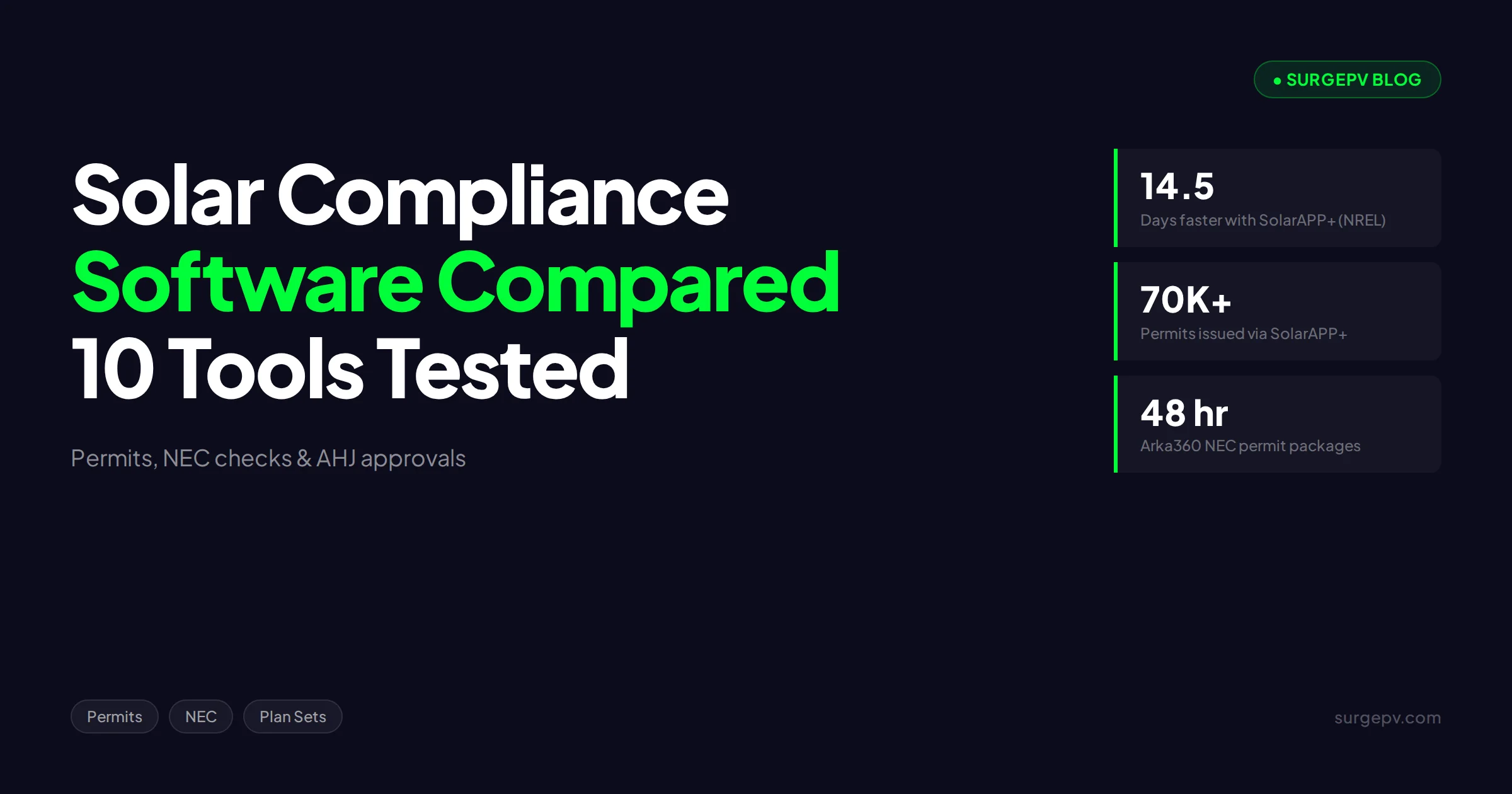
A rejected permit kills margin fast. Each resubmission adds 2 to 6 weeks, and labor, financing, and customer patience all burn while you wait. The National Renewable Energy Laboratory (NREL) found that projects permitted through automated review finish roughly 14.5 business days faster than traditional review (NREL, 2023).
We reviewed 10 solar compliance software tools against documented permitting workflows. We generated plan sets, checked single-line diagrams (SLDs), and tracked what actually passes an authority having jurisdiction (AHJ) review. Some are dedicated permit products; others are solar PV design software platforms whose output feeds the permit package. That group includes design platforms with permit output, outsourced engineering services, and the free automated review portal.
This list ranks what works in 2026. Every tool gets honest strengths and honest weaknesses. That includes our own product.
Quick Picks
| Pick | Tool | Why |
|---|---|---|
| Best for enterprise plan sets | Aurora Solar | Instant Plan Sets from LIDAR-accurate designs |
| Best for DIY residential permits | Solargraf | AHJ-compliant permit packages with validated SLDs |
| Best for fast NEC permit packages | Arka360 | 48-hour delivery, PE stamps available |
| Best outsourced permit design | GreenLancer | 200,000+ projects since 2013 |
| Best for instant code-checked permits | SolarAPP+ | Free NREL platform, instant approvals |
| Best for compliance-ready design data | SurgePV | Accurate shading and electrical data feeding plan sets |
How We Evaluated
We scored each tool on 5 criteria. Weighting reflects what gets permits approved and projects to permission to operate (PTO) faster.
| Criterion | Weight | What We compared published information about |
|---|---|---|
| First-pass approval rate | 25% | Plan set completeness, code references, SLD accuracy |
| Turnaround time | 20% | Hours or days from design to submittable documents |
| AHJ and code coverage | 20% | NEC edition handling, local amendments, jurisdiction database |
| Engineering support | 20% | PE stamps, structural and electrical reviews, revisions |
| Cost per approved permit | 15% | Subscription or per-project price vs. volume |
At-a-Glance Comparison
| Tool | Best For | Starting Price | PE Stamps | Instant Permits | Standout |
|---|---|---|---|---|---|
| Aurora Solar | Enterprise plan sets | Custom (contact sales) | Limited | — | Instant Plan Sets from one design model |
| Solargraf | DIY residential permits | $2,799/yr (Starter) | — | — | Built-in SLD validations against AHJ rules |
| Arka360 | Fast NEC permit packages | $199/mo (US) | ✓ | — | 48-hour standard, under 8-hour expedited |
| GreenLancer | Outsourced permit design | Per project | ✓ | — | 7,500+ installers served since 2013 |
| SolarAPP+ | Instant code-checked permits | $0 | — | ✓ | Automated NEC checks, 70,000+ permits issued |
| SurgePV | Compliance-ready design data | $1,899/yr (3 users) | — | — | Bankable shading and string data for plan sets |
| PVComplete | AutoCAD permit engineering | $199/mo | — | — | PVCAD permit-ready drawings, 50% time cut |
| Scanifly | Survey-grade site data | Custom (contact sales) | — | — | Drone-based as-builts that survive plan check |
| Pylon | Australian compliance docs | $4/project | — | — | One-click SLDs and voltage rise reports |
| PermitFlow | Multi-jurisdiction workflow | Custom (contact sales) | — | — | Permit tracking across hundreds of AHJs |
1. Aurora Solar — Best Compliance Software for Enterprise Plan Sets
Aurora Solar is the reference platform for US residential solar, used by over 7,000 companies. Its Instant Plan Sets feature turns a finished design into permit-ready documents without leaving the platform.
What It Does Well
The single-model workflow is the real compliance win. The same 3D design that drives the sales proposal drives the plan set. Setbacks, fire pathways, and array geometry stay consistent between what you sold and what you submit. That consistency removes a common rejection trigger: mismatched drawings.
LIDAR-assisted roof modeling gives AHJs the measurement accuracy they expect. Aurora also tracks code requirements across jurisdictions and applies them to plan set templates. G2 reviewers rate Aurora 4.6 out of 5 (G2, 2026).
For large teams, the admin layer matters. Permissions, templates, and review steps keep 20 sales reps from submitting 20 slightly different plan sets.
Our Take: Aurora is the safest enterprise pick for permit document generation. You pay a premium, and complex jurisdictions still need human review before submission.
Where It Falls Short
Pricing is custom and expensive for small teams. Automated roof modeling misses obstructions often enough that a site verify is still required. PE stamps and structural letters are not core to the product, so many Aurora users still buy engineering reviews elsewhere.
Key Features
- Instant Plan Sets for permit-ready documents
- LIDAR-assisted 3D roof modeling with automated setbacks
- Jurisdiction-aware plan set templates
- Team permissions and document review controls
Pricing
- Foundation, Build, Grow, Scale: Custom pricing, contact sales
- Free trial: Guided demo only
Who Should Use Aurora Solar
Strong fit: US residential companies submitting high permit volumes across many AHJs. Probably not right for: Solo installers, non-US markets, and teams needing bundled PE stamps.
2. Solargraf — Best for DIY Residential Permit Packages
Solargraf, owned by Enphase since 2021, builds permit generation directly into its proposal workflow. Its pitch: an AHJ-compliant permit package in minutes, not days.
What It Does Well
The permit engine is the differentiator. Solargraf generates permit packages with built-in validations, so SLDs are checked against permit requirements before you export. AHJ updates for California, Missouri, Arkansas, Texas, and Oklahoma ship inside the product.
The electrical design tool produces permit-grade SLDs without a separate drafting step. For a residential shop doing 10 to 30 permits a month, that collapses design, proposal, and permit documents into 1 subscription at $2,799 per year.
Battery compliance is solid too. Solargraf models 25+ battery manufacturers, and California installers get net energy metering (NEM) 3.0 optimization with hourly sell rates. Interconnection paperwork benefits from the same validated data.
Our Take: Solargraf covers quote through permit for standard US residential at a fair price. Cross-check its shading numbers before you commit to production figures on the plan set.
Where It Falls Short
Shading accuracy is the most common user complaint, and production figures on permit documents inherit that weakness. No PE stamps are included. Annual billing only, and it costs more than free alternatives for shops under 5 permits a month.
Key Features
- DIY AHJ-compliant permit package generation
- Electrical design tool with validated SLDs
- AHJ requirement updates for 5+ states
- Battery modeling for 25+ manufacturers with NEM 3.0 support
Pricing
- Starter: $2,799/year — 240 projects, 2 users
- Free trial: Available; new users get 120 project credits
Who Should Use Solargraf
Strong fit: US residential installers who want proposal and permit documents in 1 tool. Probably not right for: Teams needing PE stamps, complex C&I permits, or guaranteed shading precision.
3. Arka360 — Best for Fast NEC-Compliant Permit Packages
Arka360 serves 4,000+ installers across 27 countries. Its permit package service delivers National Electrical Code (NEC)-compliant plan sets in 48 hours standard, or under 8 hours expedited.
What It Does Well
Speed plus stamps is the rare combination here. Arka360 offers structural PE stamps covering fire setbacks, roof loads, and wind and snow loads, plus electrical PE stamps for utility-ready plans and SLDs. Users report permits approved “sometimes within the hour of submittal” (G2, 2026).
The platform covers all 50 US states with NEC-compliant packages. CAD export to DXF, AutoCAD, SketchUp, and PVsyst formats helps when an AHJ or utility asks for native files. The platform holds a 4.7 out of 5 G2 rating across 117 reviews.
India pricing starts at ₹7,500 per month, and the same team handles detailed engineering for markets where compliance means DISCOM net-metering documents rather than NEC plan sets. For outsourced permit engineering at scale, our sister team at Heaven Designs handles permit design and MW-scale engineering directly.
Our Take: Arka360 is the practical choice for a growing EPC that needs permits and PE stamps without hiring in-house engineers. Verify local code amendments yourself; no database catches every AHJ quirk.
Where It Falls Short
Users note that local building code amendments may not auto-apply, so manual verification is still needed. Performance issues and occasional instability appear in G2 reviews. Panel re-selection for each new polygon slows layout work.
Key Features
- NEC-compliant permit packages for all 50 US states
- 48-hour standard delivery, under 8-hour expedited
- Structural and electrical PE stamps available
- CAD export to DXF, AutoCAD, and PVsyst formats
Pricing
- US Basic: $199/month — 1 user, residential and commercial
- US Premium: $358/month — 2 users, battery sizing, CAD export
- India Lite: ₹7,500/month or ₹46,000/year
- Free trial: Contact sales
Who Should Use Arka360
Strong fit: Small and mid-size EPCs in the US and India needing permits plus engineering stamps. Probably not right for: Utility-scale developers and teams wanting fully automated local code amendments.
4. GreenLancer — Best Outsourced Permit Design Service
GreenLancer is not software in the classic sense. It is an online marketplace for permit design and engineering, and it has served 7,500+ installers on 200,000+ projects since 2013 (OpenSolar partner page, 2025).
What It Does Well
Scale and standardization. You submit project details, and GreenLancer returns a permit-ready plan set, engineering review, or PE-stamped drawings. Batch project management and in-app communication keep high volumes organized. The platform has supported $2.5 billion in deployed clean energy projects.
The service model fixes a hiring problem. Instead of employing a design engineer at $80,000+ per year, you pay per project. For installers doing 20 to 200 permits a month with lumpy volume, that math works well.
Integration coverage is wide. GreenLancer services are purchasable directly inside OpenSolar, and the marketplace handles residential, commercial, and EV charging scopes.
Our Take: GreenLancer is the answer when permits are your bottleneck and hiring is not an option. You trade per-project cost for zero fixed overhead, and quality is consistent.
Where It Falls Short
Per-project fees add up above roughly 30 permits a month, where in-house or in-tool generation gets cheaper. You depend on their turnaround queue. Highly unusual designs sometimes need extra revision cycles.
Key Features
- Permit-ready plan sets for residential and commercial
- Engineering reviews and PE-stamped drawings
- Batch project management with in-app messaging
- Direct purchase inside OpenSolar projects
Pricing
- Plan sets: Per project, typically low hundreds of dollars (industry-observed range)
- PE stamps: Priced per review by scope and state
- Free trial: Not applicable; pay per order
Who Should Use GreenLancer
Strong fit: US installers outsourcing permit design at variable volume. Probably not right for: Very high-volume shops where in-house drafting is cheaper, or non-US markets.
5. SolarAPP+ — Best for Instant Code-Checked Permits
SolarAPP+ (Solar Automated Permit Processing) is the free automated plan review platform developed with NREL and the US Department of Energy. It runs code checks and issues permits instantly for standard residential systems.
What It Does Well
The speed is unmatched because there is no queue. Contractors enter system specifications, the platform checks NEC compliance automatically, and eligible projects get permitted the same day. NREL’s 2023 performance review found SolarAPP+ projects were permitted and inspected 14.5 business days sooner than traditional projects.
Adoption keeps growing. NREL reported 70,000+ permits issued across roughly 270 jurisdictions in 13 states as of mid-2025 (US DOE, 2026). Battery storage support and 3-phase residential systems up to 25 kW arrived in late 2025. California’s SB 379 now requires most cities to offer automated permitting, which pushes adoption further.
The price is $0 for installers and jurisdictions. That makes it the highest-value compliance tool in the country where it is live.
Our Take: If your AHJ runs SolarAPP+, use it for every eligible residential job. The catch is eligibility: only standard designs in participating jurisdictions qualify.
Where It Falls Short
Coverage is the hard limit. Roughly 270 of about 19,000 US jurisdictions used it as of mid-2025. Complex roofs, ground mounts, and large systems fall outside the standard eligibility window. There is no design functionality at all; it reviews what you submit.
Key Features
- Automated NEC code compliance checks
- Instant permits for eligible residential systems
- Battery storage and 3-phase support (late 2025)
- Free for installers and jurisdictions
Pricing
- SolarAPP+: $0 — free for installers and AHJs
- Free trial: Not needed; the platform is free
Who Should Use SolarAPP+
Strong fit: Residential installers working in participating jurisdictions. Probably not right for: Complex or commercial projects, and anyone outside covered areas.
Design Data That Passes Plan Check
See how SurgePV generates the shading, string, and yield figures your permit documents depend on.
Book a DemoNo commitment required · 20 minutes · Live project walkthrough
6. SurgePV — Best for Compliance-Ready Design Data
Full disclosure: we build SurgePV. We ranked it #6 because it is not a permit package generator. Where it earns a place on this list is upstream: plan sets fail when the underlying design data is wrong, and that is the part we solve.
What It Does Well
Most permit rejections trace back to bad inputs. Wrong shading numbers produce wrong production claims. Wrong string lengths produce wrong voltage calculations on the SLD. A plan set drawn from bad data gets rejected no matter how clean the drafting is.
SurgePV keeps those inputs accurate. The 3D rooftop design module handles layout and string sizing against a real roof model. Physics-based irradiance and shading analysis produces the shading figures that go on the plan set. The generation and financial tool outputs yield, payback, internal rate of return (IRR), and net present value (NPV) from the same model.
Because everything lives in 1 cloud platform, the numbers stay consistent from design to proposal to the documents your engineer stamps. The solar proposal software layer and the module and inverter database carry the same electrical specifications your SLDs require.
Our Take: Use SurgePV to generate defensible design data, then feed it to Solargraf, Arka360, or GreenLancer for the permit documents themselves. It fixes the input problem, not the paperwork problem.
Where It Falls Short
SurgePV does not generate permit packages, plan sets, or SLDs. There are no PE stamps and no AHJ requirements database. Teams needing an all-in-one permit workflow should pair it with one of the tools ranked above.
Key Features
- 3D rooftop design with layout and string sizing
- Physics-based shadow analysis for plan-set-grade shading data
- Energy yield plus payback, IRR, and NPV modeling
- Module and inverter database with electrical specifications
Pricing
- For 3 Users plan: $1,899/year — design, simulation, financials, and proposals included
- Free trial: Available with full design and simulation capabilities
Who Should Use SurgePV
Strong fit: Installers and EPCs who want permit documents built on accurate design and shading data. Probably not right for: Teams wanting automated permit packages or PE stamps in the same tool.
7. PVComplete — Best AutoCAD-Based Permit Engineering
PVComplete’s PVCAD is the AutoCAD-native choice for permit engineering. The company joined Enact in January 2026, bringing permit-ready drawing capability into a broader platform.
What It Does Well
PVCAD claims a 50% design time reduction, and the workflow logic supports it. Automated layout optimization, electrical design, and SLD generation run inside AutoCAD, which is what most engineering departments already own. The output is permit-ready plan sets for rooftop, carport, and ground-mounted projects.
The full-stack path is the appeal: PVSketch for sales, PVCAD for engineering, PVsyst for energy modeling, and out come permit-ready plans. PVCAD Mega handles complex terrain for utility-scale work. An assistant inside the product audits designs against code standards and flags issues before submission.
Our Take: PVCAD fits engineering-led firms that live in AutoCAD and want permit drawings without leaving it. If your team does not already use AutoCAD, the learning curve outweighs the benefit.
Where It Falls Short
AutoCAD skills and licenses are required, which prices out small installers. The Enact acquisition is recent, and the integrated workflow is still settling. Sales-facing features lag dedicated proposal tools.
Key Features
- PVCAD permit-ready drawings inside AutoCAD
- Automated layout optimization and electrical design
- SLD generation with code-standard design audits
- PVCAD Mega for utility-scale complex terrain
Pricing
- PVComplete platform: From $199/month
- Free trial: Contact sales
Who Should Use PVComplete
Strong fit: Engineering-led EPCs with AutoCAD skills producing permit drawings at volume. Probably not right for: Small installers without CAD staff, or teams wanting a lightweight cloud tool.
8. Scanifly — Best for Site-Survey Accuracy That Passes Plan Check
Scanifly builds its compliance case on measurement. Drone-based surveys produce survey-grade 3D models, and plan sets drawn from them hold up under AHJ scrutiny.
What It Does Well
Rejected permits often start with bad measurements. A roof dimension off by 2 feet can invalidate setbacks, string layouts, and structural calcs at once. Scanifly’s drone photogrammetry captures the site as-built, so the drawings match reality.
The racking integrations matter for structural compliance. A January 2026 IronRidge integration saves a reported 1 to 3 hours per project, and K2 Systems, SnapNrack, Pegasus, and Unirac connections carry racking specs into the design. Fire setbacks and pathways measure directly off the 3D model.
Zapier support connects 5,000+ apps, so survey data flows into whatever permit drafting stack you run.
Our Take: Scanifly is the strongest answer when plan check keeps rejecting your measurements. It is a survey and design layer, so pair it with a permit document tool.
Where It Falls Short
Drone flights add a site visit step, which slows same-day quoting workflows. Pricing is custom and runs higher than satellite-based design tools. Permit document generation itself is not the core product.
Key Features
- Drone-based survey-grade 3D site models
- Measurement-accurate setbacks and fire pathways
- Racking integrations: IronRidge, K2 Systems, SnapNrack, Unirac
- Zapier connections to 5,000+ apps
Pricing
- Scanifly: Custom pricing, contact sales
- Free trial: Demo available
Who Should Use Scanifly
Strong fit: US installers whose permits fail on site measurement accuracy, and teams doing complex roofs. Probably not right for: Budget-first residential shops happy with satellite imagery accuracy.
9. Pylon — Best for Australian Compliance Documentation
Pylon (GetPylon) is the Australian-built tool with pay-per-project pricing. Over 3,500 solar businesses use it, and its compliance documentation set is unusually deep for $4 a project.
What It Does Well
Australian compliance is specific, and Pylon covers it natively. Small-scale Technology Certificates (STCs), Peak Reduction Certificates (PRCs) in New South Wales, Victorian Energy Efficiency Certificates (VEECs), and the Cheaper Home Batteries Program are all handled in-platform. June 2025 updates added buy now pay later (BNPL) regulation compliance and gateway support for SLDs.
The automated documentation is the compliance core. One-click SLDs, voltage rise reports, job sheets, and owner manuals generate from the design. Voltage rise calculations are a frequent grid-approval requirement in Australia, and most US-centric tools skip them entirely.
The pricing model suits compliance at any volume. At $4 per Standard project with unlimited users, a 2-person shop pays the same per permit as a national brand.
Our Take: For Australian installers, Pylon delivers the right compliance documents at the lowest entry price on this list. US installers should look elsewhere; its code coverage is Australian-first.
Where It Falls Short
Only 3 proposal templates limit document customization. Utility-scale and advanced C&I work is out of scope. Imagery coverage has gaps in 10 to 20% of regions, which can affect site plan accuracy.
Key Features
- One-click SLDs and voltage rise reports
- STC, PRC, VEEC, and battery program compliance
- Automated job sheets and owner manuals
- Pay-per-project pricing with unlimited users
Pricing
- Standard: $4/project — design, imagery, financials, documents
- Pro: $10/project — adds batteries, custom loads, commercial
- Free trial: 5 free Standard projects, no credit card
Who Should Use Pylon
Strong fit: Australian residential installers needing grid and certificate compliance documents. Probably not right for: US NEC permitting, utility-scale work, or brands needing custom templates.
10. PermitFlow — Best for Multi-Jurisdiction Permit Workflow
PermitFlow is permitting workflow software, not design software. It manages submissions, status, and requirements across hundreds of AHJs from 1 dashboard.
What It Does Well
The problem it solves is coordination, not drafting. A regional installer submitting to 40 different AHJs tracks 40 different requirement sets, portals, and review queues. PermitFlow centralizes that: application preparation, submission, status tracking, and municipality communication in 1 system.
The jurisdiction database is the asset. Requirements, checklists, and fee schedules stay current across a wide AHJ network. For installers expanding into new territories, that removes the research burden that normally slows the first 10 permits in a new market.
Our Take: PermitFlow pays for itself when you manage volume across many jurisdictions. It does not draw anything, so you still need design and plan set tools upstream.
Where It Falls Short
There is no design, SLD, or engineering capability. Pricing is custom and targets mid-size and larger operators. Solo installers in 1 or 2 jurisdictions do not need this layer.
Key Features
- Permit preparation and submission management
- Jurisdiction requirement and checklist database
- Status tracking and AHJ communication in 1 dashboard
- Multi-project, multi-state portfolio view
Pricing
- PermitFlow: Custom pricing, contact sales
- Free trial: Demo available
Who Should Use PermitFlow
Strong fit: Regional and national installers managing permits across dozens of AHJs. Probably not right for: Small local installers, or teams wanting design and drafting features.
Decision Flowchart: Which Tool Fits Your Compliance Workflow
Match your permit volume and market to a shortlist before you book demos.
- High-volume US residential company: Aurora Solar. One design model feeds proposals and plan sets.
- US residential shop wanting DIY permits: Solargraf. Proposal through permit package in 1 subscription.
- EPC needing PE stamps fast: Arka360 or GreenLancer. Pick Arka360 for in-platform generation, GreenLancer for pure outsourcing.
- Standard residential in a SolarAPP+ jurisdiction: SolarAPP+ first, every time. Free and instant.
- Team whose plan sets keep failing on bad inputs: SurgePV for design data, plus Scanifly when site measurement is the weak link.
- Engineering-led firm on AutoCAD: PVComplete PVCAD.
- Australian installer: Pylon. Native STC, voltage rise, and grid documents.
- Regional operator across many AHJs: PermitFlow on top of your design stack.
How to Choose Solar Compliance Software
Evaluate any tool against these 6 dimensions before you commit.
- First-pass approval rate. Ask the vendor for it, then ask 2 users on review sites. Everything else is secondary to permits passing on the first submission.
- Where the data comes from. Plan sets built on your actual design model beat re-drafted ones. Mismatched drawings between proposal and permit trigger rejections and change orders.
- AHJ and code coverage. Confirm the tool tracks your specific jurisdictions and NEC edition. State-level coverage claims often hide gaps at the city level.
- PE stamp path. Decide whether you need stamps in-platform (Arka360), outsourced (GreenLancer), or from your own engineer. Budget $300 to $1,000 per stamp either way.
- Cost per approved permit. Divide annual cost by permit volume. Under 10 permits a month, per-project or free tools win. Above 30, subscriptions and in-house drafting get cheaper.
- Interconnection coverage. Permits are half the battle. Check whether the tool also supports utility interconnection documents; our interconnection application guide covers that side.
Pro Tip
Pull your last 5 permit rejections and categorize the cause. Buy the tool that fixes your actual failure mode — measurement, drafting, code references, or workflow — not the one with the longest feature list.
The Compliance Myth That Costs Installers Money
The myth: compliance is a paperwork problem solved at the end of the sale. It is not. It is a data problem created at the start.
We see the same pattern across hundreds of projects. A rep designs from low-resolution imagery. The permit package inherits a wrong roof dimension. The AHJ rejects it. The crew arrives and finds the array does not fit the setbacks. The fix costs 10 times what accurate site data would have cost upfront.
The contrarian truth: the best compliance software is often the design tool that gets the inputs right. A perfect permit drafting service fed bad measurements still produces a rejected permit. This is why we ranked a design-data tool (SurgePV) and a survey tool (Scanifly) above some dedicated permit products. Fix the inputs, and the paperwork gets easy. Our solar permit package checklist shows what a clean submission actually contains.
Conclusion
The right compliance stack depends on your market and volume. Aurora Solar leads for enterprise US residential plan sets. Solargraf covers DIY residential permits at a fair price. Arka360 and GreenLancer solve the PE stamp problem without hiring. SolarAPP+ is free and instant where it is live. SurgePV and Scanifly fix the upstream data that decides whether any of them succeed.
Every tool on this list earned its place, and every one has a ceiling we told you about. Your next 3 steps:
- Categorize your last 5 permit rejections by cause, and shortlist the 2 tools that address that cause.
- Run 1 real project through each shortlisted tool’s trial, end to end, and measure time to a submittable package.
- Check whether your top AHJs run SolarAPP+, and route every eligible job through it.
If you want permit documents built on accurate design and shading data, book a 20-minute SurgePV demo.
Related Posts
- Best Solar Permitting Software
- Best Solar Electrical Design Software
- Best Solar SLD Software
- Best Solar Design Software
Where SurgePV fits
For the product-side detail, commercial design with compliance built in covers the workflow, outputs and limits.
Frequently Asked Questions
What is solar compliance software?
Solar compliance software helps installers meet building codes, electrical codes, and permitting rules. It covers code-checked plan sets, single-line diagrams, PE stamps, AHJ submissions, and interconnection documents.
What is the best free solar compliance tool?
SolarAPP+ is free for installers and jurisdictions. It runs automated code checks and issues instant permits for standard residential systems in participating areas. Coverage is the limit: it works only where the local authority has adopted it.
How much do solar permit packages cost?
In-tool permit generation runs $199 to $280 per month on platforms like Solargraf and Arka360. Outsourced plan sets from services like GreenLancer are priced per project, typically in the low hundreds of dollars. PE stamps add $300 to $1,000 per review, depending on scope.
Do I still need a PE stamp if my software generates plan sets?
Often yes. Many authorities having jurisdiction require a licensed professional engineer to stamp structural or electrical sheets. Software can prepare the documents, but the stamp itself comes from a licensed engineer.
What causes most solar permit rejections?
Incomplete documents, outdated code references, wrong setback measurements, and single-line diagram errors cause most rejections. Accurate site measurements and current AHJ requirement data prevent most of them.
Can design software replace a permit expediter?
For standard residential jobs in SolarAPP+ jurisdictions, mostly yes. For complex commercial projects, unusual roofs, or strict coastal jurisdictions, an expediter or outsourced engineering service still earns its fee.
