

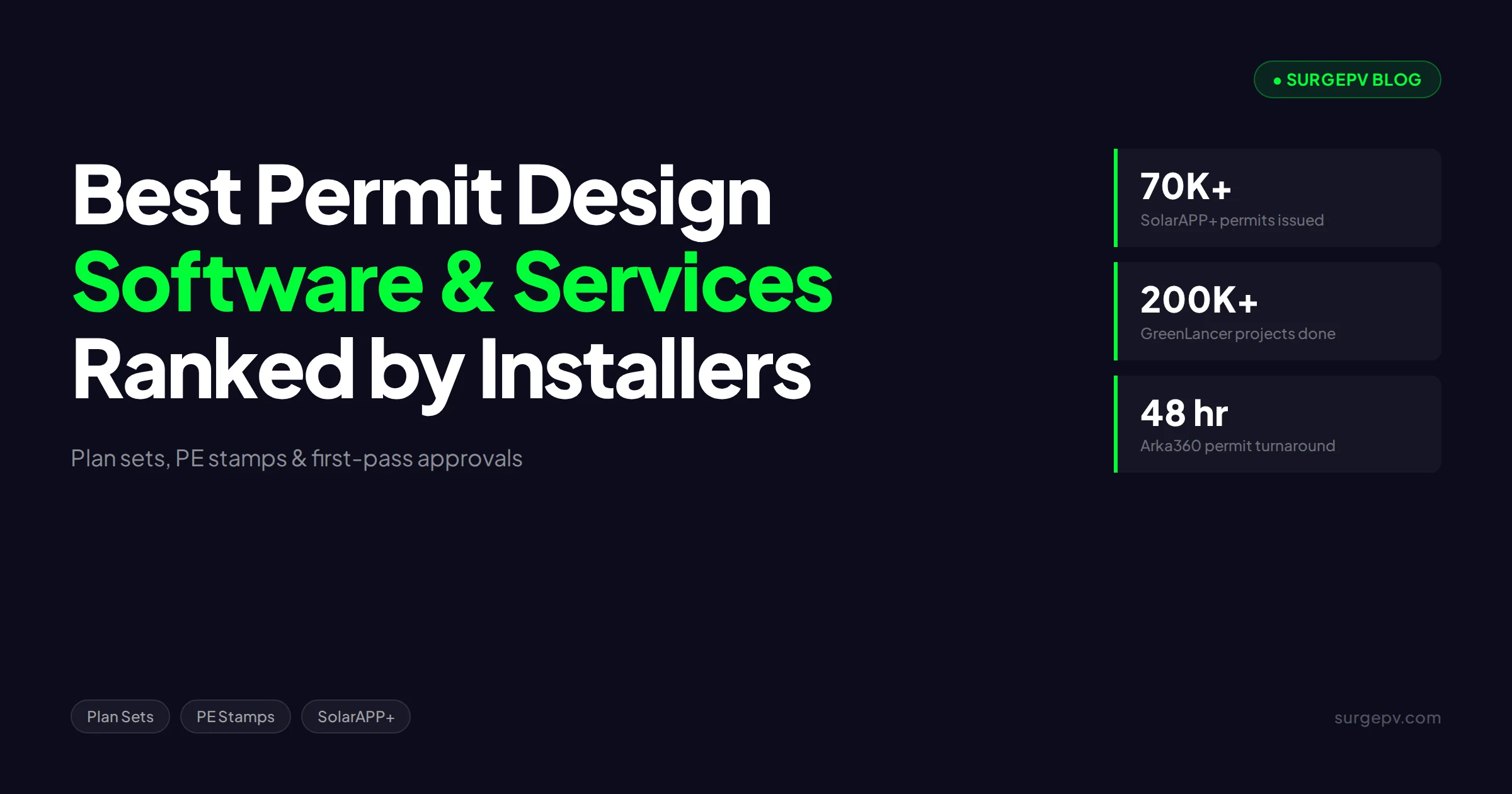
Expert Verified — Written by Keyur Rakholiya, SurgePV Editorial. 10 permit design tools and services reviewed. Pricing verified July 2026. Based on 1+ GW of delivered projects and permit submissions across 50+ countries.
A rejected permit costs more than the resubmission fee. It stalls the install crew, pushes the interconnection date, and gives the customer 3 extra weeks to cancel. First-pass approval is where profit lives.
We reviewed 10 permit design software tools and permit design services against documented installer workflows. We looked at plan set quality, AHJ compliance coverage, turnaround time, PE stamp availability, and cost per approved permit.
This list covers both paths: software that generates permit documents in-house, and services that take permitting off your desk entirely. Honest strengths, honest weaknesses, including our own product.
Quick Picks
| Pick | Tool | Why |
|---|---|---|
| Best for engineering-grade plan sets | Aurora Solar | Instant Plan Sets from LIDAR-verified designs |
| Best outsourced permit service | GreenLancer | 200,000+ projects, PE stamps, per-project pricing |
| Best DIY residential permit packages | Solargraf | AHJ-compliant DIY permits in minutes |
| Best for PE-stamped packages on a budget | Arka360 | NEC-compliant sets in 48 hours, stamps available |
| Best pay-per-permit option | SolarDesignTool | Design free, pay $49 only when you export |
| Best for permit-ready design data | SurgePV | Accurate layout, stringing, and shading in 1 file |
How We Evaluated
We scored each option on 5 criteria. Weighting reflects what gets permits approved on the first pass.
| Criterion | Weight | What We compared published information about |
|---|---|---|
| Plan set completeness | 30% | Site plan, SLD, structural details, labels, spec sheets |
| AHJ compliance coverage | 25% | NEC, IRC, fire code, and local amendment handling |
| Turnaround time | 20% | Hours or days from design to submittable package |
| Engineering support | 15% | PE stamps, structural and electrical review, revisions |
| Cost per approved permit | 10% | Subscription or per-project cost against approval rate |
At-a-Glance Comparison
| Tool | Best For | Starting Price | PE Stamps | Turnaround | Standout |
|---|---|---|---|---|---|
| Aurora Solar | Engineering-grade plan sets | Custom (contact sales) | Limited | Same day | Instant Plan Sets from verified 3D design |
| GreenLancer | Outsourced permit design | Per project | Yes | 1 to 5 days | 200,000+ completed projects |
| Solargraf | DIY residential permits | $2,799/yr (Starter) | Limited | Minutes | DIY AHJ-compliant packages with validated SLDs |
| Arka360 | Budget PE-stamped packages | $199/mo (US) | Yes | 48 hours, under 8 expedited | All-50-states NEC compliance |
| SolarDesignTool | Pay-per-permit | $50/mo + $49/package | No | 15 minutes | Design free, pay only to export |
| SurgePV | Permit-ready design data | $1,899/yr (3 users) | No | Same day | Layout, stringing, and shading feed the plan set |
| SolarAPP+ | Instant permit approval | $0 | No | Minutes | NREL automated plan review |
| OpenSolar | Free path to permits | $0 | Via partner | Same day | SolarAPP+ and GreenLancer integrations |
| PVComplete (PVCAD) | AutoCAD-based plan sets | $180/mo + AutoCAD | No | Same day | Permit-ready drafting inside AutoCAD |
| Scanifly | Survey-to-permit accuracy | Custom + credits | Via partner | 1 to 2 days | Drone-accurate as-builts feed the plan set |
1. Aurora Solar — Best Permit Design Software for Engineering-Grade Plan Sets
Aurora Solar is the reference platform for US residential design, and its Instant Plan Sets feature turns verified designs into permit documents. Over 7,000 companies use it.
What It Does Well
The plan set inherits the design. Aurora’s LIDAR-assisted 3D modeling and automated shading analysis produce roof measurements that survive plan examiner scrutiny. Instant Plan Sets export site plans, layouts, and electrical diagrams from the same file, so nothing gets re-typed.
Measurement accuracy is the real permit advantage. Installers report resolving on-site measurement disputes with Aurora’s LIDAR data. When the AHJ questions a setback or a rafter span, a verified 3D model answers faster than a ladder and a tape.
G2 reviewers rate Aurora 4.6 out of 5, with design and engineering among its highest-scored categories. For teams submitting permits weekly in strict jurisdictions, that design depth justifies the price.
Our Take: Aurora produces the strongest in-house plan sets we reviewed. You pay enterprise prices, and the automated roof modeling still misses obstructions often enough that every plan set needs a human review before submission.
Where It Falls Short
Pricing is not published, and small teams consistently call it expensive. Automated obstruction detection is hit-or-miss on complex roofs. PE stamps and wet signatures still require an outside engineer.
Key Features
- Instant Plan Sets from LIDAR-verified 3D designs
- Automated shading and roof measurement
- Electrical design with single-line diagrams
- Expert Design Service on enterprise plans
Pricing
- Foundation, Build, Grow, Scale: Custom pricing, contact sales
- Free trial: Guided demo only
Who Should Use Aurora Solar
Strong fit: US residential installers submitting permits weekly in strict AHJs. Probably not right for: Small teams on tight budgets, or anyone needing bundled PE stamps.
2. GreenLancer — Best Outsourced Solar Permit Design Service
GreenLancer is a marketplace for permit design and engineering, not a design tool. Since 2013, it has served more than 7,500 installers across 200,000+ projects, per its OpenSolar partner profile.
What It Does Well
Scale is the headline. GreenLancer’s network of drafters and engineers produces standardized plan sets for residential, commercial, and EV charging projects. PE stamps and engineering reviews cover states where your own license does not reach.
The marketplace model fits irregular volume. You pay per project, with no subscription. Batch project management and in-app communication keep multi-job pipelines organized. Standard turnaround runs 1 to 5 days depending on scope, with expedited options.
For a 5-person installer without a drafter, GreenLancer converts a fixed payroll cost into a per-permit variable cost. Residential plan sets in the industry-observed range of $100 to $400 beat a salary at most volumes.
Our Take: GreenLancer is the default outsourcing answer for US residential and light commercial permitting. Standardized output trades away customization, so review every plan set against your AHJ’s quirks before you submit.
Where It Falls Short
You give up control of turnaround during peak season queues. Standardized templates do not always match unusual AHJ requirements, and revisions add days. Complex commercial engineering needs scoping calls, not self-serve checkout.
Key Features
- Permit plan sets for residential, commercial, and EV projects
- PE stamps and engineering reviews across states
- Per-project pricing with batch project management
- Integration inside OpenSolar’s project workflow
Pricing
- Plan sets: Per project, quoted by scope
- PE stamps: Per state, added to plan set orders
- Free trial: Not applicable; pay per project
Who Should Use GreenLancer
Strong fit: Installers with irregular permit volume or no in-house drafter. Probably not right for: High-volume teams wanting same-hour turnaround and full design control.
3. Solargraf — Best Permit Design Software for DIY Residential Packages
Solargraf, owned by Enphase since 2021, bundles DIY permit generation into its residential sales platform. The pitch: quote, design, and permit in 1 subscription.
What It Does Well
Speed is real. Solargraf generates AHJ-compliant permit packages in minutes, with built-in validations that check single-line diagrams before export. The electrical design tool produces permit-ready SLDs without a separate drafting step.
AHJ updates are incorporated into the templates, which matters when codes shift. California installers get NEM 3.0 optimization alongside the permit package, so the interconnection paperwork matches the tariff math in the proposal.
For residential shops doing 20+ permits a month, bundling permitting with proposals at $2,799 per year undercuts most per-project services.
Our Take: Solargraf is the fastest DIY permit path for straightforward US residential roofs. Cross-check its shading and production output before you trust the numbers in the plan set — that is its weakest link.
Where It Falls Short
Shading accuracy is the most common user complaint, per our Solargraf research file. There is no built-in PE stamp service, so stamped structural letters need an outside engineer. Annual billing only, and complex roofs stretch the automation.
Key Features
- DIY AHJ-compliant permit packages in minutes
- Validated single-line diagrams built in
- NEM 3.0 optimization for California
- Proposal-to-permit workflow in 1 subscription
Pricing
- Starter: $2,799/year — 240 projects, 2 users
- Free trial: Available; new users get 120 project credits
Who Should Use Solargraf
Strong fit: US residential installers on simple roofs, especially Enphase-heavy shops. Probably not right for: Teams needing shading precision or bundled PE stamps.
4. Arka360 — Best Permit Design Software for PE-Stamped Packages on a Budget
Arka360 serves 4,000+ installers across 27 countries and delivers NEC-compliant permit packages in 48 hours, or under 8 hours expedited. PE stamps are available for structural and electrical.
What It Does Well
The permit package is the differentiator at this price. Arka360 advertises 100% code-compliant packages across all 50 US states. One user reported permits approved “sometimes within the hour of submittal,” per our research file.
The stamps cover what DIY tools cannot. Structural reviews address fire setbacks, roof loads, and wind and snow loads. Electrical stamps cover utility-ready plans and SLDs. CAD export sends the PV layout to AutoCAD as DXF, which helps when the AHJ wants native drawings.
Value holds up outside the US too. India pricing starts at ₹7,500 per month, and the platform holds a 4.7 out of 5 rating across 117 reviews on G2.
Our Take: Arka360 is the practical pick for a growing installer that needs stamped permit packages without Aurora pricing. Expect performance rough edges and some repetitive layout steps in exchange.
Where It Falls Short
Missing features are the top user complaint on G2. Users report occasional instability, and panel re-selection for each new polygon slows layout work. Utility-scale permitting is out of scope.
Key Features
- NEC-compliant permit packages, 48 hours standard
- Under 8-hour expedited turnaround
- Structural and electrical PE stamps
- CAD export to AutoCAD and SketchUp formats
Pricing
- US Basic: $199/month — 1 user, residential and commercial
- US Premium: $358/month — 2 users, battery sizing, CAD export
- India Lite: ₹7,500/month or ₹46,000/year
- Free trial: Contact sales
Who Should Use Arka360
Strong fit: Small and mid-size installers in the US, India, and emerging markets needing stamps. Probably not right for: Utility-scale developers and teams wanting polished performance.
5. SolarDesignTool — Best Pay-Per-Permit Design Software
SolarDesignTool is a web-based residential design tool with a simple promise: a complete permit package in 15 minutes. Users have created 700,000+ designs on the platform, per SolarDesignTool.
What It Does Well
The freemium model is the draw. You design residential systems free and pay $49 only when you export the permit package. At low volume, nothing on this list is cheaper per approved permit.
Speed is proven. Users report going from 1 to 2 designs per day to 10, and site survey time drops from 1 hour to 10 minutes with roof reports. The permit package covers the project summary, site plan, SLD, and supporting documents.
For a new installer doing 5 permits a month, the math is clean: $50 monthly plus $245 in exports beats any annual subscription.
Our Take: SolarDesignTool is the lowest-risk way to bring permitting in-house. It is residential-only and stamp-free, so treat it as a drafting accelerator, not an engineering department.
Where It Falls Short
Residential focus rules out commercial work. There are no PE stamps, and the SLD is gated behind the advanced tier. Engineering depth is thin compared with Aurora or PVCAD.
Key Features
- Complete design-to-permit workflow in 15 minutes
- One-click permit package generation
- Free design with pay-per-export pricing
- Roof reports that cut site survey time
Pricing
- Base plan: $50/month
- Permit export: $49 per package
- Free trial: Available; residential designs are free to create
Who Should Use SolarDesignTool
Strong fit: New and low-volume residential installers, plus DIY-savvy contractors. Probably not right for: Commercial installers and anyone needing engineering stamps.
Quote From Real Engineering Data
See how SurgePV turns design, shading, and financials into a customer-ready proposal in 1 workflow.
Book a DemoNo commitment required · 20 minutes · Live project walkthrough
6. SurgePV — Best for Permit-Ready Design Data
Full disclosure: we build SurgePV. We ranked it #6 because it is not a permit package generator, and we will not pretend otherwise. It earns this spot because every good permit package starts with an accurate design, and that is where we are strongest.
What It Does Well
Most permit rejections trace back to bad design data. A wrong roof dimension becomes a wrong layout. A wrong string length becomes a code violation on the SLD. A missed shading obstruction becomes a production number the inspector questions.
SurgePV fixes the source. The 3D design workspace handles rooftop layout and automated string sizing against the module and inverter database. The shadow analysis engine produces physics-based shading data from the actual 3D scene. The same file feeds generation and financial modeling, so the numbers in your permit application match the numbers in your customer proposal.
Because SurgePV is cloud-only, your designer, your drafter, and your permit service all work from 1 live model. No emailed CAD files drifting out of sync.
Our Take: If your permit rejections come from design errors, SurgePV removes the root cause. Pair it with SolarDesignTool, GreenLancer, or your own drafter for the plan set itself.
Where It Falls Short
SurgePV does not generate permit packages, SLD drawings, or PE stamps. You export the design data and finish the plan set elsewhere. There is no CRM, and very large sales orgs may want Aurora’s rep management layer.
Key Features
- 3D rooftop design with automated string sizing
- Physics-based shadow analysis
- Energy yield, payback, IRR, and NPV modeling
- Branded PDF proposals built from live design data
Pricing
- For 3 Users plan: $1,899/year — design, simulation, financials, and proposals included
- Free trial: Available with full capabilities
Who Should Use SurgePV
Strong fit: Installers and EPCs who want permit submissions built on verified design data. Probably not right for: Teams wanting 1-click permit packages in the same tool.
Want to see the design data behind a clean permit submission? Book a 20-minute demo.
7. SolarAPP+ — Best for Instant Permit Approval
SolarAPP+ (Solar Automated Permit Processing Plus) is not design software. It is NREL’s free automated plan review platform, and it approves qualifying residential permits in minutes instead of weeks.
What It Does Well
The speed is structural. SolarAPP+ checks your system specifications against the National Electrical Code (NEC), International Residential Code (IRC), and fire codes in real time. Pass the checks, and the permit issues instantly. No queue, no plan examiner backlog.
Adoption keeps growing. NREL reported over 70,000 permits issued across roughly 270 jurisdictions in 13 states as of mid-2025. GreenLancer’s SolarAPP+ guide tracks the expanding jurisdiction list. NREL performance data shows SolarAPP+ jurisdictions complete projects about 14.5 business days faster on median.
The platform is free for both AHJs and installers, funded by the US Department of Energy. When your project qualifies, there is no cheaper or faster permit path on Earth.
Our Take: If your AHJ runs SolarAPP+, design to its checklist from day 1 and skip the review queue entirely. The catch is eligibility — anything beyond standard residential rooftop falls back to traditional review.
Where It Falls Short
Scope is narrow. SolarAPP+ handles residential rooftop PV up to 38.4 kW DC, with or without storage, on existing homes. Ground mounts, new construction, multifamily, and commercial projects are excluded. Coverage is still a minority of US jurisdictions, and it reviews your design — it does not create it.
Key Features
- Instant automated code compliance checks
- Residential PV and solar-plus-storage support
- Free for installers and AHJs
- Integrations with OpenSolar and other design tools
Pricing
- Platform: $0 — free, funded by the US Department of Energy
- Free trial: Not needed; the platform is free
Who Should Use SolarAPP+
Strong fit: Residential installers working in adopted jurisdictions. Probably not right for: Commercial, ground-mount, or new-construction projects.
8. OpenSolar — Best Free Path to Solar Permits
OpenSolar is the only fully free platform on this list. 28,000+ users in 185+ countries pay nothing for design, CRM, proposals, and permit-ready drawings.
What It Does Well
The permit workflow is integration-first. OpenSolar connects directly to SolarAPP+ for instant approval in supported US jurisdictions. Outside those, its GreenLancer partnership lets you order permit plan sets, engineering reviews, and PE-stamped drawings from inside the project view.
Permit-ready drawings generate from the same 3D design the customer signed off on. That closes the gap where sales promises and permit submissions diverge.
Accuracy is third-party validated by PVEL and a US government agency. For a new installer, $0 software plus per-project GreenLancer fees is the lowest-cost compliant permit stack available.
Our Take: OpenSolar is the right starting point for any installer doing permits under 500 kW. Accept the ceiling: photogrammetry modeling is less precise than LIDAR, and complex engineering still goes to a service.
Where It Falls Short
The 500 kW system cap rules out utility work. There is no offline mode, and permit documents are less customizable than dedicated drafting tools. Stamps always route to the paid partner.
Key Features
- Free 3D design with permit-ready drawing output
- Direct SolarAPP+ integration
- In-app GreenLancer plan set and PE stamp ordering
- Full CRM and e-signature included
Pricing
- Free tier: $0 — unlimited projects and users
- Permit services: Per project via GreenLancer partnership
Who Should Use OpenSolar
Strong fit: New and budget-constrained residential installers. Probably not right for: C&I above 500 kW or teams needing native stamped plan sets.
9. PVComplete (PVCAD) — Best AutoCAD-Based Permit Design Software
PVComplete’s PVCAD is the engineer’s permit tool: full plan set drafting inside AutoCAD. Enact Solar acquired PVComplete in January 2026, folding it into a broader platform. 5,000+ users across 44 countries have designed 500,000+ projects with it.
What It Does Well
Drafting depth is the product. PVCAD automates layout optimization, electrical design, and single-line diagrams inside the AutoCAD environment AHJs and engineers already trust. The company claims a 50% design time reduction over manual drafting.
Plan sets come out permit-ready because the output is native CAD. When a plan examiner asks for a revised sheet, you edit the drawing directly instead of regenerating a PDF from a black box. The vendor’s recommended workflow runs PVSketch for sales, PVCAD for engineering, and PVsyst for energy modeling.
For EPCs with an in-house engineer, this replaces outsourced drafting entirely. Our guide to solar CAD tools covers the broader category.
Our Take: PVCAD is the right call when a licensed engineer owns your permit packages. It demands AutoCAD skills and budget, and it does nothing for teams without drafting capability.
Where It Falls Short
AutoCAD proficiency is required, and the learning curve is steep for non-drafters. There are no PE stamps or engineering services bundled. The Enact acquisition is recent, so long-term product direction is still settling.
Key Features
- Automated layout and electrical design inside AutoCAD
- Permit-ready plan sets and single-line diagrams
- PVCAD Mega for utility-scale and complex terrain
- PVSketch-to-PVCAD sales-to-engineering workflow
Pricing
- PVCAD plug-in: $180/month — requires your own AutoCAD license
- PVCAD bundle: $245/month — includes AutoCAD OEM license
- Enact platform: $199/month for up to 3 users
Who Should Use PVComplete
Strong fit: EPCs and engineering teams with AutoCAD skills producing their own plan sets. Probably not right for: Sales-led teams and installers without drafting staff.
10. Scanifly — Best for Survey-to-Permit Accuracy
Scanifly builds permit packages on drone-accurate site models. Founded by former solar contractors in 2015, it serves installers in 30+ countries with a credit-based design service.
What It Does Well
The as-built accuracy kills a whole category of permit rejections. Drone photogrammetry captures the roof as it actually exists — vents, chimneys, setbacks, and all. The plan set documents what the crew will actually find on install day.
Design services run on credits. A residential site model costs 15 credits, and a full plan set costs 70 credits. EmPower Solar reported a 53% software spend reduction after switching from Aurora, saving $100 to $300 per project, per a Scanifly case study.
For installers burned by satellite-imagery surprises, the drone model pays for itself on the first avoided truck roll. Pair it with roof modeling software knowledge to judge when drones beat LIDAR.
Our Take: Scanifly is the accuracy-first permit path for installers who already fly drones or want survey-grade data. The custom subscription pricing and credit math need a scoping call before you can budget it cleanly.
Where It Falls Short
Subscription pricing is not public; you must contact sales. The drone workflow adds a site visit step that pure satellite tools skip. Credit costs stack up at high volume, and expedited jobs carry a 5 to 30 credit surcharge.
Key Features
- Drone-based site modeling with survey-grade accuracy
- Credit-based plan sets and design services
- Max Fill layout automation
- Residential and commercial coverage in 30+ countries
Pricing
- Subscription: Custom, contact sales
- Plan set: 70 credits (residential), custom (commercial)
- Expedited: 5 to 30 credit surcharge
Who Should Use Scanifly
Strong fit: Residential and light commercial installers wanting drone-verified permit documents. Probably not right for: High-volume teams needing instant, satellite-only workflows.
How to Choose: Software, Service, or Both
Match the path to your volume and staffing before you compare prices.
- Weekly permit volume, no drafter on staff: Aurora Solar or Solargraf. In-house generation beats per-project fees at 15+ permits a month.
- Irregular volume or multi-state work: GreenLancer or Arka360. Per-project pricing and portable PE stamps fit.
- Low volume, tight budget: SolarDesignTool or OpenSolar. Free design, pay only when you export or order.
- Licensed engineer in-house: PVComplete. Native CAD output and full control.
- Accuracy problems on complex roofs: Scanifly. Drone as-builts end measurement disputes.
- AHJ runs SolarAPP+: Design to its checklist in any tool and skip the review queue.
- Design errors causing rejections: Fix the source with accurate PV design software before buying any permit tool.
Pro Tip
Track your first-pass approval rate for 90 days before switching tools. If it is already above 90%, your permit process is fine — spend the money on sales instead. If it is below 70%, the fix is usually better design data, not a faster permit service.
The Permit Myth That Costs Installers Money
The industry myth: faster permitting comes from faster plan sets. It does not. Plan examiners reject incomplete or inaccurate packages regardless of how quickly you produced them.
The real bottleneck is design quality upstream. A plan set generated in 15 minutes from a sloppy satellite trace gets rejected in week 3. A plan set built on verified measurements passes on the first pass, even if drafting took a day.
We see this across markets. The installers with 95%+ first-pass approval rates are not the ones with the fanciest permit software. They are the ones whose layouts, string sizes, and shading numbers were right before anyone opened a drafting tool. For the full submission workflow, see our solar permit package checklist and the companion piece on solar permitting automation.
For teams outsourcing detailed engineering and permit design on complex or international projects, our sister engineering practice publishes its approach at Heaven Designs permit design services.
Conclusion
The right permit design path depends on volume, staffing, and how strict your AHJs are. Aurora Solar leads for in-house engineering-grade plan sets. GreenLancer leads for outsourced permit design at any volume. Solargraf and SolarDesignTool win on DIY speed and cost. SurgePV fits where permit rejections trace back to bad design data.
3 actions to take this week:
- Pull your last 20 permit submissions and calculate your first-pass approval rate. Below 70% means a design quality problem, not a permitting problem.
- Check whether your AHJs run SolarAPP+. If yes, redesign your checklist around instant approval and cut weeks from every job.
- Trial 2 paths on the same real project: 1 software tool and 1 service. Compare cost per approved permit, not sticker price.
If your rejections start with design errors, book a 20-minute demo and see how SurgePV produces permit-ready design data.
Related Posts
- Best Solar Design Software
- Best Solar SLD Software
- Best Solar Electrical Design Software
- Single Line Diagram for Solar PV Permits
Where SurgePV fits
For the product-side detail, permit drawings and CAD output covers the workflow, outputs and limits.
Frequently Asked Questions
What is solar permit design software?
Solar permit design software generates the documents an authority having jurisdiction (AHJ) needs to approve a solar installation. That includes the site plan, roof layout, electrical single-line diagram (SLD), structural details, equipment spec sheets, and code compliance labels. Some tools generate the full plan set automatically; others produce design data that a drafter or engineer turns into the plan set.
Should I use permit design software or an outsourced permit design service?
Use software if you submit permits weekly and want control over turnaround and cost per plan set. Use a service like GreenLancer or Arka360’s permit team if your volume is irregular, your staff lacks drafting skills, or you need PE stamps in multiple states. Many installers mix both: software for simple residential jobs, a service for complex or stamped work.
How much does a solar permit plan set cost?
Costs vary by path. SolarDesignTool charges $49 per permit package on top of a $50/month plan. Outsourced residential plan sets from permit services run roughly $100 to $400 in the industry-observed range, with PE stamps adding $300 to $800 per state. Subscription tools like Aurora Solar and Solargraf bundle permit documents into monthly plans.
What documents are in a solar permit package?
A standard residential permit package includes a site plan with setbacks, a roof plan with panel layout, an electrical single-line diagram (SLD), structural attachment details with load calculations, equipment specification sheets, wire and conduit schedules, NEC-required labels and placards, and fire access pathway notes. Commercial projects add arc flash studies and utility interconnection documents.
What is SolarAPP+ and when does it replace permit design?
SolarAPP+ is a free automated plan review platform from the National Renewable Energy Laboratory (NREL). It checks residential PV and solar-plus-storage designs against NEC, IRC, and fire codes instantly. NREL reported over 70,000 permits issued through roughly 270 jurisdictions in 13 states as of mid-2025. It replaces the plan review step, not the design itself — you still need accurate system specifications to pass its checks.
How long does solar permitting take?
Traditional review takes 1 to 4 weeks for residential and 4 to 12 weeks for commercial projects, depending on the AHJ’s queue. A rejected submission typically adds 2 to 4 weeks. SolarAPP+ jurisdictions approve qualifying residential permits in minutes. Jurisdictions using SolarAPP+ completed projects about 14.5 business days faster on median, per NREL performance data.
Can free software produce permit-ready plans?
Partially. OpenSolar generates permit-ready drawings and integrates with SolarAPP+ and GreenLancer at no cost. SolarDesignTool lets you design free and charges only when you export the permit package. Fully free, stamped plan sets do not exist — PE stamps always carry an engineering fee.
