Pros
Cons
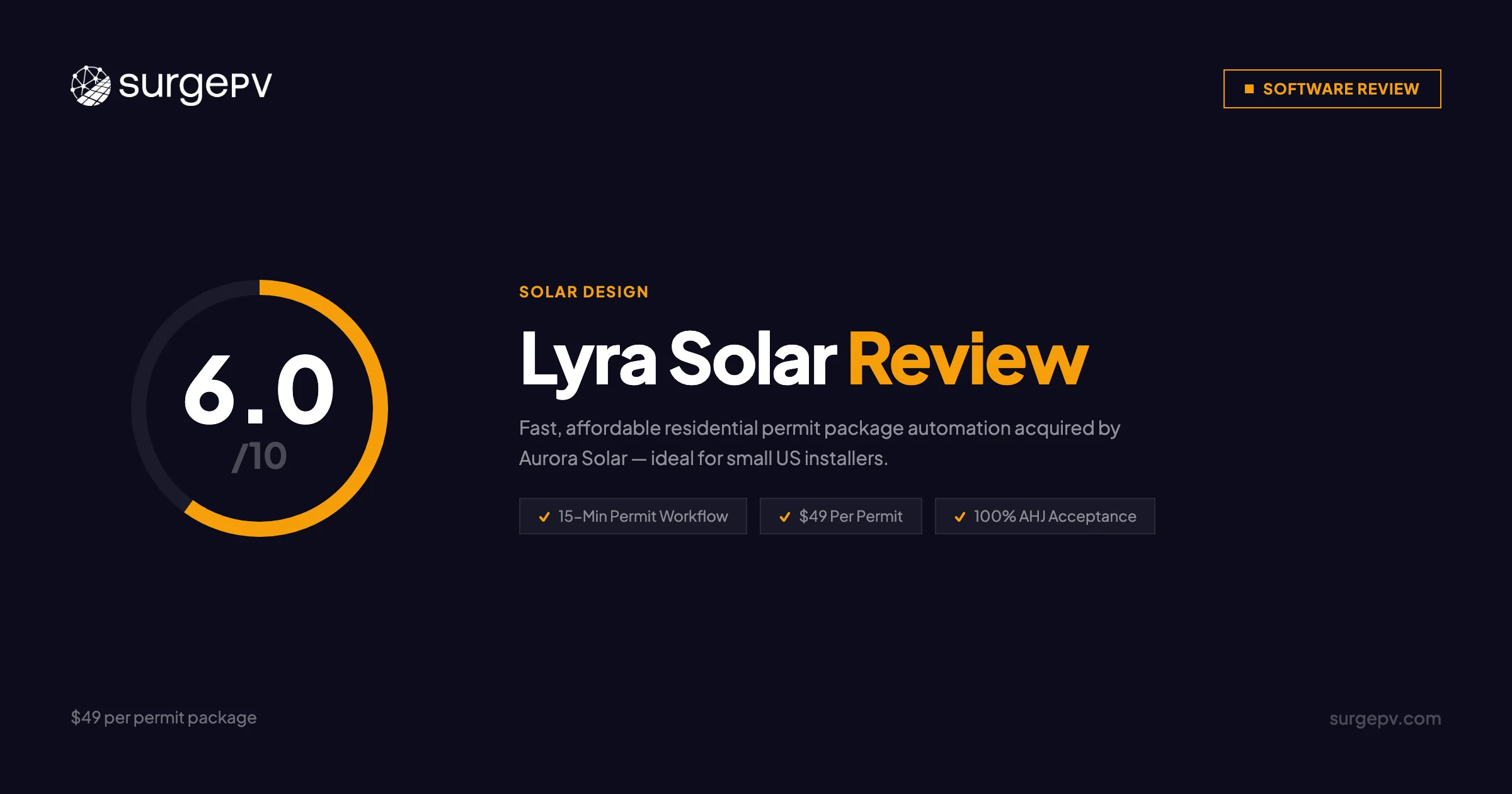
TL;DR: Lyra Solar is a pay-per-permit residential design tool that cuts the time from roof trace to AHJ-ready permit package down to 15 minutes. At $49 per package, it’s a fraction of the cost of CAD software licenses. Based on available testimonials, users praise the speed and ease of use — but formal review data is sparse. For small US residential installers needing fast, affordable permit automation, Lyra delivers real value. For EPCs who need full design, simulation, SLD generation, and proposals in one workflow, SurgePV — purpose-built solar design tools — is the more complete platform.
Author: Keyur Rakholiya Title: Contributing Writer, SurgePV | MD & CEO, Heaven Green Energy Limited Expertise: 1+ GW solar projects delivered, 20+ design software platforms tested, 10+ years EPC operations Published: 2026-03-08 Last Updated: 2026-03-08 Review Methodology: Official Lyra Solar documentation, Aurora Solar acquisition announcement, available user testimonials, comparison of published product information
Who This Review Is For
This Lyra Solar review is written for:
- Small residential solar installers evaluating permit automation tools
- Installers currently drafting permit packages manually in CAD or outsourcing to third-party services
- Solar sales teams assessing whether Lyra Solar remains viable post-Aurora acquisition
- EPCs comparing Lyra Solar vs Aurora Solar, OpenSolar, or SurgePV for their workflow
Who should skip this review:
- Commercial or utility-scale EPCs (Lyra does not support these project types)
- International installers (US AHJ compliance only)
- Teams needing full design, simulation, proposal, and CRM in one platform
What Is Lyra Solar?
Lyra Solar is a web-based residential solar design and permit package automation platform built for US installers. Its core promise: take a rooftop from initial design to a complete, AHJ-ready permit package in about 15 minutes — without CAD expertise.
Company Background
| Detail | Info |
|---|---|
| Founded | 2009–2010 (as SolarDesignTool) |
| Founder & CEO | Derek Mitchell |
| Headquarters | Santa Cruz, California |
| Team Size | 11–50 employees |
| Rebranded | SolarDesignTool → Lyra Solar |
| Acquired | Aurora Solar — July 2024 |
| Market | United States residential solar |
The platform has 9+ years of history under the SolarDesignTool name before the Lyra rebrand. Derek Mitchell founded it with the goal of democratizing access to professional solar design tools for small installers who could not justify expensive CAD software investments.
Acquisition Notice
Aurora Solar acquired Lyra in July 2024. Aurora’s stated goal was to expand its residential plan set services and permitting automation. The standalone Lyra product may continue operating, or its features may be absorbed into Aurora’s platform. Verify current availability at lyrasolar.com before purchasing.
Core Value Proposition
Lyra targets the gap between expensive CAD tools and manual drafting. Before Lyra (and tools like it), a residential permit package required either:
- In-house CAD expertise and software licenses ($500–2,000+/year), or
- Outsourcing to a third-party drafting service (slower, costly)
Lyra’s answer: $49 per permit package, no CAD training, 15 minutes per job.
Target Market
Primary users: Small to mid-sized US residential solar installers who lack in-house CAD teams or dedicated design departments.
Not for: Commercial EPCs, utility-scale developers, international markets.
Lyra Solar Pricing & License Cost
Lyra Solar Pricing 2026
Lyra operates on a pay-per-use model rather than a monthly subscription.
| Item | Cost | Notes |
|---|---|---|
| Design tool | Free | Email required; includes roof tracing, system data sheets, BOM |
| Permit package | From $49 | Per submission; AHJ-ready documentation |
| Volume discount | Tiered | More packages in 30 days = lower per-package cost |
| Revisions | Free | Unlimited revisions at no additional cost |
Post-acquisition note: Pricing may have changed since Aurora’s July 2024 acquisition. Verify at lyrasolar.com or aurorasolar.com for current rates.
What Is Included in the $49 Package
A Lyra Solar permit package includes:
- Electrical plans
- Structural calculations
- Fire setback drawings
- Site plans
- Code compliance verification (electrical, fire, structural)
Everything is AHJ-ready and comes with a 100% AHJ acceptance guarantee plus unlimited free revisions until accepted.
Total Cost of Ownership Comparison
| Workflow | Annual Cost |
|---|---|
| Manual CAD drafting (AutoCAD license) | $500–$2,000/year (software only; time not counted) |
| Lyra Solar (50 packages/month) | ~$2,450/year at $49 each (before volume discount) |
| SurgePV (all-in-one: design, SLD, proposals) | From $1,499/user/year |
At volume — say, 45 packages in 12 hours as one user reported — Lyra’s per-package cost and volume discounts make the total lower than CAD alternatives. However, Lyra does not replace the full design-to-proposal workflow that solar PV design software like SurgePV provides.
Hidden Cost: Workflow Gaps
Lyra covers permit package generation only. You still need separate tools for customer proposals, CRM, financial modeling, and full SLD generation for commercial projects. Factor in those costs before calculating total TCO.
Is Lyra Solar Free? Free Trial
The design tool is free. You can:
- Trace individual roof faces or import a full roof plan over aerial imagery
- Configure string inverters, microinverters, or optimizers
- Add energy storage systems with PV + ESS code compliance
- Generate system data sheets
- Download bills of materials
You pay only when you generate a permit package ($49 per submission).
Preview before you pay: Lyra lets you see the permit package output before purchasing — so you are not charged for work that doesn’t meet your expectations.
Unlimited revisions: If the AHJ requests changes, revisions are included at no additional cost.
This is a lower-risk model than annual software subscriptions. For installers doing occasional permit packages (fewer than 5–10 per month), the pay-per-use structure is more cost-effective than a subscription.
Lyra Solar Features & Capabilities
Design Tool
Lyra’s design environment is built for speed over simulation depth. Key capabilities:
- Trace individual roof faces over aerial imagery
- Import full roof plans
- Support for string inverters, microinverters, and optimizers
- Energy storage (ESS) integration with code compliance for PV + battery systems
- Automatic fire-code compliant ventilation setbacks and fire access pathways
- Any-complexity residential system support
Energy production modeling: Lyra integrates PVWatts for production estimates. Parameters are fine-tunable. This is sufficient for residential residential proposals but not the depth of simulation engines like PVsyst or HelioScope.
Permitting Automation
This is where Lyra delivers its clearest value:
- One-click permit package generation
- 15 minutes from design to permit-ready documentation
- Complete package: electrical plans, structural calcs, fire setbacks, site plans
- Automatic code compliance (electrical, fire, structural) — no manual verification needed
- Preview before purchase
- AHJ acceptance guarantee + unlimited free revisions
- Export formats: PDF
One user reported generating 45 permit packages in about 12 hours — roughly 16 minutes per package including review time. That pace is not achievable with manual CAD drafting.
Bill of Materials
Lyra generates a precise BOM automatically:
- Racks
- Panels
- Inverters
- All balance-of-system (BOS) components
The BOM is export-ready for procurement and estimating — useful for smaller teams who handle their own materials purchasing.
Pro Tip
Use Lyra’s free design tool to generate system data sheets and BOMs for estimating, even if you generate the permit package elsewhere. The free tier alone saves time on material takeoffs.
What Lyra Does Not Include
Lyra is not a full EPC workflow platform. It does not offer:
- Customer proposals or sales presentations
- CRM or lead management
- Financial modeling (ROI, payback, financing options)
- Full SLD generation for commercial projects
- Shadow analysis beyond PVWatts loss factors
- Commercial, carport, tracker, or utility-scale design
- International code compliance
For teams that need proposal generation alongside permit packages, solar proposal software from SurgePV fills the gap Lyra leaves.
Need More Than Permit Packages?
SurgePV handles the full workflow — design, shadow analysis, SLD generation, and proposals — in one platform built for residential and commercial EPCs.
Book a DemoNo commitment required · 20 minutes · Live project walkthrough
User Reviews & Feedback
Lyra Solar has minimal formal review coverage on platforms like G2 or Capterra. Most feedback comes from the official website and industry coverage.
Available Testimonials
“I created 45 packages from scratch in about 12 hours. We had a sudden rush of sales and I was on vacation so I had a bunch to catch up on.” — Lyra Solar user
“So easy to use that any experienced solar professional can jump in without any training.” — Lyra Solar user
Users of the predecessor product (SolarDesignTool) over 9+ years attest to consistent value — speed, accuracy, and affordability are the recurring themes.
Top Praised (Based on Available Feedback)
| Rank | Feature | Source |
|---|---|---|
| 1 | Speed — 15 minutes per permit package | User testimonial |
| 2 | Ease of use — no training required | User testimonial |
| 3 | Affordability — $49 vs CAD software costs | Official positioning |
| 4 | Preview before payment | Product feature |
| 5 | AHJ acceptance guarantee | Product feature |
Top Criticisms (Identified Through Research)
| Rank | Issue | Severity |
|---|---|---|
| 1 | Aurora acquisition — standalone future uncertain | High |
| 2 | Residential-only scope — no commercial support | High |
| 3 | No proposals, CRM, or financial modeling | Medium |
| 4 | US-only code compliance | Medium |
| 5 | Limited independent review data available | Low |
Review Data Limitation
Unlike Aurora Solar, HelioScope, or OpenSolar — which have hundreds of G2 reviews — Lyra Solar has minimal formal review coverage. This is consistent with its niche positioning as a professional permit automation tool rather than a mass-market design platform.
Pros & Cons
Pros
1. 15-Minute Permit Package Workflow
Lyra’s core claim is real. Users report generating multiple packages per hour — the 45-in-12-hours testimonial works out to roughly one every 16 minutes including review time. Manual CAD drafting for a residential permit set takes hours; outsourcing takes days. The time advantage is substantial for any installer doing more than a handful of projects per month.
2. $49 Per Package vs Hundreds in CAD Licenses
AutoCAD licenses run $500–$2,000/year before factoring in training and drafting time. At under 41 annual packages, Lyra’s total cost stays below a basic CAD license. At volume, the per-package cost drops with tiered pricing. For small installers, this is a meaningful cost reduction.
3. 100% AHJ Acceptance Guarantee
Few permit tools offer a money-back guarantee on AHJ acceptance. Lyra does — plus unlimited free revisions. This reduces the cost and stress of AHJ rejection cycles significantly.
4. Zero-Risk Preview Model
Paying $49 only after reviewing the permit package output eliminates the risk of paying for work that doesn’t fit your project. This is a meaningful differentiator from subscription-based tools where you pay regardless of output quality.
5. Automatic Code Compliance
Fire-code compliant ventilation setbacks, fire access pathways, and electrical/structural code verification are applied automatically. This removes a common source of errors in manual drafting and reduces AHJ rejection rates.
6. Free Design Tool
The free tier — roof tracing, system data sheets, BOM generation — provides standalone value even if you generate permit packages elsewhere. For estimating and material takeoffs, this is useful at no cost.
Cons
1. Aurora Acquisition — Standalone Future Uncertain
This is the largest risk with Lyra Solar. Aurora Solar acquired the company in July 2024. The standalone product may be wound down, repriced, or absorbed into Aurora’s platform. Teams building Lyra into their workflow should have a contingency plan.
2. Residential Rooftop Only
Lyra does not support commercial projects, utility-scale systems, carports, trackers, or East-West racking. If your pipeline includes commercial work, Lyra cannot handle those projects.
3. No Proposal or Sales Tools
Lyra produces permit packages — not customer proposals. There is no financial modeling, no ROI calculator, no sales presentation output. You need a separate tool for the sales side of the workflow.
4. US-Only Market
All code compliance is calibrated for US AHJs. If your business operates in Canada, Europe, or other international markets, Lyra does not apply.
5. Pay-Per-Use Scales Linearly
At low volumes, $49 per package is economical. At high volumes — 100+ packages per month — the total approaches or exceeds annual subscription alternatives. The volume discount helps, but teams should calculate their break-even point against subscription-based permit services.
6. Minimal Public Reviews
There is no substantial body of independent user reviews to verify Lyra’s claims at scale. This is an information risk when evaluating the tool versus platforms with hundreds of verified reviews.
Lyra Solar vs SurgePV
Lyra Solar and SurgePV serve different points in the solar workflow. Lyra handles permit packages for residential projects. SurgePV covers the full design-to-proposal workflow for residential and commercial EPCs.
Feature Comparison
| Feature | Lyra Solar | SurgePV | Winner |
|---|---|---|---|
| Residential permit packages | Yes — 15 min, $49/package | Full permit-ready SLD generation | Lyra Solar (speed/cost for permit docs) |
| Commercial project support | No | Yes — full commercial design | SurgePV |
| SLD generation | Basic residential | Automated, full commercial | SurgePV |
| Shadow/shading analysis | PVWatts loss factors only | Shading analysis software — dedicated engine | SurgePV |
| Customer proposals | No | Yes — full solar proposal software | SurgePV |
| Financial modeling / ROI | No | Yes — PV generation and financial modeling | SurgePV |
| CRM integration | No | Yes — integrates with existing CRM | SurgePV |
| Pricing model | $49/package (pay-per-use) | From $1,499/user/year (subscription) | Depends on volume |
| US market | Yes | Yes | Tie |
| International | No | Yes | SurgePV |
| Standalone future | Uncertain (acquired) | Independent | SurgePV |
Workflow Time Comparison (10 Residential Projects)
| Step | Lyra Solar Stack | SurgePV |
|---|---|---|
| Roof design | Included (free tool) | Included |
| Permit package | 15 min × 10 = 2.5 hrs | SLD generation: automated |
| Shadow analysis | PVWatts only | Full shading simulation: included |
| Customer proposal | Separate tool required | 15–20 min per project: included |
| Financial modeling | Separate tool required | Included |
| Total | Permit packages only | Full workflow in one platform |
When Lyra Solar Makes More Sense
- You are a small residential installer doing under 50 projects per month
- You already have proposal and CRM tools you’re happy with
- Your only gap is permit package generation
- You want zero upfront commitment (pay per use)
When SurgePV Makes More Sense
- You need design + shadow analysis + SLD + proposals in one place
- You work on commercial projects or need commercial structures
- You’re operating in multiple markets or need international coverage
- You want predictable annual pricing without per-project fees
- You need bankable simulation accuracy beyond PVWatts
Lyra Solar Alternatives
Aurora Solar
Aurora Solar acquired Lyra in July 2024. Aurora offers end-to-end residential solar design — roof modeling, shading, production simulation, proposals, and financing. If Lyra’s standalone product is discontinued, Aurora is the natural continuation. Best for residential-focused US installers who want a complete platform from one vendor. See the Aurora Solar review for full details.
OpenSolar
OpenSolar provides a free design and proposal platform with CRM-like features. It covers residential and small commercial projects across multiple countries. Best for budget-conscious teams who need proposals alongside design, without per-permit fees. The free tier is a direct Lyra alternative for installers who want no upfront cost.
SurgePV
SurgePV is built for EPCs who need the full workflow — design, shadow analysis, automated SLD generation, and proposals — for both residential and commercial projects. At $1,499/user/year, it replaces Lyra plus every other tool you currently stack around it. Best for growing teams hitting the limits of point-solution tools like Lyra.
HelioScope
HelioScope focuses on simulation depth for medium to large commercial and utility projects. It is not a Lyra alternative for residential permit automation, but it is the right tool for EPCs that have outgrown residential-only platforms. See the HelioScope review for details.
SolarDesignTool (Lyra’s Predecessor)
SolarDesignTool was the original product before the Lyra rebrand. If you used SolarDesignTool previously, Lyra Solar is its direct successor — same team, same core workflow, updated branding. The acquisition by Aurora means this lineage now sits inside one of the largest residential solar software companies in the US.
PVsyst
PVsyst is a simulation tool, not a permit package tool. It is not a direct Lyra alternative, but it is commonly used by engineers who need bankable energy yield assessments that go beyond what PVWatts provides. For residential installers who only need permit packages, PVsyst is overkill. For EPCs doing bankable commercial projects, see the PVsyst review.
Who Should Use Lyra Solar?
Best Fit for Lyra Solar
Small US residential installers: Teams doing 5–100 residential permit packages per month without in-house CAD expertise. Lyra removes the need for AutoCAD or outsourced drafting — at $49 per package, the math works for most small operations.
Installers with existing proposal tools: If you already have a separate proposal platform (or handle proposals manually) and only need permit package automation, Lyra fills that specific gap without requiring a full platform switch.
Teams testing permit automation: The pay-per-use model with preview and AHJ guarantee makes Lyra a low-risk test. Try a few packages before committing to any subscription.
Aurora Solar users post-acquisition: If you use Aurora for design and proposals, Lyra’s permit package automation may soon be part of your existing Aurora subscription rather than a separate purchase.
Not a Fit for Lyra Solar
Commercial EPCs: Lyra is explicitly residential-only. No commercial structures, no carports, no utility-scale design.
International installers: US code compliance only.
Teams needing full workflow in one tool: Lyra is a point solution. If you need design + simulation + proposals + permitting in one place, SurgePV or Aurora Solar are better fits.
High-volume installers (100+ packages/month): At that volume, subscription-based alternatives may be more cost-effective. Calculate your monthly spend against annual subscription options.
Frequently Asked Questions
What is Lyra Solar?
Lyra Solar is a web-based residential solar design and permit package automation tool for US installers. It was originally built as SolarDesignTool starting around 2009–2010 by Derek Mitchell, rebranded to Lyra Solar, and acquired by Aurora Solar in July 2024. The platform lets solar professionals design rooftop systems and generate complete, AHJ-ready permit packages in about 15 minutes.
How much does Lyra Solar cost?
The free design tool is available at no cost (email required). Permit packages start at $49 per submission. Volume discounts apply — more packages generated in a 30-day period results in a lower per-package cost. Unlimited revisions and an AHJ acceptance guarantee are included in the $49 fee. Verify current pricing at lyrasolar.com, as rates may have changed following the Aurora Solar acquisition.
Does Lyra Solar have a free trial?
Yes — the design tool itself is free. You can trace roof imagery, design the system, configure components, and download a bill of materials without paying anything. You pay the $49 permit package fee only when you are ready to generate the permit documents, and you can preview the output before completing the purchase.
Is Lyra Solar still available after the Aurora Solar acquisition?
The standalone Lyra Solar product may still be available, but its long-term future is uncertain following Aurora Solar’s July 2024 acquisition. Aurora acquired Lyra to integrate residential plan set automation into its own platform. Check lyrasolar.com and aurorasolar.com for current status before relying on Lyra as a core part of your workflow.
What is the best Lyra Solar alternative?
The best alternative depends on your workflow gap. For a full design-to-proposal platform covering residential and commercial projects, SurgePV is the strongest option. For residential-only design with Aurora’s backing, Aurora Solar (which now owns Lyra) is the natural continuation. OpenSolar offers a free design and proposal platform for budget-conscious teams. For permit-specific automation with broader coverage, compare current alternatives at surgepv.com/reviews.
Can Lyra Solar handle commercial solar projects?
No. Lyra Solar is built for residential rooftop PV systems in the United States. It does not support commercial projects, utility-scale systems, carports, trackers, or East-West racking configurations. For commercial solar design with full electrical engineering and SLD generation, SurgePV is the more appropriate platform.
What code compliance does Lyra Solar support?
Lyra automatically applies US electrical code, fire code (including ventilation setbacks and access pathways), and structural calculation requirements. All compliance is calibrated for US AHJs. It does not support international code standards.
Final Verdict
Lyra Solar Executive Summary
Strengths:
- 15-minute design-to-permit workflow — genuine speed advantage over manual CAD
- $49 per package — accessible for small residential installers
- 100% AHJ acceptance guarantee + unlimited free revisions
- Free design tool with BOM generation
- No training required for experienced professionals
- Preview before payment — zero financial risk per submission
Limitations:
- Aurora Solar acquisition — standalone availability uncertain
- Residential-only, US-only scope
- No proposals, CRM, financial modeling, or commercial design
- Minimal independent user review data
- Pay-per-use model scales linearly at high volume
The Decision Framework
Choose Lyra Solar when:
- You are a small US residential installer with 5–100 permit packages per month
- You already have proposal and CRM tools and need only permit automation
- You want pay-per-use pricing with no upfront commitment
- You are comfortable with the Aurora acquisition risk
Choose SurgePV when:
- You need design, shadow analysis, SLD, and proposals in one platform
- You work on commercial projects or need commercial structure support
- You need bankable simulation accuracy beyond PVWatts
- You want predictable annual pricing without per-project fees
- You operate across multiple markets
Value Analysis
Lyra Solar’s value proposition is specific and defensible for its target market. A residential installer doing 30 permit packages per month pays roughly $1,470/year (at $49 each, before volume discounts) — less than most annual software subscriptions and far less than a CAD license plus drafting time. The time savings are real: 15 minutes per package versus several hours with manual CAD represents a substantial labor cost reduction.
The acquisition risk changes the calculus. Building a core business workflow around a product whose standalone future is unclear is a risk that every Lyra user should account for. The prudent move: use Lyra where it works, but have a contingency — whether that’s transitioning to Aurora’s integrated platform or adopting a full-workflow tool like SurgePV.
| Comparison | Annual Cost |
|---|---|
| CAD software (AutoCAD) + manual drafting time (100 hrs × $75/hr) | $8,000–$9,500/year |
| Lyra Solar (30 packages/month, before volume discount) | ~$1,470–$1,764/year |
| SurgePV (full workflow, per user) | From $1,499/user/year |
For permit package automation specifically, Lyra wins on cost. For the full EPC workflow, SurgePV matches Lyra’s annual cost and covers every step from design to signed proposal.
Take the Next Step
See how SurgePV’s full design-to-proposal workflow compares to Lyra Solar’s permit package automation.
- Book a demo — See SurgePV’s design and proposal tools with your project types
- Compare platforms — Full comparison across solar software platforms
- Explore solar design — SurgePV design capabilities overview
- Pricing — Calculate your total cost vs Lyra + additional tools
Related Resources
Platform Comparisons:
- Aurora Solar Review — Full review of Aurora, which now owns Lyra Solar
- OpenSolar Review — Free design and proposal alternative
- HelioScope Review — Simulation-focused platform for larger projects
- PVsyst Review — Bankable simulation for commercial and utility projects
Feature Deep Dives:
- Solar design software — Complete residential and commercial design capabilities
- Solar shading analysis — Shading simulation beyond PVWatts
- Solar Proposals — Proposal generation integrated with design
- Generation and Financial Tool — ROI and financial modeling
This Lyra Solar review was written by Keyur Rakholiya, Contributing Writer at SurgePV and MD & CEO of Heaven Green Energy Limited, using the cited public sources. All Lyra Solar information is sourced from official documentation (lyrasolar.com), the Aurora Solar acquisition announcement (aurorasolar.com), and available user testimonials. We disclose that SurgePV publishes this review and disclose our company affiliation transparently.
Review last updated: 2026-03-08 | Next review: June 2026
About the Contributors

CEO & Co-Founder · SurgePV
Keyur Rakholiya is identified by SurgePV as its CEO and a company co-founder. His SurgePV author page lists only role information that can be tied to the public profile below; credentials, project totals, testing claims, media appearances, and speaking engagements are not asserted without retained evidence.

Editorial contributor · SurgePV
Rainer Neumann is credited as an editorial contributor on SurgePV content. This profile does not assert engineering credentials, project totals, software-testing experience, education, speaking engagements, or media citations because independent verification evidence is not retained in the publication record.
