

A residential solar rep in Phoenix closed a stalled $28,000 proposal by sending one 45-second video. The prospect had worried about panel performance on an older tile roof. The rep found a testimonial from a homeowner three streets away with the same roof type. The customer described the exact mounting hardware, the one-day install, and a $210 monthly bill drop. The deal signed 36 hours later.
That single win was not luck. It was the result of treating testimonials as a sales asset, not a marketing decoration. Solar is a high-stakes, 25-year purchase. Prospects need proof from people like them. A well-run testimonial program gives your sales team that proof at every stage of the funnel.
This guide is written for sales managers, business owners, and reps who want a repeatable system. It focuses on process, placement, and ROI. It shows how to move testimonials from the marketing department into the sales conversation where they actually close deals.
In this guide:
- Why solar testimonials belong in sales, not just marketing
- The testimonial workflow from first touch to post-PTO
- How to map testimonials to each stage of the solar buyer’s journey
- Where to place testimonials inside proposals and sales decks
- How to train sales reps to use testimonials correctly
- How to measure testimonial ROI for your solar business
- Disclosure and compliance requirements
- Common mistakes sales teams make with testimonials
Quick Answer
A solar testimonial is a customer statement used to reduce prospect doubt during the sales process. The most effective testimonials include specific numbers, match the prospect’s objection, and appear at the exact decision point where trust is needed.
Why Solar Testimonials Belong in Sales, Not Just Marketing
Marketing teams usually own testimonials. They place them on homepages, ads, and social feeds. That work matters, but it misses the highest-leverage use case: the one-on-one sales conversation. If you want a deeper look at building the testimonial library itself, see our solar customer testimonial strategy guide.
Solar prospects arrive with predictable fears. Will the panels damage my roof? Will the savings match the proposal? Will the install crew respect my property? Will the company still exist in 10 years? A brand claim answers none of these well. A customer who faced the same fear and signed anyway answers all of them.
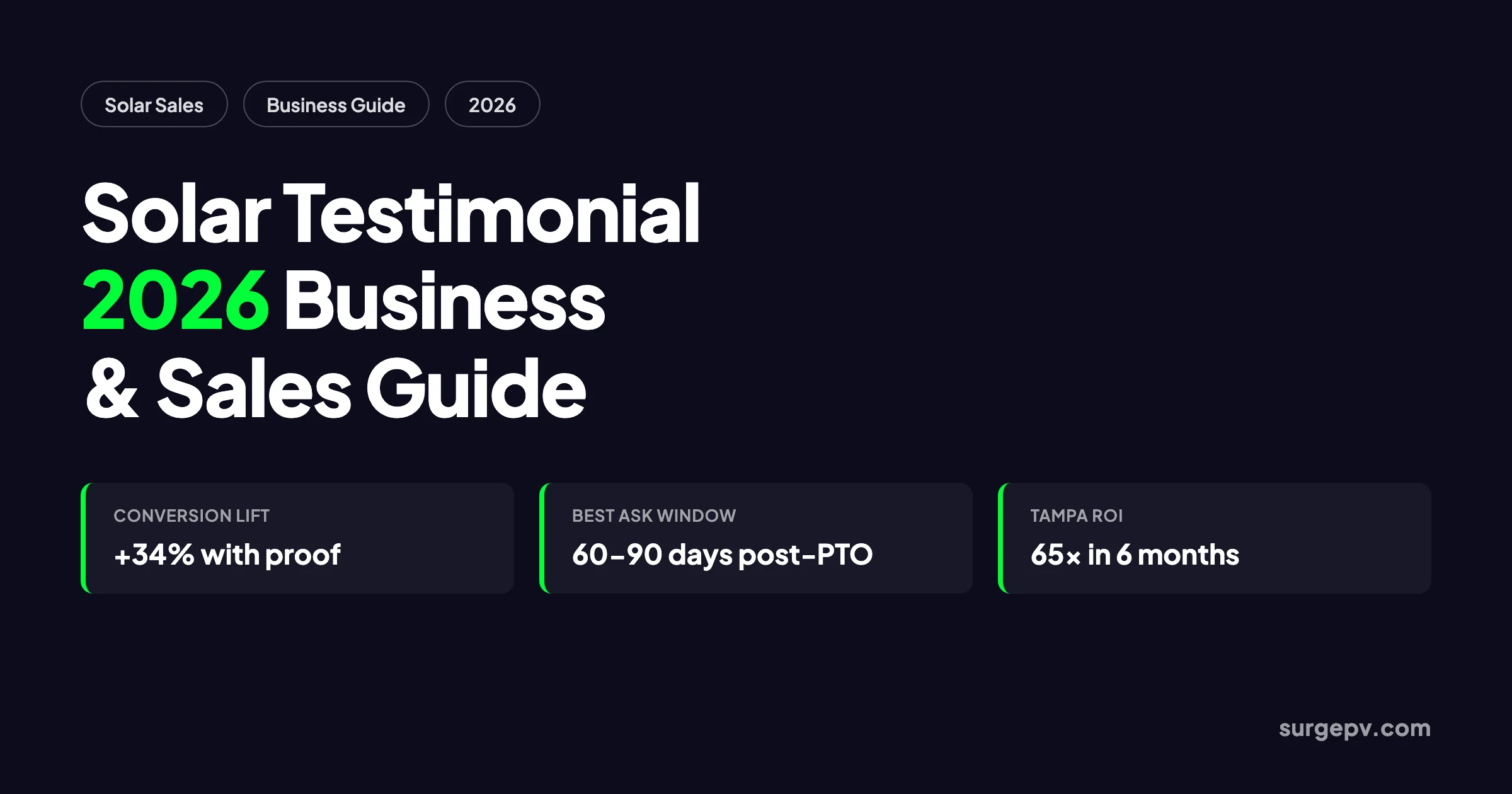
Sales pages with testimonials convert 34% more visitors than those without, according to VWO Testing Insights (2026). Video testimonials at the decision stage often lift close rates by 20-35% when they address the specific objection the prospect raised. Those gains come from moving testimonials out of a generic “trust us” section and into the moment of doubt.
The reason is simple. People trust peers more than brands. Ninety-two percent of consumers trust word-of-mouth and user-generated content more than any other form of advertising, according to CrowdRiff (2024). In solar, where the purchase is large and irreversible, that trust gap is even wider. A testimonial is not a feel-good extra. It is a risk-reduction tool.
The Trust Math for Solar Sales
Different proof points carry different weight:
| Proof type | Typical conversion lift | Best use case |
|---|---|---|
| Generic marketing claim | Baseline | Awareness |
| Star rating badge | 5-12% | Homepage, paid landing page |
| Written testimonial with photo | 15-25% | Service pages, email nurture |
| Video testimonial | 20-35% | Proposal, objection handling |
| Full case study with data | 25-45% | Commercial deals, long-cycle nurture |
The pattern is clear. The more specific and story-driven the proof, the more it moves the sale.
The Solar Testimonial Workflow from Lead to Post-PTO
A testimonial program fails when it is reactive. A sales rep asks the marketing manager for a quote, waits two days, and gets something generic. The prospect has already moved on.
The fix is a repeatable workflow built into your customer lifecycle. Each stage produces a different type of testimonial.
Stage 1: Capture enthusiasm at contract signing
The moment a customer signs is a peak emotional point. They have decided. Their doubt is low. This is the best time to ask for a short quote about why they chose you.
- Ask: “What was the one thing that made you choose us over the other quotes?”
- Record the answer in your CRM note field.
- Use this quote later for prospects who are comparing multiple installers.
Stage 2: Document the install experience
A crew photo or a 30-second voice note from the customer right after install captures fresh detail. These work well for prospects worried about roof damage, mess, or installation disruption. The best clips are unscripted. A customer saying “The crew left the driveway cleaner than they found it” carries more weight than a polished marketing line.
Stage 3: Collect proof at first savings milestone
The strongest testimonials come 60-90 days after permission to operate (PTO). The customer has seen two or three bills. Ask for the exact bill amount before and after solar. A quote like “My July bill was $287 last year and $31 this year” is worth more than any marketing copy.
Stage 4: Build the long-term case study
At the one-year mark, pull production data and annual savings. Turn your best customers into full case studies. These are your closing weapons for commercial deals and long-cycle residential prospects. One detailed case study often replaces three follow-up calls. It gives the prospect something to share with a spouse, partner, or board.
A solar CRM can automate the ask. Trigger a review request at day 75 post-PTO, when savings are fresh and enthusiasm is high. For Indian installers handling PM Surya Ghar subsidy workflows, a tool like QuickEstimate can tie testimonial requests to subsidy disbursement milestones.
Mapping Testimonials to the Solar Buyer’s Journey
Not every testimonial fits every stage. Match the proof to the prospect’s current question.
Awareness stage: star ratings and short quotes
At this stage, prospects do not know you. They are scanning options. Use aggregate star ratings, Google review snippets, and short quotes on landing pages and ads. The goal is to earn the click or the call.
Consideration stage: story-driven written testimonials
Now the prospect is comparing installers. They want to know what it is like to work with you. Written testimonials with photos, neighborhood names, and system details answer that. Place these on service pages and in nurture emails.
Decision stage: video testimonials and case studies
This is where the sale is won or lost. The prospect has a proposal in hand. They need proof that the outcome you promise is real. A video testimonial from a similar home, roof, or use case removes the final doubt.
For example, if the prospect hesitates on financing, share a testimonial from a customer who used the same loan product. If they worry about battery backup, share a customer who weathered an outage. The testimonial must mirror the objection.
Post-sale stage: referral fuel
A happy customer one year in is your best referral source. Repurpose their testimonial into referral campaigns, neighborhood marketing, and review generation. Their voice becomes a lead-generation engine.
Testimonial Formats Sales Teams Can Deploy Quickly
You do not need a production studio to make testimonials useful. Start with formats your team can create today.
Review screenshots
Pull five-star reviews from Google, Yelp, or your Facebook page. Screenshot them with the customer’s name and date visible. These work in emails, texts, and proposal appendices. Keep a folder organized by objection.
Voice notes
Ask a happy customer to record a 30-second voice memo on their phone. Voice notes feel personal and unscripted. They work well in follow-up texts: “Here is what Maria, two blocks from you, said after her first summer with solar.”
Before-and-after bill images
A side-by-side image of an August bill from last year and this year is one of the strongest pieces of proof. Pair it with one sentence from the customer. This format stops the scroll in social feeds and ends debates in sales meetings.
Short video clips
A 45-second video filmed on a smartphone beats a polished studio piece if the content is specific. The customer should answer one question only. “What surprised you most about the process?” is enough. Do not ask for a full life story.
One-page case studies
For commercial prospects, create a single-page PDF with the customer challenge, system size, savings after year one, and a quote. Attach it to the proposal as a leave-behind. Commercial buyers need documents they can forward internally.
The key is to start small. One strong testimonial in the right format beats a library of polished content no one uses. Pick the format that matches your prospect’s biggest objection. If they doubt savings, use a bill image. If they doubt workmanship, use a video. If they need to justify the decision internally, use a one-page case study.
Testimonials Inside Solar Proposals and Sales Decks
A solar proposal is a trust document. It contains numbers the prospect wants to believe but may not. A testimonial placed next to the right section turns skepticism into confidence.
Best placement for each proposal section
| Proposal section | Testimonial type | Example proof point |
|---|---|---|
| Cover / executive summary | Short quote with star rating | “Best decision we made for our home” |
| Financial summary | Written testimonial with savings numbers | “Payback hit in 6.2 years, just like the proposal said” |
| Equipment and design | Video testimonial on install quality | “Crew finished in one day and left no mess” |
| Warranty and service | Long-term customer quote | “Three years in, one email fixed a monitoring issue” |
| Financing options | Customer using same loan product | “The loan payment was $40 less than our average electric bill” |
SurgePV’s solar proposal tools lets reps drop approved testimonials directly into branded proposal templates. That keeps messaging consistent and saves reps from hunting through email threads for a quote.
One rule for proposal testimonials
Never let testimonials drown the call to action. The final page should have one clear next step. For more proposal structure ideas, read our solar proposal presentation tips. Use testimonials to support the sections above, then end clean. A proposal cluttered with quotes looks desperate.
Training Sales Reps to Use Testimonials Correctly
Most reps misuse testimonials. They mention a happy customer in passing or attach a random five-star review. The result is weak. Train reps to treat testimonials like precision tools.
Step 1: Build a searchable library
Tag every testimonial by:
- Objection addressed (roof type, financing, savings, battery, HOA)
- Customer profile (homeowner age, home type, location)
- System type (residential, commercial, battery, ground mount)
- Format (video, written, case study, review screenshot)
A rep facing a prospect worried about HOA approval should find three testimonials from customers who navigated HOAs.
Step 2: Match the testimonial to the stated objection
The golden rule: never introduce a testimonial before the prospect names the concern. If the rep leads with “We have a great customer story,” it feels like a sales pitch. If the rep responds to “I am worried about my roof” with “I understand. Here is what a customer with a tile roof said,” it feels like help.
Step 3: Use the testimonial, then ask a question
After sharing the testimonial, the rep should pause and ask, “Does that address your concern, or is there another part of the process you want to know more about?” This keeps the conversation consultative rather than pushy.
Example role-play: roof-damage objection
Prospect: “I am worried the panels will crack my clay tiles.”
Rep: “I understand. Clay tiles are a real concern. Here is what a customer in Scottsdale said three months after install.” Plays 40-second video. “She had the same tile type. She mentions the mounting foot and the crew’s process. Does that help, or do you want me to walk through the flashing detail?”
This approach names the fear, provides peer proof, and offers a deeper technical follow-up. The prospect feels heard, not sold.
Step 4: Track what works
Log which testimonials appear in won deals. Over time, you will find that 20% of your testimonials drive 80% of the impact. Double down on those.
Measuring Testimonial ROI for Solar Businesses
A testimonial program is an investment. It takes staff time, customer incentives, and production cost. The business case must be clear. These metrics also fit into the broader set of solar sales KPIs every team should track.
Metrics to track
- Lead-to-appointment rate on pages with testimonials vs. pages without.
- Proposal-to-signature rate when a relevant testimonial is included.
- Customer acquisition cost before and after launching a testimonial library.
- Sales cycle length for deals where testimonials were used vs. not used.
- Testimonial-attributed revenue using UTM tags or CRM source fields.
Example ROI calculation
A Tampa installer spent six months building a testimonial library. The investment broke down as:
- Video production: $14,500
- Customer thank-you credits: $3,000
- Internal labor: $2,500
- Total investment: $20,000
Results in the following six months:
- Website conversion rate: 1.8% to 3.4%
- Direct lead inquiries: up 240%
- Estimated additional customers: 67
- Estimated additional revenue: $1.3 million
That is a 65x return on investment. Even if half the attribution is optimistic, the program pays for itself many times over.
What to watch when reporting internally
Be honest about attribution. A testimonial rarely closes a deal alone. It removes friction so the rep, pricing, and proposal can do their jobs. Report it as a conversion-rate contributor, not the sole cause of every win.
Track these secondary signals too:
- Email reply rate when a testimonial is attached vs. a standard follow-up.
- Proposal open rate if your tool tracks document engagement. Testimonials often increase time spent on the financial section.
- Objection reduction in recorded sales calls. Reps who use targeted testimonials report fewer repeated concerns.
A simple formula for any installer
Use this to estimate your own potential return:
- Current monthly website visitors: ______
- Current conversion rate: ______%
- Average project value: $______
- Expected conversion lift from testimonials: 20-35%
- Testimonial program cost: $______
Multiply visitors by the lift by average project value. Compare to cost. Most installers with over 1,000 monthly visitors see payback within one quarter.
Disclosure and Compliance for Solar Testimonials
Testimonials are advertising. That means they are regulated. The FTC’s Endorsement Guides, updated in 2023 and reinforced by 2026 staff guidance, apply to solar testimonials the same way they apply to influencer posts.
What triggers a disclosure
A material connection exists whenever the customer received something of value in exchange for the testimonial. Common examples in solar:
- Service credit or free maintenance
- Referral payment
- Gift card
- Discount on a future upgrade
- Entry into a giveaway or sweepstakes
If any of these were provided, the testimonial must disclose it clearly and conspicuously.
How to disclose
Place the disclosure in or near the testimonial. Do not bury it in a footer or behind a “more” link. For video, include the disclosure visually and audibly. For written quotes, a line like “Customer received a $250 service credit” is enough.
What is prohibited
Fake reviews and testimonials are banned outright under the FTC’s Consumer Review Rule. That includes testimonials written by employees without disclosure, AI-generated fake customer voices, and reviews bought from third parties. Penalties can exceed $50,000 per violation in 2026, according to AuditSocials (2026).
The safest policy is simple: only use real statements from real customers, and disclose any incentive.
Common Testimonial Mistakes Solar Sales Teams Make
Even well-intentioned teams get testimonials wrong. Here are the most common failures and how to fix them.
Mistake 1: Generic praise
“Great company, highly recommend” sounds nice and proves nothing. It does not address cost, quality, savings, or process. Replace generic quotes with specific stories.
Mistake 2: Hiding testimonials on a dedicated page
A “Testimonials” page gets little traffic. Testimonials perform 3-5x better when embedded where the decision happens: on the proposal, the financing page, or the objection-handling email.
Mistake 3: Using only positive reviews
A perfect 5.0-star rating can reduce trust. Research shows purchase likelihood peaks at 4.2 to 4.5 stars, according to Northwestern University’s Spiegel Research Center. A mix of mostly positive reviews with the occasional critical response feels authentic.
Mistake 4: Asking at the wrong time
Asking for a testimonial at contract signing captures excitement but no proof. Asking two years later captures proof but low enthusiasm. The sweet spot is 60-90 days post-PTO, when savings are real and excitement remains.
Mistake 5: Failing to train reps
A testimonial library is useless if reps cannot find it. Invest 30 minutes in onboarding to show reps how to search by objection and format. Then review usage in weekly sales meetings.
Mistake 6: Using AI-generated fake testimonials
AI voice and video tools make it tempting to create a “perfect” testimonial. Do not. The FTC treats AI-generated fake testimonials as a per-se deceptive practice. The reputation damage from one exposed fake review is far worse than the cost of asking a real customer. Use real people, real results, and real disclosures.
Frequently Asked Questions
What is a solar testimonial in a business context?
A solar testimonial is a recorded customer statement used to reduce prospect doubt during the sales process. It can be a video clip, written quote, review screenshot, or full case study that shows real savings, system performance, or installation experience.
How do solar testimonials affect close rates?
Sales pages and proposals with relevant testimonials convert 34% more visitors than those without, according to VWO Testing Insights (2026). Video testimonials at the decision stage often lift close rates by 20-35% when they address the specific objection the prospect raised.
When should a sales rep introduce a testimonial?
Introduce testimonials after the prospect states a specific concern. A testimonial that matches the exact objection, roof type, or financing question is far more persuasive than dropping a generic quote early in the conversation.
What makes a solar testimonial convert instead of just sounding nice?
Specific numbers convert. A testimonial that names the system size, pre-solar bill, post-solar bill, payback period, and one surprise benefit outperforms vague praise by 4-6x. Prospects use these details to imagine their own outcome.
How can a solar company measure testimonial ROI?
Track three metrics: lead-to-appointment rate on pages with testimonials, proposal-to-signature rate when a relevant testimonial is attached, and customer acquisition cost before and after a testimonial library launch. A Tampa installer saw website conversion rise from 1.8% to 3.4% and direct inquiries rise 240% within six months.
Can solar companies pay customers for testimonials?
Yes, but the FTC requires clear disclosure of any material connection. Service credits, referral payments, or free maintenance must be disclosed in or near the testimonial. Penalties for undisclosed endorsements can exceed $50,000 per violation in 2026.
Where should testimonials go in a solar sales proposal?
Place one relevant testimonial next to each major section: savings proof near the financial summary, installation quality near the equipment and warranty section, and post-PTO support near the service terms. Keep the final page focused on the single next step, not a wall of quotes.
How do you get sales reps to actually use testimonials?
Build a searchable testimonial library tagged by objection, system type, location, and financing method. Train reps to match the testimonial to the prospect’s stated concern. Add testimonial usage to your sales playbook and weekly win-loss reviews.
Three Steps to Start This Week
- Audit your current testimonials. Pull every testimonial on your website and proposals. Mark each as specific or generic. Remove or replace anything that lacks numbers or a clear objection.
- Identify five capture candidates. Look at customers who reached 60-90 days post-PTO in the last quarter with measurable savings. Reach out this week with a simple ask.
- Train your sales team. Show reps the searchable library and run a 20-minute role-play. Have each rep match a testimonial to a common objection.
Testimonials work when they stop being decoration and start being sales ammunition. Build the workflow once, and it compounds across every rep, every proposal, and every deal.
See how SurgePV fits into your sales workflow
SurgePV’s solar proposal software, design platform, and generation and financial tool give your team the accurate system data and branded proposals that make every testimonial more credible. Book a demo to see the platform in action.
Where this fits
This article is part of SurgePV's Solar Sales & Proposals hub, which works through the topic from first principles to the decisions a project team actually has to make.


