

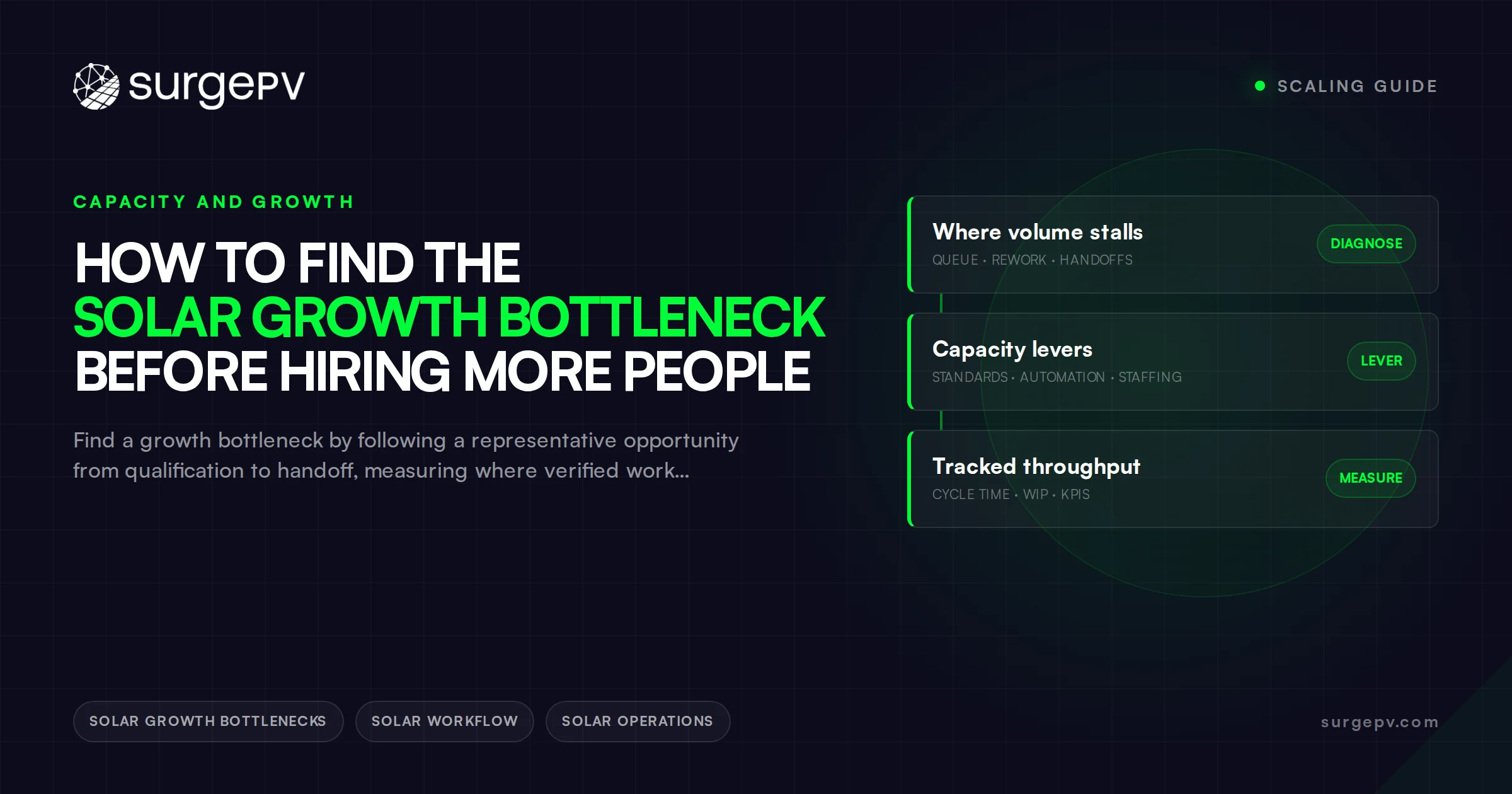
How to Find the Solar Growth Bottleneck Before Hiring More People starts with a simple premise: Find a growth bottleneck by following a representative opportunity from qualification to handoff, measuring where verified work waits or returns, and distinguishing a true capacity constraint from incomplete intake, unclear ownership, or inconsistent project data.
Direct Answer
Find a growth bottleneck by following a representative opportunity from qualification to handoff, measuring where verified work waits or returns, and distinguishing a true capacity constraint from incomplete intake, unclear ownership, or inconsistent project data.
This is a desk-research guide for installers and EPCs. It does not replace engineering, site verification, local code, utility requirements, manufacturer instructions, commercial judgment, or a project-specific review. Its purpose is to make solar growth bottlenecks decisions explainable before they affect a proposal, purchase, schedule, or handoff.
Follow one opportunity end to end
Choose a recent job that changed direction and reconstruct its path. Note what was known at qualification, what was re-entered, who waited for whom, and which decision created a loop. A real path exposes bottlenecks better than a general opinion survey.
For solar growth bottlenecks, make the review traceable: identify the source, date, owner, status, and consequence of the item being discussed. That record lets another person challenge the assumption without restarting the project conversation. In solar growth bottlenecks work, a controlled uncertainty is different from an unrecorded guess.
A useful question is what information would change this solar growth bottlenecks decision. If the answer is material, ask for evidence or set a release condition. If it is not material, record why the team can proceed. This keeps attention on the project rather than on a generic checklist.
Look for return work, not only queue size
A queue may be healthy if it contains well-defined work with a clear release rule. Repeated returns—proposal back to design, design back to sales, handoff back to estimating—are often a more costly signal.
For solar growth bottlenecks, make the review traceable: identify the source, date, owner, status, and consequence of the item being discussed. That record lets another person challenge the assumption without restarting the project conversation. In solar growth bottlenecks work, a controlled uncertainty is different from an unrecorded guess.
A useful question is what information would change this solar growth bottlenecks decision. If the answer is material, ask for evidence or set a release condition. If it is not material, record why the team can proceed. This keeps attention on the project rather than on a generic checklist.
Test the quality of the intake
A missing bill, roof photograph, tariff detail, site constraint, or customer goal can move a problem downstream. Define the smallest evidence set required before a project is treated as design-ready.
For solar growth bottlenecks, make the review traceable: identify the source, date, owner, status, and consequence of the item being discussed. That record lets another person challenge the assumption without restarting the project conversation. In solar growth bottlenecks work, a controlled uncertainty is different from an unrecorded guess.
A useful question is what information would change this solar growth bottlenecks decision. If the answer is material, ask for evidence or set a release condition. If it is not material, record why the team can proceed. This keeps attention on the project rather than on a generic checklist.
Make solar growth bottlenecks easier to review
See how SurgePV can connect the project inputs and outputs behind solar growth bottlenecks work.
Book a DemoSeparate a decision bottleneck from a skill bottleneck
A team may have capable people but no named person to resolve a scope or commercial question. Assigning an owner and deadline can remove a decision wait without altering staffing.
For solar growth bottlenecks, make the review traceable: identify the source, date, owner, status, and consequence of the item being discussed. That record lets another person challenge the assumption without restarting the project conversation. In solar growth bottlenecks work, a controlled uncertainty is different from an unrecorded guess.
A useful question is what information would change this solar growth bottlenecks decision. If the answer is material, ask for evidence or set a release condition. If it is not material, record why the team can proceed. This keeps attention on the project rather than on a generic checklist.
Check whether tools fragment the project record
When values are copied between a CRM, design file, spreadsheet, and proposal, a team spends time reconciling rather than progressing. Identify the authoritative field for each material decision.
For solar growth bottlenecks, make the review traceable: identify the source, date, owner, status, and consequence of the item being discussed. That record lets another person challenge the assumption without restarting the project conversation. In solar growth bottlenecks work, a controlled uncertainty is different from an unrecorded guess.
A useful question is what information would change this solar growth bottlenecks decision. If the answer is material, ask for evidence or set a release condition. If it is not material, record why the team can proceed. This keeps attention on the project rather than on a generic checklist.
Choose a narrow improvement test
Change one input requirement, approval rule, or record location for a short review period. Document the intended effect and unexpected consequences rather than declaring a universal gain.
For solar growth bottlenecks, make the review traceable: identify the source, date, owner, status, and consequence of the item being discussed. That record lets another person challenge the assumption without restarting the project conversation. In solar growth bottlenecks work, a controlled uncertainty is different from an unrecorded guess.
A useful question is what information would change this solar growth bottlenecks decision. If the answer is material, ask for evidence or set a release condition. If it is not material, record why the team can proceed. This keeps attention on the project rather than on a generic checklist.
Recheck the bottleneck after intervention
Relieving one constraint can reveal the next one. Keep the measurement tied to work readiness and rework, not an assumption that every faster stage automatically improves the whole business.
For solar growth bottlenecks, make the review traceable: identify the source, date, owner, status, and consequence of the item being discussed. That record lets another person challenge the assumption without restarting the project conversation. In solar growth bottlenecks work, a controlled uncertainty is different from an unrecorded guess.
A useful question is what information would change this solar growth bottlenecks decision. If the answer is material, ask for evidence or set a release condition. If it is not material, record why the team can proceed. This keeps attention on the project rather than on a generic checklist.
Applying solar growth bottlenecks without creating a paperwork burden
A solar growth bottlenecks process should make a live decision easier, not ask a team to duplicate a project record. Use the smallest evidence set that changes the next choice and make its status visible. In solar growth bottlenecks work, an item can be confirmed, estimated, pending, or superseded; those labels are more useful than a false sense of finality.
When an assumption changes, ask which related outputs require review. A solar growth bottlenecks change can affect a design, price, schedule, customer explanation, or handoff. The responsible person should not have to infer the impact from a collection of disconnected files. Document the trigger and the appropriate reviewer before the change becomes someone else’s surprise.
The operational benefit of solar growth bottlenecks clarity is continuity. A salesperson, designer, buyer, and project manager may each see the same job at different moments. They do not need identical tasks, but they need a common statement of the active version, material constraints, and next action. That is how a fast-moving opportunity remains reviewable.
Questions to ask at the next solar growth bottlenecks review
Ask whether the underlying facts are current, whether the work is ready for its next stage, whether any promise has outrun its evidence, and whether a named owner can resolve each open condition. For solar growth bottlenecks, these questions identify decision friction before it becomes rework.
Do not turn this article into a prediction about outcomes. Project conditions, local rules, customer timing, supplier availability, and team choices vary. The purpose of a solar growth bottlenecks review is to improve the quality and traceability of the decision at hand.
Make the solar growth bottlenecks decision auditable
Before release, identify the record that governs the current solar growth bottlenecks decision, the date it was last checked, and the person who can answer a challenge. If a customer-facing document includes a figure or scope that depends on the decision, link it to the same revision. This approach does not require certainty where none exists; it requires an honest status.
For solar growth bottlenecks, a concise exception note is often more effective than a long generic checklist. State the exception, the evidence still needed, the possible impact, and the next review point. The next teammate can then act from context instead of reopening the entire opportunity.
A project team should periodically inspect whether its solar growth bottlenecks controls are helping people make decisions or merely creating parallel paperwork. Remove fields that do not inform a decision and strengthen the ones that expose material changes. That keeps the process useful as workload and project mix evolve.
For solar growth bottlenecks, communicate the current basis, the material limitations, and the next verification step in the same language used by the project record. A decision remains easier to review when its explanation does not change between sales, design, and operations.
Evidence, limits, and customer communication
The National Renewable Energy Laboratory photovoltaic resources and the U.S. Department of Energy Solar Energy Technologies Office provide public technical context. They do not validate an individual project. For solar growth bottlenecks, keep the project’s own inputs, dates, and review record available to the people who need to make the next decision.
For a connected workflow, see SurgePV. It can help keep solar growth bottlenecks inputs and customer-ready outputs in one place; it does not promise a particular time saving, approval, or commercial outcome.
Frequently Asked Questions
What is the first solar growth bottlenecks check?
Start with the current project facts, their sources, and the decision they support.
Can a workflow remove all solar project uncertainty?
No. It can make solar growth bottlenecks uncertainty visible, owned, and easier to review.
When should the record be updated?
Update it whenever a material site fact, configuration, scope, assumption, or customer commitment changes.
Ready to strengthen solar growth bottlenecks?
Book a personalized SurgePV demo to explore a connected solar growth bottlenecks workflow.
Book a Free DemoSources
Primary research and reference material used for this desk-research article.
Where this fits
This article is part of SurgePV's Solar Business & Operations hub, which works through the topic from first principles to the decisions a project team actually has to make.

