

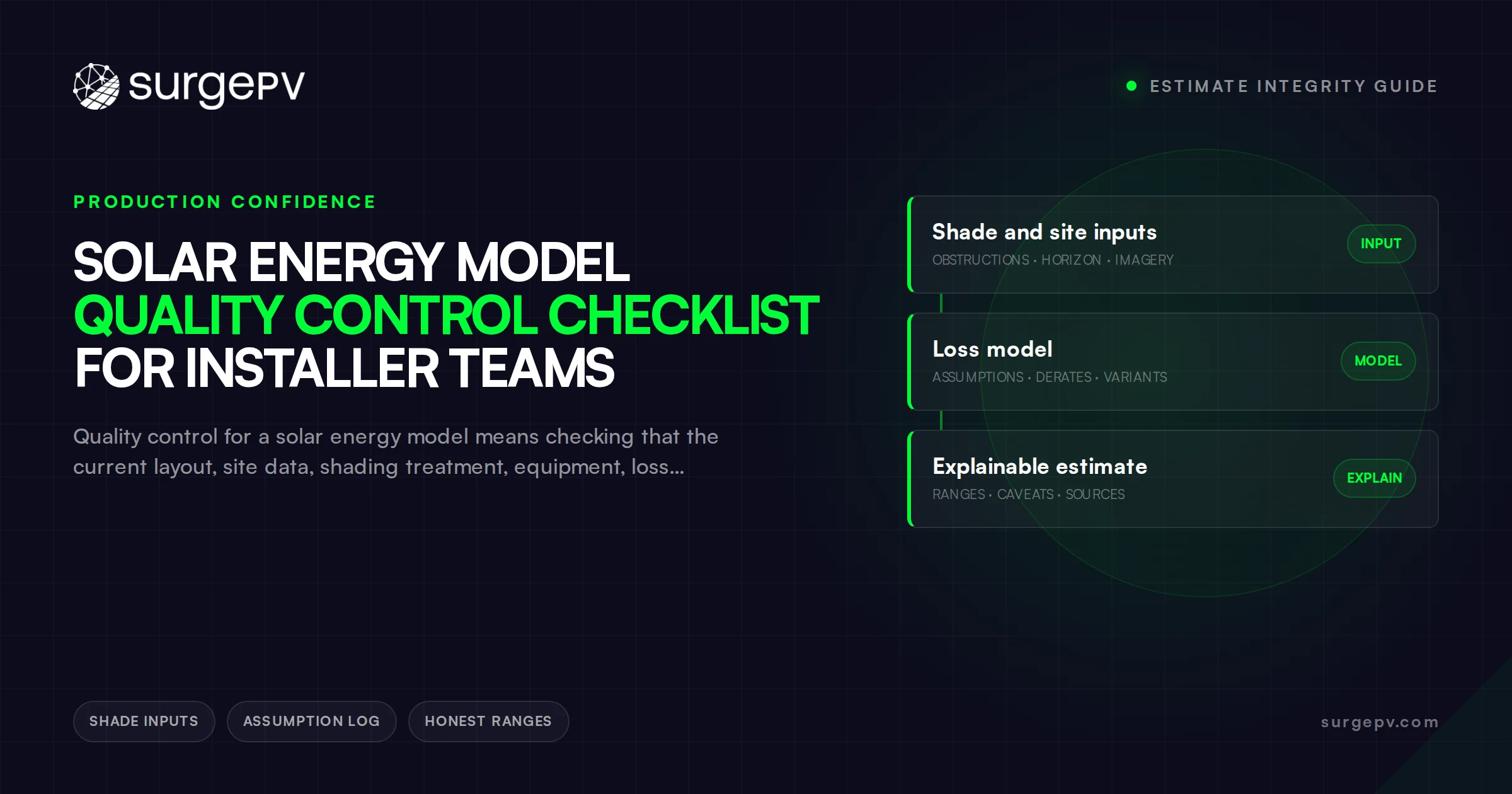
Solar Energy Model Quality Control Checklist for Installer Teams starts with a simple premise: Quality control for a solar energy model means checking that the current layout, site data, shading treatment, equipment, loss assumptions, weather inputs, and reported outputs are traceable, internally consistent, and clearly limited by their stated assumptions.
Direct Answer
Quality control for a solar energy model means checking that the current layout, site data, shading treatment, equipment, loss assumptions, weather inputs, and reported outputs are traceable, internally consistent, and clearly limited by their stated assumptions.
This is a desk-research guide for installers and EPCs. It does not replace engineering, site verification, local code, utility requirements, manufacturer instructions, commercial judgment, or a project-specific review. Its purpose is to make solar energy model quality control decisions explainable before they affect a proposal, purchase, schedule, or handoff.
Check the design basis first
Confirm which roof planes, module count, orientation, tilt, and equipment configuration the model represents. An accurate calculation applied to an old layout is not a current project result.
For solar energy model quality control, make the review traceable: identify the source, date, owner, status, and consequence of the item being discussed. That record lets another person challenge the assumption without restarting the project conversation. In solar energy model quality control work, a controlled uncertainty is different from an unrecorded guess.
A useful question is what information would change this solar energy model quality control decision. If the answer is material, ask for evidence or set a release condition. If it is not material, record why the team can proceed. This keeps attention on the project rather than on a generic checklist.
Trace site and resource inputs
Record the source and date of imagery, site information, weather or resource data, and obstruction assumptions. Public sources are useful context, but project suitability depends on the selected method and current site evidence.
For solar energy model quality control, make the review traceable: identify the source, date, owner, status, and consequence of the item being discussed. That record lets another person challenge the assumption without restarting the project conversation. In solar energy model quality control work, a controlled uncertainty is different from an unrecorded guess.
A useful question is what information would change this solar energy model quality control decision. If the answer is material, ask for evidence or set a release condition. If it is not material, record why the team can proceed. This keeps attention on the project rather than on a generic checklist.
Review shade treatment
Identify whether roof features, vegetation, adjacent objects, horizon effects, and seasonal conditions are represented or excluded. If a material shade fact is unknown, label it instead of converting it into a confident annual result.
For solar energy model quality control, make the review traceable: identify the source, date, owner, status, and consequence of the item being discussed. That record lets another person challenge the assumption without restarting the project conversation. In solar energy model quality control work, a controlled uncertainty is different from an unrecorded guess.
A useful question is what information would change this solar energy model quality control decision. If the answer is material, ask for evidence or set a release condition. If it is not material, record why the team can proceed. This keeps attention on the project rather than on a generic checklist.
Make solar energy model quality control easier to review
See how SurgePV can connect the project inputs and outputs behind solar energy model quality control work.
Book a DemoName loss and performance assumptions
Temperature, soiling, mismatch, wiring, inverter behavior, availability, clipping, and other assumptions should be reviewed according to the model. Do not conceal a collection of assumptions behind a single unexplained result.
For solar energy model quality control, make the review traceable: identify the source, date, owner, status, and consequence of the item being discussed. That record lets another person challenge the assumption without restarting the project conversation. In solar energy model quality control work, a controlled uncertainty is different from an unrecorded guess.
A useful question is what information would change this solar energy model quality control decision. If the answer is material, ask for evidence or set a release condition. If it is not material, record why the team can proceed. This keeps attention on the project rather than on a generic checklist.
Validate output consistency
Compare system size, annual generation, specific yield where used, configuration, and proposal figures to the source model. Outliers are prompts for investigation, not proof that a number is wrong.
For solar energy model quality control, make the review traceable: identify the source, date, owner, status, and consequence of the item being discussed. That record lets another person challenge the assumption without restarting the project conversation. In solar energy model quality control work, a controlled uncertainty is different from an unrecorded guess.
A useful question is what information would change this solar energy model quality control decision. If the answer is material, ask for evidence or set a release condition. If it is not material, record why the team can proceed. This keeps attention on the project rather than on a generic checklist.
Separate generation from economics
A production model does not settle savings, payback, or financing. Those also depend on load, tariff, export treatment, incentives, and other financial assumptions that need their own sources and review.
For solar energy model quality control, make the review traceable: identify the source, date, owner, status, and consequence of the item being discussed. That record lets another person challenge the assumption without restarting the project conversation. In solar energy model quality control work, a controlled uncertainty is different from an unrecorded guess.
A useful question is what information would change this solar energy model quality control decision. If the answer is material, ask for evidence or set a release condition. If it is not material, record why the team can proceed. This keeps attention on the project rather than on a generic checklist.
Release with limitations
State that outputs are modeled estimates and list material conditions that could change them. This helps customers and internal teams understand what the figure can and cannot support.
For solar energy model quality control, make the review traceable: identify the source, date, owner, status, and consequence of the item being discussed. That record lets another person challenge the assumption without restarting the project conversation. In solar energy model quality control work, a controlled uncertainty is different from an unrecorded guess.
A useful question is what information would change this solar energy model quality control decision. If the answer is material, ask for evidence or set a release condition. If it is not material, record why the team can proceed. This keeps attention on the project rather than on a generic checklist.
Turning solar energy model quality control guidance into a live project decision
The value of solar energy model quality control is not a larger document set. It is a shared way to state the governing project version, the evidence supporting it, and the conditions that remain open. Ask the person responsible for the next action to confirm that they can find those facts without reconstructing a chain of chats, attachments, or memory.
For solar energy model quality control, separate an estimate from a confirmed project fact. A team may reasonably proceed with a labeled estimate while an item is pending, but it should define what will confirm the item and which customer-facing output must change if the answer differs. This prevents a preliminary assumption from quietly becoming a delivery commitment.
Use the solar energy model quality control record to coordinate, not to prove that all uncertainty is gone. Local requirements, site conditions, equipment documentation, supplier availability, buyer decisions, and engineering judgment can change a job. The record should show how those conditions are being handled at this stage.
A concise solar energy model quality control exception note
When the normal workflow cannot be followed, write an exception note with the reason, source, potential impact, owner, due date, and release status. A concise solar energy model quality control exception is easier to review than a silent workaround. It also gives the next team member a legitimate way to escalate a decision rather than inherit an unexplained risk.
Maintain continuity across solar energy model quality control handoffs
Project work crosses roles. Sales may own the buyer discussion; design may own a configuration; operations may own delivery readiness. In solar energy model quality control, each role needs an accurate current state and a clear next action. The best handoff is not merely fast: it allows the receiving role to see the original basis and raise a material question before work advances.
Review whether solar energy model quality control controls are earning their place
Periodically ask whether a required field, checklist item, or approval identifies a real decision. Remove duplicate data entry and preserve the fields that reveal source, change, ownership, and customer impact. This lets solar energy model quality control process discipline scale without becoming a generic administrative burden.
For solar energy model quality control, do not promise a particular commercial, scheduling, or technical outcome from this method. Use the method to make the current decision evidence-led and reviewable.
For solar energy model quality control, finish each review by naming what the current record supports, what it does not support, and who will resolve the next material condition. This sentence of closure keeps customer communication and internal action connected to the same project basis.
Evidence, limits, and customer communication
The National Renewable Energy Laboratory photovoltaic resources and the U.S. Department of Energy Solar Energy Technologies Office provide public technical context. They do not validate an individual project. For solar energy model quality control, keep the project’s own inputs, dates, and review record available to the people who need to make the next decision.
For a connected workflow, see SurgePV. It can help keep solar energy model quality control inputs and customer-ready outputs in one place; it does not promise a particular time saving, approval, or commercial outcome.
Frequently Asked Questions
What is the first solar energy model quality control check?
Start with the current project facts, their sources, and the decision they support.
Can a workflow remove all solar project uncertainty?
No. It can make solar energy model quality control uncertainty visible, owned, and easier to review.
When should the record be updated?
Update it whenever a material site fact, configuration, scope, assumption, or customer commitment changes.
Ready to strengthen solar energy model quality control?
Book a personalized SurgePV demo to explore a connected solar energy model quality control workflow.
Book a Free DemoSources
Primary research and reference material used for this desk-research article.
Where this fits
This article is part of SurgePV's Solar Business & Operations hub, which works through the topic from first principles to the decisions a project team actually has to make.

