
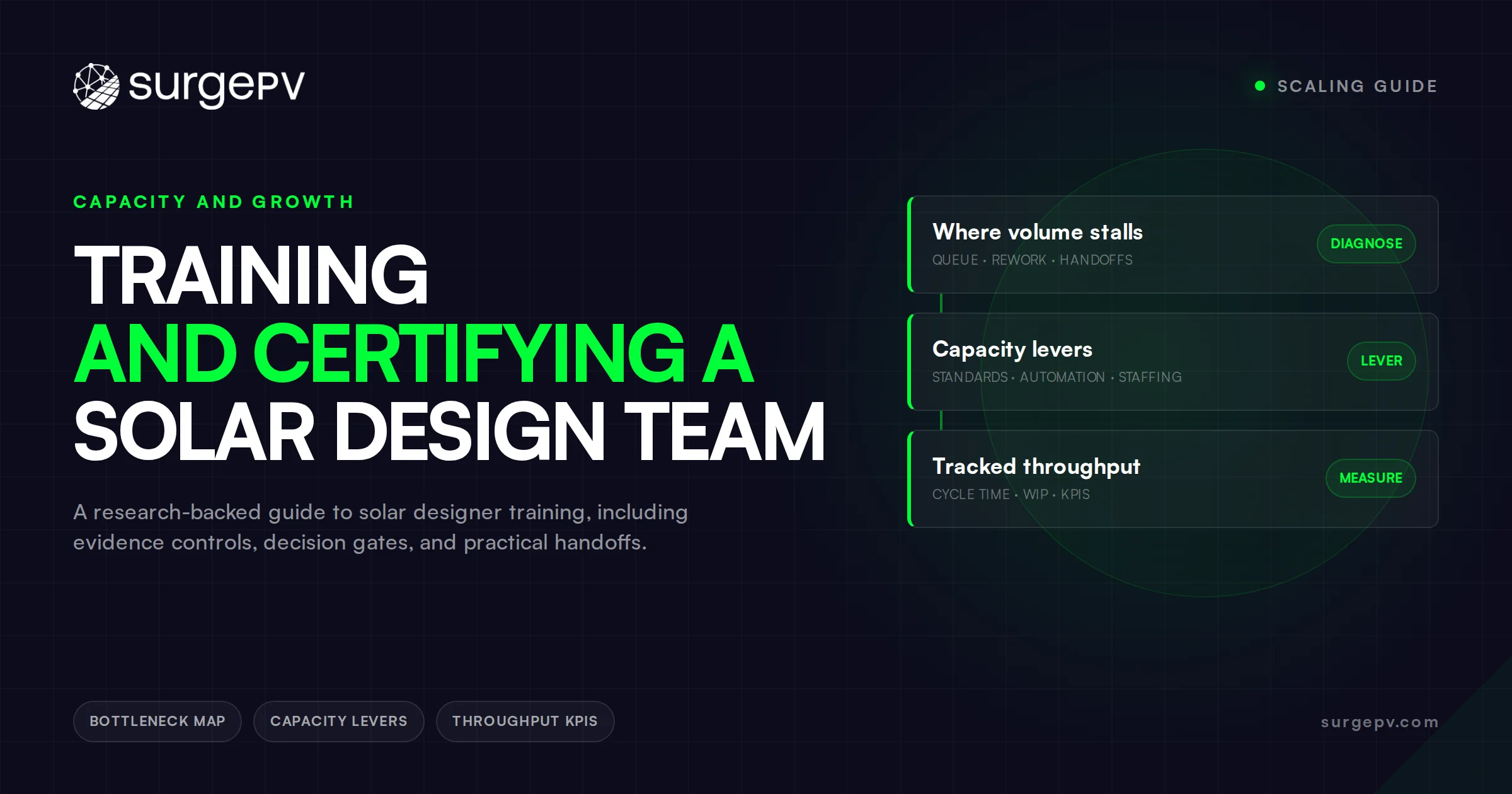
A strong training curriculum begins with a defined decision and a source record that another person can inspect. Solar projects move through sales, design, engineering, procurement, permitting, construction, and customer communication; speed at one point is not useful if it creates an untraceable assumption downstream. This guide is desk research. It explains a practical control framework and does not claim a universal outcome, approval, saving, or benchmark.
Build training around decision rights, not software menus.
A new designer needs to know which site records are authoritative, which results require review, and when to escalate a layout, electrical, or financial question. Use a competency map for intake, geometry, layout, stringing, shading, yield assumptions, proposal handoff, and revision control. Each competency should contain a practice project and observable acceptance criteria. The assessment should ask the learner to explain an assumption and locate its source, not merely reproduce a click sequence.
Identify the information that changes the decision
Create a short register for the facts that materially change scope, risk, or the next action. For each item, retain the source, retrieval date, project owner, confidence, and status. Address, utility information, site records, equipment constraints, customer priorities, and authority requirements often belong in this register. Separate a confirmed fact from a planning assumption. When information is missing, state the permitted next action rather than silently inventing a value.
NREL’s solar research and analysis collection provides useful public research context. For live work, the controlling evidence remains the applicable authority, utility, contract, equipment documentation, and site evidence. A published article is not a substitute for those records.
Set gates where an error becomes consequential
A gate is a clear rule that requires a named reviewer before a result can be relied on. Good gates occur before a customer-facing projection, permit package, procurement commitment, or construction instruction. Define the trigger, the evidence required, and the role that can clear it. An exception path is equally important: unusual projects should be routed with their unresolved question attached, rather than forced through a standard process.
Use solar design software as a connected record for design work where appropriate, but do not confuse a completed screen with a verified project condition. A layout, energy estimate, or proposal is only as reliable as its source inputs and review status.
Test the handoff with a representative project
Choose a routine project, a project with incomplete information, and an exception. Freeze the inputs, run the process, and ask the receiving colleague to complete their task without a verbal briefing. Can they identify the source? Can they tell what changed? Can they see the next owner and the unresolved condition? This is more useful than a feature demonstration because it tests the actual working relationship between teams.
The IEA PVPS programme offers publications on PV systems and markets. It can inform questions and terminology, but it does not determine a local technical or commercial decision. Keep local evidence with the project.
Design Solar Projects Faster with SurgePV
See how connected design, analysis, and proposal work can support clearer project handoffs.
Book a DemoNo commitment required · 20 minutes · Live project walkthrough
Make revisions legible
Projects change. A useful process records which input changed, why it changed, who reviewed the consequence, and which output version it affected. This protects the team from accidental reuse of an old value and gives customers a clearer explanation when scope changes. Version history need not be elaborate; a dated record with a decision note is often enough.
Generation & Financial Tool is the relevant SurgePV product area for generation and financial analysis, while Solar Proposals is relevant for customer-facing project explanations. Any forecast should state its assumptions and should not be presented as a guarantee.
Put ownership into the operating procedure
A procedure without an owner becomes stale. Assign one person or role to maintain the checklist, review repeated exceptions, and trigger updates when new markets, equipment, regulations, or project types change the evidence requirements. Review actual exceptions periodically. If the same issue occurs often, improve the standard intake or handoff rather than relying on memory.
Conclusion
solar designer training is most dependable when the team can show what it decided, what evidence supports that decision, and what remains to be verified. Start narrow, test handoffs, and preserve sources as the workflow expands.
- Keep confirmed facts separate from assumptions.
- Escalate exceptions through a named review path.
- Make source, version, and next owner visible at every handoff.
Ready to Speed Up Your Solar Workflow?
Explore SurgePV for connected solar design, analysis, and proposal work.
Book a DemoFrequently Asked Questions
What evidence should a team retain?
Use a documented review cadence
Schedule a short review at a meaningful project boundary, not simply at the end of a calendar period. Review the source record, unresolved conditions, handoff notes, and the output version that the next role will use. This avoids a common failure mode: a team fixes a document after a problem appears but never changes the upstream decision rule that allowed the problem through.
The review should produce one of three outcomes: accept the work, return it with a specific evidence request, or route it as an exception. Record the outcome in the project rather than a private message. That gives the next reviewer context and lets the process owner identify recurring friction without converting internal observations into public performance claims.
Keep claims proportionate to evidence
A clean workflow can improve clarity and reduce re-entry, but its local effect depends on project mix, team structure, and source quality. Describe the control that exists rather than promising a time saving, approval, commercial outcome, or accuracy level. When a team wants to publish a benchmark, it should retain the underlying method, data, and evidence record required by the site’s publication governance.
Retain the source records, assumptions, versions, review decision, and open conditions that materially affect the next project decision. Local authorities, utilities, contracts, and qualified reviewers determine what is required for a particular project.
When should the process be revised?
Revise it after recurring exceptions, a change in project type or geography, a material product change, or a new authority requirement. Keep a dated change note so users can tell which procedure applies.
For a solar team, a strong training curriculum begins with a defined decision and a source record that another person can inspect. Solar projects move through sales, design, engineering, procurement, permitting, construction, and customer communication; speed at one point is not useful if it creates an untraceable assumption downstream. This guide is desk research. It explains a practical control framework and does not claim a universal outcome, approval, saving, or benchmark.
Practical application: Build training around decision rights, not software menus.
A new designer needs to know which site records are authoritative, which results require review, and when to escalate a layout, electrical, or financial question. Use a competency map for intake, geometry, layout, stringing, shading, yield assumptions, proposal handoff, and revision control. Each competency should contain a practice project and observable acceptance criteria. The assessment should ask the learner to explain an assumption and locate its source, not merely reproduce a click sequence.
Practical application: Identify the information that changes the decision
Create a short register for the facts that materially change scope, risk, or the next action. For each item, retain the source, retrieval date, project owner, confidence, and status. Address, utility information, site records, equipment constraints, customer priorities, and authority requirements often belong in this register. Separate a confirmed fact from a planning assumption. When information is missing, state the permitted next action rather than silently inventing a value.
NREL’s solar research and analysis collection provides useful public research context. For live work, the controlling evidence remains the applicable authority, utility, contract, equipment documentation, and site evidence. A published article is not a substitute for those records.
Practical application: Set gates where an error becomes consequential
A gate is a clear rule that requires a named reviewer before a result can be relied on. Good gates occur before a customer-facing projection, permit package, procurement commitment, or construction instruction. Define the trigger, the evidence required, and the role that can clear it. An exception path is equally important: unusual projects should be routed with their unresolved question attached, rather than forced through a standard process.
Use solar design software as a connected record for design work where appropriate, but do not confuse a completed screen with a verified project condition. A layout, energy estimate, or proposal is only as reliable as its source inputs and review status.
Teach the review conversation
Choose a routine project, a project with incomplete information, and an exception. Freeze the inputs, run the process, and ask the receiving colleague to complete their task without a verbal briefing. Can they identify the source? Can they tell what changed? Can they see the next owner and the unresolved condition? This is more useful than a feature demonstration because it tests the actual working relationship between teams.
The IEA PVPS programme offers publications on PV systems and markets. It can inform questions and terminology, but it does not determine a local technical or commercial decision. Keep local evidence with the project.
Assess explanation before speed
When a learner submits a practice design, ask them to explain the source of the roof geometry, the status of the electrical assumptions, the reason for a layout choice, and the condition that would cause the design to change. That conversation reveals whether they can identify uncertainty. It is more useful than judging a learner only by how quickly they reproduce a finished drawing.
Give reviewers a small assessment rubric that uses observable evidence. For example, a reviewer can confirm whether the learner cited the current source record, labeled an assumption, selected the correct escalation path, and made a revision traceable. The rubric should not pretend to replace the professional judgment required for engineering, electrical, structural, permitting, or contractual matters. It simply makes the training decision consistent and explainable.
Practical application: Make revisions legible
Projects change. A useful process records which input changed, why it changed, who reviewed the consequence, and which output version it affected. This protects the team from accidental reuse of an old value and gives customers a clearer explanation when scope changes. Version history need not be elaborate; a dated record with a decision note is often enough.
Generation & Financial Tool is the relevant SurgePV product area for generation and financial analysis, while Solar Proposals is relevant for customer-facing project explanations. Any forecast should state its assumptions and should not be presented as a guarantee.
Practical application: Put ownership into the operating procedure
A procedure without an owner becomes stale. Assign one person or role to maintain the checklist, review repeated exceptions, and trigger updates when new markets, equipment, regulations, or project types change the evidence requirements. Review actual exceptions periodically. If the same issue occurs often, improve the standard intake or handoff rather than relying on memory.
Practical application: Conclusion
solar designer training is most dependable when the team can show what it decided, what evidence supports that decision, and what remains to be verified. Start narrow, test handoffs, and preserve sources as the workflow expands.
- Keep confirmed facts separate from assumptions.
- Escalate exceptions through a named review path.
- Make source, version, and next owner visible at every handoff.
Training is not authorization
Completing a lesson or reproducing an example does not, by itself, authorize a designer to clear a technical, electrical, contractual, or jurisdiction-specific decision. The organisation should define who may review and approve each decision, what evidence they need, and how learners request assistance. That boundary protects both the learner and the project.
Frequently Asked Questions
What evidence should a team retain?
Retain the source records, assumptions, versions, review decision, and open conditions that materially affect the next project decision. Local authorities, utilities, contracts, and qualified reviewers determine what is required for a particular project.
When should the process be revised?
Revise it after recurring exceptions, a change in project type or geography, a material product change, or a new authority requirement. Keep a dated change note so users can tell which procedure applies.
Sources
Primary research and reference material used for this desk-research article.
Where this fits
This article is part of SurgePV's Solar Business & Operations hub, which works through the topic from first principles to the decisions a project team actually has to make.


