Quick Answer
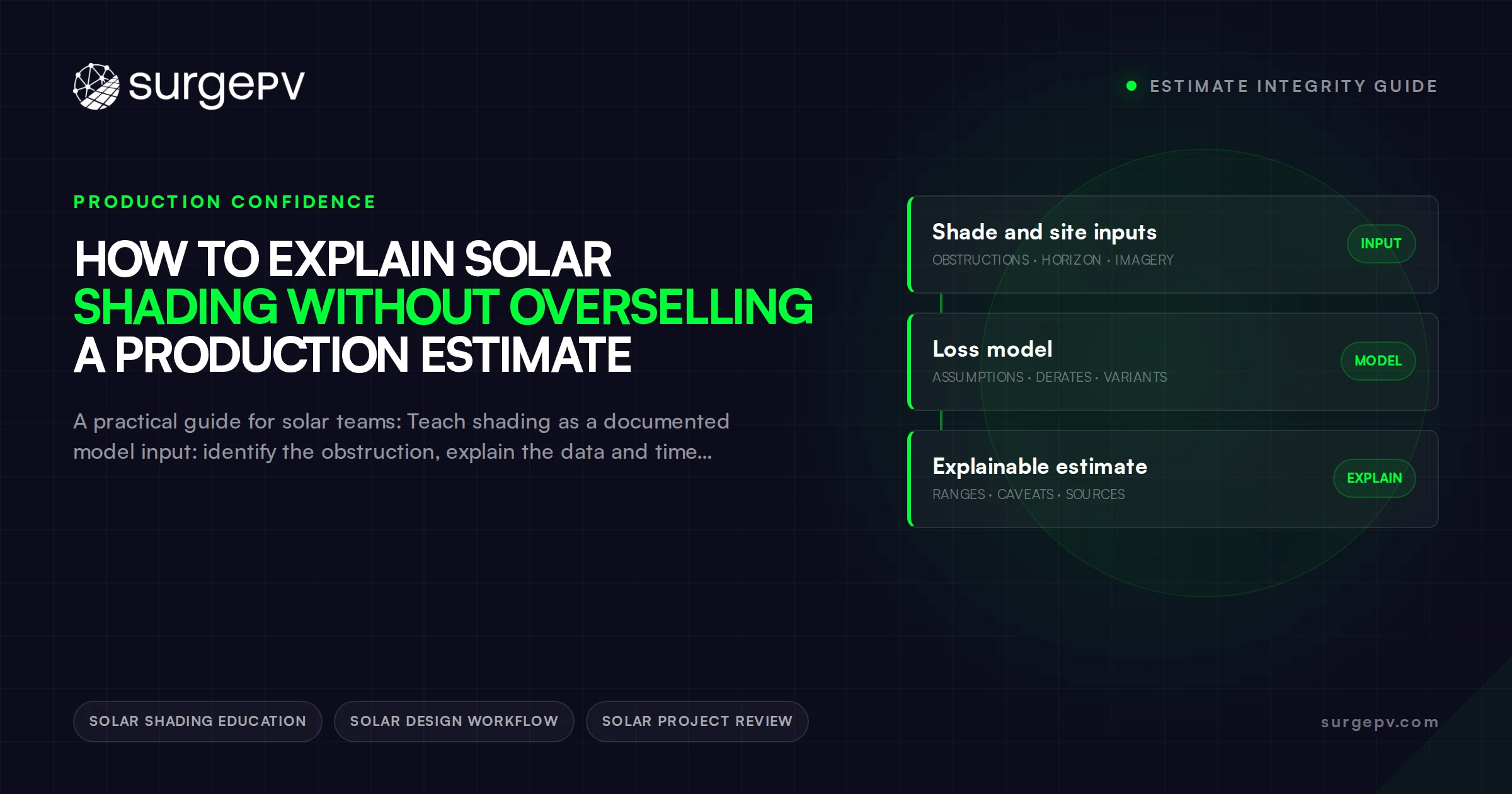
Teach shading as a documented model input: identify the obstruction, explain the data and time period used, distinguish it from a site survey, and show how a changed assumption changes the estimate.
A homeowner pointing at a mature tree is rarely asking for a lecture on geometry. They are asking whether the proposed solar system will still make sense when the tree casts a long winter shadow. The useful answer is specific about evidence and humble about uncertainty.
Direct Answer
Teach shading as a documented model input: identify the obstruction, explain the data and time period used, distinguish it from a site survey, and show how a changed assumption changes the estimate.
Why this review belongs in the project workflow
Solar shading education is most useful when it leaves a traceable decision rather than an isolated image, spreadsheet, or conversation. Solar proposals combine site facts, design assumptions, modeled outputs, and commercial information. A change in one can make another less reliable. The workflow should therefore show what is confirmed, what is estimated, and what must be revisited before release.
The article is desk research for installers and EPCs. It is not engineering advice, a site survey, or a guarantee of production, approval, savings, cost, or delivery outcomes. Use applicable local rules, equipment documentation, utility requirements, and qualified review for the project at hand.
Begin with the decision, not the software screen
Shading education works when the sales conversation starts with the customer decision: is the array location, system size, or production range credible enough to move ahead? A heat map, a three-dimensional roof model, and a percentage are inputs to that decision; they are not a promise of annual output. State the proposed array area, the major obstruction being considered, and the next fact that could materially change the answer. This stops an impressive visual from being mistaken for a completed site assessment.
A useful working question at this stage is: “What fact would make this solar shading education decision different?” For solar shading education, the answer should be placed in the project record with its source, date, and owner. That approach directs attention to material uncertainty instead of adding a generic approval step.
For a solar shading education sales and design team, for solar shading education, the value is shared language. In solar shading education, the person preparing the customer material can see the current status, while the person responsible for technical review can see which assumption is driving the conversation. For solar shading education, no public resource can determine the right answer for an individual site; local requirements, manufacturer documentation, and competent project review still govern the work.
For solar shading education, make the check observable: state the input, the method used to evaluate it, the reviewer, and the condition that would force a revision. In solar shading education review, the next person needs an intelligible record rather than a finished image with no decision trail.
The solar shading education record should also distinguish an operational choice from a technical conclusion. In a solar shading education workflow, the team may advance a qualified opportunity while marking a site fact as unresolved; it should not silently turn that unresolved fact into a final representation.
Name the four kinds of shade
A productive explanation separates horizon effects, nearby buildings or roof structures, vegetation, and self-shading between rows or roof planes. Each category changes through a different mechanism. A chimney is usually stable but may be missed in low-resolution imagery. A tree can grow, be pruned, or be removed. A neighboring development may not exist in current aerial data. Ask which objects are present, which have been measured, and which are represented only by assumptions.
For a solar shading education sales and design team, for solar shading education, the value is shared language. In solar shading education, the person preparing the customer material can see the current status, while the person responsible for technical review can see which assumption is driving the conversation. For solar shading education, no public resource can determine the right answer for an individual site; local requirements, manufacturer documentation, and competent project review still govern the work.
In solar shading education work, this is also a communication practice. A customer can accept that a preliminary model has limits when those limits are described before a commitment is implied. In solar shading education, vague confidence creates a later trust problem; a named assumption creates a path to resolve it.
For solar shading education, make the check observable: state the input, the method used to evaluate it, the reviewer, and the condition that would force a revision. In solar shading education review, the next person needs an intelligible record rather than a finished image with no decision trail.
The solar shading education record should also distinguish an operational choice from a technical conclusion. In a solar shading education workflow, the team may advance a qualified opportunity while marking a site fact as unresolved; it should not silently turn that unresolved fact into a final representation.
Make the time dimension visible
A single midday screenshot hides the fact that the sun path changes by season and that a shadow can matter most during the lower-sun periods. Explain whether the analysis assesses a representative annual path, a particular date, or an early-stage approximation. Avoid declaring that a roof is “unshaded” unless the evidence supports that narrower claim. The customer should be able to repeat back what the model includes and what a site visit must confirm.
In solar shading education work, this is also a communication practice. A customer can accept that a preliminary model has limits when those limits are described before a commitment is implied. In solar shading education, vague confidence creates a later trust problem; a named assumption creates a path to resolve it.
Keep solar shading education action proportionate. A simple, well-documented roof may only need a targeted confirmation. A complicated site or a material commercial decision may require more evidence. The important point is that the level of review is deliberate and visible.
For solar shading education, make the check observable: state the input, the method used to evaluate it, the reviewer, and the condition that would force a revision. In solar shading education review, the next person needs an intelligible record rather than a finished image with no decision trail.
The solar shading education record should also distinguish an operational choice from a technical conclusion. In a solar shading education workflow, the team may advance a qualified opportunity while marking a site fact as unresolved; it should not silently turn that unresolved fact into a final representation.
Connect shade to energy cautiously
Solar resource and shade belong in an energy model with orientation, tilt, module layout, system losses, and weather data. The NREL solar resource maps and data provide useful public context, but they do not replace a project-specific model. Present a modeled production value as an estimate based on stated inputs. If an obstruction is uncertain, show a sensitivity or label the value as pending verification rather than quietly choosing a favorable case.
Keep solar shading education action proportionate. A simple, well-documented roof may only need a targeted confirmation. A complicated site or a material commercial decision may require more evidence. The important point is that the level of review is deliberate and visible.
A useful working question at this stage is: “What fact would make this solar shading education decision different?” For solar shading education, the answer should be placed in the project record with its source, date, and owner. That approach directs attention to material uncertainty instead of adding a generic approval step.
For solar shading education, make the check observable: state the input, the method used to evaluate it, the reviewer, and the condition that would force a revision. In solar shading education review, the next person needs an intelligible record rather than a finished image with no decision trail.
The solar shading education record should also distinguish an operational choice from a technical conclusion. In a solar shading education workflow, the team may advance a qualified opportunity while marking a site fact as unresolved; it should not silently turn that unresolved fact into a final representation.
Use a reviewable customer artifact
A short, customer-ready appendix can include an annotated roof image, a list of material obstructions, the data date, the analysis status, and questions for the site survey. That artifact is more useful than a generic assurance. It gives the buyer a way to correct the record—for example, by identifying a planned extension or seasonal foliage—and gives the delivery team a traceable starting point.
A useful working question at this stage is: “What fact would make this solar shading education decision different?” For solar shading education, the answer should be placed in the project record with its source, date, and owner. That approach directs attention to material uncertainty instead of adding a generic approval step.
For a solar shading education sales and design team, for solar shading education, the value is shared language. In solar shading education, the person preparing the customer material can see the current status, while the person responsible for technical review can see which assumption is driving the conversation. For solar shading education, no public resource can determine the right answer for an individual site; local requirements, manufacturer documentation, and competent project review still govern the work.
For solar shading education, make the check observable: state the input, the method used to evaluate it, the reviewer, and the condition that would force a revision. In solar shading education review, the next person needs an intelligible record rather than a finished image with no decision trail.
The solar shading education record should also distinguish an operational choice from a technical conclusion. In a solar shading education workflow, the team may advance a qualified opportunity while marking a site fact as unresolved; it should not silently turn that unresolved fact into a final representation.
Set the right handoff threshold
Early education should lead to an explicit gate: proceed as modeled, obtain photos or measurements, revise the layout, or obtain specialist review. The threshold depends on the project and local requirements. Do not use a shade discussion to settle structural, electrical, permitting, or utility questions. Clear boundaries make the proposal more credible, especially on complex roofs.
For a solar shading education sales and design team, for solar shading education, the value is shared language. In solar shading education, the person preparing the customer material can see the current status, while the person responsible for technical review can see which assumption is driving the conversation. For solar shading education, no public resource can determine the right answer for an individual site; local requirements, manufacturer documentation, and competent project review still govern the work.
In solar shading education work, this is also a communication practice. A customer can accept that a preliminary model has limits when those limits are described before a commitment is implied. In solar shading education, vague confidence creates a later trust problem; a named assumption creates a path to resolve it.
For solar shading education, make the check observable: state the input, the method used to evaluate it, the reviewer, and the condition that would force a revision. In solar shading education review, the next person needs an intelligible record rather than a finished image with no decision trail.
The solar shading education record should also distinguish an operational choice from a technical conclusion. In a solar shading education workflow, the team may advance a qualified opportunity while marking a site fact as unresolved; it should not silently turn that unresolved fact into a final representation.
Bring solar shading education into one reviewable solar workflow
See how SurgePV can help a team keep solar shading education inputs, modeled outputs, and customer-ready solar shading education materials connected.
Book a DemoA practical solar shading education release checklist
Before using solar shading education work in a proposal or handoff, ask: is the solar shading education source data current enough for the decision; does the current solar shading education project record identify relevant unknowns; have dependent outputs been reviewed; and does the customer-facing material state meaningful solar shading education limitations? Answering those questions explicitly is more valuable than adding confidence language after the fact.
For an integrated solar shading education workflow, review the relevant Shadow Analysis page and decide how the team will define its own release conditions. SurgePV can support connected solar shading education design and proposal work; it does not replace site verification, engineering judgment, or jurisdiction-specific review.
Frequently Asked Questions
Can a solar shading model guarantee annual production?
No. A model is an estimate based on its stated data, method, weather assumptions, layout, and loss inputs. Site conditions and later design changes can alter it.
What should an installer show a customer about shading?
Show the array area, identified obstructions, data date, analysis scope, material uncertainties, and the next verification step.
When should a shading estimate be updated?
Update it when the roof layout, obstruction record, site information, or assumptions affecting the model change.
Ready to make solar shading education easier to review?
Book a personalized SurgePV demo to explore a connected solar shading education design, analysis, and proposal workflow.
Book a Free Demo