

Back to Blog
solar operations 14 min read

How to Reduce Rework When a Solar Layout Changes

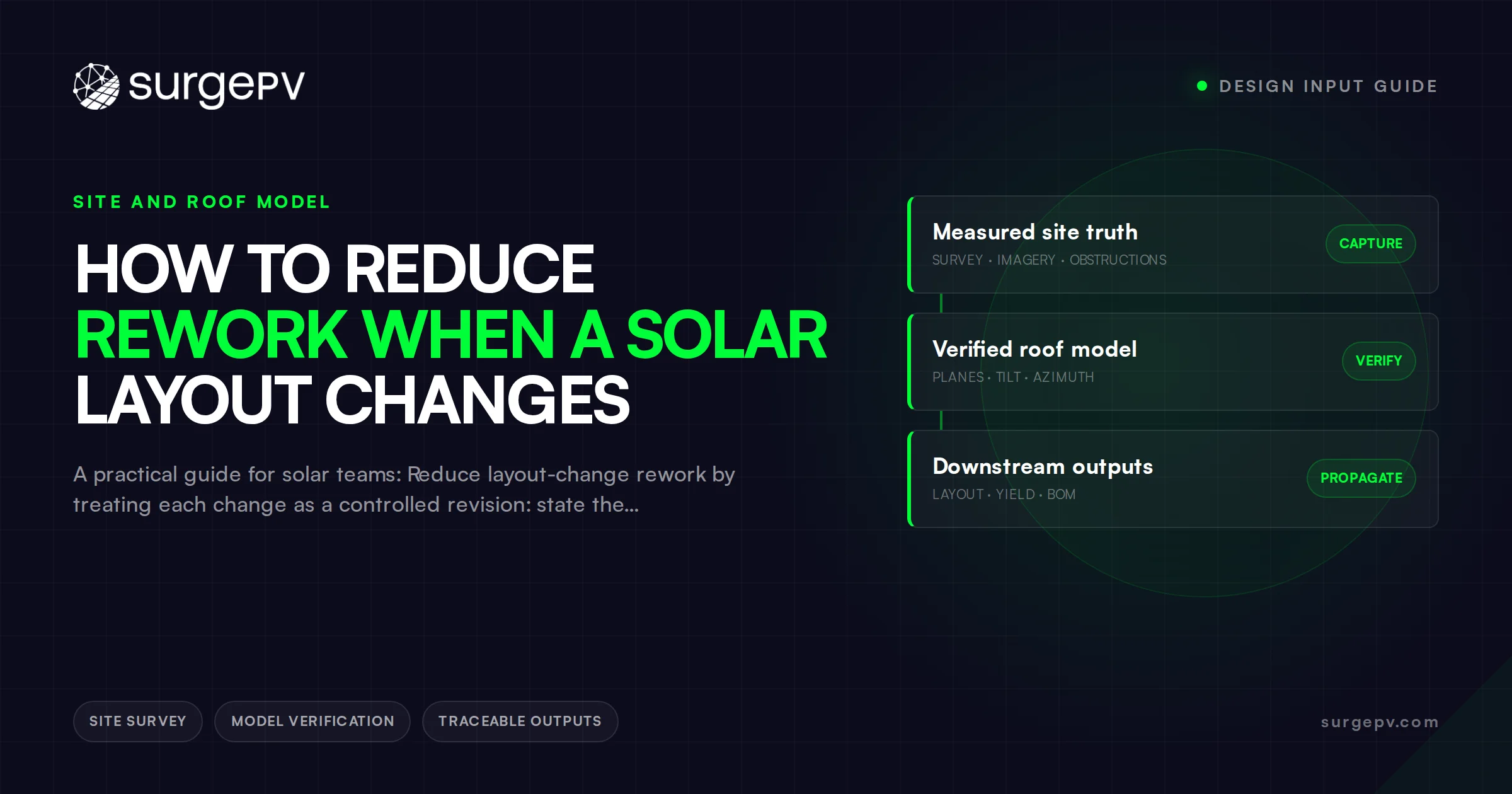
A practical guide for solar teams: Reduce layout-change rework by treating each change as a controlled revision: state the trigger, update dependent design and proposal outputs, assign reviewers, preserve the old version, and tell the customer what changed when it affects their decision.

Akash Hirpara

Written by

Akash Hirpara

Co-Founder · SurgePV

Rainer Neumann

Edited by

Rainer Neumann

Content Head · SurgePV

Published ·Updated

Quick Answer

Reduce layout-change rework by treating each change as a controlled revision: state the trigger, update dependent design and proposal outputs, assign reviewers, preserve the old version, and tell the customer what changed when it affects their decision.

Layout changes are normal in solar. A customer may add storage, a site photo may reveal an obstruction, equipment availability may change, or a field visit may reduce usable area. Rework becomes expensive when the change travels informally and different teams continue working from different versions.

Direct Answer

Reduce layout-change rework by treating each change as a controlled revision: state the trigger, update dependent design and proposal outputs, assign reviewers, preserve the old version, and tell the customer what changed when it affects their decision.

Why this review belongs in the project workflow

Reduce solar layout rework is most useful when it leaves a traceable decision rather than an isolated image, spreadsheet, or conversation. Solar proposals combine site facts, design assumptions, modeled outputs, and commercial information. A change in one can make another less reliable. The workflow should therefore show what is confirmed, what is estimated, and what must be revisited before release.

The article is desk research for installers and EPCs. It is not engineering advice, a site survey, or a guarantee of production, approval, savings, cost, or delivery outcomes. Use applicable local rules, equipment documentation, utility requirements, and qualified review for the project at hand.

Describe the change before fixing it

Every change request should state what changed, why it changed, who raised it, and which current revision it affects. “Move panels” is not enough. Is the reason shade, access, roof geometry, customer preference, equipment, code interpretation, or price? The answer determines which downstream items need attention.

A useful working question at this stage is: “What fact would make this reduce solar layout rework decision different?” For reduce solar layout rework, the answer should be placed in the project record with its source, date, and owner. That approach directs attention to material uncertainty instead of adding a generic approval step.

For a reduce solar layout rework sales and design team, for reduce solar layout rework, the value is shared language. In reduce solar layout rework, the person preparing the customer material can see the current status, while the person responsible for technical review can see which assumption is driving the conversation. For reduce solar layout rework, no public resource can determine the right answer for an individual site; local requirements, manufacturer documentation, and competent project review still govern the work.

For reduce solar layout rework, make the check observable: state the input, the method used to evaluate it, the reviewer, and the condition that would force a revision. In reduce solar layout rework review, the next person needs an intelligible record rather than a finished image with no decision trail.

The reduce solar layout rework record should also distinguish an operational choice from a technical conclusion. In a reduce solar layout rework workflow, the team may advance a qualified opportunity while marking a site fact as unresolved; it should not silently turn that unresolved fact into a final representation.

Map the dependencies

A layout can feed the bill of materials, stringing, shading treatment, energy model, financial model, drawings, proposal visuals, price, and installation instructions. Create a dependency checklist appropriate to the project type. It is better to consciously mark an item not applicable than to assume a layout update has no commercial consequence.

For a reduce solar layout rework sales and design team, for reduce solar layout rework, the value is shared language. In reduce solar layout rework, the person preparing the customer material can see the current status, while the person responsible for technical review can see which assumption is driving the conversation. For reduce solar layout rework, no public resource can determine the right answer for an individual site; local requirements, manufacturer documentation, and competent project review still govern the work.

In reduce solar layout rework work, this is also a communication practice. A customer can accept that a preliminary model has limits when those limits are described before a commitment is implied. In reduce solar layout rework, vague confidence creates a later trust problem; a named assumption creates a path to resolve it.

For reduce solar layout rework, make the check observable: state the input, the method used to evaluate it, the reviewer, and the condition that would force a revision. In reduce solar layout rework review, the next person needs an intelligible record rather than a finished image with no decision trail.

The reduce solar layout rework record should also distinguish an operational choice from a technical conclusion. In a reduce solar layout rework workflow, the team may advance a qualified opportunity while marking a site fact as unresolved; it should not silently turn that unresolved fact into a final representation.

Keep one revision visible

Use a stable project identifier and sequential revision labels. Preserve the prior layout and record the change date, reviewer, and release status. This avoids the common handoff failure in which a sales representative presents an older PDF while procurement has acted on a newer material list.

In reduce solar layout rework work, this is also a communication practice. A customer can accept that a preliminary model has limits when those limits are described before a commitment is implied. In reduce solar layout rework, vague confidence creates a later trust problem; a named assumption creates a path to resolve it.

Keep reduce solar layout rework action proportionate. A simple, well-documented roof may only need a targeted confirmation. A complicated site or a material commercial decision may require more evidence. The important point is that the level of review is deliberate and visible.

For reduce solar layout rework, make the check observable: state the input, the method used to evaluate it, the reviewer, and the condition that would force a revision. In reduce solar layout rework review, the next person needs an intelligible record rather than a finished image with no decision trail.

The reduce solar layout rework record should also distinguish an operational choice from a technical conclusion. In a reduce solar layout rework workflow, the team may advance a qualified opportunity while marking a site fact as unresolved; it should not silently turn that unresolved fact into a final representation.

Review the customer-facing effect

Not every technical revision requires a new customer conversation, but every change that affects system size, cost, modeled production, scope, or a stated assumption deserves a deliberate decision. Solar Proposals can help connect project work to customer-facing outputs; teams still need to review whether an existing proposal is superseded.

Keep reduce solar layout rework action proportionate. A simple, well-documented roof may only need a targeted confirmation. A complicated site or a material commercial decision may require more evidence. The important point is that the level of review is deliberate and visible.

A useful working question at this stage is: “What fact would make this reduce solar layout rework decision different?” For reduce solar layout rework, the answer should be placed in the project record with its source, date, and owner. That approach directs attention to material uncertainty instead of adding a generic approval step.

For reduce solar layout rework, make the check observable: state the input, the method used to evaluate it, the reviewer, and the condition that would force a revision. In reduce solar layout rework review, the next person needs an intelligible record rather than a finished image with no decision trail.

The reduce solar layout rework record should also distinguish an operational choice from a technical conclusion. In a reduce solar layout rework workflow, the team may advance a qualified opportunity while marking a site fact as unresolved; it should not silently turn that unresolved fact into a final representation.

Use evidence rather than blame

Classify rework by source: intake gap, data update, scope change, calculation issue, supplier substitution, or review miss. NREL’s photovoltaic research resources offer technical context, while claims about a particular team’s rework rate would need its own evidence. The purpose of classification is to improve the system, not make a designer defend every revision.

A useful working question at this stage is: “What fact would make this reduce solar layout rework decision different?” For reduce solar layout rework, the answer should be placed in the project record with its source, date, and owner. That approach directs attention to material uncertainty instead of adding a generic approval step.

For a reduce solar layout rework sales and design team, for reduce solar layout rework, the value is shared language. In reduce solar layout rework, the person preparing the customer material can see the current status, while the person responsible for technical review can see which assumption is driving the conversation. For reduce solar layout rework, no public resource can determine the right answer for an individual site; local requirements, manufacturer documentation, and competent project review still govern the work.

For reduce solar layout rework, make the check observable: state the input, the method used to evaluate it, the reviewer, and the condition that would force a revision. In reduce solar layout rework review, the next person needs an intelligible record rather than a finished image with no decision trail.

The reduce solar layout rework record should also distinguish an operational choice from a technical conclusion. In a reduce solar layout rework workflow, the team may advance a qualified opportunity while marking a site fact as unresolved; it should not silently turn that unresolved fact into a final representation.

Close the loop at handoff

Before procurement or installation relies on a changed layout, confirm that the project record identifies the released version and that obsolete outputs are clearly superseded. A short release note is often enough to prevent a long correction later.

For a reduce solar layout rework sales and design team, for reduce solar layout rework, the value is shared language. In reduce solar layout rework, the person preparing the customer material can see the current status, while the person responsible for technical review can see which assumption is driving the conversation. For reduce solar layout rework, no public resource can determine the right answer for an individual site; local requirements, manufacturer documentation, and competent project review still govern the work.

In reduce solar layout rework work, this is also a communication practice. A customer can accept that a preliminary model has limits when those limits are described before a commitment is implied. In reduce solar layout rework, vague confidence creates a later trust problem; a named assumption creates a path to resolve it.

For reduce solar layout rework, make the check observable: state the input, the method used to evaluate it, the reviewer, and the condition that would force a revision. In reduce solar layout rework review, the next person needs an intelligible record rather than a finished image with no decision trail.

The reduce solar layout rework record should also distinguish an operational choice from a technical conclusion. In a reduce solar layout rework workflow, the team may advance a qualified opportunity while marking a site fact as unresolved; it should not silently turn that unresolved fact into a final representation.

Bring reduce solar layout rework into one reviewable solar workflow

See how SurgePV can help a team keep reduce solar layout rework inputs, modeled outputs, and customer-ready reduce solar layout rework materials connected.

Book a Demo

A practical reduce solar layout rework release checklist

Before using reduce solar layout rework work in a proposal or handoff, ask: is the reduce solar layout rework source data current enough for the decision; does the current reduce solar layout rework project record identify relevant unknowns; have dependent outputs been reviewed; and does the customer-facing material state meaningful reduce solar layout rework limitations? Answering those questions explicitly is more valuable than adding confidence language after the fact.

For an integrated reduce solar layout rework workflow, review the relevant Solar Proposals page and decide how the team will define its own release conditions. SurgePV can support connected reduce solar layout rework design and proposal work; it does not replace site verification, engineering judgment, or jurisdiction-specific review.

Frequently Asked Questions

Which outputs should be reviewed after a layout change?

Review dependent materials, electrical assumptions, shade and energy models, financial outputs, drawings, proposal content, price, and handoff instructions as applicable.

Should old solar layouts be deleted?

Keep them as superseded revisions so the team can understand what changed and avoid working from an untracked copy.

When must a customer receive an updated proposal?

Provide or discuss an update when a revision materially changes size, price, modeled output, scope, or a customer-facing assumption.

Ready to make reduce solar layout rework easier to review?

Book a personalized SurgePV demo to explore a connected reduce solar layout rework design, analysis, and proposal workflow.

Book a Free Demo

About the Contributors

Author
Akash Hirpara
Akash Hirpara

Co-Founder · SurgePV

Akash Hirpara is Co-Founder of SurgePV and at Heaven Green Energy Limited, managing finances for a company with 1+ GW in delivered solar projects. With 12+ years in renewable energy finance and strategic planning, he has structured $100M+ in solar project financing and improved EBITDA margins from 12% to 18%.

Editor
Rainer Neumann
Rainer Neumann

Content Head · SurgePV

Rainer Neumann is Content Head at SurgePV and a solar PV engineer with 10+ years of experience designing commercial and utility-scale systems across Europe and MENA. He has delivered 500+ installations, tested 15+ solar design software platforms firsthand, and specialises in shading analysis, string sizing, and international electrical code compliance.

Get Solar Design Tips in Your Inbox

Join 2,000+ solar professionals. One email per week - no spam.

No spam · Unsubscribe anytime

Book Free Demo