

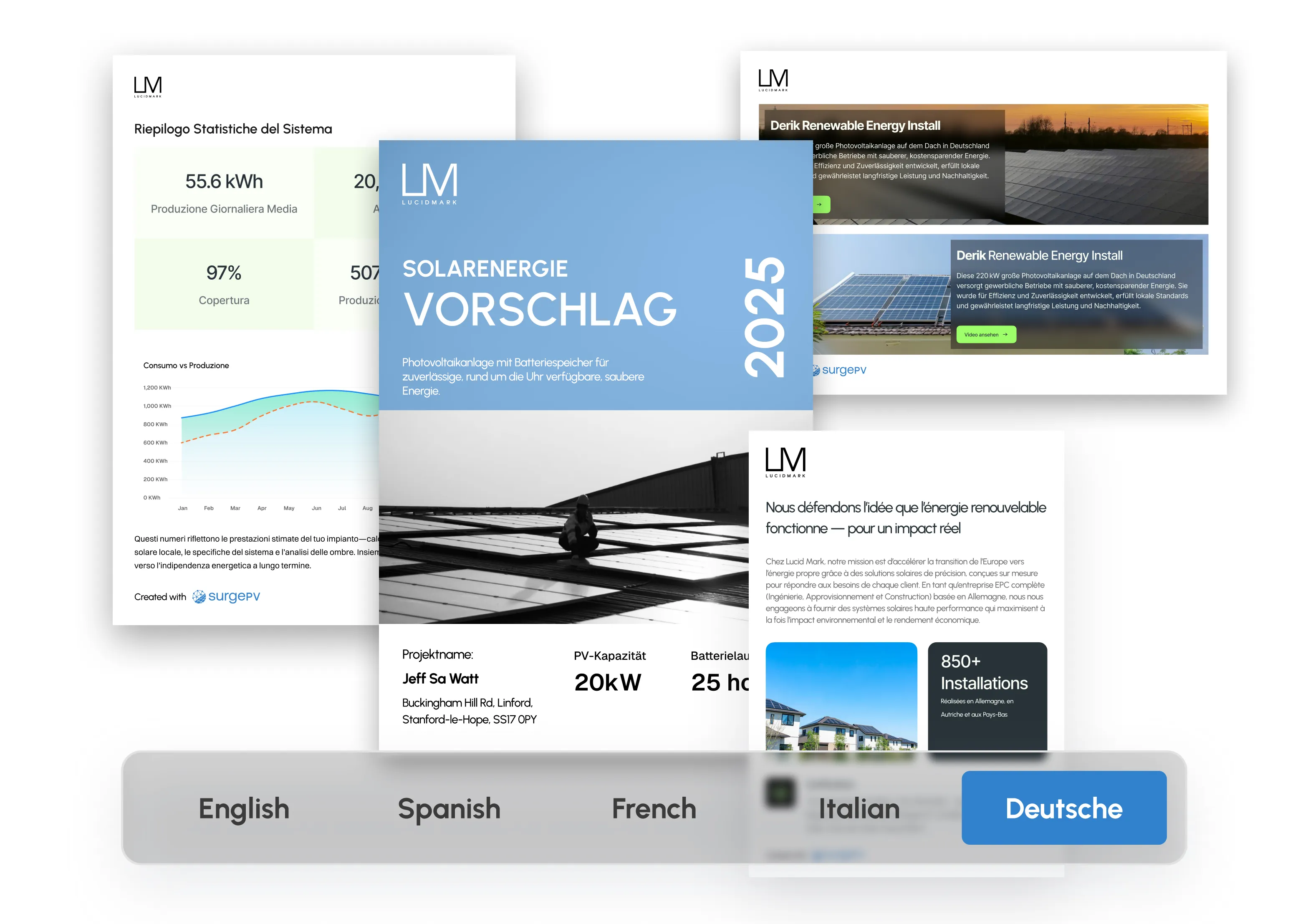
Answer
Build a multilingual solar proposal from one approved source package, then localize meaning, not just words. Assign fluent subject reviewers, preserve project numbers and units, verify jurisdiction-specific claims and terms, test layout and accessibility, compare every language against the same revision, and record which version controls. Machine translation may assist drafting, but it should not become unsupervised customer commitment.
A proposal can be grammatically correct in two languages and still describe two different projects. A decimal separator changes. “Estimate” becomes “guarantee.” An equipment note is shortened. The source proposal is revised after the translation is sent. Nobody can say which attachment controls.
A multilingual solar proposal is therefore a configuration problem as much as a language problem. The team must preserve one project identity, design basis, scenario, scope, price, assumptions, limitations, and revision while allowing the reader to understand them in an appropriate language and format.
This guide covers a controlled localization workflow. It does not provide legal translation, certified translation, tax or finance advice, jurisdictional contract language, or a claim that one proposal format works in every export market. Fluent reviewers and qualified technical, legal, tax, finance, privacy, accessibility, and contract owners remain essential.
For proposal structure, use the solar proposal presentation guide. For cross-record accuracy, use the campaign-to-proposal consistency checklist.
What makes a multilingual solar proposal trustworthy?
A multilingual solar proposal is trustworthy enough for review when every language represents the same identified project, revision, scope, design state, equipment, source data, scenario inputs, calculations, price, terms, claims, limitations, attachments, and next decision. Fluent subject reviewers must approve meaning and usability, while the package clearly states language relationships, unresolved differences, and the authority required for commitment.
Translation is only one stage. Internationalization prepares the content and system to support different languages, scripts, directions, formats, and conventions. Localization adapts the experience for a defined language, audience, jurisdiction, and transaction. Review determines whether the result preserves meaning and meets the company’s authority requirements.
W3C’s introduction to internationalization distinguishes broad preparation from language and regional adaptation. That web guidance does not validate a solar proposal or contract. It supports planning for language, script, and locale before a file reaches a translator.
| Control layer | Question | Failure to prevent |
|---|---|---|
| Project identity | Are all versions tied to one site, customer, proposal id, and revision? | Translation from the wrong project |
| Source authority | Which approved text, data, model, and terms are localizable? | Draft language becomes a commitment |
| Terminology | Which technical and commercial terms have approved meanings? | Familiar word changes project scope |
| Numeric parity | Do values, units, dates, currency, and formulas match? | Local formatting changes the number |
| Jurisdiction | Which claims and terms require local qualified review? | Source-market rule is copied abroad |
| Accessibility | Can the intended reader perceive and navigate the output? | Correct text remains unusable |
| Release control | Who approved each language and which issue was delivered? | Stale or conflicting package circulates |
Trust does not mean every sentence is literally identical. Languages organize meaning differently. It means every material commitment and limitation is equivalent enough for the stated use, and any difference is deliberate, reviewed, and recorded.
What must be frozen before translation begins?
Freeze project identity, approved source proposal, design and model revision, equipment schedule, scenario inputs, calculations, commercial scope, price basis, terms, claims, disclosures, attachments, and release purpose before translation begins. Mark text that may be localized, text that must remain unchanged, and content requiring qualified jurisdictional review. If the source changes, reopen every affected language rather than patching one file silently.
Do not send a translator a PDF without context. Supply editable source text, section ids, definitions, screenshots, customer job, language and region, reading level, tone, units, currency rules, terminology, prohibited claims, layout constraints, and the reviewers who own technical and legal questions.
Digital.gov’s plain-language guidelines emphasize creating content for the intended audience. Use that principle before translation. Ambiguous source language becomes more expensive and dangerous in multiple languages. Clarify who acts, what is estimated, which assumption controls, and what the customer must decide.
Separate four source classes
Locked data includes proposal id, equipment identity, model revision, source values, validated calculation results, and approved dates. Localization can change display conventions only through a controlled transformation.
Controlled terminology includes technical, commercial, finance, ownership, warranty, safety, and process terms. A reviewer approves their localized meaning and use.
Adaptable explanation includes headings, transitions, examples, and plain-language explanations that may need grammatical or cultural restructuring without changing claims.
Jurisdiction-held content includes legal, tax, finance, contract, incentive, permit, utility, consumer, privacy, warranty, and safety statements that cannot cross markets by translation alone.
Prepare the source for segment-level revision
Give every material heading, paragraph, table row, disclosure, chart label, CTA, and attachment reference a stable segment id. The localization record should connect that id to the source text, approved target text, reviewer, disposition, and release. When the source changes, a dependency query can identify which languages and artifacts need new review.
Avoid placing material text only inside an image. A translator may never receive it, an accessibility tool may not expose it, and a later source edit may update the caption without updating the pixels. Keep authoritative text in controlled fields and treat each generated visual as a dependent artifact.
Freeze the full context around a segment. A short phrase such as “subject to review” cannot be localized reliably when the reviewer, object, condition, and consequence are missing. Provide the surrounding decision, not a list of disconnected strings exported from an interface.
Set a reviewer matrix before work starts
Fluency does not grant every kind of authority. One person may be a fluent commercial reviewer but unable to accept electrical terminology. Another may be qualified for a contract question but not a financial calculation. Build a matrix that names the source owner, translator, fluent subject reviewer, technical reviewer, finance or tax reviewer, legal reviewer, accessibility reviewer, and final release owner as applicable.
Each material segment needs a route based on its content class. General explanatory prose may need fluent subject review. An equipment relationship needs technical review. A tax or incentive statement needs qualified jurisdictional review and a short refresh interval. A contract clause may need a prescribed legal process outside the ordinary content workflow.
If one person fills several roles, record each acceptance separately. That prevents “reviewed by Maria” from hiding whether Maria checked language, engineering meaning, numbers, terms, or final release.
FTC advertising guidance says advertising must be truthful and non-deceptive and objective claims need evidence. That general United States guidance does not govern every export market or approve a proposal. It supports retaining claim evidence and limitations when language changes.
How should a multilingual proposal be localized and reviewed?
Localize and review a multilingual solar proposal in eight controlled steps: define the target language and market, freeze the source, prepare a terminology and claim pack, create the translation draft, run fluent subject review, compare all numbers and material meaning, test the rendered document, then authorize and distribute one synchronized release. Any source revision reopens affected downstream steps.
- Define language, script, locale, audience, and use. “Spanish” or “Arabic” alone does not identify region, reader, transaction, or document purpose.
- Freeze and hash the source. Record proposal id, source language, model revision, terms revision, attachments, and approved source file.
- Build the localization pack. Include terminology, definitions, locked values, units, formatting rules, claim evidence, limitations, screenshots, and escalation owners.
- Create a draft with provenance. Record translator or tool, version, time, input file, segments changed, and unresolved questions. Machine output remains a draft.
- Run fluent subject review. A fluent reviewer with appropriate solar and commercial context checks meaning, tone, ambiguity, terminology, and customer usability.
- Run independent parity review. Compare numbers, units, equipment, scope, inclusions, exclusions, assumptions, scenarios, claims, disclosures, terms, CTA, and attachments against the frozen source.
- Test the rendered output. Check fonts, script direction, line breaks, tables, charts, symbols, links, reading order, copy-paste, mobile view, print, and accessible text.
- Authorize and distribute. Record language reviewers, qualified approvals, release purpose, recipients, controlling-version statement, superseded files, and correction route.
W3C publishes the Web Content Accessibility Guidelines as an accessibility standard for web content. A proposal PDF or document may involve additional standards, law, procurement requirements, and testing. The useful boundary is that translation accuracy does not make inaccessible content usable.
Back translation is a diagnostic, not final approval
Translating localized text back into the source language can reveal lost numbers, missing qualifiers, or changed relationships. It can also create false alarms because languages do not map word for word. Use it to flag segments for fluent review, not as proof of equivalence.
Likewise, automated terminology and numeric checks can catch mismatches but cannot decide whether the customer understands the localized concept or whether a legal term has the intended effect.
Test the proposal as the customer receives it
Review the generated PDF, web link, email body, attachment name, portal view, print set, and mobile experience that will actually be delivered. Text can be correct in the translation system and fail after rendering because a font lacks characters, a table clips, right-to-left order breaks, a chart label remains in the source language, or a link opens the wrong locale.
Test reading order and text extraction, not appearance alone. Copy critical values and sentences from the rendered file into a plain-text comparison. Check that screen readers encounter a meaningful sequence, that language metadata is appropriate where supported, and that visual emphasis does not reverse the importance of assumptions and headline results.
Keep screenshots and exported hashes with the release evidence. If the delivery system transforms or recompresses the file, compare the delivered copy with the accepted package. Sending the correct source file does not prove the recipient-facing artifact stayed correct.
Need a stable project and proposal source? SurgePV can support solar modeling and proposal generation while your fluent localization, accessibility, technical, commercial, legal, tax, finance, contract, and jurisdictional reviewers control every language release.
Explore solar proposal workflowsWhich proposal elements are most likely to change meaning?
The highest-risk proposal elements are numbers and units, dates and deadlines, equipment identity, production and savings scenarios, price and currency, incentives and tax language, ownership and finance terms, scope and exclusions, warranties, technical and safety statements, approval status, customer actions, and legal or contract terms. Review these independently from general prose and route jurisdiction-sensitive meaning to qualified owners.
Numbers, dates, units, and currency
Different locales display decimal and thousands separators differently. Dates can reverse month and day order. Currency symbols can be ambiguous. Unit conversions can introduce rounding or dimensional errors. Never ask a translator to perform calculations mentally.
Store typed source values and units. If a display conversion is needed, define the formula, source, observation time, exchange or conversion basis, rounding rule, and qualified owner. Compute by script and compare the rendered output with the source record.
Production, savings, and financial scenarios
A scenario can change meaning when “estimated,” “illustrative,” “projected,” “expected,” and “guaranteed” are treated as interchangeable. Keep the modeling method, period, inputs, uncertainty, exclusions, and prohibited interpretations visible.
DOE’s homeowner guide to solar says there is no universal solar solution and discusses site, energy, utility, purchase or lease, and estimate context. It does not validate a translated proposal, financial result, or market claim. It supports keeping project context attached to the numbers.
Equipment, scope, and responsibility
Product names and model codes may remain unchanged while generic terms need localization. Preserve the difference between included equipment, optional equipment, proposed equivalent, and illustrative category. Translate responsibility carefully: “customer provides,” “installer verifies,” “subject to engineering,” and “requires utility approval” create different work boundaries.
Claims, disclosures, and contracts
A source-market disclosure may be insufficient, unnecessary, or misleading in another jurisdiction. A translated disclaimer cannot repair a false main claim. Contract and legal language may require a qualified legal translator, local counsel, certified process, or prescribed form. The content team should not invent those requirements.
| High-risk element | Parity check | Qualified owner |
|---|---|---|
| System and equipment | Model codes, quantity, ratings, options, substitutions | Technical and procurement owners |
| Energy model | Inputs, period, method, losses, uncertainty, scenario | Qualified model reviewer |
| Financial output | Currency, formula, time basis, rates, assumptions, rounding | Finance, tax, accounting, lender owners |
| Scope | Included, excluded, optional, by-others, change conditions | Commercial, operations, contract owners |
| Claims | Evidence, qualifier, jurisdiction, observation date | Communications, compliance, legal owners |
| Approvals | Current state and responsible external party | Engineering, utility, permit, program owners |
| Customer action | Decision, document, date, channel, consequence | Sales, service, contract, privacy owners |
How should missing language capacity and disagreements be handled?
When fluent capacity is missing or reviewers disagree, hold the affected language release, preserve the competing interpretations, identify the material decision, and route it to a qualified fluent owner. Do not choose the shortest translation or let a salesperson improvise. The record should show what work may continue, what customer communication is restricted, and which evidence closes the issue.
Classify the gap. A linguistic gap concerns grammar, fluency, or ambiguity. A terminology gap concerns the accepted solar or commercial term. A source gap means the original itself is unclear. A jurisdiction gap concerns local law, tax, utility, finance, contract, safety, or program meaning. An accessibility gap concerns whether the reader can use the output.
NIST describes its Privacy Framework as a voluntary tool for identifying and managing privacy risk. It does not establish translation-vendor access, consent, cross-border transfer, retention, deletion, or legal compliance. Before sending customer or property data to a person or service, the responsible privacy and security owners must approve the purpose, minimum data, access, handling, and retention.
Illustrative workflow, not a customer case
An EPC prepares a source proposal in English and a localized proposal for a defined Spanish-speaking audience. Numeric comparison finds that one table displays a decimal separator incorrectly. Fluent review finds that a production “estimate” has become a stronger promise. Legal review holds a contract paragraph because the localized wording changes responsibility.
The team corrects the table from the typed source value, restores the bounded modeling term, and keeps the contract section restricted until qualified resolution. Both files retain one proposal id and revision. This example reports no customer, market, language accuracy rate, sales result, approval, or legal conclusion.
Copy-ready multilingual proposal localization brief
Use one brief per target language and locale. Link it to the source proposal, terminology register, reviewer records, rendered tests, and release package.
| Field | Entry |
|---|---|
| Project, proposal id, source language, target language, script, and locale | |
| Audience, reading level, accessibility needs, jurisdiction, and use | |
| Frozen source file, hash, design revision, model revision, and terms revision | |
| Locked values, equipment identities, units, dates, currency, and formulas | |
| Approved terminology, definitions, prohibited alternatives, and examples | |
| Claims, evidence, qualifiers, expiry triggers, and jurisdiction holds | |
| Localizable explanations, tone, formatting, and layout constraints | |
| Translator or tool, provenance, data handling, and unresolved questions | |
| Fluent subject reviewer and segment dispositions | |
| Numeric, scope, scenario, claim, disclosure, term, and attachment parity | |
| Accessibility and rendered-output test evidence | |
| Controlling-version statement and qualified legal review | |
| Release owner, recipients, superseded files, correction route, and next review |
Add stable segment ids to material paragraphs and tables. That makes source changes addressable. When an equipment term changes, the team can reopen the affected segments instead of retranslating or reapproving the entire document without a trace.
Where can SurgePV support the proposal workflow?
SurgePV’s repository-verified scope includes solar array layout, shading analysis, energy-yield modeling, financial modeling, electrical workflow support, bill-of-materials output, and proposal generation. These functions can provide a connected, reviewable project and proposal source for review directly before the controlled localization process begins.
No verified claim should be read as support for every language, script, locale, font, jurisdiction, certified translation, accessibility workflow, contract, or legal document. Confirm current product capabilities directly. SurgePV does not replace fluent translation, local market review, legal and tax advice, technical authority, accessibility testing, or customer understanding.
Use the solar designing platform to review the verified modeling scope. Use the proposal branding guide to keep visual identity from obscuring project evidence.
Frequently Asked Questions
Can a solar proposal be translated with machine translation alone?
Machine translation can help create a draft or surface terminology, but it should not independently create the customer commitment. A fluent reviewer with relevant technical and commercial context should compare meaning, numbers, units, scope, assumptions, claims, terms, accessibility, and jurisdiction-specific language against the approved source. Legal, tax, finance, contract, engineering, and safety content needs qualified review.
Which language version of a solar proposal should control?
The governing version depends on the contract, jurisdiction, company policy, transaction, and qualified legal review. State the relationship between versions clearly and do not assume that a disclaimer automatically resolves a contradiction. Operationally, link every language to one proposal id and revision, then stop release whenever text, numbers, scope, assumptions, or attachments are not equivalent.
Should currency and units be localized in a solar proposal?
Present currency, number formatting, date notation, decimal separators, units, taxes, and financial periods in a way the intended reader can understand, but do not convert or recalculate silently. Preserve the source value, conversion source, observation time, formula, unit, rounding rule, and reviewer. Any displayed derived result must be validated by script and checked in context.
How should a team translate technical solar terms?
Maintain an approved terminology register with the source term, definition, accepted localized term, prohibited alternatives, context, source, reviewer, and examples. Use the same equipment identity and project facts across languages. When no exact equivalent exists, preserve the term, add a plain explanation, and route technical or jurisdictional meaning to a qualified fluent reviewer.
Does SurgePV translate solar proposals into every language?
No verified product claim should be interpreted as support for every language, jurisdiction, script, font, translation workflow, or legal document. SurgePV supports solar layout, shading, yield and financial modeling, electrical workflow, bill-of-materials output, and proposal generation. Confirm current product capabilities directly, and keep fluent localization, accessibility, legal review, and customer approval with responsible owners.
One project, every language
A translated proposal should not become a second project. The customer may read different words and formats, but the equipment, numbers, assumptions, scope, responsibilities, and limitations must still belong to one controlled decision.
That standard changes the workflow. Translation begins after source control, not before it. Release happens after independent parity review, not when the text looks fluent. When the source changes, every language receives a traceable disposition. The result is less theatrical than “instant global selling,” and far more useful to the people who must rely on the proposal.
Build from one connected proposal source
See how SurgePV supports solar modeling and proposal generation while fluent reviewers and qualified owners retain localization, accessibility, technical, commercial, legal, and jurisdictional responsibility.
Book a SurgePV demoSources
Primary research and reference material used for this desk-research article.
Where this fits
This article is part of SurgePV's Solar Business & Operations hub, which works through the topic from first principles to the decisions a project team actually has to make.

