The solar market is moving faster than most design teams can draft. Global solar additions reached 452 GW in 2024. Solar PV is set to account for roughly 80% of new renewable capacity through 2030. Those figures come from the IRENA Renewable Capacity Highlights 2025 and the IEA Renewables 2025 outlook. That volume puts immediate pressure on installers and EPCs to quote more projects without adding headcount.
Instant solar design AI is the response. A designer no longer traces a roof by hand, measures obstructions, and builds a proposal across three tools. Instead, they enter an address and receive a sales-ready design within minutes. The goal is not perfection on the first click. It is a high-quality draft that a human can review, adjust, and send before the homeowner leaves the meeting.
This guide explains what instant solar design AI actually does. It also covers how it differs from older “fast” design tools, which platforms are genuinely instant, and where the technology still needs an experienced eye. It is written for installers, EPC design teams, and sales professionals who need to increase throughput without sacrificing accuracy.
In this guide:
- What instant solar design AI is and the five tasks it must automate
- Why speed has become a competitive advantage in 2026
- How the technology works, step by step
- The benchmarks that separate “instant” from merely fast
- A comparison of the leading instant solar design AI platforms
- Honest tradeoffs, limitations, and common mistakes
- Implementation best practices for installer teams
- Frequently asked questions
Quick Answer
Instant solar design AI uses satellite imagery and machine learning to model roofs, place panels, analyse shading, size inverters, and generate client proposals from a single address input in a few minutes. Leading platforms like SurgePV with Clara AI complete the address-to-3D-roof step in a few seconds and carry the layout straight through to the proposal on standard residential and small-commercial projects.
What Is Instant Solar Design AI?
Instant solar design AI is a category of cloud-based solar software. It converts a property address into a complete, client-ready design and proposal with minimal manual input. The term “instant” refers to the total elapsed time from address entry to a shareable proposal, not to the absence of engineering judgment.
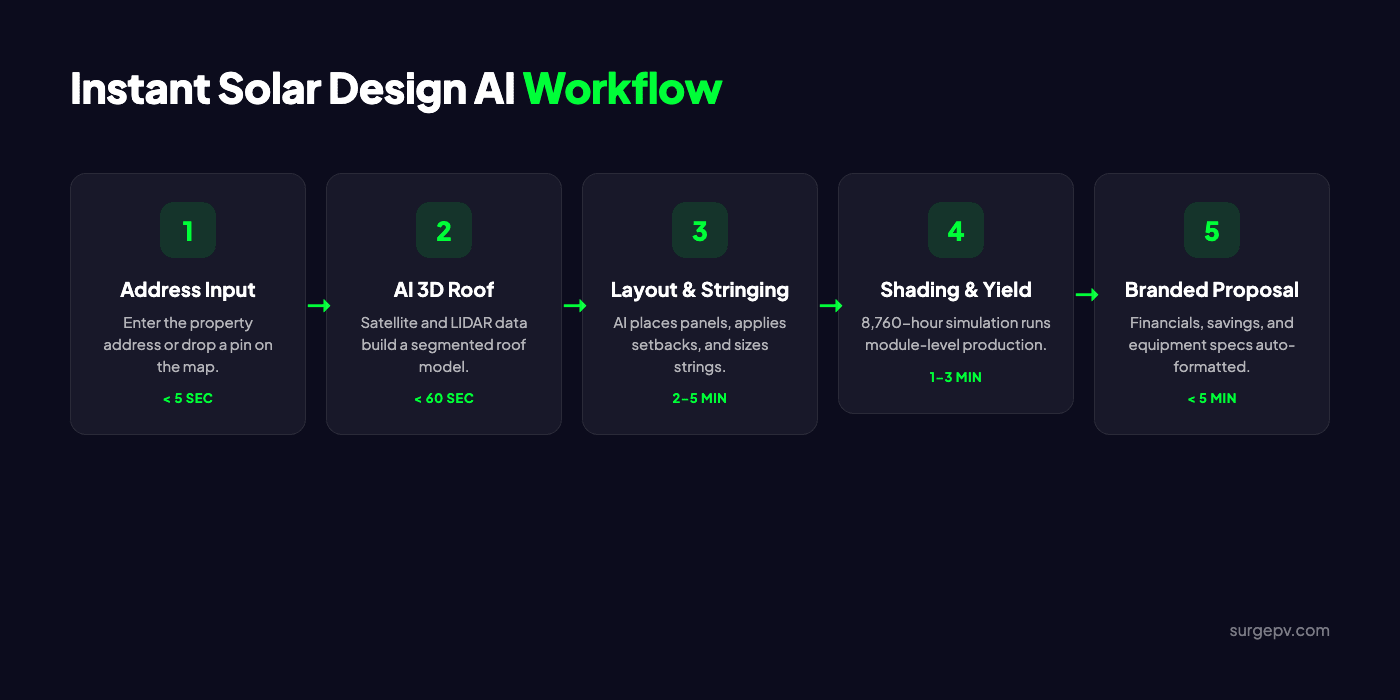
A true instant solar design workflow must handle five core tasks:
- Roof modelling from imagery. The AI detects roof planes, ridges, eaves, pitch, and azimuth from satellite or aerial imagery, often without a site visit.
- Obstruction detection. Chimneys, vents, skylights, HVAC units, parapets, and nearby trees are identified and excluded from the usable area.
- Panel placement and stringing. The AI fills usable roof area with modules, respects fire and structural setbacks, and groups panels into strings or MPPT inputs.
- Shading and production simulation. Hourly shade analysis and yield prediction are run across all 8,760 hours of a typical meteorological year.
- Proposal and financial modelling. Equipment specs, generation estimates, payback, savings, and financing options are formatted into a branded proposal. Platforms with a built-in energy and financial modeling tool keep the entire workflow inside one model, so a change in layout automatically updates the ROI table.
If a tool only automates one or two of these steps, it is a useful feature, not an instant design platform. The dividing line is whether a designer can go from address to signed proposal inside one workflow without exporting to another application.
SurgePV’s solar design software is built around this end-to-end idea. Its Clara AI assistant accepts plain-language commands. For example: “add 20 panels to the south face, avoid the chimney, and re-run the savings report.” It then executes the changes in the same canvas. That is the practical meaning of instant: the AI carries the workload, while the designer keeps control.
Why Speed Now Matters in Solar Sales
Three forces have pushed instant design from a convenience to a necessity.
Throughput pressure. The IRENA 2025 highlights show that solar alone added 452 GW globally in 2024. The IEA expects solar PV to drive around 80% of renewable capacity growth through 2030. For installers, that means more quotes per week, rather than only more installations per year. A design team that stays on manual workflows will quote a fraction of the pipeline an AI-assisted team can handle. Our broader solar software buyer’s guide 2026 breaks down how to evaluate these platforms against your current stack.
Sales velocity. A proposal delivered within four hours is far more likely to convert than one sent after 24 hours. Independent research on instant solar design software cites two figures. 60% of leads are lost to slow follow-up, and rapid proposal delivery can improve conversion rates by 40–60%. The source data varies by market, but the directional truth is consistent: the first credible proposal often wins.
Soft cost reduction. Design, customer acquisition, permitting, and financing are the largest remaining cost categories in residential solar. The U.S. Department of Energy’s Solar Energy Technologies Office soft-costs programme notes that non-hardware costs now dominate the installed price of many systems. Remote system design can reduce installation cost by up to $0.17/W, according to NREL research cited by Aurora Solar’s soft-cost overview. On a 5 kW system, that is roughly $850 saved before the truck rolls.
Speed is no longer a marketing claim. It is the difference between winning and losing the project.
How Instant Solar Design AI Works
The workflow looks simple from the outside, but each step depends on a different AI technique.
Imagery capture and preprocessing
The platform pulls high-resolution aerial or satellite imagery for the address. Some tools also ingest LIDAR point clouds, drone photos, or municipal 3D datasets. Image resolution and currency matter: a roof extension built six months ago may not appear in older captures.
Satellite-only models infer roof height and slope from shadows and texture. They work well on simple roofs but struggle with low-pitch structures and dense vegetation. LIDAR models measure elevation directly, so they produce more accurate dimensions and obstruction heights. Most high-end instant design platforms now combine both: satellite imagery for broad coverage and LIDAR for precise geometry. The shading layer then blends the two data sources to produce hourly shade maps across all seasons.
Roof segmentation with computer vision
Convolutional neural networks (CNNs) learn from millions of labelled roof images. They segment each image into roof planes, obstructions, and non-roof areas. The output is a polygon for each plane plus estimates of tilt and azimuth. LIDAR-trained models are more accurate because they use elevation data rather than inferring 3D structure from 2D photos.
Constraint application
The AI applies fire setbacks, structural exclusion zones, equipment clearances, and local code rules. A well-configured platform encodes NEC, IEC, or IS rules by jurisdiction. Designers can add project-specific constraints, such as avoiding a north-facing plane or keeping a walkway clear.
Panel placement optimisation
Reinforcement learning or genetic algorithms explore thousands of layout options. The objective is usually maximum annual production, but it can also be maximum self-consumption, lowest levelised cost, or best fit to a time-of-use tariff. The AI tests portrait and landscape orientations, row spacing, and string groupings.
Shading and production simulation
The AI runs hourly shade calculations using a 3D obstruction model and a typical meteorological year. Module-level simulation calculates P50, P75, and P90 yield scenarios. This is the same simulation layer that lenders expect from desktop tools such as PVsyst. For a deeper look at shade modelling, see our guide to solar shadow analysis.
Electrical design and proposal generation
The AI selects inverters, creates string configurations, sizes conductors, and generates single-line diagrams. It then pulls the design data into a branded proposal with financial calculations, product images, and warranty terms. SurgePV’s solar proposal software completes this step in under five minutes from a finished design.
A Real-World Speed Test: 25 kW C&I Rooftop
To make the speed claim concrete, here is a hypothetical but realistic workflow comparison for a 25 kW commercial rooftop in Gujarat, India.
Manual workflow:
- Satellite image review and roof tracing: 35 minutes
- Obstruction measurement and shade sketching: 25 minutes
- Panel layout and string sizing: 30 minutes
- Financial modelling in a separate spreadsheet: 20 minutes
- Proposal formatting: 15 minutes
- Total: 125 minutes
Instant solar design AI workflow with SurgePV:
- Address-to-3D-roof with obstruction detection: 45 seconds
- AI panel placement and stringing: 3 minutes
- 8,760-hour shading and production simulation: 2 minutes
- Financial and proposal generation: 4 minutes
- Designer review and minor adjustment: 8 minutes
- Total: roughly 18 minutes
The hours a designer gets back can be redirected to complex commercial projects, site visits, or client consultations that actually close deals. Time your own workflow on both paths before assuming either figure transfers to your team.
This example is illustrative, but it matches the throughput improvement our teams observe after the first month of using Clara AI on real projects.
Instant vs Fast: The Benchmarks That Matter in 2026
Every vendor claims speed. The useful question is whether the tool hits the benchmarks that make a real difference in a sales or engineering workflow.
| Benchmark | “Instant” threshold | Why it matters |
|---|---|---|
| Address-to-3D-roof | a few seconds | Lets a sales rep build a design during a live call |
| Total design time | 15–35 minutes for a standard residential system | Frees senior designers for complex projects |
| Roof accuracy | benchmarked accuracy vs LIDAR ground truth | Reduces change orders and re-measurement visits |
| Shade accuracy | 92–96% vs on-site measurement | Enough for most residential and small-commercial quotes |
| Proposal generation | a few minutes from address | Closes the loop before the prospect cools off |
| AI feature access | Bundled on every paid plan | Avoids surprise add-on costs at scale |
Tools that miss one or two thresholds can still be useful, but they are not truly instant. A platform that models the roof in 60 seconds still fails the instant test if it requires 45 minutes of manual stringing. It also fails if it needs a separate proposal export. That delay does not change the economics of the sales process.
SurgePV’s internal benchmark data shows Clara AI hitting the under-60-second roof target on typical residential and C&I rooftops, with stringing, shading, and proposal generation running in the same session rather than in separate tools.
Instant Solar Design AI Platforms Compared
Here is how the leading platforms compare on the capabilities that define instant design.
| Platform | AI 3D roof | Natural-language design | 8,760-hour shading | Bundled proposal | Best fit |
|---|---|---|---|---|---|
| SurgePV (Clara AI) | Yes, a few seconds | Yes, full design loop | Yes, every plan | Yes, every plan | Installers and EPCs who want one workflow |
| Aurora Solar (AutoDesigner) | Yes, LIDAR-based | Guided UI only | Scale+ tier | Partial | North American residential teams with LIDAR coverage |
| OpenSolar AI | Partial, imagery-based | Voice commands in some regions | Limited | Yes | Small installers needing free or low-cost entry |
| Arka360 AI | Yes, higher tier only | No | Limited | Yes | India-focused residential sales teams |
| Pylon AI | No | No | Limited | Yes | Sales-first teams with dedicated engineering hand-off |
Two patterns stand out. First, only SurgePV and Aurora combine serious engineering depth with AI capture. Second, SurgePV’s Clara AI is the only assistant that accepts plain-language commands across the entire design loop, including parametric changes and proposal regeneration. The other tools automate layout or roof detection but keep the remaining steps manual.
Pricing also changes the comparison, and the structure matters more than the headline number. Aurora Solar’s published pricing is $159/user/month, or $135/user/month billed annually ($1,620/year), for Basic and $259/user/month, or $220/user/month billed annually ($2,640/year), for Premium, per Aurora’s pricing page (checked 21 September 2026). Enterprise is quoted per project. SurgePV’s five-user team plan with Clara AI included is $6,495 per year at published 2026 pricing. Check which AI features sit inside the tier you are quoted and which are billed as an add-on or on credits, because that is where per-seat comparisons usually break down.
The Honest Tradeoffs
Instant solar design AI is powerful, but it is not a replacement for engineering judgment. The productive teams in 2026 use it as a first draft, not a final stamp.
Complex roofs still need a human eye
AI roof detection is excellent on standard gable, hip, and flat roofs. It struggles with hexagonal turrets, curved tiles, heavy parapets, multi-level structures, and dense tree cover. A two-minute review catches most AI errors. Skipping that review creates expensive problems downstream.
Shading models need ground truth
AI estimates obstruction heights from imagery or LIDAR. Deciduous trees, new construction, and seasonal canopy changes can shift real shading by more than the model predicts. For high-value commercial projects, verify with a drone survey or on-site shade measurement before finalising.
Local codes vary
AI tools encode common rules, such as three-foot roof setbacks. However, they may miss city amendments, historic district restrictions, or utility-specific inverter settings. The designer remains responsible for code compliance.
Proposal tone is not automatic
AI-generated proposals fill in numbers and select from pre-written blocks. They do not know whether the client is a detail-oriented engineer or a busy executive who wants a one-page summary. The best sales teams spend five to ten minutes customising tone and emphasis.
Instant Solar Design AI for Storage and Time-of-Use Tariffs
Instant design used to mean maximising annual kilowatt-hours. In 2026, the better question is whether the AI can maximise value under the customer’s actual rate structure.
A homeowner on a time-of-use tariff with high evening rates may benefit more from west-facing panels than from a pure south-facing array. A business with demand charges may need a battery sized for peak shaving, rather than only self-consumption. AI tools that optimise only for annual production will miss these opportunities.
Advanced instant solar design AI now accepts constraints such as:
- Target self-consumption percentage
- Battery capacity and charge/discharge windows
- Time-of-use rate periods and export tariffs
- Demand-charge reduction targets
The AI runs hundreds of scenarios and returns the layout and storage configuration that delivers the lowest bill or the shortest payback. This turns the design tool from a drafting aid into a financial adviser. For teams selling storage, it is the difference between a generic quote and a value-optimised proposal.
The same principle applies to grid-service programmes. In markets with virtual power plants or frequency-response payments, AI can size and schedule systems to capture ancillary revenue. These optimisations are too complex for rule-based placement, which is why machine learning is becoming the default engine behind instant design.
Key Takeaway — Instant Means Assisted, Not Autonomous
The most productive design teams treat AI as a draft engine. It handles the 80% of standard roofs and repetitive calculations in minutes. Human designers focus on the 20% of complex geometry, local codes, and client communication that determines whether the project is profitable.
Design Faster with Clara AI
SurgePV’s AI-powered design platform turns an address into a 3D roof model, shaded layout, and branded proposal in minutes. See the workflow on one of your projects.
Book a DemoNo commitment required · 20 minutes · Live project walkthrough
What Most Installers Get Wrong About Instant AI
The most common mistake is treating instant design as a black box. Teams that turn off their review process see higher change-order rates, unhappy customers, and permit rejections. The second mistake is buying AI as an add-on to a legacy tool without checking whether the workflow is actually integrated. The cloud vs desktop solar design comparison explains why integration matters more than raw feature count.
A third mistake is underestimating training. Natural-language assistants such as Clara AI reward precise phrasing. A new user who types “make it bigger” will get a different result. A user who types “increase the array by 4 panels on the south plane and recompute string sizing” will get a precise, usable change. A short onboarding period improves output quality significantly.
Finally, many installers forget the sales follow-up. A fast proposal is only valuable if the CRM keeps the lead warm. Sales professionals should map the hand-off before the design tool is live. For Indian EPCs, pairing SurgePV with QuickEstimate closes the loop from design to WhatsApp follow-up. For projects that need PE-stamped permit drawings or detailed engineering, Heaven Designs provides the engineering layer beneath the AI-generated draft.
Implementation Best Practices
Rolling out instant solar design AI successfully requires more than a software subscription. Here are the steps that separate a smooth adoption from a failed pilot.
Run a side-by-side trial. Pick 10–20 real projects. Time the address-to-proposal cycle on the AI platform and compare it with your current process. Measure accuracy against your own ground-truth measurements.
Define review checkpoints. Decide which projects get a full manual review and which can go out after a quick AI check. Complex commercial roofs and high-LCOE markets need more scrutiny.
Train on phrasing. If your tool has a natural-language interface, document the command patterns that produce the best results. Share examples across the team.
Keep ground truth updated. When AI output does not match field conditions, log the discrepancy. This feedback improves the model for future projects.
Integrate with sales workflows. Make sure the proposal hand-off to your CRM or follow-up system is automatic. Speed in design is wasted if the next touchpoint is manual.
Track the right metrics. Proposal turnaround time, conversion rate, design revisions per project, and change-order rate tell you whether the AI is actually improving outcomes.
How to Audit Instant Solar Design AI Before You Trust It
A trial on demo roofs proves nothing. The real test is how the AI handles your actual projects. Use this four-step audit before you commit to a platform.
Step 1 — Run your worst roof. Pick a project with dormers, parapets, heavy tree cover, or an irregular shape. If the AI handles it with minimal correction, it will handle your typical roofs easily.
Step 2 — Compare against ground truth. Measure a few roof edges and obstruction heights on site, then compare them with the AI output. A platform that is consistently closely benchmarked of your measurements passes the accuracy test.
Step 3 — Stress-test parametric changes. Change the module model, inverter size, or tilt angle and see how much manual work the AI saves. The best tools recompute string sizing, shading, and financials automatically. If you find yourself rebuilding the layout by hand, the AI is not yet integrated.
Step 4 — Review the proposal output. Check whether the financial model uses your local tariff, subsidy, and financing rules. For Indian installers, that means PM Surya Ghar slabs and DISCOM-specific net metering. For U.S. teams, it means ITC, state incentives, and utility rate structures.
This audit does not require a long pilot. A focused afternoon with five real projects will tell you whether a tool is truly instant or just fast marketing. For a broader technical overview of AI capabilities, see our post on AI in solar design software.
The Future of Instant Solar Design
The current generation of tools is already useful. The next generation will be nearly autonomous on standard projects.
End-to-end address-to-perit design. By 2027–2028, the default residential workflow will be: enter the address, receive a complete design, yield report, single-line diagram, and proposal, then review for five minutes and send. The individual components exist today; the remaining work is integration and validation at scale.
Regulatory automation. Platforms will pre-check local jurisdiction rules and auto-populate permit forms. Initiatives such as DOE’s SolarAPP+ already point in this direction, reducing permitting delays from weeks to minutes in participating jurisdictions.
Drone verification. AI-processed drone imagery will replace on-site shade measurement for many commercial projects. A 10-minute drone flight can produce a 3D site model with accuracy comparable to LIDAR at a fraction of the cost of a manual survey.
Tariff-aware optimisation. Instead of maximising annual production, AI will optimise for time-of-use rates, battery cycling, and grid-service revenue. This shifts the design objective from kWh to value.
The designers who thrive will be those who learn to review, correct, and explain AI output rather than produce every drawing from scratch. The skill that matters is judgment, not tracing speed.
Frequently Asked Questions
What is instant solar design AI?
Instant solar design AI is a cloud-based workflow that turns a property address into a complete, sales-ready solar design and proposal in minutes. It combines computer vision for roof modelling, machine learning for shading and placement, and automated financial modelling. Together these remove the manual drafting steps that once took hours.
How accurate is instant solar design AI?
On standard gable and hip roofs, AI roof detection is typically closely benchmarked of LIDAR ground truth. AI shade analysis from LIDAR data reaches 92–96% accuracy compared with on-site measurement. Complex roofs, heavy tree cover, and outdated imagery still require a designer’s review before the design is submitted for permits.
How much time does instant solar design AI save?
A complete residential design that used to take 75–160 minutes can be completed in 15–35 minutes with AI assistance. Address-to-3D-roof modelling alone runs in a few seconds on compatible roofs, and the designer’s remaining time goes to review rather than tracing.
Which solar design platforms offer instant AI design?
SurgePV with Clara AI, Aurora Solar with AutoDesigner, OpenSolar AI, Arka360 AI, and Pylon AI all offer AI-assisted design. SurgePV is currently the only major platform that bundles a natural-language design assistant, address-to-3D-roof in a few seconds, and 8,760-hour shading. Proposal automation is also included on every paid plan.
Will instant solar design AI replace solar designers?
No. AI removes repetitive drafting work, but human designers are still needed for complex commercial layouts, local code checks, structural verification, client consultation, and quality assurance. The role shifts from manual tracing to AI output review and client strategy.
Is instant solar design AI bankable for lenders?
Yes, if the platform runs a full 8,760-hour module-level simulation and outputs P50/P75/P90 yield scenarios with a transparent loss tree. Sales-only AI tools that skip engineering simulation are not suitable for project finance or lender review.
What are the main risks of instant solar design AI?
The biggest risks are over-reliance on automation, unverified obstruction heights, outdated satellite imagery, and local code variations that AI may not capture. A short designer review catches most errors and keeps the design compliant.
How do I choose an instant solar design AI tool?
Run the same real project through each trial. Time the address-to-proposal workflow, verify the roof model against your own ground truth, and check whether AI features are bundled or sold as add-ons. Finally, confirm the platform supports your local codes and tariff libraries.
Conclusion
Instant solar design AI is no longer a marketing label. It is a measurable workflow change. It lets installers and EPCs quote more projects, reduce soft costs, and keep senior designers focused on work that requires judgment.
Three actions will put you ahead in 2026:
- Benchmark your current address-to-proposal time. If it is measured in hours, an instant AI tool will change your close rate.
- Run a trial on real projects, not demo roofs. The real test is how the AI handles your local roof types, codes, and equipment preferences.
- Keep a human review step. The fastest design is the one that is right the first time.
If you are ready to see how instant solar design AI works on your own projects, book a SurgePV demo. Run a live design with Clara AI on one of your rooftops.
Where this fits
This article is part of SurgePV's Solar Design hub, which works through the topic from first principles to the decisions a project team actually has to make.