Back to Blog
solar design 14 min read

AI Roof Models for Solar: Inputs Professionals Still Need to Verify

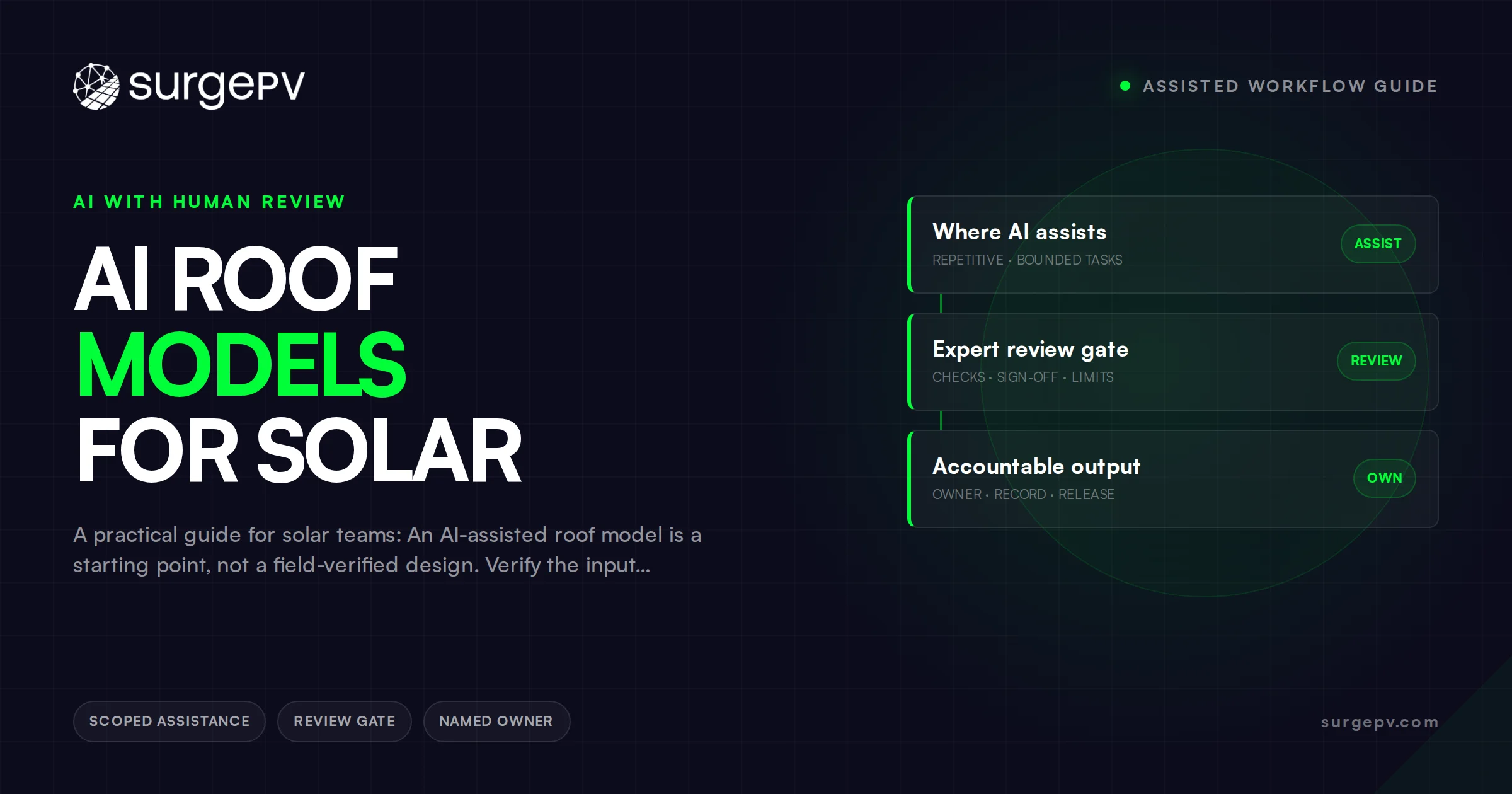
A practical guide for solar teams: An AI-assisted roof model is a starting point, not a field-verified design. Verify the input date, roof boundaries, obstructions, scale, access constraints, and any assumptions that affect a customer-facing layout or energy model.

Rainer Neumann

Written by

Rainer Neumann

Content Head · SurgePV

Rainer Neumann

Edited by

Rainer Neumann

Content Head · SurgePV

Published ·Updated

Quick Answer

An AI-assisted roof model is a starting point, not a field-verified design. Verify the input date, roof boundaries, obstructions, scale, access constraints, and any assumptions that affect a customer-facing layout or energy model.

AI can turn a roof image into a useful draft quickly. That does not make every line in the draft a physical fact. A disciplined team treats the output as a proposed interpretation of source data and asks what must be checked before it affects design, pricing, or a customer statement.

Direct Answer

An AI-assisted roof model is a starting point, not a field-verified design. Verify the input date, roof boundaries, obstructions, scale, access constraints, and any assumptions that affect a customer-facing layout or energy model.

Why this review belongs in the project workflow

AI roof model verification for solar is most useful when it leaves a traceable decision rather than an isolated image, spreadsheet, or conversation. Solar proposals combine site facts, design assumptions, modeled outputs, and commercial information. A change in one can make another less reliable. The workflow should therefore show what is confirmed, what is estimated, and what must be revisited before release.

The article is desk research for installers and EPCs. It is not engineering advice, a site survey, or a guarantee of production, approval, savings, cost, or delivery outcomes. Use applicable local rules, equipment documentation, utility requirements, and qualified review for the project at hand.

Separate detection from confirmation

An algorithm may identify planes, edges, and visible features. Confirmation is a professional act: compare the output with the source image, identify missing context, and decide whether the apparent object matters to the design. This distinction prevents a visual result from acquiring more authority than its evidence deserves.

A useful working question at this stage is: “What fact would make this AI roof model verification for solar decision different?” For AI roof model verification for solar, the answer should be placed in the project record with its source, date, and owner. That approach directs attention to material uncertainty instead of adding a generic approval step.

For a AI roof model verification for solar sales and design team, for AI roof model verification for solar, the value is shared language. In AI roof model verification for solar, the person preparing the customer material can see the current status, while the person responsible for technical review can see which assumption is driving the conversation. For AI roof model verification for solar, no public resource can determine the right answer for an individual site; local requirements, manufacturer documentation, and competent project review still govern the work.

For AI roof model verification for solar, make the check observable: state the input, the method used to evaluate it, the reviewer, and the condition that would force a revision. In AI roof model verification for solar review, the next person needs an intelligible record rather than a finished image with no decision trail.

The AI roof model verification for solar record should also distinguish an operational choice from a technical conclusion. In a AI roof model verification for solar workflow, the team may advance a qualified opportunity while marking a site fact as unresolved; it should not silently turn that unresolved fact into a final representation.

Audit the image itself

Before reviewing a model, review the image date, resolution, angle, seasonal conditions, and coverage. An older image may predate a reroof, extension, tree growth, or rooftop equipment. A satellite view may hide a vertical feature behind a parapet. Record image limitations in the project rather than relying on an individual designer to remember them.

For a AI roof model verification for solar sales and design team, for AI roof model verification for solar, the value is shared language. In AI roof model verification for solar, the person preparing the customer material can see the current status, while the person responsible for technical review can see which assumption is driving the conversation. For AI roof model verification for solar, no public resource can determine the right answer for an individual site; local requirements, manufacturer documentation, and competent project review still govern the work.

In AI roof model verification for solar work, this is also a communication practice. A customer can accept that a preliminary model has limits when those limits are described before a commitment is implied. In AI roof model verification for solar, vague confidence creates a later trust problem; a named assumption creates a path to resolve it.

For AI roof model verification for solar, make the check observable: state the input, the method used to evaluate it, the reviewer, and the condition that would force a revision. In AI roof model verification for solar review, the next person needs an intelligible record rather than a finished image with no decision trail.

The AI roof model verification for solar record should also distinguish an operational choice from a technical conclusion. In a AI roof model verification for solar workflow, the team may advance a qualified opportunity while marking a site fact as unresolved; it should not silently turn that unresolved fact into a final representation.

Check boundaries and obstacles

Roof perimeter, ridge lines, dormers, skylights, vents, mechanical equipment, walkways, and parapets are not decorative details. Each can change the usable region or trigger a later question. A checker does not need to redraw the whole project; they need a structured way to mark what is confirmed, questionable, or absent from the source.

In AI roof model verification for solar work, this is also a communication practice. A customer can accept that a preliminary model has limits when those limits are described before a commitment is implied. In AI roof model verification for solar, vague confidence creates a later trust problem; a named assumption creates a path to resolve it.

Keep AI roof model verification for solar action proportionate. A simple, well-documented roof may only need a targeted confirmation. A complicated site or a material commercial decision may require more evidence. The important point is that the level of review is deliberate and visible.

For AI roof model verification for solar, make the check observable: state the input, the method used to evaluate it, the reviewer, and the condition that would force a revision. In AI roof model verification for solar review, the next person needs an intelligible record rather than a finished image with no decision trail.

The AI roof model verification for solar record should also distinguish an operational choice from a technical conclusion. In a AI roof model verification for solar workflow, the team may advance a qualified opportunity while marking a site fact as unresolved; it should not silently turn that unresolved fact into a final representation.

Treat scale as a design input

A model can look proportionate while a scale assumption is wrong enough to change a panel row or clearance. Compare scale to trustworthy site information where available. Where no reliable reference exists, do not present a detailed layout as settled. The NREL photovoltaic research library is useful technical context; it does not validate a particular roof image.

Keep AI roof model verification for solar action proportionate. A simple, well-documented roof may only need a targeted confirmation. A complicated site or a material commercial decision may require more evidence. The important point is that the level of review is deliberate and visible.

A useful working question at this stage is: “What fact would make this AI roof model verification for solar decision different?” For AI roof model verification for solar, the answer should be placed in the project record with its source, date, and owner. That approach directs attention to material uncertainty instead of adding a generic approval step.

For AI roof model verification for solar, make the check observable: state the input, the method used to evaluate it, the reviewer, and the condition that would force a revision. In AI roof model verification for solar review, the next person needs an intelligible record rather than a finished image with no decision trail.

The AI roof model verification for solar record should also distinguish an operational choice from a technical conclusion. In a AI roof model verification for solar workflow, the team may advance a qualified opportunity while marking a site fact as unresolved; it should not silently turn that unresolved fact into a final representation.

Preserve the review trail

Keep the original source, generated model, reviewer notes, and replacement version together. A connected Solar Designing workflow can make it easier to see which project output came from which input. It does not transfer design responsibility from the project team to a model.

A useful working question at this stage is: “What fact would make this AI roof model verification for solar decision different?” For AI roof model verification for solar, the answer should be placed in the project record with its source, date, and owner. That approach directs attention to material uncertainty instead of adding a generic approval step.

For a AI roof model verification for solar sales and design team, for AI roof model verification for solar, the value is shared language. In AI roof model verification for solar, the person preparing the customer material can see the current status, while the person responsible for technical review can see which assumption is driving the conversation. For AI roof model verification for solar, no public resource can determine the right answer for an individual site; local requirements, manufacturer documentation, and competent project review still govern the work.

For AI roof model verification for solar, make the check observable: state the input, the method used to evaluate it, the reviewer, and the condition that would force a revision. In AI roof model verification for solar review, the next person needs an intelligible record rather than a finished image with no decision trail.

The AI roof model verification for solar record should also distinguish an operational choice from a technical conclusion. In a AI roof model verification for solar workflow, the team may advance a qualified opportunity while marking a site fact as unresolved; it should not silently turn that unresolved fact into a final representation.

Explain the boundary to customers

When a proposal uses an AI-assisted roof model, plain language builds more trust than magic language. Say that the layout is modeled from available information and subject to site, engineering, code, utility, and equipment confirmation as applicable. The goal is an informed next step, not a claim that uncertainty has disappeared.

For a AI roof model verification for solar sales and design team, for AI roof model verification for solar, the value is shared language. In AI roof model verification for solar, the person preparing the customer material can see the current status, while the person responsible for technical review can see which assumption is driving the conversation. For AI roof model verification for solar, no public resource can determine the right answer for an individual site; local requirements, manufacturer documentation, and competent project review still govern the work.

In AI roof model verification for solar work, this is also a communication practice. A customer can accept that a preliminary model has limits when those limits are described before a commitment is implied. In AI roof model verification for solar, vague confidence creates a later trust problem; a named assumption creates a path to resolve it.

For AI roof model verification for solar, make the check observable: state the input, the method used to evaluate it, the reviewer, and the condition that would force a revision. In AI roof model verification for solar review, the next person needs an intelligible record rather than a finished image with no decision trail.

The AI roof model verification for solar record should also distinguish an operational choice from a technical conclusion. In a AI roof model verification for solar workflow, the team may advance a qualified opportunity while marking a site fact as unresolved; it should not silently turn that unresolved fact into a final representation.

Bring AI roof model verification for solar into one reviewable solar workflow

See how SurgePV can help a team keep AI roof model verification for solar inputs, modeled outputs, and customer-ready AI roof model verification for solar materials connected.

Book a Demo

A practical AI roof model verification for solar release checklist

Before using AI roof model verification for solar work in a proposal or handoff, ask: is the AI roof model verification for solar source data current enough for the decision; does the current AI roof model verification for solar project record identify relevant unknowns; have dependent outputs been reviewed; and does the customer-facing material state meaningful AI roof model verification for solar limitations? Answering those questions explicitly is more valuable than adding confidence language after the fact.

For an integrated AI roof model verification for solar workflow, review the relevant Solar Designing page and decide how the team will define its own release conditions. SurgePV can support connected AI roof model verification for solar design and proposal work; it does not replace site verification, engineering judgment, or jurisdiction-specific review.

Frequently Asked Questions

Are AI-generated roof models survey-grade?

Not automatically. Their suitability depends on the source data, verification, project purpose, and applicable requirements.

What must be reviewed in an AI roof model?

Review source date and coverage, boundaries, visible obstructions, scale, access-related constraints, and the status of unresolved items.

Should an AI model be shown to a customer?

It can be shown as a labeled preliminary model when its assumptions and pending verification are explained clearly.

Ready to make AI roof model verification for solar easier to review?

Book a personalized SurgePV demo to explore a connected AI roof model verification for solar design, analysis, and proposal workflow.

Book a Free Demo

About the Contributors

Author
Rainer Neumann
Rainer Neumann

Content Head · SurgePV

Rainer Neumann is Content Head at SurgePV and a solar PV engineer with 10+ years of experience designing commercial and utility-scale systems across Europe and MENA. He has delivered 500+ installations, tested 15+ solar design software platforms firsthand, and specialises in shading analysis, string sizing, and international electrical code compliance.

Editor
Rainer Neumann
Rainer Neumann

Content Head · SurgePV

Rainer Neumann is Content Head at SurgePV and a solar PV engineer with 10+ years of experience designing commercial and utility-scale systems across Europe and MENA. He has delivered 500+ installations, tested 15+ solar design software platforms firsthand, and specialises in shading analysis, string sizing, and international electrical code compliance.

Get Solar Design Tips in Your Inbox

Join 2,000+ solar professionals. One email per week - no spam.

No spam · Unsubscribe anytime

Book Free Demo