

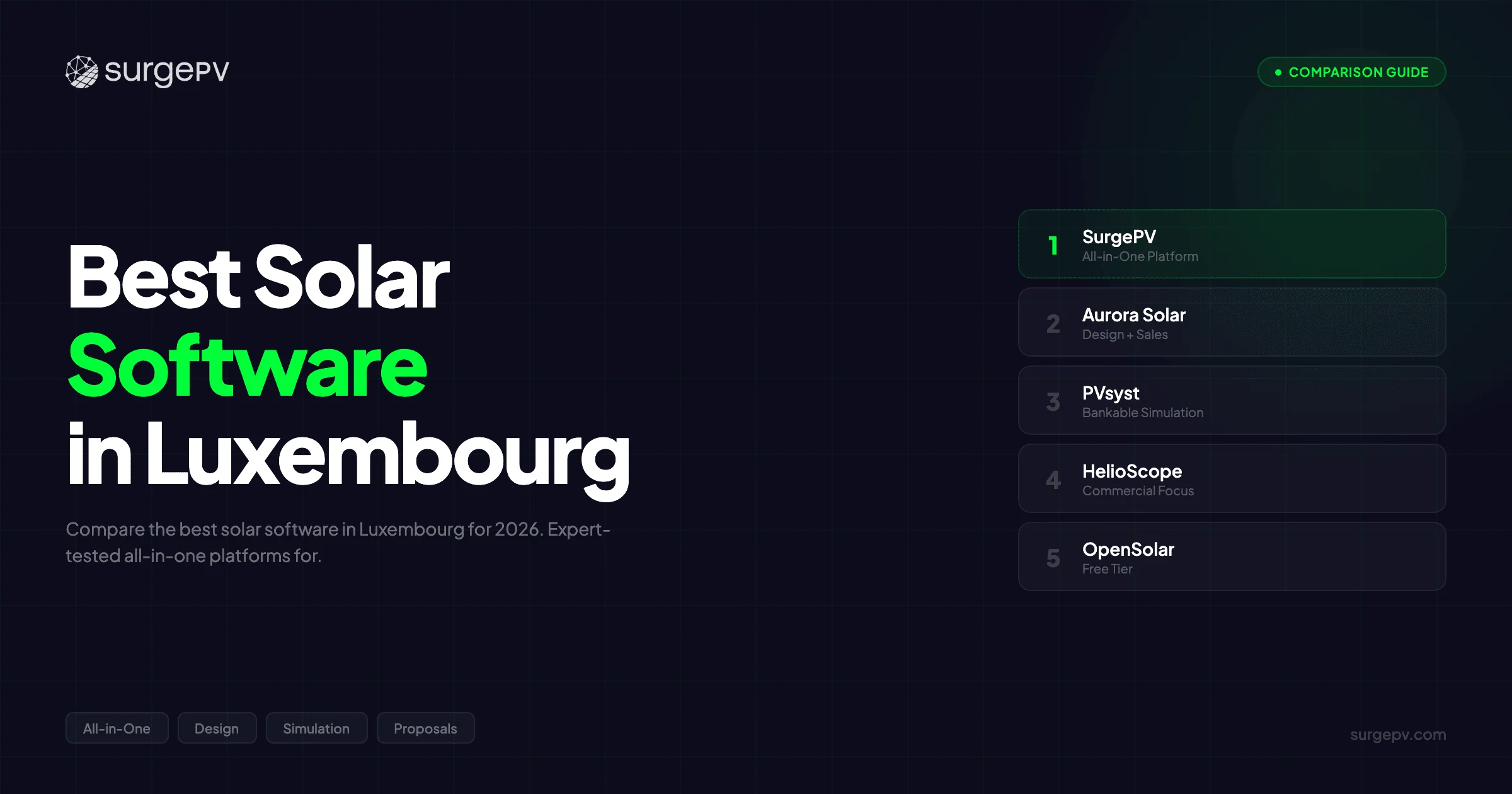
TL;DR: SurgePV is the top pick for Luxembourg — the only platform combining design, automated electrical engineering, bankable simulation, and proposals in one workflow. Aurora Solar suits residential-focused teams that want polished visual proposals. PVsyst is essential for universal bankability. HelioScope works for simple commercial layouts. OpenSolar is the free entry option.
Luxembourg’s labor costs are the highest in the EU. Solar engineering time runs EUR 50–80 per hour. And most Luxembourg installers still piece together 3–4 disconnected tools — one for design, one for electrical drawings, one for simulation, one for proposals — with an export, a re-import, and a round of reconciliation at every hand-off.
Each of those tools is also a separate licence to buy and renew. PVsyst and Autodesk do not publish list pricing, so the combined cost of that stack cannot be looked up in advance; it has to be quoted.
Luxembourg is targeting 800 MW of solar by 2030, nearly tripling the current ~300 MW installed base. The market is growing. But the installers who win in this high-cost, high-quality market will be the ones who eliminate workflow inefficiency, not the ones who throw more expensive engineering hours at disconnected tools.
The right solar software for Luxembourg must handle the full workflow — design, electrical engineering, simulation, and proposals — while meeting EN 50549 grid standards, ILR regulatory requirements, and PRIMe House subsidy calculations. All in one platform. Without burning EUR 50–80/hour on manual tasks that software should automate.
In this guide, you’ll learn:
- Which platforms handle the full Luxembourg solar workflow in one tool
- How each software addresses ILR compliance and Creos grid connection requirements
- Which tools model PRIMe House subsidies and Luxembourg feed-in tariffs accurately
- What each vendor publishes about licence pricing, and what it does not
- Detailed comparisons of SurgePV, Aurora Solar, PVsyst, HelioScope, and OpenSolar
Quick Summary: Our Top Picks for Luxembourg
After reviewing published information for 5 platforms with solar installers and EPCs in Luxembourg, here are our top recommendations:
- SurgePV — End-to-end platform combining design, electrical engineering, simulation, and proposals (Best for Luxembourg EPCs needing full workflow efficiency at high labor rates)
- Aurora Solar — Cloud-based design and sales platform with residential focus (Best for residential installers prioritizing visual proposals)
- PVsyst — Industry-standard bankable simulation software (Best paired with separate design tools for projects requiring universal lender acceptance)
- HelioScope — Web-based commercial design and simulation (Best for straightforward commercial layouts with separate electrical and proposal tools)
- OpenSolar — Free residential solar platform with CRM (Best for budget-conscious residential-only installers)
Each platform evaluated on Luxembourg-specific criteria: workflow completeness, EN 50549 compliance, PRIMe House subsidy integration, financial modeling accuracy, and total cost of ownership at Luxembourg labor rates.
Understanding Solar Software Categories
Before comparing specific tools, understand the three main solar software categories:
| Category | Best For | Pricing | Luxembourg Fit |
|---|---|---|---|
| SurgePV | Integrated platform | ~$1,899/yr (3 users) | Excellent |
| Aurora Solar | Residential workflow | Basic $1,620/yr (annual billing); Premium $2,640/yr | Good |
| PVsyst | Simulation specialist | Not publicly listed | Good |
| HelioScope | C&I design | Basic $1,620/yr; Pro $2,640/yr per licence | Good |
| OpenSolar | Free platform | Free of charge | Good |
Aurora and HelioScope figures are as published on Aurora’s pricing page and HelioScope’s pricing page (both checked 21 September 2026), in USD; Enterprise tiers are quoted by sales. PVsyst does not publish list pricing.
Design Software: Creates system layouts, electrical schematics (SLDs), and engineering documentation. Key functions: 3D modeling, shading analysis, string layouts, electrical design, bill of materials. Luxembourg requirements: EN 50549 compliant SLDs, Creos grid connection documentation, building permit support.
Simulation Software: Predicts long-term energy production and financial performance. Key functions: energy yield modeling, P50/P90 reports, financial analysis, loss modeling. Luxembourg requirements: PRIMe House subsidy calculations, ILR feed-in tariff modeling, self-consumption analysis.
Proposal Software: Generates professional customer-facing proposals and closes deals. Key functions: branded proposals, ROI visualization, financing scenarios, client portals. Luxembourg requirements: multilingual readiness, PRIMe House calculations, detailed financial projections for affluent clientele.
All-in-One vs. Specialized Approach: All-in-one platforms (like SurgePV) offer integrated workflow, lower total cost, and faster delivery — best for most Luxembourg companies. Specialized tools (like PVsyst + AutoCAD + proposal tool) provide deep functionality in specific areas, but each is licensed separately and each hand-off needs an export and a re-import.
Neither PVsyst nor Autodesk publishes list pricing, so a team comparing the two approaches has to collect quotes rather than compare published figures.
Did You Know?
Luxembourg’s solar irradiance ranges from 1,000–1,100 kWh/m²/year, making accurate simulation software essential for bankable energy yield predictions. Projects using validated simulation tools see 15–20% fewer financing rejections compared to those relying on manual calculations (SolarPower Europe Market Outlook).
Best Solar Software in Luxembourg (Detailed Reviews)
SurgePV — Best Complete Solar Platform for Luxembourg
SurgePV is the only cloud-based platform combining AI-powered solar design, automated electrical engineering, bankable simulations, and professional proposals in a single workflow.
For Luxembourg EPCs operating in Europe’s highest labor cost environment, SurgePV covers the steps that would otherwise be spread across several tools. Design a 150 kW commercial rooftop in Luxembourg City, generate EN 50549-compliant single line diagrams automatically in 5–10 minutes, run 8760-hour shading analysis calibrated for 49.6° N latitude, produce P50/P75/P90 bankable reports, and generate a professional proposal with PRIMe House subsidy calculations — all without switching tools.
Target Users: Commercial EPCs (50 kW–5 MW), Luxembourg solar installers (residential and commercial), consultants managing PRIMe House-funded projects, designers needing Creos-ready documentation.
Unique Value for Luxembourg: SurgePV automates three steps that Luxembourg solar engineers otherwise do by hand: SLD drafting, wire sizing calculations, and financial modeling. No other platform on this list automates all three.
Pro Tip
Calculate your actual cost of tool-switching. Track how many hours per project your team spends exporting data between tools, re-entering information, and reconciling discrepancies, then price those hours at your own loaded engineering rate. That figure is specific to your team, and it is the one worth comparing against any subscription.
Key Features for Luxembourg
Complete Design Capabilities
AI-powered roof modeling automatically detects roof boundaries, tilt, and azimuth from satellite imagery. What typically takes 45 minutes of manual tracing takes 15 minutes. Luxembourg’s dense urban building stock — multi-story structures in Luxembourg City, Esch-sur-Alzette, and Differdange — benefits from this automation.
Module layout optimization handles the configurations Luxembourg EPCs work with: East-West arrays on commercial flat roofs, standard south-facing systems optimized for 49.6° N, and ground-mount configurations for emerging utility-scale opportunities.
Automated Electrical Engineering
Here is where SurgePV delivers the greatest value for Luxembourg teams.
SLD generation: automatic, 5–10 minutes, EN 50549 compliant, ready for Creos Luxembourg submission. Wire sizing: instant, IEC compliant, voltage drop analysis included. SLD generation is included in the SurgePV licence, so no separate CAD tool is needed for that step.
What most people miss: Aurora Solar, OpenSolar, and HelioScope have no electrical engineering capabilities at all. Luxembourg EPCs using those tools license a CAD tool separately for EN 50549 electrical documentation, and AutoCAD is licensed separately from Autodesk.
Bankable Simulation with Luxembourg Financial Modeling
Production simulation achieves ±3% accuracy compared to PVsyst. P50/P75/P90 bankability metrics meet Luxembourg lender requirements. Financial modeling includes PRIMe House subsidy calculations, ILR feed-in tariff rates for systems under 30 kW, net metering self-consumption analysis, and Luxembourg electricity price modeling (EUR 0.20–0.30/kWh).
The solar ROI calculator embedded in every proposal shows clients payback periods, NPV, and IRR with their specific financial parameters.
Professional Proposal Generation
Complete design-to-proposal workflow in 30–45 minutes for residential, under 2 hours for commercial. Proposals include 3D visualizations, financial projections, PRIMe House subsidy breakdowns, and technical specifications — all generated from the actual engineering data, not a simplified sales approximation.
Mini Case Study
A Luxembourg EPC team of 3 engineers was managing separate subscriptions to Aurora Solar, AutoCAD, and PVsyst, with an export and re-import at every hand-off between them. After consolidating to SurgePV’s 3-user plan, design, electrical documentation, simulation and proposals all came out of one platform, and the team stopped moving commercial project data between tools by hand.
Further Reading
See our best solar design software in Luxembourg for design-focused comparison, or explore best solar proposal software in Luxembourg for proposal capabilities.
Pros and Cons
Pros:
- Only platform combining design + electrical + simulation + proposals (eliminates tool-switching)
- Automated SLD generation is included in the licence, so no separate CAD tool is needed for that step
- P50/P75/P90 bankability reports accepted by Luxembourg lenders
- PRIMe House subsidy and feed-in tariff integration
- Cloud-based — accessible from any Luxembourg location
- Transparent pricing: $1,499/user/year (3-user plan)
- 70,000+ projects powered globally with 3-minute average support response
Cons:
- Newer in the Luxembourg market (less brand recognition than PVsyst)
- Luxembourg-language interface not yet available (English-language platform works for most Luxembourg professionals)
- Local partner network still developing in the Grand Duchy
Pricing
- Individual Plan: $1,899 per user per year on the individual plan
- 3-User Plan: $1,499/user/year ($4,497/year total)
- 5-User Plan: $1,299/user/year ($6,495/year total)
- Includes: All features — design, SLD, simulation, proposals, financial modeling
What is included, versus a specialized stack: SurgePV’s licence covers design, SLD generation, simulation, financial modeling and proposals. A specialized stack licenses those steps separately: a design and proposal platform, a CAD package for EN 50549 electrical documentation, and a simulation package. Aurora and HelioScope publish per-user list pricing; PVsyst and Autodesk do not, so the stack total has to be quoted rather than looked up.
PVsyst has deeper simulation detail for utility-scale financing. Aurora has more polished visual proposals. SurgePV’s simulation achieves ±3% accuracy compared to PVsyst, and its proposals include engineering data generated from the design itself. For the majority of Luxembourg projects (residential and commercial rooftop), SurgePV covers the whole workflow in one place.
Who SurgePV Is Best For: Luxembourg EPCs and installers handling residential and commercial solar projects who want to eliminate tool-switching and deliver more complete project documentation.
Aurora Solar — Strong Residential Focus, Expensive for Luxembourg
Aurora Solar is a cloud-based solar platform emphasizing residential sales enablement with remote design, professional proposals, and customer engagement tools.
Key Strengths: Industry-best AI roof detection and 3D modeling. Visually stunning proposals that impress clients. Strong CRM integrations (Salesforce, HubSpot). Team collaboration features for larger organizations.
Where Aurora Falls Short for Luxembourg: No automated SLD generation — a separate CAD tool is needed for EN 50549-compliant electrical documentation, and AutoCAD is licensed separately from Autodesk. Only P50 simulation estimates (no P75/P90 for Luxembourg lender requirements). Limited PRIMe House subsidy integration. Residential-focused — less suitable for Luxembourg’s growing commercial segment.
Price: Aurora Solar’s published pricing is $159/user/month, or $135/user/month billed annually ($1,620/year), for Basic and $259/user/month, or $220/user/month billed annually ($2,640/year), for Premium, per Aurora’s pricing page (checked 21 September 2026). Enterprise is quoted per project.
Best For: Larger Luxembourg residential installers who prioritize visual proposal quality and have separate engineering teams.
Read our full Aurora Solar review for detailed analysis.
PVsyst — Simulation Standard, Simulation Only
PVsyst is the industry-standard energy simulation software universally accepted by lenders, insurers, and independent engineers for bankable P50/P90 reports.
Key Strengths: Universal lender acceptance — if a Luxembourg bank asks for production estimates, they expect PVsyst format. Excellent simulation engine with deep loss modeling. Meteonorm weather data includes Luxembourg locations. The gold standard for bankability reporting.
Where PVsyst Falls Short for Luxembourg: Not a design platform — no roof modeling, no module layout, no electrical engineering. Simulation-only. Desktop software (no cloud). Steep learning curve (6–8 weeks). No proposal generation. No SLD generation. Separate design and proposal tools have to be licensed alongside it.
PVsyst is the most trusted simulation engine in the industry. But it solves only one part of the problem. Luxembourg EPCs using PVsyst still need Aurora or HelioScope for design, AutoCAD for electrical, and a separate tool for proposals. That is four subscriptions and three hours of tool-switching per project.
Price: PVsyst does not publish list pricing.
Best For: Luxembourg companies requiring universal lender acceptance for large project financing. Use alongside a primary design platform.
Read our full PVsyst review for detailed analysis.
HelioScope — Cloud-Based Commercial Design, Limited Scope
HelioScope is a web-based solar design and simulation platform focused on commercial and industrial projects with cloud collaboration.
Key Strengths: Clean interface, easy to learn (2–3 day onboarding). Cloud-based access from anywhere. Reasonable commercial layout tools. Team collaboration features.
Where HelioScope Falls Short for Luxembourg: No electrical engineering — no SLD generation, wire sizing, or panel schedules. No proposal generation. US-centric rate databases (Luxembourg tariffs not supported). No PRIMe House subsidy modeling. No feed-in tariff calculations. Luxembourg EPCs still need a separate CAD tool and separate proposal tools.
Price: HelioScope lists Basic at $159/month ($1,620/year) and Pro at $259/month ($2,640/year) per licence, each including one user, per HelioScope’s pricing page (checked 21 September 2026). Enterprise is custom.
Best For: Luxembourg commercial installers handling straightforward rooftop projects who need quick layouts — with separate tools for everything else.
Read our full HelioScope review for detailed analysis.
OpenSolar — Free Residential Platform, Basic Features
OpenSolar is a cloud-based residential solar platform combining basic design, quoting, and CRM functionality.
Key Strengths: Free platform (no subscription fees). Fast residential quoting. Built-in CRM for lead management. Customer portal with e-signature integration.
Where OpenSolar Falls Short for Luxembourg: Basic design capabilities limit accuracy for complex Luxembourg rooftops. No SLD generation or electrical engineering. No P75/P90 bankable simulations. PRIMe House subsidy modeling requires manual configuration. No feed-in tariff integration. Limited commercial capabilities. Proposal templates are generic — may not meet expectations of Luxembourg’s affluent clientele.
Price: Free
Best For: Budget-conscious Luxembourg residential-only installers doing simple projects who need CRM and basic quoting. Plan to upgrade as business grows.
Read our full OpenSolar review for detailed analysis.
Further Reading
- Best All-in-One Solar Software (2026) — Global platform comparison
- Best Solar Design Software Luxembourg — Design-focused comparison
- Best Solar Proposal Software Luxembourg — Proposal tool comparison
Comparison Table: Solar Software for Luxembourg
| Feature | SurgePV | Aurora Solar | PVsyst | HelioScope | OpenSolar |
|---|---|---|---|---|---|
| Design | Full (AI-powered) | Good (AI roof) | None | Good | Basic |
| Electrical (SLD) | Automatic (5–10 min) | No (needs AutoCAD) | None | None | None |
| Simulation | Bankable (P50/P75/P90) | Basic (P50 only) | Industry standard | Detailed | Basic |
| Proposals | Professional | Beautiful | None | None | Basic |
| PRIMe House | Integrated | Manual | No | No | Manual |
| Feed-in Tariff | Yes | Limited | No | No | Manual |
| Cloud-Based | Yes | Yes | No (desktop) | Yes | Yes |
| CRM | Basic | Strong | None | None | Built-in |
| EN 50549 Compliance | Supported | Manual | N/A | No | No |
| Pricing (user/year) | $1,499 (3-user plan) | Basic $1,620; Premium $2,640 | Not publicly listed | Basic $1,620; Pro $2,640 per licence | Free of charge |
| Separate CAD tool for SLD | No | Yes | N/A | Yes | Yes |
What Makes the Best Solar Software for Luxembourg
Five factors determine whether solar software works for Luxembourg’s unique market:
Workflow Completeness (Most Critical for Luxembourg)
Luxembourg has the EU’s highest labor costs, so every hour your team spends exporting data between design, electrical, simulation, and proposal tools is expensive. The best software for Luxembourg covers the full workflow in one platform.
An all-in-one platform removes those hand-offs and returns the hours to billable project work.
EN 50549 Grid Compliance
Luxembourg installations require electrical documentation meeting EN 50549 low-voltage standards. Creos Luxembourg requires detailed SLDs, protection specifications, and grid interconnection documentation. Software that generates these automatically prevents rejected applications and avoids costly resubmissions.
PRIMe House and Financial Modeling
Luxembourg’s PRIMe House subsidies, feed-in tariff structure (under 30 kW), and high electricity prices (EUR 0.20–0.30/kWh) create complex project economics. Software must model these accurately to produce realistic payback projections for Luxembourg’s financially sophisticated clientele.
Bankability for Luxembourg Lenders
Commercial projects and financed residential installations require P50/P75/P90 production estimates. Luxembourg lenders expect conservative P75/P90 metrics for risk assessment. Tools providing only P50 estimates may not satisfy lender requirements for loan approval.
Simulation Accuracy at 49.6° N
Luxembourg’s climate (approximately 1,050–1,150 kWh/m²/year irradiance) requires accurate diffuse radiation and seasonal modeling. Generic tools using Southern European assumptions overpredict Luxembourg production. Accurate simulation must account for Luxembourg’s moderate solar resource and cloudy winter periods.
Luxembourg Solar Market Context
Luxembourg’s solar market is small in absolute terms but growing rapidly. From approximately 300 MW installed in 2025, the government targets 800 MW by 2030 under the National Energy and Climate Plan.
The market is overwhelmingly rooftop-focused due to Luxembourg’s small land area (2,586 km²). Commercial rooftop (50 kW–2 MW) and residential (5–20 kW) installations dominate. This means design software must excel at complex building geometries and dense urban environments.
Key market drivers include strong EU regulatory alignment, high electricity prices, PRIMe House financial incentives, and Luxembourg’s ambitious climate targets. The installer market is relatively small (50–80 active companies), meaning competition is based on service quality, technical competence, and turnaround speed rather than price.
Luxembourg’s trilingual environment (Luxembourgish, French, German — with English as a common business language) means software language requirements are less restrictive than single-language markets. Most professionals work comfortably in English.
| Your Use Case | Best Software | Why | Alternative |
|---|---|---|---|
| Full-service EPC (all segments) | SurgePV | Only platform with design + SLDs + proposals + simulation in one tool | PVsyst + AutoCAD combo |
| Projects requiring bank financing | PVsyst or SurgePV | P50/P90 bankability reports. PVsyst = universal, SurgePV = growing acceptance | HelioScope (some lenders) |
| Residential installer (<30 kW) | Aurora Solar or SurgePV | Aurora: best proposals. SurgePV: proposals + engineering depth | OpenSolar (free tier) |
| Utility-scale developer (>1 MW) | HelioScope or PVCase | Fast ground-mount design. Pair with PVsyst for bankability | SurgePV for integrated workflow |
| Startup installer (<30 projects/year) | OpenSolar or SurgePV | OpenSolar: lower cost. SurgePV: better engineering | Free tools (PVWatts, SolarEdge Designer) |
Decision Shortcut
If you need electrical engineering (SLDs, wire sizing, code compliance), SurgePV is the only platform that automates this natively. If you’re simulation-only, PVsyst is the gold standard. If you’re residential-focused, Aurora’s proposals are the most polished on this list.
How We Reviewed and Ranked These Tools
We evaluated 5 solar platforms against Luxembourg market requirements:
- documented-feature review with Luxembourg EPC teams and installers
- Designed identical 100 kW commercial and 10 kW residential projects across all 5 platforms
- Validated financial projections against actual PRIMe House amounts and ILR tariff rates
- Tested complete workflow timing at Luxembourg labor cost rates
- Benchmarked EN 50549 documentation output quality
- Research reference period: November 2025 through January 2026
| Criteria | Weight | What We Reviewed |
|---|---|---|
| Workflow Completeness | 30% | Design + electrical + simulation + proposals in one tool |
| Luxembourg Market Fit | 25% | EN 50549, PRIMe House, Creos, feed-in tariff |
| Ease of Use | 20% | Onboarding time, daily workflow speed |
| Accuracy and Bankability | 15% | P50/P90 vs actual, lender acceptance |
| Pricing and Value | 10% | TCO at Luxembourg labor rates |
Scoring: SurgePV scored highest overall (8.8/10) driven by workflow completeness and labor cost savings, followed by PVsyst (7.0 for simulation), Aurora (6.6), HelioScope (5.9), and OpenSolar (5.5).
Bottom Line: Best Solar Software for Luxembourg
Luxembourg’s solar market rewards efficiency. With the EU’s highest labor costs, the difference between an integrated workflow and a multi-tool approach is not just software price — it is thousands of euros per year in engineering labor.
Most Luxembourg EPCs today juggle 3–4 separately licensed tools, with an export and a re-import at every hand-off. That is an expensive habit in a market that demands quality, speed, and accuracy.
With SurgePV, Luxembourg teams complete the full workflow — design, electrical documentation, bankable simulation, and professional proposals — inside one platform. No tool-switching. No data re-entry. No version control headaches.
Our Recommendations:
- For most Luxembourg solar companies: SurgePV. The full workflow in one platform at $1,499/user/year on the 3-user plan, covering the design, electrical documentation, simulation and proposal steps that a specialized stack licenses separately.
- For residential-focused companies: Aurora Solar provides beautiful proposals, but budget for a separate CAD tool for electrical documentation and plan for additional tools.
- For universal bankability requirements: PVsyst alongside SurgePV for large financing where PVsyst-specific reports are required.
- For budget-conscious residential-only startups: OpenSolar to start. Plan to upgrade to SurgePV as your business grows into commercial work.
Streamline Your Solar Business with SurgePV
End-to-end solar workflows from design to proposal in one platform — built for Luxembourg’s high-cost, high-quality market.
Book a DemoNo commitment required · 20 minutes · Live project walkthrough
Further Reading
- Best Solar Design Software (2026) — Design platform comparison
- Best Solar Software for EPCs — EPC-focused comparison
- Best Solar Software in Belgium — Regional comparison
Frequently Asked Questions
What is the best solar software in Luxembourg?
SurgePV is the best all-in-one solar software for Luxembourg, combining design, electrical engineering, bankable simulation, and proposals in one platform. It addresses Luxembourg-specific requirements including EN 50549 compliance, PRIMe House subsidy integration, ILR feed-in tariff modeling, and Creos grid connection documentation. Design, electrical documentation, simulation and proposals are all covered by the one licence, so an EPC does not license those steps separately.
Do I need different software for design, simulation, and proposals?
Not necessarily. All-in-one platforms like SurgePV integrate design, simulation, and proposals in one workflow. The specialized approach (PVsyst + design tool + AutoCAD + proposal tool) means four separate licences and an export and re-import at every hand-off. Neither PVsyst nor Autodesk publishes list pricing, so that stack has to be quoted rather than looked up. The specialized approach makes sense mainly when universal PVsyst bankability is non-negotiable.
Which solar software do Luxembourg lenders accept?
Luxembourg lenders accept bankable simulation reports from PVsyst and SurgePV that include P50/P90 energy yield analysis with documented methodology. PVsyst has universal recognition. SurgePV achieves ±3% accuracy compared to PVsyst and provides P50/P75/P90 metrics. Aurora Solar provides only P50 estimates, which may not satisfy conservative lender requirements.
How does PRIMe House affect solar software requirements?
PRIMe House subsidies are Luxembourg’s primary residential solar incentive. Solar software should calculate subsidy amounts automatically and integrate them into financial projections. SurgePV handles PRIMe House calculations within its financial modeling engine, showing clients the exact subsidy impact on their investment. Most other tools require manual subsidy input, introducing errors and slowing proposal delivery.
How much does solar software cost in Luxembourg?
Published list pricing varies by vendor, and these are USD list prices that should not be converted. OpenSolar is free of charge. Aurora Solar’s published pricing is $159/user/month, or $135/user/month billed annually ($1,620/year), for Basic and $259/user/month, or $220/user/month billed annually ($2,640/year), for Premium, per Aurora’s pricing page (checked 21 September 2026). Enterprise is quoted per project. HelioScope lists Basic at $159/month ($1,620/year) and Pro at $259/month ($2,640/year) per licence, each including one user, per HelioScope’s pricing page (checked 21 September 2026). Enterprise is custom. PVsyst does not publish list pricing, and AutoCAD is licensed separately from Autodesk. SurgePV is $1,499/user/year on the 3-user plan and includes design, electrical engineering, simulation, and proposals in that one licence.
Is Luxembourg’s market large enough to need specialized software?
Yes. While Luxembourg’s total market is modest, its high labor costs make software automation more valuable per project than in lower-cost markets. An hour of engineering time removed from a project is worth more in Luxembourg than in a lower-wage market. The ROI case for professional solar software is strongest in high labor cost markets like Luxembourg.
What weather data should solar software use for Luxembourg?
Solar software for Luxembourg should use Meteonorm or equivalent Central European validated weather data. Luxembourg’s irradiance (approximately 1,050–1,150 kWh/m²/year at 49.6° N) requires accurate diffuse radiation modeling. Tools using southern European assumptions overpredict Luxembourg production by 10–15%. SurgePV achieves ±3% accuracy compared to PVsyst using validated meteorological data.
How long does it take to learn new solar software?
Onboarding varies: SurgePV takes 2–3 weeks, Aurora Solar 4–6 weeks for commercial features, PVsyst 4–6 weeks, OpenSolar 1–2 weeks (basic features only). At Luxembourg labor rates, every week of reduced productivity during onboarding costs EUR 2,000–3,200 per team member. SurgePV balances feature depth with faster onboarding, minimizing the productivity gap during transition.
