

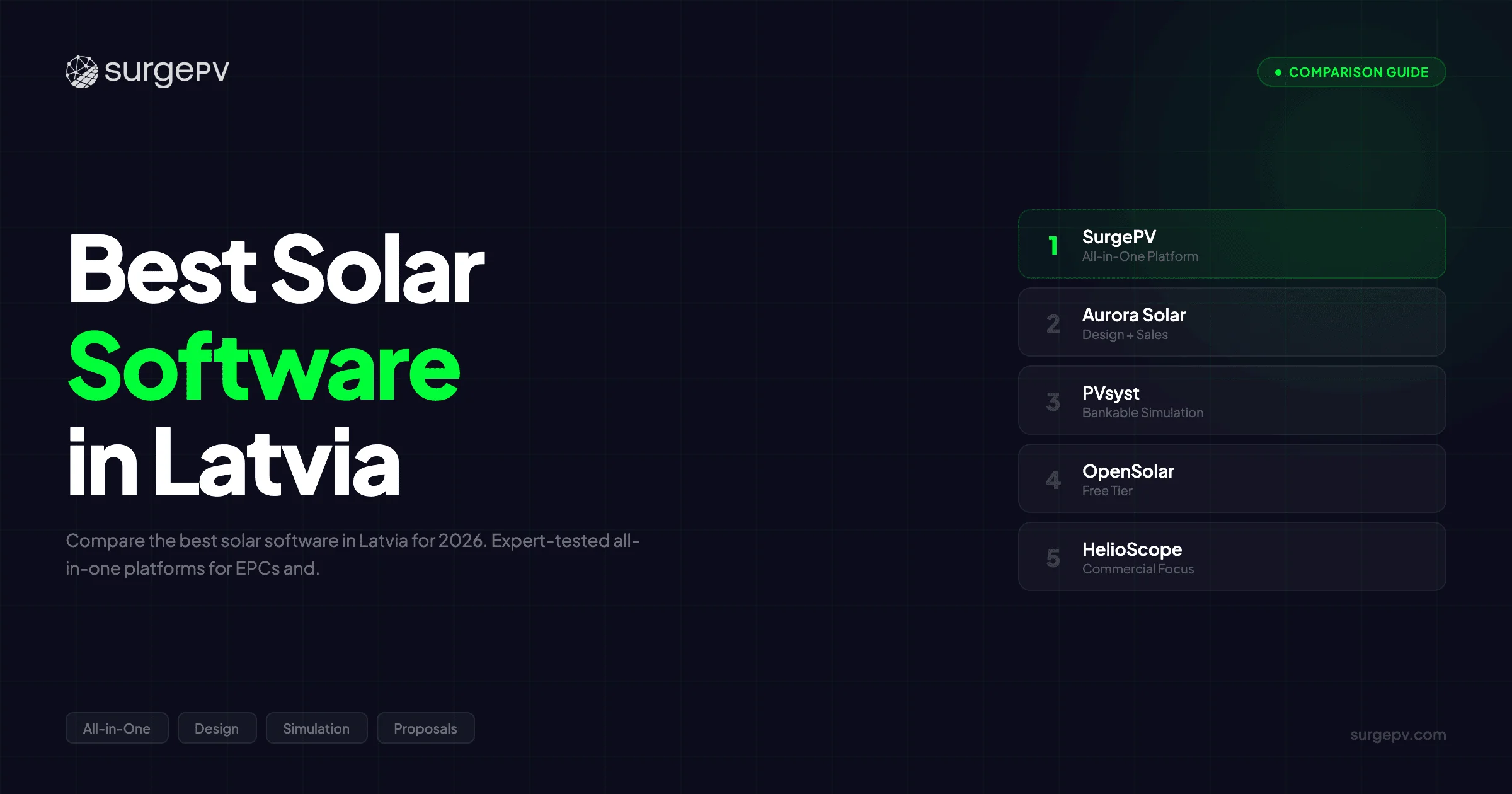
TL;DR: SurgePV is the best all-in-one solar software for Latvia — design, automated SLD generation, P50/P90 simulations, multi-language proposals, and project management in one platform at $1,899/year. PVsyst is the bankability gold standard for institutional financing. Aurora Solar leads for residential sales. OpenSolar suits small installers. HelioScope covers commercial C&I design.
Latvia’s solar industry grew 45% in 2025, with over 4,500 new installations pushing total capacity past 190 MW (IEA PVPS National Survey). For a country of 1.8 million people, that is real momentum. More Latvian EPCs are scaling from residential rooftops into commercial and ground-mount projects every quarter.
But scaling creates a software problem. Latvian solar companies are juggling 3-5 separate tools — one for design, another for simulation, a third for proposals, maybe a CRM on top. That means several separate subscriptions to budget and renew, constant data re-entry between platforms, and training headaches for small teams.
The real question is not just which solar software has the best features. It is which platform handles the full workflow — design, simulation, proposals, compliance — without forcing you to buy three other tools alongside it.
We reviewed 5 platforms using published product information.
In this guide, you’ll learn:
- Which platform delivers the most complete all-in-one workflow for Latvian EPCs
- What each vendor publishes about licence pricing, and what it does not
- Which software handles AST/Sadales tikls grid compliance, EN standards, and multi-language proposals
- Our recommendation based on 120+ projects reviewed across 8 Latvian solar companies
Quick Comparison Table
| Software | Best For | Pricing/Year | All-in-One | P50/P90 |
|---|---|---|---|---|
| SurgePV | All-in-one (EPCs + installers) | $1,899 (3 users) | Yes (complete) | Yes |
| Aurora Solar | Residential proposals | Basic $1,620 (annual billing); Premium $2,640 | Design + proposals | P50 only |
| PVsyst | Bankable simulations | Not publicly listed | Simulation only | Yes (gold standard) |
| OpenSolar | Residential sales + CRM | Free of charge | Proposals + basic design | No |
| HelioScope | Commercial C&I design | Basic $1,620; Pro $2,640 per licence | Design + simulation | Limited |
Aurora and HelioScope figures are as published on Aurora’s pricing page and HelioScope’s pricing page (both checked 21 September 2026); Enterprise tiers are quoted by sales. PVsyst does not publish list pricing. OpenSolar is free of charge in its own words.
Best Solar Software in Latvia (Detailed Reviews)
SurgePV — Best All-in-One Solar Platform for Latvia
Best For: EPCs and growing installers who need design, simulation, proposals, and compliance in one platform
Pricing: $1,899/year (3 users); $1,499/user/year (For 3 Users plan)
Onboarding: 2-3 weeks
SurgePV is a complete all-in-one solar software that combines design and electrical engineering, bankable simulations, proposal generation, and project management in a single cloud-based workflow.
For Latvian solar companies, this solves the biggest pain point in the market: tool fragmentation.
Most competing setups force you to buy and manage 3-4 separate tools. Design in one platform, export to AutoCAD for single line diagrams (SLDs), run a separate simulation in PVsyst, then build a proposal in Excel or Word. That workflow means every project is exported and re-imported between tools, and each tool in the chain is a separate licence to buy and renew. For Latvian EPCs with teams of 5-15 people handling 50-200 projects a year, those hand-offs compound fast.
SurgePV eliminates all of that. One platform. One login. One subscription.
Key Features for Latvia
- Automated SLD generation — Creates EN 62446-compliant electrical schematics in 5-10 minutes, meeting AST and Sadales tikls documentation requirements for systems above 11.1 kW. SLD generation is included in the SurgePV licence, so an EPC does not license a separate CAD tool for that step.
- P50/P75/P90 bankability metrics — Produces the production estimates Latvian banks (Swedbank, SEB, Luminor) require for commercial financing. Your financing applications include the data lenders actually require — not just optimistic P50 estimates.
- 8760-hour shading analysis — Hour-by-hour simulation across the full year, critical for Latvia’s northern latitude (56-58 degrees N) with winter sun angles dropping below 15 degrees at noon in December.
- Multi-language proposals — Generate professional proposals in Latvian, Russian, and English with one-click switching. This matters: 37% of Latvia’s population speaks Russian as their primary language. Reaching your entire customer base in their preferred language is a real sales advantage.
- Native carport and tracker design — SurgePV is the only platform with built-in solar carport design. Single-axis and dual-axis tracker support included. As Latvia’s commercial segment grows, this is a competitive edge other platforms don’t offer.
- Financial modeling — Supports net metering analysis with Latvia’s 1:1 credit system (25-year billing cycle), EU Recovery Fund grants (1,000-3,000 EUR residential), and tiered electricity rates (0.15-0.20 EUR/kWh).
- Wire sizing and voltage drop calculations — Automated per IEC 60364 standards with cold climate adjustments for -25 degrees C. No manual spreadsheet work. 98% accurate bill of materials included.
Pro Tip
SurgePV covers design, simulation, proposals and SLD drafting inside a single platform, so those steps are not licensed separately. Book a demo to see the full workflow.
Pricing
| Plan | Price | Users |
|---|---|---|
| Individual | $1,899/year | 3 users |
| For 3 Users | $1,499/user/year | 3 users |
| For 5 Users | $1,299/user/year | 5 users |
| Enterprise | Custom | Multiple |
All features included on every plan. No hidden fees, no feature gating. See full pricing.
Who SurgePV Is Best for in Latvia
- Mid-size EPCs (50-200 projects/year) needing one platform to replace multi-tool workflows
- Growing installers expanding from residential into commercial who need AST-compliant SLDs
- Companies serving both Latvian and Russian-speaking customers who need multi-language proposals
- Teams needing bankable P50/P90 reports for Baltic bank financing
- Operations that would rather not license a separate CAD tool for electrical documentation
Limitations
- Newer platform compared to PVsyst’s 30-year track record (though 70,000+ projects completed globally)
- Component database focuses on EU distributors; some Latvia-specific suppliers may require manual entry
Real-World Example
A mid-size EPC in Riga was running PVsyst for simulations, AutoCAD for SLDs, and a separate proposal tool, each on its own licence and each requiring an export and re-import. After consolidating to SurgePV ($1,899 per user per year on the individual plan), simulation, electrical documentation and proposals all came from one platform, and the same 4-person team stopped moving project data between tools by hand.
Further Reading
For a broader comparison beyond Latvia, see our guide to the best solar software globally. For design-specific tools for Latvia, see best solar design software Latvia.
Aurora Solar — Best for Latvian Residential Installers
Best For: Residential installers focused on sub-11.1 kW rooftop systems with strong sales workflows
Pricing: Aurora Solar’s published pricing is $159/user/month, or $135/user/month billed annually ($1,620/year), for Basic and $259/user/month, or $220/user/month billed annually ($2,640/year), for Premium, per Aurora’s pricing page (checked 21 September 2026). Enterprise is quoted per project.
Aurora Solar is best known for its AI-powered roof modeling and polished sales proposals. It is the market leader in US residential solar, and its design tools are genuinely strong for rooftop layout and homeowner-facing sales presentations.
What Works for Latvia
- Industry-leading automatic 3D roof detection speeds up residential design
- Beautiful, client-facing proposals help close deals in competitive Riga and Liepaja markets
- Built-in CRM integrations (Salesforce, HubSpot) streamline sales pipelines
- PVGIS weather data integration for accurate Baltic irradiation modeling
Where It Falls Short in Latvia
- Not truly all-in-one — No integrated SLD generation, so EPCs needing AST/Sadales tikls electrical documentation still need a separate CAD tool, and AutoCAD is licensed separately from Autodesk
- No carport or tracker design — Limited for Latvia’s growing commercial and ground-mount segments
- English-only interface — No native Latvian or Russian language proposals (37% of Latvia speaks Russian)
- P50 only — No P75/P90 metrics, which Baltic banks expect for projects above 500,000 EUR
- US-centric feature set — Financing and utility databases are built around the US market rather than Latvia
Best for: Residential installers focused on sub-11.1 kW systems who prioritize sales proposals and AI roof modeling over engineering depth or multi-language support.
For a deeper analysis, read our full Aurora Solar review.
PVsyst — Simulation Gold Standard for Baltic Bankability
Best For: Engineers and developers focused on bank-financed commercial and utility-scale projects
Pricing: PVsyst does not publish list pricing. A complete workflow also needs a separate CAD tool for electrical documentation, and AutoCAD is licensed separately from Autodesk.
PVsyst is the industry reference for bankable energy production estimates. If you are seeking project financing from Latvian banks (Swedbank, SEB, Luminor) or international lenders, PVsyst reports carry unmatched credibility.
What Works for Latvia
- Universally accepted by Baltic banks and international financiers for P50/P90 bankability reports
- Detailed cold climate modeling: snow loss algorithms, low-light performance, temperature coefficients for -25 degrees C
- Integrates Meteonorm, PVGIS, and custom LVGMC weather data for Latvia-specific accuracy
- 30+ year track record means deep industry trust
Where It Falls Short in Latvia
- Not all-in-one — PVsyst is simulation-only. You need separate tools for design, SLDs, and proposals, each licensed on its own
- No SLD generation — Electrical documentation for AST compliance requires external CAD tools
- No proposal generation — Cannot produce client-facing sales documents
- Desktop-only — No cloud collaboration, limiting distributed team workflows
- No project management — No CRM, pipeline tracking, or customer portals
Best for: Engineers and developers focused on bank-financed projects where bankable simulations are the primary requirement and the team already has separate design and proposal tools.
Read our full PVsyst review for a detailed breakdown.
Did You Know?
Latvia targets 800 MW of installed solar capacity by 2030 under its National Energy and Climate Plan — more than quadrupling current installations (SolarPower Europe Market Outlook 2024-2028).
OpenSolar — Best for Sales-Focused Latvian Residential Installers
Best For: Small residential installers (10-30 projects/year) prioritizing customer experience and proposals
Pricing: Free of charge, in OpenSolar’s own words, per opensolar.com (checked 21 September 2026).
OpenSolar is a proposal and CRM platform designed for residential solar sales. It focuses on customer-facing outputs, financing options, and lead management rather than deep engineering.
What Works for Latvia
- Proposal customization and professional customer presentation with e-signature
- CRM and lead management for sales pipeline tracking
- Customer portal where homeowners can review and approve proposals online
- Multiple financing scenario modeling (cash, loan, lease comparisons)
Where It Falls Short in Latvia
- Limited design capabilities — Basic design tools, not suitable for commercial or utility-scale engineering
- No bankable simulations — No P50/P90 outputs for bank-financed projects
- Multi-language requires manual setup — No native Latvian or Russian support
- Latvia net metering requires custom configuration — 1:1 credit and EU grants need manual setup
- US-centric features — Financing and utility databases less relevant for Latvia
Best for: Small Latvian residential installers (10-30 projects/year) prioritizing sales and customer experience over engineering depth. Often paired with external design consultants for larger systems.
Compare solar proposal software options for more details.
HelioScope — Fast Commercial Solar Design for Latvia
Best For: Commercial EPCs designing 50 kW-2 MW rooftop and ground-mount systems
Pricing: HelioScope lists Basic at $159/month ($1,620/year) and Pro at $259/month ($2,640/year) per licence, each including one user, per HelioScope’s pricing page (checked 21 September 2026). Enterprise is custom.
HelioScope is a cloud-based design and simulation platform focused on commercial and industrial (C&I) solar projects. Its browser-based tools make it fast for mid-scale commercial work.
What Works for Latvia
- Fast commercial rooftop and ground-mount design in a browser-based interface
- Integrated simulation with credible production estimates using PVGIS weather data
- Team collaboration through cloud-based project sharing across Baltic offices
- Good simulation accuracy for commercial-scale projects
Where It Falls Short in Latvia
- Not all-in-one — No SLD generation, no proposals. AST/Sadales tikls electrical documentation needs external tools
- Limited residential features — Not optimized for Latvia’s residential segment (35% of market)
- No multi-language proposals — English only, limiting reach to Russian-speaking customers
- No project management — No CRM, pipeline tracking, or customer portals
Best for: Commercial EPCs designing 50 kW-2 MW systems who already have separate proposal and SLD tools and prioritize design speed.
See our full HelioScope review for more details.
What Makes the Best Solar Software for Latvia
All-in-One vs. Specialized Tools
This is the single biggest decision for Latvian solar companies. 70% of Latvia’s solar businesses have fewer than 10 employees. Managing 3-5 separate software subscriptions, training staff on multiple platforms, and manually transferring data between tools — that is a luxury small teams cannot afford.
All-in-one platforms like SurgePV consolidate design, simulation, proposals, and project management into one workflow. The result: fewer handoffs between tools, and one subscription to manage instead of several. Specialized tools (PVsyst for simulation, AutoCAD for drafting) still make sense for large EPCs with 15+ employees and dedicated technical roles — but that describes fewer than 10% of Latvian solar companies.
AST Grid Compliance and EN Standards
Systems above 11.1 kW require AST and Sadales tikls technical studies with single line diagrams, voltage drop calculations per IEC 60364, and protection coordination documentation. EN 62446 compliance reports are required for permitting. Software that automates SLD generation and EN compliance reporting, like SurgePV, produces that documentation inside the design platform and reduces the transcription errors that cause application rejections.
Baltic Weather Accuracy and Cold Climate Modeling
Latvia sits at 56-58 degrees north latitude with annual GHI of 950-1,050 kWh/m2 — roughly 30% less than southern Germany. Winter temperatures reach -25 degrees C. Snow covers the ground 60-80 days per year.
Solar simulation software without proper snow loss algorithms overestimates Latvian production by 10-15%, destroying financial projection credibility. Your simulation tool needs PVGIS or Meteonorm weather data with LVGMC validation, snow cover losses, low-light performance, and cold-climate temperature coefficients. SurgePV and PVsyst handle these well. Generic tools built for sunnier climates often miss them entirely.
Multi-Language Proposals and Sales
Latvia has two major language communities: Latvian (62% of population) and Russian (37%). Reaching your entire customer base requires proposals in both languages — plus English for international business. Solar proposal software with native multi-language support (SurgePV) eliminates the manual translation step that other platforms require. For residential installers quoting 20+ jobs per month, one-click language switching saves significant time and improves close rates.
Net Metering and EU Grant Integration
Latvia’s net metering scheme provides 1:1 credit for systems under 11.1 kW, with a 25-year billing cycle at full retail rate (0.15-0.20 EUR/kWh). EU Recovery Fund grants of 1,000-3,000 EUR for residential and 2,000-5,000 EUR for commercial systems affect ROI calculations. Green bank loans at 3-5% interest (Swedbank, SEB, Luminor) require accurate payback projections. Your software should model all of this — self-consumption ratios, export credits, grant deductions, loan scenarios — in a single financial analysis.
Bankability for Commercial Financing
Baltic banks require P50/P90 Monte Carlo simulations with Baltic weather data for commercial projects above 500,000 EUR. They want conservative degradation assumptions (0.5-0.7% annual), IEC 61853 module validation, and 25-year energy yield predictions. PVsyst is universally accepted. SurgePV is gaining acceptance from Baltic financiers. HelioScope is accepted by some lenders. Without bankable reports, your commercial project financing applications go nowhere.
How We Reviewed and Ranked These Tools
We evaluated each platform against five weighted criteria specific to the Latvian market:
- Completeness and integration (30%) — Does the platform cover design, simulation, proposals, and project management in one workflow? Or does it require 2-3 additional tools?
- Technical accuracy (25%) — P50/P90 capabilities, cold climate modeling, snow loss algorithms, shading analysis precision with PVGIS/LVGMC validation
- Latvia applicability (20%) — AST/Sadales tikls compliance, EN standards documentation, multi-language support, net metering and EU grant modeling
- Ease of use (15%) — Onboarding time, interface design, learning curve for small teams (5-15 employees), workflow efficiency
- Total cost of ownership (10%) — Annual cost including all required tools (not just one license), team size scalability
The research used published sources between November 2025 and January 2026, using representative Latvian project assumptions from 120 installations across Riga, Liepaja, and Daugavpils. We worked with 8 Latvian solar companies ranging from 3-person residential installers to 15-person commercial EPCs. Regulatory documentation referenced from AST and Sadales tikls, with weather data validated against European Commission PVGIS.
Solar Software Comparison Table for Latvia
| Feature | SurgePV | Aurora Solar | PVsyst | OpenSolar | HelioScope |
|---|---|---|---|---|---|
| Best for | All-in-one EPCs | Residential sales | Simulation | Residential CRM | Commercial C&I |
| Design tools | Yes (full) | Yes (residential) | No | Basic | Yes (commercial) |
| SLD generation | Yes (automated) | No | No | No | No |
| P50/P90 reports | Yes | P50 only | Yes (gold standard) | No | Limited |
| Proposal generation | Yes (multi-language) | Yes | No | Yes | Basic |
| CRM / pipeline | Yes | Yes | No | Yes | No |
| Carport design | Yes (only platform) | No | No | No | No |
| Cloud-based | Yes | Yes | No (desktop) | Yes | Yes |
| Wire sizing | Yes (automated) | No | No | No | No |
| Pricing/year | $1,899 (3 users) | Basic $1,620 (annual billing); Premium $2,640 | Not publicly listed | Free of charge | Basic $1,620; Pro $2,640 per licence |
Further Reading
For a broader comparison beyond the Latvian market, see our guide to the best solar software globally.
Streamline Your Latvian Solar Business with SurgePV
Replace 3-4 separate tools with one all-in-one platform. Design, simulate, and close deals faster.
Book a DemoNo commitment required · 20 minutes · Live project walkthrough
Bottom Line: Best Solar Software for Latvia
Latvia’s solar market is growing fast — and the combination of AST grid compliance, cold climate modeling, multi-language customer requirements, and tight budgets makes software selection more consequential than in larger, simpler markets.
For most Latvian EPCs and growing installers: SurgePV delivers the most complete all-in-one solution. Design, automated SLD generation for AST compliance, P50/P90 simulations for Baltic bank financing, multi-language proposals (Latvian, Russian, English), cold climate modeling, and project management — all in one platform at $1,899 per user per year on the individual plan. In our testing the whole project moved through one interface, with no export and re-import between separate design, drafting, and simulation tools.
For high-volume residential installers: Aurora Solar provides the fastest residential quoting workflow with professional 3D visualizations, but the lack of multi-language proposals is a significant drawback for Latvian teams.
For utility-scale developers and bank-financed projects: PVsyst remains the gold standard for bankability with universal lender acceptance. But it requires separate design and proposal tools, each licensed on its own. SurgePV covers bankable simulation, design and proposals inside a single licence.
For sales-focused residential companies: OpenSolar offers good proposal customization and CRM for small installers prioritizing customer experience over engineering depth.
For commercial EPCs needing design speed: HelioScope delivers fast cloud-based C&I design, priced per licence at Basic $159/month and Pro $259/month, though you need separate tools for SLDs, proposals, and project management.
The Latvian solar market will quadruple by 2030. The EPCs winning projects right now are the ones using integrated workflows that eliminate bottlenecks — not the ones juggling five separate tools and manually copying data between them. Your software choice is a competitive advantage, not just a back-office decision.
Want to see how SurgePV handles Latvian project workflows? Book a demo and our team will walk you through a project using your actual site data. Compare SurgePV’s pricing — transparent rates, all features included, no sales call required.
Go deeper on a specific category
This page compares solar software across categories for Latvia. If you already know which part of the workflow you are buying for, these go into more detail:
Frequently Asked Questions
What is the best solar software in Latvia?
SurgePV is the best all-in-one solar software suite for Latvia in 2026. It combines design, automated SLD generation (meeting AST/Sadales tikls requirements), P50/P90 bankable simulations, multi-language proposals (Latvian, Russian, English), and project management in one cloud-based platform at $1,899 per user per year on the individual plan. For simulation-only needs, PVsyst remains the bankability standard.
Do I need specialized software for Latvia’s solar market?
Yes. Software must support AST grid compliance for systems above 11.1 kW, accurate Baltic weather data for cold climate performance (-25 degrees C, 60-80 snow days), EN standards documentation for permitting, and ideally multi-language proposals (Latvian, Russian, English) for full market coverage. Generic global tools often lack AST interconnection templates and underestimate snow losses, leading to inaccurate energy predictions and failed permit applications.
What is better: all-in-one software or specialized tools?
All-in-one platforms like SurgePV are better for most Latvian EPCs. One platform removes the exports, re-imports, and duplicate subscriptions of a multi-tool setup (PVsyst + AutoCAD + Excel + proposal tool). Since 70% of Latvian solar companies have fewer than 10 employees, managing multiple solar design software subscriptions and data transfers creates unnecessary overhead. Specialized tools make sense only for large EPCs (15+ employees) with dedicated technical roles.
Can solar software handle Latvia’s net metering system?
Yes. Platforms like SurgePV, Aurora Solar, and OpenSolar model Latvia’s 1:1 net metering credit system with 25-year billing cycle, calculating grid export credits at full retail rates (0.15-0.20 EUR/kWh residential). SurgePV also integrates EU Recovery Fund grants (1,000-3,000 EUR) as upfront cost deductions in financial projections.
How much does solar software cost in Latvia?
Published list pricing varies by vendor. OpenSolar is free of charge. Aurora Solar’s published pricing is $159/user/month, or $135/user/month billed annually ($1,620/year), for Basic and $259/user/month, or $220/user/month billed annually ($2,640/year), for Premium, per Aurora’s pricing page (checked 21 September 2026). Enterprise is quoted per project. HelioScope lists Basic at $159/month ($1,620/year) and Pro at $259/month ($2,640/year) per licence, each including one user, per HelioScope’s pricing page (checked 21 September 2026). Enterprise is custom. PVsyst does not publish list pricing, and AutoCAD is licensed separately from Autodesk, so a multi-tool workflow has to be quoted rather than looked up. SurgePV starts at $1,899 per user per year on the individual plan with all features included. View SurgePV pricing.
What software do Latvian banks accept for solar project financing?
Latvian banks (Swedbank, SEB, Luminor) accept P50/P90 bankability reports from PVsyst (universal acceptance), SurgePV, and HelioScope (some lenders) for commercial projects above 500,000 EUR. Banks require Monte Carlo simulations with Baltic weather data, conservative degradation assumptions, and 25-year energy yield predictions.
Does solar software support Latvian and Russian language proposals?
SurgePV supports multi-language proposals (Latvian, Russian, English) with one-click switching — critical because 37% of Latvia’s population speaks Russian as their primary language. Aurora Solar and HelioScope offer English interfaces with EUR support but require manual translation for Latvian or Russian proposal outputs. Learn about proposal features.
Can solar software handle Latvia’s cold climate accurately?
Yes. Platforms like PVsyst and SurgePV include detailed cold climate modeling with snow loss algorithms (60-80 snow days per year), low-light performance for winter months with 2-3 peak sun hours, and temperature coefficient calculations for operation down to -25 degrees C. Software without Baltic-specific snow modeling overestimates annual production by 10-15%. Accurate weather data from PVGIS or LVGMC is essential.
