

Expert Verified — Written by Keyur Rakholiya, SurgePV Editorial. 8 tools tested for free proposal capability. Pricing verified July 2026. Based on 1+ GW of delivered projects and thousands of proposals reviewed across 50+ countries.
Free solar proposal software is real, but the word “free” hides 3 different things. Some tools are free forever. Some are free trials with full features. Some are free calculators you bolt onto a spreadsheet. Each type solves a different problem.
We reviewed 8 tools that let a solar installer produce a customer-ready proposal at $0 or near $0. We reviewed documented support for residential quotes in each one, checked where the production numbers come from, and noted the exact point where the free version stops being enough.
This list ranks what actually works in 2026. We separate “free forever” from “free trial” on every tool. That includes our own product, which is a trial, not a free platform.
Quick Picks
| Pick | Tool | Why |
|---|---|---|
| Best free tool overall | OpenSolar | $0 forever: design, proposals, CRM, e-signature |
| Best free for SolarEdge shops | SolarEdge Designer | Free and DNV validated within 1% of PVsyst |
| Best free trial with real engineering | SurgePV | Full design, shading, and financials behind every quote |
| Best free starter credits | Pylon | 5 free projects, then $4 each, no monthly fees |
| Best free trial for battery proposals | Solargraf | 120 free project credits, NEM 3.0 modeling |
| Best free engineering calculators | PVWatts + SAM | NREL-built, bankable-grade math, zero cost |
How We Evaluated
We scored each tool on 5 criteria. Weighting reflects what matters when the budget is $0.
| Criterion | Weight | What We compared published information about |
|---|---|---|
| How free is free | 25% | Forever-free vs. trial limits, credits, and caps |
| Proposal quality | 25% | Visual output, interactivity, e-signature, branding |
| Number credibility | 20% | Source of production and savings figures in the quote |
| Project ceiling | 15% | System size and complexity the free tier can handle |
| Upgrade path | 15% | What you get, and pay, when free stops being enough |
At-a-Glance Comparison
| Tool | Free Model | Best For | Project Ceiling | E-Signature | Standout |
|---|---|---|---|---|---|
| OpenSolar | Free forever | Small residential installers | 500 kW (3D) | ✓ | Full CRM and proposals at $0 |
| SolarEdge Designer | Free forever | SolarEdge-committed installers | Fixed-tilt only | Limited | DNV validated accuracy at $0 |
| SurgePV | Free trial | Engineering-backed quotes | Commercial scale | ✓ | Quote inherits real design data |
| Pylon | 5 free projects | Low-volume residential | Residential, small commercial | $0.80/project | Pay-per-project, no monthly fee |
| Solargraf | 120 free credits | Battery-heavy US residential | Residential and light C&I | ✓ | NEM 3.0 and battery modeling |
| PV*SOL Online | Free basic version | Technical European projects | Basic calculations only | — | German engineering at $0 |
| PVWatts | Free forever | DIY proposal backup math | Estimate only | — | NREL production estimates |
| SAM | Free forever | Deep financial simulation | Any size | — | NREL-grade cash flow modeling |
1. OpenSolar — Best Free Solar Proposal Software Overall
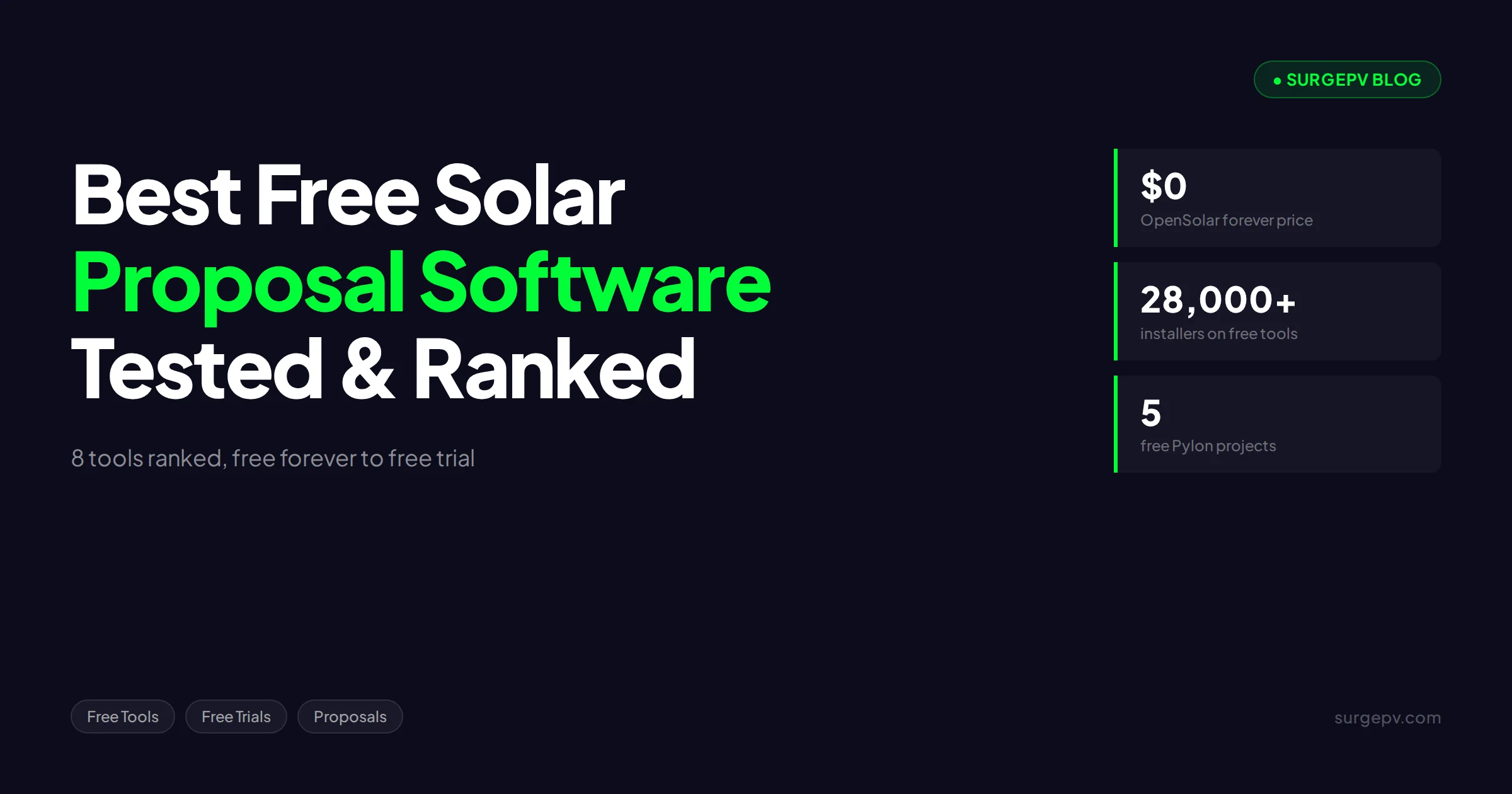
OpenSolar is the only genuinely free proposal platform we reviewed. 28,000+ users in 185+ countries pay nothing for design, CRM, proposals, and e-signatures, according to OpenSolar’s company page (2026).
What It Does Well
The price is the headline: $0 forever, unlimited projects, unlimited users. OpenSolar earns revenue from hardware partners and lenders, not installers. That makes it the default starting point for new solar businesses.
Speed is real. Users report proposals in under 2 minutes once templates are set. The interactive proposals are mobile-friendly and cover cash, loan, lease, and power purchase agreement (PPA) options. Lender integrations run in the US, UK, and Australia.
Accuracy is third-party validated by PVEL and a US government agency. The built-in CRM and full iOS and Android apps cover the whole sales loop. Most teams are operational in under 1 day.
Our Take: For a 1 to 10 person residential installer, OpenSolar’s free tier is unbeatable value. Respect the ceiling: 3D design tops out at 500 kW, and photogrammetry is less precise than LIDAR on tricky roofs.
Where It Falls Short
The 500 kW cap rules out utility-scale work, and 2D mode handles 500 kW to 1 MW only. Photogrammetry-based modeling is less precise than LIDAR. There is no offline mode, and 1 module manufacturer per project limits mixed-equipment designs.
Key Features
- 3D design studio with real-time shading
- Interactive proposals with e-signature
- Built-in CRM, payments, and financing integrations
- Full iOS and Android apps
Pricing
- Free tier: $0 — unlimited projects, users, and features
- Optional extras: Premium HD imagery bundles and enterprise white-label at extra cost
Who Should Use OpenSolar
Strong fit: New and small residential installers, budget-conscious teams, emerging markets. Probably not right for: C&I above 500 kW, bank-grade engineering needs, offline field work.
2. SolarEdge Designer — Best Free Proposal Tool for SolarEdge Installers
SolarEdge Designer is free for certified SolarEdge installers. If your installs already run on SolarEdge hardware, the design-to-quote workflow costs nothing.
What It Does Well
Free is hard to argue with. There are no license fees, subscriptions, or per-seat charges. Over 50,000 users have created 2.8 million layouts across 170+ countries, per SolarEdge (2025).
Accuracy is independently validated. DNV found Designer’s energy estimates within 1% of PVsyst, with a slight conservative bias. That makes its quotes lender-credible at zero software cost, a claim no other free tool matches.
The automation is fast. Automated roof detection, automatic stringing, and instant design validation cut design time sharply. Financial analysis supports fixed, per-watt, and bill-of-materials pricing with return on investment (ROI) forecasts.
Our Take: If 90% of your installs use SolarEdge hardware, Designer is the obvious free proposal layer. The moment you quote another inverter brand, you need a second tool.
Where It Falls Short
Hardware lock-in is absolute: SolarEdge equipment only. Shading analysis is the most-cited user weakness, and only fixed-tilt systems are supported. Proposal output is minimal next to dedicated sales tools like OpenSolar.
Key Features
- Automated roof detection and auto-stringing
- DNV validated simulation, within 1% of PVsyst
- Battery backup sizing and financial analysis
- Direct sync with mySolarEdge commissioning
Pricing
- Designer: $0 — free for certified SolarEdge installers
- Free trial: Not needed; the product is free
Who Should Use SolarEdge Designer
Strong fit: SolarEdge-committed residential installers and small commercial teams. Probably not right for: Multi-brand shops, tracker projects, and complex shading sites.
3. SurgePV — Best Free Trial for Engineering-Backed Proposals
Full disclosure: we build SurgePV. We ranked it #3 because OpenSolar and SolarEdge Designer are free forever, and SurgePV is not. The free trial is full-featured, and it exists so you can verify the numbers before you pay.
What It Does Well
Free tools split design from the quote, or skip engineering entirely. That is where savings promises go wrong. A rep types a production figure from 1 tool into another, the number drifts, and the cancelled contract arrives 6 months later.
SurgePV keeps 1 source of truth. You design the 3D rooftop layout, run physics-based solar shadow analysis software, and pull generation plus payback, internal rate of return (IRR), and net present value (NPV) from the same platform. The branded PDF proposal inherits the simulated numbers. No re-typing, no version drift.
Clara AI drafts proposal copy so reps spend time on the deal, not the wording. In our own testing, a residential quote takes under 10 minutes from address to sendable proposal.
Our Take: Use the free trial on your 3 hardest recent jobs. If the shading and savings figures hold up against your current process, the subscription pays for itself in avoided errors. If you only need simple residential quotes at $0, stay on OpenSolar.
Where It Falls Short
SurgePV is not free forever. After the trial, the 3-user plan costs $1,899 per year. There is no native CRM, so pipeline tracking needs an external tool. Very large enterprise sales orgs may still want a dedicated rep management layer.
Key Features
- 3D solar design with layout and automated string sizing
- Physics-based shadow analysis on real rooftop geometry
- Generation and financial tool for cash, loan, lease, and PPA
- Branded PDFs from our solar proposal software, built on live design data
Pricing
- For 3 Users plan: $1,899/year — design, simulation, financials, and proposals included
- Free trial: Full design and proposal capabilities, no feature locks
Who Should Use SurgePV
Strong fit: Installers and EPCs who want proposals backed by real engineering, residential through commercial. Probably not right for: Teams that need a permanently free tool or a built-in CRM.
4. Pylon — Best Free Starter Credits for Pay-Per-Project Quoting
Pylon (GetPylon) is an Australian-built tool with a pay-per-project model. You get 5 free projects with no credit card, then pay only when you quote.
What It Does Well
The pricing model is the draw. At $4 per project with no monthly fees, low-volume installers pay only when work comes in. Unlimited team users come with no per-seat costs. Over 3,500 solar businesses use it, and a 2025 Solar Nerds survey of 250+ installers voted it the #1 solar design tool.
Speed is excellent. Users report proposals in under 2 minutes, and panel placement takes under a minute after familiarization. The 3D shading analysis won a Finder innovation award in 2021.
The documentation set is unusually complete for the price. One-click single-line diagrams (SLDs), voltage rise reports, job sheets, and owner manuals generate automatically. The iPad-optimized interface suits field sales teams quoting on site.
Our Take: Pylon is the best economic fit for installers quoting under 20 projects a month. The 5 free projects are a genuine test, not a teaser. Australian compliance depth is a bonus; template variety is not.
Where It Falls Short
Only 3 proposal templates limit brand customization. Design variations cap at 5 per project. Utility-scale and advanced C&I work is out of scope, and high-resolution imagery has gaps in 10 to 20% of regions.
Key Features
- Pay-per-project pricing with unlimited users
- Award-winning 3D shading analysis
- One-click SLDs and voltage rise reports
- iPad-optimized for on-site quoting
Pricing
- Trial: 5 free Standard projects, no credit card
- Standard: $4/project — design, imagery, financials, proposals
- Pro: $10/project — adds batteries, custom loads, commercial
Who Should Use Pylon
Strong fit: Small residential installers in Australia and the US with variable quote volume. Probably not right for: High-volume teams, C&I projects, and brands needing custom templates.
5. Solargraf — Best Free Trial for Battery-Heavy Residential Proposals
Solargraf, owned by Enphase since 2021, is built for speed on straightforward residential jobs. New users get 120 free project credits, the most generous trial allowance on this list.
What It Does Well
The Express Editor lets reps adjust quotes on the spot without looping in a design team. The Good/Better/Best feature presents 3 pricing options in 1 proposal. DocuSign integration closes the deal in the same session.
Battery modeling is a genuine strength. Solargraf supports Enphase IQ Batteries, Tesla Powerwall, and 25+ manufacturers with backup scenario comparisons. California installers get NEM 3.0 optimization with California Public Utilities Commission (CPUC) hourly sell rates.
Permitting is included. Do-it-yourself permit packages generate Authority Having Jurisdiction (AHJ)-compliant documents with validated SLDs. For residential shops, that covers quote through permit in 1 subscription.
Our Take: The 120 free credits make Solargraf the best no-risk test for battery-heavy US residential quoting. Verify its shading output against a second tool before you trust the production numbers in a signed quote.
Where It Falls Short
Shading accuracy is the most common user complaint, and some teams cross-check production estimates in Aurora or HelioScope. There is no built-in CRM. After the trial, billing is annual only, starting at $2,799 per year.
Key Features
- 3-minute proposal generation with Express Editor
- Good/Better/Best multi-option pricing
- Battery design for 25+ manufacturers
- DIY AHJ-compliant permit packages
Pricing
- Trial: 120 free project credits for new users
- Starter: $2,799/year — 240 projects, 2 users
- Small Business: $4,799/year — 480 projects, 4 users
Who Should Use Solargraf
Strong fit: US residential installers, Enphase-heavy shops, California NEM 3.0 work. Probably not right for: Teams needing shading precision guarantees or a built-in CRM.
Quote From Real Engineering Data
See how SurgePV turns design, shading, and financials into a customer-ready proposal in 1 workflow.
Book a DemoNo commitment required · 20 minutes · Live project walkthrough
6. PV*SOL Online — Best Free Option for Technical European Projects
PV*SOL Online is the free browser version of Valentin Software’s engineering platform. The German company has built photovoltaic (PV) design tools since 1998.
What It Does Well
The free online version handles basic PV calculations at no cost, with no install. It is a credible way to sanity-check yield figures before they land in a proposal.
The paid desktop version is where the depth lives. PV*SOL Premium simulates at 8,760-hour resolution with module-by-module, hour-by-hour shading. The component database holds 21,000+ modules and 5,100+ inverters, per Valentin Software (2026).
For complex European residential and commercial projects, PV*SOL generates customer presentations in 24 languages. A 30-day free trial covers the full Premium feature set.
Our Take: Treat PV*SOL Online as a free engineering check, not a proposal tool. The Premium trial is worth it if your quotes need defensible shading math and you work on Windows.
Where It Falls Short
The free online version has no 3D modeling and no real proposal output. The desktop version is Windows-only, with no cloud collaboration. Financial analysis scores 6.9 out of 10 on G2’s comparison with PVsyst, and reports cannot be saved during the trial.
Key Features
- Free browser-based PV calculations
- 8,760-hour simulation with detailed shading (Premium)
- 21,000+ modules and 5,100+ inverters in the database
- Customer reports in 24 languages (Premium)
Pricing
- PV*SOL Online: $0 — basic calculations, no 3D
- Premium 2026: €845/year — 30-day free trial
- Standard 2025: €585/year
Who Should Use PV*SOL
Strong fit: Engineers and installers on complex, shading-sensitive European projects. Probably not right for: Mac users, sales-first teams, and utility-scale above 10 MW.
7. PVWatts — Best Free Production Estimator to Back a DIY Proposal
PVWatts is the National Renewable Energy Laboratory’s (NREL) free online calculator. It is not proposal software. It is the credible math behind a proposal you build yourself.
What It Does Well
PVWatts estimates energy production and cost of energy for grid-connected PV systems anywhere in the world. It runs on NREL’s solar resource data, the same data feeding commercial tools. The source is about as defensible as free gets, per NREL (2026).
For a startup installer quoting 5 jobs a month, the workflow is simple. Run PVWatts for the address, drop the annual kilowatt-hour figure into your own template, and add your pricing. Total software cost: $0.
Our Take: PVWatts plus a clean document template beats a bad paid tool. The moment you quote more than 10 jobs a month, the manual work costs more than a subscription.
Where It Falls Short
There is no roof modeling, no shade scene, and no proposal output at all. Results are annual and monthly estimates, not hour-by-hour simulations. You carry the accuracy risk on every shading assumption yourself.
Key Features
- Free production estimates from NREL solar resource data
- Global coverage for grid-connected systems
- Simple inputs: system size, tilt, azimuth, losses
- API access for developers
Pricing
- PVWatts: $0 — free forever, no account needed
Who Should Use PVWatts
Strong fit: Very early-stage installers, DIY proposal builders, and anyone double-checking a tool’s output. Probably not right for: Shaded roofs, teams needing customer-facing documents, and financed projects.
8. SAM — Best Free Tool for Deep Financial Simulation
The System Advisor Model (SAM) is NREL’s free desktop software for performance and financial modeling. It is the heaviest free tool on this list, and the hardest to learn.
What It Does Well
SAM models photovoltaic, battery storage, and concentrating solar power systems with detailed financial analysis. Cash flow, debt, taxes, incentives, NPV, IRR, and levelized cost of energy (LCOE) are all built in. It is free and open source, per NREL (2026).
For a developer or consultant building an investment-grade savings model at $0, nothing else free comes close. Many paid tools run SAM’s engine under the hood.
Our Take: SAM is a financial engine, not a sales tool. Use it to validate the economics behind big quotes, then present them in something a customer can actually read.
Where It Falls Short
The learning curve is steep, and the interface is built for analysts. There is no roof design, no proposal generation, and no cloud collaboration. Residential sales teams will abandon it inside a day.
Key Features
- Detailed PV and storage performance simulation
- Full financial models: cash flow, debt, incentives, LCOE
- Hourly and sub-hourly analysis
- Free and open source from NREL
Pricing
- SAM: $0 — free download for Windows, Mac, and Linux
Who Should Use SAM
Strong fit: Developers, consultants, and engineers modeling financed projects on a $0 budget. Probably not right for: Sales reps, small residential installers, and anyone who needs a proposal today.
Decision Guide: Which Free Tool Fits Your Business
Match your situation to a shortlist before you sign up for anything.
- New residential installer, tight budget: OpenSolar. Free forever, with CRM and e-signatures included.
- SolarEdge-committed shop: SolarEdge Designer. Free, validated, and synced to commissioning.
- Installer losing deals to bad numbers: SurgePV’s free trial. Quotes inherit real design and shading data.
- Low or unpredictable quote volume: Pylon. Pay per project after 5 free ones.
- US residential with heavy battery attach: Solargraf’s 120 free credits, with a shading cross-check.
- Engineer validating yield figures: PV*SOL Online, PVWatts, or SAM, depending on depth needed.
The Myth of the Free Lunch: What “Free” Actually Costs
Free proposal software is not free. You pay in 1 of 3 currencies, and you should know which before you commit.
Currency 1: ceilings. OpenSolar caps 3D design at 500 kW. SolarEdge Designer locks you into 1 hardware brand. The free tier works until the day your best lead needs exactly what it cannot do.
Currency 2: accuracy risk. Photogrammetry-based modeling is less precise than LIDAR. On a simple gable roof, the gap is small. On a shaded, multi-face roof, a wrong production figure becomes a wrong savings promise, and that becomes a cancelled contract or a callback.
Currency 3: your time. PVWatts plus a spreadsheet costs $0 and about 45 minutes per quote, industry-observed. At 20 quotes a month, that is 15 hours of skilled labor. A $150 per month tool is cheaper than 15 hours of a salesperson’s time.
None of this means paid tools always win. It means “free vs. paid” is the wrong question. The right question is what each lost or botched quote costs you.
Pro Tip
Run the same real address through OpenSolar, PVWatts, and 1 paid trial. If the production estimates differ by more than 5%, find out why before you quote from any of them.
How to Choose Free Solar Proposal Software
Evaluate any free tool against these 5 dimensions before you build your sales process on it.
- Read the free model, not the marketing. Forever-free, project credits, and time-limited trials are 3 different products. Write down the exact limit before you start.
- Check where the numbers come from. A proposal is only as good as its production estimate. Prefer tools with third-party validation, and cross-check shaded roofs.
- Test the customer-facing output. Send yourself a proposal as if you were the homeowner. If it looks like a spreadsheet, your close rate will know.
- Map the ceiling to your pipeline. List your 10 largest likely jobs. If the free tier cannot quote 8 of them, it is a demo, not a platform.
- Price the upgrade before you need it. The best free tools have a paid path you can afford at 2x your current volume. The worst trap you at the ceiling.
Conclusion
Free solar proposal software is good enough to build a business on, up to a point. OpenSolar is the right start for most new installers. SolarEdge Designer is free money for SolarEdge shops. Pylon and Solargraf give you real trials without monthly commitments. PVWatts and SAM back your own math at zero cost.
When quotes start breaking on shading accuracy, project size, or manual rework, that is the upgrade signal. Three concrete next steps:
- Sign up for OpenSolar and send 1 real proposal this week, even if you keep your current tool.
- Run your last 3 lost deals through 1 paid trial (SurgePV, Solargraf, or Pylon) and compare speed and numbers.
- Cross-check your current tool’s production estimate against PVWatts on 1 shaded job before your next quote.
Every tool here earned its place, and we told you where each ceiling sits. If you want to see how SurgePV turns a design into a customer-ready proposal, book a 20-minute demo.
Frequently Asked Questions
Is there a genuinely free solar proposal software?
Yes. OpenSolar is free forever with unlimited projects, unlimited users, design, proposals, CRM, and e-signatures. SolarEdge Designer is free for certified SolarEdge installers. Most other tools offer free trials or free project credits instead.
What is the best free solar proposal software in 2026?
OpenSolar is the best genuinely free option for residential installers under 500 kW per project. SolarEdge Designer is the best free choice inside the SolarEdge ecosystem. For engineering-backed proposals, SurgePV’s free trial is the strongest test drive.
Are free solar proposal tools accurate enough to quote from?
For standard residential roofs, mostly yes. OpenSolar’s accuracy is third-party validated by PVEL and a US government agency. SolarEdge Designer is DNV validated within 1% of PVsyst. For complex shading or financed C&I deals, verify free-tool numbers against a bankable simulation.
What is the catch with free solar proposal software?
The catches are ceilings, not hidden fees. Common limits include a 500 kW project cap (OpenSolar), hardware lock-in (SolarEdge Designer), photogrammetry instead of LIDAR, and fewer engineering outputs like SLDs and voltage rise calculations.
Can I make a solar proposal in Excel for free?
You can, and many installers do at low volume. Pair it with a free production estimate from PVWatts or SAM. The tradeoff is time, inconsistency between reps, and no e-signature or interactive presentation layer.
When should I upgrade from free to paid proposal software?
Upgrade when free costs you deals. The usual triggers are quoting above 500 kW, needing bankable P90 yield figures, wanting proposals generated from real design and shading data, or spending more time fixing tool limits than selling.
