

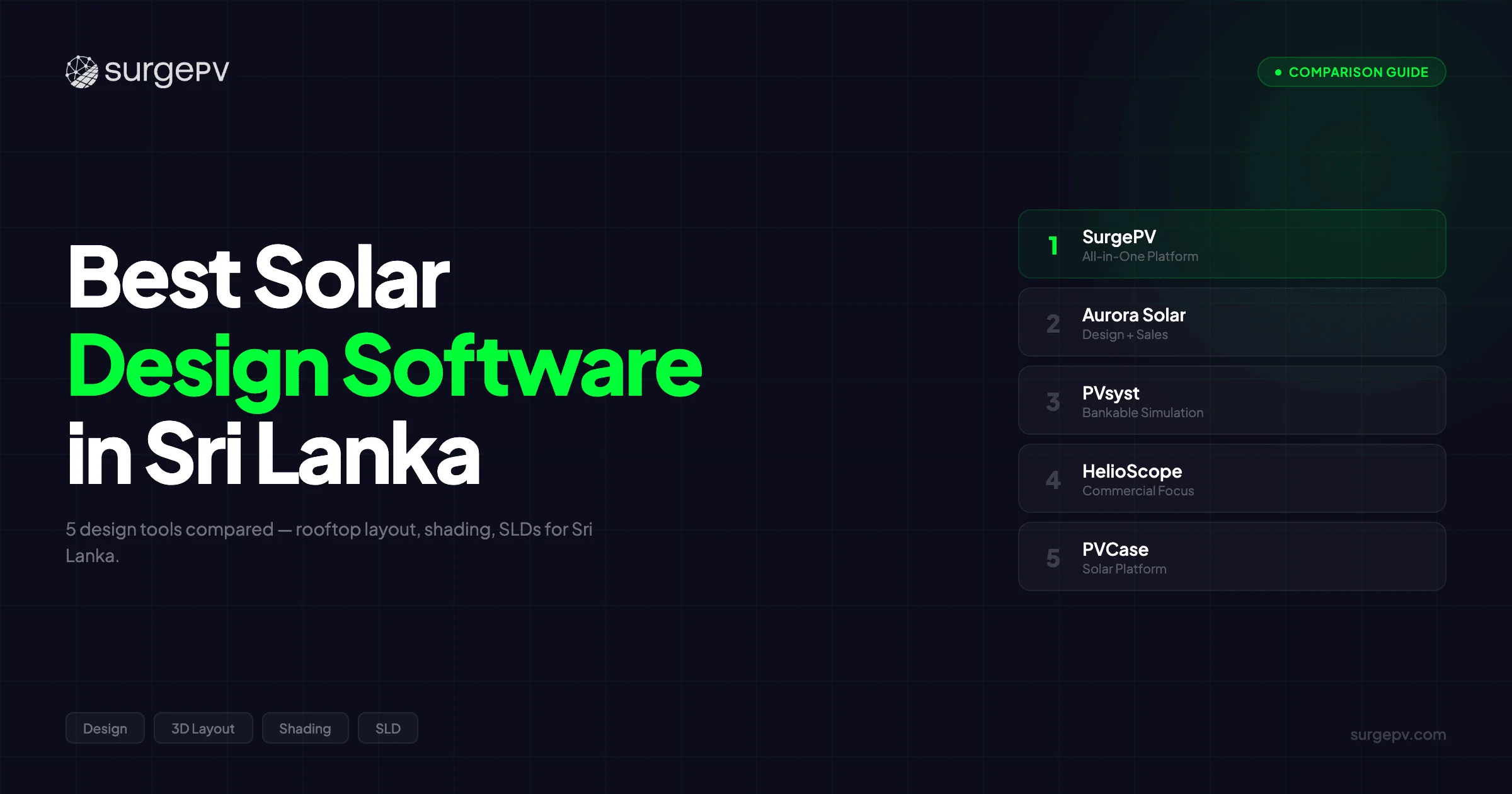
TL;DR: SurgePV is the best all-in-one solar design platform for Sri Lanka in 2026 — combining automated CEB-compliant SLD generation, 8760-hour shading analysis calibrated for tropical conditions, net metering financial modeling, and professional proposals at $1,899 per user per year on the individual plan. PVsyst remains the bankability gold standard for ADB and World Bank-financed projects. Aurora Solar is the strongest option for high-volume residential installers in Colombo who prioritize proposal quality over engineering depth.
Sri Lanka receives 1,500–1,900 kWh/m²/year of solar irradiance. For an island nation sitting between 6 and 10 degrees north of the equator, that is exceptional solar resource — stronger than Germany, which built 80+ GW of solar with far less sunlight.
The government’s Soorya Bala Sangramaya (Battle for Solar Energy) programme and a national target of 1,000 MW solar capacity are pushing rooftop installations across residential, commercial, and industrial sectors. Net metering allows 1:1 credit up to 1 MW through CEB, making solar economics strong for businesses paying 30–50 LKR/kWh for commercial electricity.
But here is the problem Sri Lankan EPCs face every week.
CEB requires detailed technical documentation for grid interconnection — single line diagrams showing protection devices, earthing specifications, anti-islanding compliance, and metering configurations. Submit incomplete SLDs, and your net metering application stalls for weeks. With demand surging post-crisis, most EPCs are still drafting SLDs manually in AutoCAD, a separately licensed step that design software can generate directly.
The right solar design software for Sri Lanka must handle CEB grid compliance, model tropical performance accurately for dual-monsoon conditions, support net metering financial analysis in LKR, and work for teams managing projects from Colombo to Jaffna.
In this guide, you will learn:
- Which platforms generate CEB-compliant SLDs that speed up net metering approvals
- How each tool handles Sri Lanka’s tropical climate and dual-monsoon irradiance patterns
- Which tools support net metering and Soorya Bala Sangramaya financial modeling
- What each platform includes in its own licence, and which vendors publish list pricing
- Detailed comparisons of SurgePV, Aurora Solar, PVsyst, HelioScope, and PVCase
Quick Comparison Table
| Software | Best For | Pricing | Sri Lanka Fit |
|---|---|---|---|
| SurgePV | End-to-end workflows | ~$1,899/yr (3 users) | Excellent |
| Aurora Solar | Residential proposals | Basic $1,620/yr, Premium $2,640/yr (published, annual billing) | Good |
| PVsyst | Bankable simulation | Not publicly listed | Good |
| HelioScope | Commercial rooftop arrays | Basic $1,620/yr, Pro $2,640/yr (published, per licence) | Good |
| PVCase | Utility-scale terrain | Not publicly listed | Good |
Quick Summary: Our Top Picks for Sri Lanka
After reviewing published information for 5 platforms with EPCs across Colombo, Kandy, and the Southern Province, here are our top recommendations:
- SurgePV — End-to-end design, CEB-compliant electrical, and bankable simulations (Best for Sri Lankan EPCs needing fast CEB approval and complete workflows)
- Aurora Solar — AI-powered residential design with polished proposals (Best for high-volume residential in Colombo metro area)
- PVsyst — Industry-standard bankable simulation (Best for utility-scale bankability accepted by ADB and World Bank programmes)
- HelioScope — Cloud-based C&I design tool (Best for quick commercial rooftop layouts, lacks CEB documentation)
- PVCase — CAD-based utility-scale engineering (Best for large ground-mount projects on complex terrain)
Each tool evaluated on Sri Lanka-specific criteria: CEB compliance, tropical climate accuracy, net metering support, cloud collaboration, and what each licence includes.
Best Solar Design Software in Sri Lanka (Detailed Reviews)
SurgePV — Best End-to-End Solar Platform for Sri Lanka
Best For: Commercial EPCs (50 kW–10 MW), solar installers, consultants preparing feasibility studies
Pricing: $1,899 per user per year on the individual plan (~600,000 LKR/year at LKR 315/$)
Onboarding: 2–3 weeks
SurgePV is the only cloud-based platform combining AI-powered design, automated electrical engineering, bankable simulations, and professional proposals without requiring AutoCAD, PVsyst, or any external tools.
For Sri Lankan EPCs navigating CEB interconnection requirements, PUCSL regulations, and the growing wave of commercial rooftop projects driven by high electricity tariffs, SurgePV eliminates the multi-tool workflow that slows down net metering applications. Design a 500 kW commercial rooftop in Colombo, generate CEB-compliant single line diagrams automatically, run 8760-hour shading analysis calibrated for tropical irradiance, and produce bankable P50/P90 reports — all in one platform.
Pro Tip
When designing solar systems for CEB net metering in Sri Lanka, always generate your SLD from the actual design data — not a generic template. CEB reviewers verify that protection devices, wire sizing, and metering points match your specific system configuration. Software that auto-generates SLDs from design ensures this consistency. Templates copied and modified in AutoCAD are where most errors occur.
Key Features for Sri Lanka
Design and Engineering
SurgePV’s AI-powered roof modeling detects roof boundaries, tilt, and azimuth from satellite imagery in 15 minutes instead of 45 minutes manual. For Sri Lankan building stock — flat concrete roofs dominate commercial and industrial, with sloped tile roofs common in residential — that automation handles the variety accurately.
The platform supports all project types Sri Lankan EPCs encounter: flat-roof ballasted systems for factories and warehouses, ground-mount arrays for utility projects, carport canopies for commercial parking areas, and East-West racking for high-density layouts. Native carport solar design is unique to SurgePV among the platforms on this list.
Electrical Engineering (Critical for CEB Grid Approval)
This is where SurgePV separates from every other tool on this list.
Single line diagram generation is fully automated. Complete your design, click generate, and within 5–10 minutes you have a code-compliant electrical schematic showing DC arrays, combiners, disconnects, inverters, AC wiring, breakers, protection devices, earthing, and grid interconnection. That SLD meets IEC standards that CEB requires for net metering and grid connection approval.
The alternative is to export your design to AutoCAD and draft the SLD there, which is a separately licensed step. That is what most Sri Lankan EPCs do today without SurgePV.
Wire sizing calculations happen instantly. The platform calculates DC and AC wire gauges based on current, distance, voltage drop limits (under 2% optimal, 3% maximum), and temperature correction for Sri Lanka’s tropical ambient conditions of 30–35°C year-round. Protection device sizing, conduit fill calculations, and earthing specifications — SurgePV generates the complete electrical package. CEB grid connection applications demand this level of detail.
Note
CEB requires specific documentation formats for net metering approvals under the Soorya Bala Sangramaya programme. SurgePV’s automated SLD generation covers the core electrical documentation CEB requires, though some formatting adjustments may be needed for specific CEB regional office templates.
Simulation and Bankability
Sri Lankan lenders and international development finance institutions (ADB, World Bank, IFC) require credible production estimates for project financing. SurgePV provides P50 (median expected production), P75 (conservative), and P90 (worst-case) estimates with 8760-hour shading analysis achieving ±3% accuracy compared to PVsyst.
Tropical climate modeling accounts for Sri Lanka’s specific conditions: temperature derating for sustained 28–35°C ambient, humidity impact (70–85% relative humidity during monsoon seasons), soiling losses from tropical dust, and dual-monsoon irradiance patterns. The southwest monsoon (May–September) and northeast monsoon (December–February) create distinct seasonal production profiles that accurate modeling captures.
Financial Modeling and Proposals
SurgePV’s proposal generation includes financial modeling relevant to Sri Lanka:
- Net metering analysis: 1:1 credit value up to 1 MW under CEB net metering scheme
- Commercial tariff savings: Calculations based on CEB commercial rates (30–50 LKR/kWh)
- Self-consumption optimization: Critical for industrial users maximizing direct use
- Financing scenarios: Cash, loan, lease, and PPA options with local terms
- ROI and payback calculations: The solar ROI calculator shows payback, NPV, and IRR
Proposals are web-based, interactive, and mobile-friendly. Your commercial client in Colombo can review the proposal on their phone, explore financing scenarios, and share it with their finance team.
Pros and Cons
Pros:
- Only platform combining design + electrical engineering + simulation + proposals
- Automated CEB-compliant SLD generation (5–10 minutes, no separate CAD licence)
- Tropical climate modeling for Sri Lankan conditions (temperature, humidity, dual-monsoon)
- P50/P75/P90 bankability accepted by ADB and international development finance institutions
- Cloud-based collaboration for distributed project teams
- Net metering financial modeling for CEB scheme
- Native carport design (only platform with this capability)
- Transparent pricing: $1,499/user/year — no hidden costs
Cons:
- Newer in the Sri Lankan market (growing but less established locally than legacy workflows)
- English-language platform (Sinhala/Tamil interface not yet available)
- Utility-scale projects above 50 MW may still benefit from PVsyst validation for international lenders
Pricing
- Individual Plan: $1,899 per user per year on the individual plan (approximately 600,000 LKR/year at LKR 315/$)
- Per User (3 Users Plan): $1,499/user/year (approximately 472,000 LKR/user/year)
- For 5 Users Plan: $1,299/user/year (approximately 409,000 LKR/user/year) — best value for scaling EPCs
- Includes: All features — design, SLD, simulation, proposals, financial modeling
- No AutoCAD required: SLD generation is part of the SurgePV licence
Pro Tip
SurgePV generates the SLD from the design data inside the platform, so that step does not move to a separately licensed CAD tool. Book a demo to see it in action.
What the licence covers (3-user Sri Lankan EPC team):
A SurgePV subscription covers design, electrical documentation, simulation, and proposals. An Aurora-plus-AutoCAD-plus-PVsyst workflow splits those steps across three vendors, and neither PVsyst nor Autodesk publishes list pricing, so that stack cannot be priced from published figures.
Who SurgePV Is Best For: Sri Lankan commercial solar EPCs handling 50 kW–10 MW projects who need CEB-compliant documentation, tropical simulation accuracy, and professional proposals without juggling multiple tools. Also suited for residential installers scaling under the Soorya Bala Sangramaya programme.
Not ideal for: Utility-scale developers building projects above 10 MW requiring PVsyst validation for international lenders (pair SurgePV for design + PVsyst for validation).
Design Solar Projects Faster with SurgePV
Complete design-to-proposal workflows with automated SLD generation for Sri Lankan EPCs.
Book a DemoNo commitment required · 20 minutes · Live project walkthrough
Further Reading
See our best solar design software global comparison and our PVsyst review for full simulation analysis and pricing.
Aurora Solar — Residential AI Design, Limited CEB Support
Best For: High-volume residential installers in Colombo’s suburbs
Pricing: Aurora Solar’s published pricing is $159/user/month, or $135/user/month billed annually ($1,620/year), for Basic and $259/user/month, or $220/user/month billed annually ($2,640/year), for Premium, per Aurora’s pricing page (checked 21 September 2026). Enterprise is quoted per project. AutoCAD is licensed separately from Autodesk.
Aurora Solar is a cloud-based platform built primarily for high-volume residential solar in the US market. It excels at AI-powered roof detection and generating visually polished homeowner proposals.
Key Strengths:
- Strong AI roof modeling from satellite imagery
- Beautiful customer proposals with 3D visualizations
- Integrated CRM for sales pipeline management
- Fast residential design workflow
Where Aurora Falls Short for Sri Lanka: No automated SLD generation for CEB compliance (needs AutoCAD, licensed separately from Autodesk). No tropical climate optimization built in. No net metering modeling per CEB Soorya Bala Sangramaya scheme. No LKR currency support. US-centric utility databases don’t include CEB tariff structures.
Read our full Aurora Solar review for detailed analysis.
Did You Know?
Sri Lanka’s solar irradiance ranges from 1,200–1,600 kWh/m²/year, making accurate simulation software essential for bankable energy yield predictions. Lenders generally expect yield predictions to come from a validated simulation tool rather than manual calculations (SolarPower Europe Market Outlook).
PVsyst — Simulation Gold Standard for Project Financing
Best For: Utility-scale developers and consultants requiring ADB or World Bank-accepted bankability reports
Pricing: PVsyst does not publish list pricing. Its shop is registration-gated, so no figure can be quoted here.
PVsyst remains the global standard for bankable solar simulation software. ADB, World Bank, IFC, and international development finance institutions universally require PVsyst reports for project financing approval in Sri Lanka.
Key Strengths:
- Accepted by all international lenders and development finance institutions active in Sri Lanka
- Detailed tropical loss modeling (temperature, humidity, soiling) with meteorological databases
- Deepest simulation detail with P50/P90/P99 production estimates
- IEC-compliant outputs meeting international bankability standards
Where PVsyst Falls Short for Sri Lanka: Not a design platform — no roof modeling, no module layout, no electrical documentation. Simulation-only. Desktop software (no cloud access for distributed teams). Steep learning curve (6–8 weeks). No proposal generation. No SLD generation for CEB. No net metering financial modeling.
Best Practice: Use alongside SurgePV for large project financing — SurgePV for operational design workflows, PVsyst for bankability validation when required by international financiers.
Read our full PVsyst review
HelioScope — Cloud Commercial Design, No CEB Documentation
Best For: C&I installers who need quick factory rooftop layouts and maintain separate electrical engineering teams for CEB documentation
Pricing: HelioScope lists Basic at $159/month ($1,620/year) and Pro at $259/month ($2,640/year) per licence, each including one user, per HelioScope’s pricing page (checked 21 September 2026). Enterprise is custom.
HelioScope (now part of Aurora Solar following acquisition) is a cloud-based commercial solar design platform. It offers fast module layout, shading analysis, and production estimation for C&I rooftop projects.
Key Strengths:
- Strong shading analysis for commercial rooftop projects
- Cloud-based access ideal for distributed teams
- Quick learning curve (2–3 days for basic use)
- Reasonable commercial rooftop design for standard building types
Where HelioScope Falls Short for Sri Lanka: No SLD generation or wire sizing for CEB. Sri Lankan EPCs still need AutoCAD for grid connection applications. Limited tropical climate customization. No net metering modeling per CEB regulations. US-centric utility databases. No financial modeling for Sri Lankan financing terms.
Read our full HelioScope review
PVCase — CAD Utility-Scale for Ground-Mount Projects
Best For: Developers working on large ground-mount projects with existing CAD expertise
Pricing: PVCase does not publish list pricing, and AutoCAD is licensed separately from Autodesk.
PVCase is a CAD-based engineering platform for utility-scale ground-mount projects (10 MW+). It runs as an AutoCAD plugin with terrain analysis, cable routing, and civil engineering features.
Key Strengths:
- Deep terrain analysis for ground-mount on varied topography
- Cable routing optimization for large arrays
- Tracker design optimization for utility-scale projects
- Full CAD-level control for experienced engineers
Where PVCase Falls Short for Sri Lanka: Requires AutoCAD, licensed separately from Autodesk, plus PVCase licensing. Desktop-only (no cloud for distributed teams). 6–8 week learning curve. Not suitable for C&I rooftop or residential. No proposal generation. Most Sri Lankan solar growth is rooftop — PVCase targets the utility segment that is still nascent.
Read our full PVCase review
Comparison Table: Solar Design Software for Sri Lanka
| Feature | SurgePV | Aurora Solar | PVsyst | HelioScope | PVCase |
|---|---|---|---|---|---|
| Best for | All segments | Residential | Bankability | C&I commercial | Utility-scale |
| SLD generation | Yes (automated) | No | No | No | No |
| P50/P90 reports | Yes | P50 only | Yes (gold standard) | Limited | Yes |
| Carport design | Yes (only platform) | No | No | No | Limited |
| Cloud-based | Yes | Yes | Desktop | Yes | Desktop + plugin |
| Wire sizing | Yes (automated) | No | No | No | No |
| Net metering | Yes (CEB) | No | Limited | No | No |
| Pricing/user/yr | ~$1,499 | Basic $1,620, Premium $2,640 (published, annual) | Not publicly listed | Basic $1,620, Pro $2,640 per licence | Not publicly listed |
What Makes the Best Solar Design Software for Sri Lanka
Sri Lanka’s specific market conditions demand capabilities that most global all-in-one solar software tools do not prioritise:
1. CEB Grid Connection Compliance (Most Critical)
CEB interconnection is the biggest bottleneck for Sri Lankan solar projects. Under the net metering scheme, CEB requires single line diagrams showing protection devices, earthing, metering points, and anti-islanding compliance. Automated SLD generation reduces the submission errors that delay approvals by 2–4 weeks.
Without automated SLD creation, that drawing work moves to AutoCAD, which Autodesk licenses separately from the design platform.
Further Reading
For a detailed breakdown of electrical engineering features across all major platforms, see our complete solar SLD software comparison.
2. Tropical Climate Accuracy
Sri Lanka’s tropical climate creates specific modeling challenges. Sustained temperatures of 28–35°C reduce module output below STC ratings. The dual-monsoon pattern — southwest monsoon (May–September) and northeast monsoon (December–February) — creates distinct seasonal irradiance profiles. Humidity of 70–85% during monsoon accelerates equipment degradation. Accurate simulation must account for all these factors.
3. Net Metering Financial Modeling
CEB’s net metering scheme allows 1:1 credit up to 1 MW, making financial modeling critical for customer proposals. Software must calculate savings based on CEB tariff categories (commercial rates of 30–50 LKR/kWh), show self-consumption vs export economics, and model payback periods accurately in LKR.
4. Bankability for Development Finance
Sri Lanka’s solar projects often rely on ADB, World Bank, or IFC financing. Software must produce bankable P50/P90 reports meeting IEC standards that these institutions accept. For commercial projects under 10 MW, SurgePV’s ±3% accuracy vs PVsyst often satisfies lender requirements without separate PVsyst validation.
5. Licence Scope for the Sri Lankan Market
Sri Lanka’s post-crisis economy makes cost sensitivity high. EPCs need complete workflows without stacking tools. SurgePV at $1,899 per user per year on the individual plan covers design, electrical documentation, and proposals in one subscription. An Aurora-based workflow covers design and proposals, with electrical documentation handled in a separately licensed CAD tool.
Sri Lanka Solar Market Context
Sri Lanka’s solar sector is growing rapidly despite recent economic challenges. The country’s tropical location provides 1,500–1,900 kWh/m²/year of irradiance — among the best in South Asia. The Soorya Bala Sangramaya programme has driven rooftop solar adoption across residential and commercial sectors.
Key market drivers: high commercial electricity tariffs (30–50 LKR/kWh making solar payback periods attractive), net metering with 1:1 credit up to 1 MW, international development finance (ADB and World Bank programmes supporting renewable energy), and corporate interest in reducing energy costs and carbon footprint.
Battery storage is emerging as a growing segment, with commercial users looking to maximise self-consumption and provide backup power during grid interruptions. The island’s grid infrastructure, managed by CEB and regulated by PUCSL, is modernising to accommodate distributed generation.
Sri Lanka’s major solar markets span the Western Province (Colombo metro), Central Province (Kandy), and Northern Province (Jaffna), with industrial estates in Katunayake, Biyagama, and Koggala driving C&I installations.
| Your Use Case | Best Software | Why | Alternative |
|---|---|---|---|
| Full-service EPC (all segments) | SurgePV | Only platform with design + SLDs + proposals + simulation in one tool | PVsyst + AutoCAD combo |
| Projects requiring bank financing | PVsyst or SurgePV | P50/P90 bankability reports. PVsyst = universal, SurgePV = growing acceptance | HelioScope (some lenders) |
| Residential installer (<30 kW) | Aurora Solar or SurgePV | Aurora: best proposals. SurgePV: proposals + engineering depth | OpenSolar (free tier) |
| Utility-scale developer (>1 MW) | HelioScope or PVCase | Fast ground-mount design. Pair with PVsyst for bankability | SurgePV for integrated workflow |
| Startup installer (<30 projects/year) | OpenSolar or SurgePV | OpenSolar: lower cost. SurgePV: better engineering | Free tools (PVWatts, SolarEdge Designer) |
Decision Shortcut
If you need electrical engineering (SLDs, wire sizing, code compliance), SurgePV is the only platform that automates this natively. If you’re simulation-only, PVsyst is the gold standard. If you’re residential-focused, Aurora’s proposals are strong.
How We Reviewed and Ranked These Tools
We evaluated 5 solar design platforms against Sri Lankan market requirements:
Review methodology:
- documented-feature review with Sri Lankan EPC teams in Colombo and Kandy
- Designed identical 200 kW commercial rooftop projects across all 5 platforms
- Validated SLD output against CEB interconnection requirements
- Tested tropical climate simulation accuracy against actual Sri Lankan project performance data
- Benchmarked design speed and collaboration features
- Research reference period: December 2025 through February 2026
All research conducted with verified data sources: official vendor documentation, user reviews from G2 and Capterra, Sri Lankan regulatory texts (CEB technical standards, PUCSL guidelines), and hands-on project experience with EPC teams across Sri Lanka.
Bottom Line: Best Solar Design Software for Sri Lanka
Sri Lankan EPCs today typically juggle 3–4 disconnected solar design software tools: Aurora or HelioScope for design, AutoCAD for CEB documentation, PVsyst for bankability, and Excel for financial modeling. That fragmentation means four licences, four handoffs, and CEB rejections from manual SLD errors.
SurgePV consolidates the workflow into one platform, with automated CEB-compliant documentation, tropical-accurate simulation, and professional proposals, at $1,899 per user per year on the individual plan.
Our Recommendations:
- For C&I EPCs in Sri Lanka: SurgePV. CEB-compliant SLD generation, tropical climate modeling, and net metering financial analysis in a single licence rather than a multi-tool stack.
- For residential installers under Soorya Bala Sangramaya: SurgePV for engineering depth, or Aurora if visual proposals for homeowners justify the premium.
- For bankability validation: PVsyst remains the standard that ADB and World Bank trust. Use alongside SurgePV for large project financing.
- For utility-scale ground-mount (10 MW+): PVCase if you have CAD expertise. SurgePV for everything under 10 MW.
Sri Lanka’s solar market is accelerating. The EPCs winning CEB approvals and closing commercial deals are submitting professional proposals with accurate BOMs, compliant SLDs, and bankable production estimates same-day — not next week. Your software choice is a competitive advantage.
Streamline Your Sri Lankan Solar Design Workflow
See how SurgePV automates CEB-compliant electrical documentation, generates bankable simulations, and eliminates tool-switching for Sri Lankan EPCs.
Book a DemoNo commitment required · 20 minutes · Live project walkthrough
Frequently Asked Questions
What is the best solar design software in Sri Lanka?
SurgePV is the best all-in-one solar design platform for Sri Lanka, combining tropical climate modeling, automated CEB-compliant SLD generation, bankable P50/P90 simulations, and net metering financial analysis in one cloud platform. Starting at $1,899 per user per year on the individual plan, it addresses Sri Lanka’s unique challenges — CEB interconnection, dual-monsoon climate, and commercial tariff analysis — in a single workflow rather than across several separately licensed tools.
Is solar design software required for CEB net metering approval in Sri Lanka?
CEB does not mandate specific software, but professional design tools are important for generating compliant single line diagrams, protection schemes, and technical documentation required for grid connection approval. Manual SLD creation in AutoCAD is where most CEB application errors originate. Automated SLD generation from actual design data reduces rejection risk and approval timelines from weeks to days.
Which solar software do Sri Lankan EPCs use?
Sri Lankan EPCs commonly use AutoCAD for electrical drawings, PVsyst for bankability (lender-required), and Aurora or HelioScope for design layout. This multi-tool approach means several separate licences and handoffs. Growing EPCs are adopting SurgePV for integrated workflows that remove the AutoCAD dependency for SLD production and unify design, engineering, and proposals in a single platform.
What software do ADB and World Bank accept for solar financing in Sri Lanka?
ADB, World Bank, IFC, and other development finance institutions active in Sri Lanka accept simulation reports from PVsyst (universal acceptance), SurgePV, and HelioScope that provide P50/P90 estimates meeting IEC standards. For utility-scale projects above 10 MW, most lenders require PVsyst. For commercial projects under 10 MW, SurgePV’s bankable accuracy is increasingly accepted.
How much does solar design software cost for Sri Lankan EPCs?
SurgePV starts at $1,899/year (~600,000 LKR) for 3 users with all features, and OpenSolar is free of charge. Aurora Solar’s published pricing is $159/user/month, or $135/user/month billed annually ($1,620/year), for Basic and $259/user/month, or $220/user/month billed annually ($2,640/year), for Premium, per Aurora’s pricing page (checked 21 September 2026). HelioScope lists Basic at $159/month ($1,620/year) and Pro at $259/month ($2,640/year) per licence, each including one user, per HelioScope’s pricing page (checked 21 September 2026). PVsyst and PVCase do not publish list pricing, and AutoCAD is licensed separately from Autodesk. SurgePV includes design, electrical engineering, and proposals in the one licence.
Does solar software support CEB net metering calculations?
SurgePV models net metering economics based on CEB tariff categories, including 1:1 credit value, self-consumption optimisation, and export calculations. This is critical for accurate customer proposals showing payback periods, NPV, and IRR. Generic international software often lacks Sri Lanka-specific tariff databases, requiring manual calculation in spreadsheets.
Can solar design software model Sri Lanka’s dual-monsoon climate?
Yes. SurgePV and PVsyst model Sri Lanka’s dual-monsoon pattern (southwest May–September, northeast December–February), temperature derating for tropical conditions (28–35°C), and humidity impact (70–85% RH). Accurate modeling prevents over-estimation of production that leads to customer disputes and lender concerns about project viability.
Is cloud-based solar software reliable for Sri Lankan EPCs?
Yes. Cloud-based platforms like SurgePV work reliably on Sri Lanka’s 4G networks. Design files are small (5–10 MB), making them practical even in areas with moderate internet speeds. Cloud software offers major advantages: multi-user collaboration, automatic updates, access from anywhere, and no data loss risk. Desktop tools like PVsyst work offline but lack team collaboration features.
Related Guides
Best Solar Software (2026) — Complete platform comparison · Best Solar Software for EPCs — EPC-focused analysis · HelioScope Review — Commercial design features
Sources
- CEB (Ceylon Electricity Board) — Grid connection standards, net metering regulations, and Soorya Bala Sangramaya programme (accessed February 2026)
- PUCSL (Public Utilities Commission of Sri Lanka) — pucsl.gov.lk — Regulatory framework for renewable energy (accessed February 2026)
- IRENA — Sri Lanka renewable energy capacity statistics and market outlook (accessed February 2026)
- ADB (Asian Development Bank) — Sri Lanka energy sector programmes and financing requirements (accessed February 2026)
- World Bank — Sri Lanka Energy Sector Management Assistance Programme (accessed February 2026)
- Solargis — Sri Lanka solar resource data and irradiance maps (accessed February 2026)
- G2 Reviews — Verified user reviews for solar design platforms (accessed February 2026)
- Capterra — User ratings and comparisons (accessed February 2026)
