


A Slovak small source is limited to 10.8 kW counted on the inverter AC side, so a design tool that shows AC and DC capacity side by side matters more here than elsewhere. This list covers four tools, Aurora Solar, HelioScope, PVsyst and SurgePV, using what each vendor publishes. Prices stay in the currency each vendor lists, not in euros.
The read is a desk comparison of public vendor pages, checked October 2026, with no side-by-side runs. SurgePV publishes this page and is one of the 4 tools on it. A wider view is on the global list of solar design software.
Criteria used for a Slovak job: AC and DC capacity visible in the design, a single line diagram that shows the disconnection point, shading and yield, a parts list, Slovak-language output, and published price.
Disclosure and methodology: SurgePV publishes this page and is one of the tools on it, so it has an interest in the result. Vendor facts come from public vendor pages read in October 2026; the operator rule comes from the Západoslovenská distribučná page cited below.
Working on a Slovak project? See SurgePV on it
Book a guided demo and bring a real site. We walk through design, yield, finance and the proposal in one platform.
Book a Free DemoChecking cost first? See the SurgePV pricing page.
Best-For Picks for Slovakia
- A small-source design held to the 10.8 kW AC limit: any tool that reports inverter AC rating next to DC array size. The Západoslovenská distribučná page counts the sum of inverter AC ratings, so ask to see both figures in a demo.
- A homeowner sale with financing attached: Aurora Solar. Aurora’s pricing page lists tablet-friendly proposals and integrated financing on all plans. Its single line diagram editor is “only available in Europe” per its help page.
- A business roof with storage, above the small-source class: HelioScope. HelioScope’s pricing page lists rooftop, carport and ground-mount layout on all plans, and P90, P95 and P99 values on Pro.
- A lender asking for a yield report on a big roof: PVsyst. Its help describes P50 to P90 evaluations. It runs on Windows only.
- Layout, financials and proposal in one subscription: SurgePV. The pricing page lists $1,899, $1,499 or $1,299 per user per year depending on seats.
Comparison Table
Alphabetical, not ranked. Read the row against the small-source limit and operator paperwork described below.
| Tool | Best for | Price (checked Oct 2026) | Free or paid | One decisive scope fact |
|---|---|---|---|---|
| Aurora Solar | Residential sales and design | Basic $159 per user per month, or $135 billed annually; Premium $259, or $220 billed annually. Aurora pricing | Paid | Basic and Premium each include 1 user and 50 projects per month |
| HelioScope | Commercial solar-plus-storage | Basic $159 per license per month or $1,620 per year; Pro $259 per month or $2,640 per year. HelioScope pricing | Paid; vendor lists a free trial | Designs up to 1.25 MW DC (Basic), 5 MW (Pro), 30 MW (Enterprise) |
| PVsyst | Yield evidence | CHF 700 per year (PVsyst 8 Professional) | Paid, one-month trial | Documents P50 to P90 evaluations; Windows only |
| SurgePV | Design plus proposals in one subscription | Individual $1,899 per user per year (1 user); 3 seats $1,499 per user per year; 5 seats $1,299 per user per year. SurgePV pricing | Paid; guided demo, no self-serve trial | Roof modeling, layout, shading, yield, financial modeling, BOM, proposals |
Language Support for Slovakia
Slovak is the language customers and the operator use, but none of the vendor pages read for this list names Slovak among its languages, and the other tools’ pages do not state their interface or proposal languages. They also name no Slovak grid operator, tariff or permit rule; those come from the operator. See the solar design workflow and shading analysis pages for SurgePV’s published scope.
Tool Entries
Alphabetical order. Each entry closes with how the tool fits a Slovak small-source design.
Aurora Solar
Best for: a Slovak installer pitching homeowners who want the layout, a tablet-friendly proposal and a financing view in one tool, and who may use its Europe-only single line diagram editor.
Not the right choice if: the project is a commercial roof; Aurora’s menu lists HelioScope for that. Its help page also says Aurora gives P50 values only, so no native P90 for a lender.
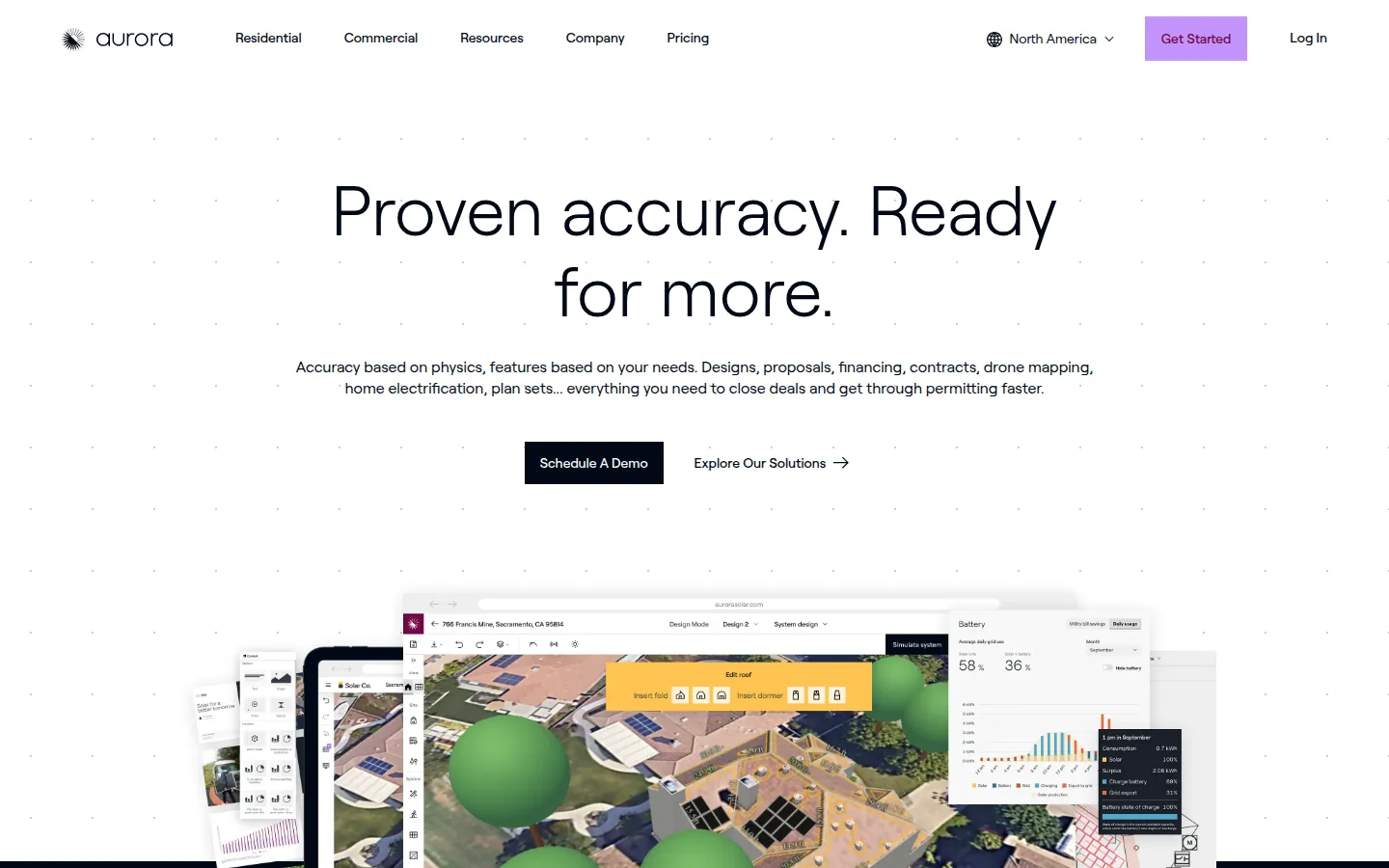
What the vendor documents: 3D roof modeling and trees, performance simulation and automated panel placement. It also lists tablet-friendly proposals and integrated financing. It has an AHJ database of more than 25,000 US jurisdictions. AHJ means the local permit office. Premium adds LIDAR-assisted modeling (laser measuring of the site), bankable shade reports and battery modeling. Enterprise adds unlimited users and a contract manager (the pricing page tooltip says e-signature tools). It also adds APIs (links that let other software connect). Enterprise also adds drone mapping, dealer and team configurations, and advanced user permissions. It adds access to plan sets, engineering stamps and professional services. Aurora’s help centre lists a DXF export, a file other drawing programs can open. It also lists a Single-Line Diagram Editor. A single-line diagram is a simple drawing of how the system is wired. The article says the editor is only available in Europe.
Price (checked October 2026): Basic $159 per user per month billed monthly, or $135 billed annually ($1,620 per year). Premium $259 monthly, or $220 billed annually ($2,640 per year). Enterprise is custom. See Aurora’s pricing page.
Limitations: Plan sets and engineering stamps are listed as add-ons. Basic and Premium each include one user. Per its help article, Aurora gives P50 values only. A P50 value is a yield level expected to be met or exceeded in 50% of years. Aurora does not natively output P90.
Vendor link: aurorasolar.com
HelioScope
Best for: Slovak business roofs, carports and ground mounts with storage, well above the 10.8 kW small-source class. Per its footer, HelioScope is an Aurora Inc. company with its own pricing.
Not the right choice if: your work is mainly homes under the 10.8 kW limit, where sales financing matters more. HelioScope’s site describes commercial software; Aurora’s residential product is the better documented fit.
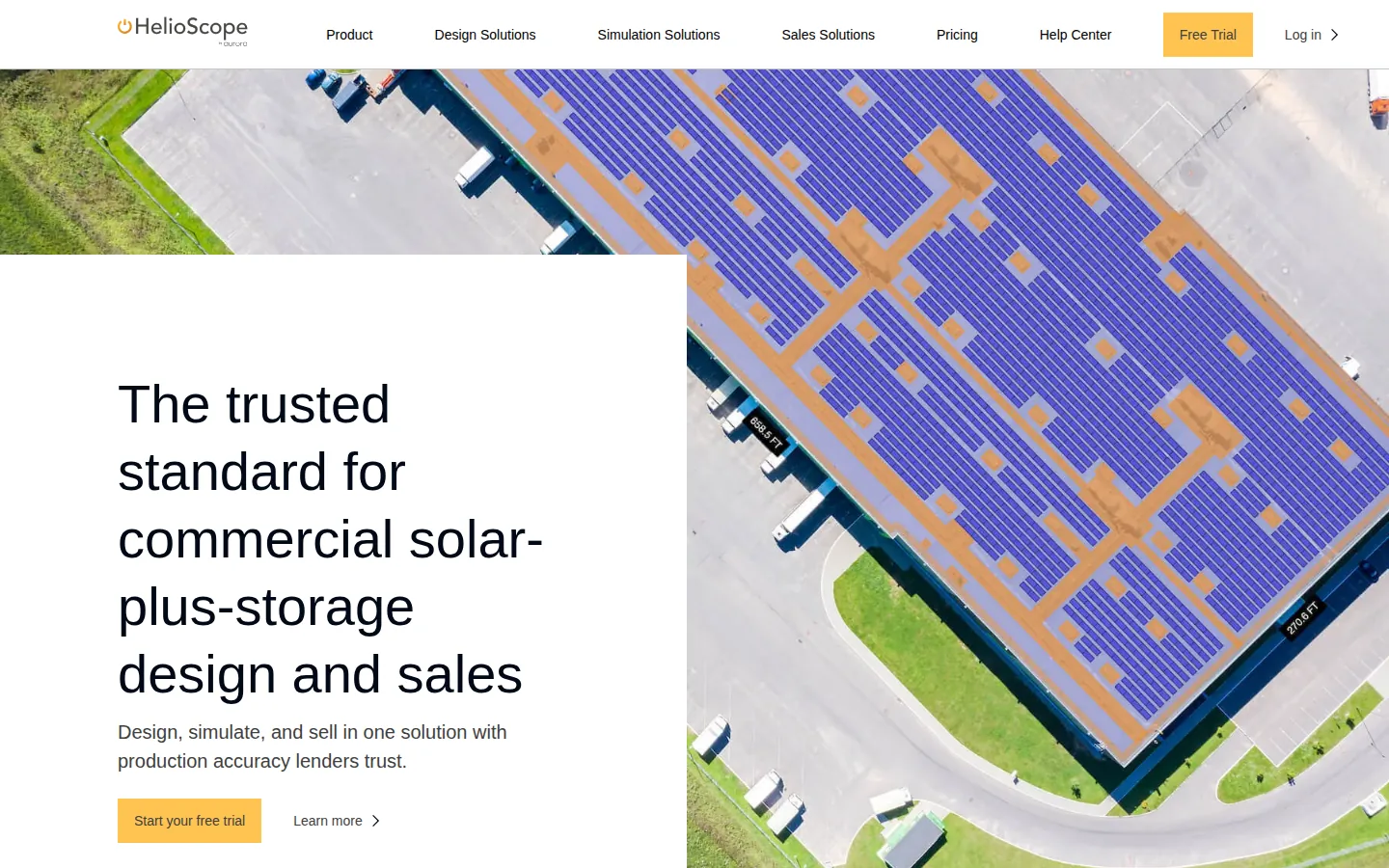
What the vendor documents: Rooftop, carport, ground-mount and battery layout on all plans. It also lists CAD (computer-aided design) export and single-line diagrams. It lists an 8760 production report (one result for each hour of the year) and shade reports too. The production report also lists a bill of materials with module, wire and inverter quantities (see the help article). Pro adds LIDAR-assisted modeling, storage modeling and financial analysis tools. Pro also adds customizable reports, sales proposals, and P90, P95 and P99 values. Enterprise adds single-axis trackers, designs up to 30 MW DC and export to PVsyst.
Price (checked October 2026): Basic $159 per license per month, or $1,620 per license per year. Pro $259 per month, or $2,640 per year. Enterprise is custom per project. See HelioScope’s pricing page. The standard free trial lasts 14 days, per its help article.
Limitations: Each Basic or Pro license covers one user. Enterprise lists unlimited users. Basic includes 10 projects per month, or 120 on annual billing. Basic designs up to 1.25 MW DC. Financials and sales proposals start at Pro.
Vendor link: helioscope.aurorasolar.com
PVsyst
Best for: a Slovak plant big enough that an investor or lender wants a simulation report, well beyond a small source.
Not the right choice if: you need a proposal from the same tool (the pages read describe none), a storage diagram, or a Mac. The requirements page says PVsyst runs only under Windows.
What the vendor documents: a P50 to P90 evaluation. P50 and P90 are yields with a 50% and 90% probability of being exceeded in a year. The languages page says English is the reference language. It lists French among the translations. The documentation itself is not translated. The single line diagram page describes an editor and viewer for PV strings, inverters and transformers. It covers grid-connected systems only, leaves out storage, and calls the feature “still work in progress”. The economic evaluation help page covers feed-in tariffs and self-consumption.
Price (checked October 2026): CHF 700 per year for PVsyst 8 Professional, with grouped-order discounts of 5% for 2 to 4 licences, 15% for 5 to 9 and 20% for 10 or more. The product page offers a one-month free trial.
Limitations: the pages read describe no proposal output. They list the Windows-only requirement and the grid-connected-only diagram editor.
Vendor link: pvsyst.com.
SurgePV
SurgePV is our product, and we publish this list.
Best for: Slovak teams that want one model to produce roof layout, shading, yield, bill of materials and proposal, priced per user. Check AC and DC ratings in the output. See the solar design workflow, shading analysis and proposal software.
Not the right choice if: you want a self-serve trial, because SurgePV offers a guided demo. Its outputs support design and documentation but do not replace approval by the responsible engineer, operator, lender, insurer or utility, and its published scope lists no CRM, monitoring or ERP product. For a free core app OpenSolar lists one; for AutoCAD-based utility-scale work PVcase lists it on its own site.
What the vendor documents: 3D roof modeling, solar array layout, shading analysis, energy-yield modeling, financial modeling, electrical workflow support, bill-of-materials output and proposal generation.
Price (checked October 2026): Individual $1,899 per user per year (1 user). 3 seats $1,499 per user per year, or $4,497 a year in total. 5 seats $1,299 per user per year, or $6,495 a year in total. See SurgePV pricing.
Limitations: Results depend on source data, assumptions, equipment models, configuration and review. Pricing and contract terms are confirmed in a written quote. This page uses only SurgePV’s pricing page and product scope summary. They do not state ground-mount coverage or size limits, so those cells read “Not stated”. Ask for them in the demo.
Vendor link: SurgePV and Book a Free Demo
What to Ask a Vendor Before Buying
Ask each vendor for a sample Slovak small-source project. First, does the output show inverter AC capacity next to DC array size? Second, does the single line diagram show the disconnection point and switchboard the operator may ask you to adapt? Third, does the proposal come out in Slovak? Fourth, is the price in the currency you are invoiced in? Where a vendor is silent, this page says so, and a demo or trial is where to settle it.
See SurgePV on a Slovak project
Book a guided demo and bring a roof, the equipment and the files you must deliver.
Book a Free DemoLive project walkthrough · No credit card required
Design Limits Set by a Slovak Distribution Operator
The Západoslovenská distribučná page on small sources up to 10.8 kW defines a small source as a generation facility aimed mainly at households and smaller businesses, with a limit of 10.8 kW. For solar, the page says the total installed capacity is the sum of the rated outputs of the inverters on the AC side. It says the rule applies from 1 December 2022 under the renewable support act. That is a design constraint, because the limit is counted on the inverter side, not on the module side. A design with an array larger in DC than the inverter AC rating can still count as the smaller figure. Check the output of each tool you shortlist for AC ratings next to DC power.
The page says the contract the operator sends sets binding technical and commercial conditions, such as the main disconnection point, switchboard modifications and protection settings. A design workflow should therefore end in a drawing that shows the disconnection point and the switchboard, which the operator may ask you to adapt. None of the vendor pages we read for this list says it outputs a Slovak operator format, so ask for a sample drawing. This page covers one operator, Západoslovenská distribučná. Slovakia has several, and we could not read the small-source rules of the others.
For yield figures, the PVGIS tool page from the European Commission Joint Research Centre lists tools for grid-connected PV, tracking PV, monthly irradiation, hourly radiation and a typical meteorological year, with exports as CSV, JSON or EPW. For grid-connected PV it asks for installed peak power in kWp, system loss in percent, slope and azimuth, and it reports yearly energy, in-plane irradiation, year-to-year variability and losses split into angle of incidence, spectral effects and temperature. A designer can use it as an independent check on a modelled yield. We did not read PVGIS documentation on its databases, so we state nothing about their coverage or accuracy.
How this changes tool choice. A small residential job in Slovakia is limited by AC inverter capacity and by operator paperwork, so the tool that fits is the one that makes AC and DC capacity visible and produces a clear single line diagram. Aurora’s single line diagram editor is “only available in Europe” per its help page, PVsyst documents an editor for grid-connected systems that is “still work in progress”, and neither page names Slovakia. For quotes and customer paperwork, see solar proposal software for Slovakia.
How We Ordered These Tools
The tools are alphabetical with no score. Picks follow what each vendor documents and the operator limit above, not any run of the software.
- Roof and array design. AC and DC capacity both need to be readable. Not assessed: layout speed or roof-model accuracy.
- Shading and energy yield. Modelled yield can be cross-checked against PVGIS. Not assessed: agreement with measured generation.
- Financial modeling and proposals. A homeowner needs a readable offer. Not assessed: proposal quality or close rates.
- Electrical and bill-of-materials outputs. The operator contract turns on a disconnection point and switchboard drawing. Not assessed: whether outputs pass any review.
- Language support. Slovak customers read Slovak. Not assessed: translation quality.
- Published price. Teams want a figure before a demo. Not assessed: discounts or total cost of ownership.
Related Solar Software Lists
- Solar software in Slovakia
- Solar proposal software in Slovakia
- Best solar design software, all markets
- Commercial solar design software
- Bankable solar simulation software
- Solar software for EPC companies
Sources and Dates
- Západoslovenská distribučná (read November 2026): Západoslovenská distribučná page on small sources up to 10.8 kW
- European Commission Joint Research Centre (read November 2026): PVGIS tool page from the European Commission Joint Research Centre
Vendor pages were read in October 2026. Tool facts come from each vendor’s own public pages, linked here by tool. Aurora Solar (DXF export, Single-Line Diagram Editor, Aurora’s pricing page, help article). HelioScope (HelioScope’s site, help article, HelioScope’s pricing page, help article). PVsyst (requirements page, P50 to P90 evaluation, languages page, single line diagram page, economic evaluation help page, CHF 700 per year for PVsyst 8 Professional, product page, pvsyst.com). SurgePV (SurgePV pricing).
Frequently Asked Questions
What is the best solar design software in Slovakia?
HelioScope lists commercial rooftop, carport and ground-mount design with storage. Aurora Solar for residential sales with financing; PVsyst for yield evidence; SurgePV for design, financial modeling and proposals in one product. None of the vendor pages read names a Slovakia utility, tariff or permit rule, so test each tool on a sample Slovakia project.
Is there free solar design software for Slovakia?
None of the tools here is free. PVsyst offers a one-month trial. SurgePV offers a guided demo.
Which solar design software works in the local language in Slovakia?
None of the vendors on this list names Slovak on the pages read. The other tools here do not state their languages on the pages read, so ask each vendor to show your language in a demo or trial.
How much does solar design software cost for Slovakia teams?
Published prices differ in currency and unit, so they are not converted. Aurora Basic is $135 per user per month billed annually. HelioScope Basic is $1,620 per license per year. PVsyst 8 Professional is CHF 700 per year. SurgePV Individual is $1,899 per user per year.
Can solar design software replace local approvals in Slovakia?
No. Outputs support design and documentation. They do not replace approval by the responsible engineer, authority, lender or utility. Ask the authority and utility for the documents they require.
What size limit should a Slovak small-source design respect?
On the Západoslovenská distribučná page for small sources, the limit is 10.8 kW, and for solar it is the sum of rated inverter outputs on the AC side, applying from 1 December 2022. Other Slovak distribution operators may publish their own pages, so check the operator for your area.
