


A French residential quote now rests on self-consumption. Since the order of 1 June 2026, installations of 9 kWc (kilowatts of peak power) or less can only sell their surplus. The tariff is 1.1 centimes per kWh excluding VAT (value added tax). The amended text lists no investment premium.
Archelios PRO lists an Enedis consumption profile import (Enedis operates the public electricity distribution network in mainland France) and euro prices by project size. PV*SOL has a French interface and a euro price. PVsyst documents P50 to P90 yield evidence. P90 is a yield expected to be met or exceeded in 90% of years (P50: 50%). OpenSolar’s core app is free and makes a single line diagram, a simple drawing of how the system is wired. SurgePV documents roof modeling, bill of materials (the parts list) and proposals, priced per user.
This is a desk comparison of what each vendor publishes, checked October 2026. We have not run side-by-side tests. Local rules below come from the Légifrance text of the 1 June 2026 order, the Commission de régulation de l’énergie (CRE), Enedis and Consuel. Tool facts come from each vendor’s own site. The CRE is the French Energy Regulatory Commission. Its role is to see that the electricity and gas markets work smoothly. Consuel is a French association whose mission is to see that electrical safety rules are followed. It applies a visa to the Attestation de Conformité (the conformity attestation) for the work done.
Criteria used: French interface, Enedis inputs, self-consumption and surplus-sale modelling, named French standards, published price currency, yield evidence.
Want to see SurgePV on your own project?
Book a guided demo and bring a real site. We walk through design, yield, finance and the proposal in one platform.
Book a Free DemoChecking cost first? See the SurgePV pricing page.
Best-For Picks for France
- Enedis consumption profile and a euro price list by project size: Archelios PRO. Its Gold plan lists “Import consumption profile from the Enedis API”, and the free plan covers projects up to 9 kWp (also kilowatts of peak power). The free plan’s feature list does not include self-consumption analysis, which is listed from Silver.
- French interface and 3D shading on a euro licence: PV*SOL. Its interface is available in French, the licence is 845 euro plus VAT, and the vendor names a French distribution partner. Its system requirements list Windows 10 and 11.
- Yield evidence for a larger project: PVsyst. Its documentation describes P50 to P90 evaluations and the software is translated into French. Its documentation describes no quotation or proposal output and a single line diagram that excludes storage.
- A free core app with a generated single line diagram: OpenSolar. Its help article lists France among the regions for single line diagrams. API Access and connectors are charged from 16 April 2026. Enedis does not ask for that diagram on a small system without storage. So it matters mainly for storage projects and for your own file.
- Roof model to bill of materials and proposal, priced per user: SurgePV. It documents roof modeling, shading, yield, financial modeling, electrical workflow support, bill of materials and proposals, and publishes a per-user price in US dollars. Ask in a demo whether it models the surplus-only tariff and works in French, because its published scope states neither.
Comparison Table
Listed alphabetically. This is not a ranking; pick by the situation above. Prices checked October 2026 on each vendor’s own page.
| Tool | Best for | Price | Free or paid | Decisive scope fact |
|---|---|---|---|---|
| Archelios PRO | Enedis profile import, euro price by size | Free to 9 kWp; EUR 990 / 1,490 / 1,990 per year, excluding tax | Free and paid | Enedis profile import is on Gold and above |
| OpenSolar | Free core app, diagram | Core app free; API Access and connectors charged from 16 April 2026 | Free core app, paid API and connectors | Help article lists France for diagrams; sales page does not |
| PV*SOL premium | French interface, 3D shading | EUR 845.00 per named user per year, plus VAT | Paid, trial download | System requirements list Windows 10 and 11 |
| PVsyst | Yield evidence | CHF 700 per year (Professional) | Paid | Documents P50 to P90 evaluations; Windows only |
| SurgePV | Roof model to BOM and proposal, per user | $1,899 per user per year (1 user); euro price and VAT not stated | Paid, guided demo | BOM and proposal generation in scope; French tariff modelling not stated |
France Criteria Matrix
Each cell is Documented, Partial or Not stated. It is based on the vendor pages we read in October 2026, which we list under Sources and Dates. Documented means the page states it for this task. Partial means the page lists a related feature but not the French item. Not stated means we did not find it on those pages. There are no scores or weights.
| Tool | French interface | Enedis inputs | Self-consumption and surplus sale | Named French standards | Price currency | Yield evidence |
|---|---|---|---|---|---|---|
| Archelios PRO | Documented (French in language menu) | Documented (Enedis API profile import on Gold; single-line schematics listed) | Partial (self-consumption analysis; French industrial and tertiary load profiles; surplus tariff not stated) | Partial (Trace standards page names NF C 15-100 and UTE C 15-712-1 for archelios CALC and elec calc projects; not stated for archelios PRO) | Documented (EUR, excluding tax) | Documented (P50, P75, P90 on Gold) |
| OpenSolar | Partial (help site in French; sales site menu lists EN, ES, DE, IT, HI) | Partial (diagram listed for France in help article; no Enedis profile stated) | Partial (help centre tariffs section of the help centre covers export and feed-in rates; no French values stated) | Not stated | Documented (core app free) | Not stated |
| PV*SOL | Documented (French among nine interface languages) | Partial (circuit diagrams; no Enedis profile stated) | Documented (self-consumption, full or surplus feed-in; French values not stated) | Not stated | Documented (EUR, plus VAT) | Partial (“bankable reports”; Bankability help topic documents P50 and P90, for full feed-in only) |
| PVsyst | Documented (French translation) | Partial (single line diagram page describes a diagram for grid-connected systems, without storage; no Enedis profile stated) | Partial (feed-in tariff and self-consumption page describes a consumption tariff plus a sale tariff for overproduction; no French values stated) | Not stated | Documented (CHF) | Documented |
| SurgePV | Not stated (product language not stated) | Not stated (electrical workflow support listed) | Partial (financial modeling listed) | Not stated | Documented (USD) | Not stated (energy-yield modeling listed) |
Two things stand out. On the pages we read, only Trace names NF C 15-100 and UTE C 15-712-1 (on its standards page, for archelios CALC and elec calc). Ask each vendor which standards its electrical outputs follow. And of the five, only the Archelios PRO product page lists an Enedis data import. This matters more after June 2026, because the surplus is now worth little and the self-consumption share drives the quote.
Not compared here: Aurora publishes a French-language Europe site with a demo request, and its pricing page shows US dollars. We kept this list to five tools.
Tool Entries
Archelios PRO
Best for: French installers and design offices who want an Enedis consumption profile import and a euro price list that scales with project size.
Not the right choice if: you need P50, P75 and P90 values below the Gold plan (the page lists them from Gold). It is also not right if you want self-consumption analysis on the free plan (the free list shows sizing, output and an economic calculation only). The product page names no French standard. The Trace standards page names NF C 15-100 and UTE C 15-712-1 for archelios CALC and elec calc, not for archelios PRO.
What the vendor documents: on the product page, 3D layout, automatic string wiring, simulation, self-consumption analysis with energy storage, economic analysis, a sizing report, and “Single-line schematics and execution plans”. Gold lists P50, P75 and P90 indicators and an Enedis API import of the consumption profile. Platinum adds custom probability indicators. The November 2025 release note adds ELMAS consumption profiles (France) based on 55,000 real measurements and 18 standard hourly profiles. It describes them as for industrial and tertiary simulations. The login page lists French among its languages. A separate product, archelios CALC, covers electrical studies and exports a single line diagram in PDF and DWG. It costs from EUR 1,350 excluding tax per year (CALC page).
Price (checked October 2026): Free for projects up to 9 kWp. Silver EUR 990 excluding tax per year (projects up to 100 kWp), Gold EUR 1,490 (up to 1 MWp), Platinum EUR 1,990 (unlimited power).
Limitations: the pages we read do not state the surplus tariff values or the June 2026 rules. The product page names no French standard.
Vendor link: trace-software.com.

OpenSolar
Best for: small installers who want a design tool with a free core app, proposals and a generated single line diagram. They should check the output against what French authorities and Consuel ask for.
Not the right choice if: you need an Enedis profile import (not stated on the pages we read) or documented P50 to P90 yield evidence.
What the vendor documents: the help article says single line diagrams are supported in France among nine other regions. The sales page lists templates for AU, US, UK, DE, IT and ES only, so the two pages disagree. The help site offers a French version, while the sales site’s language menu lists EN, ES, DE, IT and HI. The Why OpenSolar page says the community spans 185+ countries and 13+ languages.
Price (checked October 2026): the core app is free of charge for solar professionals, per the vendor. From 16 April 2026 the vendor charges for two things. API Access, which lets other software connect to OpenSolar, costs a per-project fee. The per-project API fee is on OpenSolar’s API page. Supported connectors cost a monthly fee per organization. The 16 February 2026 post says accounting connectors are billed as a monthly fee per organization. Optional paid Enterprise Services are Support at US$500 per month, Customize at US$1,350 per month, and Enterprise at a custom price (Enterprise Services page). Premium imagery is pay per image, and the app shows the price.
Limitations: the pages we read state no French tariff, Enedis or Consuel output.
Vendor link: opensolar.com.
PV*SOL premium
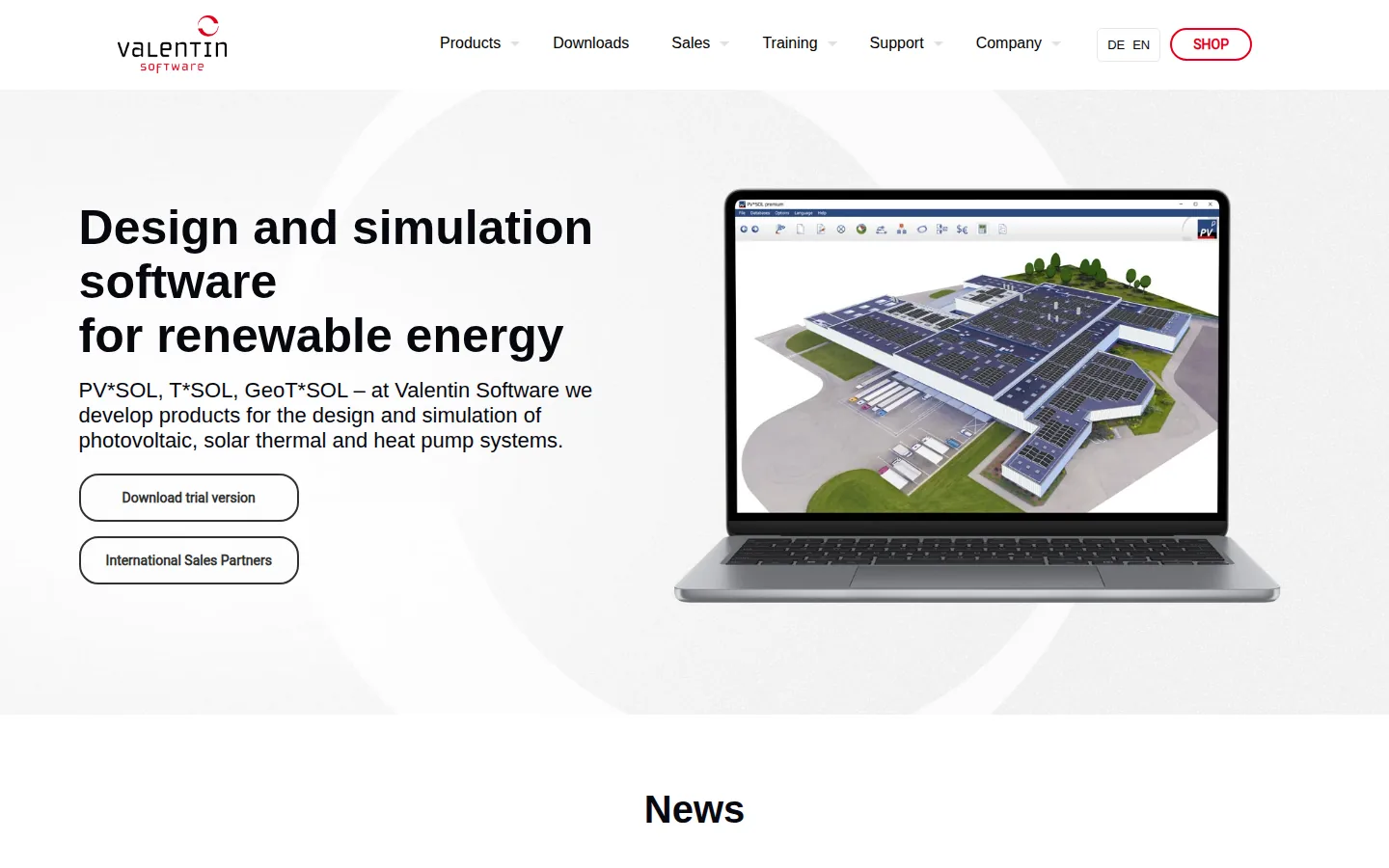
Best for: installers and design offices who want a French-language desktop tool with 3D shading, self-consumption and battery modelling on a euro named-user licence.
Not the right choice if: you work on a Mac or in a browser (the system requirements list Windows 10 and 11). It is also not right if you need an Enedis profile import (not stated on the page).
What the vendor documents: on the product page, an interface in German, English, Spanish, French, Italian, Polish, Czech, Portuguese and Turkish, project reports in 24 languages and 3D shading analysis. It also lists modelling for “full or surplus feed-in” with battery storage, “fully customizable circuit diagrams, including safety components”, and a feed-in tariff database. The page does not say which countries that database covers. The sales partner page names Fauconnet Ingénierie S.A.S. as a Valentin Software distribution partner in France since 2005.
Price (checked October 2026): EUR 845.00 plus VAT for a named-user licence, one year. A free trial version is offered for download.
Limitations: the product page says it creates “bankable reports” and does not state P50 to P90 outputs. The Bankability help topic documents P50 as the default. It also documents P90 or a self-selected P-value for the profitability calculation, and says it relates only to the concept of full feed-in. The vendor pages we read name no French standard or Consuel file.
Vendor link: valentin-software.com.
PVsyst
Best for: French-speaking engineers who need P50 to P90 yield evidence on a financed or larger project, using an interface translated into French.
Not the right choice if: you need quotations or proposals from the same tool (the pages we read describe none). It is also not right if you need a single line diagram that includes storage (the single line diagram page says storage systems are not included). Skip it too if you work on a Mac or in a browser. The requirements page says it runs only under Windows.
What the vendor documents: a P50 to P90 evaluation covering weather variability and simulation uncertainties. The languages page says English is the reference language and lists French among the translations. The pages we read describe no proposal output. The single line diagram page documents a diagram for grid-connected systems, introduced in V7.3.0 and described as work in progress.
Price (checked October 2026): CHF 700 per year for PVsyst 8 Professional. Grouped-order discounts are 5% for 2 to 4 licences, 15% for 5 to 9 and 20% for 10 or more. No euro price is published.
Limitations: the vendor pages we read do not mention Enedis, Consuel or French tariffs.
Vendor link: pvsyst.com.
SurgePV
SurgePV is our product.
Best for: teams that want roof modeling, shading, yield, financial modeling, bill of materials and proposals from one vendor with a published per-user price. These teams will confirm French outputs in a demo.
Not the right choice if: you want a self-serve trial (SurgePV offers a guided demo). It is also not right if you need a euro price with VAT in writing before talking to sales. Ask for a quote; for visitors outside India the pricing page lists US dollars. Finally, it is not right if you need an Enedis consumption profile import (Archelios PRO lists one). Outputs support design and documentation but do not replace approval by the responsible engineer, authority, lender or utility. SurgePV’s published product scope does not list a CRM. It is not a monitoring or ERP product.
What the vendor documents: 3D roof modeling, array layout, shading analysis, energy-yield modeling, financial modeling, electrical workflow support, bill-of-materials output and proposal generation. See solar design software for the product page.
Price (checked October 2026): $1,899 per user per year for 1 user, $1,499 per user for 3 seats, $1,299 per user for 5 seats, in US dollars.
Limitations: results depend on source data, assumptions and equipment models. The pricing page and published scope do not state the French surplus tariff, an Enedis import, a named French standard or a product language.
Vendor link: surgepv.com.
French Rules That Shape the Choice
The 1 June 2026 order. The order amends the S21 order of 6 October 2021 for buildings, hangars and carports up to 500 kWc. It was published in the Journal officiel of 4 June 2026 (full text on AIDA; the Légifrance entry blocks automated requests). For installations of 9 kWc or less, only sale with injection of the surplus is eligible. The installer must be qualified or certified under annex 5. The surplus tariff is “1,1 c€/kWh hors TVA”, indexed by 2% a year at each anniversary of the contract. Injection above installed power times 1,600 hours a year is not eligible. The CRE opinion of 29 April 2026 gives the previous levels for the 0 to 9 kWc segment. They were an investment premium of 8 c€/Wc and a surplus tariff of 40 €/MWh. The amended text replaces “les primes et tarifs” with “le tarif” in its article 13 and sets out no premium amount. This is in line with the CRE opinion, which backed removing the premium. We did not find transitional rules for small systems in the text we read. Check with the buyer which terms apply to a request filed before publication. The CRE opinion describes a draft that paid the tariff only in hours of zero or positive spot price. We found no such condition in the published text.
A worked example shows the stakes. A 6 kWc system can have at most 6 × 1,600 = 9,600 kWh of eligible injection a year. At 0.011 euro per kWh that is 9,600 × 0.011 = 105.60 euro in the first year. That holds only if the system actually injects that much. Quotes built on the old premium or the old surplus tariff will overstate the return.
Connection with Enedis (36 kVA or less, purchase obligation). Enedis note MOP-RAC_045E (version 1, applicable from 15 September 2025, replacing FOR-RAC_22E) lists six items. First, a site plan (required for total injection, or for surplus sale if the meter is not a Linky). Second, a mandate if a third party files. Third, a Kbis for companies. Fourth, the planning authorisation if the installation needs one. Fifth, an installer certificate. Sixth, a single line diagram. Its own table marks the last two “Non”, and says the diagram is to be supplied when storage is present. The planning authorisation is the building permit (for a building still to be built), the prior declaration of works or any other required authorisation. For a prior declaration, the filing receipt is enough when the connection does not exceed 6 kVA on any phase. An NF EN 50549-1 certificate is “Non” but supplied on request. Article 1, as amended by the June 2026 order, lists installer qualification as an eligibility condition. So ask Enedis whether it requests the certificate in practice.
Consuel. The attestation de conformité must be bought and filled in by the person who did the electrical work. The visa request goes to Consuel three weeks before the planned connection. Since 1 January 2025, under article D342-19 of the Code de l’énergie, Consuel passes the visaed attestation to the network operator. A SC 144 technical file goes with a blue or violet attestation (Consuel, four steps; technical files).
Regulator pointers. Use the CRE for tariff opinions, Enedis for connection requests and Consuel for the electrical attestation.
What to Ask a Vendor Before Buying
Ask each vendor for one residential sample. Look for these six lines. First, a surplus-only case at the current tariff with no premium. Second, an annual indexation of 2%. Third, the 1,600-hour cap. Fourth, a self-consumption share the buyer can edit. Fifth, the file you would attach to an Enedis request for a storage project. Sixth, a price in the currency you will be invoiced in. Where a vendor does not publish a feature on the pages we read, the matrix says so. A demo or trial is the place to confirm it.
How We Ordered These Tools
SurgePV publishes this page and is a vendor on this list. Its entry uses the same vendor-page sources and template as every other tool here.
We did not rank these tools. They are listed alphabetically, and the best-for picks come from the matrix above.
- French interface: clients and partners in France expect French documents, and the vendor’s own language list is the evidence we used. We did not assess translation quality.
- Enedis inputs: a consumption profile import and a diagram are the two Enedis-related inputs a vendor can publish. We did not assess whether any output is accepted by Enedis.
- Self-consumption and surplus sale: after the June 2026 order the surplus pays little, so the model of own use decides the quote. We did not assess whether any calculation is correct.
- Named French standards: installers need to know which French standards an electrical output follows. We did not assess compliance with any standard.
- Price currency: the currency shows what a French buyer will pay and whether VAT is added. We did not assess discounts or negotiated quotes.
- Yield evidence: larger projects may need a report a lender will read. We did not assess acceptance by any French lender.
Sources and Dates
Vendor pages were read in October 2026: Archelios PRO (product and prices, CALC, standards page, release note of 21 November 2025), OpenSolar (core app page, pricing post, Enterprise Services, diagrams, help centre tariffs), PV*SOL (premium, partners), PVsyst (shop, languages, single line diagram page, feed-in tariff and self-consumption page) and SurgePV (pricing). French sources are the 1 June 2026 order as reproduced by AIDA and the CRE opinion of 29 April 2026. They also include Enedis note MOP-RAC_045E and the Consuel pages. All are linked above and were read in October 2026. The Légifrance entry blocks automated requests, so we read the order on AIDA. The OpenSolar help centre returns 403 to curl, so we read it in a browser.
See SurgePV on your own project
Book a guided demo and ask for the French outputs you need.
Book a Free DemoGo Deeper on a Category
- Solar software in France, all categories
- Proposal software for French installers
- Solar design software in Spain and Belgium, the nearest country lists
- Best solar design software, all markets
Frequently Asked Questions
What is the best solar design software in France?
It depends on the job. From what the vendors publish, Archelios PRO lists an Enedis consumption profile import and euro prices by project size. PV*SOL has a French interface and a euro price. PVsyst documents P50 to P90 yield evidence. P90 is a yield expected to be met or exceeded in 90% of years (P50: 50%). OpenSolar’s core app is free, and its help article lists France for single line diagrams. API Access and connectors are charged from 16 April 2026. SurgePV documents roof modeling, bill of materials and proposals and is priced per user in US dollars.
Do I need solar design software or drafting services for a French project?
This page compares software, not outsourced drafting. For a connection of 36 kVA or less with the purchase obligation, Enedis marks the single line diagram as not mandatory. It asks for one only when storage is present. The installer still files the Enedis request and fills in the Consuel attestation, and software does not replace the responsible engineer.
What must French PV software model after the June 2026 order?
The order of 1 June 2026 allows only surplus sale for installations of 9 kWc or less. It sets one surplus tariff of 1.1 centimes per kWh excluding VAT, indexed at 2% a year, on injection up to installed power times 1,600 hours. The investment premium is not in the amended text. A proposal therefore depends on the self-consumption share, so ask a vendor how it updates tariffs.
Which photovoltaic software has a French interface or imports Enedis data?
Archelios PRO lists French in its language menu and imports an Enedis consumption profile on its Gold plan. PV*SOL premium and PVsyst both list French among their interface languages. OpenSolar’s help site is available in French, but its sales site menu lists other languages. We could not find a stated product language for SurgePV.
How much does solar design software cost in France?
Prices are published in different currencies. Archelios PRO is free up to 9 kWp per project, then 990, 1,490 and 1,990 euro per year excluding tax by plan. PV*SOL premium is 845 euro plus VAT per named user per year. PVsyst Professional is 700 Swiss francs per year. OpenSolar’s core app is free, but the vendor charges for API Access and supported connectors from 16 April 2026. SurgePV lists 1,899 US dollars per user per year for one user.
What does Enedis ask for in a connection request for a small PV system?
For 36 kVA or less with the purchase obligation, Enedis lists a site plan and a mandate if a third party files. It also lists a Kbis for companies and the planning authorisation if one is needed. Photographs are not mandatory but strongly requested. On request, it also asks for an NF EN 50549-1 certificate. The single line diagram is required only with storage. Enedis then expects the Consuel attestation, which must be requested about three weeks before the planned connection.
