


If you design solar for Czech customers, pick the tool by the job. PV*SOL premium lists Czech as a program language and has a Czech sales partner. EasySolar lists the Czech Republic as a set-up market. OpenSolar’s core app is free. PVsyst is built for yield reports on bigger projects. SurgePV puts roof modeling, bill of materials and proposals in one product, priced per user. No vendor page we read mentions a Czech grid-connection form, so ask each vendor for a sample project first.
This is a desk comparison of what each vendor publishes, checked October 2026. We have not run side-by-side tests. Local rules below come from ČEZ Distribuce, the Energy Regulatory Office (ERÚ) and the Nová zelená úsporám program. Tool facts come from each vendor’s own site.
Criteria used: Czech language, diagram for a grid application, zero-export or export limit setting, Czech market set-up, price currency, yield evidence.
This list covers five tools. Aurora Solar, HelioScope and PVcase are not compared here. See the global design list for them.
Best-For Picks for the Czech Republic
- A Czech program language: PV*SOL premium. Its product page lists Czech, and its sales partner page lists the Czech Photovoltaic Association (ČFA) for the Czech Republic and Slovakia. ČFA offers PV*SOL training courses.
- A tool the vendor says is set up for Czech work: EasySolar. Its home page lists the Czech Republic as a market with local rules set up. It does not say what those Czech rules are, so ask for a demo.
- A free core app for a small team: OpenSolar. The vendor says the core app is free for solar professionals. API Access and connectors are charged from 16 April 2026. Its proposal languages do not include Czech.
- Yield evidence on a larger project: PVsyst. It documents P50 to P90 evaluations. The pages we read describe no proposal output.
- Roof model to bill of materials and proposal in one product: SurgePV. It lists these in its published scope, priced per user in US dollars. Ask in a demo about Czech language and Czech grid forms. Its published scope states neither.
- A diagram to attach to a grid application: EasySolar, OpenSolar, PV*SOL and PVsyst each describe a generated diagram. None says its diagram follows the typical schemes ČEZ Distribuce suggests. Check a sample before you buy.
Comparison Table
Listed alphabetically. This is not a ranking; pick by the situation above. Prices checked October 2026 on each vendor’s own page.
| Tool | Best for | Price | Free or paid | Decisive scope fact |
|---|---|---|---|---|
| EasySolar | Czech set-up, design with CRM | $79 per month, 1 user included; extra user $25 per month | Paid, free trial with a card | Lists the Czech Republic as a set-up market |
| OpenSolar | Free core app | Core app free; API Access and connectors charged from 16 April 2026 | Free core app, paid API and connectors | Proposal languages do not include Czech |
| PV*SOL premium | Czech program language | EUR 845.00 per named user per year, plus VAT | Paid, trial download | Windows 10 and 11 only |
| PVsyst | Yield evidence | CHF 700 per year (Professional) | Paid, one-month trial | Documents P50 to P90 evaluations; Windows only |
| SurgePV | Roof model to BOM and proposal, per user | $1,899 per user per year (1 user) | Paid, guided demo | BOM and proposal generation in scope; language list not stated |
Czech Criteria Matrix
Each cell is Documented, Partial or Not stated, based on the vendor pages we read in October 2026. We list them under Sources and Dates. Documented means the page states it for this task. Partial means the page lists a related feature but not the Czech item. Not stated means we did not find it on those pages. There are no scores or weights.
| Tool | Czech language | Diagram for grid application | Zero export or export limit | Czech market set-up | Price currency | Yield evidence |
|---|---|---|---|---|---|---|
| EasySolar | Partial (home page: local languages set up for listed markets, Czech Republic included, and an interface in 25 languages; Czech not named in a language list; website menu lists Czech) | Partial (home page: electrical schematic exports to PDF “for the grid application and the crew”; Czech format not stated) | Not stated | Partial (Czech Republic listed as a set-up market; details not stated) | Documented ($ price; currency not named) | Partial (yield estimate and energy balance listed; P-values not stated) |
| OpenSolar | Not stated (Czech is not in the proposal language list) | Partial (single line diagram; Czech is not in the template list) | Documented (Export Limit setting) | Not stated | Partial (core app free; API Access and connectors charged from 16 April 2026; no CZK price) | Not stated |
| PV*SOL premium | Documented (Czech program language) | Partial (circuit diagrams; Czech format not stated) | Documented (vendor forum FAQ: maximum feed-in power clipping setting under AC Mains) | Partial (Czech map sections added in the September 2026 release; tariff countries not stated) | Documented (EUR, plus VAT) | Partial (“bankable reports”; P50 and P90 in the Bankability help topic, full feed-in only) |
| PVsyst | Not stated (Czech is not in the program language list) | Partial (single line diagram for grid-connected systems, storage not included) | Documented (grid power limitation help page) | Not stated | Documented (CHF) | Documented |
| SurgePV | Not stated | Not stated (electrical workflow support listed) | Not stated | Not stated | Documented (USD) | Not stated (energy-yield modeling listed) |
Two things stand out. Only PV*SOL premium lists Czech as a program language on the pages we read. No vendor states a ČEZ Distribuce, PREdistribuce or EG.D form or output. The tools differ most on language, on which currency they price in, and on whether they document P50 to P90.
Tool Entries
EasySolar
Best for: installers who want design, proposals and a customer tracking tool (CRM) in one browser product, with a vendor that lists the Czech Republic as a set-up market.
Not the right choice if: you need a stated Czech grid form, a price in koruna or euro, or P50 to P90 yield figures. The pages we read state none of these.
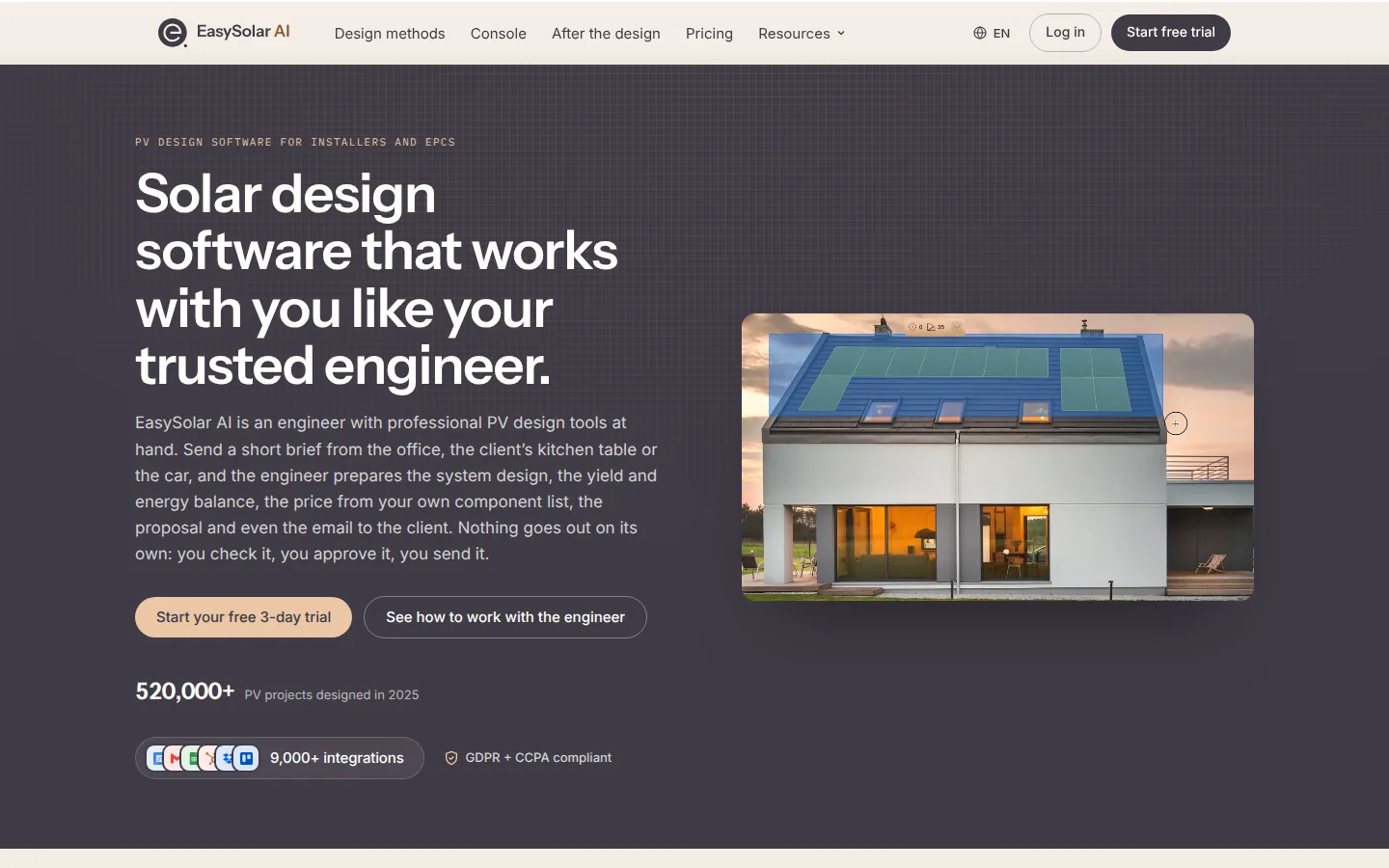
What the vendor documents: the home page lists the Czech Republic among 15 markets. Its text reads “A revived rooftop market thanks to the Nová zelená úsporám program. Localized for current net metering rules and the rapidly expanding residential segment.” The page does not say which Czech rules or tariffs are set up. It also says local languages are already in place for the markets it lists, and that the interface runs in 25 languages. It says the single line diagram exports to PDF “for the grid application and the crew”. ČEZ Distribuce, in contrast, describes a no-export route and electricity sharing (see the Czech rules below), so ask EasySolar what exactly it has set up. The price page lists, for the Business+ plan, design on Google Maps imagery, energy and battery sizing with financial analysis, a CRM built for PV, interactive proposals, a PDF, and “Automatically generated electrical diagrams”. The website menu offers English, Polish, German, Spanish, Portuguese, Italian, French, Swedish, Czech, Hungarian and Croatian. The company is EasySolar Sp. z o.o. in Lublin, Poland.
Price (checked October 2026): Business+ is $79 per month and includes 1 user. Each extra user is $25 per month. Enterprise+ is custom and starts from 50 users. The home page offers a free 3-day trial, and the price page says a card is required to start. The page does not name the currency beyond the dollar sign.
Limitations: the home page says the interface runs in 25 languages but does not name Czech in a list, so ask whether the app and proposals can be set to Czech. The pages we read name no weather data source and list no P-values.
Vendor link: easysolar.app.
OpenSolar
Best for: small installers who want a free core app with proposals and a generated single line diagram (SLD, a simple drawing of how the system is wired).
Not the right choice if: you need a Czech proposal language or a diagram template that lists the Czech Republic. Neither is on the OpenSolar pages we read.
What the vendor documents: its proposal language article lists English, Dutch, Swedish, Spanish, French, Norwegian, Thai, German, Polish, Portuguese, Italian, Danish and Finnish. Czech is not on that list. Its SLD help article says SLDs are supported in AU, NZ, US, CA, UK, FR, DE, IT, ES and IN. The SLD product page lists a shorter set. Neither lists the Czech Republic. You can create custom tariffs with flat, time-of-use, tiered and demand charges (tariff article). The off-grid article shows an Export Limit setting that you can set to 0 kW.
Price (checked October 2026): the core app is free of charge for solar professionals, per the vendor. From 16 April 2026 the vendor charges for API Access and for supported connectors. Source: its 16 February 2026 post, which says accounting connectors are billed as a monthly fee per organization. The API Access help article says an API Access fee is deducted for each new project. Optional paid Enterprise Services: Support US$500 per month and Customize US$1,350 per month.
Limitations: the pages we read state no Czech tariff, Czech form data or P50 to P90 output.
Vendor link: opensolar.com.
PV*SOL premium
Best for: designers who want a Czech program language, 3D shading analysis and generated circuit diagrams, and who value a Czech sales partner.
Not the right choice if: you work on a Mac or in a browser, because the system requirements list Windows 10 and 11. It is also not right if you need a Czech form output, because the pages we read state none.
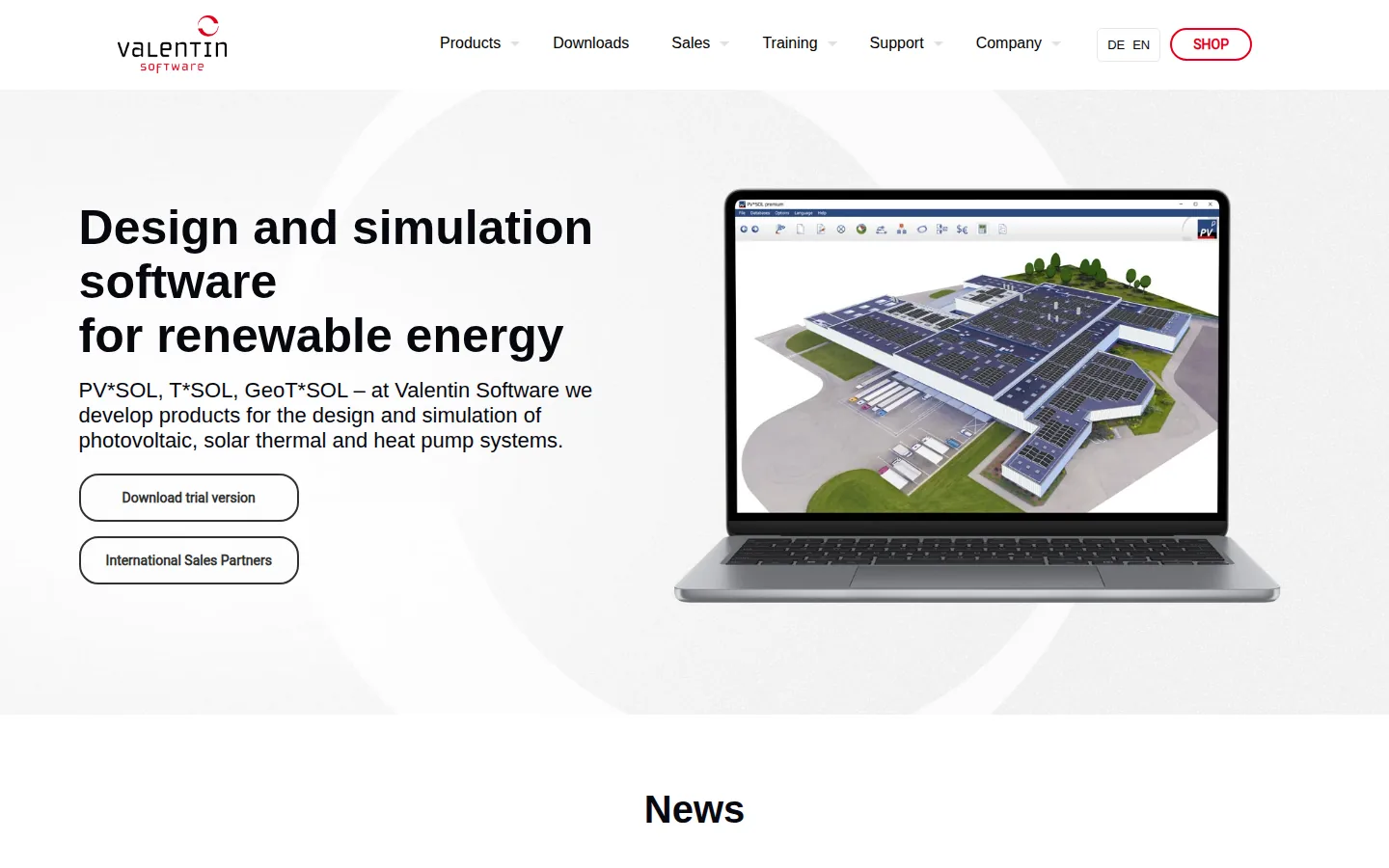
What the vendor documents: the product page lists program languages German, English, Spanish, French, Italian, Polish, Czech, Portuguese and Turkish, and project reports in 24 languages. It lists 3D visualization with shading analysis, “fully customizable circuit diagrams, including safety components”, and a 20-year financial analysis that uses a feed-in tariff database. The page does not say which countries the database covers. The September 22, 2026 release notes on that page add map sections for Poland and the Czech Republic. A customer presentation for quotations is also available. The help centre has a Bankability (P50, P90) topic and a net-metering tariff database page where you can set a country. The sales partner page lists the Czech Photovoltaic Association (ČFA) for the Czech Republic and Slovakia. It says ČFA offers PV*SOL training courses. A vendor forum FAQ says the maximum feed-in power clipping is set in System Type, Climate and Grid, under AC Mains.
Price (checked October 2026): EUR 845.00 plus VAT for a named-user licence, one year. A free trial version is offered for download.
Limitations: the product page says it creates “bankable reports”. The Bankability topic gives P50 by default and a P90 or self-selected P-value for the profitability calculation. It says this relates only to full feed-in. The pages we read name no Czech distributor form.
Vendor link: valentin-software.com.
PVsyst
Best for: yield evidence on bigger projects, such as a commercial roof or a ground-mount plant, where a lender or investor wants a simulation report.
Not the right choice if: you need quotations and proposals from the same tool, because the pages we read describe none. It is also not right if you work on a Mac or in a browser, because the requirements page says it runs only under Windows. Czech is not on its list of program languages.
What the vendor documents: a P50 to P90 evaluation. PVsyst says P50 and P90 are exceedance values: annual production has a 50% probability of exceeding the P50 value and a 90% probability of exceeding the P90 value. Its single line diagram help page describes an editor and viewer for grid-connected systems only. Storage is not included, and the page says the feature is still work in progress. A grid power limitation page explains how to model a limit on injected power. The languages page lists English, French, German, Spanish, Portuguese, Italian, Turkish, Korean, Chinese, Japanese, Polish and Russian. The economic evaluation page covers feed-in tariffs and self-consumption economics. It names no Czech rates.
Price (checked October 2026): CHF 700 per year for PVsyst 8 Professional, with grouped-order discounts of 5% for 2 to 4 licences, 15% for 5 to 9 and 20% for 10 or more. The product page also offers a one-month free trial. No euro or koruna price appears there.
Limitations: the vendor pages we read do not mention Czech forms, grants or lenders.
Vendor link: pvsyst.com.
SurgePV
SurgePV is our product.
Best for: teams that want roof modeling, shading, yield, financial modeling, bill of materials and proposals in one product, priced per user. Confirm Czech outputs in a demo.
Not the right choice if: you want a self-serve trial (SurgePV offers a guided demo). It is also not right if you need a Czech program language today, because PV*SOL lists one and SurgePV’s published scope does not. Another case is a free tool for small jobs, where OpenSolar’s core app is free. Outputs support design and documentation but do not replace approval by the responsible engineer, authority, lender or utility. SurgePV’s published product scope does not list a CRM (a customer tracking tool). It is not a monitoring or ERP (business management software) product.
What the vendor documents: 3D roof modeling, array layout and shading analysis. It also lists energy-yield modeling, financial modeling, electrical workflow support, bill-of-materials output and proposal generation. See solar design software for the product page.
Price (checked October 2026): $1,899 per user per year for 1 user, $1,499 per user for 3 seats, $1,299 per user for 5 seats. SurgePV publishes its prices in US dollars.
Limitations: results depend on source data, assumptions and equipment models. The published scope does not state a Czech language, a Czech grid form, a Czech tariff set-up or P50 to P90 outputs.
Vendor link: surgepv.com.
Czech Rules That Shape the Choice
Who connects you. You cannot choose your distribution system operator (DSO, the company that runs the local power network). It is set by territory. The Energy Regulatory Office (ERÚ) lists the main electricity DSOs as ČEZ Distribuce, EG.D and PREdistribuce (ERÚ, who are my supplier and distributor). PREdistribuce says its network covers Prague and the town of Roztoky (PREdistribuce). We read ČEZ Distribuce in detail. When we read egd.cz, it showed a site maintenance notice. Check your own distributor’s pages before you design.
A micro-source is up to 10.8 kW. ČEZ Distribuce describes a micro-source (in Czech, mikrozdroj) as a source of up to 10.8 kW that runs without a licence. It connects at low voltage at an existing supply point where no other generating plant is connected (ČEZ Distribuce, connection up to 100 kW). The application for a micro-source or a plant up to 100 kW lists, among its attachments, a single-line diagram of the source including any battery. It also needs a cadastral map and a property record, and owner consent if you do not own the site. The distributor’s micro-source page says it does not ask for project documents to be approved, and it suggests you use its typical wiring schemes. This makes diagram output a buying criterion.
A simplified route for no-export systems. The simplified connection is for micro-sources up to 10.8 kW that make power only for your own use. All power must be used at the site, so the reserved power is always zero. Power sent to the grid without permission is penalized under the current ERÚ price decision. You, the applicant, pay to measure the loop impedance at the connection point. The value must be below 0.47 ohm for a source up to 16 A per phase. That is at most 10.8 kW on three phases or 3.7 kW on one phase. For a source up to 10 A per phase the limit is 0.75 ohm, which is at most 6.9 kW on three phases or 2.3 kW on one. A zero-export or export limit setting in your design tool matters for this route.
Electricity sharing. Since August 1, 2024, people and communities can share extra power. They first create a sharing group on the portal of the Electricity Data Centre (EDC). Shared power must be made and used within the same 15-minute interval. Every plant and every consuming site needs interval metering. ČEZ Distribuce says the plant must be in permanent operation first (ČEZ Distribuce, sharing). None of the tools above states a sharing feature on the pages we read.
Grant: Nová zelená úsporám Light. The program pays 120,000 CZK for a basic photovoltaic system of at least 3 kWp with water heating, for own use. The applicant must be the owner of a family house, as a natural person, in a household that meets one of the listed conditions. One example is a household that gets state social assistance. You apply online through the system of SFŽP, the State Environmental Fund, and you can apply before, during or after the work (Nová zelená úsporám Light). Rules change, so read the page for the current terms before you quote.
Language and currency. Czech customers read Czech. Of the five tools, only PV*SOL premium lists Czech as a program language. No vendor page we read shows a price in Czech koruna. Prices come in US dollars, euro or Swiss francs.
What to Ask a Vendor Before Buying
Ask each vendor for one sample project. Then look for these items. First, whether the app and the proposal can be set to Czech. Second, a single-line diagram you could attach to a ČEZ Distribuce application. Third, a zero-export or export limit setting. Fourth, a way to enter your customer’s own tariff and a grant such as Nová zelená úsporám Light. Fifth, a price in the currency you will be invoiced in. Where a vendor does not publish a feature on the pages we read, the matrix says so. A demo or trial is the place to confirm it.
How We Ordered These Tools
We did not rank these tools. They are listed alphabetically, and the best-for picks come from the matrix above.
- Czech language: your customers and your crew read Czech. We did not assess how complete any Czech translation is.
- Diagram for grid application: ČEZ Distribuce lists a single-line diagram as an application attachment. We did not assess whether any diagram matches its typical schemes.
- Zero export or export limit: the simplified route needs zero export. We did not assess whether any tool meets the connection rules.
- Czech market set-up: local tariffs and grants affect the savings figure. We did not assess whether any set-up is correct or current.
- Price currency: the currency shows what a Czech buyer will pay and whether VAT is added. We did not assess discounts or negotiated quotes.
- Yield evidence: bigger projects may need a report a lender will read. We did not assess acceptance by any Czech lender.
Sources and Dates
Vendor pages were read in October 2026. EasySolar (home, pricing). OpenSolar (free, diagrams, enterprise services). PV*SOL (premium, partners). PVsyst (product, languages). SurgePV (pricing). Czech sources are the ČEZ Distribuce pages for producers, micro-sources, simplified connection and electricity sharing. They also include the ERÚ distributor page, the PREdistribuce site and the Nová zelená úsporám Light page. The ČEZ Distribuce and Nová zelená úsporám pages are in Czech. All are linked above and were read in October 2026. The EG.D site showed a maintenance notice when we read it, so we did not use it for rules.
See SurgePV on your own project
Book a guided demo and ask for the Czech outputs you need.
Book a Free DemoGo Deeper on a Category
- Solar design software for Czech installers
- Proposal software for Czech installers
- Solar software in Slovakia, all categories, a neighboring country list
- Solar software in Poland, all categories, a neighboring country list
- Best solar design software, all markets
Frequently Asked Questions
What is the best solar software for installers in the Czech Republic?
It depends on the job. PV*SOL premium lists Czech as a program language and has a Czech sales partner. EasySolar lists the Czech Republic as a set-up market. OpenSolar’s core app is free. PVsyst documents P50 to P90 yield figures for bigger projects. SurgePV lists roof modeling, bill of materials and proposals in one product, priced per user in US dollars. No vendor page we read mentions a Czech grid-connection form.
Is there solar design software in the Czech language?
PV*SOL premium lists Czech among its program languages. EasySolar says local languages are set up for its listed markets, which include the Czech Republic, and that its interface runs in 25 languages. It does not name Czech in a language list. OpenSolar’s list of proposal languages has no Czech, and PVsyst’s list of program languages has no Czech. SurgePV’s published scope does not state a language list.
What does ČEZ Distribuce ask for when I connect a small solar system?
ČEZ Distribuce calls a source up to 10.8 kW a micro-source. The application for a micro-source or a plant up to 100 kW lists a single-line diagram of the source, including any battery, as an attachment. ČEZ Distribuce says it does not ask for project documents to be approved for micro-sources. It suggests you use its typical wiring schemes.
What is the simplified connection for a micro-source?
It is for a system that makes power only for your own use and sends nothing to the grid. The reserved power is always zero. You measure the loop impedance at your connection point, and it must be below 0.47 ohm for a source up to 16 A per phase. For a source up to 10 A per phase the limit is 0.75 ohm. ČEZ Distribuce says power sent to the grid without permission is penalized.
Is there a grant for solar panels in the Czech Republic?
The Nová zelená úsporám Light program pays 120,000 CZK for a basic system of at least 3 kWp with water heating. It is for owners of family houses in some low-income or vulnerable households, such as those that get state social assistance. You apply online through the system of SFŽP, the State Environmental Fund. Check the program pages for the current rules before you quote a customer.
How much does solar software cost in the Czech Republic?
No vendor page we read shows a price in Czech koruna. EasySolar Business+ is $79 per month with one user. OpenSolar’s core app is free, but API Access and connectors are charged from 16 April 2026. PV*SOL premium is 845 euro plus VAT per named user per year. PVsyst Professional is 700 Swiss francs per year. SurgePV lists 1,899 US dollars per user per year for one user.
