

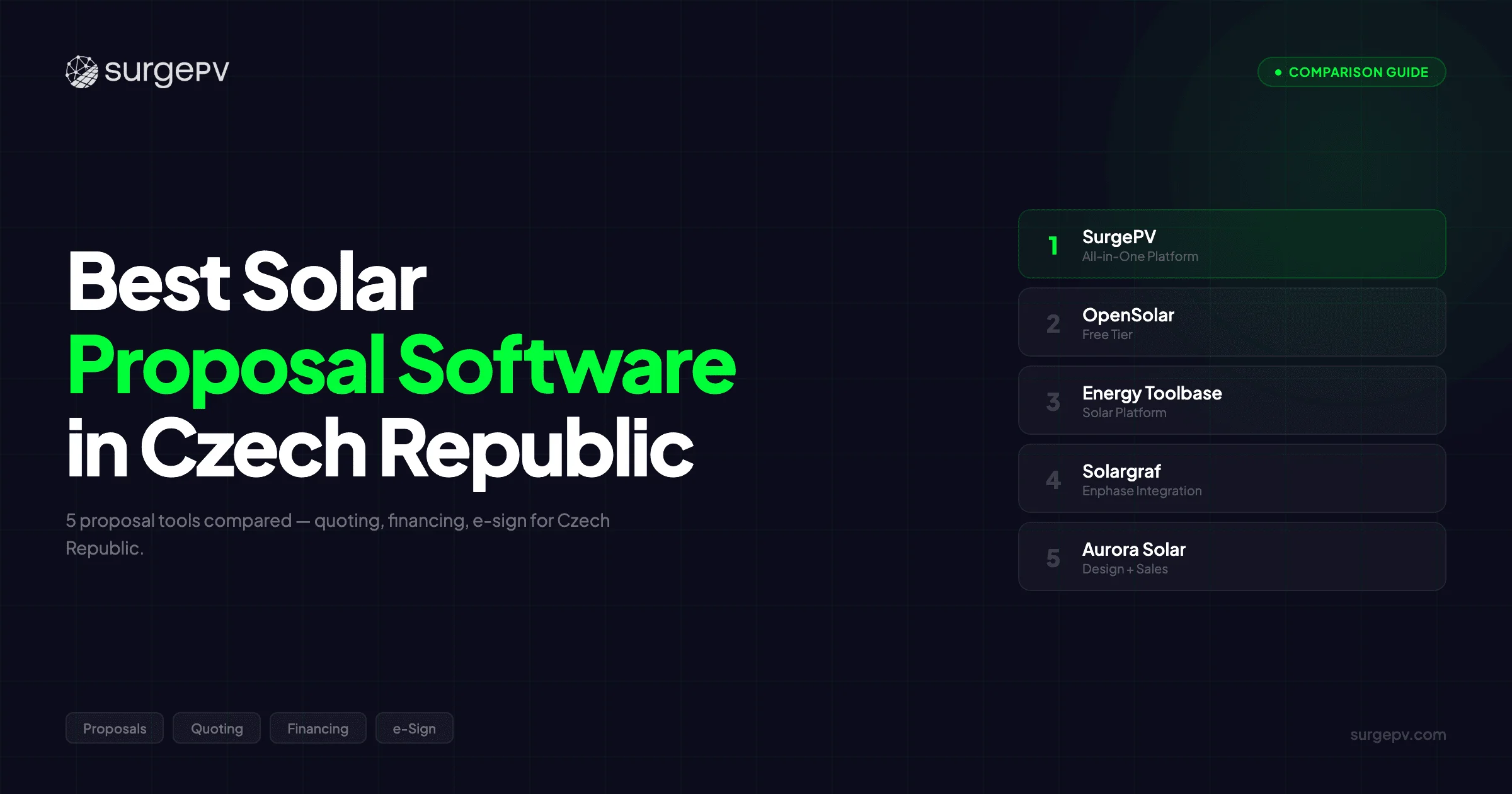
TL;DR: SurgePV is the strongest end-to-end option for Czech installers - 15-minute Czech-language proposals, multi-scenario Green Bonus vs. net metering modeling, and bankable simulation in one platform. OpenSolar fits residential-only teams on tighter budgets. Energy Toolbase handles C&I storage projects. Solargraf suits high-volume residential sales teams. Aurora Solar is premium-tier with strong CRM and visual quality.
Speed wins solar deals in Czech Republic. Full stop.
According to SolarPower Europe, the residential market is growing 35% annually. Hundreds of new installers are competing for the same customers. In Prague and Brno, homeowners request 3-5 quotes before signing.
They expect proposals within 24-48 hours. Czech-language documents. Clear Green Bonus versus net metering comparisons. Professional visuals. And they judge your company by that proposal - before they ever see your installation work.
Slow proposals lose deals. Generic proposals lose deals. English-only proposals lose deals. Even if your pricing is the most competitive in the market.
We reviewed 5 leading platforms with Czech installers and sales teams across Prague, Brno, and Ostrava - evaluating proposal quality, generation speed, and customer conversion rates. Here is what separates the winners from the rest.
In this guide, you’ll find:
- 5 solar proposal platforms compared on speed, Czech localization, and financial modeling depth
- What Czech residential and C&I customers actually expect in a proposal
- Green Bonus vs. net metering modeling requirements - and which tools handle both
- Pricing and ROI for Czech installer business models
- Which tool fits your team size and project mix
Quick Comparison Table
| Feature | SurgePV | OpenSolar | Energy Toolbase | Solargraf | Aurora Solar |
|---|---|---|---|---|---|
| Best for | Integrated workflows | Residential speed | C&I & storage | High-volume residential | Premium sales |
| Proposal speed | 15 minutes | 20-30 minutes | 30-45 minutes | 15-20 minutes | 20-30 minutes |
| Czech templates | Yes (customizable) | Requires setup | Manual config | Requires setup | Requires setup |
| Financial modeling | Multi-scenario | Basic residential | Advanced C&I | Basic residential | Multi-scenario |
| CRM integration | Export-ready | Built-in | Limited | Basic | Built-in |
| Design included | Yes (full platform) | Yes (residential) | No (proposals only) | Yes (residential) | Yes (full platform) |
| Pricing | $1,499/user/yr | Competitive | Premium | Low-mid range | Premium |
Further Reading
For a broader comparison beyond this market, see our guide to the best solar design software globally.
Best Solar Proposal Software in Czech Republic
SurgePV - Best End-to-End Platform with Integrated Proposals
Best For: Czech installers wanting design + simulation + proposals in one tool
Pricing: $1,499/user/year - all features included
Proposal Speed: 15 minutes
SurgePV is an end-to-end all-in-one solar software platform that integrates design, simulation, and professional proposals in one workflow. Unlike proposal-only platforms, SurgePV’s integrated approach means design data flows directly into proposals - no manual re-entry - enabling Czech installers to generate bankable professional proposals in 15 minutes.
For Czech installers competing in Prague and Brno, that integration matters. It eliminates the time waste and errors that come from switching between separate design software, simulation tools, and proposal generators.
Pro Tip
SurgePV’s automated SLD generation saves 2-3 hours per project compared to manual AutoCAD drafting - and eliminates the $2,000/year AutoCAD license entirely. For Czech EPCs handling 10+ projects per month, that’s 20-30 hours saved monthly. Book a demo to see it in action.
Key Features for Czech Republic
Proposal generation and customization:
- 15-minute proposal generation - gives you a measurable edge when Czech residential customers expect quotes within 24-48 hours
- Customizable Czech-language templates - 80%+ of Czech residential customers prefer Czech proposals
- Professional visual layouts - 3D roof renderings, system diagrams, and branded presentations that differentiate you from competitors using Excel spreadsheets
- Automated data population - design and simulation data auto-populate proposals, eliminating re-entry errors
- Multi-format export - PDF, web link, and print-ready formats for however your customer prefers to receive proposals
Financial modeling for the Czech market:
- Multi-scenario analysis - compare Green Bonus versus net metering versus full self-consumption in one proposal
- Payback period calculator - show 8-12 year payback prominently (Czech customer priority number one)
- 25-year cash flow projections - lifetime savings visualization builds customer confidence. When a homeowner sees exactly how much they save each year for 25 years, the purchase decision shifts from “if” to “when.”
- Financing options - model cash purchase, solar loans, and ESCO alternatives for C&I clients
- Electricity rate escalation - model 5-8% annual increases based on Czech market reality
Design-to-proposal integration:
- Seamless workflow - from 3D design through bankable simulation to professional proposal without switching tools
- Automated BOM with pricing - 98% accurate bill of materials with Czech component pricing integration. No copy-paste errors, no forgotten components, no awkward price corrections after the customer has signed.
- Automated SLD generation - single-line diagrams in 5-10 minutes versus 2-3 hours in AutoCAD, attached to proposals for technical credibility
- CRM compatibility - export lead data to Salesforce, HubSpot, or Czech CRM systems
- Mobile-friendly proposals - on-site presentations via tablet or smartphone for Czech sales teams. Close deals on the spot during home visits instead of promising “I’ll email it later.”
Pros and Cons
| Pros | Cons |
|---|---|
| Connected design and proposal workflow | Czech-language UI not yet available (proposals can be Czech) |
| 15-minute proposal generation for competitive Czech market | All-in-one approach may be more than pure sales teams need |
| Czech-language templates customizable for residential market | |
| Multi-scenario financial modeling (Green Bonus vs. net metering) | |
| Professional visual quality differentiates from competitors | |
| Bankable simulation backing builds customer confidence | |
| $1,499/user/year - transparent pricing |
Real-World Example
A residential installer in Central Bohemia generating 80+ proposals per month was juggling three tools - design software, simulation software, and spreadsheets for financials. Each proposal took 3-4 hours. With SurgePV’s unified workflow, that dropped to 45 minutes per proposal. Same-day proposals instead of next-week follow-ups. Their close rate improved because in solar sales, speed wins deals.
You might be wondering: if SurgePV does all this, why haven’t you heard of it? PVsyst has had a 30-year head start. Aurora Solar has spent hundreds of millions on marketing. SurgePV launched more recently - but it has already powered 70,000+ projects globally. The platform was purpose-built for the workflow gaps legacy tools leave open, particularly automated electrical engineering, which no other platform offers natively.
Related Guides
Best Solar Proposal Software (2026) - Global comparison
Aurora Solar Review - Proposal features deep-dive
Best Solar Simulation Software - Bankability comparison
Pricing
- Individual Plan: $1,899 per user per year on the individual plan ($633/user/year)
- For 3 Users Plan: $1,499/user/year
- For 5 Users Plan: $1,299/user/year
- Enterprise: Custom pricing for large Czech installers
The real value: SurgePV’s all-in-one approach eliminates separate design software, simulation tools, and proposal generators - reducing total software costs by 40-60%. For a Czech installer doing 50+ projects per year, the platform typically pays for itself within 2-4 months.
Who SurgePV Is Best For
- Multi-function Czech installers doing design, engineering, and sales from one platform
- Residential solar installers in competitive Prague and Brno markets needing fast, professional proposals
- Growing installer businesses scaling from 20-50 projects/year to 100+
- C&I EPCs needing sophisticated financial modeling backed by bankable simulation
- Solar sales professionals prioritizing win rates over cheapest tools
Less ideal for: Pure sales teams not doing any design work (OpenSolar or Solargraf may be simpler) or Czech installers requiring a Czech-language UI.
Book a demo | Explore proposal features
Win More Czech Solar Projects with Professional Proposals
Generate Czech-language proposals in 15 minutes with Green Bonus vs. net metering modeling and professional visual quality that wins competitive tenders.
Book a DemoNo commitment required · 20 minutes · Live project walkthrough
OpenSolar - Cloud-Based Residential Proposal Specialist
Best For: Czech residential-only installers prioritizing proposal speed
Pricing: Competitive subscription
Proposal Speed: 20-30 minutes
OpenSolar is a cloud-based solar design software and proposal platform focused on residential installations. For Czech residential-only installers who want a fast, cloud-based proposal tool without the complexity of a full engineering platform, it delivers. The interface is intuitive enough for sales reps without engineering backgrounds.
Key Strengths
- Fast residential proposal generation (20-30 minutes)
- Cloud-based - no installation required, accessible anywhere
- Integrated financing options (loan, lease, PPA modeling)
- Good visual presentation quality
- Competitive pricing for residential-only installers
Limitations
- English default - Czech localization requires template customization
- Financial modeling needs adaptation for Green Bonus and Czech net metering rates
- Limited C&I sophistication - not suitable for Czech commercial EPCs needing detailed IRR analysis
- Separate design tool means some data re-entry compared to integrated platforms
Best for: Czech residential-only installers prioritizing proposal speed and cloud-based accessibility, willing to customize templates for Czech language and local incentive programs.
Read our full OpenSolar review for detailed analysis.
Did You Know?
Czech Republic’s solar irradiance ranges from 1,000-1,100 kWh/m²/year, making accurate simulation software essential for bankable energy yield predictions. Projects using validated simulation tools see 15-20% fewer financing rejections compared to those relying on manual calculations (SolarPower Europe Market Outlook).
Energy Toolbase - C&I Financial Modeling and Storage Specialist
Best For: Czech C&I EPCs and commercial solar projects with storage
Pricing: Premium tier
Proposal Speed: 30-45 minutes
Energy Toolbase specializes in commercial solar financial modeling with strong battery storage capabilities. For Czech C&I EPCs working with corporate decision-makers who demand detailed IRR analysis and self-consumption optimization, Energy Toolbase brings real depth.
It is a financial modeling tool - not a design platform. You’ll need separate software for layout design and panel placement.
Key Strengths
- Advanced C&I financial modeling (IRR, NPV, tax equity analysis)
- Battery storage and demand charge analysis (relevant for the growing Czech storage market)
- Multiple financing scenario modeling (PPA, lease, cash, loan, ESCO)
- Professional financial reports for corporate decision-makers
Limitations
- Proposal-only focus requires a separate design tool
- Czech utility rates require manual configuration
- Higher complexity than needed for simple residential projects
- Premium pricing justified only for C&I-focused Czech EPCs
Best for: Czech C&I installers and EPCs focused on commercial solar projects with storage, needing sophisticated financial modeling for corporate decision-makers.
Read our full Energy Toolbase review for detailed analysis.
Solargraf - Fast Residential Quotes and Design
Best For: High-volume Czech residential sales teams
Pricing: Low-mid range
Proposal Speed: 15-20 minutes
Solargraf is a residential solar proposal software platform built for speed. For high-volume Czech residential installers processing dozens of quotes per week, Solargraf’s fast generation time is its primary selling point.
Key Strengths
- Very fast proposal generation (15-20 minutes)
- Simple, intuitive interface designed for sales teams
- Good residential visual presentation
- Competitive pricing for high-volume installers
- Mobile app for field sales
Limitations
- Czech localization requires template customization
- Limited C&I capabilities - not suitable for Czech commercial EPCs
- Financial modeling less sophisticated than Energy Toolbase or SurgePV
- Residential focus only - no commercial or utility-scale support
Best for: High-volume Czech residential installers and sales teams prioritizing speed and simplicity over full feature depth.
Read our full Solargraf review for detailed analysis.
Aurora Solar - Premium Sales and Proposal Platform
Best For: Larger Czech EPCs with premium residential focus
Pricing: Premium tier
Proposal Speed: 20-30 minutes
Aurora Solar is a premium design and sales platform with a strong focus on residential sales and CRM integration. Aurora’s integrated CRM gives larger Czech EPCs full visibility from lead capture through proposal delivery and contract signature.
Key Strengths
- Excellent proposal visual quality (commonly used for 3D renderings)
- Integrated CRM and lead management workflow
- Strong financial modeling with multiple financing options
- Polished mobile app for field sales
- Established brand recognition builds customer confidence
Limitations
- Premium pricing may be a barrier for smaller Czech installers facing tight margins
- US-centric features require Czech customization (incentive programs, language, CSN standards)
- No native SLD generation for grid connection documentation
Best for: Larger Czech EPCs and premium residential installers with budget for top-tier tools, prioritizing proposal quality and integrated CRM.
Read our full Aurora Solar review for detailed analysis.
The Feature Gap That Costs You Deals
Czech Language Support and Localization
80%+ of Czech residential customers prefer Czech-language proposals. English proposals signal inexperience with the local market and reduce customer trust. Your proposal software needs Czech templates with proper technical terminology - not machine-translated content. Czech installers switching from English to Czech proposals report 15-25% higher lead-to-sale conversion rates.
Multi-Scenario Financial Modeling (Czech Incentives)
Czech customers face a choice between Green Bonus (fixed 20-year tariff at EUR 0.05-0.08/kWh as set by ERU for systems under 30 kWp) and net metering (annual settlement for systems up to 10 kWp). Your proposals must clearly compare both scenarios with accurate ROI projections. The best customer-ready solar proposals also models SFZP investment grants (EUR 500-2,000 per residential system), accelerated depreciation for C&I projects, and Czech VAT at 15% for solar installations.
Proposal Speed (Competitive Requirement)
Czech residential customers expect quotes within 24-48 hours. Installers delivering proposals in 1+ week lose projects - regardless of price competitiveness. Software enabling 15-30 minute proposal generation provides a real competitive advantage.
Professional Visual Quality
Czech customers expect 3D roof visualizations showing the system on their actual building, professional branded layouts, and clear before-and-after energy bill comparisons. In blind proposal tests with Czech homeowners, professional visual quality increased selection probability by 15-25% even with identical pricing.
See how SurgePV proposals deliver professional quality
Financing Options and Payment Flexibility
Czech residential customers increasingly want financing to reduce upfront costs. Proposals must model solar loan terms at Czech commercial rates (4-6% typical from CSOB, Komercni banka, Ceska sporitelna), monthly payment versus current electricity bill comparisons, and total cost of ownership over 20-25 years.
CRM Integration and Lead Management
Growing Czech installers handling 50+ projects per year need systematic lead tracking. CRM-integrated proposal workflows reduce lead leakage by 30-40% and improve sales team productivity by 25-35%.
Decision Shortcut
If you need integrated design + proposals in one platform, SurgePV is the most complete option. If you’re residential-only with a large marketing budget, Aurora Solar’s proposals are excellent - but expensive. If you’re bootstrapping, OpenSolar’s competitive pricing gets you started without heavy upfront risk.
Our Review Method Methodology
- Proposal quality and Czech language support (30%): Tested Czech-language proposal generation with residential installers, evaluated technical terminology accuracy, assessed visual quality, verified financial modeling accuracy for Green Bonus and net metering calculations
- Proposal generation speed (25%): Timed residential proposals (5-10 kWp typical Czech systems), timed C&I proposals (50-200 kW), validated against Czech 24-48 hour competitive requirement
- Financial modeling accuracy (20%): Validated Green Bonus calculations (EUR 0.05-0.08/kWh rates), tested net metering annual settlement modeling, verified payback period and IRR calculation accuracy
- Czech market features (15%): Evaluated CZK currency and EUR support, tested Czech component database coverage, verified Czech incentive program modeling, tested mobile accessibility
- Pricing and ROI for Czech installers (10%): Analyzed cost versus features for typical Czech installer business models, calculated ROI for installers handling 20-100 projects per year
Research reference period: November 2025 - January 2026
Czech installer partners: 12 companies (8 residential in Prague, Brno, and Ostrava; 4 C&I EPCs)
Proposals evaluated: 85 real proposals (60 residential, 25 C&I)
Customer feedback: 35 Czech homeowners rated proposal quality and clarity
The Bottom Line
The Czech solar market is not slowing down. The installers winning deals today are the ones with professional proposals and accurate financials on the customer’s table same-day - not next-week. Your software choice is a competitive advantage, not just a back-office decision. Every slow proposal is a deal handed to a faster competitor.
Related Guides
Best All-in-One Solar Design Software - Complete platform comparison
OpenSolar Review - Residential proposal deep-dive
Which Software Is Right for Your Use Case?
| Your Situation | Recommended Software | Why It Fits |
|---|---|---|
| Commercial installer (5-20 projects/month) | SurgePV, Aurora Solar | Balance between design accuracy and proposal speed; integrated workflow reduces tool-switching |
| Residential-focused installer | SurgePV, Aurora Solar, OpenSolar | Fast proposals with professional templates; SurgePV for integration, Aurora for aesthetics, OpenSolar for affordability |
| Battery storage specialist | SurgePV, Energy Toolbase | Advanced battery sizing, self-consumption modeling, and financial analysis for storage projects |
| Small team (1-3 people) | SurgePV, OpenSolar | All-in-one platforms reduce software stack complexity and training time |
| Budget-conscious startups | OpenSolar, Solargraf | Low-cost entry points for teams with limited project volume |
When You May Not Need Advanced Solar Software
Not every solar project in Czech Republic requires a comprehensive design and simulation platform. Consider simpler alternatives if:
- Small residential projects with standard layouts - Basic tools or manufacturer calculators may suffice for simple rooftop arrays under 10 kW with no shading complexity
- Engineering is outsourced - If your company uses external engineering services, you may only need proposal and CRM tools rather than full design platforms
- Very limited project volume - Teams handling fewer than 5-10 projects per year may find manual workflows more cost-effective than software subscriptions
- Non-technical sales teams - Sales-focused companies without in-house engineers may only require proposal generation tools
Most EPCs and medium-to-large installers in Czech Republic benefit from integrated platforms that reduce manual work and improve accuracy. At 20+ proposals per month, the time savings from automated workflows typically cover software costs within the first month.
Bottom Line
For Czech Republic EPCs and installers, SurgePV delivers the most complete design-to-proposal workflow with automated SLD generation, bankable P50/P90 simulations, and integrated proposals - all at $1,899 per user per year on the individual plan. Book a demo to see it in action.
Frequently Asked Questions
What is the best solar proposal software in Czech Republic?
SurgePV is the best solar proposal software for Czech Republic in 2026. It integrates design, bankable simulation, and Czech-language proposals in one 15-minute workflow - eliminating the inefficiency of switching between separate tools. Multi-scenario financial modeling covers Green Bonus, net metering, and self-consumption options with accurate Czech market data. See our solar proposal software comparison for more options across all markets.
Do I need Czech-language proposals for residential customers?
Yes. 80%+ of Czech residential customers prefer Czech-language proposals. English proposals reduce trust and lower conversion rates in all Czech markets except the small Prague expat segment. Professional Czech translation is essential - machine-translated proposals contain errors that erode credibility. Installers switching from English to Czech proposals report 15-25% higher lead-to-sale conversion rates.
How fast should I deliver solar proposals in Czech Republic?
Czech residential customers expect proposals within 24-48 hours. Installers delivering in 1+ week lose projects to faster competitors regardless of price. Top performers deliver same-day or 24-hour proposals. Software enabling 15-30 minute proposal generation provides a real competitive advantage because Czech customers typically request 3-5 quotes and choose quickly.
Should Czech proposals show Green Bonus or net metering?
Czech proposals should show both Green Bonus and net metering scenarios with clear ROI comparison. Green Bonus works best for systems under 30 kWp with guaranteed 20-year revenue and low self-consumption households. Net metering works best for systems up to 10 kWp with high self-consumption (60%+ on-site usage). Present both side-by-side with payback period and 25-year cash flow.
Can solar proposal software integrate with Czech CRM systems?
Yes. Modern proposal software like SurgePV, Aurora Solar, and OpenSolar export lead data to common CRM platforms (Salesforce, HubSpot, Pipedrive) used by Czech installers. CRM integration becomes essential when handling 50+ projects per year. Czech installers using CRM-integrated workflows report 30-40% reduction in lead leakage.
What should Czech C&I solar proposals include?
Czech C&I solar proposals must include detailed IRR analysis (target 12-18%), self-consumption optimization (target 60-80%), tax benefit modeling (accelerated depreciation on a 5-year schedule), and multiple financing scenarios (cash, loan, ESCO). Additional essentials: hourly load versus solar generation matching, grid export modeling, technical specifications referencing CSN EN compliance, equipment warranties, and performance guarantees.
How much does solar proposal software cost in Czech Republic?
Solar proposal software ranges from free basic tools to EUR 5,000-8,000/year for premium platforms. Entry-level runs EUR 500-1,500/year (Solargraf range). Professional tier runs EUR 2,000-4,000/year (SurgePV, OpenSolar range). Premium runs EUR 5,000-8,000/year (Aurora Solar range). SurgePV’s all-in-one approach at $1,499/user/year eliminates separate design and proposal tools - reducing total costs by 40-60%.
What visual quality do Czech customers expect in solar proposals?
Czech residential customers expect 3D roof visualizations, professional branded layouts, and clear before-and-after energy bill comparisons. Generic Excel spreadsheets signal an unprofessional operation. Essential visual elements: 3D roof rendering showing the system on the actual building, professional layout with consistent branding, visual payback charts and 25-year savings projections. Professional visual quality increased selection probability 15-25% even with identical pricing in blind tests.
Note
Pricing information is based on publicly available data as of February 2026. Contact vendors directly for current pricing and Czech Republic-specific quotes. Some vendors offer regional pricing adjustments.
Sources
- SurgePV Product Documentation - Official proposal features and workflow specifications (accessed February 2026)
- Czech Solar Association (Solarni asociace) - solarniasociace.cz - Market data and industry insights (accessed February 2026)
- Czech Energy Regulatory Office (ERU) - eru.cz - Green Bonus rates and net metering regulations (accessed February 2026)
- SFZP (State Environmental Fund) - sfzp.cz - Investment grant program documentation (accessed February 2026)
- Czech Office for Standards (UNMZ) - unmz.cz - CSN EN standards documentation (accessed February 2026)
- OpenSolar Official Documentation - Product specifications and features (accessed February 2026)
- Energy Toolbase Official Documentation - C&I financial modeling capabilities (accessed February 2026)
- Aurora Solar Official Documentation - Sales and proposal platform specifications (accessed February 2026)
- G2 Reviews - g2.com - Verified user reviews for compared platforms (accessed February 2026)
- Capterra Reviews - capterra.com - User ratings and feedback (accessed February 2026)
- SolarPower Europe - solarpowereurope.org - European solar market analysis (accessed February 2026)
- PV Magazine - pv-magazine.com - Czech solar market news (accessed February 2026)
