

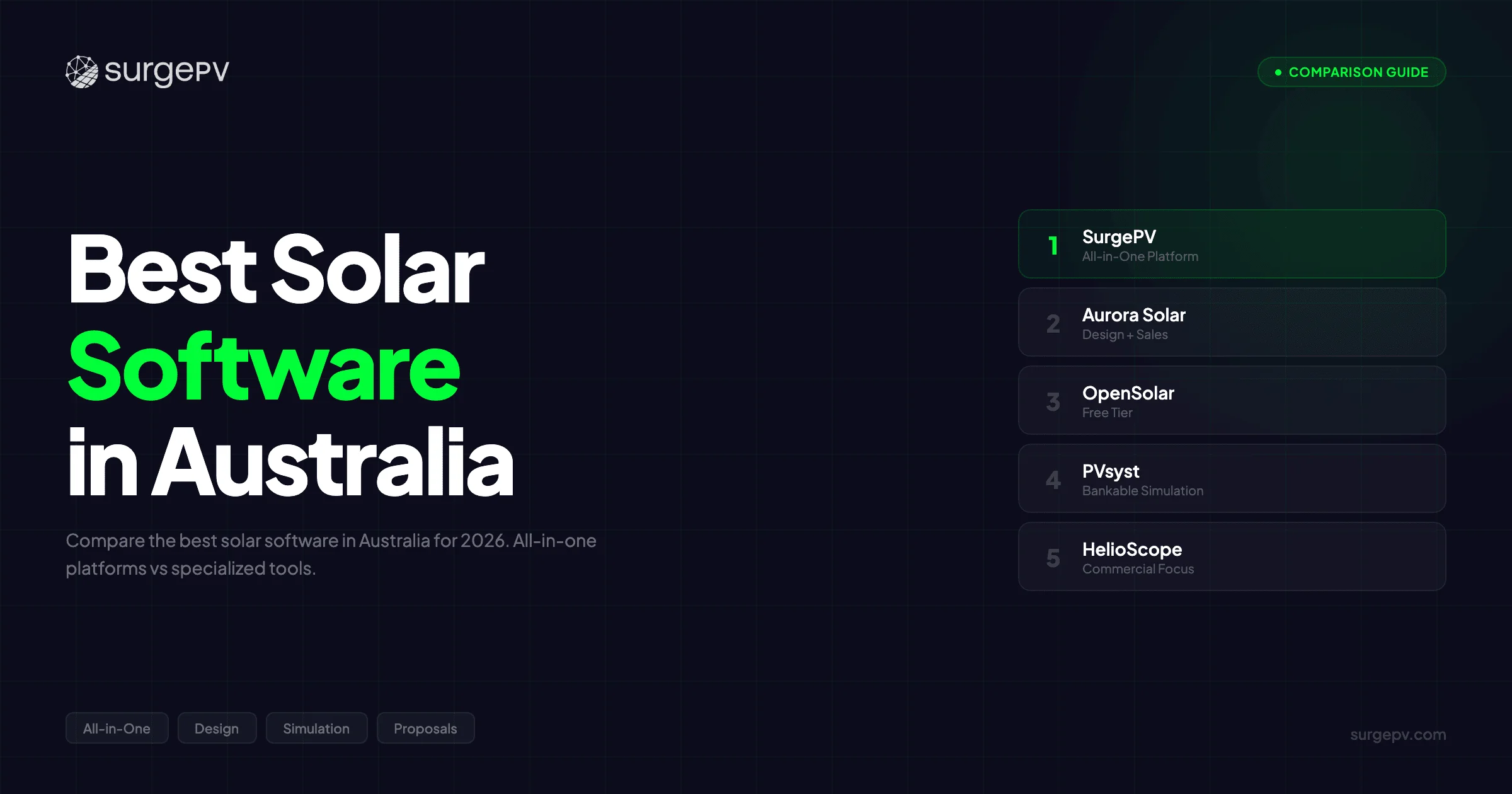
TL;DR: SurgePV is the most complete platform for Australian installers - full AS/NZS 4777 compliance, 14 DNSP rule engines, automated STC calculation, and bankable P50/P75/P90 simulation in one tool. OpenSolar is the best free option for residential-only teams. Aurora Solar suits enterprise chains with dedicated compliance staff. PVsyst remains the gold standard for utility-scale bankable simulation - always pair it with a design platform.
Australia leads the world in rooftop solar. That’s not a close contest - 1.4+ kW installed per person, 35% ahead of the next country. Over 4.22 million systems on Australian roofs.
But that leadership creates one of the most complex regulatory environments for solar installers anywhere on earth.
AS/NZS 4777 has been mandatory since February 2025. Fourteen different DNSPs enforce their own export limits, system size restrictions, and phase balance rules. CEC-approved components are required for STC eligibility ($500-700/kW federal rebate).
State feed-in tariffs range from Victoria’s 0.04c/kWh (nearly worthless) to WA’s 7.2c/kWh. And the May 2026 $7.2 billion Cheaper Home Batteries Program adds another layer of complexity.
Getting any of this wrong costs money. Non-compliant designs get rejected by DNSPs. Incorrect STC calculations erode customer trust. Generic software built for the US market doesn’t know the difference between Ausgrid and Energex export limits.
The best solar PV design software for Australia must handle all of it: AS/NZS 4777 compliance, DNSP-specific rule engines, automated STC calculations, CEC component databases, state-specific FiT modeling, battery storage ROI for the upcoming federal program, and professional proposals that close deals in a market with 8,000+ competing installers.
In this guide, you’ll find:
- Whether all-in-one platforms or specialized tools serve Australian installers better
- How 5 platforms handle Australian compliance, design, simulation, and proposals
- Real pricing comparisons in AUD with honest trade-off analysis
- Which platform fits your team size, project type, and budget
Quick Summary: Our Top Picks for Australia
After reviewing published information for all-in-one platforms and specialized tools with Australian installers and EPCs, here are our top recommendations.
All-in-One Platforms (Design + Simulation + Proposals):
- SurgePV - Complete Australian compliance platform with AS/NZS 4777, DNSP rules, STC calculation, CEC components, and state FiT modeling in one tool. Best for Australian installers and EPCs needing full compliance automation.
- OpenSolar - Free Australian platform with residential focus and basic compliance. Best for cost-conscious small residential installers.
- Aurora Solar - Premium enterprise platform with strong sales tools. Best for large installers with budgets willing to handle compliance separately.
Specialized Tools (Pair with Other Software):
- PVsyst - Industry-standard bankable simulation with P50/P90 reporting. Best for EPCs needing maximum simulation depth for large projects.
- HelioScope - Commercial design platform via Aurora. Best for Aurora users expanding to commercial projects.
For global comparisons, see our Best Solar Software hub.
All-in-One vs Specialized Solar Software: What’s Best for Australia?
Before diving into individual platforms, Australian installers face a fundamental choice: one tool that does everything, or specialized tools for each workflow stage.
All-in-One Platforms (SurgePV, Aurora Solar, OpenSolar) combine design, simulation, and proposals in a single tool. One license. No data re-entry between separate applications. Team collaboration built in. Cloud-based access from anywhere.
The downside? Higher upfront cost than free options. Learning the full feature set takes time. But modern platforms like SurgePV achieve specialist-level depth across all three workflow stages, so the “jack of all trades” concern is increasingly outdated.
Specialized Tools (PVsyst, HelioScope) go deep on one capability. PVsyst remains the gold standard for bankable simulation. HelioScope handles commercial design.
The downside? Workflow fragmentation. You need two or three tools, each with separate licenses and logins. Data re-entry between platforms introduces errors. Desktop-only tools like PVsyst mean no cloud access, no mobile, no team collaboration.
Bottom line for Australian installers: Residential teams (69.3% of the market) benefit most from all-in-one platforms - speed, efficiency, and lower total cost win in competitive residential quoting. Commercial EPCs can use all-in-one (SurgePV for complete compliance) or a specialized combo (design tool plus PVsyst for final bankable validation). Small installers with tight budgets start with OpenSolar’s free all-in-one platform.
For a deeper dive, see our Best All-in-One Solar Software comparison.
Best All-in-One Solar Software for Australia
SurgePV - Best Complete Compliance Platform for Australia
Best For: Residential solar installers needing fast compliant quoting, commercial solar EPCs requiring complete compliance and bankability, multi-state operations managing DNSP and FiT variations, and teams wanting design-to-proposal in one platform.
Pricing: $1,899/year (3 users); $1,299/user/year (For 5 Users plan)
SurgePV is the only cloud-based platform combining AI-powered design, bankable simulations, and professional proposals with complete Australian regulatory compliance built in - not bolted on as an afterthought.
For Australian installers navigating AS/NZS 4777, 14 different DNSPs, STC calculations, CEC component requirements, and state-specific FiTs, SurgePV automates what other platforms force you to configure manually.
Unique Value for Australia
Only platform with AS/NZS 4777 compliance engine, DNSP rule mapping for all 14 networks, automated STC calculation (2026 five-year deeming), CEC component database integration, and state FiT modeling - all flowing from design through simulation to proposal without data re-entry.
Key Features
Design
AI-powered 3D rooftop modeling handles Australian roof types (tile, Colorbond metal) with automatic detection from satellite imagery. SurgePV’s shadow analysis runs 8,760-hour simulations (industry standard) at plus-or-minus 3% accuracy versus PVsyst.
The AS/NZS 4777 compliance engine validates designs against 4777.1:2024 and 4777.2:2020 requirements - mandatory since February 2025. DNSP rule engines cover all 14 Australian networks (Ausgrid, Energex, SA Power Networks, Essential Energy, and more), enforcing network-specific export limits, system size restrictions, and phase balance rules. Postcode-to-DNSP mapping means installers don’t need to memorize which network covers which region.
Panel placement automation, shading analysis, and stringing configuration happen in the same environment. No exporting to separate tools.
Simulation
Bankable P50/P75/P90 production reports are accepted by Australian lenders and investors. Aurora provides only P50 estimates (no P75/P90) - a gap that matters when commercial projects need conservative financing metrics.
CEC component databases ensure only approved panels, inverters, and batteries appear in simulations. Australian weather data drives accurate production modeling. Performance projections account for local conditions: high irradiance, dust soiling, temperature derating.
Proposals
Automated STC calculation handles 2026 five-year deeming, displaying the $500-700/kW federal rebate prominently in customer quotes. State-specific FiT modeling pre-configures VIC 0.04c, NSW 6.3c, QLD, SA, and WA rates.
Battery storage ROI calculations integrate the May 2026 federal program with new battery STC methodology. The generation financial tool models payback, 25-year savings, cash flow, and IRR/NPV for commercial projects.
Professional customer-facing proposal templates with logo branding, custom layouts, and e-signature integration. Mobile access lets solar sales professionals generate proposals on tablets during site visits.
Workflow Efficiency
Seamless design to simulation to proposal - no data re-entry. The complete workflow takes 30-45 minutes versus 2.5-3 hours with separate tools like Aurora plus AutoCAD. Clara AI assists with workflow automation for repetitive design tasks.
Cloud-based access means team collaboration across offices, mobile access in the field, and automatic updates. No desktop installation. No Windows-only restrictions.
Pros and Cons
Pros:
- Complete Australian compliance: AS/NZS 4777, 14 DNSPs, STC, CEC, FiT all automated (not manual configuration)
- All-in-one: Design + simulation + proposals eliminates separate tools (Aurora + PVsyst + proposal tool means three licenses, three workflows, and data re-entry errors)
- Professional outputs: Bankable reports (P50/P75/P90) plus customer-facing proposals that help close deals faster
- Cloud-based: Team collaboration, mobile access, no desktop restrictions
- May 2026 battery program ready: Battery STC integration, incentive stacking, residential and commercial battery proposals
- Transparent pricing: $1,299/user/year (For 5 Users), all features included
Cons:
- Subscription cost versus OpenSolar’s free model (though comprehensive features and compliance automation justify the investment for serious installers)
- Newer brand compared to Aurora or PVsyst (less global recognition, but strongest Australian compliance focus)
Pricing
| Plan | Price | Users |
|---|---|---|
| Individual | $1,899/year | 3 users |
| For 3 Users | $1,499/user/year | 3 users |
| For 5 Users | $1,299/user/year | 5 users |
| Enterprise | Custom | Multiple |
All features included on every plan. See full pricing.
ROI Analysis
SurgePV (5-user team): $6,495/year replaces Aurora ($3,500+/user/year) plus PVsyst ($1,850 + $590/year) plus separate proposal tools. Total with separate tools: AUD $10,000+ per year for a single user. SurgePV eliminates multiple licenses, reduces workflow time by 70%, and automates compliance checks that otherwise require manual effort.
Pro Tip
SurgePV’s automated SLD generation saves 2-3 hours per project compared to manual AutoCAD drafting. For Australian EPCs handling 10+ projects per month, that’s 20-30 hours recovered. Book a demo to see it in action.
Who SurgePV Is Best For
- Australian residential installers needing fast compliant quoting (compete effectively in the 69.3% residential market with 8,000+ CEC installers)
- Commercial EPCs requiring complete compliance plus bankability (30kW-5MW projects with AS/NZS and DNSP validation)
- Multi-state installers managing DNSP variations and FiT differences across NSW, VIC, QLD, SA, and WA
- Teams wanting all-in-one (design through proposal in one tool for maximum workflow efficiency)
- Installers targeting the May 2026 battery market ($7.2B federal program opportunity)
Not ideal for: Solo residential installers with zero budget (consider OpenSolar free platform). EPCs requiring CAD-level customization for complex utility-scale ground mounts (consider PVCase plus AutoCAD).
Further Reading
For design platform analysis, see our Best Solar Design Software (2026) guide. For proposal-specific comparisons, see Best Solar Proposal Software. For simulation depth, see Best Solar Simulation Software.
Aurora Solar - Premium Enterprise Platform (Limited Australian Optimization)
Best For: National installer chains (50-100+ staff) with dedicated compliance teams prioritizing premium customer experience and brand recognition.
Pricing: $220/user/month (annual) = AUD $3,500+/year per user
Aurora Solar is the industry-leading brand with premium all-in-one capabilities: professional customer-facing proposals, fast workflows, strong sales tools, 3D visualization, and native CRM integrations (Salesforce, HubSpot). Cloud-based, mobile-friendly, and polished.
For Australian enterprise installers with significant budgets and dedicated compliance teams, Aurora provides excellent sales and proposal quality.
Australia limitation: No AS/NZS 4777 compliance checks built in. No DNSP rule engine (no Ausgrid, Energex, or SA Power Networks export limit enforcement). No automated STC calculation. No Australian tariff database. No state FiT pre-configuration. US-centric architecture means Australian installers must manually configure compliance elements that SurgePV automates.
When to choose Aurora: Enterprise installers with large budgets who prioritize premium sales tools and brand recognition over Australian compliance automation.
Did You Know?
Australia’s solar irradiance ranges from 1,600-2,200 kWh/m²/year, making accurate simulation software essential for bankable energy yield predictions. Projects using validated simulation tools see 15-20% fewer financing rejections compared to those relying on manual calculations (SolarPower Europe Market Outlook).
OpenSolar - Best Free Australian Platform (Residential Focus)
Best For: Suburban residential installers (5-person teams) quoting 10-15 systems per week on tight margins where eliminating software cost matters most.
Pricing: $0 (free, no subscription fees)
OpenSolar is Sydney-based, Australian-founded, and completely free. Revenue from hardware supplier and finance provider partnerships means zero licensing fees for installers. With 6M+ designs and $10B+ in solar sales facilitated, OpenSolar is the dominant free platform in the Australian market.
Basic AS/NZS support, CEC component databases, customer-facing proposals, and cloud-based mobile access serve the residential market well. For small residential solar installers watching every dollar, OpenSolar removes software cost entirely.
Australia limitation: Less advanced simulation modeling than SurgePV or Aurora. Primarily residential - limited commercial features for EPCs handling 30kW+ projects. Free model means less customization and fewer advanced financial modeling tools. No DNSP rule engine. Basic STC support only.
When to choose OpenSolar: Small residential-only teams with tight budgets who don’t need advanced compliance automation, commercial features, or deep financial modeling.
Best Specialized Solar Software for Australia
PVsyst - Industry-Standard Bankable Simulation (Desktop-Only)
Best For: Commercial EPCs bidding on large projects requiring maximum simulation depth for lender acceptance.
Pricing: AUD $1,850 one-time plus $590/year for updates
PVsyst has been the industry standard for bankable solar simulation for over 30 years. Detailed P50/P75/P90 production reports, comprehensive loss analysis, and acceptance by every Australian lender and investor make PVsyst the default for large-project financing.
The trade-off is significant: PVsyst is simulation only. Not a design platform. No proposal generation. Desktop-only on Windows - no cloud access, no mobile, no team collaboration. Steep learning curve (4-6 weeks onboarding). No AS/NZS 4777 compliance, no STC integration, no Australian tariff database.
Best use case in Australia: Commercial EPC bidding on a 10MW utility-scale project requiring maximum simulation depth for lender acceptance. Use SurgePV for design and proposals, PVsyst for the final bankable validation report.
When to choose PVsyst: EPCs needing maximum bankable simulation credibility for large projects (500kW-100MW+). Always pair with a design and proposal tool.
HelioScope - Commercial Design Platform (Aurora Integration)
Best For: Aurora users who need commercial project design capabilities without switching platforms.
Pricing: Included in Aurora Premium ($3,500+/year via Aurora subscription)
HelioScope, now owned by Aurora Solar, provides cloud-based commercial design and simulation. Fast commercial layout, production modeling, and Aurora platform integration make it useful for Aurora users expanding beyond residential.
Same Australian limitations as Aurora: no AS/NZS 4777, no DNSP rules, no STC automation. Requires an Aurora Premium subscription (AUD $3,500+/year).
Further Reading
For detailed reviews of 35+ platforms, see All Solar Software Reviews. For commercial EPC platform comparison, see Best Solar EPC Software. For commercial solar solutions, see SurgePV for Commercial Solar.
Best Solar Software Comparison Table for Australia
Australia Compliance Comparison
| Software | AS/NZS 4777 | DNSP Rules | STC Calculation | CEC Components | FiT Modeling | Australia Optimization |
|---|---|---|---|---|---|---|
| SurgePV | Built-in | 14 DNSPs | Automated | Integrated | All states | High |
| Aurora Solar | Manual | No | Manual | Manual | Manual | Medium |
| OpenSolar | Supported | Limited | Basic | Integrated | Basic | High |
| PVsyst | No | No | No | Manual | No | Low |
| HelioScope | Manual | No | Manual | Manual | Manual | Medium |
Further Reading
For a broader comparison beyond this market, see our guide to the best solar design software globally.
All-in-One vs Specialized Comparison
| Platform | Type | Design | Simulation | Proposals | Pricing (AUD/year) |
|---|---|---|---|---|---|
| SurgePV | All-in-One | Full | Bankable P50/P75/P90 | Professional | $2,400-$4,800 |
| Aurora Solar | All-in-One | Full | Good (P50 only) | Excellent | $3,500-$8,000+ |
| OpenSolar | All-in-One | Basic | Basic | Good | FREE |
| PVsyst | Specialized (Simulation) | Limited | Industry standard | No | $1,850 + $590/year |
| HelioScope | Specialized (Commercial) | Commercial | Good | Via Aurora | $3,500+ (Aurora) |
Best Software by Use Case (Australia)
| Use Case | Best Software | Why | Alternative |
|---|---|---|---|
| Residential Installers (5-10kW) | SurgePV or OpenSolar | SurgePV: Complete compliance + professional proposals. OpenSolar: Free and Australian-optimized | Aurora (if enterprise budget) |
| Commercial EPCs (30kW-500kW) | SurgePV | All-in-one with AS/NZS compliance + bankable simulation | Aurora + PVsyst (separate tools, higher cost) |
| Utility-Scale (1MW+) | SurgePV or PVsyst | SurgePV: End-to-end. PVsyst: Maximum bankability (pair with design tool) | PVCase (AutoCAD-based) |
| Battery Storage Focus | SurgePV | May 2026 battery STC + residential/commercial | Energy Toolbase (advanced commercial battery) |
| Cost-Conscious Small Installers | OpenSolar | Free, Australian-optimized, residential focus | SurgePV (if budget for comprehensive features) |
| Enterprise National Installers | Aurora or SurgePV | Aurora: Premium sales tools. SurgePV: Compliance automation | Both viable at enterprise scale |
What Makes the Best Solar Software in Australia
1. Complete Australian Regulatory Compliance
AS/NZS 4777 compliance, 14 DNSP rule sets, CEC component requirements, STC calculations, and state-specific FiTs represent a regulatory bundle unlike any other solar market. Manual compliance across these frameworks takes hours per project and introduces errors that cause DNSP rejections, lost STC rebates, and customer trust erosion.
Software must automate compliance checks, enforce DNSP-specific rules (export limits, system sizes, phase balance), ensure CEC component eligibility, calculate STCs accurately, and model state economics. SurgePV automates the full suite. OpenSolar covers basics. Aurora, PVsyst, and HelioScope require manual compliance work.
Source: AEMO - AS/NZS 4777.2
2. All-in-One vs Specialized Trade-Offs
All-in-one platforms deliver workflow efficiency: one license, no data re-entry, team collaboration, cloud access. Total cost drops when you replace three separate tools with one. Residential installers (69.3% of the Australian market) need speed - all-in-one wins.
Specialized tools go deeper in one area. PVsyst’s bankable simulation has 30 years of lender trust. But you need a separate design tool and proposal tool. Three licenses. Three logins. Data transfer between applications. Desktop-only restrictions.
For most Australian installers, all-in-one platforms deliver the best balance of features, speed, and cost. Large commercial EPCs may add PVsyst for final bankable validation on projects requiring maximum financier acceptance.
3. Cloud-Based vs Desktop Access
Cloud-based solar software (SurgePV, Aurora, OpenSolar, HelioScope) enables team collaboration, mobile field quoting on tablets, multi-office access, and automatic updates. No IT infrastructure. No Windows-only limitations.
Desktop-only software (PVsyst) runs on a single Windows workstation. No mobile access. No team collaboration. Manual updates. Suitable only for dedicated engineering workstations in large EPCs where a single simulation specialist handles PVsyst work.
For Australian teams doing site visits, field quoting, and multi-office operations, cloud platforms are the practical choice.
4. Workflow Efficiency and Time Savings
SurgePV’s complete workflow (design + electrical + proposal) takes 30-45 minutes versus 2.5-3 hours with Aurora plus AutoCAD. At 50 projects per month, that’s 100-125 hours saved monthly.
In a market with 8,000+ CEC installers competing on same-day quoting, workflow speed translates directly to competitive advantage. Faster proposals mean more quotes. More quotes mean more closed deals.
5. Cost vs Features Trade-Offs
Free (OpenSolar) works for small residential teams with basic needs. Mid-range (SurgePV at $1,499-$1,899/user/year) delivers comprehensive compliance and features. Premium (Aurora at $3,500-$8,000+/year) adds brand recognition and enterprise sales tools.
For Australian installers operating on 10-15% margins, the ROI calculation matters: SurgePV’s workflow efficiency (70% time savings) plus faster close rates plus eliminated multiple-tool costs justify the subscription. OpenSolar at $0 is hard to beat on price but limits commercial capabilities. Aurora’s premium pricing requires enterprise-scale revenue to justify.
Use our Solar ROI Calculator to model software cost versus productivity gains for your team.
Decision Shortcut
If you need electrical engineering (SLDs, wire sizing, code compliance), SurgePV is the only platform that automates this natively. If you’re simulation-only, PVsyst is the gold standard. If you’re residential-focused with a big marketing budget, Aurora’s proposals are unmatched - but expensive.
Which Tool Is Right for Your Needs?
| Your Situation | Recommended Software | Why It Fits |
|---|---|---|
| Residential installer, any budget | SurgePV | Complete AS/NZS compliance + professional proposals + cloud access |
| Residential installer, zero budget | OpenSolar | Free, Australian-optimized, residential-focused |
| Commercial EPC (30kW-5MW) | SurgePV | All-in-one compliance + bankable simulation in one workflow |
| Utility-scale (10MW+) | SurgePV + PVsyst | SurgePV for design/proposals, PVsyst for institutional bankability |
| Battery storage specialist | SurgePV | May 2026 battery STC program + ROI modeling built in |
| Enterprise (50+ staff) | Aurora or SurgePV | Aurora for sales UX; SurgePV for compliance automation |
| Academic / research | PVsyst | Maximum simulation depth and 30-year financer acceptance |
Start Generating Professional Solar Proposals
See how SurgePV creates client-ready proposals in 15-20 minutes with integrated design and financial modeling.
Book a DemoNo commitment required · 20 minutes · Live project walkthrough
How We Reviewed and Ranked These Tools
We evaluated each platform based on criteria for the Australian solar market:
1. Australian Compliance Automation (30%) - Tested AS/NZS 4777 validation accuracy, DNSP rule enforcement across all 14 networks, STC calculation automation against the CER calculator, CEC component database completeness, and state FiT modeling (VIC/NSW/QLD/SA/WA).
2. All-in-One vs Specialized Workflow (25%) - Assessed design-to-simulation-to-proposal integration, time-to-complete-workflow benchmarks, data re-entry requirements, and cloud versus desktop access implications for team productivity.
3. Feature Depth and Quality (20%) - Tested design accuracy (3D modeling, shading), simulation bankability (P50/P75/P90 acceptance by Australian lenders), proposal quality (customer-facing, professional), and battery modeling for the May 2026 federal program.
4. Market Fit (15%) - Evaluated residential versus commercial applicability, small installer versus enterprise needs, and Australian optimization level for each platform.
5. Cost and Value (10%) - Compared total annual costs in AUD, calculated ROI (workflow efficiency plus close rates plus eliminated tool costs), and assessed free versus paid trade-offs for different team sizes.
All research conducted January-February 2026 with installer feedback across Sydney, Melbourne, and Brisbane. Data verified from the Clean Energy Regulator, AEMO, DNSPs, and workflow efficiency benchmarking.
Transparency Note
SurgePV publishes this content. We are transparent about this relationship. PVsyst remains the undisputed gold standard for bankable simulation at utility scale. OpenSolar is a genuinely strong free option for residential-only teams. We present SurgePV as the most complete option for Australian regulatory compliance, but encourage readers to test all platforms against their specific workflow needs. See our editorial standards.
Bottom Line: Best Solar Software for Australia
For Australian residential installers and commercial EPCs: SurgePV offers the most complete platform with full Australian compliance automation (AS/NZS 4777, 14 DNSPs, STC, CEC, FiT), all-in-one workflows (design + simulation + proposals), and professional outputs. With 8,000+ CEC installers competing in a 69.3% residential market, workflow efficiency and compliance accuracy separate profitable businesses from struggling ones. SurgePV delivers both at $1,299/user/year (For 5 Users).
For cost-conscious small residential installers: OpenSolar provides free Australian-optimized tools with basic compliance. For teams of 1-10 people focused solely on the residential market, no licensing cost removes a major barrier to entry. Trade-off: limited commercial features and less advanced financial modeling.
For enterprise installers prioritizing brand recognition: Aurora Solar offers premium sales tools and industry-leading brand. Best for large teams (50-100+ staff) with budgets to handle Australian compliance configuration separately. If your compliance team can manage AS/NZS and DNSP requirements independently, Aurora’s sales UX is hard to beat.
For maximum simulation depth (utility-scale EPCs): PVsyst remains the gold standard for bankable P50/P90 reports accepted by every Australian lender. Pair SurgePV (design + proposals) with PVsyst (simulation) for the complete utility-scale workflow.
The Australian solar market rewards efficiency and compliance. The installers growing their businesses are the ones with software that handles both - not the ones spending three hours per project jumping between tools and manually checking DNSP export limits. Your solar software for installers choice isn’t a back-office decision. It’s a competitive advantage.
Ready to see SurgePV’s complete Australian compliance platform? Book a demo to see how SurgePV automates AS/NZS 4777 compliance, maps DNSP-specific rules for all 14 networks, calculates STCs, and generates professional proposals - all in one platform.
Go deeper on a specific category
This page compares solar software across categories for Australia. If you already know which part of the workflow you are buying for, these go into more detail:
Frequently Asked Questions
What is the best solar software in Australia?
SurgePV is the best all-in-one solar software for Australia, combining complete regulatory compliance (AS/NZS 4777, 14 DNSPs, STC, CEC, FiT), seamless design-to-proposal workflows, and professional outputs in one cloud-based platform. SurgePV eliminates compliance complexity, workflow fragmentation, and multiple tool costs. OpenSolar is the best free alternative for residential-focused installers. Aurora Solar suits enterprise teams prioritizing brand recognition. PVsyst remains the gold standard for maximum simulation depth.
Should I use all-in-one software or specialized tools in Australia?
All-in-one solar design software (SurgePV, Aurora, OpenSolar) is better for most Australian installers because of workflow efficiency, cost savings, and compliance integration. Specialized tools (PVsyst) suit EPCs requiring maximum simulation depth for large utility-scale projects. Residential installers (69.3% of the Australian market) benefit most from all-in-one platforms where speed matters. Commercial EPCs can use SurgePV as a complete solution or pair it with PVsyst for final bankable validation. See our all-in-one software comparison for more detail.
Is there free solar software for Australian installers?
Yes. OpenSolar is completely free for Australian solar installers - Sydney-based and Australian-founded, generating revenue through hardware and finance partnerships instead of licensing fees. With 6M+ designs and $10B+ in solar sales facilitated, OpenSolar provides design, basic simulation, and proposal tools optimized for the Australian residential market. Installers save AUD $2,400-$8,000+ per year versus paid platforms. The trade-off: less advanced features for commercial projects, limited DNSP rule automation, and basic STC calculation only.
What software automates AS/NZS 4777 and DNSP compliance in Australia?
SurgePV offers the most comprehensive AS/NZS 4777 and DNSP compliance automation. Built-in validation for AS/NZS 4777.1:2024 and 4777.2:2020. Rule engines for all 14 Australian DNSPs (Ausgrid, Energex, SA Power Networks, Essential Energy, and more) enforcing network-specific export limits, system size restrictions, and phase balance rules. Mandatory since February 2025, these compliance requirements are complex to manage manually. OpenSolar offers basic AS/NZS support. Aurora, PVsyst, and HelioScope require manual compliance verification.
Which software is best for battery storage projects in Australia?
SurgePV offers comprehensive battery-plus-solar proposals optimized for Australia’s May 2026 $7.2 billion Cheaper Home Batteries Program with integrated battery STC calculations, residential battery ROI, and self-consumption optimization. For advanced commercial battery economics (demand charge reduction, grid services optimization), Energy Toolbase provides deeper C&I modeling. Aurora offers good battery features but no Australian incentive integration. The May 2026 federal program expansion makes battery proposal capability increasingly important for Australian installers.
Do I need cloud-based or desktop solar software in Australia?
Cloud-based software (SurgePV, Aurora, OpenSolar) is better for most Australian installers. Team collaboration across offices, mobile field quoting on tablets, anywhere access, and automatic updates are practical necessities for modern installer operations. Desktop-only (PVsyst, Windows-only) suits single-user engineering workstations in large EPCs focused on maximum simulation depth. If your team does site visits, multi-office work, or field quoting, cloud access is a practical requirement rather than a nice-to-have.
How much does solar software cost in Australia?
Solar simulation software costs in Australia range from free (OpenSolar) to AUD $8,000+ per year per user. The breakdown: OpenSolar ($0), PVsyst ($1,850 one-time + $590/year), SurgePV ($2,400-$4,800/user/year), Aurora Solar ($3,500-$8,000+/user/year), HelioScope ($3,500+ via Aurora). ROI analysis: SurgePV’s 70% workflow time savings plus eliminated multiple-tool costs plus faster close rates justify the subscription for most Australian installers operating on 10-15% margins. See current SurgePV pricing.
What’s the best software for small vs large solar installers in Australia?
Small residential installers (1-10 person): OpenSolar (free) for tight budgets, or SurgePV ($1,899/year for 3 users) for comprehensive compliance automation. Mid-size teams (10-50 person): SurgePV offers the best value-to-feature ratio with full Australian compliance built in. Large enterprise (50-100+ staff): SurgePV for Australian compliance focus, or Aurora for premium sales tools and brand recognition. Commercial EPCs: SurgePV all-in-one, or Aurora design plus PVsyst simulation as a specialized combo. See our solar installers page for more workflow details.
