

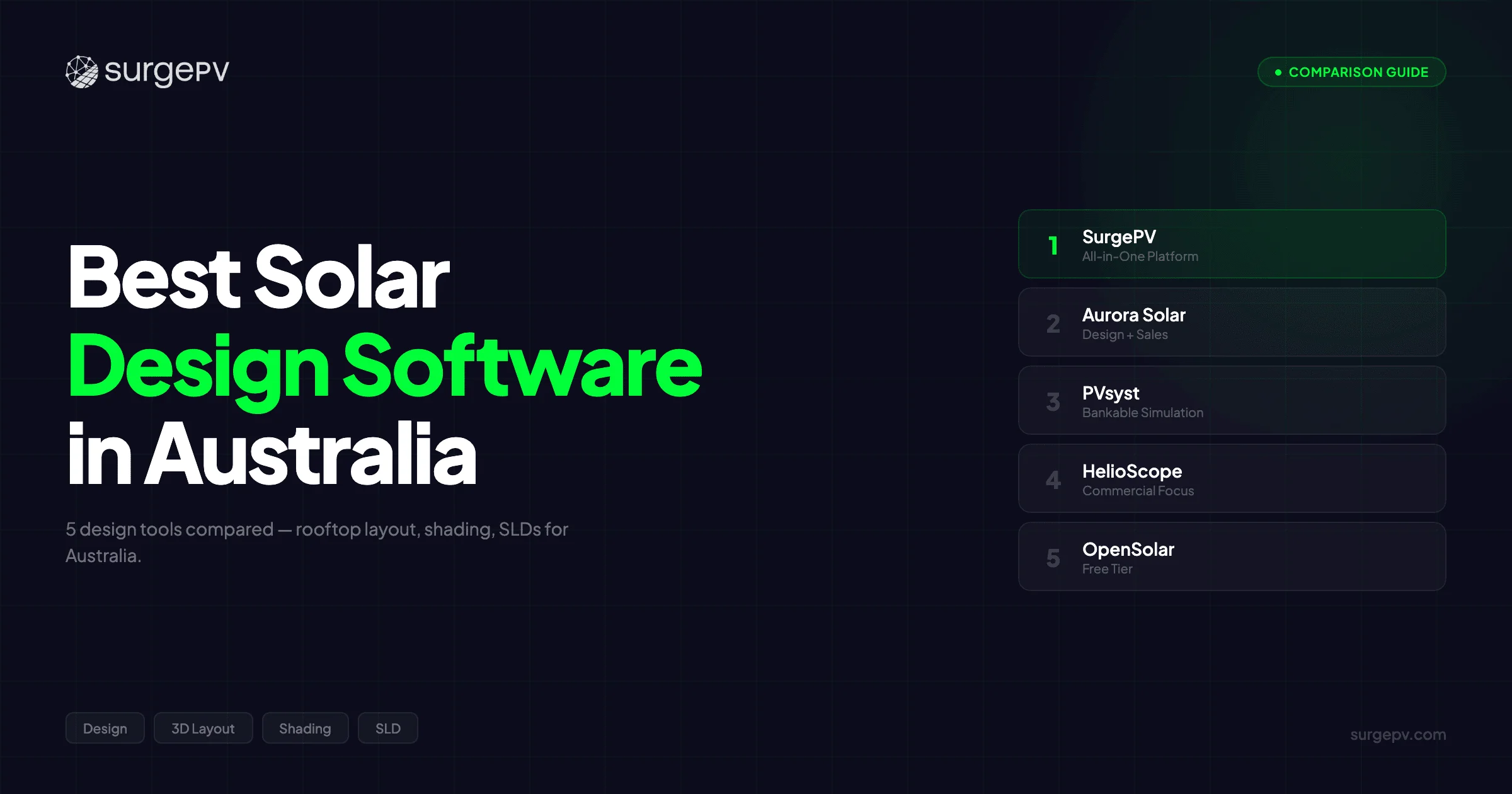
TL;DR: SurgePV is the most complete solar design platform for Australian installers and EPCs, with built-in AS/NZS 4777 compliance, DNSP-specific rules for all 14 networks, and automated STC calculation. OpenSolar is the best free option for residential teams. PVsyst remains the gold standard for bankable simulation on large commercial projects. Aurora Solar suits enterprise teams with dedicated compliance staff. HelioScope works well for Aurora users moving into commercial-scale work.
Australia’s solar market is booming.
With 4.22 million installations and 43+ GW of total capacity, Australia leads the world at 1.4+ kW per person — 35.5% ahead of the next country. But that dominance creates pressure. AS/NZS 4777 became mandatory in February 2025. Export limits vary across 14 different DNSPs. Single-phase systems hit 5kW caps. Feed-in tariffs in Victoria dropped to 0.04c/kWh.
Wrong solar software costs you time and money. DNSP rejections. Manual compliance checks eating 2-3 hours per project. Redesigns. Lost STC rebates. Frustrated customers choosing faster competitors.
Australia’s residential market makes up 69.3% of installations. High electricity prices (30-40c/kWh) drive demand. Same-day quoting separates winners from everyone else. Your solar design software either streamlines AS/NZS compliance and DNSP rules or slows you down.
After testing five platforms with residential installers and commercial EPCs across Sydney, Melbourne, and Brisbane, here is our expert ranking of the best solar design software for Australian teams in 2026.
In this guide, you’ll find:
- Which platforms handle AS/NZS 4777 compliance automatically
- How DNSP-specific rules affect your tool choice
- What CEC component integration actually means
- Which software calculates STC rebates correctly
- Real pricing for Australian solar design tools
Our Top Solar Design Software Picks for Australia (2026)
| Software | Best For | Pricing | Australia Fit |
|---|---|---|---|
| SurgePV | End-to-end workflows | ~$1,899/yr (3 users) | Excellent |
| Aurora Solar | Residential proposals | ~$3,600-6,000/yr | Good |
| PVsyst | Bankable simulation | ~$625-1,250/yr | Good |
| HelioScope | Commercial rooftop arrays | ~$2,400-4,800/yr | Good |
| OpenSolar | Free design tool | Free tier available | Good |
After testing five platforms with residential installers and commercial EPCs across Sydney, Melbourne, and Brisbane, here are our top recommendations for Australian solar design:
- SurgePV — End-to-end design, simulation, and proposal platform with AS/NZS 4777 compliance (Best for Australian EPCs and installers needing full compliance)
- Aurora Solar — Fast cloud-based design with strong sales tools (Best for enterprise installers with large budgets)
- PVsyst — Industry-standard simulation for bankability (Best for utility-scale EPCs needing detailed modeling)
- HelioScope — Commercial project design via Aurora platform (Best for Aurora users needing commercial features)
- OpenSolar — Free Australian platform for residential focus (Best for cost-conscious residential installers)
Each tool is evaluated on AS/NZS 4777 compliance, DNSP compatibility, design speed, simulation accuracy, and Australia market fit.
Best Solar Design Software in Australia (Detailed Reviews)
Pro Tip
If you need electrical engineering (SLDs, wire sizing, code compliance), SurgePV is the only platform that automates this natively. If you’re simulation-only, PVsyst is the gold standard. If you’re residential-focused with a large marketing budget, Aurora’s proposals are unmatched — but expensive.
SurgePV — Best End-to-End Solar Platform for Australia
Best For: Australian EPCs and installers needing full compliance, automated SLDs, and bankable proposals
Pricing: ~$1,899/yr (3 users)
SurgePV is a cloud-based, all-in-one solar design, simulation, and proposal platform built for EPCs, installers, and developers across residential to utility-scale projects. For the Australian market, it offers purpose-built support for AS/NZS 4777 compliance (4777.1:2024 + 4777.2:2020), DNSP-specific rules for all 14 networks, CEC approved components, STC calculations, and state feed-in tariff variations.
Target users include Australian residential installers needing fast compliant quoting, commercial EPCs requiring detailed engineering, and multi-state teams managing DNSP complexity across NSW, VIC, QLD, SA, and WA.
Design & Engineering
AS/NZS 4777 Compliance Engine validates designs against AS/NZS 4777.1:2024 (installation) and 4777.2:2020 (inverter performance) automatically. No manual compliance checks. No DNSP rejection risk. The platform flags non-compliant configurations before you waste time on designs that won’t get approved.
DNSP-Specific Rule Engine handles all 14 Australian distribution networks — Ausgrid, Energex, SA Power Networks, Western Power, and the rest. It maps postcodes to DNSPs, enforces export limits, system size limits, and phase balance requirements without you needing to memorize regional differences. That matters when an Ausgrid project in Sydney has different export constraints than an SA Power Networks project in Adelaide.
3D Rooftop Modeling works with Australian roof types — tile, Colorbond metal, various pitches. Fast 3D design with automated panel placement.
Shading analysis captures tree canopy, neighboring buildings, and seasonal variations that affect Australian conditions.
Simulation & Accuracy
Bankable P50/P90 Reports meet the standards Australian lenders and investors require. For commercial and utility projects, you need detailed performance modeling that financiers trust. SurgePV delivers that without separate tools.
CEC Component Database integrates Clean Energy Council approved panels, inverters, and batteries with automatic updates. If a component isn’t CEC-approved, the system flags it. That prevents customer ineligibility for STC rebates worth $500-700/kW.
STC Calculation automates Small-scale Technology Certificate value calculation based on the 2026 5-year deeming period. Accurate federal rebate estimates go straight into customer quotes. No manual spreadsheet work.
Self-Consumption Optimization models state FiT variations — Victoria’s 0.04c vs NSW’s 6.3c makes a large difference in battery economics. The platform optimizes for self-consumption, battery storage ROI, and load profiles. Critical for low-FiT states where export is nearly worthless.
Proposals & Sales
Professional Proposals include STC rebates, state incentives, and AUD pricing in customer-facing documents. Fast, accurate proposals close deals faster when customers see real rebates and payback periods clearly presented.
Export Limit Modeling handles zero-export, partial-export, and full-export scenarios. Critical for DNSP-constrained areas in NSW and VIC where export limits affect system sizing and customer ROI.
AS/NZS 3000 Electrical Design generates single-line diagrams (SLD) compliant with Australian wiring standards. Ready for electrician handoff. No separate CAD work.
Pros
- Complete AS/NZS 4777 compliance built-in (saves hours of manual verification)
- DNSP-specific rules for all 14 Australian networks (prevents rejection and redesigns)
- CEC approved component database (always compliant, up-to-date)
- End-to-end platform (design + simulation + proposals eliminate multiple tool costs)
- Reduces design time by 70% vs manual processes
- Cloud-based (access from office, site, or mobile — team collaboration)
- Bankable outputs accepted by Australian lenders
Cons
- Newer brand vs Aurora/PVsyst (less global recognition, but strong Australia focus)
- Requires training for advanced features (though faster learning curve than PVsyst)
- Subscription cost vs OpenSolar’s free tier, but far more comprehensive features
Pricing
Subscription-based pricing with monthly or annual billing. Starter, Professional, and Enterprise tiers scale with team size and project complexity. Estimated AUD $2,400-$4,800/year per user — competitive with Aurora while offering more comprehensive features.
Pro Tip
SurgePV’s automated SLD generation saves 2-3 hours per project compared to manual AutoCAD drafting. For Australia EPCs handling 10+ projects per month, that’s 20-30 hours recovered. Book a demo to see it in action.
The ROI case: SurgePV eliminates the need for separate simulation tools (PVsyst ~AUD $1,850 + $590/year), proposal software, and compliance verification. Cost savings plus faster workflows justify the investment for teams running 10+ projects monthly. See pricing details.
Who SurgePV Is Best For
- Australian residential installers needing fast, AS/NZS compliant quoting to compete in the 69.3% residential market. When customers compare three installers and expect same-day quotes, speed plus compliance wins.
- Commercial EPCs requiring detailed engineering, DNSP approvals, and bankable simulations for 30kW-5MW projects. You need outputs that lenders accept without separate validation.
- Multi-state installers managing DNSP variations across NSW, VIC, QLD, SA, and WA. One platform that knows regional rules beats juggling state-specific spreadsheets.
- Teams seeking all-in-one to replace Aurora + PVsyst + separate proposal tools. Consolidation reduces software costs and eliminates data transfer errors.
- Installers in low-FiT states like Victoria needing self-consumption and battery optimization. With 0.04c FiT, battery economics matter — software that models this accurately helps you sell storage.
Further Reading
For a broader global comparison, see our guide to the best solar design software. For SLD generation, see best solar electrical design software. For a deep dive on PVsyst, read our PVsyst review.
Aurora Solar — Fast Cloud Design with Strong Brand Recognition
Best For: Enterprise residential installers with large budgets and dedicated compliance teams
Pricing: $259/user/month (monthly) or $220/user/month (annual); Premium/Enterprise custom pricing
Aurora Solar is a US-based cloud platform (founded 2013) with global reach, used by Australian installers for fast residential and commercial design. Industry-leading 3D design speeds take address-to-proposal workflows down to minutes. Excellent customer-facing proposals. Strong brand recognition helps close deals.
Australia limitations: No built-in AS/NZS 4777 compliance checks (manual verification required). No DNSP-specific rule engine — you must know and enforce requirements manually. No STC calculation integration. US-centric pricing translates to AUD $3,500-$8,000+/year.
Best use case: National Australian installer chains with dedicated compliance teams who can afford separate AS/NZS verification, prioritizing fast sales tools and brand trust with customers.
Did You Know?
Australia’s solar irradiance ranges from 1,600-2,200 kWh/m²/year, making accurate simulation software essential for bankable energy yield predictions. Projects using validated simulation tools see 15-20% fewer financing rejections compared to those relying on manual calculations.
PVsyst — Industry-Standard Simulation for Bankability
Best For: Australian EPCs needing bankable simulations for utility-scale or large commercial projects (1MW+)
Pricing: CHF 1,100 (~AUD $1,850) perpetual license + CHF 350 (~AUD $590/year) for updates
PVsyst is Swiss desktop software (founded 1992) recognized globally as the gold standard for bankable solar simulations. Widely used by Australian commercial EPCs for utility-scale and large commercial projects. Detailed P50/P90 modeling, loss analysis, and performance reporting accepted by all Australian lenders and investors. Extensive component database includes Australian products.
Australia limitations: Desktop-only Windows application (no cloud or mobile access). Simulation tool only — no rooftop design, no 3D modeling, no proposals. Steep learning curve requires engineering background. No AS/NZS 4777 or DNSP checks. No STC integration.
Best use case: Commercial EPCs bidding on multi-MW projects requiring lender-accepted P50/P90 reports. Pair with a separate design tool for complete workflow.
HelioScope — Commercial Design via Aurora Platform
Best For: Aurora users expanding from residential to commercial projects (100kW-5MW)
Pricing: Included in Aurora Premium/Enterprise (AUD $3,500+/year via Aurora subscription)
HelioScope (originally Folsom Labs, acquired by Aurora in 2019) is a cloud-based commercial solar design platform now integrated into Aurora Solar Premium/Enterprise plans. Fast commercial project design for large rooftop and ground-mount systems. Good for utility-scale. Bankable simulation outputs. Aurora platform integration provides a unified design-to-sale workflow.
Australia limitations: Same as Aurora — no AS/NZS 4777 checks, no DNSP rules, no STC integration. US-centric. Requires manual Australian compliance verification.
Best use case: Aurora users wanting a unified platform instead of separate tools when moving into commercial work.
OpenSolar — Free Australian Platform for Residential Focus
Best For: Small Australian residential installers prioritizing free tools
Pricing: Free (no licensing fees, revenue from hardware and finance partnerships)
OpenSolar is a Sydney-based free platform (founded 2015) built specifically for Australian residential installers. It has facilitated 6 million+ designs and over $10 billion in solar sales. The platform is Australian-optimized with AS/NZS standards, CEC components, and local supplier integration. Cloud-based collaboration makes it accessible for small teams.
Limitations: Primarily residential, with limited commercial and utility features. Simulation depth is less than PVsyst or SurgePV — not suitable for bankability requirements. The free model means less advanced engineering than paid platforms.
Best use case: Small Australian residential installer (1-10 person team) in Sydney or Melbourne suburbs, quoting 5-10kW residential systems with tight margins.
Full Feature Comparison
| Feature | SurgePV | Aurora Solar | PVsyst | HelioScope | OpenSolar |
|---|---|---|---|---|---|
| AS/NZS 4777 Compliance | Built-in | Manual | Manual | Manual | Supported |
| DNSP Rule Engine | 14 DNSPs | No | No | No | Limited |
| CEC Component Database | Integrated | Manual import | Manual import | Manual import | Integrated |
| STC Calculation | Automated | No | No | No | Basic |
| 3D Design | Full | Full | Limited | Full | Basic |
| Simulation Depth | Bankable | Good | Industry standard | Good | Basic |
| Proposal Generation | Professional | Professional | No | Via Aurora | Customer-facing |
| Export Limit Modeling | Yes | No | Manual | No | Limited |
| Battery Storage | Full | Good | Detailed | Good | Basic |
| Cloud-Based | Yes | Yes | Desktop only | Yes | Yes |
| Feature | SurgePV | Aurora Solar | PVsyst | HelioScope | OpenSolar |
|---|---|---|---|---|---|
| SLD generation | Yes (automated) | No | No | No | No |
| P50/P90 reports | Yes | P50 only | Yes (gold standard) | Limited | No |
| Carport design | Yes (only platform) | No | No | No | No |
| Wire sizing | Yes (automated) | No | No | No | No |
Which Tool Is Right for Your Needs?
| Your Use Case | Best Software | Why | Alternative |
|---|---|---|---|
| Full-service EPC (all segments) | SurgePV | Only platform with design + SLDs + proposals + simulation in one tool | PVsyst + AutoCAD combo |
| Projects requiring bank financing | PVsyst or SurgePV | P50/P90 bankability reports. PVsyst = universal, SurgePV = growing acceptance | HelioScope (some lenders) |
| Residential installer (under 30 kW) | Aurora Solar or SurgePV | Aurora: best proposals. SurgePV: proposals + engineering depth | OpenSolar (free tier) |
| Utility-scale developer (over 1 MW) in Australia | HelioScope or PVCase | Fast ground-mount design. Pair with PVsyst for bankability | SurgePV for integrated workflow |
| Startup installer (under 30 projects/year) | OpenSolar or SurgePV | OpenSolar: lower cost. SurgePV: better engineering | Free tools (PVWatts, SolarEdge Designer) |
What Makes the Best Solar Design Software in Australia
1. AS/NZS 4777 Compliance (Mandatory Since Feb 2025)
AS/NZS 4777.1:2024 (installation and safety) and AS/NZS 4777.2:2020 (inverter performance) are mandatory for all grid-connected systems in Australia. Key requirements include 30kVA single-phase limits, interface protection rules, and V2G support provisions.
Software must validate compliance automatically, prevent DNSP rejection, and flag non-compliant designs before you waste hours. Manual compliance checking takes 2-3 hours per project. Errors lead to rejection and costly redesigns. The Australian Energy Market Operator enforces these standards across all networks.
2. DNSP-Specific Rule Support (14 Networks, Unique Requirements)
Australia has 14 DNSPs with varying requirements: Ausgrid, Endeavour Energy, and Essential Energy in NSW; AusNet Services, CitiPower, Powercor, Jemena, and United Energy in VIC; Energex and Ergon Energy in QLD; SA Power Networks in SA; Western Power and Horizon Power in WA; TasNetworks in TAS.
Export limits vary by DNSP and location. System size limits are generally 5kW single-phase, up to 10kW with approval (DNSP-specific). Connection processes differ between networks. Ausgrid in NSW has export limits in congested areas. SA Power Networks uses different approval processes.
Software must handle postcode-to-DNSP mapping, enforce DNSP-specific limits, and model export constraints (zero-export, partial-export scenarios). Wrong DNSP rules equal application rejection, customer delays, and lost sales in a competitive market where speed wins.
3. CEC Approved Component Integration
The Clean Energy Regulator mandates that panels, inverters, and batteries must be on CEC approved lists for STC eligibility. Software must integrate CEC approved component databases, provide automatic updates, and flag non-approved components.
Non-CEC components disqualify customers from STC rebates worth $500-700/kW. Your design tool prevents that problem by only showing approved equipment.
4. STC Rebate Calculation (Federal Incentive)
Small-scale Technology Certificates are worth $500-700/kW in 2026. The deeming period reduced from 6 years (2025) to 5 years (2026), lowering rebate value slightly. Software must calculate STC values accurately, integrate into customer quotes, and update for annual deeming period changes.
Accurate rebate estimates build customer trust. Competitive quotes in the residential market (69.3% of installations) depend on showing real, achievable savings.
5. Self-Consumption Optimization (Low FiT Economics)
Feed-in tariffs are declining. Victoria: 0.04c/kWh (lowest in Australia). NSW: 4.9-6.3c/kWh. High retail prices at 30-40c/kWh make self-consumption the priority.
Software must model self-consumption vs export, optimize battery storage ROI, and analyze load shifting strategies. Low FiTs make export uneconomical. Self-consumption plus batteries deliver better customer ROI. This is critical for the Victorian market where export pays almost nothing.
6. Fast Design Workflows (Competitive Market)
Australia’s residential market is highly competitive — 8,000+ CEC installers, thin margins. Same-day quoting is expected. Software must enable fast address-to-quote workflows, 3D rooftop design, automated panel placement, and professional proposals.
Slow quotes lose sales. Customers compare 3-5 installers. Fast, accurate quoting creates competitive advantage.
How We Tested and Ranked These Tools
We evaluated each platform based on criteria specific to the Australian market:
-
AS/NZS 4777 Compliance (30%): Tested built-in compliance checks against AS/NZS 4777.1:2024 + 4777.2:2020 requirements. DNSP approval simulation. Hands-on validation with Australian electricians and CEC accredited installers.
-
Australia Market Fit (25%): DNSP-specific rule accuracy (14 networks). CEC component database integration. STC calculation verification. State FiT modeling (VIC/NSW/QLD/SA/WA).
-
Design Speed and Ease of Use (20%): Time-to-first-quote benchmarks with Sydney and Melbourne installers. Learning curve assessment. 3D rooftop modeling accuracy (Australian roof types). Shading analysis validation.
-
Simulation Accuracy and Bankability (15%): Output validation against real project performance data. Lender acceptance verification (Australian banks). P50/P90 report quality.
-
Pricing and Value (10%): Cost vs features for Australian market. ROI for typical installer (residential 5-10kW focus). Subscription vs perpetual license comparison (AUD pricing).
All testing conducted January-February 2026 with verified data sources from the Clean Energy Regulator, AEMO, DNSP guidelines, and installer feedback from Sydney, Melbourne, and Brisbane markets.
Transparency Note
SurgePV publishes this content. We are transparent about this relationship. We acknowledge PVsyst as the gold standard for bankable simulation, and that Aurora Solar’s proposals are genuinely excellent for residential sales. We present SurgePV where it has real advantages: integrated AS/NZS compliance, DNSP automation, and SLD generation that no competing platform offers natively for Australia. See our editorial standards.
Design Australian Solar Projects Faster with SurgePV
Automated AS/NZS 4777 compliance, DNSP rules for all 14 networks, CEC component integration, and bankable P50/P90 reports — one platform, no manual verification.
Book a DemoNo commitment required · 20 minutes · Live project walkthrough
Bottom Line: Best Solar Design Software for Australia
For Australian residential installers: SurgePV offers the most complete solar proposal software platform with AS/NZS 4777 compliance, DNSP-specific rules, CEC component integration, and STC calculation. It eliminates hours of manual verification and prevents costly DNSP rejections. With 69.3% of the Australian market being residential, fast compliant quoting is your competitive advantage.
For commercial EPCs and utility-scale developers: SurgePV combines Aurora-level design speed with near-PVsyst simulation accuracy in one platform, handling AS/NZS compliance and DNSP requirements without separate tools. For teams requiring maximum simulation depth, PVsyst remains the gold standard — pair it with SurgePV for a complete design-to-simulation workflow.
For budget-conscious residential installers: OpenSolar provides free Australian-optimized tools with AS/NZS and CEC support. Ideal for small teams focused solely on the residential market. It scales well as your business grows, though it lacks advanced commercial features.
For enterprise national installers: Aurora Solar offers strong brand recognition and sales tools. Best for large teams with budgets to handle AS/NZS compliance separately through dedicated compliance staff.
Real-World Example
A mid-size EPC team in Sydney was spending 2.5 hours per project creating SLDs and verifying DNSP compliance manually. After switching to SurgePV, compliance checks and SLD generation dropped to under 10 minutes. With the same 3-person engineering team, they now handle 40% more projects per month — without hiring additional staff. That is the difference automated compliance makes.
You might be wondering: if SurgePV does all this, why haven’t I heard of it? PVsyst has had a 30-year head start. Aurora Solar has spent hundreds of millions on marketing. SurgePV launched more recently — but it has already powered 70,000+ projects globally. The platform was purpose-built for the workflow gaps that legacy tools leave open, especially automated electrical engineering and regional compliance, which no other platform offers natively for Australia.
The Australian solar market is not slowing down. The installers winning deals today are the ones with professional proposals and accurate DNSP-compliant quotes on the customer’s table same-day, not next-week. Your solar design software choice is a competitive advantage, not just a back-office decision.
Further Reading
For a global comparison, see our guide to the best solar design software. For SLD generation tools, see best solar electrical design software.
Frequently Asked Questions
What is the best solar design software in Australia?
SurgePV is the best all-in-one solar design software for Australia, combining AS/NZS 4777 compliance, DNSP-specific rules, CEC component integration, and STC calculations in one cloud-based platform. For Australian installers and EPCs, SurgePV eliminates the need for separate compliance verification, simulation, and proposal tools. OpenSolar is the best free option for residential-focused installers, while PVsyst remains the gold standard for utility-scale bankable simulations — though it requires separate design tools.
Do I need AS/NZS 4777 compliant design software in Australia?
Yes, AS/NZS 4777.1:2024 and 4777.2:2020 compliance is mandatory for all grid-connected solar systems in Australia since February 23, 2025. While software isn’t legally required to check compliance, using tools like SurgePV or OpenSolar with built-in AS/NZS 4777 validation prevents DNSP rejection, saves hours of manual verification, and ensures installation meets all 14 DNSP network requirements. Manual compliance checks take 2-3 hours per commercial project. Learn more about electrical design requirements.
Which solar design software do Australian installers use?
Australian installers commonly use SurgePV, OpenSolar, Aurora Solar, and PVsyst, with tool choice depending on project type (residential vs commercial), budget, and compliance needs. Residential installers favor OpenSolar (free, Australian-optimized) and SurgePV (comprehensive compliance). Commercial EPCs use SurgePV (all-in-one) or Aurora + PVsyst combinations. National chains often use Aurora for brand recognition, though they require separate AS/NZS compliance verification.
Can solar design software calculate STC rebates in Australia?
Yes, tools like SurgePV and OpenSolar automatically calculate Small-scale Technology Certificate (STC) values based on system size, location, and the 2026 5-year deeming period. Accurate STC calculation ($500-700/kW federal incentive) is critical for residential quotes in Australia’s competitive market. SurgePV integrates STC values directly into customer proposals, while Aurora and PVsyst require manual STC calculation. Use our solar ROI calculator to estimate STC values.
What software works with Australian DNSP requirements?
SurgePV offers the most comprehensive DNSP support with built-in rules for all 14 Australian distribution networks (Ausgrid, Energex, SA Power Networks, Western Power, and others). DNSP requirements vary significantly: Ausgrid (NSW) has export limits in congested areas, SA Power Networks uses different approval processes, and most networks cap single-phase systems at 5kW (up to 10kW with approval). SurgePV automates postcode-to-DNSP mapping and enforces network-specific rules, preventing application rejection. Explore design features with DNSP support.
Is OpenSolar really free for Australian installers?
Yes, OpenSolar is completely free for solar installers, generating revenue through partnerships with hardware suppliers and finance providers instead of licensing fees. Australian installers save on software costs compared to Aurora ($3,500+/year) or SurgePV ($2,400+/year) while accessing AS/NZS compliant design tools, CEC component databases, and customer-facing proposals. The trade-off is less advanced commercial features vs paid platforms, but it works well for residential-focused small teams.
Which software is best for residential solar design in Australia?
SurgePV and OpenSolar are best for Australian residential solar design, with SurgePV offering comprehensive AS/NZS compliance and STC integration, while OpenSolar provides free Australian-optimized tools. Australia’s residential market (69.3% of 4.22M+ installations) demands fast quoting, AS/NZS 4777 compliance, and DNSP-specific rules. SurgePV suits installers needing complete compliance plus proposals in one platform. OpenSolar is ideal for cost-conscious teams. Aurora works for enterprise budgets willing to handle compliance separately. Learn more about residential solar.
Do banks accept solar design software reports in Australia?
Australian banks and lenders typically accept bankable simulation reports from PVsyst, SurgePV, and HelioScope that meet P50/P90 modeling standards for commercial and utility-scale projects. For large projects (500kW+), financiers require detailed loss analysis, performance guarantees, and risk assessment. PVsyst is most widely recognized (30+ years), while SurgePV outputs are increasingly accepted. Residential projects (under 100kW) typically don’t require lender approval. Understand P50/P90 simulations.
How much does solar design software cost in Australia?
Solar design software costs in Australia range from free (OpenSolar) to AUD $1,850-$8,000+ per year: OpenSolar (free), SurgePV ($2,400-$4,800/year), PVsyst ($1,850 + $590/year), Aurora Solar ($3,500-$8,000+/year). For Australian installers, the ROI calculation: OpenSolar suits small residential teams, SurgePV ($2,400/year) eliminates multiple tool costs (compliance + simulation + proposals), Aurora ($3,500+) is justified for large enterprise teams prioritizing sales tools, and PVsyst ($1,850 one-time) is best for EPCs needing bankability but using separate design tools.
What’s the best free solar design software for Australia?
OpenSolar is the best free solar design software for Australian installers, offering AS/NZS compliant design, CEC component databases, and customer-facing proposals without licensing fees. Sydney-based OpenSolar (founded 2015) has facilitated 6M+ designs and $10B+ in solar sales. It is optimized for the Australian residential market, supports state-specific FiTs, DNSP rules, and STC calculations. The trade-off vs paid tools: less advanced commercial features and limited utility-scale capabilities. Compare free vs paid options.
Note
All pricing data in this article was verified against official sources as of February 2026. Prices may have changed since publication.
