Quick Answer
A small roof under 20 m² changes the math on residential solar. With limited area, every watt of capacity per square meter matters, and the wrong panel choice or layout can leave 30% of potential output on the table. Common design mistakes that cost 20%+ in annual yield 10. Ridge clearance, eave clearance, side margins for firefighter access Roof obstructions. 10-15%.
A small roof under 20 m² changes the math on residential solar. With limited area, every watt of capacity per square meter matters, and the wrong panel choice or layout can leave 30% of potential output on the table. This guide walks through small roof solar panel design from area calculation to final kWh estimate, covering panel selection, layout density, inverter strategy, tilt optimization, and shading mitigation. The goal is simple: extract the maximum annual energy yield from a constrained roof using proven solar design platform and a methodical engineering approach.
A small roof under 20 m² changes the math on residential solar. With limited area, every watt of capacity per square meter matters, and the wrong panel choice or layout can leave 30% of potential output on the table. Common design mistakes that cost 20%+ in annual yield 10.
TL;DR — Small Roof Solar Design
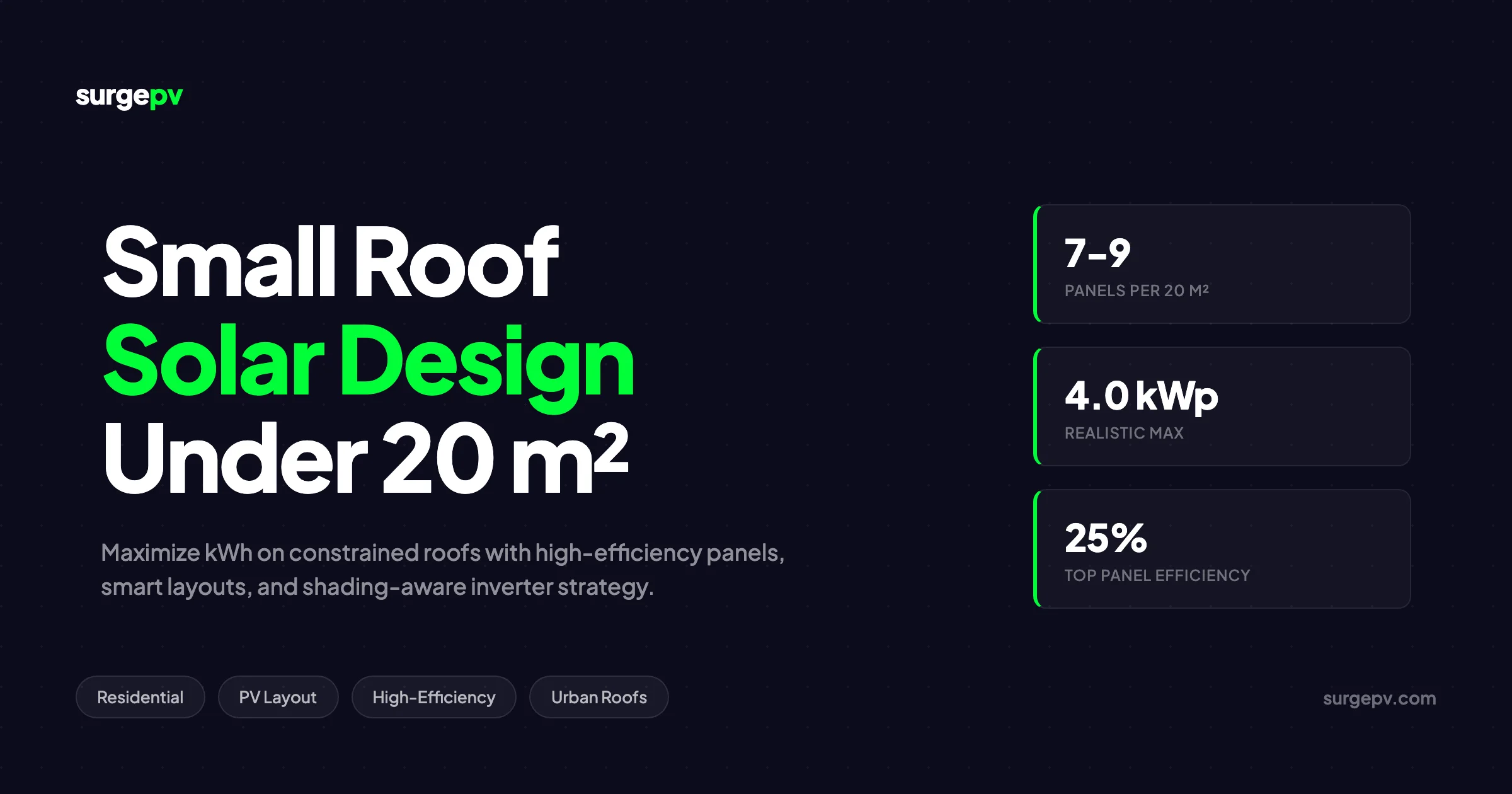
A typical 20 m² roof fits 7-9 high-efficiency panels for a 3.0-4.0 kWp system, producing 2,800-5,500 kWh per year depending on climate. Maximize output with 22-25% efficient N-type panels, portrait-orientation layout, microinverters or DC optimizers for shading resilience, and tilt within 5° of latitude. The single biggest design mistake is choosing low-cost 380 W panels — they leave 15-25% of potential capacity unused on a space-constrained roof.
What this guide covers:
- What counts as a small roof and how to measure usable area
- How many solar panels actually fit on 20 m²
- High-efficiency panel selection for maximum watts per square meter
- Layout strategies that compress capacity into tight spaces
- Inverter and module-level electronics for small arrays
- Tilt and azimuth optimization on constrained roofs
- Shading mitigation when every panel matters
- Real kWh output numbers by climate zone
- Common design mistakes that cost 20%+ in annual yield
- A worked example for an 18 m² roof in London Also see: Us Residential Solar Market Trends 2026.
What “Small Roof” Means in Solar Design
A small roof in residential solar typically means usable PV area below 25 m². This category covers terraced houses, semi-detached homes, urban townhouses, mews properties, and homes with multiple roof faces where any single face is small. The defining constraint is not total roof area but contiguous usable area on a single plane after deducting setbacks, vents, and access requirements.
Usable area rarely matches the gross roof footprint. Three deductions reduce the available space:
| Deduction | Typical Loss | Reason |
|---|---|---|
| Fire-code setbacks | 15-25% | Ridge clearance, eave clearance, side margins for firefighter access |
| Roof obstructions | 10-15% | Chimneys, vents, skylights, dormers, satellite dishes |
| Access pathways | 5-10% | Maintenance walkways between array sections |
| Total reduction | 30-50% | From gross roof area to net usable PV area |
A roof that measures 30 m² gross often delivers only 20-22 m² of usable PV space. This is why “I have a 20 m² roof” usually means closer to 14-16 m² of installable area in practice.
The physics of a small roof favor density over flexibility. On a large roof, a designer can move panels around shading, leave gaps for air circulation, or split the array across multiple orientations. On a small roof, every square meter must work hard, and the design process tightens around three priorities: maximum watts per square meter, minimum spacing losses, and panel-level resilience to partial shading.
Pro Tip
Before specifying any equipment, run an aerial scan or shadow analysis on the actual roof. A 20 m² roof in a dense suburban setting often has only 12-14 m² of unshaded usable area between 9 a.m. and 3 p.m. solar window. Designing on the gross figure leads to oversized strings and underwhelming production.
How Many Solar Panels Fit on 20 m²?
The standard residential panel in 2026 measures roughly 1.72 m × 1.13 m, an area of 1.95 m² per panel. At 440 W, that is 226 W per square meter at the panel level. The maths is straightforward: 20 m² of usable area divided by 1.95 m² per panel suggests 10 panels. Reality lands lower because of layout overhead.
Real-world fit on a 20 m² south-facing roof:
| Panel Wattage | Panel Area | Theoretical Fit | Realistic Fit | System Size |
|---|---|---|---|---|
| 380 W standard | 2.00 m² | 10 panels | 7-8 panels | 2.7-3.0 kWp |
| 440 W mainstream | 1.95 m² | 10 panels | 7-9 panels | 3.1-4.0 kWp |
| 460 W high-efficiency | 1.95 m² | 10 panels | 8-9 panels | 3.7-4.1 kWp |
| 500 W large-format | 2.20 m² | 9 panels | 7-8 panels | 3.5-4.0 kWp |
| 600-700 W commercial | 2.60-2.80 m² | 7 panels | 5-7 panels | 3.0-4.9 kWp |
The realistic-fit numbers assume portrait orientation, 25 mm panel-to-panel gaps, and 300-500 mm fire-code clearances around the perimeter. Landscape orientation reduces fit by 1-2 panels because eave-to-ridge dimension constrains the layout.
Notice that going to a 600 W panel does not always increase total capacity on a small roof. Larger panels are physically wider and longer, so fewer of them fit in tight rectangles. The sweet spot for most 20 m² roofs sits at 440-470 W panels — they deliver the highest count and the best total kWp, while staying within standard mounting hardware specifications.
According to EnergySage roof generation analysis, the average US roof solar installation produces 6.6 kW of capacity. Small-roof homes typically install 40-60% of that, with annual production scaled accordingly.
High-Efficiency Panel Selection for Small Roofs
Panel efficiency is the single most important specification on a small roof. A 22% efficient panel delivers 22% more watts per square meter than an 18% panel, and on 20 m² that gap equals roughly 880 W of additional capacity — a full extra panel’s worth of production every year for the next 25 years.
The 2026 efficiency tiers worth specifying:
| Efficiency Tier | Technology | Typical Wattage | Watts per m² | Use Case |
|---|---|---|---|---|
| 18-19% | Mono PERC standard | 380-400 W | 195-205 | Avoid on small roofs |
| 20-21% | TOPCon entry | 420-440 W | 215-225 | Budget option, acceptable |
| 22-23% | TOPCon premium / HJT | 440-470 W | 225-240 | Recommended baseline |
| 24-25% | HJT / IBC / Aiko ABC | 460-500 W | 240-260 | Best for tight spaces |
| 25%+ | LONGi Hi-MO X10, Aiko Neostar | 470-500 W | 250-265 | Maximum density |
According to Clean Energy Reviews 2026 efficiency rankings, panels in the 22-23% range now sit at the price-performance sweet spot — they deliver 90% of premium panel performance at roughly 70% of premium pricing.
Three panel families worth specifying for small-roof projects in 2026:
Aiko Neostar 3P54 (24-25% efficiency). Aiko’s all-back-contact (ABC) technology eliminates frontal shading from busbars. Power output reaches 470 W on a 1.86 m² panel — 252 W per m². Strong low-light performance and a 0.21% per year degradation rate make this panel a top choice for shaded urban roofs.
LONGi Hi-MO X10 (24-25% efficiency). Hybrid back-contact (HBC) cells with Hi-MO X10 technology push commercial-residential panels to 470-500 W. Excellent temperature coefficient (-0.26%/°C) means warmer climates lose less peak output during summer afternoons.
REC Alpha Pure-RX (22-23% efficiency). Heterojunction technology with no lead, marketed as the cleanest panel in the residential market. 460 W on 1.95 m² with a 25-year product warranty.
The temperature coefficient matters more on small roofs because there is no margin to “make up” lost output elsewhere. A panel with -0.34%/°C loses 8.5% of its rated power at 40°C cell temperature versus a panel with -0.26%/°C losing only 6.5%. On a 4 kWp system, that 2% gap costs 80-100 kWh per year for the life of the array.
Key Takeaway
On a small roof, never specify a panel below 21% efficiency. The savings on the panel cost are dwarfed by 25 years of forgone production. The break-even on upgrading from 19% to 23% efficiency is typically 4-7 years, after which the higher-efficiency panels deliver pure additional value.
For the full glossary entry on this topic, see high-efficiency panels.
Layout Strategies to Maximize kWh on Small Roofs
Layout is where good design separates from average design. Two installers using identical panels and inverters can deliver systems with 15-20% different annual yields based on how they arrange modules on the roof. Six layout strategies matter most on small roofs.
1. Portrait Orientation by Default
Portrait layout (long edge vertical, eave to ridge) usually fits more panels on residential roofs because most residential roofs are wider than they are tall. A 6 m wide × 4 m tall roof face fits 5 panels in portrait (1.13 m wide each) but only 3 panels in landscape (1.72 m wide each).
The exception is wide-shallow roof faces — typical of many UK terraced houses where the roof face measures 8 m wide × 2.5 m tall. Here, landscape orientation may fit one or two extra panels. See our guide on Battery Solar System Design UK for more. For United Kingdom-specific compliance details, see United Kingdom comparisons/mcs-vs-non-mcs.
2. Tight Inter-Panel Spacing
Standard mounting systems support 15-25 mm gaps between panels. Some installers default to 50-100 mm gaps for “easier installation,” which costs 4-6% of usable area on a small roof. Specify the minimum gap supported by your racking system and verify the layout in the design tool.
3. Minimum Setbacks
Fire codes vary by jurisdiction. In the US, IFC 605.11.3 requires a 36-inch (914 mm) ridge clearance and 36-inch access pathways for residential dwellings, with exemptions for one- and two-family homes that bring requirements down to 18 inches in some states. UK regulations under BS 7671 and BS 5839 require less aggressive clearances. Check the local AHJ before defaulting to 1 m setbacks across the board.
4. Multiple Roof Faces
Small homes often have two or three small roof faces rather than one large face. Splitting the array across faces is usually worth it when the total combined yield exceeds single-face yield by more than the cost of additional MLPE (microinverters or optimizers).
A south-facing 12 m² face plus an east-facing 8 m² face delivers roughly 92% of the energy a 20 m² south-only face would produce. The 8% production gap is usually offset by reduced shading risk and better self-consumption matching for evening loads.
5. Avoid Hip-Roof Triangle Waste
Hip roofs and complex roof geometries leave triangular dead zones near the corners. Modern AI-based design tools handle these intelligently, but manual layouts often default to rectangular arrays that ignore 1-2 m² of available area. See AI solar design for how automated layout tools handle complex geometries.
6. Vertical Stacking on Walls
When the roof maxes out at 3 kWp but the homeowner needs 5 kWp, vertical wall-mounted bifacial panels are a credible option in 2026. South-facing vertical panels deliver 60-75% of rooftop output per kWp installed, which is enough to bridge a small-roof shortfall. See bifacial solar panel design for design considerations. For more on this topic, see Bifacial Solar Panel Design Guide.
Designing a small roof project? See it in SurgePV.
Auto-fill panel layouts, run shading analysis, and compare panel options on real roof geometries in minutes. SurgePV is built for the design constraints small-roof projects bring.
Book a DemoNo commitment required · 20 minutes · Live project walkthrough
For a direct comparison, see Arka 360 vs SurgePV.
Inverter and MLPE Choices for Small Arrays
The inverter strategy on a small roof differs from large residential because of two factors: the array is more likely to face partial shading from neighboring structures, and the cost of module-level power electronics (MLPE) becomes a smaller percentage of total system cost in absolute terms.
Three inverter architectures to consider:
| Architecture | Best For | Cost Premium | Yield Benefit | Monitoring |
|---|---|---|---|---|
| String inverter | Unshaded uniform roof | Baseline | None | System-level |
| String + DC optimizers | Partial shading, mixed orientations | +8-12% | 5-15% | Panel-level |
| Microinverters | Heavy shading, multiple orientations | +12-18% | 10-25% | Panel-level |
For most small roofs in urban or suburban settings, microinverters or DC optimizers are the right call. Three reasons:
- Partial shading is nearly universal on small urban roofs. A neighbor’s chimney, a tree branch, or a skylight casts shadow across at least one panel for some part of the day. Without MLPE, that shadow drags down the entire string.
- Mixed orientations work without complex stringing. If the array splits across south and east faces, microinverters let each panel operate at its own MPPT without forcing the designer into multiple string inverters or complex parallel configurations.
- The dollar cost is acceptable. A 4 kWp system pays roughly $400-600 extra for microinverters versus string. Over 25 years at 5-15% additional yield, that pays back inside year 5.
Inverter sizing on small arrays should follow a DC/AC ratio between 1.0 and 1.15. Aggressive oversizing (1.2-1.3) is common on commercial systems but rarely justified on small residential because peak clipping losses exceed the diffuse-light benefits in most temperate climates. See inverter loading ratio for the underlying math.
For shaded urban projects specifically, microinverters deliver the highest yield per panel because each module operates independently, and a shaded panel cannot affect the rest of the array.
Tilt and Azimuth Optimization for Constrained Spaces
Tilt and azimuth determine how much solar irradiance the panel surface intercepts. On a small roof, the existing roof angles dictate these values, but small adjustments via tilt-up brackets can recover lost yield.
Optimal tilt by latitude (Northern Hemisphere):
| Latitude | Optimal Annual Tilt | Loss at 0° (Flat) | Loss at 45° |
|---|---|---|---|
| 30° (Houston, Cairo) | 25-30° | 15% | 3% |
| 40° (Madrid, New York) | 30-35° | 18% | 2% |
| 50° (London, Berlin) | 35-40° | 22% | 4% |
| 55° (Edinburgh, Hamburg) | 35-40° | 25% | 6% |
Most pitched residential roofs fall within 5-10° of optimal tilt for their latitude. Flat roofs and shallow-pitch roofs (under 15°) lose 10-22% annual yield versus optimal tilt unless tilt-up brackets are installed.
Azimuth (compass orientation) impact on annual yield in the Northern Hemisphere:
| Azimuth | Direction | Annual Yield vs South |
|---|---|---|
| 180° | Due south | 100% |
| 135° / 225° | SE / SW | 95-97% |
| 90° / 270° | East / West | 80-85% |
| 45° / 315° | NE / NW | 65-72% |
| 0° | Due north | 55-65% |
For a complete reference, see azimuth and tilt angle.
The practical takeaway: a south-southeast or south-southwest roof loses only 3-5% versus due south. East or west faces lose 15-20%. Anything north of due east or due west is generally not worth installing on a constrained roof unless paired with vertical or south-facing capacity.
For flat roofs, tilt-up brackets at 10-15° are the right choice on small roofs. Going steeper (25-30°) reduces inter-row spacing requirements, which loses panel count. The 10-15° compromise captures 90-95% of optimal annual yield while keeping array density high. For details on flat-roof design specifically, see flat roof ballasted solar systems.
Shading Mitigation on Small Roofs
Shading on small roofs is rarely uniform. A neighbor’s chimney casts a shadow across two panels for two hours in the morning. A nearby tree shadows three panels for an hour at noon in summer. A roof vent obstructs a single panel for thirty minutes each afternoon. Each of these losses is small individually, but they accumulate.
A typical urban small-roof project loses 8-15% annual yield to shading even after avoiding obvious obstructions. Aggressive shading mitigation can recover 4-8% of that loss. Five tactics work well:
1. Run a Year-Round Shading Simulation
The 9 a.m. to 3 p.m. winter shading window is a baseline check, but summer shading from leaf cover and altitude angle is different. A full 8,760-hour irradiance simulation using LIDAR or aerial imagery gives the real picture. Tools like SurgePV’s solar shadow analysis software automate this in minutes.
2. Place Panels Outside the Worst Shading Zones
Even on a 20 m² roof, there is usually a 2-4 m² zone that loses 30%+ of its irradiance. Excluding that zone from the array often costs only 1-2 panels but recovers 10-15% of the array’s annual yield. The math almost always works in favor of exclusion.
3. Use DC Optimizers or Microinverters
Module-level electronics let each panel deliver its own MPP regardless of the rest of the string. Without MLPE, a single 25%-shaded panel drags string output down by 70-90%. With MLPE, the loss is closer to 25%.
4. Bypass Diodes and Half-Cut Cells
Modern panels with three bypass diodes and half-cut cell architecture handle partial shading much better than older 60-cell panels with two diodes. When a single cell is shaded, only one third of the panel deactivates rather than the entire panel.
5. Trim or Remove Shading Sources Where Possible
Tree pruning is often within scope of a residential project. A 10-foot trim on a problem branch might recover 5-8% annual yield for the next 5-7 years. Worth proposing where the homeowner controls the tree.
Real Output Numbers: kWh Estimates by Climate Zone
Annual kWh output depends on installed kWp and the local yield factor (kWh per kWp per year). Yield factors vary widely by latitude, climate, and weather patterns.
Yield factors and expected output for a 3.5 kWp small-roof system:
| Location | Annual Yield (kWh/kWp) | 3.5 kWp Output | Daily Average |
|---|---|---|---|
| Edinburgh, UK | 850-950 | 3,000-3,300 kWh | 8-9 kWh |
| London, UK | 950-1,050 | 3,300-3,700 kWh | 9-10 kWh |
| Hamburg, Germany | 950-1,050 | 3,300-3,700 kWh | 9-10 kWh |
| Berlin, Germany | 1,000-1,100 | 3,500-3,900 kWh | 10-11 kWh |
| Munich, Germany | 1,050-1,150 | 3,700-4,000 kWh | 10-11 kWh |
| Paris, France | 1,000-1,150 | 3,500-4,000 kWh | 10-11 kWh |
| Milan, Italy | 1,200-1,300 | 4,200-4,550 kWh | 11-12 kWh |
| Madrid, Spain | 1,500-1,650 | 5,250-5,775 kWh | 14-16 kWh |
| Rome, Italy | 1,400-1,550 | 4,900-5,425 kWh | 13-15 kWh |
| Houston, USA | 1,400-1,550 | 4,900-5,425 kWh | 13-15 kWh |
| Los Angeles, USA | 1,550-1,700 | 5,425-5,950 kWh | 15-16 kWh |
| Sydney, Australia | 1,400-1,600 | 4,900-5,600 kWh | 13-15 kWh |
Real-world output also depends on system losses:
| Loss Category | Typical Magnitude |
|---|---|
| Inverter conversion | 2-3% |
| DC and AC wiring | 1-2% |
| Soiling | 2-5% |
| Module mismatch | 1-2% |
| Temperature derating | 5-10% |
| Shading (residual) | 3-8% |
| Total system losses | 14-30% |
A well-designed small-roof system holds total losses at 14-18%. A poorly-designed system pushes 25-30%. The gap between these two is the difference between a 4,000 kWh system and a 3,000 kWh system on the same hardware.
For a deeper read on UK-specific economics, see solar panel ROI in Italy for a similar yield-zone analysis approach applied across European markets. Also see: European Solar Tax Credits. For Europe-specific compliance details, see Europe solar compliance.
Common Small Roof Design Mistakes
Five mistakes account for most underwhelming small-roof installations. Each is preventable with proper solar design platform and a methodical sizing approach.
Mistake 1: Specifying Cheap Low-Efficiency Panels
A 380 W panel saves $30-50 per panel versus a 460 W high-efficiency unit. On an 8-panel system, the savings total $240-400. The yield penalty is 15-20% lower kWh production for 25 years — typically 600-800 kWh per year forgone. At average residential electricity rates, the lifetime cost of this mistake is $3,000-6,000.
Mistake 2: Using a Single String Inverter on a Shaded Roof
A small urban roof rarely escapes some partial shading. A single string inverter without optimizers loses 8-15% annual yield to shading mismatch losses that microinverters or optimizers would prevent. The $400-600 saved on equipment is dwarfed by 25 years of underperformance.
Mistake 3: Defaulting to Maximum Setbacks
Some installers default to 1 m setbacks on all sides for safety margins. On a 20 m² roof, 1 m setbacks reduce usable area to 8-10 m² — a 50% loss that often eliminates 2-3 panels. Verify the local fire code and use the actual minimum required setback.
Mistake 4: Ignoring East-West Mounting
When a south face is too small or too shaded, splitting the array across east and west faces delivers 80-85% of south-only yield while doubling the available area. East-west arrays also produce a flatter daily output curve, which improves self-consumption matching against typical residential load profiles.
Mistake 5: Skipping Battery Sizing for Small Systems
A small-roof system produces less surplus than a large system, but the surplus that does exist is more valuable per kWh because of higher self-consumption rates. A 3-5 kWh battery on a 3.5 kWp system can lift self-consumption from 30% to 70%, dramatically improving the ROI even without feed-in tariffs.
Structural Load and Mounting Considerations
A small roof is not necessarily a weak roof, but the load distribution of solar panels deserves verification before installation. Modern crystalline panels weigh 18-22 kg each. A 9-panel array adds 165-200 kg of static load distributed across the mounting points, plus dynamic wind and snow loads.
Three structural checks worth running on every small-roof project:
Roof age and condition. A roof over 20 years old should be structurally surveyed before adding panels. Replacing a roof with panels installed costs 2-3x more than re-roofing first. If the roof has fewer than 8-10 years of life remaining, replace it before installing solar.
Rafter spacing and span. Standard residential rafters at 400-600 mm centers handle solar loads comfortably. Older roofs with 800 mm spacing or weakened rafters from past leaks may need reinforcement at the mounting points.
Mounting hardware compatibility. Tile roofs, slate roofs, standing-seam metal roofs, and corrugated metal each require different mounting hardware. The wrong bracket choice voids the roof warranty and risks water ingress. Most issues come from generic clamp-on hardware applied to specialty roof types.
According to RJC Engineering’s Design Guide for Rooftop Solar, panel arrays add 3-4 pounds per square foot of distributed load, well within the 20+ pounds per square foot capacity of typical residential roofs. The risk is rarely total load and almost always concentrated point loads at mounting brackets.
For complex roof types like slate, see solar panels on slate roof design. For standing-seam metal roofs, see solar panel mounting on standing-seam metal roof.
Battery Storage Sizing for Small Systems
A small-roof solar system produces less surplus than a large system, but the surplus that does exist is more valuable per kWh because of higher self-consumption rates. A 3.5 kWp system without storage typically achieves 25-35% self-consumption — meaning 65-75% of generated kWh exports to the grid at low feed-in rates while the homeowner buys evening electricity at retail prices.
Adding battery storage shifts the math. Self-consumption rises to 65-80% with a properly sized battery, capturing midday surplus for evening use. Read Adding Battery Storage Services for a complete walkthrough.
Battery sizing rules for small-roof systems:
| System Size | Annual Production | Recommended Battery | Self-Consumption |
|---|---|---|---|
| 2.5 kWp | 2,500-3,500 kWh | 3-5 kWh | 60-70% |
| 3.5 kWp | 3,500-5,000 kWh | 5-7 kWh | 65-75% |
| 4.5 kWp | 4,500-6,500 kWh | 7-10 kWh | 70-80% |
The key sizing constraint on a small system is daily surplus. Oversizing the battery beyond daily surplus wastes capacity. A 10 kWh battery on a 3 kWp system might only fill 4-5 kWh on a typical day, with the remaining capacity sitting idle for years.
Three specific battery configurations work well for small-roof projects:
AC-coupled retrofit (e.g., Enphase IQ Battery, Tesla Powerwall). Pairs cleanly with microinverter arrays. AC coupling adds a 5-8% round-trip efficiency penalty but simplifies installation and lets the homeowner add storage years after the initial PV install.
DC-coupled hybrid inverter (e.g., SolarEdge Energy Hub, Sungrow SH-RS). Single inverter handles both PV and battery, slightly higher round-trip efficiency. Best when battery and PV install simultaneously.
Modular DC battery (e.g., LG Chem RESU Prime, BYD Battery-Box). Stackable in 3-5 kWh increments. Useful when a homeowner wants to start with a smaller battery and expand later as electricity prices rise.
For more on hybrid inverter selection, see hybrid inverter.
Self-Consumption Optimization for Small Systems
Self-consumption matters more on small systems because feed-in tariffs in 2026 sit at 30-50% of retail rates across most European markets. Every kWh consumed on-site is worth 2-3x the value of the same kWh exported.
Three tactics increase self-consumption beyond what battery storage alone delivers:
1. Time-Shift Hot Water and Heating
A heat pump water heater controlled by a smart switch consumes 1-3 kWh per heating cycle. Setting the heater to operate during midday surplus hours captures excess production at retail value. The same applies to underfloor heating, EV charging, and dishwasher cycles.
2. Dynamic Tariff Optimization
UK Octopus Agile and similar dynamic tariffs in Germany (Tibber, Awattar) reward homeowners for shifting consumption off-peak. A small solar system combined with a dynamic tariff and a smart home controller increases effective self-consumption value by 15-25%.
3. Load Shifting via Smart Home Controllers
Devices like the Loxone Mini Server, Home Assistant, or proprietary controllers from inverter manufacturers monitor real-time generation and trigger appliance loads when surplus is available. The intelligence layer alone adds 10-20% to effective system value without changing any hardware.
Permit and Grid Connection Considerations
Small-roof systems usually qualify for streamlined permitting paths. In the EU, systems under 30 kWp typically fall under simplified notification procedures. In the US, residential systems under 10 kW use standardized Rule 21 or equivalent fast-track interconnection.
UK-specific path for systems under 3.68 kW per phase: G98 connection notification (no DNO approval required pre-install). Systems above 3.68 kW per phase require G99 application before energization.
Germany under 10 kWp: registered with the Marktstammdatenregister within one month of commissioning, no advance approval required from the Netzbetreiber.
Spain under 15 kWp: Real Decreto 244/2019 self-consumption registration via the autonomous community’s energy authority.
Italy under 20 kWp: Modello Unico for residential self-consumption with simplified GSE registration. For Italy-specific information, see Commercial Rooftop Solar Case Study Italy.
The practical impact is that a small-roof system is usually live within 4-8 weeks of contract signing — far faster than commercial-scale projects. The bottleneck is rarely permitting; it is panel and inverter lead time.
Worked Example: 18 m² Roof in London
A real-world walkthrough makes the design process concrete. Consider a London terraced house with the following parameters:
| Parameter | Value |
|---|---|
| Roof gross area | 22 m² |
| Roof orientation | Due south |
| Roof pitch | 35° |
| Usable area after setbacks | 18 m² |
| Annual electricity use | 4,500 kWh |
| Local yield factor | 1,000 kWh/kWp |
| Required system size | 4.5 kWp |
Step 1: Panel selection. Specify Aiko Neostar 460 W panels at 1.86 m² each. Power density is 247 W/m².
Step 2: Layout calculation. 18 m² ÷ 1.86 m² = 9.7 panels theoretical. Realistic fit accounting for inter-panel gaps and edge clearances is 9 panels.
Step 3: System sizing. 9 panels × 460 W = 4,140 W = 4.14 kWp installed. This is below the 4.5 kWp target, but close enough that the homeowner accepts it.
Step 4: Inverter selection. Specify Enphase IQ8M microinverters (one per panel). Total array AC capacity 3,840 W. DC/AC ratio 1.08, well within standard limits. Microinverters chosen to handle the chimney shading from the neighboring property between 8-9 a.m.
Step 5: Annual production estimate. 4.14 kWp × 1,000 kWh/kWp × 0.85 (system efficiency) = 3,520 kWh per year. This covers 78% of household consumption.
Step 6: Financial outcome. At UK domestic electricity rate of £0.27/kWh, this saves £950/year before any export payments. Adding a typical Smart Export Guarantee at £0.075/kWh on the surplus 30% of generation adds £80/year. Total savings £1,030/year. System cost £8,500 installed. Simple payback 8.3 years, well within the 25-year panel warranty.
For the financial math behind this calculation, see SurgePV’s solar financial analysis tool which automates yield simulation and ROI modeling.
Cost Breakdown for a 4 kWp Small-Roof System
Pricing in 2026 has stabilized after several years of decline. A turnkey 4 kWp small-roof installation lands in the following ranges across major markets:
| Market | Hardware Cost | Installation | Total Installed | Cost per kWp |
|---|---|---|---|---|
| UK | £4,000-5,500 | £2,500-3,500 | £6,500-9,000 | £1,625-2,250 |
| Germany | €5,500-7,000 | €2,500-3,500 | €8,000-10,500 | €2,000-2,625 |
| Spain | €4,500-6,000 | €2,000-3,000 | €6,500-9,000 | €1,625-2,250 |
| Italy | €5,000-6,500 | €2,500-3,500 | €7,500-10,000 | €1,875-2,500 |
| USA | $7,500-9,500 | $4,500-6,000 | $12,000-15,500 | $3,000-3,875 |
Hardware breakdown for the typical 4 kWp small-roof system:
| Component | Cost Share |
|---|---|
| Solar panels (9 × 460 W) | 35-45% |
| Inverter / microinverters | 15-20% |
| Mounting hardware | 8-12% |
| Cabling and connectors | 5-7% |
| Monitoring and metering | 3-5% |
| Labor | 25-35% |
Premium component upgrades on a small-roof system pay back faster than on a large system because they are spread over a smaller absolute capacity. Upgrading from 19% to 24% efficient panels costs roughly £400-600 extra on a 4 kWp install but generates 15-20% more lifetime kWh. Adding microinverters costs £400-700 extra but recovers 10-25% of yield in shaded conditions. Both are nearly always worth specifying.
For a country-specific cost reference, see solar panel ROI in Italy and the European solar incentives overview.
Conclusion
Small roof solar is a design problem that rewards careful engineering. Three actions matter most:
- Specify high-efficiency panels in the 22-25% range. The cost premium pays back in 4-7 years and delivers 15-25% more lifetime kWh than budget panels.
- Use module-level power electronics on shaded urban roofs. Microinverters or DC optimizers recover 5-15% of the yield that string inverters lose to partial shading.
- Run a real shading simulation on the actual roof geometry before specifying equipment. Manual estimates miss 8-15% of the picture, and that gap costs the homeowner thousands of kWh over the system lifetime.
A well-designed 20 m² rooftop solar system covers 60-80% of typical residential consumption and pays back in 7-12 years across most European and US markets. The constraint is the roof, not the technology.
Software Workflow for Small-Roof Design
Manual design of a small-roof system using paper sketches and spreadsheets typically takes 3-5 hours and produces inconsistent results. Modern solar software for installers compresses the workflow to under an hour while improving accuracy.
A typical software-driven design session for a 20 m² roof:
| Step | Manual Time | Software Time |
|---|---|---|
| Roof measurement and area calculation | 30-45 min | 2-5 min (aerial import) |
| Panel layout iteration | 60-90 min | 5-10 min (auto-fill) |
| Shading analysis | 45-60 min | 2-5 min (ray tracing) |
| Inverter and stringing | 30-45 min | 2-5 min (auto-stringing) |
| Energy yield simulation | 30-60 min | 1-2 min (8,760-hour run) |
| Financial modeling | 30-45 min | 5-10 min (template) |
| Proposal generation | 60-90 min | 5-10 min (template) |
| Total | 4-6 hours | 22-47 minutes |
The bigger benefit is iteration speed. A homeowner asks “what if we add 2 panels on the east face?” — manual design takes 30 minutes to recompute, software takes 30 seconds. This responsiveness changes the sales conversation from “I’ll get back to you” to “let me show you right now.”
Three software capabilities matter most for small-roof projects:
Automated panel placement. Tools that auto-fill panels respecting setbacks, obstructions, and inter-panel spacing eliminate the most tedious step in layout design. See auto design and panel layout auto fill for the underlying capabilities.
Hourly shading simulation. A 20 m² roof in a dense urban setting needs hour-by-hour shading data, not annual averages. SurgePV’s solar shadow analysis software handles 8,760-hour simulations against LIDAR roof models in minutes.
Multi-option financial comparison. Small-roof homeowners often weigh 3 kWp without battery against 4 kWp with battery against splitting capacity across two roof faces. Side-by-side ROI comparison closes deals that single-option proposals lose. The solar proposal software approach to multi-option presentation is built for exactly this scenario. For the latest details on France, see Agricultural Solar Case Study.
Frequently Asked Questions
How many solar panels fit on a 20 m² roof?
After accounting for setbacks, vents, and access pathways, a 20 m² roof typically fits 7 to 9 modern 440 W panels. That delivers a 3.0 to 4.0 kWp system. Higher density is possible with 600 W+ panels in a tight portrait layout, pushing capacity to 4.5 kWp on the same area.
What is the best solar panel for a small roof?
High-efficiency N-type TOPCon or HJT panels in the 22-25% efficiency range deliver the most watts per square meter. Panels like Aiko Neostar, LONGi Hi-MO X10, and REC Alpha Pure-RX produce 440-470 W on a standard 1.7 m² footprint, or 500-700 W on larger formats. For roofs under 20 m², these compress more capacity into limited space.
How much electricity can a small 20 m² solar system produce?
A 3.5 kWp system on 20 m² generates 2,800 to 5,500 kWh per year depending on location. UK and northern Germany average 950-1,100 kWh per kWp annually. Southern Spain, Italy, and California reach 1,500-1,700 kWh per kWp. Multiply your installed kWp by the local yield factor for a realistic annual estimate.
Should I use microinverters or string inverters on a small roof?
Microinverters or DC optimizers are usually the better choice on small roofs. Small arrays often face partial shading from chimneys, dormers, or neighboring structures, and module-level electronics prevent a single shaded panel from dragging down a full string. The 8-15% cost premium pays back through 5-25% additional annual yield in shaded conditions.
Can I fit a 5 kW solar system on a small roof?
A 5 kWp system needs 22-25 m² of usable roof space using standard 440 W panels. On a 20 m² roof, you can hit 5 kWp only with 600 W+ high-density panels arranged in portrait orientation with minimal setbacks. Most small-roof homeowners settle at 3.0-4.5 kWp, which still covers 60-80% of typical residential consumption.
Does roof tilt and orientation matter more on a small roof?
Yes, because every percentage point of yield loss compounds when capacity is already constrained. A south-facing roof at 30-35° tilt in the northern hemisphere captures peak annual irradiance. East or west orientations lose 10-20% production. On small roofs, that 20% loss is the difference between covering your evening loads and falling short.
Where this fits
This article is part of SurgePV's Solar Design hub, which works through the topic from first principles to the decisions a project team actually has to make.