

Quick Answer
A 90 kg installer stepping on the centre of a slate snaps it. Natural slate ranges from 4 mm to 12 mm in a single batch. Standard tile hooks designed for 10 mm concrete tile will lift the course above when fitted under a 4 mm Welsh slate. - Brittle edges.
Designing solar for a slate roof is a different job from designing solar for concrete or composite tile. Slate is heavier, more fragile, harder to cut, and almost always older. In the UK alone, around 23 percent of pre-1919 housing stock has a slate or stone roof, and most sit inside conservation areas, national parks, or listed building registers. Get the bracket selection and the heritage compliance pass right and the install runs in two to three days. Get either wrong and the homeowner ends up with cracked tiles, a refused planning application, or a roof leak two winters later. For UK-specific information, see Battery Solar System Design UK. For the latest details on UK, see Heritage Building Solar Case Study.
A 90 kg installer stepping on the centre of a slate snaps it. Natural slate ranges from 4 mm to 12 mm in a single batch. Standard tile hooks designed for 10 mm concrete tile will lift the course above when fitted under a 4 mm Welsh slate. - Brittle edges.
This guide walks through the full design workflow for slate roof solar in 2026, including bracket selection, structural checks, heritage planning rules, and how to use solar design software to model the array before a single tile gets lifted.
TL;DR — Slate Roof Solar Design
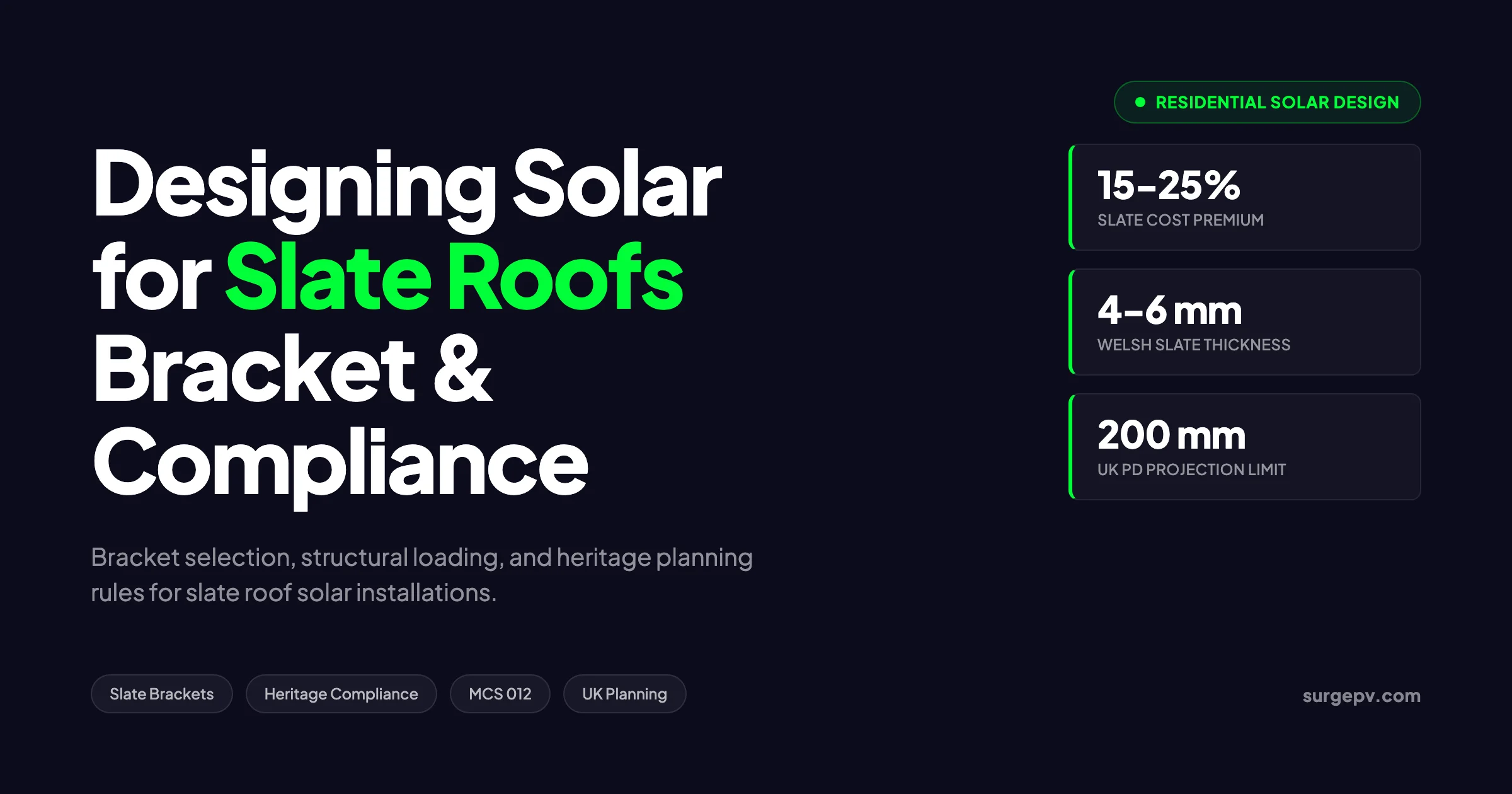
Slate roof installations cost 15 to 25 percent more than concrete tile and take 1 to 2 days longer. The bracket has to bolt to the rafter, never the slate. UK permitted development allows slate roof solar on most homes, but listed buildings and Article 4 conservation areas need consent. Use slate-specific hooks like Solar Slate Plate, K2, or Solar Limpets for visible roofs. Use in-roof PV slates from GB-Sol or Solstice for heritage settings.
For United Kingdom-specific compliance details, see United Kingdom comparisons/mcs-vs-non-mcs.
What Makes Slate Roof Solar Design Different
Slate is a metamorphic rock split into thin, dense tiles. A standard Welsh slate weighs 30 to 35 kg per square metre, against 45 to 55 kg per square metre for concrete tile and 22 to 28 kg per square metre for clay pantile. The total dead load on a slate roof is lower than concrete, but the tile itself is far less forgiving when bent, drilled, or stepped on at the wrong angle.
Three properties drive the design difference:
- Fragility under point load. A 90 kg installer stepping on the centre of a slate snaps it. The same load on a concrete tile rarely cracks it. Walk boards and battens are mandatory, not optional.
- Irregular thickness. Natural slate ranges from 4 mm to 12 mm in a single batch. Standard tile hooks designed for 10 mm concrete tile will lift the course above when fitted under a 4 mm Welsh slate.
- Brittle edges. Slate cuts cleanly with a guillotine but chips under impact. Trying to drill through a slate to mount a bracket is the single most common cause of a leaking roof on a solar job.
These properties point to one rule: the bracket must mount to the rafter, never to the slate. Every credible mounting system on the market follows it. See Solar Racking Design Guide for detailed guidance.
Pro Tip
Before quoting any slate roof job, ask the homeowner when the roof was last repointed and whether they have any spare slates in the loft. Heritage slates are no longer in production and a single missing tile can hold up an install for weeks.
The Three Mounting Approaches for Slate
Slate roof brackets fall into three categories. Picking the right one is the most important design decision on the project.
1. Hook Brackets (Slide-Under Systems)
Hook brackets slide between two slate courses and bolt to the rafter. The hook arm extends above the slate and connects to the rail that carries the panels. The slate above the hook is not drilled or cut. Most installs use this approach.
Common UK and European hook systems include: Also see: European Solar Tax Credits. For Europe-specific compliance details, see Europe solar compliance.
| System | Hook material | Slate thickness range | MCS 012 |
|---|---|---|---|
| Solar Slate Plate | Stainless steel + composite | 4 mm to 14 mm | Yes |
| Solar Limpets | Aluminium hook + flashing | 4 mm to 12 mm | Yes |
| K2 Singletrack Slate Hook | Stainless steel | 5 mm to 10 mm | Yes |
| Renusol Slate Hook | Stainless steel | 5 mm to 12 mm | Yes |
| IronRidge Slate Hook (US) | Stainless steel | 5 mm to 14 mm | UL 2703 |
The thickness range matters. Welsh slate, Spanish slate, and Brazilian slate all sit in different bands. A K2 hook works well on a 7 mm Spanish slate but lifts a 4 mm Welsh slate visibly. See our guide on Hotel Solar + EV Charging Case Study for more.
2. Slate Replacement Plates
Replacement plates remove a single slate and substitute a metal or composite plate with an integrated mounting bolt. The plate carries its own flashing skirt that overlaps the courses below. Solar Slate Plate and IronRidge Tile Replacement Mount are the leading options.
Replacement plates suit roofs where slate thickness varies wildly, where the original slates are damaged near the install zones, or where the homeowner wants the cleanest possible visual finish. They cost more per fixing point than hooks but cut install time by 20 to 30 percent because the slate cutting step disappears.
3. In-Roof Integrated Systems
In-roof systems replace the slate entirely across the array footprint. The modules sit flush with the surrounding slate rather than 80 mm above it. UK installers use:
- GB-Sol PV Slate. A solar slate roof tile that interlocks with traditional slate. Each tile generates around 10 W. A typical 4 kWp system uses 400 to 500 PV slates.
- Solstice Shingle. A US in-roof system increasingly available in Europe through specialist resellers.
- Marley SolarTile. A polymer-composite tile system that mimics a slate finish at lower cost than genuine PV slate.
In-roof solutions are the default route for listed buildings, conservation areas, and national parks. They cost 30 to 50 percent more than on-roof systems but produce the visual finish that heritage planners actually approve.
Slate Types and How They Affect the Design
Not all slate is the same. The four slate types installed on UK and European housing each have different thickness, density, and durability profiles. The bracket plan and the install timeline both shift depending on which slate sits on the roof.
Welsh Slate
Welsh slate from quarries like Penrhyn, Ffestiniog, and Cwt-y-Bugail dominates pre-1920 housing across England, Scotland, and Wales. Welsh slate is the thinnest of the four common types, typically 4 mm to 6 mm. It is also the most durable, with a service life of 100 to 150 years.
The thinness creates two design constraints. First, standard tile hooks lift the course above visibly. Second, the slate edge chips under any side-load, which rules out brackets that clamp the slate edge. Solar Slate Plate and Solar Limpets are the two systems specifically engineered for this thickness range.
Spanish Slate
Spanish slate, mostly from Galicia, became the dominant import after Welsh quarries scaled back in the 1990s. Spanish slate runs 5 mm to 8 mm and has a service life of 75 to 100 years. Most slate roofs laid since 1995 are Spanish.
Spanish slate accepts a wider range of brackets than Welsh slate. K2 Singletrack, Renusol slate hooks, and Schletter Eco05 all work without lifting the course above. Install times on Spanish slate run close to install times on concrete tile.
Brazilian Slate
Brazilian slate is the budget option used on speculative developments since 2000. It runs 6 mm to 10 mm thick with a service life of 50 to 80 years. The colour can drift from slate grey toward purple-grey under UV exposure.
Brazilian slate is the easiest of the four types to drill, cut, and replace. The cost premium for solar on Brazilian slate is the lowest of the four, often only 8 to 12 percent above concrete tile.
Composite Slate
Composite slate covers fibre-cement tiles like Cembrit Westerland, Marley Eternit Birkdale, and Tegral Thrutone. These are lighter than natural slate at 18 to 22 kg per square metre, with a service life of 50 to 60 years.
Composite slate accepts standard tile hooks without modification. The bracket plan follows the same logic as concrete tile. The only design adjustment is a slightly higher contingency for cracked tiles, since composite slate is more brittle than concrete but less brittle than natural slate.
| Slate type | Thickness | Service life | Solar premium | Best brackets |
|---|---|---|---|---|
| Welsh | 4 to 6 mm | 100 to 150 years | 20 to 25 percent | Solar Slate Plate, Solar Limpets |
| Spanish | 5 to 8 mm | 75 to 100 years | 15 to 20 percent | K2, Renusol, Schletter |
| Brazilian | 6 to 10 mm | 50 to 80 years | 8 to 12 percent | Most slate hooks |
| Composite (fibre-cement) | 6 to 9 mm | 50 to 60 years | 5 to 10 percent | Standard tile hooks |
Bracket Selection Decision Tree
Use this decision logic when scoping a slate job:
- Is the property listed Grade I or Grade II?* Specify in-roof PV slate. On-roof systems are routinely refused.
- Is the property in a conservation area with an Article 4 Direction or in a national park? Specify in-roof or rear-elevation only with hook brackets.
- Is the slate thickness under 5 mm? Use Solar Slate Plate or Solar Limpets. Avoid standard K2 or Renusol hooks.
- Are more than 10 percent of the slates in the install zone cracked or slipped? Specify slate replacement plates and budget for re-roofing of the install zone first.
- Standard pre-1990 Welsh or Spanish slate, sound condition, no heritage status? Hook brackets are the lowest cost route. K2, Renusol, and Solar Limpets all work.
Pro Tip
Always order 10 percent extra brackets and 5 spare slates per kWp. Slate breaks during install are normal even with skilled labour. Going back to source a single matching slate after the scaffold comes down adds days to the job.
Heritage and Planning Compliance in 2026
The planning rules around slate roof solar are stricter than for any other roof type because slate roofs cluster in older housing stock. The 2024 changes to the General Permitted Development Order in England widened permitted development for solar but kept all heritage controls in place.
England, Scotland, and Wales: Permitted Development
Standard solar PV on a slate roof falls under permitted development in all three nations as long as:
- The panels project no more than 200 mm from the roof plane
- The array is not installed on a wall facing a highway in a conservation area, national park, area of outstanding natural beauty, or world heritage site
- The building is not listed
- The site is not under an Article 4 Direction that has removed solar PD rights
If any of these conditions fails, a planning application is required. Listed buildings always require listed building consent regardless of permitted development status.
Listed Buildings
Around 500,000 buildings in England and 47,000 in Scotland are listed. The grading determines how flexible the planning authority will be:
| Grade | Solar viability | Typical recommendation |
|---|---|---|
| Grade I (England) / Category A (Scotland) | Very limited | Outbuilding or ground-mount only |
| Grade II* / Category B | Limited | Rear elevation in-roof PV slate |
| Grade II / Category C | Workable | In-roof PV slate or low-visibility hooks |
Listed building consent applications need elevation drawings, a materials schedule, and a heritage impact assessment. Budget 8 to 16 weeks for the determination. National Trust and Historic Houses Association consultees often add a further 4 weeks.
Conservation Areas
There are around 10,800 conservation areas in England and 660 in Scotland. Solar PV is permitted development in most, but Article 4 Directions remove that right in roughly 12 percent of them, mostly in central London, York, Bath, Edinburgh, and the Cotswolds.
Always check the local planning portal before quoting. The national Magic Map shows conservation areas and national parks. The Article 4 status sits inside the local authority’s policy database and is not on the Magic Map.
Europe: Country-Specific Heritage Rules
Heritage rules vary widely across Europe. Italy operates a vincolo paesaggistico system that requires Soprintendenza approval for solar in protected zones and on listed buildings. Germany’s Denkmalschutz law devolves to the Länder, with Bavaria and Baden-Württemberg the strictest. France’s Architectes des Bâtiments de France must sign off on solar within 500 m of a listed monument. Country-specific guidance is covered in European solar incentives and solar energy policies in Europe. Also see: solar panel ROI in Italy. Also see: Germany solar subsidies. Also see: France solar feed-in tariffs.
Design Your Slate Roof Project in SurgePV
Import high-resolution roof imagery, validate bracket spacing against rafter centres, and run heritage-grade visual impact renders, all in one tool.
Book a DemoNo commitment required · 20 minutes · Live project walkthrough
For a direct comparison, see Arka 360 vs SurgePV.
Structural Loading on Slate Roofs
Slate roofs are not always older or weaker than concrete tile roofs, but they sit on a different mix of timber stock. Pre-1945 slate roofs typically use sawn softwood rafters at 100 mm by 50 mm with centres around 400 mm. Modern slate-laid trussed roofs use engineered timber at 35 mm to 45 mm depth with centres at 600 mm.
The structural design pass has to confirm three things:
Dead Load
A standard solar array adds 18 to 22 kg per square metre on top of the existing roof load. Slate at 30 to 35 kg per square metre, plus battens at 5 kg per square metre, plus a 20 kg per square metre array gives a total dead load of around 60 kg per square metre. BS 5534 and ASCE 7 both treat this as well within the capacity of any rafter sized for a slate roof, but the calculation must be documented.
Wind Uplift
Wind uplift is the failure mode that catches most installers out. A 1.7 m by 1.1 m solar panel facing into a 130 km/h gust experiences around 1.5 kN of uplift force. Each rafter-fixed bracket has to carry 0.5 to 0.8 kN of design uplift. Bracket manufacturer datasheets list the rated uplift capacity, and all MCS 012 compliant brackets exceed the BS 5534 requirement.
Snow Load
Snow load matters in northern Europe, the Alps, and the US Northeast. The reference snow load for Edinburgh is 0.5 kN per square metre, for Munich 1.6 kN per square metre, for Boston 1.4 kN per square metre. The snow load combines with the array dead load. ASCE 7 and EN 1991-1-3 cover the calculation method.
The simplest way to validate the structural pass is in a solar design platform tool that runs the bracket spacing check against rafter centres and the uplift check against panel size and wind zone in one pass.
Installation Workflow Step by Step
Once the design is locked, the install itself follows a predictable sequence. Slate jobs add 1 to 2 days to a standard 1 to 2 day install, mostly in the bracket fitting and slate cutting steps.
Step 1: Scaffold and Roof Access
Slate roofs need a full scaffold, not a tower. Foot traffic on slate without walk boards causes 5 to 10 percent slate breakage on most jobs. Plan for at least 1 metre of working space at the eaves and access to the ridge.
Step 2: Identify Rafter Positions
Lift a row of slates near the eave to expose the batten. Mark the rafter centres on the batten with chalk. Transfer the marks up the roof using a plumb bob or a laser. Most slate roofs have rafter centres within 5 mm of nominal, but pre-1900 roofs can drift up to 50 mm and the bracket layout has to follow the actual centres.
Step 3: Lift the Course Above the Bracket Position
For hook brackets, lift the slate two courses above the bracket position. This exposes the batten at the bracket height. The slate immediately above the hook stays in place in most systems, but Solar Limpets and Solar Slate Plate require both courses to be lifted briefly during fitting.
Step 4: Fit the Bracket and Flashing
Bolt the bracket to the rafter using two 8 mm by 80 mm coach screws. Apply lead or EPDM flashing under the slate to direct any water that gets past the slate course onto the slate below the bracket. Do not rely on mastic alone.
Step 5: Cut and Refit the Slate
The slate that sits over the hook arm needs a small notch cut to fit around the hook stem. Use a slate guillotine, never an angle grinder. The notch should be 2 to 3 mm wider than the hook stem to allow thermal movement.
Step 6: Install Rails and Modules
Once all brackets are in, fit the rails and run the module installation. Rail span depends on the bracket spacing and panel size. K2 Singletrack rails span 2.4 m at maximum. Renusol rails span 2.1 m. IronRidge XR100 spans 1.8 m on a slate roof.
Step 7: Final Inspection and Slate Replacement
Walk the roof a final time, replace any slates broken during the install, and clear all debris from the gutters. Photograph every bracket from inside the loft and outside the roof for the install handover pack. MCS 012 documentation requires both views.
Key Takeaway
The single biggest predictor of a clean slate install is the experience of the lead installer. Crews with fewer than 10 slate roof installs under their belt break 8 to 12 percent of slates on average. Crews with 50+ installs break under 2 percent.
Cost Breakdown for a 4 kWp Slate Roof System
A typical 4 kWp residential install in the UK in 2026 carries the following cost structure. Slate adds a clear premium across labour, brackets, and contingency.
| Cost line | Concrete tile | Welsh slate | Listed slate (in-roof) |
|---|---|---|---|
| Modules (10 x 410 W) | £1,400 | £1,400 | £1,400 |
| Inverter | £900 | £900 | £900 |
| DC and AC cabling | £350 | £350 | £400 |
| Mounting system | £450 | £750 | £3,800 |
| Scaffold | £600 | £750 | £950 |
| Labour (2 to 3 days) | £1,400 | £2,200 | £3,400 |
| Slate cutting and replacement | n/a | £200 | £400 |
| Listed building consent fees | n/a | n/a | £700 |
| Contingency (5 to 10 percent) | £325 | £475 | £850 |
| Total | £5,425 | £7,025 | £12,800 |
The headline numbers tell the story. Concrete tile installs land around £1,300 per kWp. Slate installs land around £1,750 per kWp. Listed building in-roof systems land around £3,200 per kWp.
These numbers feed directly into the financial analysis. A standard slate roof install typically pays back in 9 to 11 years at UK electricity prices. A listed in-roof system pays back in 14 to 18 years. The solar yield and financial analysis inside SurgePV runs both scenarios in parallel for the homeowner-facing proposal.
Common Design Mistakes on Slate Jobs
Five mistakes show up over and over on slate roof solar projects. Each one is fixable in the design phase, before the scaffold goes up.
Mistake 1: Bracket Spacing Tied to Tile Width Instead of Rafter Centres
Designers used to concrete tile roofs sometimes lay out brackets at slate-width intervals (around 250 mm). Slate roofs need brackets at rafter centres (400 to 600 mm). The bracket has to land on a rafter, not between rafters. Always overlay the bracket plan on the rafter plan.
Mistake 2: Standard Tile Hooks on Thin Welsh Slate
K2, Schletter, and similar tile hooks are designed for slate at 6 mm to 12 mm thickness. Original Welsh slate is often 4 mm to 5 mm. The hook arm sits proud and lifts the slate above it. Use a slim-profile hook like Solar Slate Plate or Solar Limpets for any slate under 5 mm.
Mistake 3: Ignoring Thermal Movement
Slate roofs flex more than concrete tile roofs across a 40 °C temperature swing. Brackets need 2 to 3 mm of clearance at the slate notch. Brackets fitted hard against the slate edge crack the slate within a year.
Mistake 4: Skipping the Loft Inspection
Every slate roof job needs a loft inspection. Insulation, services, and timber condition all change the design. A loft inspection takes 30 minutes and catches structural issues that would otherwise surface mid-install.
Mistake 5: Promising a Front-Elevation Install in a Conservation Area
The single largest cause of failed planning applications on slate roof solar is a front-elevation array in a conservation area. Quote a rear-elevation or in-roof option from the start. If the homeowner insists on front-elevation, run a pre-application enquiry with the planning officer before commissioning the scaffold.
How Solar Design Software Handles Slate Roofs
Modern solar design platform handles slate roof projects in four key passes that manual design cannot match for speed or accuracy.
Pass 1: Roof Capture
High-resolution aerial imagery, drone capture, or LIDAR data feeds into the design tool. The tool builds a 3D model of the roof, identifies pitch and azimuth automatically, and exposes any complex geometry like dormers, hips, and valleys.
Pass 2: Shading Analysis
The solar shadow analysis software runs an hour-by-hour simulation across the full year. Slate roofs often sit on older houses with mature trees, tall chimneys, and neighbouring buildings, all of which create shading patterns that change with the sun’s seasonal arc. Sectional shading can be the difference between a 4 kWp design that hits 4,200 kWh per year and the same kWp count delivering 3,400 kWh. Read [Solar Shading Analysis Guide](/blog/solar-shading-analysis-guide) for a complete walkthrough.
Pass 3: Layout and Bracket Plan
The design tool produces the panel layout, the rail layout, and the bracket plan. The bracket plan can be overlaid on the rafter centres for visual confirmation before the install team arrives. Bracket spacing is validated against rail span limits and against the manufacturer’s MCS 012 datasheet.
Pass 4: Proposal and Permit Pack
The output feeds into a solar proposal software workflow that produces a homeowner-facing proposal, a permit-ready single-line diagram, and a structural sign-off pack. For listed building applications, the same tool exports elevation visuals that planning officers can drop into the consultation pack.
The full workflow is covered in the residential solar system design guide and the solar design principles for installers guide.
Pro Tip
For any heritage application, render the layout from the same viewpoint as the planning officer’s site visit. Most refusals come down to a perceived visual impact that the homeowner and the installer never even saw. A 3D render from the public footpath defuses 80 percent of those objections.
Slate Roof Solar in the United States
The US market for slate roof solar is smaller than the UK but growing in the Northeast. Slate housing stock concentrates in Massachusetts, New York, Pennsylvania, and Connecticut. Most of those homes pre-date 1940 and many sit inside historic districts.
US compliance differs from the UK in three ways:
- NEC 2026 governs electrical compliance. The 2026 cycle introduced new bonding requirements at the bracket level for aluminium racking on slate.
- NABCEP installer certification is the practical standard. Slate-specific assessments are now part of the NABCEP PV Installer credential.
- AHJ-level historic district controls vary by city. Boston, Cambridge, Salem, Princeton, and Philadelphia all run historic district commissions that pre-empt state-level permitted development.
Bracket choice in the US shifts toward IronRidge Tile Replacement Mount, QuickMount PV Slate Mount, and Unirac Slate Hook. The hook geometry is similar to UK systems but the wind zone math runs through ASCE 7 rather than BS 5534. The solar design software for the US market covers wind zone classification at the design stage.
Documentation Pack for a Heritage Slate Install
A heritage slate solar project produces three to five times the documentation of a standard install. Getting the pack right at the design stage shortens the planning timeline by 4 to 8 weeks.
The Visual Impact Statement
Listed building consent applications and conservation area applications both need a visual impact statement. The statement runs 6 to 10 pages and covers:
- The proposed array location and elevation
- Photographs of the building from public viewpoints
- 3D renders showing the array in context
- A materials schedule listing modules, racking, and flashing colour
- A justification for the chosen approach versus alternatives
- A reversibility statement confirming the install can be removed without permanent damage
Most of this content comes out of the cloud solar design tool at the design stage. The 3D render is the single most useful element. Planning officers reject applications when they cannot picture what the finished install will look like from the street.
The Structural Sign-Off
Heritage roofs need a written structural sign-off from a chartered structural engineer. The sign-off confirms that the rafters can carry the additional dead and live load and that the bracket plan distributes the load correctly across rafter centres.
The structural engineer needs the bracket plan, the panel weight, the rail span, and the wind zone classification. All four come out of the design software. Most engineers turn the calculation around in 3 to 5 working days at a typical fee of £350 to £600 for a residential project.
The Materials Schedule
The materials schedule lists every visible component on the roof. For listed buildings, the schedule is what the planning officer compares against the heritage assessment. A typical schedule covers:
- Module make and model, with the colour of the frame and backsheet
- Rail manufacturer, with the colour of the anodising
- Bracket make and model
- Flashing material, colour, and thickness
- DC isolator location and finish
- Cable run path and any external conduit
Black-on-black modules with black anodised rails read better than silver frames on a slate roof. Most heritage applications now require the all-black specification.
The Heritage Officer Pre-Application
The most underused tool in the heritage planning process is the pre-application enquiry. Most local planning authorities offer a paid pre-app at £150 to £400. The heritage officer reviews the proposal informally and gives an indication of whether the application is likely to succeed.
A pre-app saves the cost of a refused application and the 8-week wait that comes with it. Always run a pre-app for any listed building project and any conservation area project where the array is visible from a public viewpoint.
Heritage Compliance Checklist
Use this checklist on every slate roof job before quoting:
- Confirmed slate type (Welsh, Spanish, Brazilian, composite)
- Measured slate thickness on a sample tile
- Counted rafter centres in the loft
- Identified planning status (PD, conservation area, Article 4, listed)
- Checked for an Article 4 Direction on the local planning portal
- Inspected slate condition for cracks, slips, and delamination
- Confirmed bracket compatibility with slate thickness
- Validated rafter spacing against bracket plan
- Specified flashing material and detail
- Documented structural calculation (BS 5534 or ASCE 7)
- Prepared visual impact render for heritage applications
- Photographed roof state pre-install for the handover pack
A complete checklist is the difference between a 12-week project and a 24-week project on heritage roofs.
Conclusion: Three Action Items for Slate Roof Solar Design
Slate roof solar is technically more demanding than concrete tile, but the design rules are well established. To run a successful slate project:
- Start with the bracket selection. Slate thickness, listing status, and rafter centres dictate the choice. Get this wrong and the rest of the design unravels.
- Build the heritage compliance pass into the quote, not the install. Confirm planning status before the scaffold goes up. Listed building consent and conservation area controls add weeks, not days, to the timeline.
- Use solar design software to model the array before the scaffold goes up. Hour-by-hour shadow analysis, rafter-aligned bracket plans, and structural sign-off all run faster in a single tool than in CAD plus Excel plus a paper checklist.
For a tour of how SurgePV handles slate roof projects from drone capture to permit pack in a few minutes, book a demo.
Frequently Asked Questions
Can you put solar panels on a slate roof?
Yes. Solar panels can be installed on slate roofs using non-penetrating hook systems, slate-replacement plates, or rafter-mounted brackets that pass under the slate course. The installer never drills directly through the slate. With the right bracket and a careful design pass, a slate roof installation lasts as long as the panels themselves, typically 30 to 40 years.
How much extra does solar cost on a slate roof?
Slate roof installations cost 15 to 25 percent more than installations on concrete or composite tiles. The premium covers extra labour time, specialist brackets, slate cutting, and replacement of cracked tiles during the install. A 4 kWp system that costs £6,500 on concrete tile typically lands at £7,500 to £8,000 on slate.
Do slate solar installations need planning permission in the UK?
Standard slate roof solar falls under permitted development in England, Scotland, and Wales as long as panels do not project more than 200 mm from the roof plane and are not on the principal elevation in a designated area. Listed buildings always require listed building consent. Conservation areas with an Article 4 Direction also require a planning application.
What are the best brackets for slate roofs?
Hook-style brackets like Solar Slate Plate, Solar Limpets, K2 slate hooks, and Renusol slate kits are the most common UK options. They slide between slate courses and bolt to the rafter without drilling the slate. For listed buildings, in-roof systems like GB-Sol PV Slate or Solstice integrated panels replace the slate entirely and produce a flush finish.
Will solar panels damage a slate roof?
A correctly installed system causes no long-term damage. Risk comes from poor workmanship: cracked tiles during foot traffic, undersized rafters, missed flashing, or hooks that lift the course above. A pre-install structural check, MCS 012 compliant brackets, and an experienced slate installer are the three controls that prevent damage.
Can solar panels go on a listed slate roof?
Solar on a listed roof is possible but not automatic. Local planning authorities weigh visual impact against decarbonisation policy. In-roof slate-tile PV systems and rear-elevation arrays are the routes most likely to win consent. Front-elevation, full-roof arrays on Grade I and Grade II* listings are routinely refused.
What design software should installers use for slate roof projects?
Slate jobs benefit from solar design software that imports high-resolution roof imagery, runs hourly shadow analysis, validates structural loading per BS 5534 or ASCE 7, and produces a permit-ready layout that highlights bracket positions versus rafter centres. SurgePV handles all four steps in one workflow.
Where this fits
This article is part of SurgePV's Solar Installation hub, which works through the topic from first principles to the decisions a project team actually has to make.

