Quick Answer
Flat roof ballasted solar systems use concrete blocks or pavers instead of roof penetrations. Typical tilt: 10–15° for south-facing, 5–10° for east-west. Ballast weight: 15–25 kg/m² depending on wind zone. Wind uplift is the primary design constraint — systems must withstand 120–180 km/h gusts. Structural assessment is mandatory.
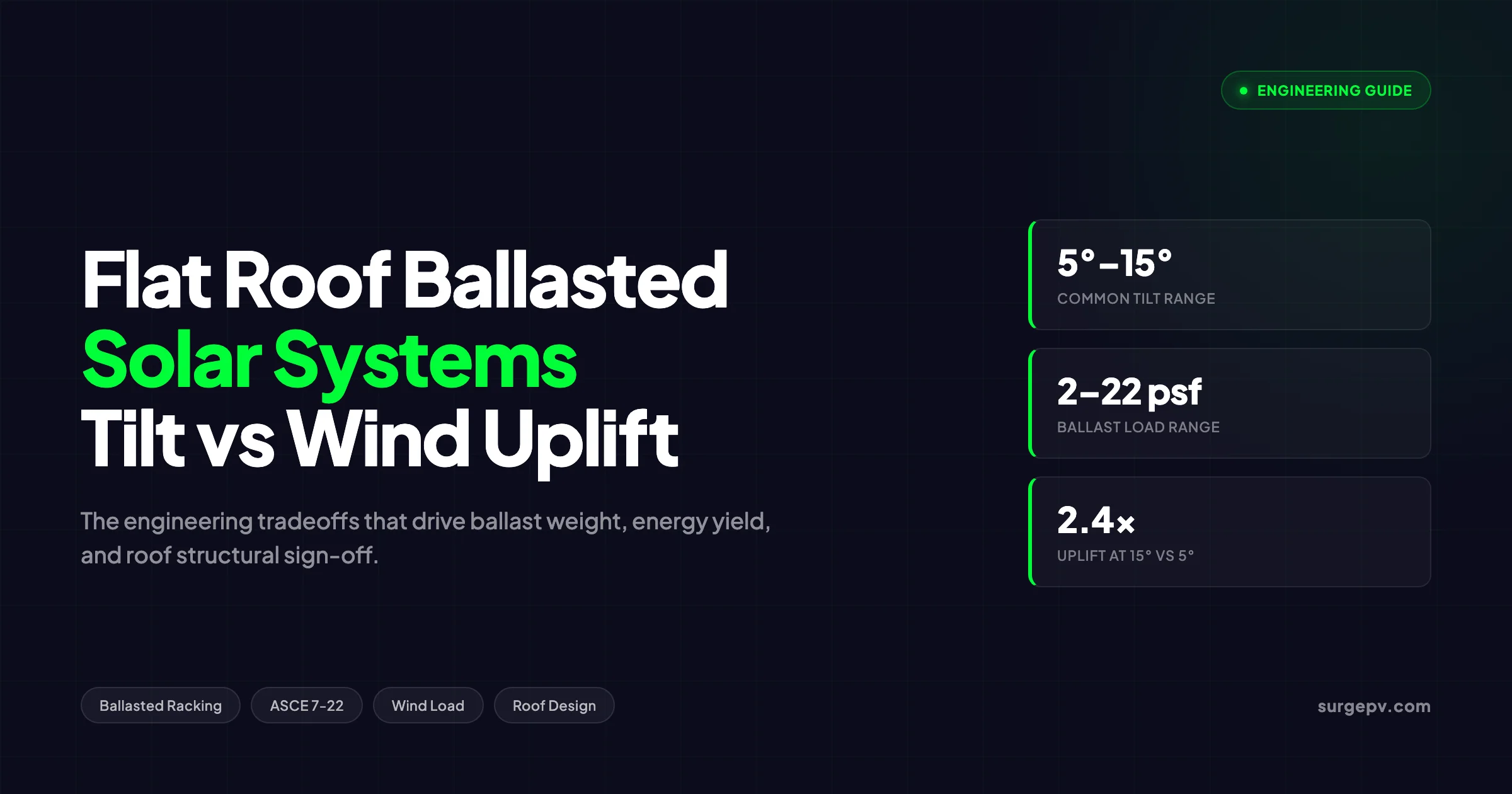
Flat roof ballasted solar systems use concrete weight, not roof penetrations, to hold panels in place. Lower tilt angles cut wind uplift forces dramatically — a 10-degree array typically needs 30 to 40 percent less ballast than a 15-degree array, but produces 3 to 5 percent less annual energy. The right tilt depends on roof load capacity, local design wind speed, latitude, and whether your structure can carry the dead load without retrofit.
Flat roof ballasted solar systems use concrete blocks or pavers instead of roof penetrations. Typical tilt: 10–15° for south-facing, 5–10° for east-west. Ballast weight: 15–25 kg/m² depending on wind zone.
Flat roof ballasted solar systems use concrete blocks or pavers instead of roof penetrations. Typical tilt: 10–15° for south-facing, 5–10° for east-west. Ballast weight: 15–25 kg/m² depending on wind zone. Wind uplift is the primary design constraint — systems must withstand 120–180 km/h gusts. Structural assessment is mandatory.
This guide walks through the physics, the ASCE 7-22 rules that govern ballast design, real ballast weight numbers per tilt angle, and the design mistakes that stall permits or trigger expensive roof reinforcements. Use it to specify a flat roof array that passes structural review on the first submission.
TL;DR — Tilt vs Uplift Tradeoffs
A 5-degree array minimizes ballast and roof load but loses 7 to 12 percent annual energy versus latitude-tilt. A 10-degree array is the residential and small-commercial sweet spot for most US and European latitudes. A 15-degree or higher array squeezes out more annual yield but needs 1.5 to 2x the ballast and rarely fits roofs with marginal structural capacity. Wind tunnel data from the racking manufacturer, not generic ASCE tables, drives the final ballast weight.
For more on this topic, see Solar Racking Design Guide. For Europe-specific compliance details, see Europe solar compliance.
What this guide covers:
- How ballasted mounting systems work on flat and low-slope roofs
- The aerodynamic physics that ties tilt angle to wind uplift
- Ballast weight numbers at 5, 10, and 15 degrees in pounds per square foot
- Roof structural capacity limits and how to check yours
- ASCE 7-22 changes that affect every ballasted PV designer
- East-west versus south-facing layouts on the same roof
- Hybrid ballasted plus mechanical attachment systems
- Tilt selection rules for different climate zones
- Common design errors that fail permit review
You can run the structural and energy yield modeling described in this guide directly inside solar design software like SurgePV, which handles roof load checks, tilt optimization, and ballast layout in one workflow. For a direct comparison, see Arka 360 vs SurgePV.
How Ballasted Solar Mounting Works on Flat Roofs
A ballasted solar system holds the panel array down with concrete blocks, paver weights, or weighted trays sitting on top of the roof membrane. The racking is connected together as a rigid raft, and the combined dead weight resists wind uplift and seismic shear. No bolts penetrate the roof.
The approach works because flat and low-slope roofs (slopes under 10 degrees) have enough surface area to spread the load. A 50 kW array on a typical 4,000-square-foot warehouse roof might add 4 to 6 psf of total dead weight, which most modern commercial roofs absorb without reinforcement.
Three things make ballasted systems attractive on flat roofs:
- No penetrations means no roof warranty conflicts and no leak risk at hundreds of bolt locations
- Faster install — a four-person crew can set a 100 kW ballasted array in two days, versus four to five days for a fully attached system
- Lower racking part count, which reduces material cost by roughly 15 to 25 percent versus mechanical attachment
The tradeoff is dead weight. Every concrete block sitting on the roof eats into the structural capacity reserved for snow, maintenance traffic, and HVAC equipment. The art of ballasted design is matching the array layout, tilt angle, and ballast distribution to a roof’s actual capacity.
For background on the underlying mounting hardware, see our ballasted racking glossary entry, which covers component-level details.
Where Ballasted Systems Make Sense
Ballasted mounting fits these roof types well:
- Single-ply membrane roofs (TPO, PVC, EPDM) on commercial buildings
- Modified bitumen and built-up roofs with sufficient deck capacity
- Concrete deck roofs on multi-family residential and mixed-use buildings
- Low-slope residential additions and garage roofs
- Warehouse, distribution center, and big-box retail roofs
Where ballasted does not work:
- Lightweight steel deck without structural reinforcement
- Roofs with less than 5 psf of available live load capacity after existing dead loads
- Sites with design wind speeds above 150 mph (Florida coast, hurricane-zone islands)
- Pitched residential roofs (anything over 10 degrees of slope)
The Tilt Angle Decision: 5, 10, and 15 Degrees Compared
Tilt angle is the single most important variable in flat roof PV design because it controls four interconnected outcomes: wind uplift force, ballast weight, energy yield per panel, and module density per square foot of roof.
The table below summarizes the tradeoffs across the three most common tilt angles for ballasted residential and small-commercial arrays.
| Parameter | 5° tilt | 10° tilt | 15° tilt |
|---|---|---|---|
| Annual energy vs latitude tilt | 88-92% | 92-95% | 95-97% |
| Wind uplift coefficient (relative) | 1.0x | 1.4-1.6x | 2.0-2.4x |
| Typical interior ballast (psf) | 2-4 | 4-7 | 7-11 |
| Typical perimeter ballast (psf) | 4-6 | 7-10 | 10-15 |
| Module density (W per sq ft of roof) | 13-16 | 11-13 | 9-11 |
| Self-shading row spacing (ft per row) | 3-4 | 5-6 | 7-9 |
| Snow shedding | Poor | Marginal | Good |
| Common application | High-density commercial, weight-limited roofs | Default residential and small commercial | Northern climates, snow-prone, latitude over 45° |
A few things stand out from this comparison.
Energy yield differences are smaller than most installers assume. Going from 5 to 15 degrees in a US latitude band of 35 to 42 degrees adds only 4 to 7 percent annual production per panel. That gain disappears entirely if the steeper tilt forces you to space rows further apart and you end up with fewer total panels.
Ballast scales non-linearly with tilt. Doubling tilt from 5 to 10 degrees roughly doubles the perimeter ballast. Going from 10 to 15 degrees adds another 50 to 70 percent. The relationship is driven by the increase in projected frontal area and the change in flow separation around the panel edge.
Module density flips the equation. A 5-degree east-west or shallow south-facing layout fits 30 to 50 percent more wattage on the same roof. On a roof where the customer’s load can absorb the extra production, the lower per-panel yield is irrelevant — total kWh is what matters.
Pro Tip
For residential flat roofs in latitudes 30 to 45 degrees, default to 10 degrees south-facing or 5 to 7 degrees east-west. Reserve 15-degree tilt for sites where snow shedding is a real concern (latitude above 45° with reliable winter snow) and the roof has clear structural headroom.
Wind Uplift Physics: Why Tilt Angle Drives Ballast Weight
Wind hitting a tilted panel does two things. It pushes the panel back (drag), and it generates lift across the upper surface (uplift). The lift component is what tries to peel the array off the roof, and the magnitude depends on the angle of attack and the airflow pattern around the array edges.
For a flat panel lying on the roof, wind flows over the top with almost no pressure differential. Lift is minimal. As tilt rises, the panel acts more like an airplane wing — the pressure on the underside builds while the upper surface develops low pressure from accelerating airflow. That pressure differential creates the uplift force the ballast has to counter.
Three regimes appear in the wind tunnel data:
0 to 5 degrees: pressure equalization regime. Air flows around and under the panel almost equally. Net uplift is dominated by general roof corner and edge pressures defined in ASCE 7. Ballast requirements are driven mostly by panel weight and seismic resistance, not aerodynamics.
5 to 15 degrees: rapid uplift growth. Pressure coefficients climb sharply through this range as the panel develops its own aerodynamic profile. Research published in the Journal of Wind Engineering documents a near-linear increase in net uplift coefficient between 2 and 10 degrees, then continued growth through 20 degrees but with declining slope.
15+ degrees: turbulence-dominated regime. Beyond 15 degrees, the array generates its own turbulent wake. Loading is governed by array-induced turbulence rather than smooth flow over the panel. Ballast requirements stay high but the marginal increase per degree of tilt slows.
This is the practical takeaway: every degree of tilt added in the 5 to 15 range costs you more in ballast than in any other range. That is exactly the range where most flat roof arrays sit.
Edge and Corner Pressure Zones
Wind uplift is not uniform across the roof. ASCE 7 divides the roof into three zones with different pressure coefficients:
- Zone 1 (interior field): Lowest pressures. Most of the roof falls here.
- Zone 2 (edge band): Moderate pressures. A strip running along the roof perimeter, typically 10 to 15 percent of the smallest plan dimension wide.
- Zone 3 (corners): Highest pressures. The four corner squares where flow separates and creates the strongest suction.
A ballasted array in Zone 3 may need 2 to 3 times the ballast of the same array in Zone 1. This is why most ballast layouts step up the block count along edges and double or triple it in corners.
Some installers solve the corner problem by setting the array back from the parapet — a setback of 2 to 3 feet from the roof edge moves modules out of Zone 3 and into Zone 2 or even Zone 1. The setback costs you usable roof area but can reduce total ballast tonnage by 15 to 25 percent. Also see: Us Residential Solar Market Trends 2026. For United States-specific compliance details, see United States arizona/phoenix.
For a complete primer on the underlying load calculation method, see our wind load calculation glossary entry.
Parapet Walls Change the Picture
A parapet wall around the roof perimeter changes the airflow pattern. Tall parapets (3 feet or higher) create a recirculation zone behind them, which shifts the highest uplift pressures inboard from the edge. Short or no parapets leave the corner zones fully exposed.
ASCE 7-22 includes parapet height as an explicit input for rooftop solar wind loads. Designers who ignore it on parapet-walled roofs leave 10 to 20 percent of ballast capacity unused, while designers who assume a parapet on a roof that lacks one undersize the ballast and risk array displacement in a design-level wind event.
Ballast Weight Calculation: Real Numbers per Tilt Angle
Ballast weight per square foot is the number that drives every other downstream decision — concrete block count, racking layout, structural review, install labor, and shipping cost. The values below are typical industry ranges, not site-specific design values. A licensed engineer using the racking vendor’s wind tunnel data must produce the actual project numbers.
| Site condition | 5° tilt (psf) | 10° tilt (psf) | 15° tilt (psf) |
|---|---|---|---|
| Interior zone, low wind (90 mph) | 2-3 | 4-6 | 7-10 |
| Interior zone, moderate wind (115 mph) | 3-4 | 5-8 | 8-12 |
| Interior zone, high wind (140 mph) | 4-6 | 7-11 | 11-16 |
| Perimeter zone, low wind | 4-6 | 7-10 | 10-14 |
| Perimeter zone, moderate wind | 5-8 | 8-12 | 12-17 |
| Perimeter zone, high wind | 7-10 | 11-15 | 15-22 |
| Corner zone, low wind | 6-9 | 10-14 | 14-20 |
| Corner zone, moderate wind | 8-12 | 12-17 | 17-24 |
| Corner zone, high wind | 11-16 | 16-22 | 22-32 |
Several patterns are worth noting.
Going from 5 to 10 degrees roughly doubles ballast in interior zones. A 100 kW array at 5 degrees and 3 psf interior ballast carries about 1,500 lb of concrete in the interior zone. At 10 degrees and 6 psf, that jumps to 3,000 lb. Add the perimeter and corner premium and the total weight roughly doubles.
Going from 10 to 15 degrees adds another 50 to 70 percent. The same 100 kW array might require 4,500 to 5,500 lb of total ballast at 10 degrees and 7,500 to 9,500 lb at 15 degrees. That is the difference between a single pickup truck delivery and a flatbed crane lift onto the roof.
High wind sites can push ballasted out of contention entirely. A 15-degree array in a 140 mph wind zone with corner ballast at 22 psf will exceed most commercial roof capacities. At that point, hybrid or fully attached systems are the only path forward.
Worked Example: 30 kW Residential Flat Roof Array
Consider a real residential design scenario.
- Roof: 2,400 sq ft flat roof, TPO membrane, concrete deck, 20 psf live load capacity
- Existing dead loads: 4 psf (membrane plus insulation plus drains)
- Available capacity for solar: 16 psf
- Location: Phoenix, Arizona — 115 mph design wind speed, exposure category C
- Array: 30 kW, 70 panels at 425 W each, 10-degree south-facing tilt
- Roof zone breakdown: 70 percent interior, 22 percent perimeter, 8 percent corner
Ballast calculation per zone:
- Interior (49 panels): 6 psf x panel footprint (~22 sq ft) = 132 lb per panel
- Perimeter (15 panels): 10 psf x 22 sq ft = 220 lb per panel
- Corner (6 panels): 14 psf x 22 sq ft = 308 lb per panel
Total ballast: (49 x 132) + (15 x 220) + (6 x 308) = 6,468 + 3,300 + 1,848 = 11,616 lb
Plus racking weight (roughly 1,800 lb) and panel weight (70 x 50 lb = 3,500 lb) brings total dead load to roughly 16,900 lb across 1,540 sq ft of array footprint, or 11 psf average over the array area. Spread over the full 2,400 sq ft roof, the average load is 7 psf — well under the 16 psf available capacity.
Notice how the corner panels carry almost double the interior ballast. This is why most well-designed ballast layouts use a graduated block count, not a uniform distribution. A flat ballast plan wastes weight in the interior and underloads the corners.
For the financial side of this kind of system, you can model production and payback using a solar financial modeling that handles tilt-specific yield curves automatically.
Roof Structural Capacity: What Your Building Can Handle
Before any tilt-vs-ballast tradeoff matters, the roof has to carry the load. Structural capacity check is the first design gate, and it kills more flat roof solar projects than any other single issue.
Reading a Roof’s Capacity
Most building plans list two relevant numbers:
- Live load capacity: What the roof can carry on top of its own dead weight, designed for snow, wind, and maintenance traffic. Typical values are 20 psf for older commercial roofs and 30 psf for modern construction in non-snow zones.
- Existing dead loads: Roof membrane, insulation, drains, mechanical equipment, and any prior modifications. Often 3 to 8 psf on commercial roofs and 10 to 15 psf on roofs with rooftop HVAC.
Available capacity for solar is roughly: live load capacity minus snow load minus a 25 percent safety factor. For a 30 psf live load roof in a 15 psf snow zone:
(30 - 15) x 0.75 = 11.25 psf available for solar dead load
That number sets the upper bound on combined panel, racking, and ballast weight. A typical 6 psf ballasted array fits comfortably. A 12 psf high-tilt high-wind ballast plan does not.
When the Roof Cannot Carry the Design
Several options exist when the structural check fails:
- Drop the tilt angle. Going from 15 to 10 degrees can cut total dead load by 35 to 45 percent. Going from 10 to 5 degrees cuts it another 30 to 40 percent.
- Switch to east-west. Shallow east-west layouts use less ballast per square foot than tilted south-facing arrays.
- Switch to mechanical attachment. Bolts spread loads through the roof structure into beams and columns, bypassing the roof deck capacity question.
- Hybrid ballast plus mechanical. Ballast the interior, mechanically attach the corners and edges. This cuts total dead load by 30 to 50 percent.
- Roof reinforcement. Add steel beams or column reinforcement under the array footprint. Costly, often 20 to 40 percent of the project cost, but unavoidable on some retrofits.
- Reduce array size. Fit only what the structure carries.
A structural engineer’s load report is mandatory for any flat roof solar permit in the US. Budget $400 to $800 for the report on a residential flat roof, and $800 to $2,500 for commercial. This is fixed cost, not negotiable, and skipping it almost always results in a permit denial.
For the underlying calculation method, see our load analysis and mounting load calculator glossary entries.
Run Tilt and Ballast Tradeoffs in One Workflow
SurgePV combines roof structural checks, tilt optimization, ballast layout, and energy yield modeling so you can compare three or four design variants in minutes instead of days.
Book a DemoNo commitment required · 20 minutes · Live project walkthrough
ASCE 7-22 and Wind Tunnel Testing: What Changed for Ballasted PV
ASCE 7-22 is the current US standard for minimum design loads, and the rooftop solar provisions in Chapter 29 changed meaningfully from the prior 7-16 edition. Designers working on ballasted PV need to understand four updates.
Update 1: Wind Tunnel Data Required for Tilted Rooftop Arrays
ASCE 7-22 explicitly directs designers to use wind tunnel data following the procedures in ASCE 49 for tilted rooftop solar arrays. The simplified Chapter 29 method only covers panels mounted parallel to the roof surface (typical pitched residential installs).
In practice this means: every flat roof ballasted array uses the racking manufacturer’s published wind tunnel report to derive pressure coefficients. The Mibet, IronRidge, Unirac, Anchor, Sollega, and Ecolibrium-style ballasted vendors all publish these reports for their products.
The implication for designers: ballast values from one vendor’s wind tunnel testing are not interchangeable with another vendor’s product. Switching racking mid-project requires re-running the structural calculations.
Update 2: Tornado Loads Now in Scope
Chapter 32 of ASCE 7-22 added tornado load provisions for the central US. PV racking manufacturers selling into tornado-zone states have to expand their wind tunnel testing to cover tornado-induced pressures, which are more severe than straight-line winds at the same wind speed.
The practical effect on ballasted design: in tornado zones (most of the central plains states), expect ballast values to climb 10 to 25 percent versus the same wind speed in a non-tornado zone.
Update 3: Seismic Path Restriction
Section 13.6.12 of ASCE 7-22 says solar panels cannot be considered as part of the load path that resists interconnection forces unless the panels themselves have been evaluated or tested for that loading.
This wipes out a class of older ballasted designs that relied on the panel itself to transfer shear between racking units. Modern ballasted systems use independent racking interconnects (rails, splices, or rigid baseplates) that handle seismic shear without loading the panels in shear.
If you are working with a racking system designed before 2022, check whether the seismic load path has been re-engineered to comply.
Update 4: Effective Wind Areas for PV
ASCE 7-22 clarified the effective wind area calculation for low-slope ballasted PV. The effective wind area is now the larger of:
- The actual tributary area of the racking element being checked
- One-third of the span length squared
For ballasted arrays, this generally results in larger effective wind areas (and therefore lower pressure coefficients) than designers calculated under the older interpretation. Net effect: slightly less conservative ballast values for most projects, particularly larger continuous arrays.
For a deeper look at the standard itself, see our ASCE 7 glossary entry.
East-West Layouts: A Different Tradeoff Set
The east-west ballasted layout is a different design philosophy. Instead of tilting all panels toward the south at 10 to 15 degrees, you tilt half the panels east at 5 to 10 degrees and the other half west at 5 to 10 degrees, with the panels paired back-to-back into a continuous tent-like row.
The aerodynamic and structural implications are different from a south-facing tilted layout.
| Metric | South-facing 15° | East-west 10° | Difference |
|---|---|---|---|
| Annual yield per kWp | 100% (baseline) | 90-95% | -5 to -10% |
| Panels per 1,000 sq ft of roof | 22-28 | 35-45 | +50-70% |
| Interior ballast (psf) | 7-11 | 3-5 | -50 to -60% |
| Total system cost per Wp | 100% (baseline) | 80-90% | -10 to -20% |
| Daily generation curve | Sharp midday peak | Flatter, longer curve | More aligned with commercial loads |
The numbers favor east-west on most roofs where roof area exceeds the customer’s energy needs is not a constraint. You install more total wattage per square foot, weigh down the roof less per square foot, and generate a daily production profile that matches typical commercial demand better than a south-facing system that peaks at noon.
The case for south-facing stays strong when:
- Roof area is the binding constraint and per-panel yield matters more than total wattage
- Net metering rules pay full retail for export at any time of day
- The site is at a high latitude (above 45 degrees) where the south-facing yield advantage grows
- Snow shedding is a winter requirement
A practical compromise some designers use: shallow south-facing tilt (5 to 7 degrees) instead of east-west. You give up some module density compared to back-to-back east-west, but you keep the south-facing energy advantage and avoid the 5 to 10 percent yield penalty.
For more on layout optimization, see our tilt azimuth optimization glossary entry.
Self-Shading Constraints
Whatever tilt and orientation you choose, row-to-row shading sets the panel density. The general rule for inter-row spacing on a flat roof: Read [Solar Shading Analysis Guide](/blog/solar-shading-analysis-guide) for a complete walkthrough.
Row spacing = panel height × (cos(tilt) + sin(tilt) / tan(solar elevation at design hour))
For a 5-degree tilt, the spacing required to avoid self-shading at 9 AM on December 21 at 40 degrees latitude is roughly 1.2x panel height. At 10 degrees tilt, that jumps to 1.6x. At 15 degrees, 2.1x.
This is why steep south-facing layouts use so much more roof area than shallow east-west ones. The spacing you have to maintain between rows eats up the yield advantage from the steeper angle.
For details on the design parameters, see our tilt analysis glossary entry.
Hybrid Systems: Mixing Ballast and Mechanical Attachment
A hybrid system uses ballast for the interior of the array and mechanical attachments (bolts through the roof into the structural deck) for the perimeter and corners. This solves the highest-ballast-weight problem at the perimeter without paying the labor and warranty cost of fully attaching every connection point.
Hybrid is now the default for many commercial flat roof installations because it captures the cost advantages of ballast where they matter most (the array interior) while putting mechanical resistance where uplift forces are highest (the corners).
The typical hybrid breakdown for a 100 kW array on a 10,000 sq ft roof:
- Interior zone (~70 percent of array footprint): full ballast, 4 to 6 psf
- Perimeter zone (~22 percent): light ballast plus mechanical anchors every 8 to 12 ft
- Corner zone (~8 percent): minimal ballast, mechanical anchors every 6 to 8 ft
Total dead weight on the roof drops by 30 to 50 percent versus a fully ballasted system at the same tilt. The number of roof penetrations is small enough (typically 20 to 40 anchors on a 100 kW array versus 200+ on a fully attached system) that membrane warranty providers will usually accept the design.
When hybrid makes sense:
- High-wind sites where corner ballast values exceed roof capacity
- Roofs with marginal structural capacity that cannot carry full ballast at the corners
- Tall buildings (over 60 ft) where perimeter pressures climb sharply with height
- Sites near coastal or open-fetch terrain (exposure category D)
When hybrid is overkill:
- Low-wind interior sites with plenty of structural headroom
- Smaller arrays under 30 kW where the marginal labor of mechanical anchors is not worth it
- Sites where the membrane warranty does not allow any penetrations at all
Tilt Angle Selection by Climate and Latitude
The optimal tilt for energy yield alone is roughly equal to the site’s latitude. But for ballasted flat roof systems, structural and economic factors shift the optimum lower. The table below shows the practical residential and small-commercial tilt range by region.
| Region | Latitude band | Recommended tilt | Reasoning |
|---|---|---|---|
| US Sunbelt (Phoenix, LA, Houston) | 30-35° | 5-10° south or 5° east-west | Low yield penalty for shallow tilt, high cooling loads benefit from east-west spread |
| US Mid-Atlantic (DC, Philadelphia) | 38-42° | 10° south or 7° east-west | Balanced — moderate snow, moderate wind, latitude tilt acceptable |
| US Northeast (Boston, NYC) | 40-45° | 10-15° south | Snow shedding starts to matter, latitude tilt closer to optimum |
| US Pacific Northwest (Seattle, Portland) | 45-48° | 10° south or 7° east-west | Diffuse light dominates, steep tilt offers little yield gain |
| US Mountain West (Denver, SLC) | 35-42° | 10-15° south | High solar resource, snow load capacity, latitude tilt works |
| Florida and Gulf Coast | 25-30° | 5° east-west | Hurricane wind speeds make low tilt mandatory |
| Southern Europe (Spain, Italy, Greece) | 35-42° | 10° south or 5-7° east-west | Similar to US Sunbelt, often east-west for commercial roofs |
| Central Europe (Germany, France, BeNeLux) | 47-53° | 10-15° south or 10° east-west | High latitude, but east-west still wins on commercial buildings |
| Northern Europe (UK, Scandinavia) | 51-60° | 15° south for residential, 10° east-west for commercial | Diffuse light, east-west yield penalty smaller |
| India (Delhi, Mumbai, Chennai) | 13-28° | 10° south | Latitude-near tilt with good annual yield |
| Australia (Sydney, Melbourne) | 33-38° | 10° north (southern hemisphere) | Mirror of US Sunbelt logic |
A nuance worth noting: residential customers in net-metering markets often want every kWh the system can produce because grid export is paid at retail. East-west and shallow tilt makes less sense for them than for commercial customers whose load profile peaks midday and tapers in the evening.
For European market context on policies that affect this tradeoff, see our coverage of European solar incentives and the EU rooftop solar mandate under EPBD.
Snow Load Considerations for Northern Sites
Snow on a flat ballasted array is a separate structural problem. Snow that accumulates between rows of panels can create drifts that exceed the design snow load on the roof.
ASCE 7-22 includes provisions for snow drift around rooftop obstructions. Solar arrays count as obstructions, and the drift load behind a row of panels can be 1.5 to 2.5 times the ground snow load.
Two design responses help:
- Steeper tilt (15 degrees plus) lets snow slide off panels faster and reduces the drift problem
- Wider row spacing reduces the drift accumulation between rows
In high-snow climates (over 40 psf ground snow), a 5-degree east-west layout can become structurally infeasible because of drift, even though the panel weight and ballast are modest. A 15-degree south-facing layout with wider spacing is sometimes the only design that meets the combined snow plus solar load.
For more on this, see our snow load calculation glossary entry.
Common Design Mistakes That Stall Permits
Patterns repeat across thousands of permit submissions. The mistakes below account for most of the failed structural reviews on ballasted flat roof PV.
Mistake 1: Using Generic ASCE Tables Instead of Vendor Wind Tunnel Data
The Chapter 29 method in ASCE 7-22 does not cover tilted rooftop solar. Designers who plug into the simplified tables get pressure coefficients that are either far too conservative (oversized ballast, project does not pencil) or non-compliant (the AHJ rejects the calculation method entirely).
Fix: pull the racking manufacturer’s wind tunnel report and use those pressure coefficients with site-specific design wind speed and exposure category.
Mistake 2: Uniform Ballast Distribution
A flat ballast plan with the same block count under every panel wastes weight in the interior and undersizes corners. Total ballast tonnage is high, structural review still flags the corner pressures, and the array fails design-level wind testing.
Fix: graduated ballast plan with three or four density tiers — interior, two perimeter sub-zones, and corner.
Mistake 3: Ignoring Parapet Height
Parapet walls change pressure coefficients meaningfully. A 4 ft parapet on a 1-story building can reduce corner pressures by 25 to 40 percent. A designer who ignores the parapet leaves ballast capacity unused. A designer who assumes a parapet that does not exist undersizes the array.
Fix: measure parapet height as part of every site survey, and confirm whether the racking vendor’s wind tunnel data includes parapet effects.
Mistake 4: No Setback from Roof Edge
Placing modules right against the parapet puts every panel in Zone 3 corner pressures. A 2 to 3 ft setback moves most of the array into Zone 2 or even Zone 1, cutting total ballast tonnage by 15 to 25 percent.
Fix: run a setback sensitivity check during design. The roof area you give up is usually less valuable than the ballast weight you save.
Mistake 5: Skipping the Roof Inspection
A roof that looks fine from the ground may have hidden structural issues. Sagging deck plates, water-damaged insulation, corroded purlins, and prior repairs are common on commercial roofs over 15 years old.
Fix: physical roof inspection by the structural engineer, not just a desktop review of building plans. Budget $300 to $600 for a thorough commercial roof inspection.
Mistake 6: Forgetting Roof Replacement Lifespan
A flat membrane roof typically lasts 20 to 25 years. A ballasted PV array typically lasts 25 to 30 years. If the roof is 10 years into its life when the array goes on, the customer faces a roof replacement underneath the array sometime in years 12 to 18 of the system.
Fix: assess roof condition and remaining life as part of every design. If the roof needs replacement within 5 years, recommend roof replacement first or factor the deconstruction and reset cost into the proposal.
Mistake 7: Modeling Yield with the Wrong Tilt
Designers sometimes model 15-degree south-facing yield in a tool, then build a 10-degree array because of structural constraints. The customer sees production come in 5 to 8 percent below proposal and gets unhappy.
Fix: lock the tilt angle in the design tool to match the as-built design before generating the customer proposal. A good solar proposal software will pull the design parameters directly so the proposal matches reality.
Putting It Together: A Design Sequence That Works
A practical sequence for designing a flat roof ballasted array:
- Pull roof age, deck type, live load capacity, existing dead loads, parapet height, and any rooftop obstructions from building plans plus a physical inspection
- Calculate available structural capacity for solar
- Pull design wind speed, exposure category, and snow load for the site from local code data
- Pick three candidate configurations: shallow south-facing, latitude south-facing, and east-west
- Run ballast calculations for each using vendor wind tunnel data
- Compare total dead weight, module count, and annual energy yield
- Eliminate any configuration that exceeds available structural capacity
- Pick the configuration that maximizes net economic value to the customer
- Engineer-stamp the structural calculations
- Generate the customer proposal at the locked design parameters
Steps 4 through 6 are where good solar PV design software earns its cost. A tool that runs three design variants in 20 minutes pays for itself on every flat roof project versus the half-day per variant a manual workflow takes.
Conclusion: Three Action Items
- For most US and European residential flat roofs in latitudes 30 to 45 degrees, default to 10 degrees south-facing or 5 to 7 degrees east-west. Reserve 15-degree tilt for snow-prone northern climates with confirmed structural headroom.
- Treat the racking vendor’s wind tunnel report as the source of truth for ballast values. Generic ASCE tables do not cover tilted rooftop arrays under ASCE 7-22 and will either oversize ballast or fail permit review.
- Always graduate ballast across three or four zone tiers (interior, perimeter sub-zones, corner). Uniform ballast wastes weight where it is not needed and undersizes the corners where uplift is highest.
Frequently Asked Questions
What is a ballasted solar system on a flat roof?
A ballasted solar system is a mounting design that uses concrete blocks or weighted trays to hold the racking in place instead of bolts that penetrate the roof membrane. The dead weight of the ballast resists wind uplift and seismic motion, which keeps the array fixed without compromising waterproofing on a flat or low-slope roof.
How much ballast weight do I need for a 10-degree tilt angle?
A 10-degree ballasted array typically requires 4 to 7 pounds per square foot of total dead load in low-wind interior zones, rising to 8 to 12 psf at perimeter and corner zones where uplift pressure is highest. Final values depend on local design wind speed, exposure category, parapet height, and the manufacturer’s wind tunnel data, so a structural engineer must sign off on the actual numbers for each site.
Is a ballasted solar system better than a mechanically attached one?
Ballasted systems avoid roof penetrations and install faster, which makes them the default choice for membrane roofs that have spare structural capacity. Mechanically attached systems are better when the roof cannot support the added dead weight, when wind speeds exceed roughly 130 mph, or when the array sits in an exposed corner zone where ballast volume becomes uneconomical.
What tilt angle minimizes wind uplift on a flat roof solar array?
Tilt angles between 5 and 10 degrees produce the lowest wind uplift on flat roof PV arrays because the panel presents a smaller frontal area to oncoming wind. Research shows pressure coefficients rise sharply between 2 and 10 degrees, then continue climbing through 20 degrees, so every degree of added tilt translates into measurable extra ballast or more frequent mechanical anchors.
Can my flat roof support a ballasted solar array?
Most commercial and multi-family residential roofs built after 1970 carry at least 20 psf of live load capacity, which leaves room for a 4 to 8 psf ballasted PV array. Older roofs, lightweight steel deck construction, and roofs with existing HVAC equipment frequently fail the structural check, so a licensed structural engineer must verify capacity before any panel goes up.
Does ASCE 7-22 require wind tunnel testing for ballasted PV?
ASCE 7-22 directs designers to use wind tunnel data following the procedures in ASCE 49 for ballasted rooftop arrays because the Chapter 29 prescriptive method does not cover the aerodynamics of tilted rooftop modules. All major racking vendors publish wind tunnel reports for their products, and any test that yields values below code thresholds must pass independent peer review under Section 31.5.3.
What is the difference between south-facing and east-west ballasted layouts?
South-facing tilted arrays produce 5 to 10 percent more annual energy per panel but use roughly 50 percent of the available roof area because of inter-row shading gaps. East-west ballasted layouts pack panels back-to-back at 5 to 10 degree tilts, fit 60 to 80 percent more wattage on the same roof, weigh less per square foot, and produce a flatter daily generation curve that often matches commercial loads better.
Where this fits
This article is part of SurgePV's Solar Design hub, which works through the topic from first principles to the decisions a project team actually has to make.