Quick Answer
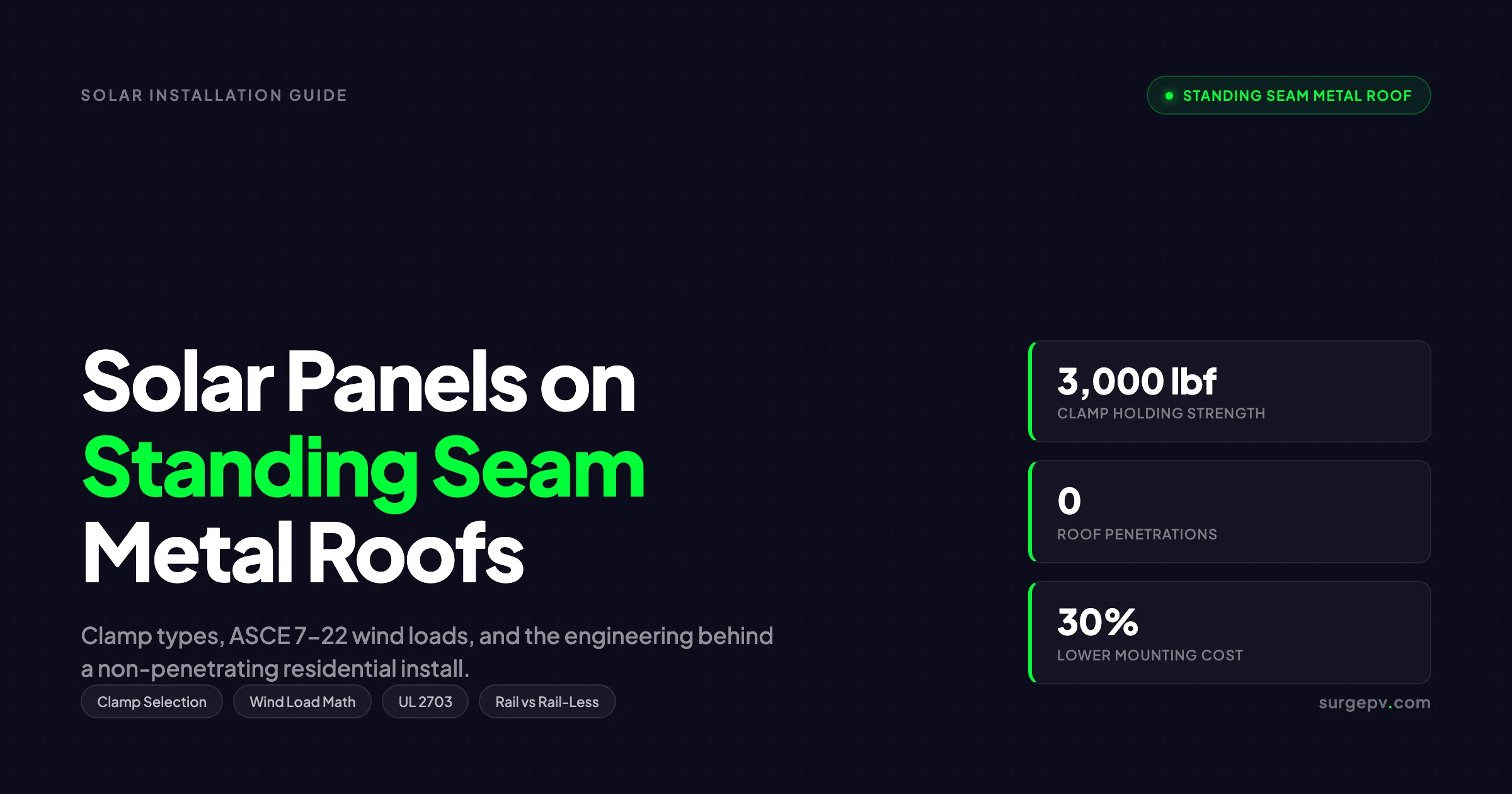
A 24-gauge Galvalume or aluminum standing seam panel carries a 40 to 70 year service life with finish warranties of 30 to 50 years. The solar modules above it carry a 25 to 30 year power warranty. A two-person crew can attach a 6 kW residential array in 4 to 6 hours of mounting time.
A standing seam metal roof is the single best surface in residential solar. The seams act as built-in mounting rails, the panel itself outlives the array, and a well-engineered clamp transfers wind and snow loads into the building structure without ever piercing the roof. Solar panels on a standing seam metal roof can be installed in 30 to 50 percent less labor time than a comparable composition shingle install, the homeowner keeps the roof manufacturer’s lifetime warranty, and the entire array is fully reversible at end of life. Read Solar Racking Design Guide for a complete walkthrough.
A 24-gauge Galvalume or aluminum standing seam panel carries a 40 to 70 year service life with finish warranties of 30 to 50 years. The solar modules above it carry a 25 to 30 year power warranty. A two-person crew can attach a 6 kW residential array in 4 to 6 hours of mounting time.
This guide is written for installers, designers, and AHJ reviewers who need the engineering detail behind those claims. It covers seam profile identification, the three clamp families, ASCE 7-22 wind load math, attachment spacing, holding strength data from UL 2703, real installation cost numbers, and the failure modes we have seen in the field.
TL;DR — Solar on Standing Seam Metal Roofs
Non-penetrating clamps grip the raised seam and transfer all loads into the structural deck without piercing the roof. The right clamp depends on seam profile (snap-lock, mechanical-lock, T/bulb, trapezoidal). Holding strength runs 1,500–3,000+ lbf per clamp. ASCE 7-22 governs wind pressure and edge/corner zone spacing. Direct-attach (rail-less) systems cut mounting cost 25–50 percent versus railed systems. Always pull a structural letter and a roof manufacturer warranty confirmation before installation.
In this guide:
- The four standing seam profiles you will see in the field and how to identify each one
- The three clamp families and the major manufacturers in each (S-5!, SnapNrack, AceClamp, EcoFasten, IronRidge, RoofClamp)
- Rail-less versus railed mounting on standing seam — when to use which
- ASCE 7-22 wind load calculation walkthrough with a worked example
- UL 2703 mechanical load testing and how to read a clamp holding strength table
- Snow load, combined loading, and thermal expansion design rules
- Cost per watt for standing seam installs and breakdown of the savings
- Step-by-step installation walkthrough, torque values, and inspection checklist
- The five most common failure modes and how to avoid them
Why Standing Seam Metal Roofs Are the Best Surface for Residential Solar
The case for solar on a standing seam metal roof is structural, financial, and warranty-related at the same time.
The roof outlasts the array. A 24-gauge Galvalume or aluminum standing seam panel carries a 40 to 70 year service life with finish warranties of 30 to 50 years. The solar modules above it carry a 25 to 30 year power warranty. A composition shingle roof under solar will need to be replaced and the array de-installed and re-installed at least once over the system life — a 4,000 to 7,000 USD cost on a typical residential system. On a standing seam roof, that re-roof event does not happen.
The seam is a structural rail. Standing seam panels are designed to transfer wind uplift and snow load into purlins or solid decking through the seam itself. A correctly specified solar clamp loads the seam in the same direction the building was engineered for. There is no point load on a flexible substrate, no compression of an underlayment, and no thermal break to fail.
Zero penetrations. The single most common warranty claim on a metal roof is a leak at a fastener penetration. A non-penetrating clamp eliminates the failure mode entirely. The roof manufacturer’s water-tightness warranty stays in force because the clamp does not pierce the panel.
Faster installation. Crews can install a standing seam array 30 to 50 percent faster than a comparable shingle array, according to S-5! and SnapNrack labor studies. The seam provides built-in alignment, the clamps are tool-light, and there is no flashing to weatherproof. A two-person crew can attach a 6 kW residential array in 4 to 6 hours of mounting time.
Cooler module operation. Standing seam roofs reflect more solar radiation than asphalt and create an air gap under the module. Field measurements from NREL and SolarPower Europe report module operating temperatures 4 to 8 °C lower on metal roofs than on shingle roofs in the same climate. That translates to 1.5 to 3 percent more annual energy yield over a system that uses PV design software to optimize tilt and string layout. Also see: European Solar Incentives. For Europe-specific compliance details, see Europe solar compliance.
The trade-off is that not every standing seam roof is solar-ready. Seam height, seam profile, panel gauge, and purlin spacing all need to clear minimum thresholds before any clamp can be specified. The next section walks through how to read the roof in front of you.
Standing Seam Roof Anatomy: Profiles, Seam Heights, and Materials
Before specifying a clamp, you have to identify what is on the roof. Four geometric families dominate U.S. and European residential standing seam, and each one has a specific clamp pairing.
The Four Standing Seam Profiles
| Profile | Seam Height | Seam Geometry | Typical Clamp Family |
|---|---|---|---|
| Snap-lock standing seam | 1.0–1.75 in (25–45 mm) | Two folded edges that snap together over a male leg | S-5-S, AceClamp A2, RoofClamp RCT |
| Mechanical-lock (double-fold) | 1.5–3.0 in (38–76 mm) | Field-seamed with a power seamer; 90° or 180° double fold | S-5-V, S-5-Z, SnapNrack 500, EcoFasten SimpleBlock-U |
| T-seam / bulb seam | 1.5–3.0 in (38–76 mm) | Symmetrical T or rounded bulb head | S-5-T, S-5-B, RoofClamp RCT |
| Trapezoidal / face-fastened | varies | Exposed screw through rib top (not a true standing seam) | S-5-N, EcoFasten SimpleBlock-Trap |
A homeowner often calls everything a “standing seam roof,” but trapezoidal panels with exposed fasteners are functionally a different product and need a different attachment family. Confirm visually before specifying.
Field Identification Checklist
Run these five checks before ordering any clamps:
- Measure seam height with a digital caliper or ruler at three points along one panel. Note the minimum value found.
- Measure seam width at the head of the fold. Snap-lock seams are typically 0.4–0.6 in wide; mechanical-lock seams are 0.2–0.5 in wide.
- Photograph the seam in cross-section. Many manufacturers will identify the profile and the panel gauge from a clear photo.
- Identify the panel gauge. 24-gauge steel and 0.032 in aluminum are the two most common residential grades. Lower gauge (thicker) panels generally yield higher clamp holding strength.
- Locate fasteners and clips. Snap-lock and mechanical-lock panels use concealed clips. If you see exposed screws on the panel face, you are working with a face-fastened panel — not a standing seam.
Materials and Galvanic Compatibility
Most residential standing seam roofs are 24-gauge steel with a Galvalume or Kynar 500 finish, or 0.032–0.040 in aluminum. Solar clamps for these roofs are typically 6005-T5 or 6061-T6 aluminum bodies with stainless 304 or 316 set screws and bolts. The pairing avoids galvanic corrosion at the contact point because aluminum-to-aluminum or aluminum-to-stainless-on-Galvalume sits within an acceptable galvanic potential range.
A galvanic mismatch is rare in modern systems, but field-installed copper or untreated carbon steel hardware can cause pitting at the contact point inside 5–10 years. Reject any clamp shipment that includes plain steel fasteners or any non-stainless hardware.
Pro Tip — Verify the Seam Before You Specify
Two roofs that look identical from the ground can have different seam profiles. We have seen 1.5 in mechanical-lock seams that fail a snap-lock-only clamp installation because the fold geometry is reversed. Spend 10 minutes on the roof with a caliper and a phone camera before you put a clamp in the BOM.
The Three Clamp Families on a Standing Seam Roof
Every standing seam clamp on the market belongs to one of three mechanical families. The family determines what the clamp can grip, how it transfers load, and what its published holding strength is.
Family 1 — Set-Screw Compression Clamps
The set-screw compression clamp is the most common design on residential standing seam roofs. Two or more round-point or oval-point set screws drive horizontally through the clamp body and compress against the seam material. The compression friction holds the clamp; gravity, uplift, and lateral loads transfer through the clamp body into the seam and into the panel.
Examples: S-5-S (snap-lock), S-5-V (mechanical-lock), S-5-T (T-seam), S-5-B (bulb-seam), AceClamp A2.
Strengths. Universal across most snap-lock and mechanical seams. No deformation of the seam if torque is correct. Removable and reusable. The S-5! round-point set screw is engineered to compress without piercing the finish coating, so the corrosion warranty stays intact. Also see: Us Residential Solar Market Trends 2026. For United States-specific compliance details, see United States arizona/phoenix.
Limitations. Holding strength is set-screw torque-dependent. Under-torque and the clamp slips; over-torque and the screw can pierce thin-gauge panels. Each clamp must be torqued and re-torqued (the S-5! manual specifies torque verification at 160–180 in-lb after 24 hours of seam compression settling).
Family 2 — Cam / Wedge Mechanical Clamps
The cam or wedge clamp uses an internal cam, lever, or expanding wedge to grip the seam. Tightening one bolt actuates the cam, which mechanically locks against the seam without relying on direct compressive force.
Examples: SnapNrack Series 500 (cam-lock), Quick Mount PV E-Mount, AceClamp Solar Snap (push-pin).
Strengths. Tool-light installation. Many designs are torque-set or torque-limited at the design value, so over-tightening is harder. Push-pin variants like the AceClamp Solar Snap eliminate set screws entirely — the installer drops the clamp on the seam and a push-pin locks it.
Limitations. Less universal — each cam clamp is designed for a narrower band of seam profiles. Mismatched seams can defeat the cam mechanism. Some designs are rated for snap-lock seams only and cannot grip a mechanical-fold seam.
Family 3 — Universal Wide-Jaw Clamps
The universal wide-jaw clamp uses a one-piece body with a deep, contoured throat that conforms to a wide range of seam geometries. Two or more set screws still compress against the seam, but the wider jaw lets a single SKU cover snap-lock, T-seam, and bulb-seam profiles.
Examples: RoofClamp RCT, S-5-K Grip, Mibet 6061-T6 universal clamp.
Strengths. One SKU covers ~95 percent of standing seam profiles. Useful for retrofit fleets where the installer cannot pre-survey every roof. Some wide-jaw clamps also accept large bulb and T-seams that narrow-throat designs reject.
Limitations. Higher unit price than a profile-specific clamp. Larger physical footprint may be visually obtrusive on a low-pitch architectural roof.
Side-by-Side Family Summary
| Family | Typical Holding Strength | Primary Use Case | Cost Per Clamp (USD) |
|---|---|---|---|
| Set-screw compression | 1,500–3,000+ lbf | Most residential and commercial standing seam | 12–28 |
| Cam / wedge mechanical | 1,200–2,500 lbf | Snap-lock with tool-light install | 18–35 |
| Universal wide-jaw | 1,500–2,800 lbf | Retrofit fleets, mixed seam inventory | 22–40 |
Holding strength is typical published pull-out (uplift) per clamp on a 24-gauge Galvalume snap-lock seam. Always reference the specific clamp-and-roof combination in the manufacturer load test summary.
Major Clamp Manufacturers Compared
The U.S. residential standing seam clamp market is consolidated around six brands. Each one has a different strength.
S-5!
The category leader. Founded by Rob Haddock in 1992, S-5! sells more standing seam clamps than every other manufacturer combined. The product line covers 23+ clamp variations matched to specific roof manufacturers (S-5-N for Nucor Vulcraft, S-5-Z for ZIP-RIB, S-5-K Grip for KlipLok, etc.). The PVKIT 2.0 rail-less system pairs the clamps with a direct-attach module clip and is the industry benchmark for low-cost standing seam solar.
When to specify S-5!: Any project that needs a roof manufacturer warranty letter. S-5! has approvals from nearly every metal roof maker in North America.
SnapNrack
The Series 500 standing seam system from SnapNrack pairs a cam-action clamp with the company’s UL 2703 rail platform. The system is popular with crews already standardized on SnapNrack rail for shingle roofs because the rail and module clamps are common across both attachment types.
When to specify SnapNrack: Mixed-roof fleets where a single rail platform reduces SKU count.
AceClamp
AceClamp builds the A2 set-screw clamp and the Solar Snap push-pin clamp. The Solar Snap is one of the few tool-free clamp designs on the market and is specified for trapezoidal standing seam panels where set-screw alignment is difficult.
When to specify AceClamp: Trapezoidal seams or any project where installer training time is the bottleneck.
EcoFasten
The SimpleBlock-U is EcoFasten’s standing seam attachment. Pre-installed oval-point set screws and a T-slot top make it compatible with the ClickFit rail system. EcoFasten markets primarily through residential channels and is most common in the Northeast and Midwest U.S.
When to specify EcoFasten: Residential systems already specifying ClickFit rails.
IronRidge HALO
IronRidge entered the standing seam market with the HALO Universal Mounting System. The HALO sits on top of a third-party clamp (S-5! is the most common partner) and delivers IronRidge’s XR rail and bonding system to the standing seam install. The strength is the same XR rail the installer is already familiar with from shingle work.
When to specify IronRidge HALO: Crews already standardized on IronRidge XR rails.
RoofClamp / Sno-Blox
The RoofClamp RCT is a one-SKU universal clamp that the manufacturer claims fits 95 percent of standing seam profiles. It is heavier and pricier than a profile-specific clamp but eliminates inventory risk on retrofit fleets.
When to specify RoofClamp: Retrofit and re-roof crews working across many seam types.
Design Your Standing Seam Array in SurgePV
Place modules, simulate shading, and generate a stamped layout for your standing seam roof in one workflow. Built for installers who price by the watt.
Book a DemoNo commitment required · 20 minutes · Live project walkthrough
For more on this topic, see Solar Shading Analysis Guide.
Rail-Less vs. Railed Mounting on Standing Seam
Once the clamp is selected, the next decision is whether to use a traditional rail platform or a direct-attach (rail-less) mounting kit. The answer has cost, layout, and serviceability implications.
Railed Standing Seam Systems
A railed system uses two horizontal aluminum rails per row of modules. The rails bolt to L-feet or directly to clamp tops, and the modules clamp to the rails with mid- and end-clamps. The rail platform is what every installer trained on a shingle roof already knows.
Strengths. Module placement is flexible — the rail can extend beyond the seam grid and accommodate non-rectangular roof shapes. Wire management is built into the rail. Mid-array module replacement is straightforward. UL 2703 listing is well-established for major rail brands.
Limitations. Higher material cost (rails add 0.05–0.10 USD per watt). Heavier dead load on the roof. More skyline visibility (rails sit above the seam).
Rail-Less (Direct-Attach) Systems
Rail-less systems eliminate the rail. The module bolts directly to a clamp top with a module bonding clip. The most established product is the S-5! PVKIT 2.0, which uses an EdgeGrab clip that compresses the module frame against the clamp top.
Strengths. 25 to 50 percent material cost reduction. 30 to 50 percent labor reduction (S-5! published study, 2022). Lower wind profile because the module sits closer to the seam. No rail-related thermal expansion design.
Limitations. Module placement is constrained to the seam grid — you can only attach where there is a seam. Mid-array module replacement requires removing adjacent modules. UL 2703 listing is module-specific (not generic), so the BOM must list a specific clamp + module combination that has been listed together.
When to Pick Each One
| Project Condition | Better System |
|---|---|
| Rectangular array, standard module size, cost sensitive | Rail-less |
| Non-rectangular array, custom module placement | Railed |
| Crew trained on IronRidge / SnapNrack | Railed |
| Crew specialized in metal roofs, S-5! shop | Rail-less |
| Dense urban roof with strict aesthetic review | Rail-less (lower profile) |
| Heavy snow region with long unsupported spans | Railed (rail handles span load) |
For most residential standing seam projects in 2026, rail-less is the more cost-effective answer when the array is rectangular and the modules align with the seam grid. SurgePV’s solar software auto-detects seam geometry from satellite imagery and recommends the seam-aligned layout that maximizes attachment efficiency. For a direct comparison, see Arka 360 vs SurgePV.
Wind Load Engineering: ASCE 7-22 Walkthrough
This is the section where most installations fail their AHJ review. Standing seam clamp selection and spacing are governed by ASCE 7-22 wind pressure analysis, and the calculations changed in ways that catch crews still using ASCE 7-10 or 7-16 references.
What ASCE 7-22 Changed
ASCE 7-22 was published in December 2021 and is referenced by IBC 2024. Three changes affect standing seam solar directly:
- Updated wind speed maps. The 50-year mean recurrence interval maps were revised. Many coastal counties moved up by 5 to 10 mph in design wind speed.
- New PV-specific figures. Figures 29.4-7 and 30.3-2 through 30.3-7 cover roof-mounted solar. Parallel-to-roof PV is now treated as a roof component and has explicit pressure coefficients (GCp) by zone.
- Edge and corner zone amplification. The corner zone uplift coefficient increased on low-rise buildings. Corner zones in residential applications often see GCp values 25 to 40 percent higher than ASCE 7-10 produced.
A crew using a 2018 manufacturer span table that was not updated for ASCE 7-22 will under-design the corner zones by 15 to 25 percent. That is the single most common engineering error we see in AHJ rejections.
For the underlying definitions and exposure category assignments, see our wind load calculation glossary entry and the ASCE 7 reference page.
The Core Calculation
The ASCE 7-22 design wind pressure on a roof-mounted solar component is:
p = qh × (GCp - GCpi)Where:
- p = design wind pressure (psf)
- qh = velocity pressure at mean roof height (psf)
- GCp = external pressure coefficient (PV component, by zone)
- GCpi = internal pressure coefficient (typically ±0.18 for enclosed buildings)
The velocity pressure qh comes from:
qh = 0.00256 × Kz × Kzt × Kd × Ke × V²Where:
- Kz = velocity pressure exposure coefficient (depends on exposure category: B, C, or D)
- Kzt = topographic factor (typically 1.0 except near hills or escarpments)
- Kd = directionality factor (0.85 for components and cladding)
- Ke = ground elevation factor
- V = basic wind speed (mph) from ASCE 7-22 Figure 26.5-1
Worked Example — Phoenix Suburb
A 6 kW residential array on a 1,800 sq ft single-story home in Phoenix, Arizona.
| Parameter | Value | Source |
|---|---|---|
| Basic wind speed V | 110 mph | ASCE 7-22 Fig 26.5-1B |
| Exposure category | C (suburban open) | ASCE 7-22 Sec 26.7 |
| Kz at 15 ft mean roof height | 0.85 | ASCE 7-22 Tab 26.10-1 |
| Kzt | 1.0 | flat terrain |
| Kd | 0.85 | ASCE 7-22 Tab 26.6-1 |
| Ke | 0.99 | elevation 1,150 ft |
| Velocity pressure qh | 21.7 psf | calculated |
| Interior zone GCp (PV uplift) | -1.0 | ASCE 7-22 Fig 30.3-2 |
| Corner zone GCp (PV uplift) | -2.5 | ASCE 7-22 Fig 30.3-2 |
| Interior design pressure | -25.6 psf uplift | calculated |
| Corner design pressure | -58.4 psf uplift | calculated |
The corner zone uplift is 2.3 times the interior zone uplift. On a 17.6 sq ft 410 W module, that is 1,028 lbf of uplift in the corner zone versus 451 lbf in the interior zone. Two clamps per module in the corner zone need to resist 514 lbf each — well within the 1,500+ lbf published holding strength of an S-5-S clamp on a 24-gauge snap-lock seam.
From Pressure to Clamp Spacing
Most manufacturer span tables are organized by:
- Module size and weight
- Seam type and panel gauge
- Wind exposure category
- Basic wind speed
- Roof zone (interior, edge, corner)
Reading the table backwards: pick the highest pressure zone the array touches, find the maximum span at that pressure, and use that span across the entire array (or zone the array and use different spans for interior vs. corner). Most residential arrays that stay 3 ft from the roof edge can use a uniform interior-zone span.
For projects in the U.S., the SurgePV generation and financial tool integrates with ASCE 7-22 wind data so the design output includes the engineered clamp spacing for the project’s exact zip code.
Key Takeaway — Don’t Trust Old Span Tables
If the clamp manufacturer’s span table is dated before mid-2023, it is almost certainly built on ASCE 7-10 or 7-16 coefficients. Using it on a project where IBC 2024 is in force will fail engineering review at AHJ. Confirm the table reference standard on the first page before specifying.
Snow Load, Combined Loading, and Thermal Expansion
Wind is not the only load that drives clamp spacing. Snow, dead load, and thermal expansion all interact, and the controlling load case in cold climates is usually the combined snow-and-wind case under ASCE 7-22 Chapter 2.
Ground Snow Load and Roof Conversion
ASCE 7-22 Figure 7.2-1 defines ground snow load (Pg) by location. The flat-roof snow load (Pf) is:
Pf = 0.7 × Ce × Ct × Is × PgWhere:
- Ce = exposure factor (0.9–1.2)
- Ct = thermal factor (1.0 for heated buildings)
- Is = importance factor (1.0 for residential)
A 35 psf ground snow region (typical for upstate New York, northern Michigan, Vermont) yields a flat-roof snow load of about 22 to 29 psf depending on exposure. On a 17.6 sq ft module, that is 387 to 510 lbf of snow dead load per module on top of the 50 to 60 lb module weight. Two clamps per module need to carry 220 to 285 lbf each in pure compression.
Compression loading is generally not the limiting case for a standing seam clamp — most clamps have compression ratings 2 to 3 times their uplift ratings. The clamp body sits on the seam and the seam transfers load directly into the panel and structure.
Snow Sliding and Snow Retention
The bigger snow concern on standing seam is snow sliding. Smooth metal panels shed snow as cohesive slabs, and a sliding mass can shear off solar modules or ice-dam against the array. Solutions:
- Snow guards above the array. S-5! ColorGard or similar snow retention bars upslope of the modules break the slab into smaller releases.
- Snow guards below the array. Catch any released snow before it reaches gutters or pedestrian areas.
- Module mid-clamps rated for combined load. ASCE 7-22 combined load case 6 (1.0 D + 1.0 S + 0.45 W) is typically the controlling case for snow climates.
Dead Load
Module + clamp + rail (if used) dead load is typically:
| System | Dead Load (psf) |
|---|---|
| Rail-less direct-attach (S-5! PVKIT) | 2.5–3.0 |
| Railed system (IronRidge XR, SnapNrack Ultra) | 3.0–4.0 |
| Module weight only (60-cell, 410 W) | 2.6–2.8 |
Existing residential structures designed to IRC are required to carry 20 psf live load and a snow load by region. A 3 psf solar dead load is a small addition, but a structural engineer still needs to confirm the existing purlin or rafter capacity. Use SurgePV’s shadow analysis to confirm the array layout and stay clear of structural reinforcement triggers.
Thermal Expansion and the Floating Clamp
Standing seam panels expand and contract with temperature. A 30 ft Galvalume panel can move 0.20 to 0.30 in across a 100 °F temperature swing. The roof is designed to handle this — the panel slides on its concealed clip system and floats relative to the structural deck.
Solar clamps must not bind that movement. Two design rules:
- Use a non-piercing set screw. A round-point set screw (like the S-5! design) compresses against the seam without penetrating the finish. The clamp slides with the panel; nothing tears.
- Do not over-torque. Excessive torque can crush the seam and fix the clamp permanently in place. Once the panel moves and the clamp does not, the panel deforms or the clamp pulls off.
Manufacturer torque specs typically run 130 to 180 in-lb for set-screw clamps. Always use a calibrated torque wrench. We re-torque every clamp 24 hours after initial install to compensate for seam compression settling.
UL 2703 and Holding Strength Data
UL 2703 is the standard for solar mounting systems, and it governs the published holding strength values that appear on every clamp manufacturer’s spec sheet. Reading those values correctly is the difference between an engineered install and a guess.
What UL 2703 Tests
UL 2703 covers four main test categories for a mounting system:
- Mechanical load — uplift and downforce simulating wind and snow up to 5,400 Pa (113 psf).
- Bonding and grounding — electrical continuity from module frame to grounding conductor.
- Fire classification — module-mount system fire rating (Class A, B, or C).
- Cycling, salt fog, humidity — environmental durability over the system life.
The mechanical load test is what produces the holding strength number on the spec sheet. The system is loaded incrementally to failure, and the published value is typically 50 to 60 percent of the failure load (a safety factor of 1.67 to 2.0).
How to Read a Holding Strength Table
A typical S-5! load test summary lists holding strength by:
- Roof manufacturer (Englert, Fabral, ATAS, McElroy, etc.)
- Panel profile (1.5 in snap-lock, 1.75 in mechanical-lock, 2 in T-seam)
- Panel gauge (22, 24, 26 gauge)
- Set-screw torque (in-lb)
- Load direction (uplift, downforce, lateral)
A representative entry: S-5-S on Englert SmartLock 24-gauge snap-lock at 160 in-lb torque — 1,654 lbf uplift, 2,310 lbf downforce, 1,287 lbf lateral.
Three things to notice:
- Uplift is always the lowest of the three. Wind uplift is the controlling case for most projects.
- Lower gauge (thicker panel) yields higher holding strength. A 22-gauge seam holds 15 to 25 percent more than a 26-gauge seam.
- The specific roof brand matters. Two snap-lock panels from different manufacturers can yield holding strengths that differ by 30 percent.
What Is Not in UL 2703
UL 2703 does not cover the structural deck, purlins, or rafters under the standing seam panel. The clamp can hold 3,000 lbf, but if the underlying purlin pulls out at 1,200 lbf, the system fails at the purlin. This is why a structural engineer’s structural letter is mandatory in nearly every U.S. AHJ — UL 2703 stops at the clamp.
Approved Combinations and Roof Manufacturer Letters
Major roof manufacturers maintain published lists of approved solar attachments. Examples:
- Englert publishes an “Approved Solar Attachment” list updated annually.
- McElroy Metal posts approved S-5! and AceClamp products on its tech support portal.
- ATAS International issues project-specific warranty confirmation letters within 2 weeks for an approved clamp + roof combination.
For any project that needs the roof manufacturer’s water-tightness warranty to remain in force, request a written confirmation letter before ordering. Most letters cite the specific clamp, the torque value, and the maximum array dead load.
Step-by-Step Installation Walkthrough
This is the workflow our crews follow for a typical 6 kW residential standing seam array. The same workflow scales to commercial sizes; the engineering inputs change but the field steps do not.
Step 1 — Pre-Installation Survey
A 30-minute roof visit before the install day saves field problems. Record:
- Seam profile, height, and width (digital caliper)
- Panel gauge and finish (manufacturer ID stamp on the panel underside)
- Purlin or rafter spacing and direction
- Existing penetrations, vents, and obstructions
- Access path and material staging zone
Photograph everything. The structural engineer will ask for the underside framing photo. The roof manufacturer will ask for the seam cross-section photo.
Step 2 — Engineering Documents
Prepare and submit:
- Stamped structural letter referencing ASCE 7-22 and IBC 2024
- Wind load calculation by zone with attachment spacing table
- Roof manufacturer warranty confirmation letter
- Single-line diagram, plan view, and module layout
- UL 2703 system listing for the clamp + module + (optional) rail combination
Solar proposal software automates most of this paperwork — the engineered output goes directly into the AHJ submission package.
Step 3 — Layout and Chalk Lines
On install day:
- Snap a chalk line along each seam that will receive a clamp. Verify the line runs parallel to the seam, not the roof edge.
- Mark clamp positions along each chalk line using the engineered spacing.
- Tighter spacing at corners and eaves per the ASCE 7-22 zone analysis.
- Confirm that every clamp position is over a structural purlin or rafter.
Step 4 — Clamp Installation
For a set-screw compression clamp:
- Slide the clamp over the seam in the correct orientation (ridge-side up for most designs).
- Position the clamp at the chalk line mark.
- Tighten the set screws in a cross pattern to 50 percent of final torque.
- Tighten in cross pattern to full torque (typically 160 to 180 in-lb).
- Mark the clamp with a paint pen to confirm torque verification on inspection.
For a cam or wedge clamp, follow the manufacturer single-bolt procedure — no torque sequence needed.
Step 5 — Rail (If Applicable)
Bolt L-feet to the clamp tops. Slide rail sections in with the rail manufacturer’s expansion joint at the engineered span. Verify rail level with a 4 ft level. Tighten L-foot bolts to 16 ft-lb.
Step 6 — Module Installation and Bonding
Place modules onto rails or directly onto rail-less clamps. Tighten mid-clamps to module manufacturer torque (typically 8 to 12 ft-lb). Verify electrical bonding continuity from each module frame back to the grounding conductor with a low-resistance ohmmeter — UL 2703 requires less than 0.1 ohms.
Step 7 — Re-Torque at 24 Hours
Return to the site within 24 hours of clamp installation. Re-torque every set-screw clamp to the manufacturer specification. Seam material compresses slightly under load, and the re-torque is part of the manufacturer’s installation specification.
Step 8 — Inspection and Documentation
The AHJ inspector will check:
- Stamped structural letter on site
- Visible torque verification marks on each clamp
- Module electrical bonding continuity
- Disconnect labeling and conductor sizing
- Module count and string configuration matching the submitted plan
Document torque values, clamp lot numbers, and inspection date on the project closeout package.
Cost Analysis: Standing Seam vs. Shingle Mounting
For installers pricing a standing seam project, the mounting cost difference versus shingle is often misunderstood. Here is the breakdown for a 6 kW residential array (15 modules, 410 W each).
Material Cost Comparison
| Component | Shingle (Comp Roof) | Standing Seam (Railed) | Standing Seam (Rail-Less) |
|---|---|---|---|
| Flashing / clamp | 30 attachments × $18 = $540 | 30 clamps × $22 = $660 | 30 clamps × $22 = $660 |
| L-feet / brackets | included | $180 | $0 |
| Rails | $420 | $420 | $0 |
| Module mid/end clamps | $90 | $90 | $0 (integrated into PVKIT) |
| Module clips (rail-less) | $0 | $0 | $180 |
| Wire management | $60 | $60 | $40 |
| Total mounting BOM | $1,110 | $1,410 | $880 |
| Per watt | $0.181 | $0.230 | $0.143 |
The standing seam railed system is 27 percent more expensive in material than shingle. The standing seam rail-less system is 21 percent cheaper.
Labor Cost Comparison
| Activity | Shingle | Standing Seam (Railed) | Standing Seam (Rail-Less) |
|---|---|---|---|
| Roof prep | 1.5 hr | 0.5 hr | 0.5 hr |
| Attachment install | 4.0 hr | 2.5 hr | 2.5 hr |
| Rail install | 2.0 hr | 2.0 hr | 0 hr |
| Module install | 3.0 hr | 3.0 hr | 2.0 hr |
| Electrical | 4.0 hr | 4.0 hr | 4.0 hr |
| Total field labor | 14.5 hr | 12.0 hr | 9.0 hr |
| Labor at $85/hr (2-person) | $1,232 | $1,020 | $765 |
Net total mounting cost (material + labor):
| System | Total Cost | Cost per Watt |
|---|---|---|
| Shingle (composition) | $2,342 | $0.381 |
| Standing seam (railed) | $2,430 | $0.396 |
| Standing seam (rail-less) | $1,645 | $0.268 |
The rail-less standing seam install is 30 percent cheaper end-to-end than a comparable shingle install. That delta drives most of the field economics on standing seam jobs and is why direct-attach systems are now the default for installers who specialize in metal roofs.
For a full ROI breakdown including the avoided re-roof cost over the 25-year system life, run the project through a solar financial analysis tool — the standing seam saves another $4,000 to $7,000 by avoiding the array de-install and re-install required when a shingle roof reaches end of life.
Common Failure Modes and How to Avoid Them
The five problems we see most often in standing seam solar field reports.
1. Set-Screw Loosening From Seam Compression Settling
What happens. The set screw compresses the seam material on day one. Over the next 24 to 72 hours, the seam material settles slightly, the contact pressure drops, and the set screw is no longer at design torque. Holding strength can fall 15 to 25 percent.
Prevention. Re-torque every set-screw clamp 24 hours after initial installation. Mark each clamp with a paint pen to verify the re-torque on inspection.
2. Wrong Clamp for the Seam Profile
What happens. A snap-lock clamp goes on a mechanical-lock seam, or vice versa. The clamp body does not fully engage the seam, and field holding strength is 30 to 50 percent below the spec sheet.
Prevention. Pre-install survey with caliper measurement of seam height and width. Match dimensions against the manufacturer compatibility chart. Photograph the seam cross-section and email it to the manufacturer’s tech support if any doubt remains.
3. ASCE 7-22 Corner Zone Under-Design
What happens. The crew uses an interior-zone clamp spacing across the entire array because the manufacturer span table did not break out edge and corner zones. The corner clamps pull out in the first 100+ mph wind event.
Prevention. Verify the span table is dated post-2023 and references ASCE 7-22. Apply tighter spacing at corner and edge zones — typically 50 to 70 percent of the interior zone span.
4. Galvanic Mismatch With Plain Steel Hardware
What happens. A field installer substitutes a plain steel bolt for the spec’d stainless 304 hardware because of supply issues. Five years later, the contact point pits and the clamp body corrodes.
Prevention. Reject any clamp shipment with non-stainless hardware. Match the manufacturer hardware spec on the closeout documentation.
5. Seam Crushing From Over-Torque
What happens. An installer uses a non-calibrated torque wrench or a hand-feel torque, and the set screw exceeds the 180 in-lb maximum. The seam material crushes, and the clamp becomes a fixed point on a panel that needs to thermally float.
Prevention. Calibrated torque wrench on every clamp. Annual calibration of the wrench. No exceptions for “experienced installers” — torque calibration drift is real.
Designing the Array in SurgePV
The mounting decisions above plug into the array design itself. SurgePV’s solar design software ingests the seam grid from satellite or LIDAR imagery, places modules on seam-aligned spacing, and outputs the engineered attachment layout.
The workflow:
- Import the roof. Address-based satellite import or LIDAR upload.
- Detect seam orientation. SurgePV identifies seam direction and spacing automatically on metal roofs.
- Place modules on the seam grid. The layout engine snaps modules to seam-aligned positions to maximize attachment points per module.
- Run shading analysis. Solar shadow analysis software projects vent stack and dormer shading across all 8,760 hours of the year.
- Generate the attachment plan. Each clamp position is marked on the construction drawing with the engineered spacing per ASCE 7-22 zone.
- Output proposal documents. Solar proposal tools auto-generates the customer-facing proposal with the attachment plan, energy yield, and ROI.
The same design data feeds the structural engineer’s review and the AHJ submission package, so the project moves from sale to permit in a single workflow.
For more on how the residential design workflow connects sales and engineering, see our companion guide.
Conclusion: Three Action Items
If you are pricing a standing seam project this quarter:
- Survey before you specify. A 30-minute roof visit with a caliper resolves 90 percent of the clamp-mismatch problems we see. Photograph the seam, measure the height and width, and confirm the panel gauge before ordering.
- Verify your engineering references. Confirm the manufacturer span table is dated post-2023 and references ASCE 7-22. If it is older, escalate to the manufacturer’s engineering department for an updated table or a project-specific PE letter.
- Default to rail-less. For rectangular residential arrays on a clean seam grid, direct-attach systems like the S-5! PVKIT 2.0 cut total mounting cost 25 to 30 percent versus a railed system. Rail systems are still the right answer for non-rectangular layouts and heavy snow regions, but rail-less is the cost benchmark.
Frequently Asked Questions
How are solar panels attached to a standing seam metal roof without penetrations?
Solar panels attach to a standing seam metal roof using mechanical clamps that grip the raised seam. Set screws compress against the seam and transfer module loads through the clamp body into the roof panel and into the building’s structural deck. No fastener penetrates the roofing membrane, so the watertight integrity and roof manufacturer warranty stay intact. The most common products are S-5!, SnapNrack Series 500, AceClamp, IronRidge HALO, and EcoFasten SimpleBlock.
What is the best clamp for a standing seam metal roof?
There is no single best clamp. The right clamp depends on the seam profile: snap-lock seams pair with the S-5-S, AceClamp A2, or RoofClamp RCT. Mechanical-lock and double-folded seams require the S-5-V, S-5-Z, or SnapNrack 500. Trapezoidal and bulb seams need a wider-jaw clamp such as the S-5-T or RoofClamp RCT. Always confirm seam dimensions (height, width, geometry) before specifying.
How much weight can standing seam clamps hold?
Pull-out (uplift) holding strength varies by seam type and clamp: S-5! published a holding strength of 1,500 to 3,000+ lbf per clamp on common 24-gauge snap-lock and standing seam roofs, depending on roof manufacturer and seam profile. Mechanically seamed roofs typically yield the highest holding values. Each project should reference the specific roof-and-clamp combination on the manufacturer’s load test summary table.
What is the typical clamp spacing for a standing seam solar installation?
Clamp spacing is determined by ASCE 7-22 wind pressure analysis and module mechanical load ratings, not a rule of thumb. For a typical residential roof in a 110 to 140 mph design wind speed zone, clamps land every 2 to 4 feet along each module row. High-uplift zones (roof corners, eaves) require closer spacing. Engineering software or the mounting manufacturer’s published span table sets the final layout.
Will solar panels void my standing seam metal roof warranty?
No, when installed with a non-penetrating clamp approved by the roof manufacturer. Most major standing seam roof brands publish an approved attachment list. S-5! holds approvals from nearly every U.S. metal roof manufacturer because the clamp does not pierce the panel and uses a round-point set screw that does not damage the seam coating. Always submit the proposed clamp and torque value to the roof manufacturer for a warranty confirmation letter before installation.
Do I need a structural engineer to mount solar on a standing seam metal roof?
Yes, in nearly every U.S. jurisdiction. The Authority Having Jurisdiction (AHJ) requires a stamped structural letter that confirms the existing purlins or rafters can carry combined dead, live, snow, and wind loads with the array installed. The engineer references ASCE 7-22 and IBC 2024 for wind pressure and the IRC for residential framing. The cost is typically 250 to 800 USD for a residential review.
What seam profiles are NOT compatible with standing seam clamps?
Face-fastened trapezoidal panels (with exposed screws through the rib) and corrugated panels are not compatible with standing seam clamps. Those roofs require a different attachment family — usually a sealing washer and self-drilling screw through the rib top with a butyl or EPDM grommet. The S-5! T-series mini-clamp and EcoFasten SimpleBlock-Trap are designed for these exposed-fastened profiles. Confirm the clamp jaw geometry against the actual seam before ordering.
How does ASCE 7-22 affect solar mounting on standing seam roofs?
ASCE 7-22 (referenced in IBC 2024) updated wind pressure coefficients for low-slope rooftop solar in Figures 29.4-7 and 30.3-2 through 30.3-7. The standard treats parallel-to-roof PV as a roof component for uplift, with edge and corner zone amplification. Most clamp manufacturers updated their span tables in 2023 to 2024 to reflect ASCE 7-22 — using outdated tables based on ASCE 7-10 or 7-16 can under-design the attachment by 15 to 25 percent in corner zones.
Sources
- S-5! — Solar Panels on Metal Roof technical hub
- S-5! Cost Savings Best Practices for Solar Mounting on Standing Seam
- Sustainable Energy Action Committee — ASCE 7 Updates for Solar PV
- Solar Permit Solutions — ASCE 7-22 Solar Wind Load Standards
- EcoFasten — Installing Solar on Standing Seam Metal Roofing
- Intertek — UL 2703 Mounting Systems and Devices Overview
- AceClamp — Solar Snap Racking System
- SnapNrack — Metal Roof Solutions
Where this fits
This article is part of SurgePV's Solar Installation hub, which works through the topic from first principles to the decisions a project team actually has to make.