

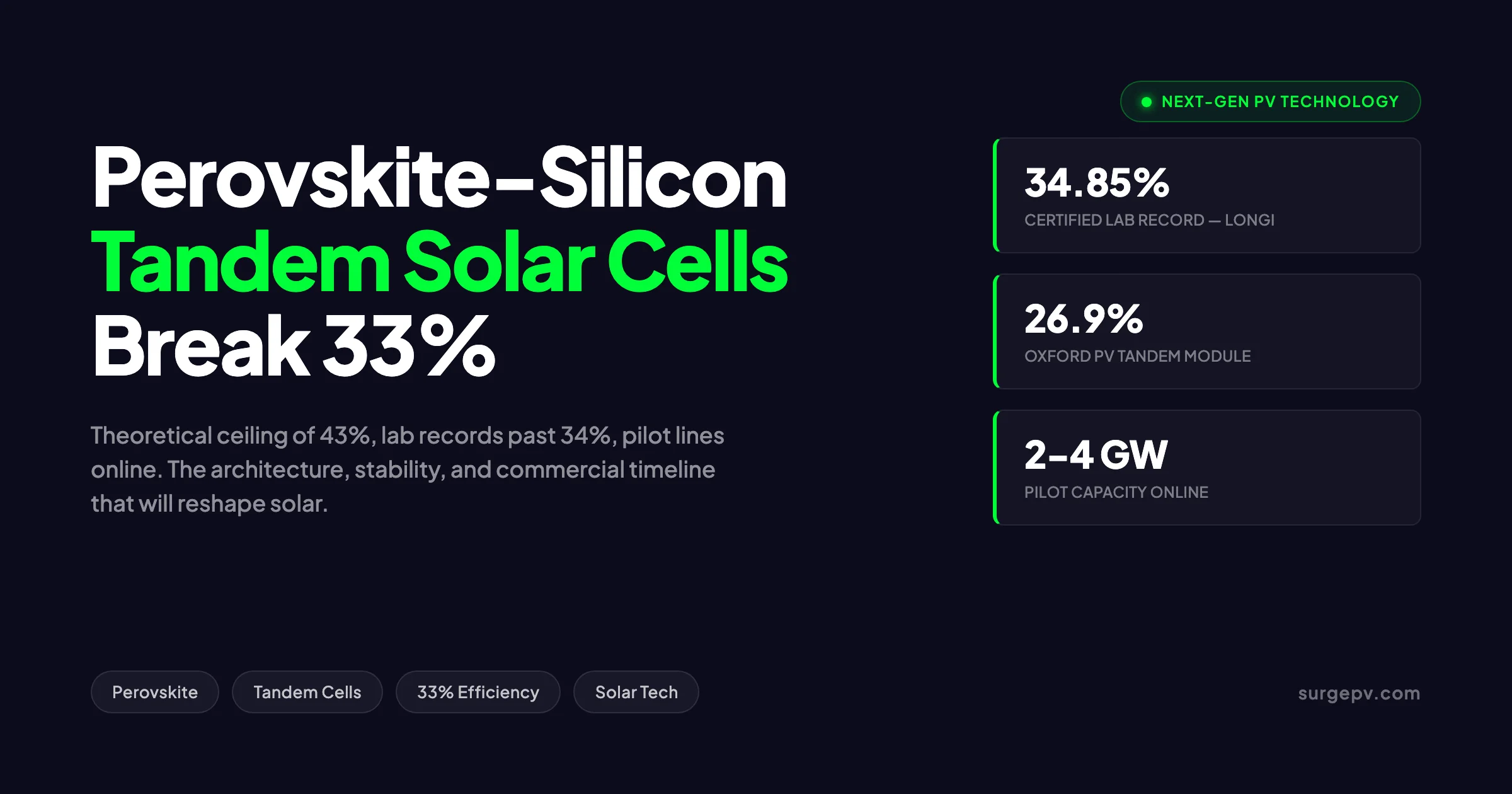
In November 2023, LONGi Green Energy crossed a line the photovoltaic industry had been chasing since the 1960s. Its perovskite-silicon tandem cell hit a certified 33.9% efficiency at the European Solar Test Installation, the first double-junction PV device to break the Shockley-Queisser single-junction limit of 33.7%. By April 2025 the same lab pushed the number to 34.85%. The theoretical ceiling for this architecture is around 43%. Also see: European Solar Incentives.
Perovskite-silicon tandem cells stack a perovskite top cell on silicon, capturing more of the solar spectrum. Lab records reached 33.9% in 2024. Manufacturing challenges include uniform deposition and 25-year stability. First commercial products expected 2027–2028.
That is the headline. The reality on a project site in 2026 is more measured. Oxford PV is shipping commercial 24.5% tandem modules to US utility customers, Hanwha Qcells has 28.6% mass-production-ready cells passing IEC certification, and a half-dozen Chinese tier-one manufacturers have pilot lines under construction. Mainstream installer-grade tandem panels with 25-year warranties are still 18 to 36 months away. This guide walks the technology, the records, the architectures, the stability story, and the commercial timeline that matters when you are scoping projects in PV design software today.
TL;DR — Perovskite-Silicon Tandem Solar Cells in 2026
Certified lab record: 34.85% (LONGi, April 2025). Commercial-size mass-production cell: 28.6% (Hanwha Qcells M10, December 2024). Shipping module: 24.5% commercial, 26.9% record (Oxford PV). Two architectures dominate: 2-terminal monolithic and 4-terminal mechanically stacked. Theoretical limit: 43%. Primary blocker: validated 25-year operational stability. Commercial pilot volumes ramp in 2026 to 2027, mainstream availability 2027 to 2030.
By the end of this guide you will understand:
- How a tandem cell breaks the Shockley-Queisser limit and why 43% is the real ceiling
- The difference between 2-terminal monolithic and 4-terminal mechanically stacked architectures
- Why every record since 2023 has come from interface engineering, not new absorbers
- Which manufacturers have GW-scale commercial timelines and which are still in pilot
- The exact stability metrics blocking 25-year warranties
- What a tandem module actually means for project economics in 2026
Latest Updates: Perovskite Tandem Solar in 2026
The first half of 2026 has been a busy stretch for perovskite tandem milestones. Several events deserve attention before walking the technology in depth.
Key Headlines, January to May 2026
1. Flexible perovskite-silicon tandem hits a certified 33.6% efficiency, published in Nature, May 2026.
2. Solx and Caelux announce a 5-year partnership to produce 3 GW of domestic perovskite-silicon tandem modules in Puerto Rico, targeting 28% module efficiency.
3. GCL exhibits a 26.36% commercial tandem module prototype with a stated 2026 product launch.
4. Oxford PV begins delivering 25%-efficient modules in series and pre-announces a 26% product line for late 2026.
5. Hanwha Qcells modules pass IEC 61215 UV exposure, thermal cycling, humidity freeze, and damp heat tests at its German R&D center.
| Date | Event | Source |
|---|---|---|
| Apr 2025 | LONGi reports 34.85% certified efficiency, 1 cm² two-terminal device | NREL Best Research-Cell Efficiency Chart |
| Jul 2025 | LONGi publishes 34.6% record method in Nature | Nature, “Efficient perovskite/silicon tandem with asymmetric self-assembly molecule” |
| Sep 2024 | Oxford PV completes first commercial sale of tandem modules | PV-Tech |
| Dec 2024 | Hanwha Qcells hits 28.6% on full-area M10 mass-production cell | Fraunhofer CalLab |
| Jan 2024 | Helmholtz-Zentrum Berlin certifies 32.5% perovskite-silicon tandem | HZB press release |
| 2026 | Tandem PV opens 40 MW commercial demonstration factory, Fremont CA | PV-Tech |
The pattern is consistent: lab records climb roughly 1 absolute percentage point per year. Commercial module efficiency lags the lab by 6 to 8 percentage points. The gap is closing as pilot lines mature, but it has not collapsed.
What a Perovskite-Silicon Tandem Cell Actually Is
A solar cell is a semiconductor sandwich. Photons strike the absorber, knock electrons loose, and an internal electric field shuttles those electrons through a circuit. Every absorber has a property called the bandgap, which is the minimum photon energy it can absorb. Photons below the bandgap pass through unconverted. Photons well above the bandgap deposit excess energy as heat, not electricity.
This is the core inefficiency of a single-junction silicon cell. Silicon’s bandgap is 1.12 eV, which corresponds to light at around 1,100 nm in the near-infrared. Blue and ultraviolet photons carry 3 to 4 eV but contribute only 1.12 eV worth of electrical work. The rest becomes heat. William Shockley and Hans-Joachim Queisser worked out in 1961 that this thermalisation loss caps a single-junction cell at roughly 33.7% under standard test conditions.
The Tandem Trick in One Sentence
Stack a wide-bandgap absorber on top of a narrow-bandgap absorber so blue light is converted at high voltage by the top cell and red light is converted at lower voltage by the bottom cell, recovering most of the thermalisation loss.
Perovskite is a class of crystalline materials with the general formula ABX₃. In solar cells the A site is typically a mix of methylammonium, formamidinium, and cesium cations. The B site is lead. The X site is a mix of iodide and bromide halides. The bandgap is tunable from roughly 1.2 eV to 2.3 eV by changing the halide ratio. For a tandem with silicon underneath, you want around 1.68 eV, which means a mixed iodide-bromide perovskite optimised to absorb blue and green photons while transmitting red and infrared to the silicon below.
That is the entire conceptual basis. The execution is where 60 years of physics meet 8 years of materials engineering.
Why 33.7% Was the Wall and 43% Is the New Ceiling
The Shockley-Queisser limit is not a law of physics in the same sense as conservation of energy. It is a thermodynamic ceiling under a specific set of assumptions: one absorber, ideal radiative recombination, full coverage of the AM1.5 solar spectrum, and standard test conditions of 1 kW/m² and 25°C. Different assumptions give different limits.
For a single-junction silicon cell, accounting for real losses gives a practical ceiling of around 29.4%. The current record sits at 27.3% for HJT and 26.9% for TOPCon, so silicon has roughly 2 percentage points of headroom left before fundamental limits bite.
For a two-junction tandem with an optimally matched top cell at around 1.68 eV and a silicon bottom cell at 1.12 eV, the radiative limit climbs to roughly 43%. Three-junction tandems push the theoretical ceiling above 49%, and four-junction architectures with concentrators can approach 70% at the cost of enormous complexity. Two-junction perovskite-silicon is the sweet spot for terrestrial PV: a meaningful efficiency jump using a top cell that can be deposited from solution onto an existing silicon wafer.
| Architecture | Theoretical Limit | Best Certified Cell | Best Commercial-Size Cell | Best Module |
|---|---|---|---|---|
| Single-junction silicon | ~29.4% | 27.3% (LONGi HJT, 2022) | 27.0% (LONGi HBC, 2024) | 24.7% (LONGi Hi-MO X10) |
| Single-junction perovskite | ~33.7% | 26.7% (KAUST, 2024) | 24.0% (CubicPV) | — |
| Perovskite-silicon tandem (2T) | ~43.0% | 34.85% (LONGi, 2025) | 28.6% (Qcells M10, 2024) | 26.9% (Oxford PV, 2024) |
| All-perovskite tandem | ~43.0% | 30.3% (additive approach, 2026) | — | — |
| Triple-junction (lab) | ~49.3% | 39.5% (NREL, 2022) | — | — |
The gap between 34.85% lab and 26.9% module is 7.95 absolute percentage points. That gap exists because lab cells are 1 cm² with hand-optimised contacts, perfect anti-reflective coatings, no series-resistance losses across a wafer, and no encapsulation losses. Real modules scale up the active area by roughly 25,000x and add glass, encapsulant, ribbon interconnects, and edge sealing. Every step costs efficiency.
The interesting trend is that the gap is closing at the rate of about 1 percentage point per year as pilot lines mature. By 2027 to 2028, expect commercial modules above 28% and lab records above 36%.
Where the 43% Ceiling Comes From
The 43% theoretical limit is not arbitrary. It assumes a top cell at 1.73 eV and a bottom cell at 1.12 eV, with perfect spectrum splitting between them and only radiative recombination losses. In practice, three losses sit between this ceiling and a real device.
First, the perovskite top cell does not absorb 100% of photons above its bandgap. Around 5 to 10% slip through to the silicon, where they generate carriers but at a lower voltage than the top cell could have produced. This is parasitic absorption and it costs roughly 2 absolute percentage points.
Second, the perovskite cell does not have a perfect Voc. The Shockley-Queisser limit for a 1.68 eV absorber is 1.35 V open-circuit voltage. The best published tandem cells achieve roughly 2.0 V combined across the perovskite top and silicon bottom, which is about 0.15 V short of the radiative ceiling for the stack. Closing that gap is where the self-assembled monolayer hole transport material breakthroughs of 2024 to 2025 have moved the needle.
Third, current is constrained by spectrum and bandgap matching. A 2-terminal monolithic tandem operates in series, so total current is set by the smaller of the two photocurrents. Bandgap engineering can match currents under standard test conditions but not across the full diurnal and seasonal range. Annual energy yield losses from spectral mismatch typically run 2 to 4% in a well-designed 2-terminal device.
Subtract these three losses from 43% and you arrive at the 37 to 39% range that most researchers believe is achievable for a real 2-terminal perovskite-silicon tandem cell. Module-level efficiency will lag by another 3 to 5 percentage points, putting the long-run ceiling for commercial modules around 32 to 34%. That is roughly 50% more energy per square meter than today’s best silicon modules.
The Two Architectures: 2-Terminal vs 4-Terminal
A tandem can be built two fundamentally different ways. The choice affects manufacturing cost, efficiency, and how the cell interacts with the inverter.
2-Terminal (Monolithic) Tandem
The perovskite top cell is deposited directly onto the silicon bottom cell. The two cells share electrical contacts and operate in series, like batteries stacked in a flashlight. Total current flows through both cells, so the cell with the lower current limits the whole device. Voltage adds: a typical silicon cell produces 0.7 V at maximum power, a perovskite top cell produces 1.2 V, and a monolithic tandem produces around 1.9 to 2.0 V.
Pros:
- Single substrate, simpler module integration
- Fewer interfaces, lower optical loss
- All certified efficiency records above 32% are 2-terminal
- Drops into existing module assembly with one extra wafer
Cons:
- Current matching is critical; spectral changes during the day cause current mismatch losses
- The top cell bandgap must be precisely tuned to maximise current matching
- A single failed layer kills the whole stack
LONGi’s 34.85%, Qcells’ 28.6%, and Oxford PV’s 26.9% module record are all 2-terminal devices.
4-Terminal (Mechanically Stacked) Tandem
The perovskite and silicon cells are fabricated separately and stacked with an optical coupling layer. Each cell has its own electrical contacts and its own maximum power point tracker. Currents do not need to match.
Pros:
- No current-matching constraint, so the top cell bandgap is flexible
- Either cell can be swapped or upgraded independently
- Spectral changes do not penalise the system the way they do for 2-terminal
Cons:
- Two separate cell substrates, two encapsulation steps, two contact sets
- Optical losses at every additional interface
- Two MPPT inputs per module is awkward for installers; most inverters do not handle this elegantly
- Cost of materials and assembly is meaningfully higher
LONGi’s commercial-sized 4-terminal module reached 25.8% on a square meter device. Most commercial roadmaps are pursuing 2-terminal because the cost and simplicity advantages outweigh the spectral-matching penalty.
Pro Tip for Designers
If you encounter 4-terminal tandem modules in a tender, check the inverter compatibility list before quoting. Most string inverters expect a single DC source per input. A 4-terminal module with two outputs requires either two inputs per module or a parallel-combiner approach, which adds wiring complexity and may not be supported by the warranty.
The Material Chemistry Behind the Records
The perovskite top cell is where the action has been since 2018. The early generation of perovskite cells used pure methylammonium lead iodide (MAPbI₃), which has a bandgap of 1.55 eV. This is too narrow for an optimal silicon tandem. It also degrades under heat above 85°C because the methylammonium cation is volatile.
The current generation uses mixed-cation, mixed-halide compositions. A representative formula is Cs₀.₀₅(FA₀.₈₃MA₀.₁₇)₀.₉₅Pb(I₀.₈₃Br₀.₁₇)₃, with cesium added for thermal stability, formamidinium replacing most of the methylammonium for a wider absorption range, and a controlled iodide-to-bromide ratio that sets the bandgap to roughly 1.68 eV. This composition is the workhorse of the 32%+ certified tandems.
The recipe changes constantly. Helmholtz-Zentrum Berlin’s 32.5% record used additive engineering with passivation agents at both the perovskite-electron-transport-layer interface and the perovskite-hole-transport-layer interface. KAUST and Fraunhofer ISE collaborated on a 33.1% device that passivated a textured-silicon-compatible perovskite with 1,3-diaminopropane dihydroiodide. LONGi’s 34.6% used an asymmetric carbazole-based self-assembled monolayer as the hole-selective layer, paired with double-side-textured heterojunction silicon underneath.
The lesson: bulk perovskite composition matters, but the interface stack is where every record-setting paper now lives. Carrier extraction at the perovskite-charge-transport-layer interface is the dominant loss mechanism in modern tandem cells, and self-assembled monolayer molecules have replaced the older PTAA and Spiro-OMeTAD hole transport materials in almost every record device.
What Self-Assembled Monolayers Actually Do
A self-assembled monolayer (SAM) is a single molecular layer that bonds chemically to one surface and presents a controlled chemical group to the other. In a perovskite cell, the SAM sits between the perovskite absorber and the transparent conductive oxide that collects holes. Its job is to extract holes from the perovskite efficiently while blocking electrons, all without forming defect states that recombine carriers.
The breakthrough SAM molecules of 2024 to 2025 include 2PACz (2-(9H-carbazol-9-yl)ethyl phosphonic acid) and the asymmetric carbazole variants LONGi used for its 34.6 and 34.85% records. These molecules anchor to indium tin oxide via a phosphonic acid group, present a carbazole core to the perovskite, and use a tuned spacer to control distance and orientation. The result is a contact roughly 10 to 50 nanometers thick, fully transparent, and with carrier extraction efficiency above 95%.
This is not glamorous physics. It is precise organic chemistry applied at scale. The reason perovskite tandem records have advanced 4 absolute percentage points in 3 years is that the SAM toolkit has matured rapidly, and the same molecules now work reproducibly in 5 different labs and 3 manufacturer pilot lines. Manufacturing-friendly synthesis routes for the leading SAM candidates are now established.
The Texture Compatibility Problem
A second engineering breakthrough that enabled the 32%+ records was getting perovskite to deposit cleanly on textured silicon surfaces. Standard industrial silicon cells have a pyramidal surface texture roughly 1 to 5 microns in feature size. The texture suppresses front-surface reflection and improves light trapping in the silicon below.
The problem: depositing a uniform perovskite film on a textured surface is hard. Spin-coating produces thickness variations that follow the texture, leading to short circuits at the peaks. Early tandem records used polished silicon to sidestep this, but a polished silicon bottom cell loses 1 to 2 percentage points of efficiency versus a textured one.
The 33.1% Fraunhofer ISE / KAUST result and the LONGi 34.6% result both used what is now called the “submicron texture” or “asymmetric texture” approach: the silicon front surface has a fine texture compatible with conformal perovskite deposition, while the back surface keeps a standard pyramidal texture for infrared light trapping. This dual-side approach is now the consensus design for high-efficiency tandem cells.
The Stability Problem in Numbers
Stability is the single largest commercial barrier. Perovskite cells in the lab degrade through five distinct mechanisms.
| Failure Mode | Cause | Mitigation Status |
|---|---|---|
| Moisture ingress | Hygroscopic A-site cations, halide leaching | Multi-layer barrier encapsulation works in damp-heat tests |
| Thermal stress | Methylammonium volatility, lattice expansion mismatch | Mixed-cation compositions push T80 above 1,000 hours at 85°C |
| UV degradation | Photocatalytic damage at TiO₂ ETL interface | SnO₂ ETL and UV-filtering encapsulants reduce but do not eliminate |
| Ion migration | Halide ions drift under bias and light | Bilayer interface passivation slows; not solved |
| Mechanical stress | Thermal expansion mismatch with silicon | Textured silicon and stress-relief layers help; needs field validation |
The headline metric is T80, the time to reach 80% of initial power output under standardised stress. For project finance you want T80 above 25 years under outdoor conditions, which translates to roughly 10,000 hours under accelerated indoor stress at maximum power point tracking with 1-sun illumination at 65 to 85°C. For more on this topic, see Solar Racking Design Guide.
The current state of the art on T80:
- Best published lab perovskite tandem: 2,000+ hours T80 under continuous 1-sun illumination, per the May 2026 Nature paper on flexible tandems
- Hanwha Qcells: 95% efficiency retention after 1,000 hours of MPP tracking at 25°C
- Oxford PV current commercial series: 10-year warranty, target 20-year warranty for the late-2026 product line
Compare with crystalline silicon, where T80 routinely exceeds 30 years in field deployment and 25-year linear power warranties are standard. The gap is real, but it is closing. Most tandem developers project IEC 61215 certification with full 25-year warranties in the 2027 to 2030 window, contingent on field deployments from 2024 onwards accumulating credible degradation curves.
Why IEC 61215 Matters
IEC 61215 is the qualification standard every commercial PV module must pass to be considered for utility-scale project finance. It includes UV preconditioning, 200 thermal cycles between -40 and +85°C, 10 humidity-freeze cycles, 1,000 hours of damp heat at 85°C and 85% relative humidity, and hot-spot endurance testing. Perovskite tandems have passed individual segments of IEC 61215 at multiple labs. No commercial perovskite tandem module has yet completed the full sequence at a scale and consistency that satisfies utility lenders.
Why Perovskite Has Missed Every Production Deadline Since 2018
This is the contrarian section. Perovskite has been “five years away from commercial production” continuously since 2018. Every projection has slipped. It is worth understanding why before reading any 2026 roadmap optimistically.
The original deadline slips were about lab reproducibility. Early perovskite recipes were spin-coated in glove boxes with batch-to-batch variation that made yield projections meaningless. That problem is largely solved. Mixed-cation perovskite recipes are now reproducible across multiple labs and pilot lines, with cell-to-cell efficiency standard deviations under 0.5%.
The next round of slips was about scale-up. Spin-coating works for 1 cm² research cells. It does not work for M10 or M12 wafers, much less for full modules. The industry has moved to slot-die coating, blade coating, and vacuum thermal evaporation for the perovskite absorber, with each approach hitting roughly 75% of the spin-coated efficiency at production-relevant areas. This is also a tractable problem now.
The slips that remain are about stability under real outdoor conditions and yield at GW scale. Both are still open. Oxford PV has not publicly disclosed yield rates at its Brandenburg facility. Field data on tandem modules deployed in 2024 will not produce meaningful degradation curves until 2027 to 2028. The 2026 to 2027 commercial production targets being announced by Qcells, GCL, and LONGi are pilot to ramp transitions, not steady-state GW-scale operations.
A second concern is competitive dynamics. Silicon HJT and TOPCon module efficiencies are pushing into 25% territory at the commercial scale, narrowing the efficiency advantage that justifies the additional capex and complexity of tandem integration. If LONGi can build a 25% module at $0.10/W and a tandem at 28% costs $0.15/W, the tandem only wins in space-constrained applications. The crossover point depends on tandem capex falling, which depends on yields that have not yet been demonstrated.
The honest read of the 2026 outlook: pilot commercial volumes will ship, specialty applications like BIPV and high-end residential will adopt early, and utility-scale deployment with full bankability is most plausible in 2028 to 2030. Anyone projecting tandem dominance by 2026 is selling something. Anyone projecting tandem never happens is ignoring 34.85% and the $2 billion of pilot-line capex already committed.
Manufacturing: Who Has Real Production Capacity in 2026
The map of perovskite tandem production in 2026 is concentrated in three regions: Germany, Korea, and China, with a growing US footprint. Also see: Germany solar subsidies.
| Manufacturer | Location | Current Capacity | 2026-2027 Plan | Best Efficiency |
|---|---|---|---|---|
| Oxford PV | Brandenburg, Germany | 100 MW pilot line | Allocating to utility + specialty; GW-scale plant 2026-2027 | 26.9% module |
| Hanwha Qcells | Bitterfeld-Wolfen, Germany + USA | R&D pilot line | Commercial production 2026, mass production H1 2027 | 28.6% cell (M10) |
| LONGi | Xianyang, China | Pilot tandem line | GW-scale ramp once cell record translates to module | 34.85% cell |
| GCL | Suzhou, China | 500 MW production line | 26.36% commercial tandem module in 2026 | 27.06% module (1.71 m²) |
| Tandem PV | Fremont, California | 40 MW demonstration factory | First commercial deliveries 2026 | Not disclosed |
| Caelux + Solx | California + Puerto Rico | 100 MW perovskite glass | 3 GW Aurora module supply over 5 years, 28% target | 28% module target |
| CubicPV | Bedford, Massachusetts | Pilot scale | Mini-module 24% record; commercial timeline 2027+ | 24% mini-module |
The structural picture: Germany has the established pilot infrastructure (Oxford PV, Qcells Bitterfeld). Korea and the US carry the next wave of capacity through Qcells’ planned US expansion and the wave of US startups around Caelux, Tandem PV, CubicPV, and Swift Solar. China has the scale potential, but the timing of LONGi, Trina, Jinko, and Aiko moving from pilot to mass production is opaque. When they do, capacity will dwarf the West.
This is also the strategic story behind the Inflation Reduction Act and Section 45X manufacturing credits. The US has structured incentives to build domestic perovskite tandem capacity before Chinese tier ones dominate the technology the way they dominate single-junction silicon today.
Specifying Tandem Modules in Your Next Bid?
SurgePV models perovskite tandem performance with degradation-aware production curves, so your proposals reflect realistic 25-year yield, not nameplate efficiency.
Book a DemoNo commitment required · 20 minutes · Live project walkthrough
For a direct comparison, see Arka 360 vs SurgePV.
The Commercial Timeline Most Analysts Agree On
Synthesising the public roadmaps from Oxford PV, Qcells, LONGi, GCL, and the consensus view from PV Magazine, TaiyangNews, and the US Department of Energy:
2024 to 2025 (already happened):
- First commercial tandem modules shipped (Oxford PV, September 2024)
- 28.6% mass-production-ready cell certified (Qcells, December 2024)
- 34.85% lab record certified (LONGi, April 2025)
2026 (this year):
- Pilot commercial volumes from Oxford PV, GCL, Tandem PV
- Qcells commercial production begins
- 26 to 28% module efficiency at the high end
- 10-year warranties standard; first 15-year warranties from selected vendors
- BIPV and high-end residential adoption begins in earnest
2027:
- Qcells mass production at GW scale (H1 2027)
- LONGi and other Chinese tier ones move from pilot to ramp
- 28 to 30% commercial module efficiency
- 20-year warranties become commercially available
- First utility-scale tandem projects break ground using bankable modules
2028 to 2029:
- Multi-GW tandem capacity across multiple manufacturers
- Module ASP within 20% of best-in-class silicon
- 25-year linear power warranties available from at least 2 manufacturers
- IEC 61215 certification of GW-scale tandem product lines
- Tandem share of new commercial PV deployment crosses 5% globally For Global-specific compliance details, see Global net-metering-by-country. For Global-specific compliance details, see Global solar-permitting-speed-by-country.
2030+:
- Tandem becomes the default for space-constrained applications
- LCOE parity with silicon for utility-scale
- Tandem share of new deployments approaches 25% in mature markets
These are not forecasts I have made up. They are the consensus view from the manufacturer roadmaps and analyst consensus today. Each milestone has slip risk attached, particularly the 25-year warranty step, which is gated by stability validation that no one can accelerate.
Cost Picture: What Does a Tandem Module Cost in 2026?
Public data on tandem module pricing is sparse. Oxford PV has not published list pricing for its commercial modules. The Solx-Caelux partnership is targeting commercial deliveries but has not disclosed unit economics. What we know from triangulating LONGi’s investor materials, Hanwha’s earnings calls, and reporting in PV Magazine:
- Cell-level capex for a tandem line is roughly 1.5 to 2 times a silicon-only line at equivalent capacity, because the perovskite deposition equipment adds processes
- Bill of materials for the perovskite top cell adds roughly $0.04 to $0.06/W versus a single-junction silicon cell
- Yield at pilot scale is the gating cost factor; Oxford PV has not disclosed yield, but pilot-line yields below 70% are typical and well below the 95%+ that silicon achieves
The likely 2026 to 2027 pricing premium for tandem modules over best-in-class silicon is 30 to 50%. For a project where the silicon module is $0.10/W, expect tandem at $0.13 to $0.15/W. At that premium the LCOE math only works for:
- Rooftop projects where you need 25 to 30% more energy from the same area
- BIPV where the architectural value justifies the premium
- High-electricity-cost markets where annual yield matters more than capex
- Projects with strict carbon-intensity targets that benefit from higher embedded energy density
For utility-scale ground-mount projects in low-irradiance markets, tandem does not pencil in 2026 to 2027. By 2028 to 2029, as production scales and the premium shrinks below 15%, the tandem-versus-silicon decision flips for an expanding share of projects.
What This Means for Installers and Project Designers Today
If you are running a commercial or residential installation business in 2026, here is the practical read.
Most projects: Specify n-type TOPCon or HJT modules. These are commodity-priced, well-warranted, and you can model their 25-year performance with confidence in solar proposal software. The marginal yield gain from tandem does not justify a 30% module premium for a typical rooftop or ground-mount project.
Space-constrained rooftops: Tandem starts to make sense as soon as you have commercial supply. A 26% tandem module produces 18% more kWh per square meter than a 22% TOPCon. If the customer is paying for the kWh, not the panel, and the roof is the binding constraint, that 18% can move the project. Use shading analysis software to confirm the production assumption before quoting.
BIPV and architecturally integrated: Tandem is the obvious choice as soon as it is available with credible warranties. The colour and form-factor flexibility of perovskite deposition opens designs that single-junction silicon cannot match.
Utility-scale: Wait. Bankability is the binding constraint, not nameplate efficiency. A 30% tandem with a 10-year warranty is not financeable for a 25-year PPA. Revisit in 2028.
Procurement strategy: If you sell to commercial customers who care about technology positioning, get on a pilot allocation list now. Oxford PV, Qcells, and Tandem PV are all building partner networks. Being in the queue when GW-scale supply arrives in 2027 to 2028 will matter.
How Tandem Will Reshape the Solar Industry by 2030
Three structural shifts are likely if perovskite tandem hits even the conservative end of its commercial roadmap.
Module efficiency as a competitive axis returns. For a decade module efficiency has been a slow-moving differentiator. From 2008 to 2018 the industry moved from 16% to 22% commercial modules. From 2018 to 2026 the move has been incremental: 22% to 24%. Tandem injects a 4 to 6 percentage point jump in 24 months. Manufacturers who own the technology will price for the premium. Those who do not will compete on cost in a shrinking commodity segment.
Manufacturing geography shifts. Perovskite deposition is a different process from silicon ingot and wafer manufacturing. The advantage Chinese tier ones built around polysilicon, ingot, and wafer capacity does not translate one-for-one to perovskite. Western players who own perovskite IP (Oxford PV, Qcells, US startups around Caelux and Tandem PV) have a window to establish capacity before the Chinese ramp.
Project economics change for space-constrained applications. Rooftop solar in dense urban markets has been efficiency-limited for years. A 30% module changes the kWh per square meter math by 30 to 40%. Residential battery sizing, EV charging integration, and self-consumption rates all shift upward. The market for commercial rooftop in markets with high electricity prices, like Germany, the UK, parts of the US Northeast, and Japan, expands materially. Read more about Battery Solar System Design UK.
LCOE math for utility-scale needs a 2028 to 2030 reset. Tandem at scale does not just mean higher efficiency, it means different module dimensions, different inverter topology choices, and potentially different tracker geometry. Project sponsors who lock in 25-year tariffs in 2026 on silicon-only assumptions may find themselves underbid by tandem-equipped competitors in 2028 to 2029.
Supply chain diversification becomes a strategic conversation. Single-junction silicon supply is dominated by China at every stage from polysilicon to wafer to cell to module. Perovskite layers add fewer than ten new materials and unlock a manufacturing path that does not begin with Chinese polysilicon. For procurement teams running geopolitical risk against project economics, this is a meaningful structural shift. The US Inflation Reduction Act 45X credits, EU Net Zero Industry Act provisions, and Indian PLI scheme are all positioning to capture some of this re-shoring opportunity. Also see: Best Solar Design Software India. Read more about 5kW Solar Panel Price in India.
Inverter and BOS design will evolve. A 28 to 32% tandem module produces roughly 50% more watts per square meter than a 20% module from a decade ago. DC cabling, combiner boxes, fuse ratings, and string sizing all scale with module power. Inverter manufacturers are already shipping higher DC input voltages and current ratings, and the next generation of utility inverters being designed in 2026 to 2027 explicitly accommodates 600 to 700 W modules. Trackers will need stronger torque tubes to handle the wind load on physically larger high-power modules. See String Sizing Solar PV System for detailed guidance.
Frequently Asked Questions
What is the difference between a perovskite tandem and an all-perovskite tandem?
A perovskite-silicon tandem uses a perovskite top cell on a crystalline silicon bottom cell. The silicon provides decades of established manufacturing know-how and stability. An all-perovskite tandem uses two perovskite cells, a wide-bandgap perovskite on top and a narrow-bandgap perovskite (typically tin-lead) on the bottom. All-perovskite tandems have the same theoretical limit of 43% but face a much harder stability problem because the tin-containing bottom cell oxidises rapidly. Best certified all-perovskite tandem in 2026 is 30.3%, versus 34.85% for perovskite-silicon. Commercial timelines for all-perovskite are 2 to 4 years behind perovskite-silicon.
How does perovskite-silicon tandem compare to gallium arsenide multi-junction?
Gallium arsenide multi-junction cells achieve 39.5% (NREL three-junction) and have powered satellites for 30 years. They are not commercially viable for terrestrial solar because the substrate and processing costs are roughly 100 times silicon. Perovskite-silicon tandem targets the same efficiency range at silicon-like cost. The industry view is that perovskite-silicon will displace single-junction silicon in terrestrial markets, while GaAs remains the choice for space and concentrator applications.
Is the lead in perovskite cells an environmental problem?
A typical perovskite layer contains roughly 0.5 to 1 gram of lead per square meter of module, sealed between glass and a polymer encapsulant. EU RoHS regulations currently exempt photovoltaic applications, and end-of-life recycling is the same glass and aluminum recovery process as standard silicon modules, with a small additional perovskite recycling step under development. The environmental risk is largely about preventing damaged or unencapsulated modules from leaching lead into soil or water. Several research groups are working on lead-free tin perovskites, but the efficiency is roughly 10 percentage points lower and stability is worse.
Why is current matching such a big problem in 2-terminal tandems?
In a series circuit, current is constrained by the weakest cell. If the perovskite top cell generates 19 mA/cm² at maximum power and the silicon bottom cell could generate 20 mA/cm², the tandem operates at 19 mA/cm² and loses the silicon’s potential 1 mA/cm². Worse, current generation in each cell depends on the spectrum hitting it. Morning and evening, when the sky is redder, the silicon current rises and perovskite current falls. Midday with clear blue skies, the perovskite current rises. Across a day, spectral mismatch losses can cost 2 to 4% of annual energy yield versus a 4-terminal architecture. Bandgap tuning of the perovskite top cell, typically to 1.66 to 1.72 eV, is calibrated to minimise this annual mismatch.
Can I retrofit perovskite onto an existing solar panel?
Not as a homeowner or installer. Perovskite deposition requires vacuum thermal evaporation, slot-die coating, or blade coating equipment that is part of cell manufacturing. The Caelux approach is the closest thing to a retrofit: a perovskite-coated glass that drops into a standard silicon module assembly line, adding the tandem layer at the panel manufacturer level. There is no field-installable perovskite upgrade.
Will perovskite tandem affect solar panel warranties differently?
Likely yes, in two ways. Power warranties for tandem modules in 2026 to 2027 are typically 10 years, climbing to 20 years for next-generation products in 2026 to 2028. Compare with 25-year linear power warranties standard on silicon. Product warranties (covering manufacturing defects) for tandem are typically 12 to 15 years, versus 12 to 25 years for silicon. The gap closes over time as stability data accumulates. Installers should expect to manage customer expectations around the warranty difference during the 2026 to 2028 transition.
How does perovskite tandem performance change with temperature?
Tandem modules have a temperature coefficient near -0.30%/°C, compared with -0.34%/°C for HJT and -0.30%/°C for TOPCon. The perovskite top cell has a smaller temperature coefficient than silicon, around -0.20%/°C, but it dominates current generation less than silicon does, so the overall module temperature coefficient is similar to HJT. Real-world high-temperature performance is comparable to HJT, with the same caveat that long-term stability under high-temperature cycling is the open question.
What is the carbon payback time for a perovskite tandem module?
Best public estimates from life-cycle analysis put the embodied energy of a perovskite tandem module 10 to 20% higher than an equivalent silicon module, but the higher efficiency means the energy payback time is roughly equal at 1.0 to 1.5 years in good solar markets. Carbon payback time is similarly comparable. The full LCA picture depends heavily on the energy mix used in cell and module manufacturing, which is location-dependent.
Conclusion: Three Things to Do This Quarter
-
Specify single-junction silicon in current bids. TOPCon and HJT are commodity-priced and bankable. Do not delay projects in 2026 hoping for tandem. The technology is real but not yet on a distributor’s shelf at scale you can rely on.
-
Add tandem to your 2027 to 2028 procurement scenario. If you serve commercial customers where roof area or facade space is the binding constraint, build a relationship with Oxford PV, Qcells, or Tandem PV now. Pilot allocations in 2026 to 2027 will determine who has volume access when mass production ramps.
-
Update your proposal software with realistic tandem performance curves. If you model tandem at nameplate efficiency and silicon at degraded yield, your comparisons are wrong. Tandem degradation curves are still being established. Build the assumption into your proposals as a sensitivity, not a point estimate. See our guide on Agricultural Solar Case Study for more.
For deeper dives into adjacent topics, see our analyses of single-junction perovskite cells, TOPCon vs HJT vs perovskite head-to-head, n-type vs p-type silicon, bifacial panel design, the 2026 solar panel efficiency ranking, solar module price forecast 2026 to 2028, solar panel degradation rates, and solar panel warranty comparison. For technical definitions, the perovskite solar cell, HJT solar cell, cell efficiency, and high-efficiency panels glossary entries are starting points.
The shift to tandem is not a question of whether, it is a question of when each project segment crosses the cost-and-warranty threshold. For most installers, that crossover lands between 2028 and 2030. The work between now and then is to be ready: relationships with the right manufacturers, modeling tools that handle tandem realistically in solar software, and customer conversations that frame the technology accurately without either over-promising 2026 deployment or under-selling the genuine transformation coming this decade.
Sources: LONGi 34.85% record announcement, PV Magazine on LONGi 34.6%, Oxford PV Tandem Cell Production, Fraunhofer ISE 25% module record, Qcells 28.6% M10 record, Nature: Flexible 33.6% tandem, US DOE Perovskite Solar Cells.
Where this fits
This article is part of SurgePV's Solar Technology hub, which works through the topic from first principles to the decisions a project team actually has to make.
