

Quick Answer
TOPCon (Tunnel Oxide Passivated Contact) achieves 24–25% efficiency with lowest manufacturing cost. HJT (Heterojunction) reaches 24–26% with better temperature coefficient but higher cost. Perovskite tandems promise 30%+ but remain in development. In 2026, TOPCon dominates new capacity; HJT grows in premium segments.
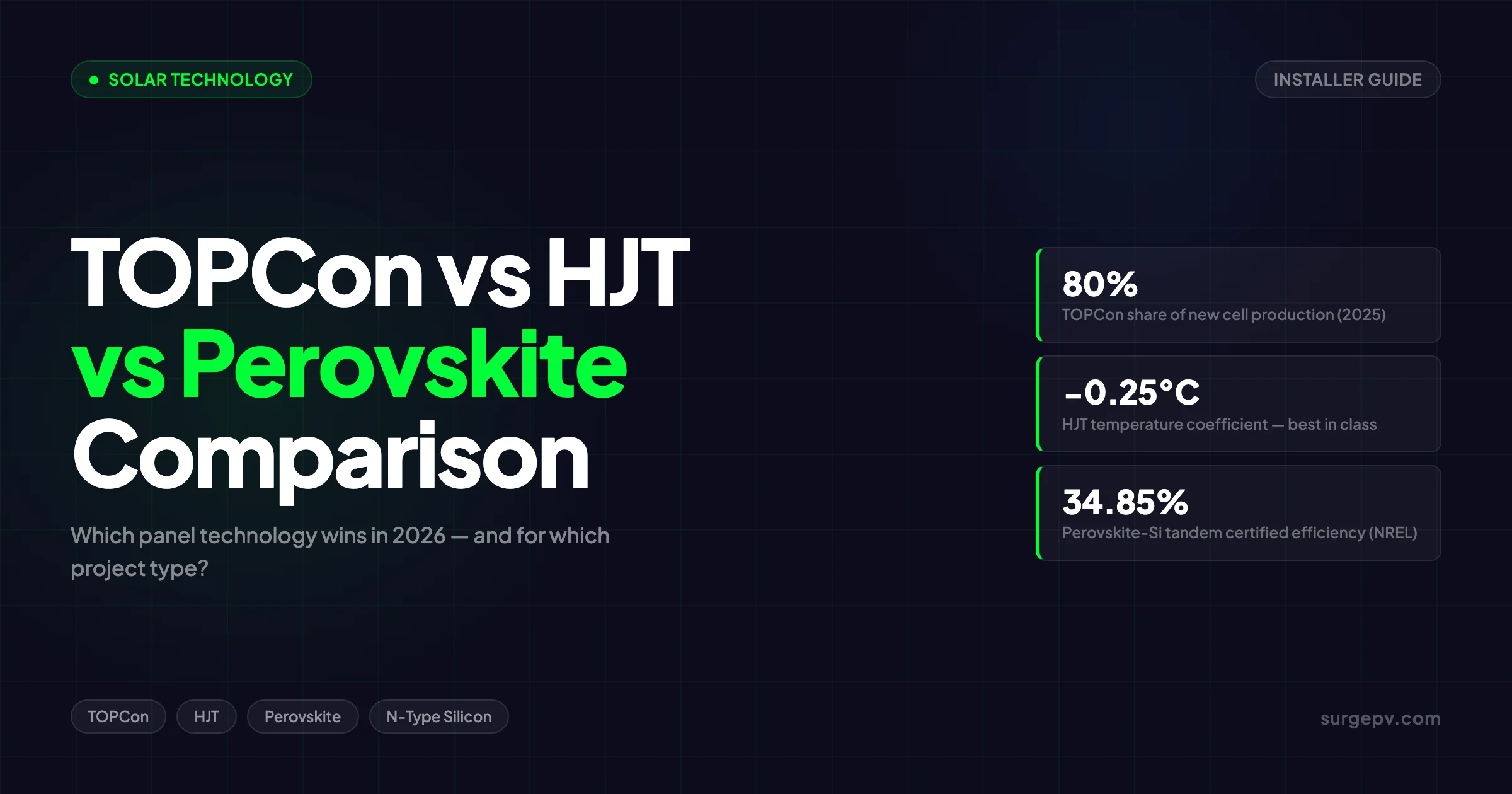
By the end of 2025, TOPCon technology accounted for roughly 80% of all new solar cell production capacity installed worldwide — a transition from p-type PERC that took less than three years. In the same period, HJT expanded its production base with multi-gigawatt factories opening in China, and perovskite solar cells reached 34.85% certified efficiency in the laboratory. For solar installers and project developers specifying panels today (and the solar proposal software operators quoting them to customers), three technologies dominate every serious conversation: TOPCon, HJT, and perovskite. Each represents a distinct trade-off between cost, efficiency, temperature tolerance, and commercial readiness. This guide covers the real performance data, manufacturer landscape, and a direct verdict on which technology fits which project in 2026.
TOPCon (Tunnel Oxide Passivated Contact) achieves 24–25% efficiency with lowest manufacturing cost. HJT (Heterojunction) reaches 24–26% with better temperature coefficient but higher cost. Perovskite tandems promise 30%+ but remain in development.
TOPCon (Tunnel Oxide Passivated Contact) achieves 24–25% efficiency with lowest manufacturing cost. HJT (Heterojunction) reaches 24–26% with better temperature coefficient but higher cost. Perovskite tandems promise 30%+ but remain in development. In 2026, TOPCon dominates new capacity; HJT grows in premium segments.
TL;DR — TOPCon vs HJT vs Perovskite in 2026
TOPCon is the volume play: near-PERC costs, 24–26% efficiency, 80% of new cell production, available from every tier-1 manufacturer. HJT is the performance play: 26%+ efficiency, best temperature coefficient (–0.25%/°C), worth the 30–50% cost premium in hot climates or tight roof spaces. Perovskite is the emerging play: 34.85% tandem efficiency in labs, first commercial products shipping from Oxford PV and Hanwha Qcells, but mainstream availability with 25-year warranties is still 2–4 years out. For most 2026 installations, TOPCon wins on value. For rooftops with average cell temperatures above 45°C, HJT wins on lifetime yield.
What this guide covers:
- How each technology works at the cell level — and why the physics drives the performance differences
- A complete side-by-side comparison: efficiency, temperature coefficient, bifaciality, degradation, and cost
- LCOE modeling for temperate and hot climates — where each technology wins
- The real perovskite commercial timeline: what is shipping vs. what is still in the lab
- String design and inverter compatibility considerations for n-type panels
- End-of-life, recycling, and the lead question for perovskite
Latest Updates: Solar Panel Technology in 2026
The table below captures the current state of all three technologies as of May 2026.
| Technology | Commercial Efficiency | Temp Coefficient | Annual Degradation | Cost vs. PERC | 2025 Market Share |
|---|---|---|---|---|---|
| PERC (p-type, reference) | 20–22% | –0.34%/°C | 0.50–0.55%/yr | Baseline | Declining |
| TOPCon | 24–26% | –0.30%/°C | 0.35–0.40%/yr | +10–15% | ~80% of new capacity |
| HJT | 26–27%+ | –0.25%/°C | 0.25–0.30%/yr | +30–50% | ~8–10% of new capacity |
| Perovskite-Si tandem (lab) | 34.85% (NREL-certified) | Not standardized | Not established | N/A | Pre-commercial |
| Perovskite-Si tandem (commercial) | 24.5% (Oxford PV pilot) | TBD | TBD | Premium | Pilot-scale only |
Key Takeaway — The N-Type Transition Is Complete
The solar industry completed its transition from p-type PERC to n-type silicon (TOPCon and HJT) in 2024–2025. Both TOPCon and HJT are n-type technologies, meaning they experience lower light-induced degradation and better long-term stability than PERC. For installers, specifying a p-type PERC module in 2026 makes sense only for extreme cost-constraint projects — and even then the gap is narrowing fast.
What Is TOPCon? The Technology That Captured 80% of New Production
TOPCon stands for Tunnel Oxide Passivated Contact. The name describes the key innovation: a thin tunnel oxide layer (1–2 nm thick) applied to the rear surface of an n-type silicon wafer, followed by a doped polysilicon layer. Together, these layers passivate the rear surface — suppressing recombination of electron-hole pairs that would otherwise reduce efficiency — while still allowing current to tunnel through quantum mechanically.
How TOPCon Works at the Cell Level
Standard p-type PERC cells apply a passivation layer on the rear surface and rely on aluminum back-surface field contacts. The problem with any metal contact to silicon is that it creates a recombination center. TOPCon addresses this with the tunnel oxide and polysilicon stack, which provides near-ideal passivation at the contact points without sacrificing conductance.
The result is a cell with very low surface recombination velocity, enabling open-circuit voltage (Voc) values above 720 mV in production. Compare this to roughly 680–690 mV for standard PERC. Higher Voc translates directly into higher efficiency — and TOPCon production cells routinely achieve 24–26% at module level.
TOPCon cells are built on n-type silicon wafers, which have lower impurity concentrations than the p-type silicon used for PERC. N-type silicon is inherently less susceptible to boron-oxygen defects that cause light-induced degradation (LID) in PERC panels. This is why TOPCon panels show first-year degradation under 0.5% and annual degradation of 0.35–0.40%/year, versus PERC’s 0.50–0.55%.
Why TOPCon Took Over Manufacturing
The transition from PERC to TOPCon was faster than most analysts predicted because existing PERC production lines can be retrofitted with relatively modest capital investment. The tunnel oxide and polysilicon deposition steps are incremental additions — not a complete factory rebuild. Manufacturers like Jinko Solar, Trina Solar, JA Solar, and Canadian Solar scaled TOPCon capacity by upgrading existing PERC lines rather than building greenfield factories.
By 2025, TOPCon modules from tier-1 manufacturers were priced within 10–15% of equivalent PERC panels. At 24–26% efficiency versus PERC’s 20–22%, the cost-per-watt premium essentially disappeared. You get substantially more power for roughly the same investment per square meter.
TOPCon Limitations
TOPCon’s temperature coefficient of –0.30%/°C is measurably worse than HJT’s –0.25%/°C. In climates where panel temperatures regularly exceed 45°C — the Middle East, South Asia, Northern Africa, southern Australia — this difference matters. A 450W TOPCon panel operating at 65°C loses roughly 12% of its rated output. An equivalent HJT panel loses about 10%. Over 25 years in a hot climate, that compounds into real production loss. For Africa-specific compliance details, see Africa solar compliance. For Australia-specific compliance details, see Australia comparisons/lgc-vs-stc.
TOPCon also has a slightly lower bifaciality factor (80–85%) compared to HJT (85–95%), which matters for bifacial ground-mount installations where rear-side irradiance contributes significantly to yield. For a complete breakdown of how rear-side gain is modeled in system design, the bifacial solar panel design guide covers the methodology. For more on this topic, see Bifacial Solar Panel Design Guide.
Pro Tip — Apply Temperature Corrections in Your Designs
When specifying TOPCon panels, always use the actual temperature coefficient in energy yield simulations rather than STC efficiency. In climates above 30°C average ambient, the annual yield difference between TOPCon and HJT can shift the LCOE comparison. Good solar design software applies temperature corrections automatically using TMY weather data for the project location.
For France-specific information, see Agricultural Solar Case Study. See our guide on Floating Solar Farms France for more.
What Is HJT? The Premium Performer That Wins in Heat
HJT stands for Heterojunction Technology (sometimes written HIT, a registered trademark Panasonic used for its specific variant). The fundamental architecture differs from TOPCon: instead of a passivation layer on the back contact, HJT wraps an n-type crystalline silicon wafer in thin amorphous silicon layers on both the front and rear surfaces.
How HJT Works at the Cell Level
The cell structure from front to back: transparent conductive oxide (TCO) → intrinsic amorphous silicon (~5 nm) → p-type amorphous silicon (~5 nm) → n-type crystalline silicon wafer → intrinsic amorphous silicon (~5 nm) → n-type amorphous silicon (~5 nm) → TCO → silver grid contacts.
The amorphous silicon layers create a heterojunction — a junction between two materials with different crystal structures — providing exceptional surface passivation on both sides. Recombination velocity at the amorphous/crystalline interface is lower than in any other commercial silicon cell technology. This enables open-circuit voltages above 750 mV in the best production cells, compared to TOPCon’s ~720 mV.
HJT is inherently symmetric, meaning both surfaces have similar passivation quality. This makes it an excellent bifacial cell: bifaciality factors of 85–95% are standard for HJT versus 80–85% for TOPCon.
The Temperature Coefficient Advantage
HJT’s most practical advantage for hot-climate installations is its temperature coefficient of –0.24 to –0.26%/°C. The amorphous silicon layers have a positive temperature coefficient that partially counteracts the negative coefficient of crystalline silicon, resulting in a net Tc significantly lower than any other silicon cell technology.
At 45°C operating temperature — common for rooftop panels on summer afternoons across most of the world — an HJT panel loses approximately 5–6% of its rated output. A TOPCon panel loses 7–8%. That 2-percentage-point gap translates to roughly 2–3% more annual energy production in hot climates. Over 25 years, the difference compounds.
HJT also has lower annual degradation (0.25–0.30%/year) than TOPCon (0.35–0.40%/year). These two advantages — better temperature performance and slower degradation — are why HJT generates meaningfully more lifetime energy in warm and hot climates despite having the same nameplate wattage as a TOPCon alternative.
HJT Manufacturing Constraints
HJT requires specialized production equipment — particularly plasma-enhanced chemical vapor deposition (PECVD) for the amorphous silicon layers — that cannot be retrofitted from existing PERC lines. A new HJT production line costs roughly 1.3–1.5 times the capital investment of an equivalent TOPCon line.
HJT cells also consume more silver paste per watt than TOPCon. The low-temperature processing requirements (amorphous silicon degrades if heated above ~200°C) rule out the high-temperature firing used in standard silicon cell metallization, requiring more contact silver for equivalent conductance. Higher silver content per watt is the structural reason HJT remains 30–50% more expensive per watt at module level, even as overall solar panel prices fall.
Manufacturers are pursuing silver reduction through copper plating, screen-printing optimization, and silver-coated copper pastes. The cost gap is narrowing but has not closed as quickly as industry forecasts from 2022–2023 projected.
Key Takeaway — When HJT Makes Commercial Sense
HJT justifies its cost premium in three scenarios: hot climates where ambient temperature regularly exceeds 30°C; space-constrained rooftops where watts per square meter is the binding constraint; and premium residential projects where customers want the highest-performing warranted silicon module available. Outside these scenarios, the cost premium is difficult to recover in a standard financial model at 2026 module prices.
For a broader look at how cell architecture affects real-world performance beyond the spec sheet, the half-cut vs full-cell solar panel guide examines additional factors that influence installer decisions at the module level.
What Is Perovskite? Lab Records, First Commercial Products, and What Comes Next
Perovskite solar cells use a crystal structure with the ABX3 formula — typically a lead halide compound — that can be tuned to absorb different parts of the solar spectrum by adjusting the halide composition. The term “perovskite” describes the crystal structure, not a single material.
The core insight for efficiency: perovskite’s bandgap can be tuned from roughly 1.2 eV to 2.3 eV by changing the halide ratio. Crystalline silicon has a fixed bandgap of 1.1 eV. By stacking a perovskite top cell (tuned to ~1.68 eV) on a silicon bottom cell, a tandem device captures a wider slice of the solar spectrum than either material alone — which is why laboratory efficiencies now exceed 34%. For a full technical breakdown of perovskite physics, stability challenges, and manufacturing approaches, the dedicated perovskite solar cells guide covers the technology in depth.
Where Perovskite Stands in 2026
Laboratory records: LONGi Green Energy holds a certified 34.85% efficiency on a perovskite-silicon tandem cell (NREL Best Research-Cell Efficiency Chart, 2025). A perovskite single-junction cell reached 26.61% certified efficiency in April 2026 using a cesium-doping strategy (TechXplore, 2026). A perovskite-silicon triple-junction device at Fraunhofer ISE achieved 30.02% independently certified efficiency in early 2026.
Commercial products: Oxford PV delivered the first commercial perovskite-silicon tandem modules (72-cell, 24.5% efficiency) to U.S. utility customers in September 2024. Hanwha Qcells demonstrated 28.6% efficiency on M10-sized perovskite-silicon tandem cells using mass-production-compatible processes in December 2024. Saule Technologies has been shipping building-integrated perovskite modules for facade applications in Poland and Japan since 2021.
The gap that matters: Oxford PV’s commercial module achieves 24.5% — exactly where a premium HJT panel sits today, but at significantly higher cost and without a 25-year outdoor warranty. LONGi’s 34.85% lab record represents a tandem architecture on a small research cell, not a commercial-size module with 25 years of outdoor data. The stability challenge — particularly moisture ingress and thermal cycling — remains the primary barrier between current perovskite products and mainstream installer availability.
TOPCon vs HJT vs Perovskite: Full Side-by-Side Comparison
| Metric | TOPCon | HJT | Perovskite-Si Tandem |
|---|---|---|---|
| Commercial efficiency | 24–26% | 26–27%+ | 24.5% (Oxford PV pilot) |
| Lab efficiency record | ~28.7% | ~29.2% | 34.85% (NREL, LONGi) |
| Temperature coefficient | –0.30%/°C | –0.25%/°C | Not standardized |
| Bifaciality factor | 80–85% | 85–95% | ~90% (estimated, tandem) |
| First-year degradation | ~0.5% | ~0.4% | Not established |
| Annual degradation | 0.35–0.40%/yr | 0.25–0.30%/yr | Not established |
| Cost vs. PERC baseline | +10–15% | +30–50% | Premium (pilot pricing) |
| 25-year warranty available | Yes | Yes | No |
| Standard inverter compatible | Yes | Yes | Yes (commercial products) |
| Manufacturing scalability | High — PERC retrofit | Moderate — new lines | Low — pilot-scale |
| Market share (2025) | ~80% of new capacity | ~8–10% | Pre-commercial |
| Best use case | Most installations | Hot climate, tight roof | Utility pilots, BIPV |
What These Numbers Mean for Real Projects
Efficiency difference in practice: A 26% HJT panel and a 25% TOPCon panel with the same cell count will have roughly 4% higher output under standard conditions. On a residential 10 kW system, that is approximately 400W more installed capacity with the same number of panels — meaningful for tight rooftops, marginal for large open commercial arrays where the panel count is not constrained.
Degradation over 25 years: A TOPCon panel rated at 450W degrading at 0.38%/year produces approximately 90.5% of initial output after 25 years. An HJT panel at 0.27%/year produces approximately 93.4%. Over the full system life, HJT generates roughly 3% more cumulative energy in identical irradiance conditions — real but not dramatic in temperate climates.
Temperature effect in hot climates: At 60°C cell temperature (typical summer afternoon in hot regions), a 450W TOPCon panel outputs roughly 402W. An equivalent 450W HJT panel outputs approximately 415W. In a 100-panel commercial array, that is 1.3 kW of continuous output difference during peak summer hours — every day.
Perovskite vs silicon: At current pilot pricing, perovskite-silicon tandem modules are not competitive for standard commercial or residential installations. The technology is relevant for utility procurement officers watching the leading edge, and for BIPV applications where silicon modules cannot fit the form factor.
Performance in the Field: Climate and Project Type
Hot and Arid Climates (Middle East, India, Sub-Saharan Africa, Northern Australia)
HJT is the technically superior choice. Temperature coefficient and degradation rate advantages compound over 25 years to produce meaningfully more energy than an equal-rated TOPCon system. Whether that yield advantage justifies the 30–50% module cost premium requires explicit LCOE modeling with local weather data — but in climates with average cell temperatures above 50°C, HJT increasingly wins the financial case.
For commercial projects in locations like Dubai, Rajasthan, or Cairo, running a detailed simulation in a generation and financial tool that accounts for hourly temperature profiles routinely shows HJT with a lower 20-year LCOE than TOPCon for fixed-tilt arrays, particularly where no single-axis tracking compensates for temperature losses. See Solar Racking Design Guide for detailed guidance.
Temperate Climates (Northern/Central Europe, Northeast US, Japan, Southern Australia)
TOPCon wins on value. Average cell temperatures stay lower, which narrows HJT’s temperature coefficient advantage to under 1% additional annual yield in most of Germany, the UK, or the US Northeast. The 30–50% cost premium for HJT is genuinely hard to justify when annual yield differences shrink to 1–2%. TOPCon from a tier-1 manufacturer with a strong warranty is the right specification for the majority of European residential and commercial projects. Also see: Germany solar subsidies. Also see: European Solar Incentives.
Bifacial Ground-Mount (Utility Scale)
HJT’s higher bifaciality factor (85–95%) becomes a real asset for large bifacial ground-mount systems with high albedo ground surfaces. Combined with its low degradation rate and temperature coefficient, HJT is gaining traction at utility scale where developers optimize for maximum 25-year energy production. The bifacial solar panel design guide covers how to model rear-side irradiance gain correctly in system simulations — a step many utility developers underinvest in.
Space-Constrained Rooftops
For rooftops where the binding constraint is square meters of available area — not budget — HJT generates more kWh per square meter due to higher efficiency. A dense urban residential installation where the homeowner wants maximum production from a small south-facing dormer roof benefits from every percentage point of module efficiency. HJT makes sense here even in temperate climates, because the efficiency premium directly enables more annual production rather than just shifting the degradation curve.
BIPV and Specialty Applications
Perovskite is genuinely competitive for building-integrated photovoltaics where color tunability, thin-film form factors, or non-rectangular geometry makes standard silicon modules impractical. Saule Technologies’ BIPV installations demonstrate real-world viability for facade applications. For any other application type in 2026, perovskite is not a practical specification.
For shading analysis on complex rooftops — where the right technology choice can shift the yield calculation — SurgePV’s shadow analysis software calculates per-string and per-module shading losses that affect technology selection in ways that specification sheets do not capture. For a direct comparison, see Arka 360 vs SurgePV.
The Real Cost Comparison: Price Per Watt and 25-Year LCOE
Module Prices (May 2026, Indicative Wholesale)
Spot market pricing varies by region, order volume, and manufacturer. These figures reflect approximate European and US wholesale pricing for tier-1 products:
| Technology | Module Price ($/W, wholesale) | Notes |
|---|---|---|
| PERC (p-type) | $0.15–0.20 | Rapidly being phased out |
| TOPCon | $0.17–0.23 | Near-parity with PERC |
| HJT | $0.25–0.35 | Cost premium persists |
| Perovskite-Si tandem | $0.80–1.50+ | Pilot-scale, utility contracts only |
Simplified LCOE Comparison: 100 kW Commercial Rooftop
This comparison models the module component of LCOE for a 100 kW commercial rooftop installation. Balance-of-system, installation labor, and inverter costs are assumed equal for both technologies — the variable is module cost and technology-specific yield performance. Read more about France Solar Feed-in Tariffs.
Temperate climate (Germany, average annual cell temperature ~38°C):
| Parameter | TOPCon | HJT |
|---|---|---|
| Module cost (100 kW) | $20,000 | $30,000 |
| Year 1 production (temperature-adjusted) | ~98,500 kWh | ~100,500 kWh |
| 25-year cumulative production | ~2,260,000 kWh | ~2,340,000 kWh |
| Module LCOE (module cost only) | ~$0.0088/kWh | ~$0.0128/kWh |
TOPCon wins in this climate. The HJT yield advantage (approximately 3.5% more cumulative production) does not offset the 50% higher module cost.
Hot climate (UAE, average annual cell temperature ~57°C):
| Parameter | TOPCon | HJT |
|---|---|---|
| Module cost (100 kW) | $20,000 | $30,000 |
| Year 1 production (temperature-adjusted) | ~96,000 kWh | ~99,600 kWh |
| 25-year cumulative production | ~2,185,000 kWh | ~2,320,000 kWh |
| Module LCOE (module cost only) | ~$0.0091/kWh | ~$0.0129/kWh |
TOPCon still wins at current market prices in this illustrative model. HJT’s yield advantage is larger (approximately 6% more cumulative production in hot climate), but the cost gap remains the dominant factor at 2026 pricing. The equation changes if HJT module prices fall to within 15–20% of TOPCon — which is achievable as HJT production scales, but has not happened yet.
Key Takeaway — Always Model Your Specific Project
These LCOE figures are illustrative for the module cost component only. Full project economics require site-specific irradiance data, local electricity prices, financing costs, and real module pricing from your supply chain. The yield difference between TOPCon and HJT can shift the conclusion for specific projects in extreme climates. Use the generation and financial tool to run the numbers for your actual project conditions before specifying modules.
Manufacturing, Supply Chain, and Brand Landscape
TOPCon Manufacturers
Virtually every major Chinese tier-1 module manufacturer has committed to TOPCon:
- Jinko Solar — Tiger Neo product line; one of the largest TOPCon production footprints globally
- Trina Solar — Vertex N series; extensive distributed-generation and utility track record
- JA Solar — DeepBlue 4.0 Pro; strong distribution network across Europe and Asia
- Canadian Solar — HiHero and BiHiKu N-type ranges; North American market strength
- LONGi Green Energy — Hi-MO 6 and Hi-MO X6; holds world records for both TOPCon and perovskite-silicon tandem efficiency
The competitive intensity at the TOPCon level has compressed margins across the board. Tier-1 TOPCon panels are commoditized in 2026 in ways that PERC never fully achieved. This benefits installers on price but requires careful attention to warranty terms, manufacturer financial health, and bankability — not all low-cost TOPCon products come with equally robust long-term support.
HJT Manufacturers
HJT production is more concentrated, reflecting the higher capital barrier:
- REC Group — Alpha Pure-R series; among the most widely distributed HJT products in Europe
- Panasonic — Original commercial HJT developer; the HIT cell architecture from Sanyo remains the lineage for most current HJT designs
- Meyer Burger — Swiss manufacturer; European-made HJT panels targeting premium residential and commercial segments
- Huasun Energy — Chinese HJT specialist; aggressive capacity expansion from 2022 onward
- Risen Energy — Hybrid HJT/TOPCon development; growing HJT export volumes
HJT capacity is expanding as Chinese manufacturers invest in the technology. The production cost gap with TOPCon has narrowed, but the silver consumption challenge means HJT pricing will remain elevated until silver reduction processes mature at scale.
Supply Chain Considerations
The overwhelming dominance of Chinese manufacturing in TOPCon creates concentration risk for European and US installers subject to tariffs or import restrictions. European HJT manufacturing (Meyer Burger, REC Group’s Norwegian operations) provides partial supply chain diversity at a price premium. For large utility developers with long procurement timelines, this is a legitimate planning factor. For most residential and commercial installers, it is a secondary concern relative to module performance and warranty terms.
Design Any Panel Technology with Accurate Yield Simulations
SurgePV includes up-to-date TOPCon and HJT panel libraries with temperature-corrected energy yield simulations and integrated LCOE financial modeling for any project location.
Book a DemoNo commitment required · 20 minutes · Live project walkthrough
Which Technology Should Installers Specify in 2026?
The decision framework below maps project scenarios to the recommended technology. The right specification depends on climate, budget, and the specific project constraints.
Decision Framework by Project Type
| Project Type | Climate | Priority | Recommended Technology |
|---|---|---|---|
| Standard residential rooftop | Temperate (Europe, NE USA) | Value | TOPCon |
| Premium residential rooftop | Temperate | Best performance | HJT |
| Residential rooftop | Hot (India, ME, Australia) | Value | TOPCon (model yield first) |
| Residential rooftop | Hot | Maximum yield | HJT |
| Space-constrained rooftop | Any | Watts per sq meter | HJT |
| Commercial flat roof | Temperate | Value | TOPCon |
| Commercial flat roof | Hot | Performance | HJT |
| Bifacial ground-mount | Temperate | Value + bifacial gain | TOPCon bifacial |
| Bifacial ground-mount | Hot | Maximum yield | HJT bifacial |
| BIPV or facade | Any | Form factor | Perovskite (Saule pilot) or HJT |
| Utility pilot | Any | Cutting-edge research | Perovskite-Si tandem (Oxford PV) |
String Design Implications for N-Type Panels
Both TOPCon and HJT are n-type, and both affect string design in specific ways:
Higher Voc at low temperatures. N-type panels have a lower temperature coefficient magnitude, meaning Voc rises less steeply in cold weather than p-type PERC. This is favorable — you are less likely to hit the inverter’s maximum input voltage — but still requires calculating cold-temperature Voc using the panel’s specific Voc temperature coefficient, not the PERC default.
No LID. N-type panels do not suffer from the boron-oxygen light-induced degradation that causes p-type PERC to lose 1–2% output in the first 50 hours of exposure. Year-one production from n-type panels matches the design simulation more closely than PERC.
TCO front contact on HJT. HJT uses a transparent conductive oxide front contact rather than metal fingers, which produces slightly different current-voltage characteristics. Never mix HJT and TOPCon cells in the same string — the different IV curve shapes create mismatch losses.
Higher Isc on large-format HJT. High-efficiency HJT panels at large formats (182mm or 210mm cell) can have higher short-circuit current (Isc) than older PERC panels. Confirm the optimizer or microinverter maximum input current rating against the HJT panel’s Isc before specifying MLPE systems.
SurgePV’s solar design software maintains updated n-type panel libraries and validates string configurations against inverter specifications, flagging any incompatibilities before they become field problems.
Perovskite vs Silicon: The Commercial Timeline
Understanding when perovskite becomes a viable mainstream option requires separating three distinct milestones:
Milestone 1: First commercial products. Already reached. Oxford PV, Saule Technologies, and Hanwha Qcells have demonstrated or shipped commercial-grade perovskite-silicon products. Pilot-scale production is real.
Milestone 2: Competitive pricing with silicon. Not yet reached. Oxford PV’s utility-pilot modules price significantly above commercial TOPCon. Manufacturing scale and production yield rates need to improve substantially before perovskite-silicon tandems compete on $/W for standard applications.
Milestone 3: 25-year outdoor warranty certification. Not yet reached. IEC 61215 accelerated aging tests — damp-heat (1,000 hours at 85°C/85% RH), thermal cycling (200 cycles, –40°C to +85°C), UV exposure — are challenging for perovskite due to sensitivity to moisture and heat. Encapsulation solutions are improving rapidly, and some devices have passed the standard damp-heat test while retaining over 95% of initial efficiency. But no manufacturer has offered a 25-year outdoor warranty backed by field data at commercial scale.
Realistic Timeline to Mainstream Availability
| Milestone | Expected Window | Key Driver |
|---|---|---|
| First GW-scale perovskite-Si tandem factory | 2026–2027 | Hanwha Qcells, LONGi investment |
| IEC 61215 certification for commercial tandem modules | 2027–2028 | Stability data maturation |
| Mainstream installer availability | 2028–2030 | Manufacturing scale + warranty |
| Price parity with HJT | 2030–2032 | Manufacturing learning curve |
This 2028–2030 window aligns with the consensus view from IRENA and IEA analysts. Installers should plan their 2026–2028 project pipelines against TOPCon and HJT without relying on perovskite availability — but should factor perovskite tandem pricing into financial models for projects with operations extending into the 2030s.
Pro Tip — Two Companies to Watch
Oxford PV (first commercial tandem modules delivered, backed by European utility buyers) and Hanwha Qcells (28.6% on M10 cells using mass-production processes) are the two most likely first movers toward mainstream perovskite availability. If either company announces GW-scale production with a warranty product, the timeline is compressing ahead of consensus forecasts.
Inverter and System Compatibility in Practice
String Inverters
TOPCon and HJT panels work with all major string inverter platforms — Sungrow, Huawei, SMA, Fronius, and others. The key design variable is maximum string voltage.
N-type panels have lower temperature coefficient magnitude than PERC, meaning Voc rises less in cold temperatures. String Voc calculations using a standard PERC temperature correction will overestimate cold-temperature Voc for n-type panels — but only in one direction (conservative). Always use the panel’s actual Voc temperature coefficient from the datasheet for NEC Article 690 string sizing compliance.
Power Optimizers
HJT panels work with DC power optimizers (SolarEdge, Tigo) but require confirming the optimizer’s maximum input current rating against the panel’s Isc. High-efficiency, large-format HJT panels can exceed the Isc ratings of optimizers specified for older PERC panels.
Microinverters
Both TOPCon and HJT panels are compatible with microinverter systems (Enphase IQ8 series and equivalents). The main requirement is confirming that the panel’s maximum power point voltage (Vmp) falls within the microinverter’s MPPT voltage window — particularly relevant for high-wattage panels where Vmp can be higher than typical PERC equivalents.
Configuration in Solar Design Software
Modern all-in-one solar software maintains panel libraries with accurate n-type parameters, applies correct temperature corrections during string sizing, and flags any configuration issues before they become field problems. Manually entering n-type panel parameters into tools designed around PERC defaults is a source of specification errors — use a platform with current panel database coverage.
End-of-Life, Recycling, and Environmental Considerations
Silicon-Based Panels (TOPCon and HJT)
TOPCon and HJT panels follow the same recycling pathway as PERC: glass recovery, silver reclamation, and silicon wafer processing. Both technologies use slightly higher silver content per watt than PERC due to n-type cell metallization requirements. HJT uses the most silver per watt of any mainstream silicon technology due to its low-temperature processing constraints.
Established recycling programs handle n-type silicon panels without modification: PV Cycle in Europe, SEIA Recycling Programs in the US, and manufacturer-operated take-back schemes. The presence of amorphous silicon layers in HJT does not create a disposal challenge — amorphous silicon is inert and non-toxic.
Perovskite: The Lead Question
Standard high-efficiency perovskite cells use lead halide compounds. The lead content of a perovskite cell is approximately 0.4–0.5 g/m² — low in absolute terms but still a regulated hazardous substance in most jurisdictions. The first commercial perovskite installations will require approved disposal pathways, and manufacturers offering products without defined recycling programs should raise questions before signing long-term contracts.
Lead-free tin-based perovskite is an active research area. Tin-only perovskite has reached 15.1% efficiency (Linköping University, 2023), and tin-lead mixed perovskite reached 22.0% (Monash University, 2024). Commercially viable lead-free perovskite at competitive efficiency is still in development — the toxicity concern is real but will likely be addressed before perovskite reaches mainstream commercial volumes.
Embodied Carbon
N-type silicon panels carry slightly higher embodied carbon than PERC due to additional processing steps. A typical TOPCon module has roughly 700–800 kg CO₂e/kWp embodied, versus 600–650 for PERC. HJT is modestly higher still due to PECVD deposition energy requirements. These figures are small relative to the carbon avoided over a 25-year operational life, but relevant for projects reporting against Scope 3 emissions targets or participating in environmental product declaration (EPD) schemes.
Conclusion
Three panel technologies define the 2026 solar market. TOPCon is the rational default for the majority of installations: near-PERC costs, 24–26% efficiency, full 25-year warranties from every major tier-1 manufacturer, and a supply chain with genuine depth. HJT is the right call for hot climates, space-constrained rooftops, and premium residential projects where the temperature coefficient and degradation advantages justify the 30–50% cost premium. Perovskite-silicon tandem is real and advancing — but mainstream installer availability with outdoor warranties is still several years from being a standard specification.
Three practical takeaways for your 2026 project pipeline:
- Default to TOPCon from a tier-1 manufacturer with a 25-year linear power warranty for most residential and commercial projects in temperate climates
- Model before upgrading to HJT — run the LCOE with actual location climate data before paying the premium; the math only clearly favors HJT in genuinely hot climates or space-limited applications
- Monitor Oxford PV and Hanwha Qcells for perovskite tandem availability; reassess in 2028 when IEC 61215 certification data from the first commercial pilots matures
Frequently Asked Questions
What is the difference between TOPCon and HJT solar panels?
TOPCon uses a thin tunnel oxide passivation layer on an n-type silicon wafer to suppress surface recombination, achieving 24–26% commercial efficiency at near-PERC manufacturing costs. HJT wraps an n-type wafer in amorphous silicon layers to create a heterojunction, delivering 26%+ efficiency and a superior temperature coefficient of –0.25%/°C. The practical difference is cost and climate suitability: TOPCon costs roughly 30–50% less than HJT per watt and performs comparably in temperate climates, while HJT generates measurably more energy wherever panels regularly exceed 45°C.
Which solar panel technology has the highest efficiency in 2026?
In commercial production, HJT leads single-junction silicon with 26%+ module efficiency. Back-contact IBC variants reach 26–27.8%. In the laboratory, perovskite-silicon tandem cells achieved a certified 34.85% efficiency (LONGi, NREL-certified 2025). For installer-grade products with 25-year warranties, HJT is the highest-efficiency option currently available. Mainstream perovskite tandems at competitive prices are still 2–4 years from commercial availability.
Is TOPCon better than HJT for hot climates?
No. HJT is the better choice in hot climates. Its temperature coefficient of –0.25%/°C means panels at 45°C lose roughly 5–6% of rated output. TOPCon’s –0.30%/°C coefficient produces 7–8% loss at the same temperature. Over 25 years in a desert or tropical climate, that difference compounds into meaningful energy yield. HJT also degrades slower — approximately 0.25–0.30%/year versus TOPCon’s 0.35–0.40%/year — widening the lifetime production gap further.
When will perovskite solar panels be commercially available?
Limited commercial perovskite-silicon tandem products are already shipping. Oxford PV delivered 24.5% efficiency modules to U.S. utility customers in September 2024. Hanwha Qcells achieved 28.6% efficiency on M10 cells using mass-production processes in December 2024. Mainstream installer-grade perovskite panels with 25-year outdoor warranties at competitive prices are realistically expected between 2027 and 2030, contingent on resolving long-term humidity and thermal-cycling durability under IEC 61215.
Are HJT panels worth the premium over TOPCon?
For most projects in temperate climates, no. TOPCon’s cost-per-watt is roughly 30–50% lower than HJT, and the efficiency gap is 1–2 percentage points in practice. The math favors HJT in three scenarios: very hot climates where the temperature coefficient advantage compounds over decades; space-constrained rooftops where every watt per square meter matters; and premium projects where buyers want the highest-performing silicon panel available.
Can TOPCon and HJT panels work with standard inverters?
Yes. Both TOPCon and HJT panels are compatible with all standard string inverters, microinverters, and power optimizers. However, their n-type architecture produces higher open-circuit voltages and lower temperature coefficients than p-type PERC, which changes string sizing calculations. Always recalculate maximum string Voc at minimum expected temperature when using n-type panels. Modern PV design software handles n-type panel libraries and flags string sizing limits automatically.
Where this fits
This article is part of SurgePV's Solar Technology hub, which works through the topic from first principles to the decisions a project team actually has to make.
