

Quick Answer
N-type solar cells achieve 24–26% efficiency with lower degradation (0.3–0.4% per year) and better low-light performance. P-type cells are cheaper to manufacture but degrade faster (0.5–0.7% per year) and have 22–24% efficiency. In 2026, N-type (TOPCon, HJT) dominates new capacity additions.
The shift from P-type to N-type solar cells is the most significant technology transition in PV manufacturing since the move from poly to mono. P-type PERC cells dominated the market from 2015 to 2023. N-type TOPCon and HJT architectures have overtaken them in 2024 to 2026 because they deliver higher efficiency, lower degradation, and better temperature performance at a cost premium that has shrunk from 25 percent to under 10 percent.
N-type solar cells achieve 24–26% efficiency with lower degradation (0.3–0.4% per year) and better low-light performance. P-type cells are cheaper to manufacture but degrade faster (0.5–0.7% per year) and have 22–24% efficiency. In 2026, N-type (TOPCon, HJT) dominates new capacity additions.
TL;DR — N-Type vs P-Type Solar Cells
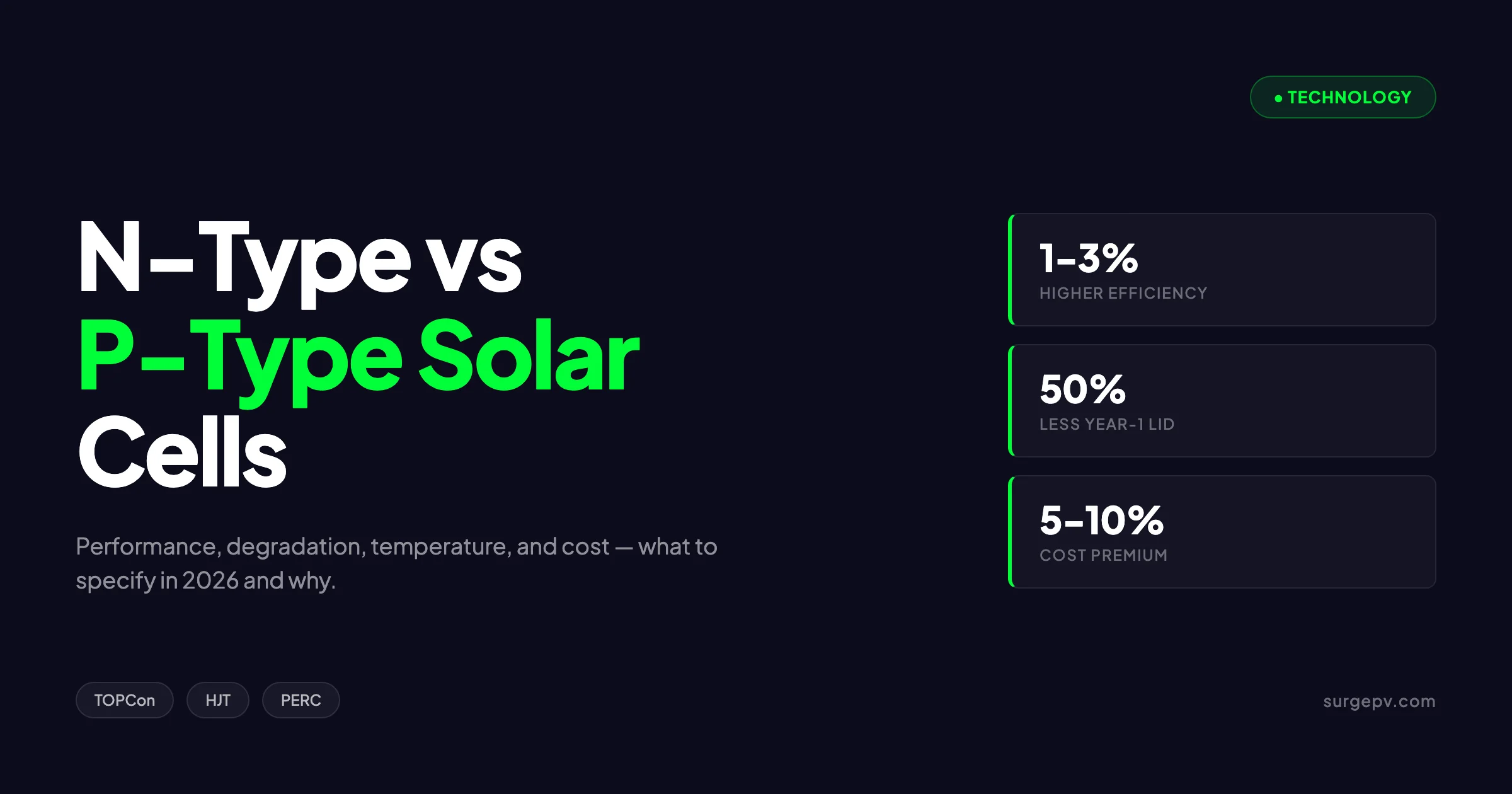
N-type cells deliver 1 to 3 percent higher efficiency, 50 percent lower first-year degradation, and better temperature coefficients than P-type. The cost premium is 5 to 10 percent in 2026, down from 25 to 30 percent in 2022. For new installations, N-type is the better choice in nearly every scenario.
This guide breaks down the technical, performance, and economic differences between N-type and P-type cells, the architecture variants within each family, and the decision framework for installers specifying panels in 2026 and quoting them in solar proposal software.
The Technical Difference
The base material of every silicon solar cell is doped silicon. The dopant used determines whether the cell is P-type or N-type, and that single choice cascades into significant performance differences.
P-Type Cells
P-type cells use boron as the dopant in the silicon base. Boron has 3 valence electrons compared to silicon’s 4, which creates “holes” (positive charge carriers). Light absorption excites electrons, creating electron-hole pairs that produce current.
P-type technology dominated the market for two decades because boron doping was easier and cheaper to manufacture at scale. The manufacturing infrastructure was established, the supply chain was mature, and module costs were the lowest available.
N-Type Cells
N-type cells use phosphorus as the dopant. Phosphorus has 5 valence electrons, contributing extra free electrons (negative charge carriers). The fundamental physics is similar but the resulting cell properties are different.
N-type cells were technically superior from the beginning, but manufacturing complexity kept them niche until production techniques matured. The 2020 to 2024 period saw massive capital investment in N-type production lines, driving costs down to near-parity with P-type.
Why the Doping Matters
The doping choice affects several cell properties that compound into meaningful real-world differences:
- Light-induced degradation (LID): P-type cells lose 1 to 2 percent efficiency in the first year due to boron-oxygen complexes. N-type cells lose under 0.5 percent.
- Temperature coefficient: N-type cells lose less efficiency in heat. The temperature coefficient runs around -0.30 percent per degree Celsius for N-type versus -0.35 percent for P-type.
- Bifaciality: N-type cells naturally support higher rear-side absorption, achieving bifacial gain factors of 75 to 85 percent versus 65 to 75 percent for P-type.
- Long-term degradation: N-type cells degrade roughly 0.4 percent per year versus 0.5 percent per year for P-type, compounding over 25 years.
For broader temperature context, see solar panel temperature coefficient and for the degradation context, [solar panel degradation rates](/blog/solar-panel-degradation-rates).
Architecture Variants
Both P-type and N-type families have multiple cell architectures. Understanding the architectures matters because product names often emphasize architecture (TOPCon, HJT, PERC) rather than the underlying type.
P-Type Architectures
Aluminum BSF (Back Surface Field): The original P-type architecture, dominant until around 2015. Efficiency around 16 to 17 percent. Now obsolete in commercial production.
PERC (Passivated Emitter Rear Cell): The dominant P-type architecture from 2015 to 2023. Adds a rear surface passivation layer that boosts efficiency to 19 to 22 percent. Still in production but declining.
TOPCon-P: A passivated contact variant of P-type that approaches N-type efficiency. Limited commercial deployment because it loses the cost advantage that justified P-type in the first place.
N-Type Architectures
TOPCon (Tunnel Oxide Passivated Contact): The most common N-type architecture in 2026. Uses a thin tunnel oxide layer plus polysilicon rear contact for excellent passivation. Cell efficiency 22 to 25 percent. Module efficiency 21 to 23 percent.
HJT (Heterojunction): Combines crystalline silicon with amorphous silicon thin films. Cell efficiency 22 to 26 percent. Higher manufacturing cost than TOPCon but slightly better temperature coefficient and bifaciality. For more on this topic, see Bifacial Solar Panel Design Guide.
IBC (Interdigitated Back Contact): All electrical contacts on the rear surface, eliminating front-side shading from busbars. Cell efficiency 24 to 27 percent. Most expensive architecture; primarily in premium residential modules from SunPower (now SunRey) and a few others. Shadow analysis software identifies shading issues before installation.
TBC (Tunnel-oxide Back Contact): A hybrid combining TOPCon and IBC concepts. Cell efficiency 25 to 27 percent. Limited commercial deployment in 2026 but growing.
Efficiency Comparison
Efficiency is the single most-quoted spec in solar panels. The comparison shows clear N-type advantages but the magnitude depends on the specific architectures compared. See our guide on Agricultural Solar Case Study for more. Read more about Floating Solar Farms France.
Module Efficiency Ranges (2026)
| Technology | Module Efficiency | kWp per m² |
|---|---|---|
| P-type PERC | 19.5 to 22.0% | 195 to 220 W/m² |
| P-type TOPCon-P | 21.0 to 22.5% | 210 to 225 W/m² |
| N-type TOPCon | 22.0 to 23.5% | 220 to 235 W/m² |
| N-type HJT | 22.5 to 24.0% | 225 to 240 W/m² |
| N-type IBC | 23.5 to 25.0% | 235 to 250 W/m² |
The difference between P-type PERC and N-type TOPCon is typically 2 to 3 percent absolute efficiency. For a residential installation, this translates to 30 to 40 W more per panel for the same physical size.
What the Efficiency Difference Means in Practice
For a residential installation with 24 panels of 400 W (P-type PERC) versus 430 W (N-type TOPCon):
- P-type system size: 9.6 kWp
- N-type system size: 10.32 kWp
- Annual production difference (4 sun-hours/day average): 1,050 to 1,200 kWh
At 0.20 USD per kWh (US residential average), the N-type system produces 200 to 240 USD more revenue annually. Over 25 years with 0.4 percent versus 0.5 percent annual degradation, the cumulative difference is 6,500 to 8,000 USD.
For more on yield calculations, see the PV generation and financial modeling coverage.
Roof-Constrained Sizing
The efficiency difference matters most when roof space is the binding constraint. A 30 m² roof produces:
- 5.85 kWp with 19.5% efficient P-type panels
- 7.05 kWp with 23.5% efficient N-type panels
That is a 20 percent system size advantage purely from cell technology. For homeowners with small roofs and high electricity bills, N-type can mean the difference between a system that meets their goals and one that does not.
Degradation Comparison
Solar panels lose efficiency over time. The rate of loss differs significantly between P-type and N-type, with implications for both warranty terms and 25-year economics.
Light-Induced Degradation (LID)
LID happens in the first months of operation. P-type panels typically lose 1 to 2 percent due to boron-oxygen complexes. N-type panels lose under 0.5 percent because the chemistry is different.
The LID difference is captured in module power tolerance specs. P-type panels are typically rated based on stabilized power after LID. N-type panels are rated near initial power because LID is negligible.
Annual Degradation
After the first year, panels continue degrading slowly. Industry data:
| Technology | Year 1 | Years 2-25 (per year) | 25-Year Output |
|---|---|---|---|
| P-type PERC | -2.0% | -0.50% | 84.9% of nameplate |
| N-type TOPCon | -0.5% | -0.40% | 89.9% of nameplate |
| N-type HJT | -0.5% | -0.35% | 91.0% of nameplate |
| N-type IBC | -0.5% | -0.30% | 92.0% of nameplate |
The N-type advantage compounds. By year 25, the cumulative production difference is 5 to 8 percent versus P-type, on top of the initial efficiency advantage.
Warranty Implications
N-type advantages have shifted manufacturer warranty terms. P-type PERC modules typically warranty 80 to 84 percent power retention at 25 years. N-type TOPCon modules typically warranty 87 to 90 percent. N-type HJT and IBC modules typically warranty 88 to 92 percent.
The warranty difference translates directly to financial risk. A bankable project assumes the worst-case warranty floor when sizing financing. N-type panels reduce the worst-case scenario.
Temperature Performance
Solar panels operate hotter than ambient temperature, especially in summer. The temperature coefficient determines how much efficiency is lost as cells heat up.
Temperature Coefficients
| Technology | Power Temperature Coefficient |
|---|---|
| P-type PERC | -0.34 to -0.36 %/°C |
| N-type TOPCon | -0.29 to -0.32 %/°C |
| N-type HJT | -0.24 to -0.26 %/°C |
| N-type IBC | -0.27 to -0.29 %/°C |
HJT panels have the best temperature coefficient. In hot climates, this advantage compounds throughout the year.
Real-World Temperature Impact
A panel operating at 60°C cell temperature (typical summer rooftop conditions) compared to STC (25°C):
- P-type PERC: -0.35 × (60-25) = -12.25% from rated power
- N-type TOPCon: -0.30 × (60-25) = -10.5% from rated power
- N-type HJT: -0.25 × (60-25) = -8.75% from rated power
For a 10 kWp system in hot summer conditions:
- P-type: 8,775 W actual output
- TOPCon: 8,950 W actual output
- HJT: 9,125 W actual output
The HJT advantage is roughly 350 W on a 10 kWp system in peak conditions. Across hot summer hours, the cumulative production advantage is 100 to 200 kWh annually.
For more on extreme conditions, see string sizing for extreme climates. Read String Sizing Solar PV System for a complete walkthrough.
Specify the Right Module for Every Project
SurgePV’s module library covers 1,000+ panels with full electrical specs, temperature coefficients, and degradation curves. Run yield comparisons across N-type and P-type options in seconds.
Book a DemoNo commitment required · 20 minutes · Live project walkthrough
See our guide on France Solar Feed-in Tariffs for more.
Cost Comparison in 2026
Cost is where the N-type story gets interesting. The cost premium has eroded dramatically over 4 years.
Module Price Trends
| Year | P-type PERC (USD/W) | N-type TOPCon (USD/W) | Premium |
|---|---|---|---|
| 2020 | 0.22 | 0.30 | 36% |
| 2022 | 0.20 | 0.27 | 35% |
| 2023 | 0.16 | 0.20 | 25% |
| 2024 | 0.14 | 0.17 | 21% |
| 2025 | 0.12 | 0.13 | 8% |
| 2026 | 0.10 | 0.11 | 10% |
The premium is now small enough that the energy production advantage of N-type easily covers it for most installations.
Production Capacity Shift
Tier-1 manufacturers have shifted production capacity decisively to N-type. By 2026:
- LONGi: 60+ percent of new capacity is N-type
- JinkoSolar: 65+ percent of new capacity is N-type
- Trina Solar: 55+ percent of new capacity is N-type
- JA Solar: 50+ percent of new capacity is N-type
The capacity shift reduces P-type availability and supports N-type pricing parity. By 2027 to 2028, P-type may be more expensive than N-type because production scale will have crossed.
System-Level Cost Impact
For a 10 kWp residential system:
| Cost Component | P-type | N-type TOPCon | Difference |
|---|---|---|---|
| Modules (10 kWp) | 1,000 USD | 1,100 USD | +100 USD |
| Other equipment | 4,500 USD | 4,500 USD | 0 |
| Installation | 7,000 USD | 7,000 USD | 0 |
| Total | 12,500 USD | 12,600 USD | +100 USD |
The N-type premium at the system level is under 1 percent for a typical residential install. Compared to the production advantage of 5 to 8 percent over 25 years, the economics strongly favor N-type.
Bifacial Performance
Both P-type and N-type panels can be bifacial, meaning they generate power from rear-side light too. The difference is how much rear-side gain you actually get.
Bifacial Gain Factor
The bifacial gain factor is the ratio of rear-side power to front-side power.
| Technology | Bifacial Gain Factor |
|---|---|
| P-type PERC bifacial | 65 to 75% |
| N-type TOPCon bifacial | 75 to 85% |
| N-type HJT bifacial | 85 to 95% |
For ground-mount or commercial flat-roof installations with reflective surfaces, the bifacial gain advantage of N-type can add 3 to 8 percent to total system production.
For more on bifacial design, see bifacial solar panel design.
Manufacturer Comparison
The leading manufacturers all offer N-type panels in 2026. The differences are in architecture, efficiency tier, and price positioning.
Top N-Type Module Manufacturers
| Manufacturer | Flagship N-Type Product | Architecture | Module Efficiency |
|---|---|---|---|
| LONGi | Hi-MO 9 | TOPCon BC | 23.6 to 24.4% |
| JinkoSolar | Tiger Neo | TOPCon | 22.7 to 23.5% |
| Trina Solar | Vertex N | TOPCon | 22.5 to 23.3% |
| JA Solar | DeepBlue 4.0 X | TOPCon | 22.7 to 23.2% |
| Canadian Solar | TOPHiKu7 | TOPCon | 22.7 to 23.5% |
| Maxeon | Maxeon 6 | IBC | 22.8 to 23.5% |
| Risen Energy | Hyper-ion | HJT | 22.8 to 23.5% |
| REC Group | Alpha Pure-RX | HJT | 22.6 to 23.0% |
For broader manufacturer context, see solar panel efficiency ranking 2026 and solar panel warranty comparison.
When P-Type Still Makes Sense
There are limited but real scenarios where P-type panels remain the better choice in 2026.
Scenario 1: Existing Inventory
Installers with significant P-type inventory should sell through it before transitioning. The cost difference does not justify writing down inventory if the panels can be installed within their warranty production date.
Scenario 2: Commercial Lowest-Bid Procurement
For commercial RFPs where price-per-watt is the dominant decision criterion, P-type still wins by a narrow margin. The procurement spec rarely captures the long-term degradation difference.
Scenario 3: Repair and Replacement
If a customer needs replacement panels for an existing P-type system, matching with new P-type is cleaner than mixing N-type modules into a P-type system. Mixed systems work but complicate string design and aesthetic matching.
Scenario 4: Specific Manufacturing Constraints
Some niche markets and certain government procurement programs continue specifying P-type for manufacturing-source diversity reasons. These are shrinking but still exist.
What’s Coming Next
The N-type transition is largely complete. The next 18 to 36 months will see continued evolution in two directions.
Direction 1: Cell Efficiency Plateau
TOPCon and HJT are approaching the practical efficiency ceiling for single-junction silicon (around 26 to 27 percent at the cell level). Further gains require multi-junction architectures or non-silicon technologies.
The implication: efficiency gains will slow. Manufacturers will compete more on cost, durability, and integration features (microinverters, optimizers, monitoring) rather than raw efficiency.
Direction 2: Tandem Cells with Perovskite
Perovskite-on-silicon tandem cells offer theoretical efficiencies of 30+ percent. Several manufacturers (Oxford PV, LONGi, JinkoSolar) have demonstrated tandem modules in production.
Commercial deployment of tandem cells remains 2 to 4 years out due to durability questions. By 2028 to 2030, tandem may begin replacing TOPCon and HJT as the new standard.
For more on perovskite, see perovskite solar panels: when will they be ready for commercial use? and TOPCon vs HJT vs perovskite solar panels.
Conclusion: Specify N-Type for New Installations
The N-type versus P-type decision is largely settled in 2026. N-type panels deliver better economics across nearly every scenario, and the cost premium has shrunk to under 10 percent.
Three action items for installers updating their module specifications:
- Audit your current panel specifications and shift new project specs to N-type TOPCon or HJT modules from tier-1 manufacturers.
- Update your customer-facing materials to highlight the long-term advantages of N-type technology.
- Negotiate volume pricing on N-type modules with at least 2 to 3 tier-1 manufacturers to maintain procurement flexibility.
For broader technology context, see TOPCon vs HJT vs perovskite solar panels and half-cut vs full-cell solar panels.
Frequently Asked Questions
What is the main difference between N-type and P-type solar cells?
P-type cells use a boron-doped silicon base; N-type cells use a phosphorus-doped silicon base. The doping affects efficiency, degradation rate, temperature coefficient, and manufacturing cost. N-type cells are more efficient and degrade less but cost slightly more.
Are N-type panels better than P-type?
Yes for new installations in 2026. N-type panels deliver 1 to 3 percent higher efficiency, 50 percent lower first-year light-induced degradation, better temperature performance, and longer-term warranties. The cost premium has shrunk to 5 to 10 percent versus equivalent P-type panels.
What is the cost difference between N-type and P-type panels?
In 2026, N-type panels cost 5 to 10 percent more per watt than equivalent P-type panels. The premium has dropped from 20 to 30 percent in 2022 as N-type production capacity has scaled. Cost parity is expected by 2027 to 2028.
Will P-type panels become obsolete?
P-type production is declining and will likely fall to under 30 percent of global market share by 2027. Tier-1 manufacturers have shifted production lines to N-type TOPCon and HJT. P-type panels remain available but the technology roadmap favors N-type. For Global-specific compliance details, see Global net-metering-by-country. For Global-specific compliance details, see Global solar-permitting-speed-by-country.
What is TOPCon, and is it the same as N-type?
TOPCon (Tunnel Oxide Passivated Contact) is one specific N-type cell architecture, not all N-type technology. Other N-type architectures include HJT (Heterojunction) and IBC (Interdigitated Back Contact). All three deliver higher efficiency than P-type PERC.
Does the n-type advantage matter for residential customers?
Yes, but the impact is modest. A 10 kWp residential N-type system produces 2 to 4 percent more energy over 25 years than an equivalent P-type system. For most homeowners, the additional revenue covers the cost premium with margin to spare.
Should I switch to N-type panels for my installations?
If you are not already on N-type panels in 2026, switch within the next 6 months. Tier-1 manufacturers have prioritized N-type production, P-type pricing has lost its advantage, and customers increasingly request N-type by name. Solar design software helps optimize system design.
Where this fits
This article is part of SurgePV's Solar Technology hub, which works through the topic from first principles to the decisions a project team actually has to make.
