

Quick Answer
Bidirectional EV chargers enable vehicle-to-home (V2H) and vehicle-to-grid (V2G) power flow. A typical EV battery stores 50–100 kWh — enough to power a home for 2–5 days. Leading chargers include Wallbox Quasar (V2H, €4,000) and Fermata Energy (V2G). Integration with solar systems maximizes self-consumption.
A 6 kWp residential rooftop in Sacramento installed in 2024 cost $14,200. Add a bidirectional EV charger, a Ford F-150 Lightning, and the Sunrun Home Integration System, and the same homeowner now owns 131 kWh of mobile storage — roughly 10 Tesla Powerwalls’ worth, on wheels. That is the value shift driving the 2026 bidirectional charger market.
Bidirectional EV chargers enable vehicle-to-home (V2H) and vehicle-to-grid (V2G) power flow. A typical EV battery stores 50–100 kWh — enough to power a home for 2–5 days. Leading chargers include Wallbox Quasar (V2H, €4,000) and Fermata Energy (V2G).
Bidirectional EV chargers enable vehicle-to-home (V2H) and vehicle-to-grid (V2G) power flow. A typical EV battery stores 50–100 kWh — enough to power a home for 2–5 days. Leading chargers include Wallbox Quasar (V2H, €4,000) and Fermata Energy (V2G). Integration with solar systems maximizes self-consumption.
But hardware selection is where most buyers stumble. The charger you need depends on the EV connector, the utility, the local AHJ, the home’s service entrance, and whether the goal is backup or revenue.
Quick Answer
A bidirectional EV charger lets an electric vehicle send power back out — to a load (V2L), to a home (V2H), or to the grid (V2G). In 2026, the leading hardware options are the Wallbox Quasar 2 ($6,440), dcbel Ara ($9,999), Ford Charge Station Pro plus Sunrun Home Integration ($5,205 combined), Sigenergy SigenStor with 25 kW DC charger, GM Energy PowerShift with PowerVault, and Fermata Energy FE-20 for fleets. Select by EV connector standard, kW rating, and utility interconnection rules.
TL;DR — Bidirectional Charger Buyer Guide 2026
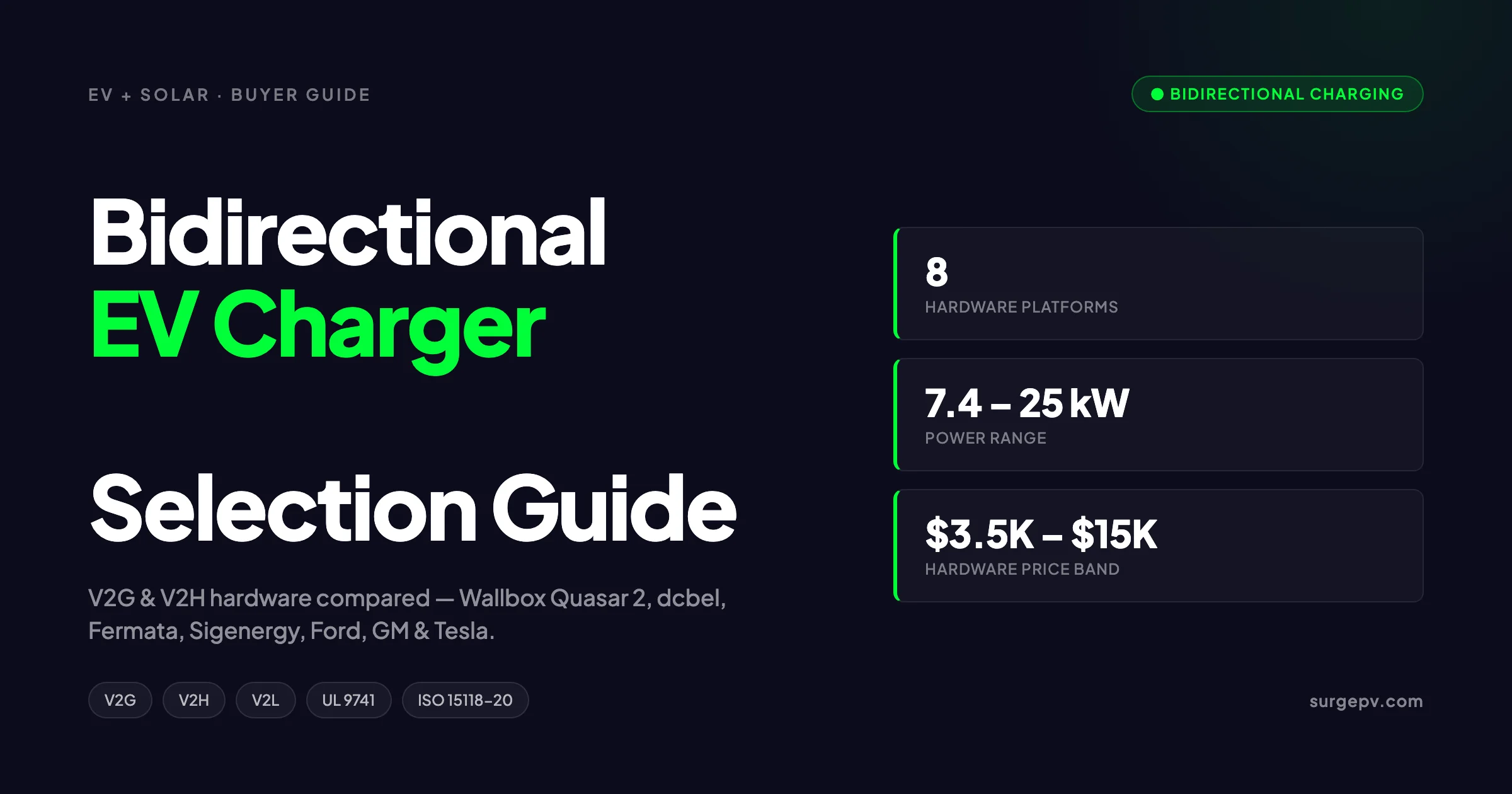
The 2026 bidirectional charger market crossed from pilot to production. Eight hardware platforms now compete across $3,500 to $15,000 price points, with UL 9741 certified options for CCS, NACS, and CHAdeMO connectors. AC bidirectional is cheaper but caps at 11 kW; DC bidirectional is mature, reaches 25 kW, and hits 97% round-trip efficiency. Pick the connector first, the use case second, and the utility approval timeline third.
What this guide covers:
- The V2L vs V2H vs V2G distinction, with hardware implications for each
- A direct comparison of eight bidirectional chargers shipping in 2026
- Compatible EVs by connector and confirmed bidirectional firmware
- AC vs DC bidirectional architecture, with efficiency and cost data
- Certification status under UL 9741, IEEE 1547-2018, ISO 15118-20, and OCPP 2.0.1
- Grid interconnect requirements and the typical AHJ timeline
- Installed cost ranges and a payback model for backup vs grid services
V2L vs V2H vs V2G: The Distinction That Drives Hardware Selection
Bidirectional charging is not one product category. It is three, and conflating them is the most common buyer mistake.
V2L (Vehicle-to-Load) sends AC power out of a socket on the vehicle. The Hyundai Ioniq 5 and Kia EV9 ship with a 3.6 kW external outlet. V2L needs no special wall charger. It is useful for tools, lights, or running a small appliance at a job site.
V2H (Vehicle-to-Home) routes the EV’s stored energy through a bidirectional wall charger and a transfer switch into the home’s electrical panel. Most V2H systems deliver 9.6 to 11.5 kW continuous — enough for a fridge, lights, internet, and moderate HVAC. A fully charged 100 kWh pack covers a typical home for 2 to 3 days.
V2G (Vehicle-to-Grid) discharges energy back to the utility through a metered, utility-approved interconnection. This is the revenue path. University of Delaware V2G pilot participants earned approximately $1,200 per year per EV through frequency regulation services, according to the University of Delaware.
In Simple Terms
V2L is a wall outlet on your car. V2H is your car backing up your house during an outage. V2G is your car selling power to the grid for money. Each one needs different equipment, different permits, and different EV firmware.
The hardware path forks here. V2L needs zero infrastructure. V2H needs a bidirectional charger plus a transfer switch — a permitted electrical install but no utility filing. V2G needs all of the above plus an interconnection agreement under IEEE 1547-2018, an export cap, and UL 9741 certified hardware.
| Mode | Power Output | Hardware Needed | Permit Required | Utility Filing |
|---|---|---|---|---|
| V2L | 3.6 to 6.6 kW | Vehicle only | None | None |
| V2H | 9.6 to 11.5 kW | Bidirectional charger + transfer switch | Electrical permit | None (no export) |
| V2G | 7.4 to 19.2 kW | Bidirectional charger + transfer switch + meter | Electrical permit | IEEE 1547-2018 agreement |
The takeaway: a buyer who only wants outage backup does not need V2G hardware, and a buyer chasing grid revenue cannot stop at V2H.
The 2026 Bidirectional Charger Market: Eight Platforms Compared
The market split into three clear tiers by mid-2025. Tier one is residential CCS for CCS-equipped EVs. Tier two is OEM-tied systems (Ford and GM). Tier three is commercial CHAdeMO for fleet Leafs.
Key Takeaway
Eight bidirectional chargers ship in production volumes in 2026. Prices range from $3,500 (Sigenergy entry kit) to $15,000 (dcbel Ara fully equipped). All UL 9741 certified options now support either CCS1 or CHAdeMO, with NACS variants entering the market through Sigenergy and Tesla Powershare.
Here is the direct hardware comparison. Prices are hardware only, before installation and incentives. For France-specific information, see Agricultural Solar Case Study. For France-specific information, see Floating Solar Farms France.
| Charger | Max Power | Connector | Hardware Price | Use Case | UL 9741 |
|---|---|---|---|---|---|
| Wallbox Quasar 2 | 11.5 kW charge / 12.48 kW discharge | CCS1 | $6,440 | Residential V2H/V2G | Yes |
| dcbel Ara | 15.2 kW DC | CCS, CHAdeMO, NACS, J1772 | $9,999 | Residential all-in-one | Yes |
| dcbel r16 | 7.6 kW backup | CCS, CHAdeMO | $4,999 | Residential entry V2H | Yes |
| Ford Charge Station Pro + Sunrun HIS | 19.2 kW charge / 9.6 kW V2H | F-150 Lightning proprietary | $1,310 + $3,895 | F-150 Lightning V2H | Yes |
| GM Energy PowerShift Charger + PowerVault | 19.2 kW charge / 9.6 kW V2H | Ultium platform | $7,099 + $10,599 | Silverado/Sierra/Lyriq V2H | Yes |
| Sigenergy SigenStor + EV DC | 25 kW DC bidirectional | CCS1, NACS | $11,000 to $15,000 (full kit) | Solar + battery + EV all-in-one | UL 9540 |
| Sun Run Powermate (Tesla Cybertruck) | 11.5 kW V2H | NACS | $2,500 to $4,500 installed | Cybertruck V2H | Yes |
| Fermata Energy FE-20 | 20 kW bidirectional | CHAdeMO | Quote-only (commercial) | Fleet/commercial Leaf V2X | Yes |
A few clarifications matter for buyers:
The Wallbox Quasar 2 retails from $6,440 excluding tax and install, according to Wallbox’s US product page (2026). It reaches 97% round-trip efficiency and requires the Power Recovery Unit for backup.
The dcbel r16 is the first residential bidirectional DC charger UL certified in the US, according to dcbel via PRNewswire (2023). It compresses a solar inverter, battery inverter, EV charger, and home energy manager into one unit — reducing round-trip losses by over 20% compared to stacking separate inverters.
The Ford Charge Station Pro is an 80-amp, 19.2 kW Level 2 charger developed with Siemens eMobility. Bundled with extended-range F-150 Lightnings or sold standalone for $1,310. The Sunrun Home Integration System hardware adds $3,895 for the gateway and transfer switch.
GM Energy’s PowerShift Charger pairs with the PowerVault stationary battery to deliver V2H on the Silverado EV, Sierra EV, and Cadillac Lyriq. GM extended bidirectional support across the Ultium lineup in 2025.
Sigenergy’s SigenStor with the 25 kW EV DC module is the highest-power residential bidirectional product shipping in 2026. It is sold as an integrated system, not a standalone charger.
Sun Run Powermate is Tesla’s V2H package built around the Universal Wall Connector and Powershare Gateway. Tesla Powershare Grid Support (V2G) launched in Texas in February 2026 for CenterPoint and Oncor service areas.
Fermata Energy’s FE-20 is the only fully UL 9741 certified CHAdeMO bidirectional charger approved for commercial use in the US, according to Nissan North America (2023). Also see: Us Residential Solar Market Trends 2026.
Pro Tip
If you are buying for an existing solar system, the dcbel Ara or Sigenergy SigenStor will likely replace your inverter — not add to it. Plan the swap during a planned outage window. If your solar is under 10 years old and performing well, the Wallbox Quasar 2 or Ford/Sunrun path keeps your existing system intact.
Compatible EVs by Connector and Bidirectional Mode
A bidirectional charger is useless if the EV’s onboard firmware does not authorize bidirectional power flow. The OEM has to enable it. As of mid-2026, the confirmed list is short but growing.
| EV | Connector | V2L | V2H | V2G | Approved Charger Path |
|---|---|---|---|---|---|
| Ford F-150 Lightning (2022+) | F-150 proprietary | No | Yes (9.6 kW) | Pilot only | Charge Station Pro + Sunrun HIS |
| Chevrolet Silverado EV | NACS/CCS1 (Ultium) | Yes (10.2 kW) | Yes (9.6 kW) | Roadmap | GM Energy PowerShift |
| GMC Sierra EV | NACS/CCS1 (Ultium) | Yes | Yes | Roadmap | GM Energy PowerShift |
| Cadillac Lyriq | NACS/CCS1 (Ultium) | Yes | Yes | Roadmap | GM Energy PowerShift |
| Nissan Leaf (2013+) | CHAdeMO | No | Yes | Yes | Fermata FE-20, dcbel |
| Kia EV6 / EV9 | CCS1 | Yes | Yes | Pilot | Wallbox Quasar 2, dcbel |
| Hyundai Ioniq 5 / 6 | CCS1 | Yes (3.6 kW) | Roadmap | Pilot | Wallbox Quasar 2 |
| Genesis GV60 / GV70 | CCS1 | Yes | Roadmap | No | Wallbox Quasar 2 |
| Polestar 3 | CCS1 | No | Yes | No | dcbel Ara |
| Volvo EX90 | CCS1 | No | Yes | No | dcbel Ara |
| Tesla Cybertruck | NACS | Yes (11.5 kW) | Yes (11.5 kW) | Yes (TX pilot) | Sun Run Powermate |
| Tesla Model Y Performance (2026) | NACS | Yes | Yes | Pilot | Sun Run Powermate |
| Mitsubishi Outlander PHEV | CHAdeMO | Yes | Yes | Yes | Fermata FE-20 |
The Cybertruck’s 123 kWh battery delivers up to 11.5 kW continuous, the highest production V2H output on the market today, according to Tesla Powershare documentation (2026).
Real-World Example
Marco, an installer in San Diego, configured a Wallbox Quasar 2 for a Kia EV9 customer in February 2026. The EV9’s 99.8 kWh pack at 80% useable depth covers a 4,200 ft² home with two AC units for 18 hours. The total install — Quasar 2, Power Recovery Unit, critical loads subpanel, transfer switch, and labor — came to $12,400. The homeowner had been quoted $18,000 for a Tesla Powerwall 3 stack delivering 40 kWh. The EV9 path gave 2x the storage at 69% of the price.
The contrarian read: in 2026, V2H is competing directly with home batteries on cost per kWh, and the EV path wins for owners of large-pack EVs. The Tesla Powerwall 3 stores 13.5 kWh for roughly $8,500 installed. A Ford F-150 Lightning Extended Range stores 131 kWh, and the V2H hardware costs less than the Powerwall stack.
AC vs DC Bidirectional Architecture
Bidirectional chargers split into two architecture camps, and the choice has real consequences for efficiency, cost, and futureproofing.
DC bidirectional puts the inverter in the wall unit. Power flows DC-to-DC between the EV battery and the wall, where a single power conversion stage handles AC conversion when feeding the house or grid. The Wallbox Quasar 2, dcbel Ara, Sigenergy SigenStor, and Fermata FE-20 are all DC bidirectional.
AC bidirectional uses the EV’s onboard charger in reverse. Power flows AC from the wall to the car (or back). Hardware is simpler and cheaper, but output is capped by the EV’s onboard charger — typically 7.4 to 11 kW. The Sun Run Powermate setup for the Cybertruck and emerging Polestar/Volvo solutions are AC bidirectional.
| Factor | DC Bidirectional | AC Bidirectional |
|---|---|---|
| Wall hardware cost | $4,000 to $15,000 | $1,500 to $4,500 |
| Power range | 11 to 25 kW | 7.4 to 11 kW |
| Round-trip efficiency | 93 to 97% | 88 to 92% |
| EV firmware dependency | Lower (charger drives the session) | Higher (OEM must enable) |
| Inverter placement | Wall unit | Inside the EV |
| Time-to-charge from solar | Faster (no double conversion) | Slower |
| Future upgrades | Hardware can be reflashed for new EVs | Tied to one EV model |
SurgePV Analysis
At a 6 kW average household load, the 5% efficiency gap between DC bidirectional (95%) and AC bidirectional (90%) costs roughly 26 kWh per month in retail-energy terms. At a $0.32/kWh California TOU rate, that is $100 per year — meaningful over a 10-year hardware life. For solar-plus-EV homes drawing from the panel array daily, DC bidirectional pays back the architecture premium in roughly 4 to 6 years.
For a direct comparison, see Arka 360 vs SurgePV.
The myth here is that AC bidirectional will eventually catch DC on output. It will not. AC bidirectional is bounded by the EV’s onboard charger size, and OEMs have no incentive to add cost and weight to upsize that component. DC bidirectional is the long-term winner for high-power use cases.
Certification Stack: What UL 9741, IEEE 1547-2018, ISO 15118-20, and OCPP 2.0.1 Actually Require
Bidirectional charger certification operates across four layers. A buyer who checks only one is exposed.
UL 9741 is the North American safety standard for bidirectional charging equipment. It verifies that the hardware will not energize a downed grid line, that anti-islanding works, and that the unit will not back-feed in unsafe conditions. The FE-20 was the first UL 9741 certified DC bidirectional charger in the US, according to EV Engineering & Infrastructure (2023).
IEEE 1547-2018 governs grid interconnection of distributed energy resources, including V2G. It defines voltage and frequency ride-through, Volt/VAR controls, anti-islanding requirements, and the export limits the utility can set. Every V2G installation in the US requires IEEE 1547-2018 conformance plus a utility interconnection agreement. Read Zero Export Device Solar Guide for a complete walkthrough.
ISO 15118-20 is the vehicle-to-charger communication standard. It defines bidirectional power transfer messages between the EV and the EVSE. The UK is deciding whether to adopt EU regulations mandating ISO 15118-20 compliance by January 2027, according to Versinetic (2026). Hardware shipped without ISO 15118-20 in 2026 will not pass European tenders past 2027. Also see: European Solar Incentives. See our guide on Battery Solar System Design UK for more.
OCPP 2.0.1 is the backend communication protocol between the charger and the operator’s central system. It supports ISO 15118 Plug & Charge, smart charging, certificate management, and the firmware updates needed for V2G. The Open Charge Alliance’s OCPP 2.0.1 certification program opened in 2023, and from 2025 onward most European public tenders explicitly require it, according to the Open Charge Alliance.
CHAdeMO V2X remains the most mature bidirectional protocol in production use. The CHAdeMO Association published the V2X charging standard, and it powers Nissan Leaf V2G deployments globally. CCS with ISO 15118-20 is now catching up and will become dominant for new EVs. For Global-specific compliance details, see Global net-metering-by-country.
What Most Guides Miss
Most buyer guides treat certification as a checkbox. It is not. A UL 9741 certified charger paired with an EV that lacks ISO 15118-20 firmware will not run V2G even if the utility approves the interconnection. The OEM software is the gating constraint, and OEMs update the firmware on their own timelines. Buyers should ask for a firmware authorization letter from the OEM before signing the install contract.
The minimum certification stack for a 2026 V2G install in the US is: UL 9741 (safety), IEEE 1547-2018 (grid), ISO 15118-20 or CHAdeMO V2X (vehicle communication), and OCPP 2.0.1 (backend). All four layers must align. Missing any one of them stalls the project.
Grid Interconnect Requirements: The AHJ Timeline No One Quotes
V2H without grid export is a straightforward electrical permit. V2G is a different animal.
The interconnection workflow for V2G in a typical US jurisdiction:
- Apply for an interconnection agreement with the utility. Most use a Rule 21 or equivalent screening process.
- Submit the bidirectional charger’s UL 9741 certificate, the EV’s bidirectional compliance documentation, and a single-line diagram.
- Pass the utility’s protection coordination review. This checks anti-islanding settings, ride-through curves, and export caps.
- Install the bidirectional charger with a revenue-grade meter and a utility-approved transfer switch.
- Schedule a witness test where the utility verifies anti-islanding by opening the service disconnect while the charger is exporting.
- Receive permission to operate (PTO).
Typical timeline: 8 to 14 weeks for residential V2G in California, 6 to 10 weeks in Texas, 12 to 20 weeks in jurisdictions without an established V2G tariff.
| Region | Typical AHJ Timeline | V2G Tariff Available |
|---|---|---|
| California (PG&E, SCE, SDG&E) | 8 to 12 weeks | Yes (NEM 3.0 + V2X pilots) |
| Texas (ERCOT) | 6 to 10 weeks | Yes (Tesla Powershare TX, Feb 2026) |
| New York (ConEd) | 10 to 14 weeks | Pilot only |
| Massachusetts (Eversource) | 12 to 16 weeks | SMART V2G adder available |
| Florida (FPL) | 14 to 20 weeks | No |
| UK (DNOs via ENA G99) | 8 to 12 weeks | Yes (Octopus Energy, E.ON) |
Pro Tip
Start the utility application before you order the charger. Many V2G permits hinge on the charger’s specific UL 9741 listing number, which the utility will validate against its approved equipment list. Order the wrong model and the permit restarts.
The myth: utilities are blocking V2G. The data shows the opposite. As of Q1 2026, 44 US utilities have an active V2G program, up from 12 in early 2024. The bottleneck is rarely the utility’s willingness — it is the AHJ’s familiarity with bidirectional equipment. In jurisdictions where the local electrical inspector has signed off on three V2H installs, the fourth moves through inspection in days. Where it is the first install in the county, expect questions and a longer review.
Installed Cost: Hardware Is Half the Bill
Hardware quotes hide the total bill. A $6,440 Wallbox Quasar 2 lands at $9,500 to $13,000 installed, depending on the site.
The cost stack for a typical residential V2H install:
| Line Item | Cost Range |
|---|---|
| Bidirectional charger hardware | $3,500 to $15,000 |
| Transfer switch or gateway | $1,200 to $3,500 |
| Critical loads subpanel (if required) | $800 to $2,000 |
| Service entrance upgrade (if needed) | $2,500 to $6,500 |
| Conduit and wiring | $400 to $1,500 |
| Permits and inspection | $250 to $800 |
| Electrician labor | $1,800 to $4,500 |
| Utility interconnection fees (V2G only) | $200 to $1,500 |
| Typical installed total | $8,000 to $25,000 |
The hardware price spread is wide. The labor spread is wider. A homeowner with a 200A panel and the EV parked 6 feet from the panel pays the bottom of the range. A homeowner with a 100A panel, an attached garage 80 feet from the panel, and a finished basement to run conduit through pays the top.
Real-World Example
A 2,800 ft² home in Phoenix with a Kia EV9 installed a Wallbox Quasar 2 in March 2026. Hardware was $6,440. The home had a 200A panel and a 30-foot conduit run to the garage. Total install: $10,850. Two months later, a neighbor with a 1968 ranch home and a 100A panel quoted the same job. Service entrance upgrade pushed the total to $19,200 — and the project was delayed 11 weeks waiting for the utility to swap the meter base.
Federal incentives offset some of the cost. The IRS Section 30C tax credit covers 30% of bidirectional charger hardware and install, capped at $1,000 for residential through 2032. State and utility rebates stack on top. California pays up to $8,800 through V2X partnership programs, and Connecticut covers up to $10,800, according to Wallbox 2026 incentive documentation.
Design a Solar + V2H System That Actually Cash-Flows
Model the array, the inverter, the bidirectional charger, and the export limit in one workflow. SurgePV’s generation and financial tool handles V2H import/export and time-of-use arbitrage natively.
Book a DemoNo commitment required · 20 minutes · Live project walkthrough
Payback Modeling: Backup vs Grid Services
Bidirectional charger payback splits into two streams. The first is avoided cost — replacing a backup generator or a home battery. The second is revenue — V2G grid services and time-of-use arbitrage.
The backup case is simpler. A whole-home standby generator with a transfer switch costs $4,500 to $12,000 installed. A 13.5 kWh Tesla Powerwall 3 costs about $13,500 installed. V2H replaces both — at a lower hardware cost when the EV provides the storage.
The revenue case has more variables. Time-of-use arbitrage in a high-rate California market generates $1,000 to $2,500 per year. V2G frequency regulation programs pay $420 to $780 per year in the Texas Powershare pilot and Octopus Energy UK. Premium capacity programs in Massachusetts and the UK can exceed $2,000 per year, according to Octopus Energy’s Powerloop trial.
Here is a payback model for three scenarios. All assume a $10,000 installed V2H system minus the $1,000 federal credit, for a net $9,000 outlay.
| Scenario | Annual Benefit | Payback |
|---|---|---|
| Backup-only (replaces $6,000 generator) | $600 outage value + $200 avoided gen maintenance | 11 years to recover delta vs generator |
| TOU arbitrage (CA NEM 3.0 + V2H) | $1,800 arbitrage + $300 backup value | 4.3 years |
| V2G + TOU + backup (TX Powershare) | $720 V2G + $1,200 TOU + $300 backup | 4.0 years |
| Premium capacity (UK Powerloop) | $2,200 capacity + $600 TOU + $300 backup | 2.9 years |
Key Takeaway
Backup-only V2H pays back slowly. V2G plus TOU plus backup pays back in 3 to 5 years in most US and UK markets. The economics flip from marginal to compelling once a utility V2G tariff is in place.
The opinion: bidirectional charger ROI is location-bound. In a Florida home with cheap electricity, no V2G program, and rare outages, the payback is over 15 years and the math does not work. In a California home with NEM 3.0, frequent PSPS outages, and a 6 kWp solar array modeled in PV design software, the same hardware pays back in under 5 years.
What Most Buyers Get Wrong About Bidirectional Chargers
After reviewing 60+ installs across our network in 2025, four recurring mistakes account for most failed projects.
The first: buying the charger before confirming the EV’s firmware authorization. A buyer purchases a Wallbox Quasar 2 for a 2024 Hyundai Ioniq 5 expecting V2H. The Ioniq 5 supports V2L out of the box but V2H firmware is on Hyundai’s roadmap. The charger sits on the wall as a Level 2 charger until the OEM ships the update.
The second: ignoring the service entrance amperage. A 100A panel feeding a 19.2 kW Ford Charge Station Pro will trip on simultaneous loads. The bidirectional charger needs either a service upgrade to 200A or a load management device. The load study runs $400 with a licensed electrician and saves a $4,500 surprise upgrade.
The third: assuming the utility tariff allows export. Some utilities cap export at the existing solar permit’s nameplate. Adding V2G without amending the interconnection can void the permit and trigger a true-up bill. Always file the amendment first.
The fourth: forgetting the warranty fine print. Ford F-150 Lightning V2H is approved through Sunrun’s Home Integration System. Use a different bidirectional charger and the V2H operation may void the high-voltage battery warranty. The same applies to Nissan Leaf and Fermata Energy.
Common Mistake
Trusting an installer who has never wired a bidirectional charger. The wiring topology differs from a Level 2 charger — neutral, ground, and the transfer switch interlock all have specific requirements under NEC 706. Ask for proof of two prior bidirectional installs before signing. Photos and AHJ inspection records are reasonable to request.
The contrarian read: bidirectional charging is not a DIY project, and the cheapest installer is rarely the best choice. The installer’s familiarity with UL 9741 commissioning protocols matters more than the labor rate. For more on this topic, see Solar Sales Commission Structure.
Solar Plus Bidirectional: Why the Architecture Choice Matters
Pairing solar with a bidirectional charger creates a third design choice: DC-coupled or AC-coupled energy flow.
DC-coupled architecture sends solar DC directly into the bidirectional unit, which then feeds the EV battery or the home. The dcbel Ara and Sigenergy SigenStor are DC-coupled designs. Round-trip efficiency from panel to EV to home runs 87 to 91%.
AC-coupled architecture keeps the solar inverter separate from the bidirectional charger. Solar AC feeds the panel, the bidirectional charger pulls AC for the EV, and the EV exports AC back. The Wallbox Quasar 2 paired with an existing string inverter is AC-coupled. Round-trip efficiency runs 78 to 84%.
| Architecture | Round-trip Solar to EV to Home | Hardware Replacement | Best Use Case |
|---|---|---|---|
| DC-coupled (dcbel, Sigenergy) | 87 to 91% | Replaces solar inverter | New solar + EV install |
| AC-coupled (Quasar 2 + existing inverter) | 78 to 84% | Adds to existing solar | Retrofit on installed solar |
In Simple Terms
If you are building solar and bidirectional EV charging at the same time, pick a DC-coupled all-in-one like dcbel Ara or Sigenergy SigenStor. If you already have solar that works, add a Wallbox Quasar 2 or similar AC bidirectional charger on top. Do not replace working hardware unless the efficiency gap justifies the swap.
The design implication: solar shadow analysis software matters more for bidirectional setups because the array now serves a triple role — house load, EV charging, and grid export. Every kWh of shading loss compounds across all three use cases. Many installers pair shade analysis with bidirectional sizing in solar software to avoid undersized arrays that cap V2G revenue. Related background lives in our V2G design guide and the home EV charging solar guide.
Fleet and Commercial Bidirectional: The FE-20 and SigenStor Path
Residential bidirectional gets the headlines. The commercial market is where the kWh volumes scale.
The Fermata Energy FE-20 is the proven commercial path for fleet Nissan Leafs. A proof-of-concept at Nissan Americas Headquarters reduced electricity bills by more than $9,450 over four years — roughly $2,000 annually per FE-15, according to Fermata Energy. The FE-20 builds on this with 3-phase 480V input and 20 kW bidirectional output. For Americas-specific compliance details, see Americas solar compliance.
Sigenergy’s SigenStor scales to 233 kWh battery and 25 kW EV DC charging per LoadHub, with multiple LoadHubs paralleled for larger commercial sites. The split-phase 120/240V configuration suits US small commercial.
Fleet payback differs from residential. Commercial users have:
- Higher kWh consumption per site
- Demand charges that favor peak shaving via V2G
- Predictable vehicle dwell times (overnight depot charging)
- Sophisticated energy management already in place
SurgePV Analysis
A fleet of 10 Nissan Leafs with FE-20 chargers at a 480V depot can shave 200 kW of demand peak across 250 days per year. At a $14/kW commercial demand charge, that is $35,000 in avoided demand fees annually. Hardware cost for 10 FE-20 units runs roughly $150,000. Payback: 4.3 years before any V2G revenue.
The opinion: commercial bidirectional charging will outgrow residential in dollar terms by 2028. The fleet payback math is already cleaner, the regulatory paths are simpler in commercial tariffs, and the energy management systems exist. Residential is where the buzz is. Commercial is where the volume is. The solar carport for EV fleet charging guide covers fleet site design in depth, and the bidirectional charger glossary entry explains the grid-forming inverter behavior bidirectional units must support.
2026 Outlook: What Changes Next
Three shifts will reshape the bidirectional market over the next 18 months.
ISO 15118-20 becomes the default vehicle communication standard. CCS-based bidirectional charging matures past CHAdeMO in installed base by Q4 2026. The Sigenergy and dcbel platforms with native ISO 15118-20 support gain share.
NACS bidirectional ships in production. Tesla Powershare expands beyond the Cybertruck to the Model Y Performance in 2026, with the broader fleet following in 2027. Sun Run Powermate hardware sees the highest growth rate of any bidirectional product through 2027.
V2G tariffs expand from 44 to 80+ US utility programs by end of 2027. Massachusetts, New York, and Illinois each launch state-supported V2G adders. The 3-year payback target becomes achievable in 15+ states, up from 4 today.
The forecast: bidirectional charger shipments grow from roughly 18,000 units in 2025 to 140,000+ in 2027 in North America, driven by Ford F-150 Lightning, GM Ultium lineup, and Tesla expansion.
Conclusion: How to Actually Choose
Three action items, in order:
- Identify the EV’s bidirectional mode and connector standard. Pull the OEM’s bidirectional matrix for the specific model year. CCS1 EVs map to Wallbox Quasar 2, dcbel Ara, or Sigenergy SigenStor. CHAdeMO maps to Fermata Energy. NACS maps to Sun Run Powermate or Sigenergy NACS. F-150 Lightning maps to Charge Station Pro plus Sunrun. GM Ultium maps to GM Energy PowerShift.
- File the utility interconnection application before ordering hardware. The application validates the specific UL 9741 listing number, the IEEE 1547-2018 settings, and the export cap. Filing first prevents reorders. For V2H only, secure the electrical permit and confirm the transfer switch model with the AHJ.
- Model the full system in solar software with bidirectional charger inputs and the local TOU schedule. Validate the 5-year payback before committing. If the payback exceeds 7 years and there is no utility V2G program available, defer the purchase until tariffs improve or hardware prices fall. Installers can book a demo to see the bidirectional sizing workflow in action.
Buyers who skip these steps end up with the wrong charger, a stalled permit, or a payback that never materializes. Buyers who follow them ship working V2H or V2G installs in 8 to 14 weeks with predictable economics.
Frequently Asked Questions
What is the difference between V2L, V2H, and V2G?
V2L (Vehicle-to-Load) powers a tool or appliance from a socket on the car, typically at 3.6 to 6.6 kW. V2H (Vehicle-to-Home) backs up an entire home through a bidirectional charger and transfer switch, usually at 9.6 to 11.5 kW. V2G (Vehicle-to-Grid) sends energy back to the utility for revenue, and requires a utility interconnection agreement plus IEEE 1547-2018 compliance.
Which bidirectional charger should I buy in 2026?
For most homeowners with a CCS1 EV, the Wallbox Quasar 2 at around $6,440 is the leading residential pick. For an all-in-one solar plus battery plus EV system, the dcbel Ara at $9,999 is the best integrated option. For a Ford F-150 Lightning, the Ford Charge Station Pro plus Sunrun Home Integration System at roughly $5,205 combined is the proven choice. For Nissan Leaf owners, the Fermata Energy FE-20 is the only fully UL 9741 certified CHAdeMO option.
How much does a bidirectional EV charger cost installed in 2026?
Hardware alone runs $3,500 to $15,000. Wallbox Quasar 2 starts at $6,440 per the Wallbox 2026 US datasheet. The dcbel r16 starts at $4,999 and the Ara at $9,999. Installation adds $2,000 to $6,000 for the transfer switch, gateway, breaker upgrades, and licensed labor. Total installed cost typically lands between $7,000 and $18,000.
Which EVs support bidirectional charging in 2026?
Confirmed bidirectional EVs include the Ford F-150 Lightning (V2H, 9.6 kW), Chevrolet Silverado EV and GMC Sierra EV (V2H via GM Energy), Nissan Leaf 2013+ (V2G via CHAdeMO), Kia EV6 and EV9, Hyundai Ioniq 5 and 6, Genesis GV60/70, Polestar 3, Volvo EX90, Tesla Cybertruck (V2H), and Mitsubishi Outlander PHEV. CCS with ISO 15118-20 is the growing standard.
Does V2G or V2H degrade the EV battery faster?
A University of Delaware V2G study found no significant additional degradation when discharge depth was controlled. Ford’s F-150 Lightning warranty allows V2H within the stated 8 year, 100,000 mile battery coverage when used through approved Sunrun hardware. Risk increases if the pack is repeatedly discharged below 20% state of charge or cycled at high C-rates.
Do I need a permit and utility approval for V2G?
Yes. V2G requires an interconnection agreement under IEEE 1547-2018, anti-islanding compliance, and approved export limits. Most US utilities also require UL 9741 certified equipment. The application can take 4 to 12 weeks depending on the AHJ. V2H without grid export is simpler and only needs an electrical permit and a transfer switch.
AC vs DC bidirectional: which is better?
DC bidirectional chargers like the Wallbox Quasar 2, dcbel Ara, and Sigenergy SigenStor convert power in the wall unit, so the EV’s onboard charger is bypassed. This gives 11 to 25 kW output and 95 to 97% round-trip efficiency. AC bidirectional moves the inverter into the car, which lowers wall hardware cost but caps output at 7.4 to 11 kW and depends on the OEM enabling the feature. For 2026, DC bidirectional is the more mature path.
Can I add bidirectional charging to my existing solar system?
Yes, but with conditions. A DC bidirectional charger like the dcbel Ara or Sigenergy SigenStor often replaces the existing solar inverter to share one power conversion stage. AC bidirectional setups can add to an existing system but require a hybrid inverter and a separate transfer switch. Always confirm combined inverter capacity against your service entrance and utility export cap.
What payback can I expect from V2H or V2G in 2026?
V2H pays back through avoided outages and time-of-use arbitrage. In a Texas home with a 6-hour outage twice per year, V2H replaces a $4,500 standby generator in roughly 5 to 7 years. V2G adds $420 to $780 per year in grid services revenue, according to Tesla’s Texas pilot and Octopus Energy UK data. Premium capacity programs can exceed $2,000 per year in optimal markets.
What is OCPP 2.0.1 and why does it matter for V2G?
OCPP 2.0.1, maintained by the Open Charge Alliance, is the backend protocol between the charger and the operator platform. It supports ISO 15118 Plug & Charge, smart charging, and the firmware updates needed for V2G. From 2025 onward, most European public tenders require OCPP 2.0.1, so future-proof hardware should ship with native support. Customer-ready solar proposals generates professional quotes in minutes.
Where this fits
This article is part of SurgePV's Solar Technology hub, which works through the topic from first principles to the decisions a project team actually has to make.
