

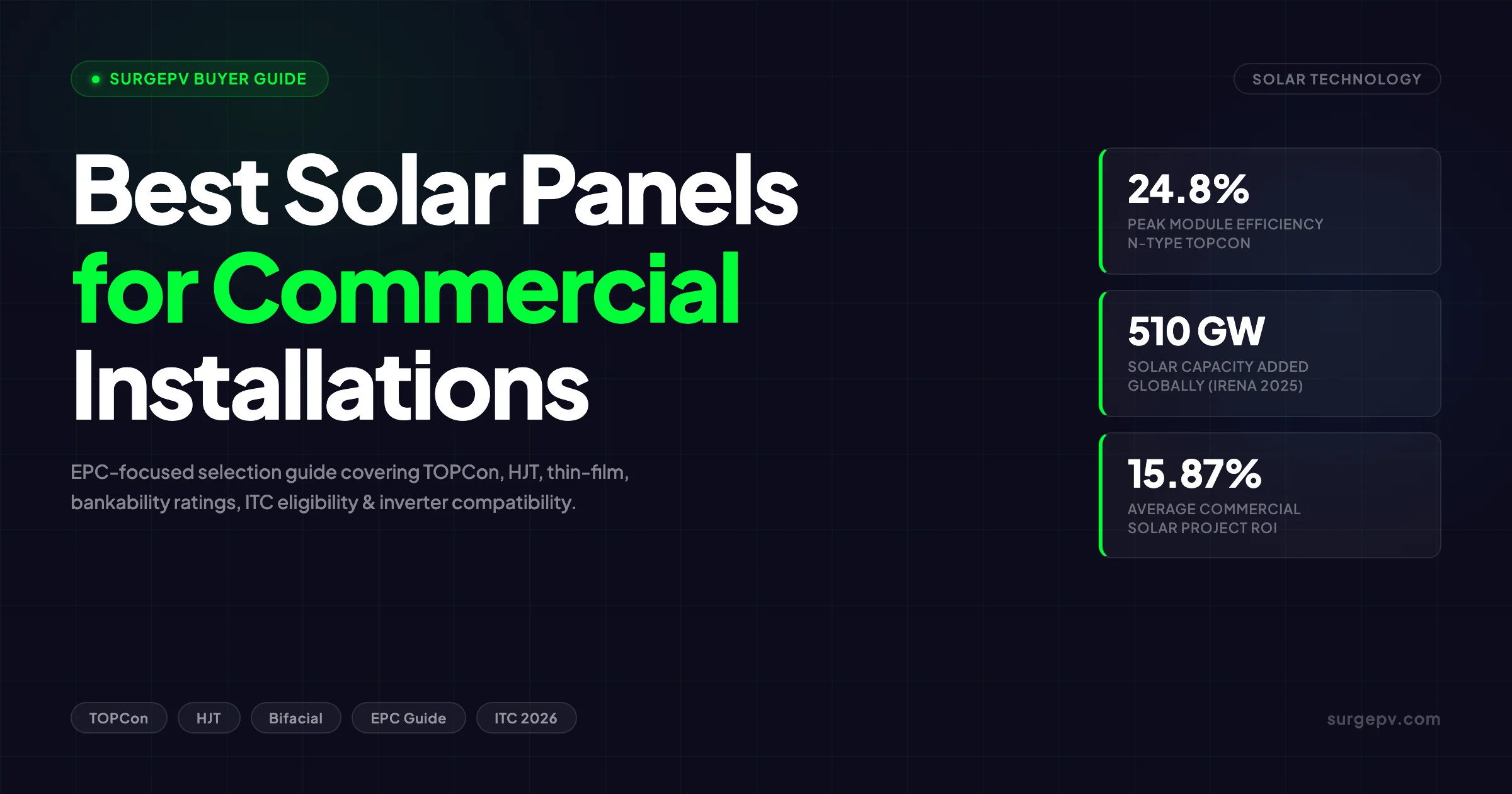
Global solar installations reached 2,391 GW by the end of 2025, with 510 GW added in that year alone, according to the IRENA Renewable Capacity Statistics 2025. Module prices fell to around $0.30 per watt DC — a record low. For EPCs and commercial solar installers, that creates a deceptively difficult spec challenge: when dozens of panels claim 22%+ efficiency, selection comes down to bankability, temperature performance, inverter pairing, structural load ratings, and domestic content eligibility. This guide covers the 10 best commercial solar panels in 2026, the cell technology trade-offs between TOPCon, HJT, PERC, and thin-film, and the EPC checklist that separates a well-specified project from a warranty call in year three.
TL;DR — Commercial Panel Selection in 2026
N-type TOPCon dominates commercial specs: JA Solar, Jinko, LONGi, and Trina Solar lead on efficiency and supply chain depth. HJT is worth the 10–20% premium in hot climates. First Solar thin-film is the right call for humid and coastal sites or projects requiring Buy American Act compliance. The 30% ITC safe harbor deadline is July 3, 2026 — projects must begin construction by then to lock in the credit.
What this guide covers:
- The difference between residential and commercial-grade panels
- Cell technology comparison: TOPCon vs HJT vs PERC vs thin-film
- 10 best commercial solar panels with full spec breakdowns
- How to evaluate bankability, warranties, and manufacturer risk
- Inverter compatibility and 1500V string design considerations
- Commercial ROI, ITC, MACRS depreciation, and bonus credits
- Installation logistics: wafer size, connectors, and structural load
What Makes a Solar Panel Suitable for Commercial Use?
Not every high-efficiency panel works for a C&I or ground-mount project. Several characteristics separate commercial-grade modules from residential equipment.
Wattage and module size. Residential panels typically run 350–420W. Commercial panels start at 450W and push past 700W for utility-scale applications. Higher wattage per module reduces the total panel count, cuts labor hours, and lowers balance-of-system (BOS) costs — a meaningful difference across a 500 kW project.
System voltage rating. Commercial systems almost universally run at 1500V DC, while residential systems run at 1000V. The higher voltage reduces current, which means smaller wire gauges, lower resistive losses, and longer strings — fewer combiner boxes and fewer inverter inputs. Any panel specified for a commercial project should carry a 1500V rating. Not all panels do.
Mechanical and structural ratings. Commercial installations face unique structural demands. Rooftop commercial systems must meet the wind and snow load ratings of the building — typically ASCE 7-22 for US projects. Ground-mount systems need sufficient frame stiffness for tracker compatibility. Panels using 210mm silicon wafers (Trina Vertex N, JA DeepBlue 5.0) are physically larger and heavier, which affects racking specifications and crane requirements on large sites.
IEC certification. IEC 61215 (design qualification and type approval) and IEC 61730 (safety qualification) are minimum requirements for any bankable commercial project. Some lenders and offtakers also require IEC 61701 (salt mist corrosion resistance) for coastal sites and IEC 62716 (ammonia resistance) for agricultural installations.
Bankability is the factor most residential buyers never consider, but it is what lenders, insurance providers, and offtakers require. Bloomberg NEF’s Tier 1 list and the PVEL/Kiwa PV Module Scorecard are the two dominant references. A panel can be technically excellent but financially risky if the manufacturer lacks the balance sheet depth to honor a 25-year performance guarantee.
Pro Tip
Always check the manufacturer’s most recent PVEL scorecard and Bloomberg Tier 1 status before finalizing a commercial spec. Both are updated quarterly. A manufacturer that dropped off the Tier 1 list in the prior quarter is a red flag — even if their panels score well on efficiency tests.
Cell Technology Comparison: TOPCon, HJT, PERC, and Thin-Film
The commercial panel market in 2026 is shaped by four cell technologies. Each has a distinct efficiency profile, temperature behavior, degradation curve, and cost position.
| Technology | Efficiency Range | Temp Coefficient | Year 1 Degradation | Output at Year 25 | Typical Cost |
|---|---|---|---|---|---|
| P-type PERC | 19.5–21.5% | -0.35 to -0.40%/°C | 2–3% | 80–83% | Lowest |
| N-type TOPCon | 21.0–24.8% | -0.29 to -0.32%/°C | 1–2% | 87–90% | Mid |
| N-type HJT | 21.2–23.6% | -0.24 to -0.27%/°C | 0.4–0.5%/yr | 90–92% | Mid-High |
| CdTe Thin-Film | 18.8–19.7% | -0.27 to -0.32%/°C | ~0.3%/yr | ~88% | Mid (per Wp) |
TOPCon is the dominant commercial technology in 2026. It offers the best efficiency-to-cost ratio, is available in bifacial configurations, and is produced at scale by all major Chinese manufacturers and Q CELLS. The shift from P-type PERC to N-type TOPCon happened rapidly between 2023 and 2025 — most new commercial capacity additions now use TOPCon. JinkoSolar holds the TOPCon cell efficiency world record at 27.79%, certified by NREL in 2025.
HJT (heterojunction technology) is the premium option. Its temperature coefficient of -0.24 to -0.27%/°C means it loses less output on hot days compared to TOPCon or PERC. A 500 kW system in Phoenix sees meaningfully higher annual yield with HJT panels than equivalent TOPCon panels — the efficiency gap narrows in hot weather. HJT also degrades more slowly (0.4–0.5%/year vs. 0.5–0.6%/year for most TOPCon panels), which improves the P90 energy estimate used in project financing.
PERC is a mature P-type technology that still ships at significant volume due to its low cost. For projects where budget is the primary constraint and the climate is temperate, high-quality PERC panels from Canadian Solar or Q CELLS remain a viable commercial spec. Their main disadvantage is faster degradation and higher temperature sensitivity relative to N-type alternatives.
CdTe thin-film from First Solar occupies a unique niche. It has lower nominal efficiency than silicon technologies, but it performs disproportionately well in heat, humidity, and diffuse light — the conditions that reduce silicon panel output most. First Solar’s panels also qualify for Buy American Act (BAA) and Berry Amendment compliance, which is mandatory for federal and military projects.
For a detailed breakdown of the technology trade-offs, see our TOPCon vs HJT vs Perovskite comparison.
The 10 Best Commercial Solar Panels in 2026
These panels are evaluated on efficiency, bankability, temperature performance, 1500V compatibility, bifacial availability, warranty terms, and supply chain reliability. They are not ranked — the right panel depends on your project type, climate, and contract requirements.
1. JA Solar DeepBlue 4.0 Pro — Best All-Around Commercial TOPCon
Key Specs:
| Attribute | Value |
|---|---|
| Power range | 460–650W |
| Efficiency | 21.8–23.3% |
| Cell technology | N-type TOPCon, bifacial |
| Temperature coefficient | -0.28 to -0.30%/°C |
| System voltage | 1500V |
| Performance warranty | 30 years (linear) |
JA Solar is one of the world’s three largest panel manufacturers, and the DeepBlue 4.0 Pro is their primary commercial product. It hits the efficiency and wattage targets most EPCs need without the weight and racking complexity of the 210mm DeepBlue 5.0 series. Its 182mm half-cut cells are compatible with the widest range of commercial racking systems, and its 1P tracker compatibility makes it a standard spec for ground-mount projects in the 200 kW to 5 MW range.
PAN files for the DeepBlue 4.0 Pro are widely available and validated against field performance data — a practical consideration when running production simulations in solar design software like SurgePV, Helioscope, or PVsyst. Simulations with accurate PAN files produce yield estimates within 2–3% of measured output; inaccurate or generic files can introduce 5–8% optimism bias into a project’s energy model.
JA Solar consistently earns Bloomberg Tier 1 status and strong PVEL scorecard rankings. For most commercial project lenders, they are an unconditional Tier 1 manufacturer.
Watch out: JA Solar’s module production is primarily China-based. If your project requires the domestic content ITC bonus under IRA Section 45X, the DeepBlue 4.0 Pro does not qualify.
2. Jinko Solar Tiger NEO III — Best for High-Volume Commercial Projects
Key Specs:
| Attribute | Value |
|---|---|
| Power range | 490–550W |
| Efficiency | 22.5–24.0% |
| Cell technology | N-type TOPCon, bifacial |
| Temperature coefficient | -0.29%/°C |
| System voltage | 1500V |
| Performance warranty | 30 years |
Jinko Solar holds the N-type TOPCon cell efficiency world record at 27.79% (NREL-certified, 2025), and that R&D depth shows in the Tiger NEO III’s field performance. Jinko is the world’s largest solar manufacturer by annual shipment volume, which means supply chain risk is lower than with second-tier brands — critical for projects where delivery delays cost real money.
The Tiger NEO III’s bifacial configuration with a transparent backsheet adds 5–15% rear-side energy yield on ground-mount projects with light-colored substrates. For a 300 kW ground-mount in a sunny US market, bifacial gain alone adds $15,000–$25,000 in lifetime energy value at commercial electricity rates. See our bifacial solar panel design guide for a full bifacial gain calculation methodology.
Watch out: Jinko panels are produced in China and Vietnam. The specific manufacturing origin of the module series you’re quoting matters — Vietnamese-origin modules face different tariff treatment than Chinese-origin modules under current US trade policy. Confirm origin before executing a purchase agreement.
3. LONGi Hi-MO X10 Explorer — Best Efficiency for Space-Constrained Sites
Key Specs:
| Attribute | Value |
|---|---|
| Power | 495W (60-cell format) |
| Efficiency | 24.3% |
| Cell technology | N-type HPBC (Hybrid Passivated Back-Contact) |
| Temperature coefficient | -0.28%/°C |
| System voltage | 1500V |
| Performance warranty | 30 years |
LONGi’s HPBC technology achieves 24.3% module efficiency — among the highest in commercial production. On a rooftop where usable area is limited, a LONGi Hi-MO X10 system can generate 10–12% more energy than an equivalent PERC system in the same footprint. That translates directly to more kilowatts installed on a building where the roof is the binding constraint.
The Hi-MO X10 has a smaller physical footprint than 210mm competitors, which eases logistics on elevator-access commercial rooftops where crane access is limited and roof load capacity is a design constraint. It is a preferred spec for urban commercial projects — hospitals, multi-story office buildings, and manufacturing facilities — where installation logistics are as important as raw wattage.
Watch out: As a back-contact panel, the Hi-MO X10 has stricter shade tolerance requirements than conventional half-cut panels. Partial shading creates larger performance penalties because back-contact cells cannot rely on bypass diodes in the same way as front-contact designs. Model the shade impact carefully using solar shadow analysis software before specifying it on a rooftop with chimneys, HVAC units, or parapets.
4. Trina Solar Vertex N — Best for Large Ground-Mount Projects
Key Specs:
| Attribute | Value |
|---|---|
| Power range | 640–720W |
| Efficiency | 22.8–23.7% |
| Cell technology | N-type TOPCon, bifacial |
| Temperature coefficient | -0.28%/°C |
| System voltage | 1500V |
| Performance warranty | 30 years |
Trina Solar’s Vertex N line uses 210mm silicon wafers to hit 640–720W per panel — the highest wattage class in commercial production. Higher wattage per panel means fewer panels to install on large projects, reducing labor, racking hardware, and electrical wiring costs. On a 1 MW ground-mount, switching from 550W to 700W panels reduces total panel count by roughly 22%. For a 1 MW project with $0.20/W installed labor cost, that is approximately $40,000 in labor savings.
Trina holds the commercial module efficiency record at 25.44% on an HJT module (set in early 2025), demonstrating the R&D capability behind the Vertex N line. In standard TOPCon production, the Vertex N delivers 23.7% — placing it among the top performers by efficiency in the 600W+ wattage class.
Watch out: 210mm panels are physically larger and heavier than 182mm equivalents — typically 37–40 kg per panel. Verify that your racking system is rated for the Vertex N’s dimensions and weight before specifying, especially on ballasted rooftop systems where roof load calculations are constrained.
5. First Solar Series 7 — Best for Hot, Humid, and Federal Projects
Key Specs:
| Attribute | Value |
|---|---|
| Power range | 525–550W |
| Efficiency | 18.8–19.7% |
| Cell technology | CdTe thin-film |
| Temperature coefficient | -0.27%/°C |
| System voltage | 1500V |
| Performance warranty | 25 years |
First Solar is the only major thin-film manufacturer still operating at commercial scale, and the Series 7 is its flagship large-format panel. Its 18.8–19.7% efficiency is lower than N-type silicon competitors, but CdTe technology has two performance advantages that make it the right choice for specific project types.
First, First Solar panels degrade at approximately 0.3% per year — about half the rate of most silicon panels. An NREL study of First Solar’s Colorado installation confirmed this field degradation figure across 25 years of real measured data. At year 25, a Series 7 installation retains roughly 88% of nameplate output.
Second, CdTe performs better than silicon in heat and humidity. At 40°C above standard test conditions, a First Solar panel loses approximately 10.8% of output. An equivalent silicon PERC panel loses 14–16%. For projects in humid subtropical climates — Florida, Gulf Coast, Southeast Asia — this translates to 3–5% more annual energy generation from the same nameplate capacity.
First Solar panels are manufactured in Ohio, qualifying for the domestic content ITC bonus (+10%) and Buy American Act compliance. They are the required choice for federal agency projects and state projects with Buy American procurement requirements.
Watch out: First Solar’s Voc temperature coefficient is positive, unlike silicon panels, which have a negative Voc coefficient. This reversed behavior catches installers off guard when designing strings without validating PAN files in simulation software. Always use First Solar’s official PAN files — do not substitute with a generic CdTe file.
6. Maxeon 7 — Best Long-Term Warranty and Lowest Degradation
Key Specs:
| Attribute | Value |
|---|---|
| Power range | 415–445W |
| Efficiency | 22.8–24.1% |
| Cell technology | N-type IBC (back-contact) |
| Temperature coefficient | -0.27%/°C |
| Performance warranty | 40 years |
| Annual degradation | 0.25% (years 2–40) |
Maxeon (formerly SunPower’s panel division) makes the only commercially available panel with a 40-year warranty. Its IBC (interdigitated back-contact) cell design eliminates front-side electrodes, maximizing the active cell area and reducing resistive losses. The 0.25% annual degradation rate is the lowest of any mass-produced panel available today.
For EPCs working on commercial projects with long-term lease or PPA structures — typically 15–25 year terms — Maxeon’s degradation curve translates directly into a higher P90 energy estimate and lower financed risk. Some lenders and tax equity investors accept a lower DSCR on Maxeon projects precisely because the performance data behind the 40-year warranty is backed by decades of field measurements.
Watch out: Maxeon panels are premium-priced — typically 25–40% more per watt than comparable TOPCon panels. For price-competitive bids where the differentiator is cost per kWh over 10 years rather than 25 years, Maxeon may not win the project economics argument. Their IBC design also has limited compatibility with partial-shade rooftop environments, similar to LONGi’s back-contact approach.
7. Canadian Solar HiKu7 — Best Value High-Wattage Commercial Panel
Key Specs:
| Attribute | Value |
|---|---|
| Power range | 640–665W |
| Efficiency | 20.6–21.4% |
| Cell technology | PERC monocrystalline, bifacial available |
| Temperature coefficient | -0.34%/°C |
| System voltage | 1500V |
| Performance warranty | 25 years |
Canadian Solar’s HiKu7 offers the lowest price entry into the 640W+ wattage class. While it uses P-type PERC rather than N-type TOPCon, Canadian Solar’s manufacturing quality and bankability are consistently rated among the highest globally. The HiKu7 is a pragmatic choice when project budget is constrained and the client needs the BOS savings that high-wattage panels deliver, but cannot justify the premium for N-type technology.
Canadian Solar has manufacturing facilities in multiple countries, which provides flexibility for tariff management. Their US-distributed stock typically ships from Southeast Asian facilities and does not qualify for the domestic content ITC bonus.
Watch out: The HiKu7’s PERC technology carries a higher temperature coefficient (-0.34%/°C) than N-type alternatives. On projects in high-temperature climates, model the annual production carefully using the generation and financial tool. The gap between nameplate and actual yield is wider for PERC in hot conditions than the efficiency spec sheet suggests.
8. REC Group Alpha Pure-RX — Best HJT Panel for Hot Climates
Key Specs:
| Attribute | Value |
|---|---|
| Power range | 450–470W |
| Efficiency | 22.3–22.6% |
| Cell technology | N-type HJT (heterojunction), bifacial |
| Temperature coefficient | -0.24%/°C |
| System voltage | 1500V |
| Performance warranty | 25 years (92% at year 25) |
REC Group’s Alpha Pure-RX is the leading HJT panel for commercial installations. Its -0.24%/°C temperature coefficient is one of the lowest in production — only matched by a handful of HJT competitors. In climates where summer temperatures consistently push module temperatures above 60°C, the REC Alpha outperforms equivalent TOPCon panels by 2–4% in annual energy yield. Over a 25-year project, that gap compounds into a meaningful difference in total kilowatt-hours delivered.
The Pure-RX line is lead-free, which matters for projects in the EU under the RoHS directive, and for EPCs building ESG-compliant systems for corporate offtakers with sustainability covenants in their power purchase agreements.
Watch out: REC Alpha panels are priced at a premium above standard TOPCon. If the project is in a temperate climate — Pacific Northwest, UK, Germany — the temperature coefficient advantage delivers less incremental value and the premium is harder to justify in a competitive bid. Run the climate-adjusted annual yield comparison before specifying.
9. Q CELLS Q.TRON XL-G2.3 — Best for US Domestic Content Compliance
Key Specs:
| Attribute | Value |
|---|---|
| Power range | 620–625W |
| Efficiency | 21.8–22.3% |
| Cell technology | N-type TOPCon (Q.ANTUM NEO) |
| Temperature coefficient | -0.29%/°C |
| System voltage | 1500V |
| Performance warranty | 25 years |
Q CELLS operates a manufacturing facility in Dalton, Georgia — one of the few panel manufacturers with US-based module assembly at meaningful scale. The Q.TRON XL-G2.3 qualifies for the IRA domestic content bonus credit (+10% ITC) when sourced from the Georgia facility, making it one of the most competitive options for US commercial projects that are stacking incentives.
Q CELLS’ Q.ANTUM NEO technology is a proprietary N-type TOPCon variant that consistently earns top-tier PVEL PV Module Scorecard rankings. Their US availability, domestic manufacturing, and bankability rating make them a preferred spec for commercial projects developed with tax equity investors who require Tier 1 panels from manufacturers with established US legal entities.
Watch out: Q CELLS’ US-manufactured panels carry a price premium of approximately 8–15% above equivalent Chinese-origin TOPCon. The domestic content ITC bonus (+10%) typically offsets this premium for projects that qualify — but only if the system owner has sufficient US tax liability to utilize the credit. Work through the tax equity structure before assuming the bonus is economically accessible.
10. Aiko Solar Neostar — Highest Commercially Available Efficiency
Key Specs:
| Attribute | Value |
|---|---|
| Power range | 480–510W |
| Efficiency | 24.1–25.0% |
| Cell technology | N-type ABC (All Back-Contact) |
| Temperature coefficient | -0.24%/°C |
| System voltage | 1500V |
| Performance warranty | 30 years |
Aiko Solar’s ABC (All Back-Contact) technology achieves 25.0% module efficiency in production — the highest of any commercially available silicon panel as of 2026. The ABC design eliminates front-side electrode shading entirely, and combined with N-type passivation, delivers both peak efficiency and one of the lowest temperature coefficients in the market.
Aiko began mass production of ABC panels in late 2025. For space-constrained commercial rooftops where every square meter matters — hospitals, factories, urban office buildings — Aiko’s efficiency advantage translates directly into more kilowatts per square meter of available roof area.
Watch out: Aiko is a newer entrant to international markets compared to JA Solar, Jinko, or LONGi. Their long-term bankability is still being established. Before specifying Aiko on a financed project, verify their current Bloomberg Tier 1 status and confirm that your lender or tax equity partner will accept them. Their limited international supply chain history also increases procurement risk on tight project timelines.
How to Evaluate Commercial Solar Panels: The EPC Checklist
Efficiency and wattage are table stakes. The following checklist covers what distinguishes a strong commercial spec from one that creates problems at installation or during the warranty period.
Bankability Verification
- Bloomberg Tier 1 status: Published quarterly. A manufacturer must demonstrate bankable module products financed in real projects, with at least two external debt-funded projects in the past two years.
- PVEL/Kiwa PV Module Scorecard: The most rigorous independent test protocol. Look for Top Performer status in the categories relevant to your climate — PID resistance, LID/LETID, thermal cycling, humidity freeze, and dynamic mechanical load.
- UL/IEC certifications: IEC 61215 and IEC 61730 minimum. Add IEC 61701 for coastal or marine projects.
PAN File Accuracy
PAN files (panel data files) are the input used by simulation tools — including solar software like SurgePV, Helioscope, and PVsyst — to model energy yield. An inaccurate PAN file produces an optimistic production estimate, which creates variance between the model and measured output.
Always use manufacturer-provided PAN files validated against measured field data rather than generic files. For high-stakes projects (tax equity, project finance), commission an independent energy assessment using a third-party validated PAN file.
Temperature Coefficient by Climate Zone
| Climate Zone | Best Cell Technology | Reason |
|---|---|---|
| Hot desert (Phoenix, Riyadh, Delhi) | HJT or IBC | Low temp coefficient minimizes heat-related output loss |
| Hot humid (Florida, Gulf Coast, SE Asia) | HJT or CdTe thin-film | Low temp coefficient plus humidity resistance |
| Temperate (Midwest US, Western Europe) | TOPCon | Adequate efficiency, best cost |
| Cold (Nordic countries, high altitude) | TOPCon or PERC | Temperature advantage less important; cost matters more |
Bifacial Gain by Installation Type
| Installation Type | Expected Bifacial Gain | Notes |
|---|---|---|
| Ground-mount, light gravel substrate | 10–20% | High albedo; clearance 0.8m+ |
| Ground-mount, grass or soil | 5–12% | Variable albedo; measure site-specific albedo |
| Commercial rooftop, white TPO membrane | 5–10% | Moderate rear-side irradiance |
| Commercial rooftop, gray EPDM membrane | 3–7% | Low albedo limits rear-side contribution |
| Carport, concrete ground | 8–15% | Good reflectivity if maintained |
Model bifacial gain using your specific site albedo before committing to bifacial versus monofacial — the difference between a 5% and 15% bifacial gain changes the project economics meaningfully. See our bifacial solar panel design guide for the full calculation methodology.
Structural and Logistics Check
- Module weight: 210mm panels typically weigh 35–40 kg. Verify roof load limits and racking capacity before specifying.
- Module dimensions: Confirm orientation compatibility with the chosen racking system — portrait vs. landscape, 1P vs. 2P tracker compatibility.
- Connector type: MC4 is the industry standard. Some manufacturers use proprietary connectors or connectors that require adapters. Verify compatibility with inverter and combiner box connectors before the project ships.
- Frame gauge: Heavier steel frame gauges reduce racking hardware requirements and improve wind resistance on exposed commercial sites.
Bankability, Warranties, and Manufacturer Risk
Commercial solar projects have 25–40-year lifespans. A performance warranty from a manufacturer that ceases operations in year 10 is worthless. Evaluating manufacturer risk is as important as evaluating the panel’s technical spec.
What to Look for in a Performance Warranty
| Warranty Attribute | Minimum Standard | Best-in-Class |
|---|---|---|
| Product warranty (defects) | 12 years | 25–40 years (Maxeon) |
| Performance guarantee | 80% at year 25 | 87–92% at year 25 |
| Linear degradation | Year 1 loss 2–3%, then 0.5–0.7%/yr | Year 1 loss under 1%, then 0.25–0.4%/yr |
| Bankability rating | Bloomberg Tier 1 | PVEL Top Performer plus Tier 1 |
Degradation matters in project finance. When lenders calculate the P90 energy yield of a commercial project, they apply a degradation assumption over the loan term. A panel with 0.4%/year degradation (HJT) produces approximately 6% more energy at year 25 than a panel with 0.7%/year degradation (PERC), assuming the same nameplate output. That difference directly affects the debt service coverage ratio and the project’s financeable amount.
Warranty transferability. If the commercial project will be sold or refinanced during its life — common for EPCs who develop and flip projects — verify that the panel warranty transfers to a new owner without manufacturer consent or a transfer fee. Some manufacturers charge $0.02–$0.05/W for warranty assignment, which adds up on a multi-MW project sale.
Key Takeaway — Degradation Math
A 1% improvement in annual degradation rate compounds into an 8–10% difference in total lifetime energy generation over 25 years. For a 500 kW system generating 700,000 kWh/year, that is 56,000–70,000 kWh in additional lifetime generation — worth $5,000–$8,000 per year at commercial electricity rates.
Inverter Compatibility and Electrical Design
Panel selection and inverter selection are coupled decisions. Specifying a panel without confirming inverter compatibility is a design error that surfaces at commissioning, not in the spec sheet review.
1500V string sizing. Most commercial string inverters accept 1500V DC input. At 1500V, a typical 550W panel (Voc = 45–50V) allows strings of 28–33 panels depending on the low-temperature Voc correction. NEC Article 690 requires a 1.25 multiplier on the sum of Voc ratings — verify that the string Voc at the lowest design temperature does not exceed the inverter’s maximum input voltage.
String inverters vs. central inverters. String inverters are the standard for commercial systems under 2 MW. Above 2 MW, central inverters offer lower per-watt cost but require 1000V DC systems and combiner boxes. The panel selection decision affects which inverter architecture makes economic sense for the project scale.
Power optimizer compatibility. Optimizers from SolarEdge, Tigo, or SMA are sometimes specified for commercial rooftops with partial shading. Not all optimizers are compatible with all panels — verify frame width compatibility and connector type before specifying. See our full microinverters vs string inverters vs optimizers guide for a detailed comparison.
Back-contact panels require additional care. LONGi Hi-MO X10 and Maxeon IBC panels require that shading across a string is uniform. A single shaded panel in a back-contact string creates a larger production loss than on a conventional half-cut cell design. If back-contact panels are being specified on a rooftop with chimneys, HVAC units, or parapets, model the shade impact using solar shadow analysis software before committing to the spec.
MPPT range. Verify that the inverter’s MPPT voltage range accommodates the string’s operating voltage through all seasons. In cold climates, Voc rises significantly — a string that stays within the MPPT range in summer may exceed the maximum MPPT voltage in January. For a full electrical design walkthrough, see our commercial solar system design guide.
Design Your Commercial Project With Accurate Panel Data
SurgePV’s panel library includes validated PAN files for all major commercial modules — JA Solar, Jinko, LONGi, First Solar, Maxeon, and more. Run production simulations, bifacial gain analysis, and financial modeling in one platform.
Book a DemoNo commitment required · 20 minutes · Live project walkthrough
Commercial Solar ROI and Tax Incentives in 2026
Panel selection affects project economics beyond the purchase price. Efficiency, degradation rate, and domestic content eligibility all shape the project’s return over its lifetime.
Investment Tax Credit — act now. The 30% base ITC applies to commercial solar projects that begin construction before the safe harbor deadline of July 3, 2026. Under IRS Notice 2013-29, “beginning construction” requires either continuous physical work or payment of 5% of total project cost. Projects that miss the deadline risk operating under a reduced credit rate if Congress allows the IRA incentives to lapse.
ITC bonus stacking:
| Bonus | Additional Credit | Requirement |
|---|---|---|
| Base ITC | 30% | Construction before July 3, 2026 |
| Domestic content | +10% | Panels and structural steel manufactured in the US |
| Energy community | +10% | Project in qualifying energy community (coal or fossil fuel community) |
| Low-income community | +10–20% | Qualifying census tract or environmental justice community |
| Maximum combined | 60–70% | All applicable bonuses stacked |
The domestic content bonus is why Q CELLS (Dalton, Georgia) and First Solar (Perrysburg, Ohio) have become preferred specs on US commercial projects. Both qualify for the +10% ITC adder that Chinese-manufactured panels do not.
MACRS depreciation. Commercial solar qualifies for 5-year MACRS accelerated depreciation. With 100% bonus depreciation (reinstated for property placed in service after January 19, 2025), a $500,000 commercial solar project generates a first-year depreciation deduction of approximately $237,500 — 50% of the depreciable basis, after the ITC basis reduction. Combined with the ITC, a project owner with sufficient tax liability can recover 50–65% of project cost in year one.
Real portfolio data. Paradise Energy’s commercial portfolio analysis puts the average commercial system ROI at 15.87% with an average payback of 9.05 years — without aggressive ITC and MACRS stacking. With the full incentive stack, effective payback can drop to 5–7 years. Their portfolio average system size is 146.82 kW at an average cost of $335,018.
Installed cost ranges in 2025, per Greenlancer’s commercial cost guide:
- Small systems (25–100 kW): $1.80–$2.55/W installed
- Mid-size systems (100–500 kW): $1.40–$1.90/W installed
- Large systems (500 kW–2 MW): $1.10–$1.50/W installed
For detailed ROI modeling including demand charge reduction and utility rate escalation, use the generation and financial tool. For a full breakdown of ITC, domestic content, and energy community bonuses, see our solar IRA tax credits guide.
Installation and Logistics Considerations for EPCs
The best panel on paper can become a project problem if logistics are not managed from the spec stage. These are the practical considerations that matter at the jobsite.
Wafer size and weight. The shift to 210mm silicon wafers produces higher wattage but larger, heavier panels. A 700W panel weighs approximately 37–40 kg. On a rooftop project, verify crane access and roof load ratings before committing to 210mm panels. On a ground-mount project, verify that tracker arms are rated for the longer panel spans these modules require. Some single-axis tracker systems require 1P or 2P configurations that only work within specific module dimension ranges.
Connector compatibility. The industry standard is MC4, but “MC4-compatible” is not the same as “MC4.” Connectors from different manufacturers may appear interchangeable but can create arcing risks when mismatched. NEC 2023 and IEC 62852 both address connector interoperability. For commercial projects, specify that all connectors — on panels, combiners, and inverter inputs — come from the same manufacturer or are explicitly certified as interchangeable.
Supply chain and tariff risk. US solar tariffs on Chinese-origin modules have been in effect since 2018 and were extended under the IRA. Vietnamese-origin and Malaysian-origin modules face separate tariff schedules. When specifying Chinese or Southeast Asian panels on a US project, confirm the current tariff rate and factor it into the landed cost per watt. Tariff changes on short notice have caught EPCs with executed purchase agreements on panels that are suddenly uneconomical.
End-of-life recycling. The EU WEEE Directive requires panel manufacturers to provide end-of-life recycling for EU-marketed products. For US projects, recycling programs are manufacturer-specific. First Solar maintains a dedicated take-back program for all panels it sells. Most crystalline silicon manufacturers participate in PV Cycle in Europe but have no formal US equivalent. EPCs building ESG-compliant systems for corporate clients should confirm the recycling plan before signing the EPC contract.
For a complete installation process walkthrough, see our commercial solar system design workflow.
How SurgePV Simplifies Commercial Panel Selection
Panel selection is an iterative process that requires simulation data to validate. SurgePV’s solar design software includes a validated panel library with PAN files for all major commercial modules — JA Solar, Jinko, LONGi, Trina, First Solar, Maxeon, Q CELLS, and REC Group.
The platform’s shadow analysis tool models bifacial rear-side irradiance at the panel level, so you can quantify the bifacial gain for your specific site albedo and ground clearance before committing to a bifacial spec. For back-contact panels like the LONGi Hi-MO X10 or Maxeon 7, the shade tolerance model shows exactly which obstruction scenarios create disproportionate losses — allowing you to catch design problems before they become commissioning problems.
The generation and financial tool connects the energy simulation output directly to a financial model that includes ITC, MACRS depreciation, domestic content bonuses, demand charge reduction, and utility rate escalation. The ROI difference between a Q CELLS US-manufactured panel and a Chinese-origin TOPCon panel — after factoring in the domestic content adder — is visible in the same interface, with no manual spreadsheet work.
For commercial clients who need a bankable proposal, solar proposal software generates full C&I proposals with panel specs, energy yield projections, financial returns, and equipment warranties in a format built for CFO-level review. See our commercial solar design software buyer guide for a full evaluation of tools built for EPC workflows.
Conclusion
Selecting the best commercial solar panels in 2026 is a systems problem, not a spec sheet exercise. The panel that wins on efficiency alone rarely wins on project economics or jobsite reality.
- Match cell technology to climate. TOPCon for most temperate markets. HJT for hot climates where the temperature coefficient premium pays back over the project term. First Solar CdTe for humid and coastal projects, or any project with federal procurement requirements.
- Verify bankability before specifying. Bloomberg Tier 1 and PVEL Top Performer status are table stakes for any financed commercial project. Do not specify a manufacturer that lacks both, regardless of how attractive the efficiency numbers look.
- Factor the full incentive stack into the panel selection. For US projects, the domestic content ITC adder (+10%) changes the economics of US-manufactured panels (Q CELLS, First Solar) vs. imports. Model it explicitly before the project bid — it often determines which panel wins the project.
Frequently Asked Questions
What are the best solar panels for commercial buildings in 2026?
For most commercial projects, JA Solar DeepBlue 4.0 Pro, Jinko Tiger NEO III, and LONGi Hi-MO X10 are the top performers — combining N-type TOPCon efficiency (21–24%), strong bankability, and 1500V system compatibility. First Solar Series 7 is the preferred choice for hot, humid climates and projects requiring BAA compliance.
Are bifacial solar panels worth it for commercial installations?
Yes, for most commercial applications. Bifacial panels generate 5–20% more energy from rear-side irradiance, improving project ROI without increasing the footprint. Ground-mounted and carport systems see the largest bifacial gains. For rooftop installations with low-albedo membrane roofs, the rear-side gain drops to 3–8%, so the economics are site-specific. Model the bifacial gain with your specific site albedo before specifying.
What is the difference between TOPCon and HJT for commercial solar?
Both are N-type cell technologies that outperform conventional PERC. TOPCon panels (21–24% efficiency) are more affordable and widely available — ideal for most commercial projects. HJT panels reach similar efficiency with a better temperature coefficient (-0.24 to -0.27%/°C vs. -0.29 to -0.32%/°C for TOPCon), making them superior in hot climates. HJT panels typically cost 10–20% more per watt than equivalent TOPCon.
How many solar panels does a commercial building need?
A rule of thumb: 4–5 kW of panels per 1,000 square feet of usable roof area. A 100 kW commercial system requires approximately 180–220 panels at 450–550W each. The exact count depends on available roof space, shading, tilt angle, local irradiance, and whether the system is sized to offset partial or full electrical consumption.
What wattage solar panels are best for commercial use?
For commercial rooftop systems, 450–600W panels balance logistics and layout density. For ground-mounted commercial and utility-scale projects, 600–700W+ panels from Trina Solar, JA Solar, and Jinko Solar reduce BOS costs. Panels above 600W use 210mm silicon wafers and require compatible racking and inverter inputs — verify equipment compatibility before specifying.
Does the 30% ITC still apply to commercial solar in 2026?
Yes. The 30% base Investment Tax Credit applies to commercial solar projects that begin construction before the safe harbor deadline of July 3, 2026. Additional bonuses — domestic content (+10%), energy community (+10%), and low-income communities (+10–20%) — can raise the effective credit to 60–70%. Commercial projects also qualify for MACRS 5-year accelerated depreciation, often recovering 50–65% of project cost in year one with bonus depreciation.


