

Quick Answer
Solar panel warranties in 2026: product warranty 12–25 years (covers defects), performance guarantee 25–30 years (80–85% output), and labor warranty 0–5 years (installation). Tier-1 manufacturers (Jinko, LONGi, Trina, Canadian Solar) offer 25-year product warranties. Premium brands (SunPower) extend to 40 years.
Solar panel warranties come with impressive numbers on the spec sheet — “25 years,” “30 years,” “40 years” — but the year count alone tells you very little. Two panels can carry identical 30-year performance warranties while one guarantees 87.4% output at year 30 and the other guarantees 80%. One may cover labor costs when a panel fails; the other ships a replacement panel and leaves the installer with a $1,500 swap bill. One is backed by a Tier 1 manufacturer with audited financial reserves; the other comes from a company that may not exist when the claim is filed. For solar installers and EPC companies specifying panels for clients, these gaps translate directly into warranty liability, service cost exposure, and long-term client relationships.
Solar panel warranties in 2026: product warranty 12–25 years (covers defects), performance guarantee 25–30 years (80–85% output), and labor warranty 0–5 years (installation). Tier-1 manufacturers (Jinko, LONGi, Trina, Canadian Solar) offer 25-year product warranties. Premium brands (SunPower) extend to 40 years. For Canada-specific compliance details, see Canada comparisons/solar-designing.
Solar panel warranties in 2026: product warranty 12–25 years (covers defects), performance guarantee 25–30 years (80–85% output), and labor warranty 0–5 years (installation). Tier-1 manufacturers (Jinko, LONGi, Trina, Canadian Solar) offer 25-year product warranties. Premium brands (SunPower) extend to 40 years.
This guide benchmarks the warranty terms for the leading manufacturers — product warranty length, performance warranty length, output floor guarantees, annual degradation caps, labor reimbursement, certified installer programs, and bankability signals — so installers can populate the warranty section of solar proposal software accurately. It also covers what voids a warranty, what happens when manufacturers exit the market, and a scoring framework for procurement decisions.
TL;DR — Solar Panel Warranty Comparison
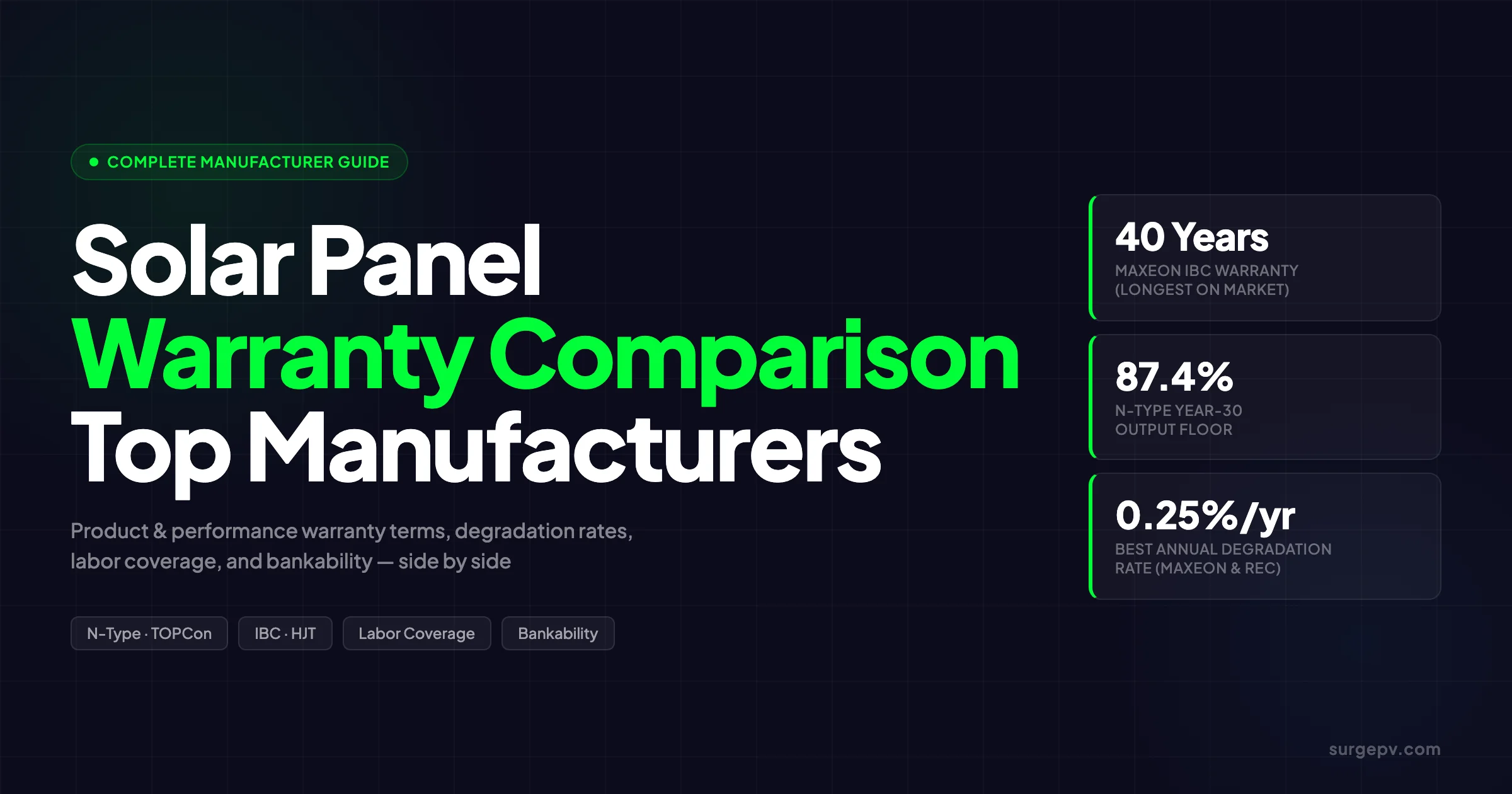
N-type TOPCon panels from Jinko, JA Solar, Canadian Solar, and Trina Solar have standardized at 30-year performance warranties with 87.4% output floors and 0.40% annual degradation. Maxeon IBC holds the market record at 40 years with 88.3% output at year 40. Labor reimbursement is rare — REC ProTrust and Q CELLS Q.PARTNER are the main exceptions. P-type PERC panels typically guarantee 80–83% output at year 25, roughly 7 percentage points below N-type equivalents at the same age.
Read more about Agricultural Solar Case Study. See our guide on Floating Solar Farms France for more.
The Four Types of Solar Panel Warranty Coverage
Most solar panel warranties consist of two instruments: a product warranty and a performance warranty. The full warranty stack includes four distinct types of coverage, and each protects against a different risk.
Product warranty (workmanship warranty): Covers manufacturing defects in the physical panel — delamination, cracked glass, failed junction boxes, corroded connectors, and cell damage from production flaws. The industry standard was 10–12 years for most of the 2010s. It has shifted to 25 years for most current-generation products. Product warranty length matters most in the early-to-mid system lifetime when component failure risk is highest.
Performance warranty: Guarantees that the panel produces at least a minimum percentage of its rated output by a specified year — typically year 25 or year 30. This is the more complex and financially significant warranty for long-term system owners. The output floor, the degradation rate cap, and the first-year allowance together determine how much power the panel is guaranteed to deliver across its life.
Installer workmanship warranty: Separate from the manufacturer warranty, issued by the installing company. Covers installation quality — improper racking, water infiltration from poor roof penetrations, wiring failures attributable to installation error. Industry standard ranges from 1 to 10 years; premium installers offer 25-year workmanship warranties to match the panel’s product warranty period. For more on this topic, see Solar Racking Design Guide.
Labor warranty: The most contentious coverage gap in the industry. Most manufacturer warranties cover replacement hardware only. When a panel fails under product warranty, the manufacturer ships a new panel — but the cost to remove the failed panel, install the replacement, retest the circuit, and update system documentation is typically on the installer or system owner. Only a handful of manufacturers have addressed this gap through certified installer programs.
Pro Tip
When quoting clients, be explicit about which warranty comes from the manufacturer and which comes from your company. Clients often assume a “25-year warranty” covers everything — including swap labor. Defining the split in the contract avoids disputes and helps clients understand the real value of programs like REC ProTrust and Q CELLS Q.PARTNER.
What “25-Year Warranty” Really Means — and What It Doesn’t
A 25-year performance warranty is a floor, not a guarantee of a specific output level. Two panels with identical 25-year performance warranty durations can deliver dramatically different amounts of energy over their lifetime depending on the output floor and annual degradation rate in the warranty document.
The output floor gap matters more than duration
A P-type PERC panel warranted at 80% output at year 25 and an N-type TOPCon panel warranted at 87.4% output at year 30 represent roughly 7–8 percentage points of guaranteed capacity. On a 10 kWp residential system, that gap equals 700–800 Wp of warranted output. Compounded across 25–30 years of generation in a mid-European irradiance environment (~1,000 kWh/kWp/yr), the cumulative difference in guaranteed generation is 100,000–150,000 kWh. For a system with a feed-in tariff or PPA, that is real contracted revenue. Also see: European Solar Incentives.
First-year degradation
All solar panels degrade faster in year 1 due to light-induced degradation (LID). P-type PERC panels typically lose 2–3% of their rated output in the first year from LID alone. N-type TOPCon panels limit this to around 1%, because N-type silicon is far less susceptible to boron-oxygen LID. Many manufacturer warranties specify the first-year output floor separately: Maxeon guarantees 98% output at year 1; N-type TOPCon manufacturers typically guarantee 99%.
Annual degradation cap and compounding
The difference between 0.40%/yr (N-type TOPCon) and 0.65%/yr (P-type PERC) compounds to roughly 6 percentage points by year 25. That is not a rounding error — it represents 600 Wp of guaranteed capacity on a 10 kWp system.
Warranted vs. real-world degradation
NREL’s meta-analysis of 2,000+ PV systems worldwide found a median actual field degradation rate of 0.94%/yr for older panels. For modern monocrystalline silicon panels installed after 2000, actual median degradation is approximately 0.4%/yr — meaning current N-type TOPCon warranty terms are close to aligned with real-world expectations, while P-type warranty degradation assumptions are conservative buffers that panels often beat in practice.
The detailed field-measured data by panel type is covered in the [solar panel degradation rates guide](/blog/solar-panel-degradation-rates).
What a performance warranty does not protect against
- Natural disaster damage (property insurance, not panel warranty)
- Output shortfall from soiling, shading, or clipping not attributable to the panel itself
- Performance decline from inverter or wiring issues
- Damage from improper installation, cleaning, or unauthorized modification
- Labor costs to replace a failed panel (unless a certified installer program is in place) Shadow analysis software identifies shading issues before installation.
When using solar design tools to model system performance and financial projections, the warranted degradation rate — not optimistic assumptions — is the correct basis for minimum guaranteed energy output. Any client commitment on lifetime production should be bounded by the warranty floor.
Solar Panel Warranty Comparison: Top Manufacturers
The table below covers the leading Tier 1 manufacturers by global shipment volume and market presence. Data sourced from manufacturer warranty documents and publicly available specifications as of Q1 2026. For Global-specific compliance details, see Global net-metering-by-country.
| Manufacturer | Model Line | Product Warranty | Perf. Warranty | EOW Output | Annual Degradation | Labor Coverage | Certified Program |
|---|---|---|---|---|---|---|---|
| Maxeon | IBC | 40 yr | 40 yr | 88.3% (yr 40) | 0.25% | Yes (select markets) | Maxeon Dealer |
| REC Group | Alpha Pure | 25 yr | 25 yr | 92.0% (yr 25) | 0.25% | Yes — full (ProTrust) | REC Certified Installer |
| Panasonic | EverVolt HPBC | 25 yr | 25 yr | 92.0% (yr 25) | 0.25% | Via AllGuard | AllGuard |
| LONGi | Hi-MO X6 | 25 yr | 30 yr | 88.9% (yr 25) | 0.40% | No | — |
| Jinko Solar | Tiger Neo (N-type) | 25 yr | 30 yr | 87.4% (yr 30) | 0.40% | No | — |
| JA Solar | Deep Blue 4.0 Pro | 25 yr | 30 yr | 87.4% (yr 30) | 0.40% | No | — |
| Canadian Solar | TOPHiKu6 | 25 yr | 30 yr | 87.4% (yr 30) | 0.40% | No | — |
| Trina Solar | Vertex S+ | 25 yr | 30 yr | 87.4% (yr 30) | 0.40% | No | TrinaProtect (select) |
| Silfab | Prime / Elite | 25 yr | 30 yr | 82.6% (yr 30) | 0.50% | Yes (certified installer) | Silfab Certified |
| Q CELLS | Q.TRON (N-type) | 25 yr | 25 yr | 86.0% (yr 25) | 0.50% | $250/claim | Q.PARTNER |
| Astronergy | CHSM N-type | 15 yr | 30 yr | 87.4% (yr 30) | 0.40% | No | — |
| Tongwei | N-type | 12–15 yr | 30 yr | 87.4% (yr 30) | 0.40% | No | — |
| Risen Energy | RSM N-type | 12 yr | 25 yr | 80.7% (yr 25) | 0.55% | No | — |
| Q CELLS | Q.PEAK DUO (P-type) | 12 yr | 25 yr | 83.1% (yr 25) | 0.54% | No | Q.PARTNER (limited) |
| Jinko Solar | Cheetah Plus (P-type) | 12 yr | 25 yr | 83.1% (yr 25) | 0.55% | No | — |
| Trina Solar | P-type (older lines) | 25 yr | 25 yr | 80.0% (yr 25) | 0.65% | No | — |
| SunPower | Legacy M-Series | ⚠ See notes | ⚠ | — | — | — | Ch. 11 Aug 2024 |
EOW = End of Warranty. Data sourced from manufacturer warranty documents. Always verify with the current warranty certificate before procurement, as terms are updated periodically.
Three tiers visible in the data:
Premium tier (Maxeon, REC, Panasonic): 25–40 year product warranties, 0.25% annual degradation, 88–92% output floors, labor coverage in at least some configurations. These panels command a price premium, but the warranty terms are genuinely superior — particularly for residential systems where client trust and long-term service relationships matter.
High-performance N-type tier (LONGi, Jinko Tiger Neo, JA Deep Blue, Canadian TOPHiKu6, Trina Vertex S+): 25-year product warranties, 30-year performance warranties, 87.4% output floors, 0.40% degradation — now the standard for current-generation N-type TOPCon panels. No labor coverage as standard. This tier covers the majority of Tier 1 panel volume shipped globally.
Standard and legacy P-type tier (Q CELLS Q.PEAK, Jinko Cheetah, Trina P-type, Risen): 12-year product warranties, 25-year performance warranties, 80–83% output floors, 0.54–0.65% degradation. Lower up-front cost but real long-term output risk for projects designed to specific energy targets over a 25+ year contract.
Astronergy and Tongwei offer competitive performance warranty terms (30 years, 87.4% floor, 0.40%/yr) but shorter product warranties — 15 years and 12–15 years respectively. That gap is material for commercial projects with 20+ year financing: a panel exhibiting physical defects in year 16 is not covered under product warranty.
Key Takeaway
The 87.4% output floor at year 30 has become the benchmark for N-type TOPCon panels. If a manufacturer’s performance warranty falls below this level for an N-type product, scrutinize the warranty document carefully. If it meets this level, compare product warranty length, labor coverage, and bankability next.
N-Type vs P-Type: How Cell Technology Shapes Warranty Terms
The improvement in warranty terms over the last five years is not primarily the result of manufacturers offering better coverage. It reflects a fundamental shift in silicon cell technology — from P-type PERC to N-type TOPCon, HJT, and IBC — with real degradation characteristics that justify tighter warranty floors.
Why P-type degrades faster: LID
P-type PERC cells use boron-doped silicon. When exposed to sunlight, boron-oxygen complexes form within the crystal structure, permanently reducing carrier lifetime. This is light-induced degradation (LID). P-type panels typically lose 2–3% of rated output in the first year from LID alone. Annual degradation then settles at 0.55–0.80%, faster than N-type alternatives.
N-type silicon and LeTID resistance
N-type silicon uses phosphorus doping rather than boron. Without the boron-oxygen interaction, N-type cells are much less susceptible to LID. First-year degradation for N-type panels sits at around 1%. Annual degradation rates for N-type TOPCon hold at 0.40%/yr in manufacturer warranties — and NREL field data suggests modern monocrystalline panels perform close to or better than warranted rates.
Three N-type architectures and their warranty implications:
TOPCon (Tunnel Oxide Passivated Contact): The dominant N-type architecture in high-volume Tier 1 production. Jinko Tiger Neo, JA Solar Deep Blue 4.0 Pro, Canadian Solar TOPHiKu6, and Trina Vertex S+ all use TOPCon cells. Standard warranty: 25-year product, 30-year performance, 87.4% floor, 0.40%/yr degradation.
HJT (Heterojunction Technology): Higher manufacturing cost than TOPCon but better temperature coefficient and low-light performance characteristics. Panasonic’s EverVolt HPBC uses a hybrid back-contact architecture that incorporates HJT principles. Warranty: 25-year product, 25-year performance, 92% floor, 0.25%/yr degradation.
IBC (Interdigitated Back Contact): The highest-efficiency N-type architecture. No front-side metallization means fewer shadow losses and fewer metal-contact failure points. Maxeon uses IBC for its premium line. Warranty: 40-year product, 40-year performance, 88.3% output floor at year 40, 0.25%/yr degradation.
Practical implications for project specifications
On a 100 kWp commercial rooftop system, the difference between a P-type panel with an 80% output floor at year 25 and an N-type TOPCon panel with 87.4% at year 30 is approximately 7–8 kWp of guaranteed capacity. In a European irradiance environment (~1,000 kWh/kWp/yr), that gap represents roughly 8,000 kWh/yr of warranted generation. Over 25 years, it amounts to 200,000 kWh. For a project with a feed-in tariff or PPA, that is auditable contracted revenue.
When using solar software to model generation forecasts, input the warranted degradation rate as the minimum performance assumption. The difference between P-type and N-type degradation scenarios is substantial in any lifetime production simulation.
The cell technology comparison — TOPCon vs HJT vs next-generation architectures — is covered in detail in TOPCon vs HJT vs Perovskite solar panels. For France-specific information, see France Solar Feed-in Tariffs.
Certified Installer Programs: When Your Credential Is Part of the Warranty
Several manufacturers have addressed the labor cost gap by creating certified installer programs that link warranty terms — and labor reimbursement — to the installer’s certification status. For installers, qualifying for these programs is a business differentiator: it expands the warranty offering to clients and reduces service cost exposure over the system lifetime.
REC ProTrust
REC’s ProTrust program is the most comprehensive manufacturer-backed warranty in the residential solar market. Installation must be by an REC Certified Solar Professional.
ProTrust covers:
- 25-year product and performance warranty on REC Alpha series panels
- 25-year labor reimbursement for panel replacement (systems up to 25 kW)
- Installer bankruptcy backstop: third-party insurance ensures claims can be filed and paid even if the original installer has closed
The third-party insurance backstop is what sets ProTrust apart from every other program in this comparison. If REC itself exits the market, the insurance policy remains valid. No other standard manufacturer warranty program currently includes this protection.
Q CELLS Q.PARTNER
Q CELLS’ Q.PARTNER program provides certified installers with:
- Up to $250 per warranty claim for labor reimbursement
- Available for systems up to 25 kW
- Requires Q.PARTNER certification and system registration within 30 days of installation
The $250 per-claim coverage is modest compared to real swap costs — typical truck roll and panel replacement labor runs $500–$2,000 per panel — but it is better than zero and easy for established installers to qualify for. Q.PARTNER certification requires no volume minimums.
Silfab Certified Installer
Silfab manufactures panels in North America (Washington state and Ontario). Its certified installer program includes extended labor coverage and supports Silfab’s positioning as a supply-chain-resilient option for installers concerned about tariff exposure or geopolitical risk associated with Chinese panel supply chains. For US commercial projects with American-content requirements or Buy America provisions, Silfab is one of the few panel options with documented domestic manufacturing.
TrinaProtect (Trina Solar)
Trina’s TrinaProtect program offers a 25-year product warranty and 25-year performance warranty for residential systems. Labor coverage is not included as standard. The program requires system registration and applies to specific Trina panel models. It is less comprehensive than REC ProTrust but provides additional warranty documentation for residential clients and installers who want to differentiate on the spec sheet.
What certified programs mean in competitive sales
If two installers bid the same residential job — one using standard panel warranty terms and one using REC ProTrust — the certified installer can offer a 25-year labor warranty as a line item in the proposal. In a market where most proposals compete on price alone, a fully documented 25-year labor warranty is a tangible differentiator that supports a higher-margin panel specification.
Pro Tip
List certified installer program enrollment as a warranty line item in every proposal that uses a certified panel: “25-year product warranty + 25-year labor warranty (REC ProTrust program).” Clients notice the explicit labor coverage when comparing proposals side by side, especially clients who have heard stories of out-of-pocket swap costs from friends or neighbors.
What Voids a Solar Panel Warranty
Most solar panel warranties include specific events that void coverage. Some are within the installer’s control during installation; others are within the client’s control during system operation. Knowing these before the project closes protects both parties.
Installer actions that can void warranty:
| Action | Effect |
|---|---|
| Installation by non-certified installer (for certified programs) | Voids REC ProTrust, Q.PARTNER, Silfab enhanced warranty — entire labor coverage lost |
| Electrical configuration outside manufacturer specs | May void product warranty for resulting failures |
| Mechanical damage during installation (micro-cracks, scratched backsheet) | Voids coverage for resulting defects |
| Installation in environments outside specs (extreme coastal salt exposure without marine-rated panels) | May limit or void coverage |
| Missing warranty registration within required window | Forfeits all certified program benefits; some standard warranties also require registration |
Client actions that can void warranty:
| Action | Effect |
|---|---|
| Walking on panels | Creates micro-cracks; voids product warranty for resulting damage |
| Pressure washing or improper cleaning chemicals | Voids warranty for delamination or surface degradation |
| Unauthorized modifications (adding incompatible batteries, replacing inverters from different brands without guidance) | Voids warranty for the affected circuit |
| Relocating panels to a different property | Typically voids or does not transfer to new location |
| Self-repair or replacement of connectors | Voids product warranty for affected components |
| Natural disaster damage (hail, wind, flooding) | Excluded from all manufacturer warranties — property insurance applies |
System design and warranty compliance
Correct system design is directly linked to warranty validity. Panels operating with tilt angles, string configurations, or voltage parameters outside manufacturer specifications risk voiding warranty for design-related failures. This is one of the less-discussed reasons why solar design tools that verifies electrical design against manufacturer specifications is not optional for any installer who wants to maintain warranty validity for clients.
If the solar yield and financial analysis models production using assumptions that place panels outside their specified operating range — for example, string sizing that drives operating voltage outside the inverter’s MPPT window in ways that stress panel connectors — and a failure follows, the manufacturer may deny the product warranty claim on the basis of improper design.
Bankability and Financial Risk: Reading Between the Lines
A 40-year warranty is only as valuable as the manufacturer’s ability to honor it 40 years from now. The warranty document is a promise; the manufacturer’s financial health determines whether that promise gets kept.
What bankability means
BloombergNEF’s Tier 1 designation is the most widely cited bankability metric in the solar industry. A manufacturer achieves Tier 1 status when its panels have been financed by at least 6 different commercial banks on a non-recourse basis within the past 2 years. The bankability glossary entry explains how lenders assess this in detail.
Tier 1 designation does not assess product quality directly — it assesses whether banks are willing to take credit risk on projects using those panels. Banks run their own technical due diligence before financing, so Tier 1 approval is an indirect signal of both product reliability and manufacturer financial stability.
Warranty reserve adequacy
Public manufacturers disclose warranty accrual rates in financial filings — the percentage of revenue set aside to cover future warranty claims. Healthy accrual rates range from 0.5–2% of revenue. Data from WarrantyWeek’s analysis of manufacturer financial filings provides a signal of claim rates versus reserves:
| Manufacturer | Reported Claims Rate | Accrual Rate | Notes |
|---|---|---|---|
| JinkoSolar | ~0.3% | ~1.0% | Consistent; low claim rate |
| First Solar | Below 1% | 0.5–1.5% | Thin-film failure modes differ from crystalline |
| Canadian Solar | Often exceeded accruals (since 2013) | 0.5–2.0% | Monitor reserve adequacy |
| SunPower | Spiked to 6.3% (Q1 2021); 1.3% (Q2 2023) | High | Filed Ch. 11 August 2024 |
A manufacturer with persistent high claims rates burns through its warranty reserve faster than it builds it. In an inflationary cost environment, underfunded reserves are a real risk for long-term claimants — particularly for systems installed in the middle of a warranty term when the manufacturer’s financial position may deteriorate before the claim window closes.
Geographic concentration risk
Most Tier 1 panel manufacturers are Chinese-domiciled. In an environment of escalating tariffs and geopolitical uncertainty, warranty enforcement from a Chinese manufacturer for US or European customers involves jurisdictional complexity. Several EPC procurement teams have begun specifying domestically manufactured panels (Silfab, Heliene in North America; Waaree or REC in Europe) for large commercial projects to reduce this exposure.
For EPC companies evaluating procurement, using all-in-one solar software with a validated component library that flags bankability status and warranty tier can automate the first layer of due diligence in the panel selection workflow.
When Manufacturers Exit the Market
The warranty comparison table shows what manufacturers promise. The events below show what happens when those promises are tested.
SunPower Corporation (August 2024)
SunPower was the market leader in high-efficiency residential panels in North America. It filed for Chapter 11 bankruptcy in August 2024. Complete Solaria acquired SunPower’s operational assets in September 2024 and rebranded as SunPower Inc. in April 2025.
Critical detail: Complete Solaria/SunPower Inc. explicitly did not assume warranty obligations from installations completed before September 30, 2024. Homeowners with SunPower systems installed before that date have warranty claims with no clear manufacturer counterparty. Their recourse runs through the Chapter 11 bankruptcy estate as general unsecured creditors, where recovery rates are typically low.
LG Solar (2022 exit)
LG Electronics exited the solar panel market in 2022, citing margin pressure and capital reallocation. LG committed to honoring remaining warranties but increasingly handled claims as cash settlements — typically $150–$400 per panel rather than providing replacement hardware. Customers who expected like-for-like panel replacements received checks that in many cases did not cover the labor cost of sourcing and installing an alternative panel.
Panasonic Solar North America (April 2025)
Panasonic announced on April 28, 2025 that it was discontinuing solar panel and battery storage products in North America. Unlike SunPower’s abrupt bankruptcy, Panasonic committed to honoring existing product and performance warranties, and its AllGuard extended warranty program remained active as of the announcement date. Panasonic has the financial resources and stated intent to honor obligations — but installers with ongoing Panasonic-dependent service relationships will need to plan for alternative panel sourcing for new projects. See Adding Battery Storage Services for detailed guidance.
What to do when a manufacturer exits:
- Register all warranties promptly — most programs require registration within 30–90 days; missing this window forfeits certified program benefits
- Maintain complete installation records: serial numbers, warranty certificates, spec sheets, installation dates
- For commercial projects with long-term financing, consider requiring manufacturers to post warranty reserve bonds or carry third-party warranty insurance (REC ProTrust is currently the only major residential program with this structure)
- For high-value systems installed using manufacturer lines that show financial stress signals (high claims rates, declining Z-scores), supplement with third-party solar warranty coverage from providers like Solar Insure
Key Takeaway
REC ProTrust is the only major certified installer program with explicit third-party insurance backing warranty obligations. If REC exits the market, ProTrust policyholders can still file claims against the insurance policy. No other standard manufacturer warranty program currently includes this protection for residential systems.
Design Systems That Hold Up to Warranty Scrutiny
SurgePV’s design platform helps installers verify that every system specification stays within manufacturer warranty parameters — string sizing, voltage limits, tilt and orientation, and shading thresholds — before a project is committed.
Book a DemoNo commitment required · 20 minutes · Live project walkthrough
Warranty Claim Process: Step by Step
When a panel fails — whether it shows a physical defect within the product warranty period or its output drops below the performance warranty floor — the claim process follows a standard sequence. Knowing it in advance prevents avoidable documentation failures and delays.
For a detailed walkthrough including manufacturer-specific portal links and escalation timelines, see the solar warranty claims for installers guide.
Step 1 — Identify the issue
For product warranty claims: inspect for delamination, cracked glass, discoloration, junction box failure, or hot-spot damage visible through thermal imaging. Photograph the defect with the panel serial number visible.
For performance warranty claims: pull monitoring data showing output below the warranted floor. Determine whether the shortfall is panel-specific or affects the entire string — string-level shortfall may indicate a wiring or inverter issue rather than a panel defect, which affects warranty eligibility.
Step 2 — Gather documentation
Collect the following before any claim submission:
- Original purchase invoice with panel serial numbers
- Manufacturer warranty certificate with registration confirmation
- Installation records: spec sheets, string configuration, tilt and azimuth
- Monitoring system reports showing output data over time
- Photos of the physical defect or screenshots of monitoring data
Step 3 — Contact the installer first
The installer typically initiates the manufacturer claim on the client’s behalf. Manufacturers often prioritize installer-initiated claims because installers provide faster documentation and take responsibility for verifying the installation was spec-compliant.
Step 4 — Contact the manufacturer directly if the installer is unavailable
Most Tier 1 manufacturers operate dedicated warranty claim portals or warranty support lines. Have all documentation ready before submitting. Response timelines vary: some manufacturers commit to 5–10 business days for initial review; others have no published SLA.
Step 5 — Manufacturer review
The manufacturer reviews documentation and may request additional information or dispatch a third-party inspector. Performance warranty claims above a certain size may require professional-grade I-V curve tracing equipment to verify the output shortfall — an added cost for the claimant unless covered by a certified installer program.
Step 6 — Claim resolution
Outcomes include:
- Replacement panel shipped (claimant typically pays labor unless enrolled in a certified program)
- Cash settlement (increasingly common for discontinued product lines)
- Repair authorization
Step 7 — Labor reimbursement (if applicable)
If enrolled in REC ProTrust or Q CELLS Q.PARTNER, submit labor cost documentation to receive reimbursement per program terms after the claim is resolved.
Step 8 — System record update
Update the monitoring configuration with the new panel’s serial number. Retain all claim documentation — if the replacement panel subsequently fails, this documentation chain is essential for the next claim.
Performance Warranty Claims Are Harder Than Product Claims
Performance warranty claims require demonstrating that actual output has fallen below the warranted floor and that the shortfall is from panel degradation — not soiling, shading, inverter underperformance, or wiring. Manufacturers investigate each alternative cause before approving performance claims. Continuous monitoring data from a properly calibrated system, segmented by string, is the strongest evidence base you can maintain.
A Warranty Scoring Framework for Procurement Teams
Rather than comparing warranties manufacturer by manufacturer on an ad hoc basis, EPC procurement teams benefit from a repeatable scoring rubric applied at the procurement stage. The framework below assigns points across eight dimensions, producing a composite score out of 100.
| Dimension | Criteria | Max Points |
|---|---|---|
| Product warranty length | Under 15 yr = 0 pts; 15–19 yr = 5 pts; 20–24 yr = 8 pts; 25 yr = 12 pts; 30+ yr = 15 pts | 15 |
| Performance warranty length | 25 yr = 10 pts; 26–29 yr = 13 pts; 30 yr = 16 pts; 35+ yr = 18 pts; 40 yr = 20 pts | 20 |
| EOW output floor | Below 80% = 0 pts; 80–83% = 5 pts; 84–86% = 8 pts; 87–89% = 12 pts; 90%+ = 15 pts | 15 |
| Annual degradation rate | Above 0.60% = 0 pts; 0.50–0.60% = 4 pts; 0.41–0.49% = 7 pts; 0.40% = 10 pts; 0.30% or below = 12 pts | 12 |
| Labor coverage | None = 0 pts; Partial ($250 equivalent) = 4 pts; Full labor reimbursement = 8 pts; Full + third-party backstop = 10 pts | 10 |
| Manufacturer bankability | Not Tier 1 = 0 pts; Tier 1 with concerns = 4 pts; Confirmed Tier 1, stable = 8 pts | 8 |
| Warranty transferability | Non-transferable = 0 pts; One-time transfer = 3 pts; Fully transferable = 5 pts | 5 |
| Certified installer program | None = 0 pts; Basic program, no labor = 3 pts; Program with labor + backstop = 5 pts | 5 |
| Manufacturer financial stability | Bankrupt or exited = 0 pts; High claim rate = 3 pts; Stable public company = 6 pts; Strong + third-party insurance = 8 pts | 8 |
| Claim process clarity | Opaque = 0 pts; Standard portal, no SLA = 3 pts; Documented process + response SLAs = 7 pts | 7 |
Applying the scoring to key manufacturers:
- Maxeon IBC + Maxeon Dealer program: 15 + 20 + 12 + 12 + 6 + 8 + 5 + 3 + 6 + 5 = ~92/100
- REC Alpha Pure + ProTrust: 12 + 10 + 15 + 12 + 10 + 8 + 5 + 5 + 8 + 7 = ~92/100
- Jinko Tiger Neo (no certified program): 12 + 16 + 12 + 10 + 0 + 8 + 5 + 0 + 6 + 3 = ~72/100
- Trina P-type (no certified program): 12 + 10 + 5 + 4 + 0 + 8 + 3 + 0 + 6 + 3 = ~51/100
The scoring reveals the premium tier’s real advantage: Maxeon and REC earn most of their points in product warranty length, labor coverage, and financial stability — dimensions that matter most over a 25–40 year system lifetime, not just on procurement day.
For commercial projects where the warranty terms are part of a bankable financing package, require manufacturers to score above 70 as a minimum procurement threshold. For residential systems where the warranty promise is part of your sales proposition, consider requiring 75+ and a certified installer program enrollment.
Conclusion
Three decisions have the most impact on solar panel warranty quality across a system’s lifetime:
-
Specify N-type TOPCon or better: The shift from P-type PERC to N-type TOPCon has moved the market standard from 80% output at year 25 to 87.4% output at year 30. There is no commercial case for specifying P-type panels on new projects where the client’s system will be in service for 20+ years.
-
Enroll in a certified installer program: REC ProTrust and Q CELLS Q.PARTNER are the two programs with genuine labor coverage. Completing the certification is a one-time investment; the business case builds over every system where a warranty claim arises. REC ProTrust’s third-party insurance backstop is worth more than any other single warranty feature available in residential solar today.
-
Score manufacturer bankability before procurement: Use the framework above to evaluate financial stability alongside warranty terms. A 40-year warranty from a manufacturer with deteriorating financials is not worth more than a 25-year warranty from a financially stable Tier 1. The SunPower and LG Solar exits are concrete reminders that warranty length is only part of the equation.
Frequently Asked Questions
What is the difference between a product warranty and a performance warranty on solar panels?
A product warranty covers physical defects — delamination, cracked cells, failed junction boxes — for a stated number of years. A performance warranty guarantees the panel produces at least a minimum percentage of its rated output by year 25 or 30. Product warranties protect against panel failure; performance warranties protect against gradual power decline. Both need to be reviewed before specifying panels for any project with a long-term client commitment.
Which solar panel manufacturer offers the longest warranty?
Maxeon Solar Technologies offers the longest warranty on the market — 40 years for both product and performance coverage on its IBC solar panel line. REC Group offers 25-year full-system coverage including labor via its ProTrust program. Most other Tier 1 manufacturers, including Jinko Solar, JA Solar, Canadian Solar, and Trina Solar, now offer 25-year product warranties and 30-year performance warranties on their N-type TOPCon lines.
Do solar panel warranties cover labor costs?
Most manufacturer warranties cover the replacement panel only, not the labor to remove and reinstall it. Typical replacement labor runs $500–$2,000 per panel depending on roof access, height, and string reconfiguration. The main exceptions: REC ProTrust provides full 25-year labor coverage for certified installers on systems up to 25 kW; Q CELLS Q.PARTNER covers up to $250 per claim for certified Q.PARTNER installers; Maxeon covers labor in select markets through its dealer program.
What voids a solar panel warranty?
Common warranty-voiding actions include: installation by a non-certified or unregistered installer (for certified programs), unauthorized modifications, walking on panels, using improper cleaning chemicals or pressure washers, and failure to register the warranty within the required post-installation window. Natural disaster damage is excluded from all manufacturer warranties — that falls under property insurance. For a complete list of voiding triggers, review the specific warranty certificate from the manufacturer before installation.
Are solar panel warranties transferable when selling a home?
Most major manufacturers allow warranty transfer to a new homeowner, typically within 30–90 days of the property sale. Fees are usually nominal or waived. Workmanship warranties from the original installer are generally not transferable if that company has closed. Buyers should confirm transferability directly with the manufacturer before closing — do not rely on the seller’s representation alone.
What happens to my solar panel warranty if the manufacturer goes bankrupt?
If the manufacturer files for bankruptcy, warranty obligations become general unsecured creditor claims and may recover little or nothing. LG Solar settled remaining claims as cash payments of $150–$400 per panel. SunPower’s assets were acquired by Complete Solaria in September 2024, which explicitly did not assume pre-September 2024 warranty obligations. REC ProTrust is the only major program backed by third-party insurance that remains valid regardless of REC’s corporate status.
How do N-type panels compare to P-type panels on warranty terms?
N-type panels (TOPCon, HJT, IBC) carry meaningfully better warranty terms. Current N-type TOPCon panels guarantee 87.4–92% output at year 25–30 with 0.25–0.40% annual degradation. P-type PERC panels typically guarantee 80–83% output at year 25 with 0.55–0.80% annual degradation. N-type panels also have lower first-year degradation — around 1% versus 2–3% for P-type — because N-type silicon has far lower susceptibility to light-induced degradation from boron-oxygen complex formation.
How do I file a solar panel warranty claim?
Gather your purchase invoice, warranty certificate, panel serial numbers, installation records, and monitoring data showing the output shortfall or photos of the defect. Contact your installer first — they typically initiate manufacturer claims on your behalf. If the installer is unavailable, contact the manufacturer’s warranty portal directly. The manufacturer will review documentation, may dispatch an inspector, and will issue a replacement panel, cash settlement, or repair authorization. Labor reimbursement is available only if the system was installed under a certified installer program (REC ProTrust or Q CELLS Q.PARTNER).
Where this fits
This article is part of SurgePV's Solar Technology hub, which works through the topic from first principles to the decisions a project team actually has to make.
