

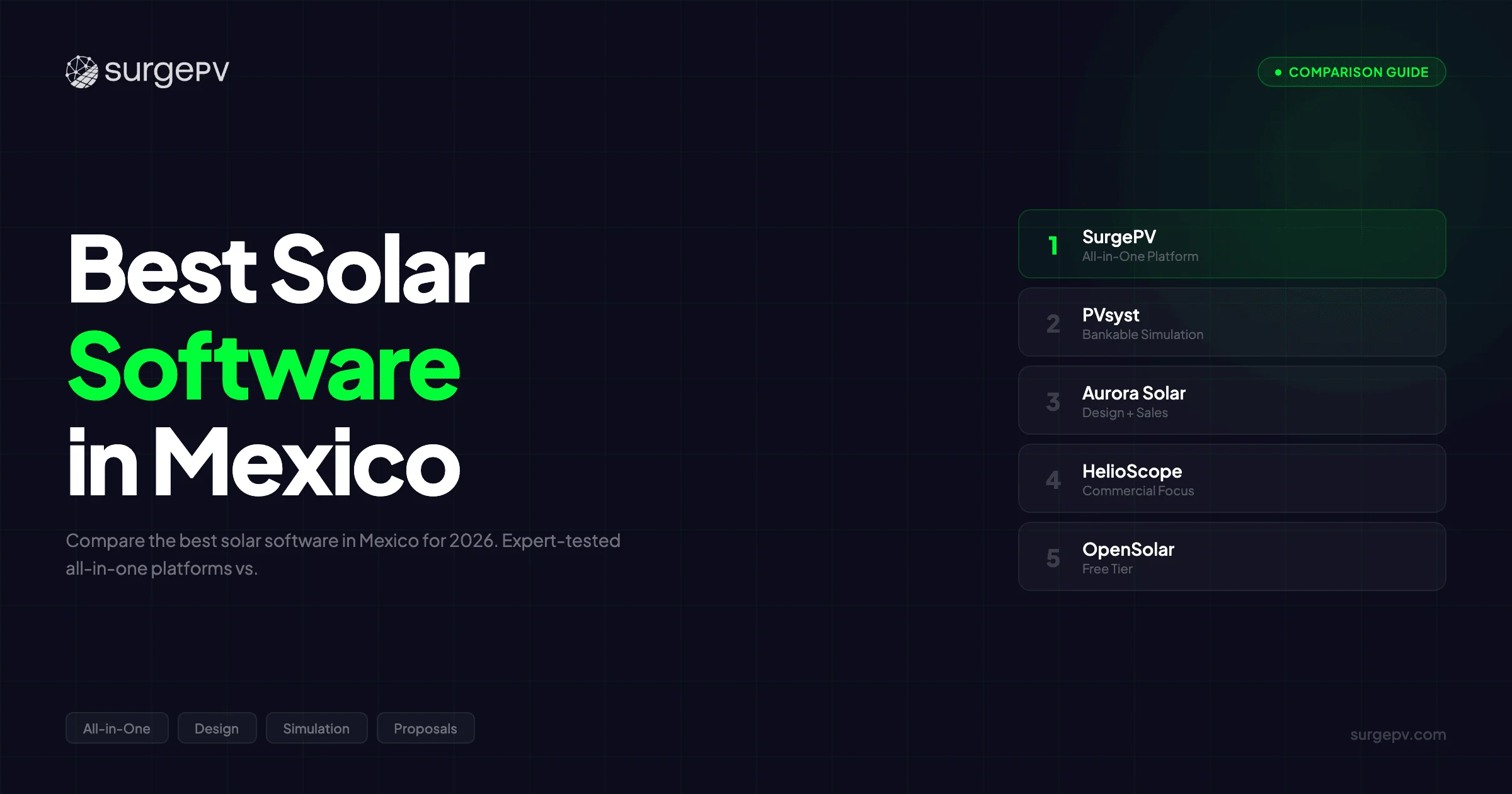
TL;DR: SurgePV is the best all-in-one solar software for Mexico, covering in one platform the work most EPCs split across a design tool, AutoCAD, PVsyst and Excel. PVsyst remains the gold standard for bankability validation on large financed projects. Aurora Solar leads for residential sales workflows. HelioScope suits mid-size commercial EPCs with dedicated electrical teams. OpenSolar is the most affordable entry point for small residential operations.
Here’s the typical software stack for a Mexican EPC in 2026: PVsyst for simulation, AutoCAD for electrical drawings, Aurora or HelioScope for design, Excel for financial modeling, and Word for proposals.
That is five separate applications, four of them under their own licence or subscription, each with its own renewal date, seat count and training curve. PVsyst does not publish list pricing, and AutoCAD is licensed separately by Autodesk, so the only way to know what the stack costs your team is to collect current quotes.
Mexico’s solar market hit 10.2 GW installed in 2025 and is growing 18–22% annually toward 15+ GW by 2027. The commercial segment (25% of the market) is where most EPC growth is happening. CFE interconnection demands complete electrical documentation. NOM-001-SEDE compliance differs from U.S. NEC. CENACE grid codes add another layer for projects above 500 kW. And net billing calculations are complex enough that spreadsheet errors can over-promise ROI to the client.
Every hour spent switching between tools is an hour not spent closing the next project.
In this guide, you’ll find:
- Which platforms deliver end-to-end workflows (design + simulation + electrical + proposals) in one tool
- How each platform handles Mexico’s CFE interconnection, NOM-001-SEDE, and net billing requirements
- Total cost of ownership when you include add-on tools, training, and workflow overhead
- Which simulation reports NAFIN, Bancomext, and international lenders accept for financing
- Detailed comparisons of SurgePV, PVsyst, Aurora Solar, HelioScope, and OpenSolar
Quick Summary: Our Top Picks for Mexico
After reviewing published information for 5 platforms with EPCs operating across Mexico’s residential, commercial, and utility-scale segments, here are our top recommendations:
- SurgePV — End-to-end design, electrical engineering, simulation, and proposals in one platform (Best for Mexican EPCs wanting to consolidate their software stack)
- PVsyst — Industry-standard bankable simulations (Best for validation alongside an operational design platform, not standalone)
- Aurora Solar — Cloud design with polished proposals (Best for residential sales teams, requires AutoCAD for commercial electrical docs)
- HelioScope — Cloud commercial design with bankable estimates (Best for mid-size commercial EPCs with separate electrical teams)
- OpenSolar — Affordable cloud platform with multilingual proposals (Best for small residential installers starting out)
Each tool is evaluated on Mexico-specific criteria: feature completeness, CFE/NOM compliance, workflow efficiency, bankability, and total cost of ownership.
Best Solar Software in Mexico (Detailed Reviews)
| Software | Best For | Pricing | Mexico Fit |
|---|---|---|---|
| SurgePV | Integrated platform | $1,899/yr (3 users) | Excellent |
| PVsyst | Simulation specialist | Not published | Good |
| Aurora Solar | Residential workflow | $159/user/mo, $135/user/mo billed annually (published) | Good |
| HelioScope | C&I design | $159/mo or $1,620/yr per licence (published) | Good |
| OpenSolar | Free platform | Free | Good |
Aurora Solar publishes list pricing of $159 per user per month for Basic, or $135 per user per month billed annually, and $259 per user per month for Premium, or $220 per user per month billed annually, with Enterprise quoted per project by sales (aurorasolar.com/pricing/, checked 21 September 2026). HelioScope publishes $159 per month or $1,620 per year per licence for Basic and $259 per month or $2,640 per year per licence for Pro, each including one user, with Enterprise quoted by sales (helioscope.aurorasolar.com/pricing/, checked 21 September 2026). OpenSolar is free of charge (opensolar.com, checked 21 September 2026). PVsyst does not publish list pricing.
SurgePV — Best All-in-One Solar Platform for Mexico
About SurgePV
SurgePV is the only cloud-based platform that combines AI-powered solar design, automated electrical engineering, bankable simulations, and professional proposal generation in a single workflow. No tool-switching. No exporting between platforms. No juggling four different licenses.
For Mexican EPCs, that integration solves the core problem: workflow fragmentation. Instead of PVsyst for simulation + AutoCAD for SLDs + Aurora for design + Excel for financials, you do everything in SurgePV. The data flows from design to electrical to simulation to proposal without manual re-entry, copy-paste errors, or format conversion headaches.
Target Users: Commercial EPCs (50 kW–10 MW), solar installers scaling from residential to commercial, sales teams needing design-backed proposals, consultants managing multiple client projects.
Unique Value for Mexico: SurgePV covers in one platform the functions most EPCs buy separately. That means one contract and one interface rather than a design subscription, a CAD licence, a simulation licence and a spreadsheet, and the design data carries through to the electrical documents and the proposal without re-entry.
Pro Tip
Before evaluating any solar platform for Mexico, list every tool your team currently uses for a single commercial project — design, electrical, simulation, financials, proposals. Count the hours. Count the annual licenses. That’s your true baseline cost. Most Mexican EPCs are surprised when they add it up.
Key Features for Mexico
End-to-End Design Workflow
SurgePV handles the complete project lifecycle in one platform. Start with AI-powered roof modeling that detects boundaries, tilt, and azimuth from satellite imagery instead of manual tracing. Optimize module layouts for maximum density. Add shading analysis with 8760-hour calculations.
The platform supports Mexico’s commercial structure types: carport solar (parking lot canopies at malls and corporate campuses), single-axis and dual-axis trackers for utility-scale, and East-West racking for flat commercial roofs. SurgePV is the only platform with native carport design.
Automated Electrical Engineering
This is SurgePV’s primary competitive advantage and the feature that matters most for Mexican EPCs navigating CFE interconnection.
Single Line Diagram (SLD) generation is automated. Complete your design, generate a code-compliant electrical schematic in 5–10 minutes. DC arrays, combiners, disconnects, inverters, AC wiring, breakers, grid interconnection — all documented and ready for CFE submission.
Wire sizing calculations are instant. The platform handles DC and AC wire gauges, voltage drop analysis (<2% optimal, 3% max), temperature correction factors, and conduit fill adjustments. Adaptable to NOM-001-SEDE requirements with licensed engineer verification.
No other platform on this list offers integrated SLD generation. Aurora doesn’t. HelioScope doesn’t. OpenSolar doesn’t. PVsyst doesn’t (it’s simulation-only). That means every other option pairs with a CAD package, most commonly AutoCAD, which is licensed separately by Autodesk, plus manual electrical drafting.
Structurally that is a second licence to buy and a second skill set to staff, on top of the design subscription. SurgePV produces the same documents inside the design platform, so the CAD seat and the drafting step both drop out of the workflow.
Bankable Simulations
P50/P75/P90 production estimates with 8760-hour shading analysis. NAFIN, Bancomext, and international lenders accept SurgePV’s bankable reports for commercial project financing, which is sufficient for most Mexican commercial projects under 5 MW.
Financial modeling supports CFE tariff structures: DAC (residential high-consumption), GDMTH (commercial medium voltage), GDMTO (commercial high voltage), PDBT (small commercial), and DIST. Net billing calculations with wholesale-rate compensation modeling. ROI calculator with cash, loan, and PPA scenarios in MXN.
Mini Case Study: Consolidating a 4-Tool Stack in Monterrey
A mid-size Mexican EPC in Monterrey was running Aurora for design, AutoCAD for electrical drawings, PVsyst for simulation, and Excel for financials. Four applications, four sets of credentials, and a manual handoff at every boundary.
They consolidated onto SurgePV. Design, electrical documentation, simulation and the client proposal now come out of one project file, so the CFE interconnection pack is generated rather than assembled by hand across tools.
Professional Proposals
Web-based, interactive, mobile-friendly proposals generated from your actual design data. Spanish language support for Mexican clients. Branded formatting with your EPC’s identity. Financial projections that match your simulation — no data translation errors between tools.
Note
SurgePV’s all-in-one approach doesn’t mean it’s the best tool for every single function. PVsyst’s simulation depth is greater. Aurora’s visual proposals are prettier. PVCase’s CAD control is more granular. But no single tool comes close to SurgePV’s combined workflow efficiency. The question isn’t “which tool is best at X?” — it’s “which approach saves my team the most time and money across the complete project lifecycle?”
Pros & Cons
Pros:
- Only True All-in-One Platform: Design + electrical + simulation + proposals in one workflow. Replaces 3–4 separate tools
- Eliminates AutoCAD Dependency: Automated SLD generation removes the separate CAD licence and the manual drafting step
- CFE-Ready Outputs: Electrical documentation ready for interconnection submission. NOM-adaptable with licensed engineer verification
- Bankable Reports: P50/P75/P90 metrics accepted by NAFIN, Bancomext
- Transparent Pricing: $1,299/user/year (For 5 Users), all features included. No hidden tiers
- Single Workflow: Design, electrical, simulation and proposal in one project file, with no exports between applications
Cons:
- CFE Tariff Database: Mexican tariff rates not pre-loaded. Manual input required for DAC, GDMTH, GDMTO schedules. One-time setup
- Newer Platform: Less market presence in Mexico than Aurora or PVsyst. Feature set is complete, but brand familiarity takes time
- Utility-Scale Ceiling: Best for projects up to 10 MW. Larger utility-scale (10+ MW) projects needing CAD-level terrain customization may need PVCase
Pricing
Transparent Annual Plans:
- Individual Plan: $1,899 per user per year on the individual plan ($633/user/year)
- For 3 Users Plan: $1,499/user/year
- For 5 Users Plan: $1,299/user/year (Best value for Mexican EPCs)
- Enterprise: Custom pricing for large teams
Mexico Stack Structure Comparison (5-user team):
| Tool Stack | Separate contracts | Where pricing comes from |
|---|---|---|
| SurgePV (all-in-one) | 1 | SurgePV published list pricing |
| Aurora + AutoCAD + PVsyst + Excel | 4 | Aurora published; AutoCAD licensed separately by Autodesk; PVsyst not published |
| HelioScope + AutoCAD + PVsyst + Excel | 4 | HelioScope published; AutoCAD licensed separately by Autodesk; PVsyst not published |
| OpenSolar + AutoCAD + PVsyst + Excel | 4 | OpenSolar free of charge; AutoCAD licensed separately by Autodesk; PVsyst not published |
Note
Aurora Solar publishes list pricing of $159 per user per month for Basic, or $135 per user per month billed annually, and $259 per user per month for Premium, or $220 per user per month billed annually, with Enterprise quoted per project by sales (aurorasolar.com/pricing/, checked 21 September 2026). HelioScope publishes $159 per month or $1,620 per year per licence for Basic and $259 per month or $2,640 per year per licence for Pro (helioscope.aurorasolar.com/pricing/, checked 21 September 2026). OpenSolar is free of charge (opensolar.com, checked 21 September 2026). PVsyst does not publish list pricing and AutoCAD is licensed separately by Autodesk, so a like-for-like stack total cannot be sourced. Request current quotes before comparing.
Who SurgePV Is Best For
- Commercial EPCs: 100 kW–10 MW projects needing CFE documentation, NOM compliance, bankable simulations, and professional proposals in one platform
- Scaling Installers: Residential installers expanding into commercial work who can’t afford 4-tool stacks and 8-hour project timelines
- Budget-Conscious Operations: Mexican EPCs carrying several separate software contracts who want to consolidate them into one
- Efficiency-Focused Teams: EPCs where the same person designs, engineers, and sells — common in Mexico’s mid-size installer market
Not Ideal For: Utility-scale developers (10+ MW) needing CAD-level terrain customization with dedicated AutoCAD teams. Large organizations that specifically need PVsyst-branded reports for institutional financing. Teams deeply embedded in Aurora’s CRM ecosystem who prioritize CRM integration over workflow consolidation.
Streamline Your Solar Business with SurgePV
End-to-end solar workflows from design to proposal in one platform, with one subscription instead of a fragmented tool stack.
Book a DemoNo commitment required · 20 minutes · Live project walkthrough
PVsyst — Simulation Standard, Requires Separate Design Tools
Overview
PVsyst is the global gold standard for bankable solar simulations. Every major financier — NAFIN, Bancomext, IFC, European development banks — recognizes PVsyst reports. When a Mexican EPC needs to secure financing for a 10 MW project, PVsyst validation is often non-negotiable.
But PVsyst is a simulation engine, not a complete solar platform.
You can’t design panel layouts in PVsyst. You can’t generate SLDs. You can’t create proposals. You can’t manage your sales pipeline. PVsyst does one thing — simulation and bankability validation — and does it better than anyone. But you need an entire separate software stack for everything else.
Key Strengths:
- Most trusted bankability tool worldwide (universally accepted by Mexican and international financiers)
- Deepest loss modeling with P50/P90/P99 and detailed sensitivity analysis
- IEC-compliant outputs meeting international standards
- Extensive meteo database covering all Mexican climate zones (1,600–2,200 kWh/m² irradiance)
Mexico Limitation: Simulation-only. Requires separate tools for design (Aurora, SurgePV, HelioScope), electrical engineering (AutoCAD), and proposals (Excel/Word or dedicated tool), so the workflow spans several applications with a manual handoff at each boundary.
Best Use Case in Mexico: Validation for large projects (5+ MW) seeking institutional financing. Pair PVsyst (validation) with SurgePV (operational design) for the strongest combination. Smaller EPCs (<5 MW commercial) can often use SurgePV’s bankable reports without separate PVsyst validation.
Pricing:
- PVsyst does not publish list pricing on its own site. Its shop is registration-gated, so request a quote directly.
- Model: Desktop license, per-seat
Did You Know?
Mexico’s solar irradiance ranges from 1,500–2,200 kWh/m²/year, making accurate simulation software essential for bankable energy yield predictions. Lenders assess the yield model behind a project, so a validated simulation tool is part of how a financing package is put together.
Aurora Solar — Design + Sales Platform, Missing Electrical Engineering
Overview
Aurora Solar is the market leader in residential solar design and sales. The AI roof modeling creates accurate 3D models in seconds. The proposals are the most visually polished in the industry. CRM integrations (Salesforce, HubSpot) make Aurora a strong fit for sales-driven operations.
For Mexican EPCs, Aurora works well for the design and proposal stages. Where it falls short is electrical engineering and Mexico-specific compliance.
Aurora lacks SLD generation and wire sizing. For CFE interconnection, you’ll need a CAD package such as AutoCAD, which is licensed separately by Autodesk, and a manual electrical drafting step on each commercial project. Aurora’s financial modeling requires manual configuration for CFE tariff structures — it doesn’t come pre-loaded with Mexican rates.
Key Strengths:
- Industry-best AI roof detection and 3D modeling
- Most polished proposal presentation in the market
- Strong CRM integrations for sales pipeline management
- Large user community and extensive training resources
Mexico Limitation: No electrical engineering. No CFE tariff database. Requires AutoCAD for commercial interconnection documentation. Financial modeling needs manual configuration for DAC, GDMTH, GDMTO tariffs.
A fair objection: Aurora leads in the U.S. residential market. Mexico’s market has different requirements: CFE interconnection documentation, NOM-001-SEDE compliance, net billing (not net metering) financial modeling, and Spanish-language business culture. Market leadership in one country doesn’t automatically translate.
Best Use Case in Mexico: Residential installers in major metros (Mexico City, Monterrey, Guadalajara) with dedicated engineering teams handling CFE documentation separately.
Pricing:
Aurora Solar publishes list pricing of $159 per user per month for Basic, or $135 per user per month billed annually, and $259 per user per month for Premium, or $220 per user per month billed annually, with Enterprise quoted per project by sales (aurorasolar.com/pricing/, checked 21 September 2026). If you add a CAD package for commercial electrical documentation, that is licensed separately by Autodesk and priced by them, so budget it as a second contract.
HelioScope — Commercial Design with Strong Simulations
Overview
HelioScope (now part of Aurora Solar) is a cloud-based commercial solar design platform with strong simulation capabilities. For mid-size Mexican EPCs focused on 200 kW–5 MW commercial rooftops, HelioScope offers solid design tools, bankable energy estimates, and team collaboration features.
The acquisition by Aurora creates some uncertainty about long-term product direction and pricing. As of February 2026, HelioScope operates somewhat independently, but the integration roadmap is unclear.
Like Aurora, HelioScope lacks electrical engineering features. No SLD generation or wire sizing for CFE interconnection documentation.
Key Strengths:
- Strong commercial rooftop design tools (good for Mexico’s industrial parks and warehouse complexes)
- Cloud-based team collaboration (useful for distributed Mexican EPC teams)
- Bankable energy estimates with detailed loss modeling
- Terrain modeling for ground-mount projects
Mexico Limitation: No electrical engineering. Requires a separate CAD package for CFE documentation. No integrated proposal generation — you’ll need a separate tool.
Best Use Case in Mexico: Mid-size commercial EPCs with separate electrical engineering teams. Teams already invested in Aurora’s ecosystem who want commercial-optimized design tools.
Pricing:
HelioScope publishes $159 per month or $1,620 per year per licence for Basic and $259 per month or $2,640 per year per licence for Pro, each including one user, with Enterprise quoted by sales (helioscope.aurorasolar.com/pricing/, checked 21 September 2026).
OpenSolar — Affordable Entry Point for Residential Installers
Overview
OpenSolar is free of charge (opensolar.com, checked 21 September 2026), making it an attractive entry point for small Mexican installers starting their businesses. The interface is intuitive, onboarding takes 1–2 weeks, and multilingual support includes Spanish for Mexican client proposals.
For small residential operations (1–5 person teams) doing basic system design and proposals, OpenSolar covers the fundamentals at no licence cost.
The limitation is depth. OpenSolar lacks electrical engineering (no SLD, no wire sizing), has limited commercial capabilities, and the financial modeling doesn’t match the complexity needed for Mexico’s CFE tariff structures. As your Mexican EPC grows from residential to commercial, you’ll outgrow OpenSolar.
Key Strengths:
- Free of charge, so there is no licence barrier for new Mexican installers
- Intuitive interface with fast onboarding (1–2 weeks)
- Multilingual proposal support (Spanish for Mexican clients)
- Transparent pricing model
Mexico Limitation: No electrical engineering for CFE documentation. Limited commercial capabilities. Basic financial modeling doesn’t handle GDMTH/GDMTO tariff complexity well.
Best Use Case in Mexico: Small residential installers (1–5 person teams) doing 5–15 residential installations per month. DAC avoidance projects for homeowners.
Pricing:
- OpenSolar is free of charge (opensolar.com, checked 21 September 2026).
But here’s the catch: The platform itself costs nothing, but the surrounding workflow is not free. Commercial electrical documentation still needs a CAD package such as AutoCAD, licensed separately by Autodesk, and bankable simulations still need PVsyst, which does not publish list pricing. That is two more contracts to source and manage, and the design data still has to move between them by hand. SurgePV’s $1,299/user/year includes those functions in one platform.
Best Solar Software Comparison Table for Mexico
| Software | Design | Electrical (SLD) | Simulation | Proposals | Cloud-Based | CFE Compliance | All-in-One | Pricing (Annual/User) |
|---|---|---|---|---|---|---|---|---|
| SurgePV | Yes | Yes (automated) | P50/P75/P90 | Yes (web) | Yes | Compliant | Yes | $1,299–1,899 |
| PVsyst | No | No | P50/P90/P99 | No | Desktop | Validation only | No | Not published |
| Aurora Solar | Yes | No | P50 only | Yes (polished) | Yes | Needs CAD add-on | No | $159/user/mo, $135/user/mo billed annually (published) |
| HelioScope | Yes | No | P50/P90 | No | Yes | Needs add-ons | No | $159/mo or $1,620/yr per licence (published) |
| OpenSolar | Basic | No | Basic | Yes | Yes | Needs add-ons | Partial | Free |
Key Takeaway
SurgePV is the only true all-in-one platform covering design, electrical engineering, simulation, and proposals. Every other option needs two to four additional tools to match the same workflow coverage, which means several separate contracts and a manual handoff between them.
What Makes the Best Solar Software in Mexico
1. All-in-One Capabilities (Design + Simulation + Proposals)
Mexico Context: A fragmented four-tool stack means four contracts, four renewal cycles and four training tracks. New hires have to learn each application before they are productive on a full project.
Why It Matters: Tool-switching isn’t just about software costs. It’s about data integrity (errors when transferring between tools), training burden (each tool requires separate expertise), and team velocity (more time on tools = less time on revenue-generating work).
Further Reading
For a deeper dive into all-in-one vs specialized tool approaches, see our best all-in-one solar software comparison.
2. CFE/NOM Compliance Features
Mexico Requirement: CFE interconnection requires complete electrical documentation. NOM-001-SEDE compliance differs from U.S. NEC. CENACE grid codes apply to projects above 500 kW. Software that generates NEC-compliant outputs gives you a strong foundation — your licensed engineer handles NOM-specific adjustments.
Why It Matters: CFE approval timelines run 3–6 months. Incomplete electrical documentation restarts the clock. Automated SLD generation produces the submission pack from the design itself rather than through a separate manual drafting cycle.
3. Bankability (P50/P90 for Mexican Lenders)
Mexico Requirement: NAFIN, Bancomext, and international lenders require P50/P75/P90 production estimates with IEC-compliant methodology before approving project financing.
Why It Matters: Mexico’s commercial solar market depends on financing. Projects that can’t produce bankable reports can’t secure capital.
4. Net Billing Financial Accuracy
Mexico Requirement: Net billing compensates surplus energy at wholesale rates, not retail. CFE tariff structures (DAC, GDMTH, GDMTO, PDBT, DIST) each have different rate schedules. Software must model self-consumption ratios and wholesale-rate compensation accurately.
Why It Matters: Inaccurate financial projections over-promise ROI to the client. In Mexico’s relationship-driven market, one broken promise costs you every referral that client would have generated.
5. Utility-Scale Support
Mexico Context: Utility-scale solar represents 60% of Mexico’s installed capacity. Projects in Sonora, Chihuahua, and Baja California increasingly use single-axis trackers in high-irradiance zones (1,800–2,200 kWh/m²). Layout optimization directly impacts levelized cost of energy (LCOE).
Software Must: Support tracker design with backtracking algorithms, terrain modeling, and ground coverage ratio optimization.
6. Workflow Efficiency (Time Savings)
Mexico Context: Mexican EPCs complete 20–50 commercial projects per year with 3–10 person teams. With a four-tool stack, every project carries an export, an import and a re-entry step at each tool boundary. An all-in-one platform removes those handoffs because the design data is already there.
Why It Matters: Recovered hours translate directly to revenue. Time your own team on a representative commercial project before and after consolidating, then price the difference at your billed engineering rate.
| Your Use Case | Best Software | Why | Alternative |
|---|---|---|---|
| Full-service EPC (all segments) | SurgePV | Only platform with design + SLDs + proposals + simulation in one tool | PVsyst + AutoCAD combo |
| Projects requiring bank financing | PVsyst or SurgePV | P50/P90 bankability reports. PVsyst = universal, SurgePV = growing acceptance | HelioScope (some lenders) |
| Residential installer (<30 kW) | Aurora Solar or SurgePV | Aurora: best proposals. SurgePV: proposals + engineering depth | OpenSolar (free of charge) |
| Utility-scale developer (1+ MW) in Mexico | HelioScope or PVCase | Fast ground-mount design. Pair with PVsyst for bankability | SurgePV for integrated workflow |
| Startup installer (<30 projects/year) | OpenSolar or SurgePV | OpenSolar: free of charge. SurgePV: deeper engineering | Free tools (PVWatts, SolarEdge Designer) |
Decision Shortcut
If you need electrical engineering (SLDs, wire sizing, code compliance), SurgePV is the only platform that automates this natively. If you’re simulation-only, PVsyst is the gold standard. If you’re residential-focused, Aurora’s proposals are unmatched.
How We Reviewed & Ranked These Tools
We evaluated each platform based on Mexico-specific criteria weighted by importance to Mexican EPCs:
-
Feature Completeness (30% of score): Assessed whether each platform covers design, electrical engineering, simulation, and proposals natively or requires add-on tools. Scored platforms on the number of additional tools needed to complete a standard Mexican commercial project workflow.
-
CFE/NOM Compliance (25% of score): Tested SLD generation, wire sizing, and protection scheme outputs against CFE interconnection requirements and NOM-001-SEDE standards. Measured time to generate compliant documentation. Evaluated adaptability to Mexican code requirements.
-
Workflow Efficiency (20% of score): Measured end-to-end project completion time across platforms. Included tool-switching overhead, data transfer between platforms, training time for new users, and cloud collaboration features for distributed Mexican EPC teams.
-
Bankability (15% of score): Evaluated P50/P75/P90 production estimate accuracy. Tested report acceptance by NAFIN, Bancomext, and international lenders. Assessed IEC compliance and loss modeling depth.
-
Value vs. Cost (10% of score): Assessed each vendor’s published pricing where it exists, noted where pricing is quoted only through sales, and counted the number of additional licences a full Mexican commercial workflow would require. Compared that against feature completeness.
All research conducted January–February 2026 with verified data sources: official vendor documentation, user reviews from G2 and Capterra, CFE published tariff schedules, CENACE grid code specifications, NOM-001-SEDE standards, NAFIN financing requirements, and hands-on project experience with EPC teams across Mexico.
Bottom Line: Best Solar Software for Mexico
For Mexican EPCs wanting to consolidate, SurgePV is the clear winner. One platform replacing 3–4 tools. Design + electrical + simulation + proposals at $1,299/user/year (For 5 Users plan). That is one contract to manage instead of four, and the design data carries through to the CFE documentation and the client proposal without re-entry.
For large projects needing institutional validation, pair SurgePV (operational design platform) with PVsyst (bankability validation). Use SurgePV for daily workflows — design, electrical, proposals. Use PVsyst when NAFIN, Bancomext, or international lenders specifically require PVsyst-branded reports.
For residential sales teams, Aurora Solar’s visual proposals and CRM integrations work well for high-volume residential sales in Mexico’s DAC avoidance market. Budget for a separate CAD licence, which Autodesk prices directly, if you expand into commercial projects requiring CFE electrical documentation.
For mid-size commercial EPCs with electrical teams, HelioScope provides solid commercial design. If you already have CAD expertise in-house for CFE documentation, HelioScope plus a CAD package works, though it remains two contracts and a manual handoff rather than SurgePV’s single workflow.
For new installers starting small, OpenSolar is free of charge (opensolar.com, checked 21 September 2026) and has no licence barrier. It works for basic residential operations. Plan your upgrade path early — you’ll outgrow it quickly as you take on commercial projects and need CFE documentation.
What most people miss about choosing solar software in Mexico: it’s not about finding the best tool for each individual function. PVsyst has the deepest simulation. Aurora has the prettiest proposals. PVCase has the most CAD control. But buying “best-in-class” for every function means four tools, four contracts, and a manual handoff at every boundary. The smart move is choosing the platform that covers each function well enough inside one workflow. In 2026, that platform is SurgePV.
Further Reading
- Best Solar Design Software — Design tool comparison
- Best Solar Proposal Software — Proposal tool comparison
- PVsyst Review — In-depth simulation analysis
Streamline Your Solar Business with SurgePV
Replace 3–4 tools with one all-in-one platform for Mexican solar projects — design, electrical engineering, bankable simulations, and professional proposals.
Book a DemoNo commitment required · 20 minutes · Live project walkthrough
Go deeper on a specific category
This page compares solar software across categories for Mexico. If you already know which part of the workflow you are buying for, these go into more detail:
Frequently Asked Questions
What is the best all-in-one solar software for Mexico?
SurgePV is the best all-in-one solar software for Mexico, combining design, automated electrical engineering (SLDs, wire sizing), bankable P50/P75/P90 simulations, and professional proposals in one cloud platform. It covers work that Mexican EPCs otherwise split across a design tool, AutoCAD, PVsyst and Excel.
SurgePV publishes its own list pricing at $1,299 per user per year on the five-user plan, which is one subscription rather than four separate licences.
Do Mexican EPCs need multiple software tools?
Most Mexican EPCs currently use 3–4 tools because no single platform historically covered design, electrical engineering, simulation, and proposals. SurgePV is the first platform to integrate all four functions, eliminating the need for separate AutoCAD, PVsyst, and Excel workflows.
If your EPC handles projects under 5 MW, SurgePV alone covers the complete workflow. For large projects (5+ MW) needing institutional financing, pair SurgePV (operational design) with PVsyst (bankability validation). That’s 2 tools instead of 4.
How does CFE compliance affect solar software choice?
CFE interconnection requires complete electrical documentation — SLDs, wire sizing, protection schemes — for approval. Most solar design platforms (Aurora, HelioScope, OpenSolar) do not include electrical engineering features, so Mexican EPCs typically add AutoCAD, which is licensed separately by Autodesk, and draft the documentation manually.
SurgePV generates SLDs and wire sizing natively, producing CFE-ready documentation inside the same platform and removing the separate CAD step from the workflow.
Which solar software reports do NAFIN and Bancomext accept?
NAFIN, Bancomext, and international lenders typically accept simulation reports from PVsyst, SurgePV, and HelioScope that meet IEC standards (IEC 61724, IEC 61853) with P50/P75/P90 production estimates.
PVsyst is the universal standard for bankability. SurgePV provides the same P50/P75/P90 metrics. For commercial projects under 5 MW, SurgePV’s bankable reports are typically sufficient. For large projects seeking institutional financing, pair SurgePV with PVsyst validation.
How much does a complete solar software stack cost in Mexico?
The typical Mexican EPC runs four tools, and only some of them publish list pricing. Aurora Solar publishes $159 per user per month for Basic, or $135 per user per month billed annually, and $259 per user per month for Premium, or $220 per user per month billed annually, with Enterprise quoted per project by sales (aurorasolar.com/pricing/, checked 21 September 2026). HelioScope publishes $159 per month or $1,620 per year per licence for Basic and $259 per month or $2,640 per year per licence for Pro, each including one user (helioscope.aurorasolar.com/pricing/, checked 21 September 2026). PVsyst does not publish list pricing, and AutoCAD is licensed separately by Autodesk. SurgePV publishes $1,299 per user per year on the five-user plan.
Because several vendors quote only through sales, a like-for-like stack total cannot be sourced from published figures. Build yours from current quotes, and account for the structural cost of the multi-tool route: separate contracts, separate renewals, separate training, and a data handoff at every tool boundary.
Does Spanish language support matter for solar software in Mexico?
For technical design work, most Mexican engineers use English interfaces (IEC standards, equipment datasheets, NEC/NOM codes are English). However, client-facing proposals must be in Spanish. Mexican business owners and facility managers expect Spanish-language documents.
SurgePV, Aurora, and OpenSolar support multilingual proposal generation. For solar sales professionals in Mexico, Spanish proposals are a competitive necessity, not a nice-to-have.
Can I use one software for both residential and commercial projects in Mexico?
Yes. SurgePV handles both residential (DAC avoidance projects) and commercial (GDMTH/GDMTO tariff projects) in one platform. Aurora focuses on residential but can handle basic commercial design. OpenSolar is primarily residential. HelioScope is primarily commercial.
The advantage of one platform for both segments is workflow consistency. Your team learns one tool, not two. Your data lives in one place. Scaling from residential to commercial doesn’t require a software migration.
What happens if my software doesn’t support NOM-001-SEDE compliance?
If your design software generates NEC/IEC-compliant documentation but doesn’t specifically address NOM-001-SEDE differences, your licensed Mexican engineer reviews and adjusts the outputs before CFE submission. NOM compliance is ultimately verified by a licensed professional, not by software.
The key advantage of platforms with electrical engineering features (SurgePV) is that they generate the SLD and wire sizing documentation for you, so your engineer reviews and adjusts it for NOM rather than building it from scratch in a separate CAD package.
Sources
- SurgePV Product Documentation — Official feature specifications, pricing, proof points (accessed February 2026)
- CFE (Comision Federal de Electricidad) — https://www.cfe.mx — Interconnection requirements, tariff schedules, net billing regulations (accessed February 2026)
- CENACE — https://www.cenace.gob.mx — Grid code specifications, wholesale market rates, interconnection standards (accessed February 2026)
- NAFIN (Nacional Financiera) — https://www.nafin.com — Solar project financing requirements, bankability standards (accessed February 2026)
- NREL (National Renewable Energy Laboratory) — https://www.nrel.gov — Mexico irradiance data, solar resource assessments (accessed February 2026)
- IEA PVPS — https://iea-pvps.org — Mexico market reports, installed capacity data, growth projections (accessed February 2026)
- PV-Tech — https://www.pv-tech.org — Mexico solar market analysis, commercial segment growth (accessed February 2026)
- G2 Reviews — https://www.g2.com — Aurora Solar, PVsyst, OpenSolar verified user reviews (verified February 2026)
- Aurora Solar Official Pricing — https://aurorasolar.com/pricing/ (checked 21 September 2026)
- PVsyst Official Shop — https://www.pvsyst.com/en/shop/ (checked 21 September 2026; registration-gated, no list pricing published)
- HelioScope Official Pricing — https://helioscope.aurorasolar.com/pricing/ (checked 21 September 2026)
- OpenSolar — https://www.opensolar.com (checked 21 September 2026; free of charge)
