

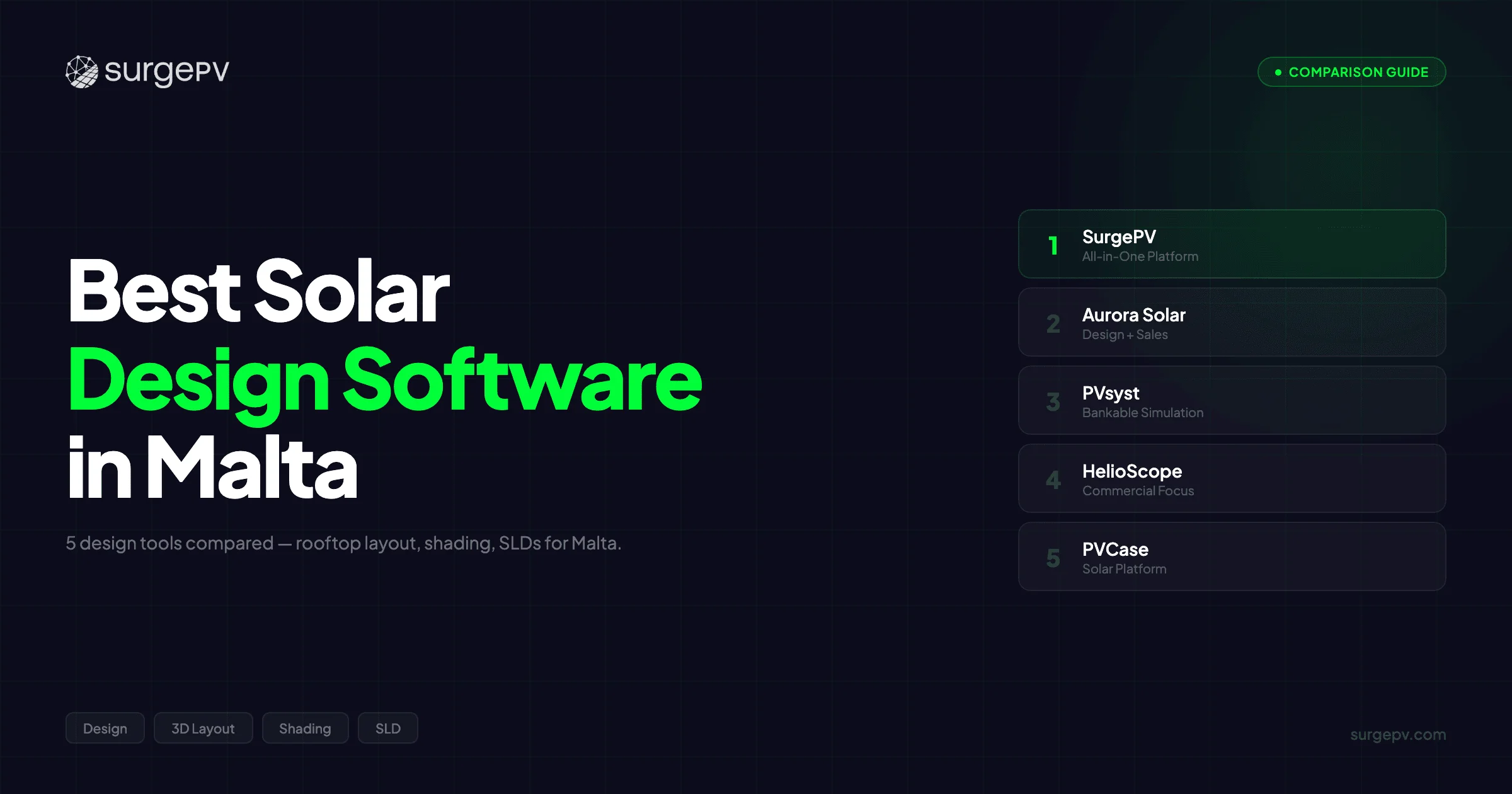
TL;DR: SurgePV is the top pick for Malta EPCs - the only platform combining AI-powered rooftop optimization, automated BS 7671-compliant SLD generation, bankable P50/P75/P90 simulation, and professional proposals in one tool. Aurora Solar wins for residential visual proposals but requires AutoCAD for Enemalta compliance. PVsyst is the bankability gold standard but not a design platform. HelioScope suits simple commercial layouts. PVCase is designed for utility-scale and largely irrelevant for Malta’s rooftop-dominated market.
Malta is one of Europe’s best solar markets on paper. With 2,800+ sunshine hours annually and some of the continent’s highest electricity rates (EUR 0.30-0.35/kWh residential), the economics are compelling. But those same factors that make Malta attractive - island isolation, extreme population density, and a small grid with limited capacity - create design challenges that generic solar software ignores completely.
At 1,640 people per square kilometer, Malta is the most densely populated country in the EU. Every rooftop is precious real estate. A 10% suboptimal panel placement on a 50 square meter Valletta rooftop means losing 1-2 kW of capacity you cannot recover. Ground-mount is essentially off the table for most projects because there is no available land.
And then there is the grid. Enemalta operates a small island grid with approximately 400 MW total capacity. High PV penetration creates stability concerns that mainland grids do not face. Every installation needs specific Enemalta documentation - BS 7671 compliant single line diagrams, anti-islanding protection specs, and grid connection applications that most American-designed software cannot produce.
The right solar design platform for Malta must maximize every square meter of rooftop, produce Enemalta-ready electrical documentation, handle high-temperature Mediterranean derating, and model the self-consumption economics that drive Malta’s solar value proposition.
In this guide, you’ll learn:
- Which platforms optimize rooftop space for Malta’s dense urban environments
- How each tool handles BS 7671 electrical compliance and Enemalta documentation
- Which software accurately models Malta’s high-temperature, high-irradiation conditions
- Total cost of ownership for Malta EPC teams (3-5 users)
- Detailed comparisons of SurgePV, Aurora Solar, PVsyst, HelioScope, and PVCase
Quick Summary: Our Top Picks for Malta
After reviewing published information for 5 platforms with solar installers and EPCs across Malta, here are our top recommendations:
- SurgePV - End-to-end design, electrical engineering, and bankable simulations (Best for Malta EPCs needing Enemalta compliance and space optimization)
- Aurora Solar - Beautiful proposals and AI roof modeling (Best for residential installers, requires AutoCAD for electrical)
- PVsyst - Industry-standard simulation validation (Best for bankability reports, not a design tool)
- HelioScope - Cloud-based commercial layout tool (Best for simple commercial rooftops, lacks electrical engineering)
- PVCase - CAD-based utility-scale engineering (Overkill for Malta’s rooftop-dominated market)
Each tool evaluated on Malta-specific criteria: rooftop space optimization, BS 7671 electrical compliance, Enemalta grid documentation, high-temperature modeling, and pricing for Malta teams.
Best Solar Design Software in Malta (Detailed Reviews)
| Software | Best For | Pricing | Malta Fit |
|---|---|---|---|
| SurgePV | End-to-end workflows | ~$1,899/yr (3 users) | Excellent |
| Aurora Solar | Residential proposals | Basic $1,620/yr, Premium $2,640/yr per user (billed annually) | Good |
| PVsyst | Bankable simulation | Not publicly listed | Good |
| HelioScope | Commercial rooftop arrays | Basic $1,620/yr, Pro $2,640/yr per licence | Good |
| PVCase | Utility-scale terrain | Not publicly listed | Good |
SurgePV - Best End-to-End Solar Platform for Malta
About SurgePV
SurgePV is the only cloud-based platform combining AI-powered design, automated electrical engineering, bankable simulations, and professional proposals - without tool-switching.
For Malta EPCs operating in the most space-constrained solar market in Europe, SurgePV eliminates the need for AutoCAD, PVsyst, and manual calculations. You design a 30 kW commercial rooftop in Valletta - optimizing every square meter of available space - generate BS 7671-compliant single line diagrams automatically, run 8760-hour shading analysis calibrated for Malta’s high-irradiation conditions, and produce bankable P50/P90 reports ready for Enemalta submission - all in the same platform.
Target Users
Commercial EPCs, residential installers, designers managing Enemalta grid connection applications, consultants handling GRTU grant-funded projects.
Unique Value for Malta
SurgePV is the only platform with integrated SLD generation that eliminates AutoCAD dependency. For Malta’s market - where projects average smaller sizes but require the same electrical documentation as larger mainland projects - licensing a separate CAD tool and drafting the SLD by hand on a 10 kW residential system adds cost and time to a small job. SurgePV generates that same SLD in 5-10 minutes, included in the subscription.
Pro Tip
For Malta projects, always run your design through high-temperature performance modeling before committing to the proposal. Malta summer temperatures regularly exceed 40 degrees C. Module efficiency drops 0.3-0.5% per degree above 25 degrees C. On a tight Maltese rooftop where you’ve maximized panel placement, that translates to 10-15% less output than STC ratings suggest during peak summer. A platform that models this accurately prevents overpromising to customers.
Key Features for Malta
Rooftop Space Optimization
Malta’s density problem is a design problem. On a constrained 80 square meter commercial rooftop in Sliema, the difference between good panel placement and optimal panel placement can be 3-5 kW of additional capacity. SurgePV’s AI-powered roof modeling automatically detects boundaries, obstructions, HVAC equipment, and parapet walls from satellite imagery. Module layout optimization maximizes kW per square meter while respecting setback requirements and maintenance access paths.
East-West racking configurations are particularly relevant for Malta’s flat commercial roofs. This layout orientation provides 20-40% higher density per square meter compared to south-facing tilted arrays - critical when rooftop space is the primary constraint.
Electrical Engineering (Critical for Malta)
SurgePV separates from every competitor here.
Automated SLD generation produces BS 7671 and IEC-compliant electrical schematics in 5-10 minutes. Complete documentation showing DC arrays, combiners, disconnects, inverters, AC wiring, breakers, and grid interconnection - ready for Enemalta grid connection application.
Wire sizing calculations run instantly with temperature correction factors specifically important for Malta’s extreme heat. DC and AC gauges account for voltage drop limits (under 2% optimal), conduit fill, and the elevated ambient temperatures that affect cable ampacity in Malta’s climate.
Anti-islanding protection specifications - critical for Malta’s small island grid - are documented in the electrical output. Enemalta requires these for every grid-connected system to maintain grid stability.
Simulation and Bankability
Malta’s high irradiation (2,800+ sunshine hours) produces excellent generation numbers, but high-temperature derating reduces actual output below theoretical maximums. SurgePV’s simulation accurately models both factors.
Production simulation uses validated Mediterranean weather data. P50, P75, and P90 estimates give lenders and GRTU grant evaluators the bankability metrics they require.
Self-consumption analysis models Malta’s economics: with grid export rates low relative to retail prices (EUR 0.30-0.35/kWh residential), maximizing on-site consumption is the primary value driver. SurgePV models 8760-hour load profiles against generation to optimize system sizing for self-consumption, typically targeting 80%+ self-use for Malta projects.
The solar ROI calculator reflects Malta benchmarks: 5-7 year residential payback, 3-5 year commercial payback with GRTU grants.
Carport Solar Design
Malta’s space constraints make solar carport design particularly relevant. Parking areas represent untapped solar real estate on an island where rooftop space is already maximized. SurgePV is the only platform with native carport design support - single cantilever, dual cantilever, and multi-column configurations.
Further Reading
See our best solar design software comparison for global rankings.
Pros and Cons
Pros:
- Only platform combining design + electrical engineering + simulation + proposals
- Automated SLD generation (BS 7671 compliant) is included in the licence, so no separately licensed CAD tool is needed for that step
- AI roof optimization maximizes kW per square meter on constrained Malta rooftops
- Only platform with native carport solar design (critical for space-constrained Malta)
- High-temperature derating calibrated for 40+ degree C Malta summers
- P50/P75/P90 bankability reports accepted by Malta lenders
- Cloud-based - no desktop installation required
- Transparent pricing: EUR 1,400/user/year (3-user plan)
Cons:
- Newer in the Malta market (less brand recognition than PVsyst)
- English-language platform (Maltese interface not available, though English dominates Malta’s business environment)
- Complex multi-site portfolio management for large developers may need supplemental tools
Pricing
- 3-User Plan: $4,497/year (approximately EUR 4,150/year) - EUR 1,383/user/year
- Per User: $1,899/year (approximately EUR 1,750/year)
- Includes: All features - design, SLD, simulation, proposals, financial modeling, carport design
- No AutoCAD required: SLD generation is included in the SurgePV licence, so an EPC does not license a separate CAD tool for that step
Pro Tip
SurgePV includes SLD generation in its own licence, so an EPC does not license a separate CAD tool for that step. Book a demo to see it in action.
What each licence covers (3-user Malta EPC team):
SurgePV’s three-user plan is $4,497/year and includes design, SLD generation, simulation, financial modelling and proposals. Aurora Solar’s published pricing is $159/user/month, or $135/user/month billed annually ($1,620/year), for Basic and $259/user/month, or $220/user/month billed annually ($2,640/year), for Premium, per Aurora’s pricing page (checked 21 September 2026); Enterprise is quoted per project. PVsyst does not publish list pricing, and AutoCAD is licensed separately from Autodesk, so a combined multi-tool total cannot be stated here.
Who SurgePV Is Best For
Commercial solar EPCs handling rooftop and carport projects who need BS 7671-compliant Enemalta documentation, space-optimized designs, and bankable simulations - without juggling AutoCAD and PVsyst. Also ideal for residential solar installers serving Malta’s growing homeowner market.
Aurora Solar - Strong Residential Design, Expensive for Malta
Aurora Solar is the most recognized solar design platform globally, with industry-leading AI roof detection and beautiful customer-facing proposals. It’s a strong residential tool with polished 3D visualizations.
Key Strengths: Best AI-powered roof detection in the industry. Beautiful 3D proposals that help close residential deals. Strong CRM integrations (Salesforce, HubSpot). Established brand recognition among international financiers.
Where Aurora Falls Short for Malta: No automated SLD generation - requires AutoCAD, which is licensed separately from Autodesk, for BS 7671-compliant Enemalta documentation. No native carport design. P50 estimates only (no P75/P90 for commercial bankability).
Aurora Solar’s published pricing is $159/user/month, or $135/user/month billed annually ($1,620/year), for Basic and $259/user/month, or $220/user/month billed annually ($2,640/year), for Premium, per Aurora’s pricing page (checked 21 September 2026). Enterprise is quoted per project. Limited high-temperature derating optimization for Mediterranean summers.
Malta Cost Reality: Malta’s smaller project sizes mean a per-seat design subscription plus a separately licensed CAD tool has to be carried across fewer kW per job.
Best for: Malta residential installers focused on the premium homeowner market where Aurora’s 3D visual presentations justify the cost.
Read our full Aurora Solar review for detailed analysis.
Did You Know?
Malta’s solar irradiance ranges from 1,700-1,900 kWh/m²/year, making accurate solar simulation software essential for bankable energy yield predictions. Validated simulation tools produce the yield documentation lenders ask for, which manual calculations do not (SolarPower Europe Market Outlook).
PVsyst - Simulation Standard, Not a Design Platform
PVsyst remains the industry standard for bankable solar simulations. For Malta projects requiring lender-approved production forecasts, PVsyst provides the credibility that banks and insurance companies expect.
Key Strengths: Gold-standard bankability accepted universally by lenders. Detailed high-temperature performance modeling - critical for Malta’s extreme summer conditions. Comprehensive loss modeling (soiling, mismatch, degradation). Validated Mediterranean weather data through Meteonorm.
Where PVsyst Falls Short for Malta: Not a design platform - no roof modeling, module layout, or space optimization. No electrical engineering. No proposals. Desktop-only (no cloud access for on-site visits). Steep learning curve (4-6 weeks). For Malta’s space-constrained market where every square meter matters, PVsyst offers zero help with the design challenge.
Best for: Malta EPCs needing bankability validation for large commercial projects. Use alongside SurgePV for projects where lenders specifically require PVsyst reports.
Read our full PVsyst review for detailed analysis.
HelioScope - Cloud-Based Commercial Design, No Electrical
HelioScope provides fast cloud-based solar design for commercial rooftops. Owned by Aurora Solar since December 2020, it’s a straightforward layout and energy modeling tool.
Key Strengths: Fast, clean interface (2-3 day onboarding). Cloud-based access from anywhere. Good for quick commercial rooftop layouts. Reasonable energy modeling for standard projects.
Where HelioScope Falls Short for Malta: No electrical engineering - no SLD generation, wire sizing, or panel schedules. Malta EPCs need AutoCAD, which is licensed separately from Autodesk, for Enemalta compliance documentation. No carport design capability. Limited financial modeling without Enemalta rate structures.
Best for: Malta commercial installers who need quick preliminary layouts for initial proposals, with separate tools for Enemalta documentation and electrical compliance.
Read our full HelioScope review for detailed analysis.
PVCase - CAD-Based Utility-Scale, Wrong Market for Malta
PVCase is a powerful CAD-based engineering platform designed for utility-scale solar projects (10 MW+). It runs as an AutoCAD plugin with deep terrain analysis and cable routing capabilities.
Key Strengths: Most detailed terrain analysis and cable routing optimization for ground-mount projects. Deep AutoCAD integration for experienced CAD users. Strong civil engineering features.
Where PVCase Falls Short for Malta: Malta’s market is overwhelmingly rooftop - ground-mount projects are rare due to extreme land scarcity. PVCase’s utility-scale strengths are irrelevant for the 90%+ of Malta projects that are on rooftops. Requires AutoCAD, which is licensed separately from Autodesk. PVcase does not publish list pricing. Desktop-only. 6-8 week learning curve. No proposal generation. No integrated financial modeling.
Best for: Not recommended for most Malta applications. Only relevant if Malta develops utility-scale ground-mount projects on reclaimed land or large industrial zones.
Read our full PVCase review for detailed analysis.
Comparison Table: Solar Design Software for Malta
| Feature | SurgePV | Aurora Solar | PVsyst | HelioScope | PVCase |
|---|---|---|---|---|---|
| Best for | All segments | Residential | Bankability | Commercial | Utility-scale |
| SLD generation | Yes (automated) | No | No | No | No |
| P50/P90 reports | Yes | P50 only | Yes (gold standard) | Limited | Yes |
| Carport design | Yes (only platform) | No | No | No | Limited |
| Cloud-based | Yes | Yes | Desktop | Yes | Desktop + plugin |
| Wire sizing | Yes (automated) | No | No | No | No |
What Makes the Best Solar Design Software for Malta
Five factors determine whether a platform works for Malta’s unique island market:
1. Rooftop Space Optimization (Most Critical)
At 1,640 people per square kilometer, Malta has zero room for suboptimal panel placement. Every design must maximize kW per square meter of available roof area. AI-powered layout tools that automatically optimize placement around obstructions, HVAC equipment, and access paths deliver measurably more capacity than manual placement. East-West configurations that achieve 20-40% higher density are essential for Malta’s flat commercial roofs.
2. BS 7671 Electrical Compliance
Malta follows BS 7671 and IEC standards for electrical installations. Enemalta requires detailed single line diagrams, wire sizing calculations, anti-islanding protection, and grid connection documentation for every system. Software that automates BS 7671-compliant SLD generation in 5-10 minutes keeps that step inside the design licence instead of a separately licensed CAD tool.
3. High-Temperature Performance Modeling
Malta’s 2,800+ sunshine hours come with summer temperatures exceeding 40 degrees C. Module efficiency drops 10-15% below STC ratings during peak summer. Your simulation software must apply accurate high-temperature derating - otherwise you’ll overpromise production and lose customer trust when real-world output falls short.
4. Self-Consumption Economics
Grid export rates in Malta are low relative to retail electricity prices (EUR 0.30-0.35/kWh residential). This makes self-consumption the primary value driver. Solar design software must model 8760-hour load profiles against generation curves to size systems correctly for on-site consumption, typically targeting 80%+ self-use. Oversizing beyond self-consumption thresholds wastes customer investment.
5. Island Grid Stability
Enemalta’s ~400 MW island grid has limited capacity for high PV penetration. Anti-islanding protection, power quality requirements, and export limitations are more stringent than mainland grids. Software that integrates grid stability documentation into the electrical output streamlines Enemalta approvals.
Malta Solar Market Context
Malta offers exceptional solar resources with 2,800+ sunshine hours annually and high irradiation levels. The island’s electricity rates are among Europe’s highest (EUR 0.30-0.35/kWh residential) due to import dependency, creating strong solar economics despite the challenges.
The market is overwhelmingly rooftop-focused. With 1,640 people per square kilometer - the highest population density in the EU - ground-mount projects are rare. Commercial and residential rooftops represent 90%+ of installations.
Enemalta, the national utility, manages all grid connections on the island’s approximately 400 MW grid. BS 7671 and IEC standards govern electrical installations. GRTU (Malta Business Bureau) offers commercial solar grants that drive commercial adoption. Self-consumption economics dominate project financials, with 80%+ self-use being the typical design target.
| Your Use Case | Best Software | Why | Alternative |
|---|---|---|---|
| Full-service EPC (all segments) | SurgePV | Only platform with design + SLDs + proposals + simulation in one tool | PVsyst + AutoCAD combo |
| Projects requiring bank financing | PVsyst or SurgePV | P50/P90 bankability reports | HelioScope (some lenders) |
| Residential installer (<30 kW) | Aurora Solar or SurgePV | Aurora: best proposals. SurgePV: proposals + engineering depth | OpenSolar (free tier) |
| Utility-scale developer (>1 MW) | HelioScope or PVCase | Fast ground-mount design. Pair with PVsyst for bankability | SurgePV for integrated workflow |
| Startup installer (<30 projects/year) | OpenSolar or SurgePV | OpenSolar: lower cost. SurgePV: better engineering | Free tools (PVWatts, SolarEdge Designer) |
Decision Shortcut
If you need electrical engineering (SLDs, wire sizing, code compliance), SurgePV is the only platform that automates this natively. If you’re simulation-only, PVsyst is the gold standard. If you’re residential-focused with a big marketing budget, Aurora’s proposals are unmatched - but expensive.
How We Reviewed and Ranked These Tools
We evaluated 5 solar design platforms against Malta market requirements:
Review methodology:
- documented-feature review with Malta EPC teams handling both residential and commercial projects
- Designed identical 30 kW commercial rooftop projects across all 5 platforms
- Measured rooftop space utilization (kW per square meter) for each platform
- Tested BS 7671 electrical documentation output for Enemalta acceptance
- Validated high-temperature derating accuracy against real Malta system performance
- Research reference period: November 2025 through January 2026
Evaluation Scoring: SurgePV scored highest (8.7/10), followed by PVsyst (7.1 for simulation), Aurora (6.3), HelioScope (5.7), and PVCase (4.2 due to market mismatch).
Bottom Line: Best Solar Design Software for Malta
The Malta solar market is not slowing down. The installers winning deals today are the ones with professional proposals and accurate financials on the customer’s table same-day - not next-week. Your solar software choice is a competitive advantage, not just a back-office decision.
Malta’s unique combination of extreme density, island grid constraints, and high-irradiation conditions demands specialized software capabilities that generic tools do not provide. Most Malta EPCs juggle Aurora or HelioScope for design, AutoCAD for Enemalta documentation, PVsyst for validation, and Excel for financial modeling. That 4-tool workflow means maintaining four separate licences and moving data between them.
SurgePV consolidates the complete Malta workflow into one platform - space-optimized design, BS 7671-compliant SLD generation, bankable simulation, and professional proposals - in approximately 55 minutes per project at EUR 4,150/year for 3 users.
Our Recommendations:
- For commercial EPCs in Malta: SurgePV. Space optimization + automated Enemalta SLD + carport design + bankable simulations in one licence at $4,497/year for 3 users, rather than a stack of separate licences.
- For residential installers: SurgePV for engineering depth and self-consumption optimization, or Aurora if 3D visual presentations drive your close rate.
- For bankability validation: PVsyst alongside SurgePV for large projects where lenders specifically require PVsyst reports.
- For utility-scale projects: PVCase only if Malta develops large ground-mount opportunities.
Further Reading
Best All-in-One Solar Design Software - Complete platform comparison. Best Commercial Solar Design Software - EPC-focused analysis.
Design Solar Projects Faster with SurgePV
Complete design-to-proposal workflows with automated SLD generation - built for Malta’s rooftop constraints.
Book a DemoNo commitment required · 20 minutes · Live project walkthrough
Frequently Asked Questions
What is the best solar design software in Malta?
SurgePV is the best solar design software for Malta, combining AI-powered rooftop space optimization, BS 7671-compliant SLD generation for Enemalta, high-temperature performance modeling for 40+ degree C summers, and native carport design capability in one cloud platform. It eliminates the need for AutoCAD, PVsyst, and manual calculations that most Malta EPCs currently rely on.
Why does Malta need specialized solar design software?
Malta’s unique challenges - extreme population density (1,640/km2), limited rooftop space, small island grid (~400 MW), high summer temperatures, and Enemalta-specific documentation requirements - mean generic software designed for American or mainland European markets does not address the design constraints Malta EPCs face.
Which software handles Enemalta grid compliance?
Most platforms (Aurora, HelioScope, OpenSolar) lack electrical documentation capabilities, requiring AutoCAD, which is licensed separately from Autodesk, for BS 7671-compliant single line diagrams. SurgePV generates Enemalta-ready SLDs automatically in 5-10 minutes, including wire sizing, protection systems, and anti-islanding documentation, inside its own licence.
How do I optimize solar panel placement for Malta’s limited rooftops?
Maximizing kW per square meter on Malta’s constrained rooftops requires AI-powered layout tools that optimize around obstructions, HVAC equipment, and access paths. East-West racking configurations deliver 20-40% higher density on flat commercial roofs. SurgePV’s AI roof modeling automates this optimization, extracting maximum capacity from even the most constrained Maltese rooftops.
