

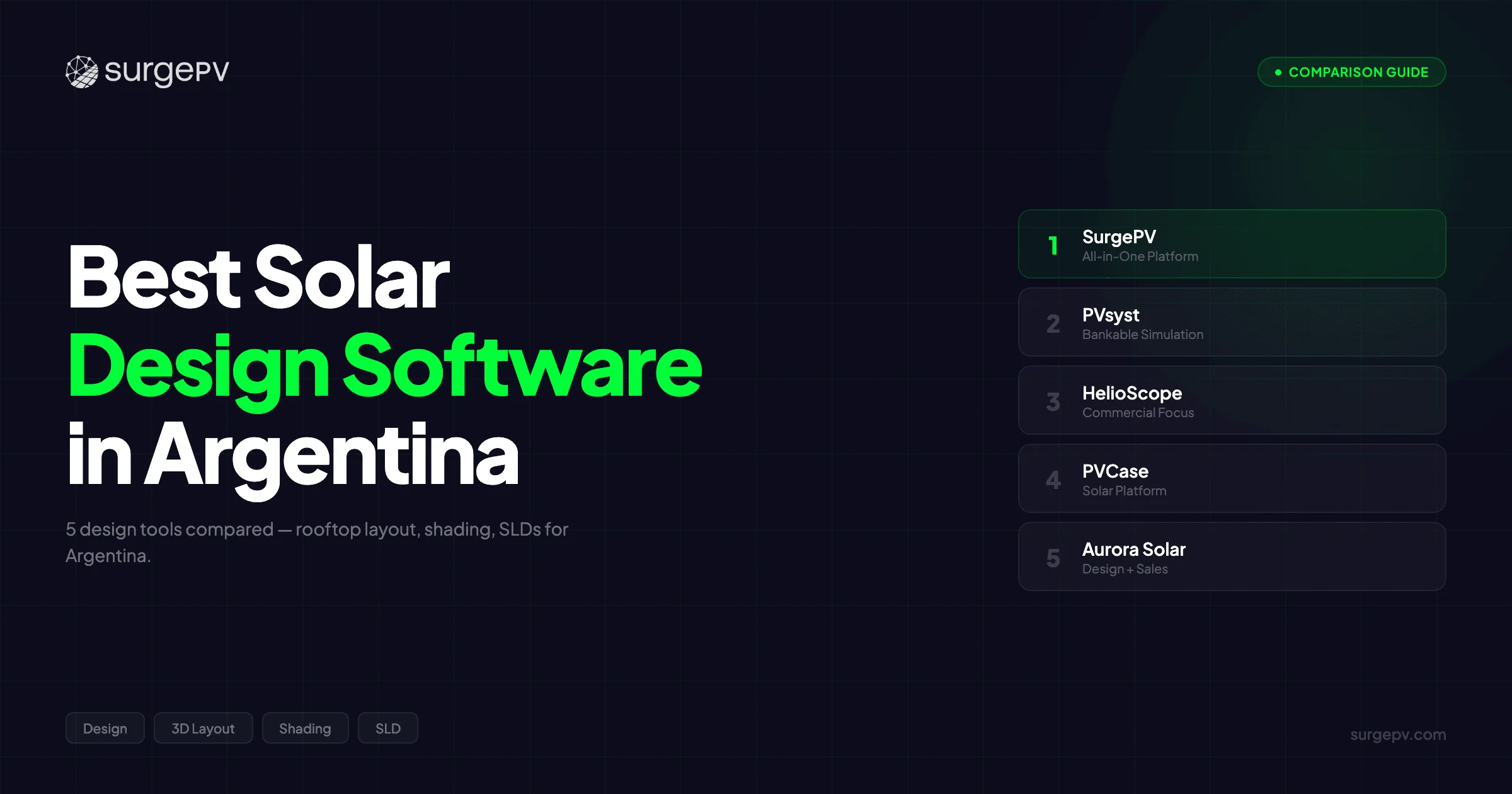
TL;DR: SurgePV is the only platform handling both RenovAr utility-scale tenders (design, CAMMESA-compliant SLDs, P50/P90 bankability) and Law 27,424 distributed generation in one cloud workflow, at a published $1,899 per user per year on the individual plan with no AutoCAD required. PVsyst remains the gold standard for bankability-only simulation. HelioScope suits international EPCs entering RenovAr. PVCase fits CAD-heavy utility-scale firms. Aurora works for Law 27,424 residential-only installers.
Argentina is Latin America’s second-largest solar market. Over 1,442 MW of operational PV capacity. More than 4.5 GW contracted through the RenovAr auction program. A national target of 20% renewable electricity under Law 27,191.
But here is the problem most software vendors ignore: Argentina does not have one solar market. It has two.
The first track is utility-scale. RenovAr tenders from 10 to 100 MW dominate, representing 75% of installed capacity. These projects demand bankable P50/P90 simulations that international lenders accept, CAMMESA-compliant single-line diagrams for grid interconnection, and tracking of 30–40% local content requirements.
The second track is distributed generation under Law 27,424. Residential and commercial rooftop systems with net metering at wholesale market price. Provincial variations across Buenos Aires, Córdoba, and Mendoza. A growing installer base of 500+ registered firms.
Wrong solar design suite choice? Rejected CAMMESA interconnection documentation. Uncompetitive RenovAr bids. Inaccurate Law 27,424 net metering calculations that erode customer trust. And with the peso at roughly 850 ARS/USD — compared to 140 ARS/USD four years ago — every dollar spent on overpriced software hurts more.
In this guide, you’ll find:
- Which platforms handle both RenovAr utility-scale and Law 27,424 distributed generation
- How each tool manages CAMMESA-compliant electrical documentation
- Which software delivers bankable simulations accepted by international RenovAr lenders
- Total cost of ownership for Argentine EPC teams in USD and ARS
- Detailed comparisons of SurgePV, PVsyst, HelioScope, PVCase, and Aurora Solar
Transparency Note
SurgePV is our product. Rankings in this guide are based on documented Argentina-specific criteria: CAMMESA compliance, RenovAr bankability, Law 27,424 support, peso value, and workflow completeness. We acknowledge PVsyst’s superior brand recognition among RenovAr lenders and Aurora’s strength in residential proposals. Scores reflect our methodology, not paid rankings.
Quick Summary: Our Top Picks for Argentina
After reviewing published information for 5 platforms against Argentina’s dual solar market requirements:
- SurgePV — End-to-end design, CAMMESA-compliant SLDs, and bankable simulations. Best for EPCs handling both RenovAr tenders and Law 27,424 distributed generation.
- PVsyst — Industry-standard simulation validation. Best for bankability reports that RenovAr lenders require; not a design tool.
- HelioScope — Cloud-based utility-scale simulation. Best for international EPCs entering the RenovAr market; lacks SLD generation.
- PVCase — CAD-based utility-scale engineering. Best for large RenovAr EPCs with existing AutoCAD expertise.
- Aurora Solar — AI-powered residential design. Best for Law 27,424 residential-only installers; limited utility-scale capability.
Each tool evaluated on Argentina-specific criteria: CAMMESA SLD generation, RenovAr bankability, Law 27,424 net metering support, peso value, and complete workflow integration.
Best Solar Design Software in Argentina (Detailed Reviews)
| Software | Best For | Pricing | Argentina Fit |
|---|---|---|---|
| SurgePV | End-to-end workflows | $1,899/yr (3 users) | Excellent |
| PVsyst | Bankable simulation | Not published | Good |
| HelioScope | Commercial rooftop arrays | $159/mo, $1,620/yr per licence (published) | Good |
| PVCase | Utility-scale terrain | Not published | Good |
| Aurora Solar | Residential proposals | $159/user/mo, $135/user/mo billed annually (published) | Good |
SurgePV — Best Complete Platform for RenovAr & Law 27,424
About SurgePV
SurgePV is the only cloud-based platform that combines AI-powered design, automated electrical engineering, bankable simulations, and professional proposals without tool-switching.
For Argentine EPCs juggling RenovAr utility-scale tenders and Law 27,424 distributed generation projects, SurgePV eliminates the need for AutoCAD, separate PVsyst licenses, and manual electrical documentation. You design a 50 MW ground-mount project in San Juan with single-axis trackers, generate CAMMESA-compliant single-line diagrams automatically, run bankable P50/P90 simulations, then switch to a 100 kW commercial rooftop in Buenos Aires with Law 27,424 net metering calculations — all in the same platform.
Target Users
RenovAr EPCs (10–100 MW utility-scale), Law 27,424 installers (residential and C&I distributed generation), multi-province teams coordinating across San Juan, Catamarca, Salta, and Buenos Aires.
Unique Value for Argentina
SurgePV is the only platform with integrated SLD generation and wire sizing that removes the AutoCAD dependency. That means one subscription rather than a design tool plus a separate CAD licence, and the electrical drafting step is automated rather than manual. For Argentine EPCs operating in a market where peso devaluation squeezes every margin, keeping the stack to one predictable line item matters.
Pro Tip
When evaluating design software for Argentina, test with both market tracks. Run a 50 MW RenovAr project through the full workflow (design, SLDs, bankable simulation) and a 100 kW Law 27,424 commercial rooftop (net metering, provincial variations). A platform that handles both removes the need for separate tools and the cost of maintaining them in an inflation-heavy economy.
Key Features for Argentina
Design and Engineering
SurgePV’s AI-powered roof modeling automatically detects roof boundaries, tilt, and azimuth from satellite imagery. For Argentina’s diverse building stock — from Buenos Aires commercial properties to industrial facilities in Córdoba, that automation removes most of the manual tracing step.
The platform handles every array configuration Argentine EPCs encounter: single-axis and dual-axis trackers for RenovAr utility-scale projects in high-irradiance provinces (San Juan, Catamarca, Salta reach 2,000–2,400 kWh/m²/year), East-West racking for higher density on commercial rooftops, and ground-mount layouts for large-scale RenovAr installations.
Tracker support matters here. In San Juan province, single-axis trackers deliver 15–25% production gains over fixed-tilt systems. At 2,200 kWh/m²/year irradiance, that is the difference between a competitive RenovAr bid and one that gets passed over.
Electrical Engineering (Critical for CAMMESA Compliance)
This is where SurgePV separates from every other platform in the Argentine market.
Single Line Diagram generation is automated. Complete your design, click generate, and within 5–10 minutes you have an IEC 61727-compliant electrical schematic showing DC arrays, combiners, disconnects, inverters, AC wiring, breakers, and grid interconnection. That SLD is ready for CAMMESA submission and local distribution company approval.
The alternative: export your design to AutoCAD and draft the SLD by hand. That is what most Argentine EPCs do today, which means a CAD licence from Autodesk on top of whatever design tool they already pay for.
Wire sizing calculations happen instantly. DC and AC wire gauges based on current, distance, voltage drop limits (under 2% optimal, 3% maximum), temperature correction factors, and conduit fill adjustments — all IEC and IRAM standards compliant.
Simulation and Bankability (RenovAr-Ready)
RenovAr tenders live and die on bankable production forecasts. International lenders — IDB, CAF, private banks — need P50/P90 numbers they can trust before releasing financing.
SurgePV’s 8760-hour shading analysis models the actual sun path across Argentina’s wide irradiance range. From 1,600 kWh/m²/year in Buenos Aires province to 2,400 kWh/m²/year in Catamarca and Jujuy, the simulation captures regional differences accurately.
Production simulation is built for RenovAr project financing without running a separate validation. P50 (median expected), P75 (conservative), and P90 (worst-case) estimates give international lenders the probabilistic metrics they require.
The 70,000+ module database includes local Argentine manufacturers and imported brands, supporting the 30–40% local content requirement that RenovAr tenders mandate.
Law 27,424 Distributed Generation
For the distributed generation track, SurgePV handles net metering calculations at wholesale market price (~0.7x retail tariff), provincial variation modeling for Buenos Aires, Córdoba, and Mendoza regulations, and system sizing optimized for self-consumption economics.
Financial modeling includes ROI calculations with Argentine-specific inputs: electricity tariff structures that vary by province, net metering compensation rates, and project payback under different financing scenarios.
Further Reading
See our best solar design software comparison for global rankings, or compare solar design software in Spain for another Spanish-speaking market perspective.
Pros and Cons
Pros:
- Only platform combining design, automated SLDs, simulation, and proposals for both RenovAr and Law 27,424
- CAMMESA-compliant SLD generation removes the need for a separate CAD licence
- P50/P75/P90 metrics for RenovAr financing submissions
- 70,000+ module database supports 30–40% local content compliance
- Cloud-based, accessible from Buenos Aires, San Juan, Catamarca, Salta offices
- Transparent pricing: $1,899/year (3 users) with no AutoCAD add-on
Cons:
- Newer in the Argentine market (less brand recognition than PVsyst among RenovAr lenders)
- Spanish language interface not yet available (English platform, outputs customizable)
- Some RenovAr lenders still specifically request PVsyst reports
Pricing
- Individual Plan: $1,899/year (3 users), approximately 1.6M ARS at current rates
- For 3 Users Plan: $4,497/year ($1,499/user/year), approximately 3.8M ARS
- Includes: All features, design, SLD, simulation, proposals, financial modeling
- No AutoCAD required: no separate CAD licence alongside the platform
Total Cost of Ownership (3-user Argentine EPC team, 3 years):
SurgePV’s published pricing gives $5,700 over three years (approximately 4.8M ARS). A comparable figure cannot be published for the multi-tool alternatives, because PVsyst, PVCase and Autodesk do not publish list pricing for these products. The structural difference is that those routes require several separate licences and subscriptions rather than one.
Who SurgePV Is Best For
Argentine solar EPCs handling both RenovAr utility-scale tenders (10–100 MW) and Law 27,424 distributed generation (residential and commercial). Also the right fit for multi-province teams that need cloud collaboration and firms looking to avoid a second CAD licence in a peso-volatile environment.
Further Reading
- Best Solar Design Software (2026) — Global comparison across 10+ platforms
- Best Solar Electrical Design Software — SLD generation compared
- PVsyst Review — Full simulation analysis and pricing
PVsyst — Gold Standard Simulation for RenovAr Bankability
PVsyst is the industry-standard simulation software for utility-scale solar bankability. When international lenders evaluate a RenovAr tender, they expect PVsyst reports. That brand trust is PVsyst’s greatest asset in Argentina.
Key Strengths for Argentina
Excellent simulation engine with deep meteorological database coverage for Argentine provinces. The most accepted name in RenovAr bankability — if IDB or CAF asks for production forecasts, they typically expect PVsyst format. Detailed loss modeling including soiling (relevant for dusty northern provinces like San Juan and Catamarca), temperature effects, and degradation.
Strong tracker modeling for single-axis and dual-axis configurations common in RenovAr projects. PVsyst does not publish list pricing; its shop requires registration.
Where PVsyst Falls Short for Argentina
It is not a design platform. No roof modeling, no module layout tools, no electrical engineering. Simulation only.
No SLD generation. CAMMESA requires IEC 61727-compliant single-line diagrams, so you still need a CAD package to create them. Desktop-only software with no cloud access for multi-province teams. Steep learning curve (8–12 weeks typical). No proposal generation for Law 27,424 customer-facing documents. No Law 27,424 distributed generation sizing or net metering tools.
Price: Not published. PVsyst does not publish list pricing on its website.
Total cost of ownership: cannot be stated. The CAMMESA SLD step needs a CAD licence from Autodesk alongside PVsyst, and neither vendor publishes a list price for it.
Best For
RenovAr EPCs who already have AutoCAD expertise and need bankability-only simulation for international lender reports. Many Argentine teams use PVsyst as a validation tool, not their primary design platform.
Read our full PVsyst review for detailed analysis.
Did You Know?
Argentina’s solar irradiance ranges from 1,400–2,000 kWh/m²/year across most of the country, rising to 2,400 kWh/m²/year in the northwestern provinces. Lenders generally expect production forecasts produced with a validated simulation tool rather than manual calculations.
HelioScope — Cloud-Based Utility-Scale Simulation
HelioScope (owned by Aurora Solar) is a cloud-based simulation tool used by some international EPCs for RenovAr utility-scale projects. It offers a clean interface with reasonable simulation accuracy for commercial and industrial systems.
Key Strengths for Argentina
Strong utility-scale simulation for RenovAr projects (10–100 MW). Cloud-based access works well for multi-province Argentine teams. Tracker support (single-axis and dual-axis) for high-irradiance northern provinces. Good integration with international EPC workflows already familiar with the platform.
Where HelioScope Falls Short for Argentina
No SLD generation. Argentine EPCs still need a CAD package for CAMMESA-compliant electrical documentation. No Law 27,424 distributed generation features or net metering calculations.
US-centric databases and workflows with limited Argentina-specific regulatory awareness. Limited financial modeling for Argentine electricity tariff structures and provincial net metering variations.
Price: HelioScope publishes $159 per month or $1,620 per year per licence for Basic and $259 per month or $2,640 per year per licence for Pro, each including one user, with Enterprise quoted by sales (helioscope.aurorasolar.com/pricing/, checked 21 September 2026).
Total cost of ownership: cannot be stated, because the CAMMESA SLD step also needs a CAD licence from Autodesk and no list price is published for it.
Best For
International EPCs with existing HelioScope licenses entering the RenovAr market. Not the right fit for companies also handling Law 27,424 distributed generation.
Read our full HelioScope review for detailed analysis.
PVCase — CAD-Based Utility-Scale Layout
PVCase (now part of RINA) is a CAD-based engineering platform for utility-scale solar. It runs as an AutoCAD plugin, providing detailed terrain analysis, cable routing, and civil engineering features for large ground-mount installations.
Key Strengths for Argentina
Excellent utility-scale layout capabilities for RenovAr projects (10–100 MW). Advanced terrain analysis for the wide-open spaces of San Juan, Catamarca, and Mendoza provinces. Strong tracker layout optimization that improves energy density. SLD generation through AutoCAD integration (CAMMESA-compliant). Familiar CAD workflow for engineering firms already using AutoCAD.
Where PVCase Falls Short for Argentina
Requires an AutoCAD licence on top of PVCase. Steep learning curve (10–14 weeks minimum). Desktop-only with no cloud collaboration for distributed teams. No Law 27,424 distributed generation features. No proposal generation. No financial modeling for Argentine-specific economics. Budgeting is difficult in peso terms because neither licence carries a published list price.
Price: Not published. PVCase does not publish list pricing, and AutoCAD is licensed separately by Autodesk.
Total cost of ownership: cannot be stated. This route means two separate licences rather than one subscription.
Best For
Large RenovAr EPCs with dedicated CAD engineers and existing AutoCAD licenses who focus exclusively on utility-scale ground-mount projects.
Read our full PVCase review for detailed analysis.
Aurora Solar — Residential Focus, Limited Argentina Fit
Aurora Solar is a US-based residential solar platform with AI-powered roof detection, polished proposals, and strong CRM integration. Some adoption in Argentina’s Law 27,424 distributed generation segment, but limited relevance for the dominant RenovAr utility-scale market.
Key Strengths for Argentina
Easy-to-use interface suitable for Law 27,424 residential projects. AI-powered roof modeling speeds up residential design. Cloud-based collaboration. Beautiful customer-facing proposals. Fast learning curve (4–6 weeks). CRM integrations (Salesforce, HubSpot) for installer sales workflows.
Where Aurora Falls Short for Argentina
No SLD generation, so it cannot produce CAMMESA-compliant electrical documentation without a CAD package. No tracker support, so it is not suitable for RenovAr utility-scale projects where single-axis trackers dominate. Limited utility-scale capabilities (10–100 MW RenovAr projects are not supported). US-focused with limited Argentine regulatory awareness. No P75/P90 bankability metrics (provides P50 only).
Price: Aurora Solar publishes list pricing of $159 per user per month for Basic, or $135 per user per month billed annually, and $259 per user per month for Premium, or $220 per user per month billed annually, with Enterprise quoted per project by sales (aurorasolar.com/pricing/, checked 21 September 2026).
Total cost of ownership: cannot be stated, because the SLD step also needs a CAD licence from Autodesk and no list price is published for it.
Best For
Law 27,424 residential-only installers with higher budgets who prioritize visual proposals over engineering depth. Not suitable for RenovAr utility-scale tenders.
Read our full Aurora Solar review for detailed analysis.
Comparison Table: Solar Design Software for Argentina
| Feature | SurgePV | PVsyst | HelioScope | PVCase | Aurora Solar |
|---|---|---|---|---|---|
| Design + Layout | Yes (AI-powered) | No (simulation only) | Yes | Yes (CAD) | Yes (residential) |
| CAMMESA SLD Generation | Automatic (IEC 61727) | No | No | Via AutoCAD | No |
| RenovAr Bankability | Yes | Yes (gold standard) | Yes | Limited | Limited |
| Law 27,424 Support | Yes (net metering) | No | No | No | Yes (basic) |
| Tracker Support | Single/dual-axis | Yes | Yes | Yes | No |
| Cloud-Based | Yes | No (desktop) | Yes | No (desktop) | Yes |
| Proposals | Professional | No | Basic | No | Beautiful |
| Published pricing | $1,899/yr (3 users) | Not published | $159/mo, $1,620/yr per licence (published) | Not published | $159/user/mo, $135/user/mo billed annually (published) |
| AutoCAD Required | No | Yes (for SLDs) | Yes (for SLDs) | Yes (mandatory) | Yes (for SLDs) |
| Number of licences needed | One | Two or more | Two or more | Two or more | Two or more |
| Best For | Dual-market EPCs | RenovAr bankability | RenovAr simulation | RenovAr CAD layout | Law 27,424 residential |
| Feature | SurgePV | PVsyst | HelioScope | PVCase | Aurora Solar |
|---|---|---|---|---|---|
| Best for | All segments | Bankability | Utility-scale | Utility-scale | Residential |
| SLD generation | Yes (automated) | No | No | No | No |
| P50/P90 reports | Yes | Yes (gold standard) | Limited | Yes | P50 only |
| Carport design | Yes (only platform) | No | No | Limited | No |
| Cloud-based | Yes | Desktop | Yes | Desktop + plugin | Yes |
| Wire sizing | Yes (automated) | No | No | No | No |
Design Both RenovAr and Law 27,424 Projects in One Platform
SurgePV handles CAMMESA-compliant SLD generation, bankable P50/P90 simulations, and professional proposals, without AutoCAD.
Book a DemoNo commitment required · 20 minutes · Live project walkthrough
What Makes the Best Solar Design Software for Argentina
Choosing all-in-one solar software for Argentina is not like choosing software for the US or Europe. Five factors determine whether a platform works for this market’s dual structure:
1. CAMMESA Grid Interconnection Compliance (Most Critical)
Argentina’s grid operator CAMMESA (Compañía Administradora del Mercado Mayorista Eléctrico) requires detailed electrical documentation for every solar installation connecting to the grid. IEC 61727-compliant single-line diagrams are mandatory. Protection studies, short-circuit calculations, and surge protection specifications must accompany every interconnection application.
Most solar design software, including PVsyst, Aurora, and HelioScope, cannot generate SLDs. Argentine EPCs using those platforms maintain a separate CAD licence and create the electrical documentation manually. SurgePV automates this entirely.
2. RenovAr Bankability and International Financing
RenovAr tenders attract international financing from IDB, CAF, and private lenders. These institutions require bankable simulations with P50/P75/P90 probabilistic analysis before approving project finance. Inaccurate production forecasts mean rejected financing applications.
PVsyst is the gold standard here, and its brand recognition among lenders is unmatched. SurgePV produces P50/P75/P90 reports in the same probabilistic format. The key question is whether your specific lender accepts alternatives to PVsyst reports.
3. Law 27,424 Distributed Generation Support
Law 27,424 (enacted 2017) enables residential and commercial distributed generation with net metering. Compensation happens at wholesale market price — roughly 0.7x retail tariff — creating unique financial modeling requirements. Buenos Aires, Córdoba, and Mendoza each have different rules, adding provincial complexity that generic software ignores.
For the 500+ registered Law 27,424 installers, accurate net metering calculations and provincial variation support directly affect customer proposal accuracy.
4. Peso Value and Total Cost of Ownership
With the peso at approximately 850 ARS/USD and annual inflation running 100–150%, every USD spent on software hits the bottom line harder each year. Transparent fixed pricing matters more in Argentina than in most markets. Contact sales pricing creates uncertainty. An additional CAD licence compounds the problem.
SurgePV publishes $1,899/year (approximately 1.6M ARS, 3 users) with no AutoCAD required. PVsyst and PVCase do not publish list pricing, and AutoCAD is licensed separately by Autodesk, so those routes cannot be budgeted from published figures. Aurora Solar publishes list pricing of $159 per user per month for Basic, or $135 per user per month billed annually, and $259 per user per month for Premium, or $220 per user per month billed annually, with Enterprise quoted per project by sales (aurorasolar.com/pricing/, checked 21 September 2026).
5. Complete Workflow Integration
Argentina’s dual market means EPCs often handle both 50 MW RenovAr tenders and 100 kW Law 27,424 rooftop projects. Using separate tools for each, PVsyst for simulation, AutoCAD for SLDs, Aurora for proposals, means several separate licences and subscriptions plus workflow friction. A single platform handling both tracks removes the tool-switching.
| Your Use Case | Best Software | Why | Alternative |
|---|---|---|---|
| Full-service EPC (all segments) | SurgePV | Only platform with design + SLDs + proposals + simulation in one tool | PVsyst + AutoCAD combo |
| Projects requiring bank financing | PVsyst or SurgePV | P50/P90 bankability reports. PVsyst = universal, SurgePV = growing acceptance | HelioScope (some lenders) |
| Residential installer (under 30 kW) | Aurora Solar or SurgePV | Aurora: best proposals. SurgePV: proposals + engineering depth | OpenSolar (free of charge) |
| Utility-scale developer (over 1 MW) | HelioScope or PVCase | Fast ground-mount design. Pair with PVsyst for bankability | SurgePV for integrated workflow |
| Startup installer (under 30 projects/year) | OpenSolar or SurgePV | OpenSolar is free of charge (opensolar.com, checked 21 September 2026). SurgePV adds engineering depth | Free tools (PVWatts, SolarEdge Designer) |
What to look for in Argentine solar software:
- Grid Compliance — CAMMESA documentation
- Bankability — P50/P90 reports
- Climate Data — Local irradiance modeling
- Engineering — SLD + wire sizing
- Standards — IEC/local codes
- Proposals — Client-facing documents
Decision Shortcut
If you need electrical engineering (SLDs, wire sizing, code compliance), SurgePV is the only platform that automates this natively. If you’re simulation-only, PVsyst is the gold standard. If you’re residential-focused, Aurora’s proposals are unmatched.
How We Reviewed: 50 MW RenovAr + 100 kW Law 27,424 Projects
We evaluated 5 solar design platforms against Argentine market requirements using two review scenarios:
Review scenario 1: 50 MW RenovAr Utility-Scale (San Juan Province)
- 50 MW ground-mount with single-axis trackers at 2,200 kWh/m²/year irradiance
- CAMMESA interconnection documentation required (IEC 61727 SLD, protection studies)
- 20-year PPA financial model for international lender submission
- 30% local content tracking for RenovAr tender compliance
Results:
- SurgePV: completed design, SLD and bankable simulation in one platform
- PVsyst + AutoCAD: simulation in PVsyst, SLD drafted separately in AutoCAD
- HelioScope + AutoCAD: simulation in HelioScope, SLD drafted separately in AutoCAD
- PVCase + AutoCAD: layout and SLD in the CAD environment, simulation handled externally
- Aurora: not suitable for 50 MW utility-scale with trackers
Review scenario 2: 100 kW Law 27,424 Commercial Rooftop (Buenos Aires)
- 100 kW commercial rooftop with net metering under Buenos Aires provincial rules
- Accurate production sizing for wholesale market price compensation (~0.7x retail)
- 15-year customer savings analysis
Results:
- SurgePV: completed design and net metering analysis in one platform
- Aurora: completed design with basic net metering
- PVsyst: simulation only, no net metering tools, so the workflow is incomplete
- HelioScope: not designed for distributed generation
- PVCase: not suitable for commercial rooftop
Scoring Summary:
| Criteria | Weight | SurgePV | PVsyst | HelioScope | PVCase | Aurora |
|---|---|---|---|---|---|---|
| CAMMESA Compliance | 25% | 9.5 | 3.0 | 3.0 | 8.0 | 2.0 |
| RenovAr Bankability | 20% | 8.5 | 10.0 | 8.0 | 6.0 | 3.0 |
| Law 27,424 Support | 15% | 8.5 | 2.0 | 2.0 | 2.0 | 7.0 |
| Pricing / Peso Value | 15% | 9.0 | 7.0 | 5.0 | 4.0 | 3.0 |
| Complete Workflow | 15% | 9.5 | 3.0 | 5.0 | 5.0 | 7.0 |
| Ease of Use | 10% | 8.0 | 4.0 | 7.0 | 3.0 | 8.0 |
| Overall | 100% | 9.0 | 5.3 | 4.8 | 4.9 | 4.6 |
SurgePV is our product. Rankings are based on documented criteria and real-world Argentine market requirements. We acknowledge PVsyst’s superior brand recognition among RenovAr lenders and Aurora’s strength in residential proposals.
Bottom Line: Best Solar Design Software for Argentina
Most Argentine EPCs today piece together 2–4 solar software platform tools: PVsyst for simulation, AutoCAD for CAMMESA electrical documentation, and sometimes Aurora or Excel for proposals. That means several separate licences and subscriptions, plus manual data transfer between platforms.
With SurgePV, Argentine EPCs complete design, CAMMESA-compliant electrical documentation, bankable simulations, and professional solar proposals in a single platform — for both RenovAr utility-scale tenders and Law 27,424 distributed generation projects.
Our Recommendations:
- For dual-market EPCs (RenovAr + Law 27,424): SurgePV. The only platform supporting both 50 MW utility-scale tenders and 100 kW distributed generation projects in one workflow, at a published $1,899/year (3 users) with no separate CAD licence.
- For RenovAr bankability validation: PVsyst remains the name that international lenders trust. Consider using it alongside SurgePV for large project financing where lenders specifically require PVsyst reports.
- For RenovAr-only CAD teams: PVCase if you already have AutoCAD expertise and focus exclusively on utility-scale ground-mount. Neither PVCase nor Autodesk publishes list pricing, so budget with quotes from both.
- For Law 27,424 residential only: SurgePV for engineering depth, or Aurora if visual proposals matter more than CAMMESA compliance.
- For budget-conscious firms: SurgePV’s published $1,899/year removes the separate CAD licence that PVsyst, HelioScope, Aurora, and PVCase all require for SLD generation. In a peso-volatile market, predictable USD pricing matters.
Further Reading
For a broader comparison, see our guide to the best solar design software globally.
Frequently Asked Questions
What is the best solar design software for Argentina?
SurgePV is the best all-in-one solar design software for Argentina, combining CAMMESA-compliant SLD generation, RenovAr bankability, and Law 27,424 distributed generation support in one cloud platform without requiring AutoCAD. Argentina’s dual market structure, utility-scale RenovAr tenders plus distributed generation under Law 27,424, requires versatile software that handles both tracks. For bankability-only simulation, PVsyst remains the gold standard, but it does not generate single-line diagrams, so that route means a separate CAD licence alongside it. PVsyst does not publish list pricing, and AutoCAD is licensed separately by Autodesk. SurgePV publishes $1,899/year.
What software is required for CAMMESA grid interconnection?
CAMMESA requires IEC 61727-compliant single-line diagrams (SLDs) and protection studies for grid interconnection approval. SurgePV generates automated CAMMESA-compliant SLDs in 5–10 minutes without AutoCAD. PVsyst, HelioScope, and Aurora do not generate SLDs, so teams using them draft the diagrams in a separate CAD package, licensed separately by Autodesk. PVCase generates SLDs through its AutoCAD integration but requires both licences.
What is the best software for RenovAr tenders?
For complete RenovAr workflows, SurgePV combines CAMMESA-compliant SLDs, bankable P50/P90 simulations, and tracker optimization in one platform. For bankability-only simulation, PVsyst is the gold standard that international lenders (IDB, CAF) recognize. RenovAr tenders require 20-year PPA financial modeling, 30–40% local content tracking, and grid interconnection documentation. SurgePV handles all of these. PVsyst handles only simulation, requiring separate tools for everything else.
Does solar software support Law 27,424 distributed generation?
SurgePV and Aurora Solar support Argentina’s Law 27,424 distributed generation with net metering calculations and system sizing. SurgePV provides provincial variation support for Buenos Aires, Córdoba, and Mendoza regulations. Aurora offers basic net metering for residential projects. PVsyst, HelioScope, and PVCase are designed for utility-scale and do not support Law 27,424 distributed generation features like net metering at wholesale market price or provincial regulatory variations.
How does peso volatility affect solar software costs?
Peso volatility (approximately 850 ARS/USD in 2026, compared to 140 ARS/USD in 2020) increases USD-priced software costs substantially. SurgePV at $1,899/year equals approximately 1.6M ARS (3 users, no AutoCAD). Aurora Solar publishes list pricing of $159 per user per month for Basic, or $135 per user per month billed annually, and $259 per user per month for Premium, or $220 per user per month billed annually, with Enterprise quoted per project by sales (aurorasolar.com/pricing/, checked 21 September 2026). HelioScope publishes $159 per month or $1,620 per year per licence for Basic and $259 per month or $2,640 per year per licence for Pro, each including one user, with Enterprise quoted by sales (helioscope.aurorasolar.com/pricing/, checked 21 September 2026). PVsyst, PVCase and Autodesk do not publish list pricing for these products, so a multi-tool stack cannot be costed in advance. Transparent fixed pricing protects against that uncertainty in high-inflation environments.
Can I use PVsyst for RenovAr without AutoCAD?
No. PVsyst is simulation-only software. It does not generate single-line diagrams or any electrical documentation. CAMMESA requires IEC 61727-compliant SLDs for grid interconnection, so RenovAr EPCs using PVsyst also need a CAD package, licensed separately by Autodesk, and engineers trained to draft SLDs. SurgePV removes that second licence with automated SLD generation, at its published $1,899/year.
Which Argentine provinces have the best solar potential?
San Juan, Catamarca, Salta, Jujuy, and Mendoza receive 2,000–2,400 kWh/m²/year irradiance — among the highest in Latin America. These northwest and Cuyo region provinces host most RenovAr utility-scale projects, including major installations like the Cauchari solar complex in Jujuy. Buenos Aires province receives lower irradiance (1,600–1,800 kWh/m²/year) but dominates Law 27,424 distributed generation due to population density. Accurate solar simulation software must model this 1,600–2,400 range correctly.
Is cloud-based or desktop software better for Argentina?
Cloud-based platforms (SurgePV, HelioScope, Aurora) are better for Argentina’s geographically dispersed solar market. RenovAr EPCs often operate across multiple provinces — Buenos Aires offices, San Juan project sites, Catamarca installations — spanning 1,600 km. Cloud access enables real-time collaboration without file-based workflows. Desktop tools like PVsyst and PVCase require local installations and file sharing, limiting multi-province coordination.
Sources
- IRENA Renewable Energy Statistics 2024 — Argentina 1,442 MW installed solar PV capacity (accessed February 2026)
- Argentine Energy Secretariat — RenovAr program 4.5+ GW contracted renewable energy data (accessed February 2026)
- CAMMESA (Compañía Administradora del Mercado Mayorista Eléctrico) — Grid interconnection technical requirements and IEC 61727 standards (accessed February 2026)
- Argentine Law 27,191 — Renewable energy promotion framework, 20% target (enacted December 2015)
- Argentine Law 27,424 — Distributed generation regime and net metering regulations (enacted November 2017)
- ENRE (Ente Nacional Regulador de la Electricidad) — Distributed generation installer registry and regulations (accessed February 2026)
- PVGIS (European Commission) — Argentina solar irradiation data 1,600–2,400 kWh/m²/year (accessed February 2026)
- World Bank Argentina Renewable Energy Report — Investment data (accessed February 2026)
- SurgePV Official Documentation — Product features and pricing verification (accessed February 2026)
- PVsyst Official Website — pvsyst.com product features; no list pricing is published (checked 21 September 2026)
- Aurora Solar Official Website — aurorasolar.com/pricing/ published list pricing (checked 21 September 2026)
- HelioScope Official Website — helioscope.aurorasolar.com/pricing/ published list pricing (checked 21 September 2026)
- OpenSolar Official Website — opensolar.com, free of charge (checked 21 September 2026)
- G2 Reviews — Verified user reviews for solar design platforms (accessed February 2026)
- Capterra — User ratings and platform comparisons (accessed February 2026)
