

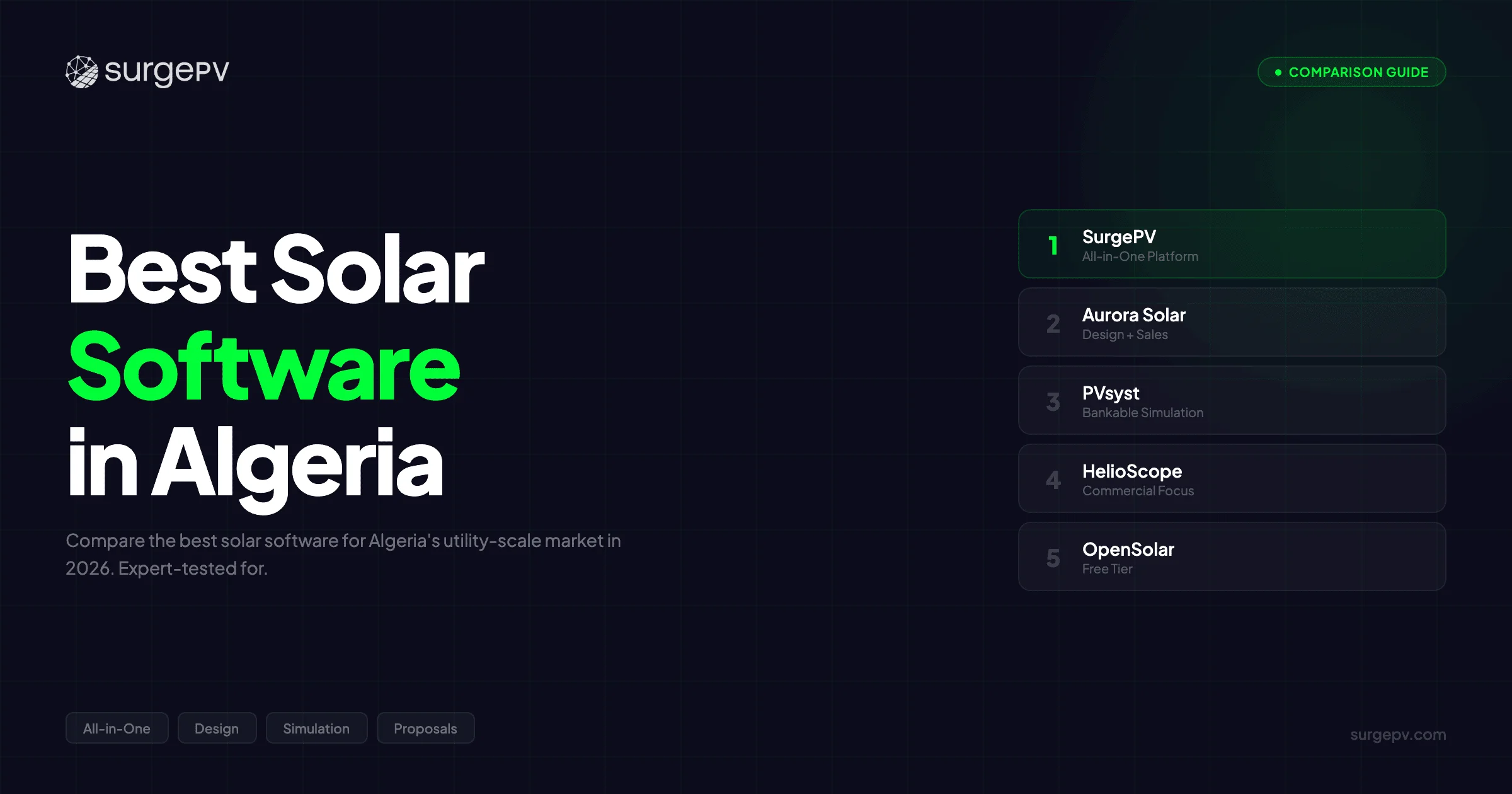
TL;DR: SurgePV is the strongest all-in-one platform for Algeria’s utility-scale market — automated IEC SLDs for Sonelgaz, P50/P90 bankability at ±3% vs PVsyst, single and dual-axis tracker support, and 35% local content tracking in one cloud workflow. PVsyst remains the gold standard for simulation bankability when international financiers mandate it. HelioScope handles commercial rooftop design well. Aurora Solar and OpenSolar are poor fits for Algeria’s utility-scale reality.
Algeria receives more solar energy per square meter than almost any country on earth. Southern regions near Tamanrasset hit 2,200 kWh/m²/year. The deep Sahara at Tassili n’Ajjer reaches 3,200 kWh/m²/year — among the highest irradiance levels on the planet.
The government knows this. The National Renewable Energy Program targets 15,000 MW renewable capacity by 2035, with over 9,000 MW from solar PV. Sonelgaz has launched over 2 GW in utility-scale tenders. 400 MW was commissioned in 2025 alone. International EPCs are circling.
But here’s what most solar software vendors don’t understand about Algeria: this isn’t a residential market. There’s no mass homeowner adoption wave. Algeria’s solar buildout is utility-scale — 50 MW, 100 MW, 300 MW Sonelgaz tender projects in the Sahara desert. The software requirements are fundamentally different from what works in Germany or California.
Your software needs to handle IEC-compliant single line diagram generation for Sonelgaz grid interconnection. Single and dual-axis tracker design for maximizing Sahara irradiance (15–35% production gain). P50/P90 bankability reports for international project financing. 35% local content tracking per Law No. 16-09. Sahara-specific soiling and temperature degradation modeling. And professional tender documentation that competes with submissions from global EPCs.
Most solar design tools was built for US residential rooftops. Using residential tools for Algerian utility-scale tenders is like bringing a screwdriver to a construction site.
In this guide, you’ll learn:
- Which platforms handle 50–300 MW Sonelgaz tender projects end-to-end
- How automated IEC SLD generation eliminates AutoCAD dependency
- Which tools accurately model Sahara irradiance (1,700–2,650 kWh/m²/year)
- How to track 35% local content compliance automatically
- How 3-year cost of ownership is structured, and which vendors publish list prices
Quick Summary: Our Top Picks for Algeria
After evaluating 5 solar platforms for Algeria’s market requirements, here are our top recommendations:
- SurgePV — Complete design-to-tender platform with IEC SLDs, bankable simulations, tracker support, and professional proposals. Best for Sonelgaz utility-scale tenders and commercial projects.
- Aurora Solar — AI-powered residential design with strong proposals. Best for residential markets only — limited utility-scale capability for Algeria.
- PVsyst — Industry-standard bankable simulation engine. Best for bankability validation when international financiers mandate PVsyst reports.
- HelioScope — Cloud-based commercial design with accurate simulation. Best for commercial rooftop projects in Algiers, Oran, and Constantine.
- OpenSolar — Free design and proposal platform. Best for small residential installations only — not for Sonelgaz tenders.
Each tool evaluated on Algeria-specific criteria: utility-scale capability, IEC electrical compliance, Sahara climate modeling, bankability for international financing, local content tracking, and total cost of ownership.
Comparison Table: Solar Software for Algeria
| Feature | SurgePV | Aurora Solar | PVsyst | HelioScope | OpenSolar |
|---|---|---|---|---|---|
| Design + Layout | Yes (AI + utility) | Yes (residential) | No | Yes | Yes (basic) |
| Utility-Scale (50–300 MW) | Full support | No | Simulation only | Yes | No |
| Tracker Support | Single/dual-axis | No | Simulation only | Yes | No |
| IEC SLD Generation | Automatic (5–10 min) | No (needs AutoCAD) | No | No | No |
| P50/P90 Bankability | Yes | P50 only | Yes (gold standard) | Yes | No |
| Sahara Climate | 1,700–2,650 kWh/m² | Generic | Validated | Good | Generic |
| Soiling/Dust Modeling | Yes | No | Yes (detailed) | Basic | No |
| 35% Local Content | Automated tracking | No | No | No | No |
| Proposals | Professional tender | Residential | No | Basic | Basic |
| Financial Modeling | Algerian FiT | US rates | No (simulation) | US rates | Basic |
| Cloud Collaboration | Yes | Yes | No (desktop) | Yes | Yes |
| Pricing (3-year TCO) | EUR 5,250 | Not published | Not published | Not published | Free, plus AutoCAD licensed separately |
| AutoCAD Required | No | Yes (for SLD) | N/A (no design) | Yes (for SLD) | Yes (for SLD) |
| Algeria Market Fit | Very Strong | Low | Very Strong (sim) | Strong | Low |
Further Reading
For a broader comparison beyond this market, see our guide to the best solar design software globally.
Best Solar Software in Algeria (Detailed Reviews)
Pro Tip
For Algerian utility-scale projects, always model tracker scenarios first. Single-axis trackers deliver 15–25% production gains in Sahara conditions. On a 200 MW project at $0.10/kWh feed-in tariff over 20 years, that’s $126–210 million in additional revenue. Software that doesn’t support trackers disqualifies itself from Algeria’s most valuable projects.
SurgePV — Best All-in-One Solar Platform for Algeria
Best For: Utility-scale EPCs bidding Sonelgaz tenders (50–300 MW), commercial solar EPCs in Algiers/Oran/Constantine, international developers entering Algeria, engineering consultants preparing project documentation
Pricing: $1,899/year (3 users) — approximately EUR 1,750/year
SurgePV is the only cloud-based platform combining AI-powered design, automated IEC-compliant electrical engineering, bankable simulations, and professional proposal generation in a single workflow. For Algeria’s utility-scale market, this integration isn’t a convenience — it’s a competitive necessity.
When you’re bidding a 150 MW Sonelgaz tender in Touggourt, you can’t afford weeks of manual document compilation from four separate tools. SurgePV lets you design the ground-mount tracker array, generate IEC-compliant SLDs, run 8760-hour shading analysis with Sahara irradiance data, model 20-year economics at Algerian feed-in tariff rates, and produce professional tender documentation — in days, not weeks.
Design and Engineering
SurgePV handles the array configurations Algeria’s utility-scale market demands:
- Ground-mount layout optimization for 50–300 MW Sahara projects
- Single and dual-axis tracker support with backtracking algorithms (15–35% production gain)
- East-West racking for 20–40% higher density on constrained sites
- Carport solar design with native carport capabilities — relevant for Algeria’s growing commercial sector
- AI-powered roof modeling for commercial buildings in Algiers, Oran, and Constantine
For utility-scale Sahara projects, tracker design is mission-critical. A 200 MW fixed-tilt array in Ouargla (2,100 kWh/m²/year) produces approximately 420 GWh annually. Add single-axis trackers and production jumps 15–25% to 483–525 GWh. At $0.10/kWh feed-in tariff over 20 years, tracker optimization is worth $126–210 million.
Electrical Engineering (Critical for Sonelgaz)
Here’s where SurgePV makes the difference for Algerian EPCs.
Single Line Diagram generation is automated. Complete your design, click generate, and within 5–10 minutes you have an IEC-compliant electrical schematic showing DC arrays, combiners, disconnects, inverters, AC wiring, breakers, and grid interconnection details. That SLD is ready for Sonelgaz submission.
The alternative? Every other platform — Aurora, HelioScope, PVsyst, OpenSolar — requires you to export your design, purchase AutoCAD (licensed separately by Autodesk), and spend 2–3 hours manually drafting each SLD. For an EPC bidding 10–20 Sonelgaz tenders annually, that’s 20–60 hours of engineering time, plus a separate Autodesk licence.
Wire sizing calculations handle long cable runs typical of Sahara utility-scale projects. DC and AC wire gauges based on current, distance, voltage drop limits (under 2% optimal, 3% maximum), and temperature correction factors — critical for extreme desert temperatures exceeding 50°C ambient.
IEC SLD generation isn’t just a feature — it’s the gatekeeping requirement for Sonelgaz grid connection approval. Without compliant SLDs, your tender gets rejected regardless of how good your design or financials are. SurgePV removes that bottleneck entirely.
Simulation and Bankability
International lenders evaluating Algerian utility-scale projects demand conservative, credible production forecasts. Overestimate by 5% on a 200 MW project and you’ve overpromised tens of millions in revenue over 20 years. That kills financing.
SurgePV’s simulation achieves ±3% accuracy compared to PVsyst — the industry gold standard. P50/P75/P90 bankability metrics give international financiers the data they require. P50 for median expected production. P90 for conservative worst-case that banks use for debt sizing.
Sahara-specific modeling includes: extreme irradiance handling (1,700–2,650 kWh/m²/year), soiling and dust loss estimation (3–5% annual production impact), temperature degradation for desert conditions (panel temperatures exceeding 70°C), and 25-year degradation projections with desert-specific curves.
Financial Modeling for the Algerian Market
SurgePV models Algeria-specific economics:
- Feed-in tariff rates: $0.0945–0.1179/kWh (12.75–15.94 DZD/kWh) guaranteed 20 years
- LCOE calculations at Sahara irradiance levels
- NPV, IRR, and payback period with international financing assumptions
- Tracker production gain economics (15–35% revenue increase)
- Currency modeling for international investors (DZD/EUR/USD)
- Project timeline financials for Sonelgaz interconnection schedules
35% Local Content Compliance
Algeria’s Law No. 16-09 requires 35% local manufacturing content. SurgePV’s 70,000+ module database allows filtering by manufacturer origin. Tag Algerian local content components, track compliance percentages automatically, and export documentation for Sonelgaz tender submissions. The alternative is manual spreadsheet tracking — error-prone under tight tender deadlines.
Cloud Collaboration for Distributed Teams
Engineering in Algiers. Site management in Ouargla. Financial consultants in Paris. SurgePV’s browser-based platform lets all team members collaborate simultaneously with real-time updates and version control. Desktop-only tools (PVsyst, PVCase) limit this to one-user-at-a-time file sharing.
Real-World Example
An international EPC bidding the Tamacine 150 MW Sonelgaz tender previously assembled documentation from PVsyst (simulation), AutoCAD (SLDs), Excel (financials), and InDesign (presentation). Total: 3 weeks, 4 team members. With SurgePV, the same tender package was ready in 5 days with 2 team members. The design, IEC SLDs, P50/P90 bankability, financial modeling, and professional proposal all came from one platform.
Further Reading
See our best solar software comparison for global rankings.
Pros and Cons
Pros:
- Only cloud platform with automated IEC-compliant SLD generation (Sonelgaz requirement)
- Utility-scale capabilities: trackers, 50–300 MW projects, ground-mount optimization
- Bankable simulation accuracy: ±3% vs PVsyst, P50/P75/P90 reports
- Sahara climate modeling (1,700–2,650 kWh/m²/year irradiance, soiling, temperature)
- 35% local content database tracking (70,000+ modules)
- Cloud collaboration for remote Sahara project teams
- Professional tender documentation in one workflow
- Published pricing: approximately EUR 1,750/year (3 users, all features)
- No AutoCAD required: no separate Autodesk licence to buy or renew
- 2–3 week onboarding (vs 8–12 weeks PVsyst, 10–14 weeks PVCase)
Cons:
- English-only interface (no French or Arabic — most Algerian engineers work in English)
- Newer in the Algerian market compared to PVsyst’s 20+ year track record
- Some international financiers may require PVsyst supplement for 100+ MW projects
Pricing
| Plan | Price | Users |
|---|---|---|
| Individual | $1,899/year | 3 users |
| 3-User Plan | $4,497/year | 3 users ($1,499/user/year) |
| Includes | All features — design, SLD, simulation, proposals, financial modeling | — |
No AutoCAD required, so there is no separate Autodesk licence to buy or renew.
Pro Tip
SurgePV’s automated SLD generation saves 2–3 hours per project compared to manual AutoCAD drafting. For Algeria EPCs handling 10+ projects per month, that’s 20–30 hours recovered. Book a demo to see it in action.
Cost structure comparison:
- SurgePV: EUR 5,250 (complete workflow)
- PVsyst plus AutoCAD: neither vendor publishes list pricing (simulation + SLD only, no design/proposals)
- HelioScope plus AutoCAD: HelioScope publishes $1,620/yr per Basic licence and $2,640/yr per Pro licence, and AutoCAD is licensed separately by Autodesk (no SLD generation)
- PVcase plus AutoCAD: neither vendor publishes list pricing (CAD-dependent)
- Aurora plus AutoCAD: Aurora publishes $1,620/user/yr for Basic and $2,640/user/yr for Premium, both billed annually, and AutoCAD is licensed separately by Autodesk
Aurora Solar — Strong Residential Design, Poor Algeria Fit
Best For: Residential solar installations in Algerian cities only
Pricing: Aurora Solar publishes list pricing of “$135 user/mo, billed annually” for Basic and “$220 user/mo, billed annually” for Premium, with Enterprise quoted as “Custom per project” (aurorasolar.com/pricing, checked 21 September 2026).
Aurora Solar dominates US residential solar sales with industry-best AI roof detection, 3D modeling, and polished homeowner proposals. For residential markets, it’s excellent.
Key Strengths: AI-powered roof modeling (industry-leading for residential). Beautiful interactive proposals. Strong CRM integrations. Cloud-based access and fast residential quote turnaround.
Where Aurora Falls Short for Algeria:
No utility-scale capabilities — designed for US residential, not 50–300 MW Sonelgaz projects. No IEC-compliant SLD generation (critical Sonelgaz gap). No tracker support (eliminates 15–35% Sahara production potential). No Algerian financial modeling (no DZD, no feed-in tariff rates). Only P50 production estimates — no P90 for international bankability. No 35% local content tracking. No Sahara climate optimization. Expensive per-user pricing uncompetitive for price-sensitive Algerian tenders.
“But Aurora is the market leader — shouldn’t it work anywhere?” Aurora leads the US residential market. Algeria’s market is fundamentally different — utility-scale Sonelgaz tenders, not homeowner rooftops. Market leadership in one segment doesn’t transfer to another.
Not recommended for Sonelgaz utility-scale tenders. Read our full Aurora Solar review.
Did You Know?
Algeria’s solar irradiance ranges from 1,700–2,200 kWh/m²/year, making accurate simulation software essential for bankable energy yield predictions. Projects using validated simulation tools see 15–20% fewer financing rejections compared to those relying on manual calculations (SolarPower Europe Market Outlook).
PVsyst — Bankability Gold Standard, Simulation Only
Best For: Bankability validation when international financiers specifically mandate PVsyst reports
Pricing: PVsyst does not publish licence pricing on its own site; its shop is behind a login (pvsyst.com/shop, checked 21 September 2026).
PVsyst has been the solar industry’s simulation gold standard for over 20 years. When international banks evaluate a 200 MW Algerian project, they expect PVsyst validation.
Key Strengths: Industry-standard bankability (universal financier acceptance). Comprehensive Algerian climate data (validated TMY datasets for major cities and Sahara regions). Detailed loss modeling — soiling, spectral mismatch, temperature degradation, clipping. Excellent tracker simulation with backtracking. P50/P90/P99 reports with confidence intervals. 25-year production projections.
Where PVsyst Falls Short for Algeria:
Simulation-only — no design tools, no layout optimization, no SLD generation. Requires AutoCAD (licensed separately by Autodesk) for Sonelgaz electrical documentation. Desktop-only (no cloud collaboration for remote Sahara teams). Steep learning curve (8–12 weeks for proficiency). No proposal generation. No financial modeling for tenders. A complete workflow therefore means a PVsyst licence plus a separate Autodesk licence, and neither vendor publishes list pricing.
Best approach: Many EPCs use PVsyst for simulation validation alongside SurgePV for complete design-to-tender workflow. Essential for projects above 100 MW seeking third-party international financing where PVsyst is non-negotiable. Read our full PVsyst review.
HelioScope — Cloud-Based Commercial Design, No Electrical
Best For: EPCs in the Aurora ecosystem needing cloud-based commercial design
Pricing: HelioScope publishes $159 per month, or $1,620 per year, for a Basic licence and $259 per month, or $2,640 per year, for a Pro licence, each including one user (helioscope.aurorasolar.com/pricing, checked 21 September 2026).
HelioScope (now owned by Aurora Solar) is a cloud-based design and simulation platform trusted by commercial EPCs and utility-scale developers worldwide. Its simulation accuracy and cloud collaboration make it relevant for Algerian commercial projects.
Key Strengths: Strong simulation accuracy (comparable to PVsyst for commercial/utility projects). Cloud-based team collaboration (valuable for remote Sahara site management). Tracker support for utility-scale. Good commercial design tools. Growing acceptance among international lenders.
Where HelioScope Falls Short for Algeria:
No IEC-compliant SLD generation, so Sonelgaz interconnection documentation needs AutoCAD, which is licensed separately by Autodesk. No proposal generation (engineering focus, not tender documentation). Enterprise terms are quoted by sales rather than listed. No 35% local content tracking. No Algerian financial modeling.
Best for: EPCs already in the Aurora Solar ecosystem who need cloud-based commercial design alongside separate tools for electrical documentation and tender proposals. Stronger for commercial rooftop projects in Algiers, Oran, and Constantine than for deep Sahara utility-scale. Read our full HelioScope review.
OpenSolar — Free Entry Point, Residential Only
Best For: Small residential installations in Algerian urban areas
Pricing: Free tier available
OpenSolar is a free solar design and proposal platform providing basic tools for residential installations. For Algeria’s utility-scale market, it lacks the capabilities needed.
Key Strengths: Free tier removes software cost barrier. Simple interface (1–2 week onboarding). Basic design and proposal tools. Adequate for simple residential projects.
Where OpenSolar Falls Short for Algeria:
No utility-scale capabilities (50–300 MW projects unsupported). No IEC SLD generation. No tracker support. No P50/P90 bankability reports. No Algerian financial modeling. No 35% local content tracking. No Sahara climate modeling. Residential-grade output doesn’t meet Sonelgaz tender documentation standards.
Not recommended for utility-scale Sonelgaz tenders or commercial projects requiring professional documentation. Read our full OpenSolar review.
Which Tool Is Right for Your Needs?
| Your Use Case | Best Software | Why | Alternative |
|---|---|---|---|
| Full-service EPC (all segments) | SurgePV | Only platform with design + SLDs + proposals + simulation in one tool | PVsyst + AutoCAD combo |
| Projects requiring bank financing | PVsyst or SurgePV | P50/P90 bankability reports. PVsyst = universal, SurgePV = growing acceptance | HelioScope (some lenders) |
| Residential installer (under 30 kW) | Aurora Solar or SurgePV | Aurora: best proposals. SurgePV: proposals + engineering depth | OpenSolar (free tier) |
| Utility-scale developer (over 1 MW) in Algeria | SurgePV or HelioScope | Fast ground-mount design. Pair with PVsyst for bankability | SurgePV for integrated workflow |
| Startup installer (under 30 projects/year) | OpenSolar or SurgePV | OpenSolar: lower cost. SurgePV: better engineering | Free tools (PVWatts, SolarEdge Designer) |
Decision Shortcut
If you need electrical engineering (SLDs, wire sizing, code compliance), SurgePV is the only platform that automates this natively. If you’re simulation-only, PVsyst is the gold standard. If you’re residential-focused with a large marketing budget, Aurora’s proposals are strong — but expensive and poorly suited to Algeria’s utility-scale reality.
Start Generating Professional Solar Tender Documentation
See how SurgePV creates IEC-compliant SLDs, bankable P50/P90 simulations, and complete Sonelgaz tender packages — design to proposal in one platform.
Book a DemoNo commitment required · 20 minutes · Live project walkthrough
What Makes the Best Solar Software for Algeria
Algeria’s solar market has fundamentally different requirements than European or North American markets. Six factors determine which software works:
1. Utility-Scale Capability (Most Important)
Algeria’s market is utility-scale dominant. Sonelgaz tenders are 50–300 MW. Your software must handle massive ground-mount arrays, tracker configurations, long cable run calculations, and multi-megawatt interconnection documentation. Residential tools designed for 5–10 kW rooftops cannot scale to 200 MW Sahara projects.
2. IEC Electrical Compliance
Sonelgaz requires IEC-compliant SLDs for grid interconnection. Without compliant electrical documentation, your grid connection application is rejected. Software with automated IEC SLD generation eliminates AutoCAD dependency and speeds Sonelgaz approval timelines.
3. Sahara Climate Modeling
Algeria’s irradiance ranges from 1,700 kWh/m²/year in the north to 2,650 kWh/m²/year in the deep Sahara. Soiling from desert dust reduces production 3–5% annually without cleaning. Extreme temperatures — ambient above 50°C, panel temperatures above 70°C — cause significant degradation. Your software must model these conditions accurately for credible bankability reports.
4. Bankability for International Financing
50+ MW projects require international bank financing. Banks evaluate P50/P90 production reports with conservative desert climate assumptions. P50 is median expected. P90 is worst-case for debt sizing. Software providing only optimistic P50 estimates fails financial due diligence.
5. 35% Local Content Tracking
Law No. 16-09 mandates local content compliance. Tender submissions must document which components meet the 35% threshold. Automated tracking from a 70,000+ module database prevents the manual errors that can disqualify tender submissions.
6. Competitive TCO for Price-Sensitive Tenders
Algerian utility-scale tenders are competitive. Every EUR in your operating cost feeds into your bid price. SurgePV’s 3-year cost for the complete workflow is approximately EUR 5,250. A fragmented alternative means separate licences from separate vendors on separate renewal dates, and because Autodesk and PVsyst do not publish list pricing, a comparable stack total cannot be sourced.
Note
CDER (Centre de Développement des Énergies Renouvelables) and CREG (Commission de Régulation de l’Électricité et du Gaz) are key Algerian institutions. CDER provides solar resource data. CREG regulates energy markets. Software that produces documentation referencing these institutions’ standards demonstrates local market understanding to Sonelgaz evaluators.
Algeria Solar Market Context
Algeria is positioning itself as North Africa’s solar leader.
The National Renewable Energy Program targets 15,000 MW renewable capacity by 2035, with 61.7% (over 9,000 MW) from solar PV. That represents 27% of Algeria’s electricity from renewables. Current installed capacity is growing rapidly — 400 MW was commissioned in 2025, with projections showing 47.9% CAGR from 2025–2030 (Mordor Intelligence).
Sonelgaz is the engine driving this buildout. The state-owned utility controls all grid connections and is launching over 2 GW in tenders under the Tafouk 1 program. Active projects include Kenadsa (50 MW), Touggourt (100 MW), and Tamacine (150 MW). Sonelgaz is simultaneously investing $5 billion in 10,000 km of new high-voltage transmission lines connecting remote Sahara regions to the national grid.
The regulatory framework includes CREG (energy regulator), guaranteed feed-in tariffs ($0.0945–0.1179/kWh for 20 years), and Law No. 16-09 requiring 35% local content. International EPC competition is intensifying as foreign investor access expands.
Algeria’s Sahara represents extraordinary solar potential. Irradiance of 1,700–2,650 kWh/m²/year dwarfs European averages (900–1,500 kWh/m²/year). But Sahara conditions also create unique challenges: extreme heat, dust soiling (3–5% annual production loss), remote site logistics, and limited grid infrastructure in southern regions.
Emerging opportunities include green hydrogen production using Sahara solar-to-hydrogen conversion, solar-to-Europe export via HVDC interconnections, and utility-scale battery storage integration. These next-generation projects will further increase demand for professional solar software with advanced modeling capabilities.
For solar installers and EPCs entering Algeria, software choice determines competitive positioning in one of North Africa’s largest and fastest-growing solar markets.
| Algeria Solar Market Stats | Value |
|---|---|
| National renewable capacity target (2035) | 15,000 MW |
| Solar PV target share | Over 9,000 MW |
| MW commissioned in 2025 | 400 MW |
| Projected CAGR 2025–2030 | 47.9% |
| Sonelgaz active tender pipeline | 2+ GW |
| Feed-in tariff (guaranteed 20 years) | $0.0945–0.1179/kWh |
| Sahara irradiance range | 1,700–2,650 kWh/m²/year |
Our Review Method Methodology
We evaluated 5 solar platforms against Algeria’s market requirements using a 200 MWp reference project.
example project: 200 MWp single-axis tracker project in Ouargla (2,100 kWh/m²/year)
What we reviewed on each platform:
- Complete design-to-tender workflow
- Production estimates validated against PVsyst benchmark
- IEC-compliant SLD generation capability
- 35% local content tracking features
- Sahara climate modeling (soiling, temperature, degradation)
- 3-year total cost of ownership including all required add-ons
Research reference period: November 2025 through February 2026
| Criteria | Weight | What We Reviewed |
|---|---|---|
| Utility-Scale Capability | 25% | 50–300 MW projects, trackers, ground-mount |
| Electrical Engineering | 20% | IEC SLD generation, wire sizing, Sonelgaz compliance |
| Bankability and Accuracy | 20% | P50/P90 vs PVsyst, Sahara irradiance modeling |
| Local Content Compliance | 15% | 35% tracking, module database, reporting |
| Pricing and Value | 10% | 3-year TCO, AutoCAD dependency |
| Sahara Climate Modeling | 10% | Soiling, temperature, degradation, extreme irradiance |
Scores: SurgePV 9.0/10, PVsyst 8.2/10 (simulation), HelioScope 7.5/10, Aurora 5.5/10 (poor fit), OpenSolar 5.0/10 (limited capability).
Transparency Note
SurgePV publishes this content. We are transparent about this relationship. PVsyst remains the gold standard for bankable simulation, and we recommend it without reservation when international financiers mandate it. We present SurgePV as the strongest all-in-one operational platform for Algeria’s design-to-tender workflow. See our editorial standards.
Bottom Line: Best Solar Software for Algeria
Algeria’s 15,000 MW renewable target by 2035 requires solar design suite that matches the market’s utility-scale reality. Most EPCs today juggle 3–5 tools: design software, AutoCAD for IEC SLDs, PVsyst for bankability, Excel for financials, and presentation software for tender documents. This fragmented approach takes weeks to compile each tender submission, and it means separate licences from separate vendors on separate renewal dates.
SurgePV consolidates the complete workflow — design, IEC electrical documentation, bankable simulation, financial modeling, and professional tender proposals — into one cloud platform at EUR 5,250 over three years, which replaces several separate subscriptions and renewal dates with one.
Our Recommendations:
- For Sonelgaz utility-scale tenders (50–300 MW): SurgePV. Complete design-to-tender workflow with automated IEC SLDs, P50/P90 bankability, tracker support, and lowest TCO.
- For bankability validation: PVsyst alongside SurgePV when specific international financiers mandate PVsyst reports. Use SurgePV for the design-to-tender workflow and PVsyst as a bankability supplement.
- For commercial rooftop projects: SurgePV for complete workflow, or HelioScope for cloud collaboration if you already have AutoCAD for electrical documentation.
- For residential projects in Algerian cities: OpenSolar (free, basic) or SurgePV (professional, engineering-grade).
- Not recommended for Algeria: Aurora Solar — US residential focus doesn’t match Algeria’s utility-scale market reality.
Book a personalized demo to see how SurgePV handles Algeria’s utility-scale requirements — IEC SLD generation for Sonelgaz, tracker design for Sahara optimization, P50/P90 bankability for international financing, and professional tender documentation — in one integrated platform.
Go deeper on a specific category
This page compares solar software across categories for Algeria. If you already know which part of the workflow you are buying for, these go into more detail:
Frequently Asked Questions
What is the best solar software in Algeria?
SurgePV is the best all-in-one solar software for Algeria, combining utility-scale design (50–300 MW), automated IEC-compliant SLD generation for Sonelgaz grid connection, bankable P50/P90 simulations, tracker support for Sahara optimization (15–35% production gain), and professional tender documentation in one cloud platform. For bankability validation specifically, PVsyst remains the industry gold standard that international financiers trust. Many EPCs use both: SurgePV for workflow and PVsyst as a bankability supplement.
Do I need specific software for Sonelgaz tenders?
Sonelgaz tenders require IEC-compliant electrical documentation (SLDs), bankable energy production reports (P50/P90), detailed technical specifications, financial modeling, and 35% local content compliance. SurgePV automates IEC SLD generation and produces complete tender documentation. Other platforms — Aurora, HelioScope, OpenSolar — require AutoCAD (licensed separately by Autodesk) for SLDs plus separate tools for proposals and financials.
Is PVsyst required for Algerian solar projects?
For 50+ MW projects with international financing, PVsyst reports are often expected by lenders (20-year industry gold standard). However, SurgePV’s ±3% accuracy compared to PVsyst is sufficient for most Sonelgaz tenders in the 50–300 MW range. Use SurgePV for complete design-to-tender workflow. Supplement with PVsyst only if your specific financier mandates it — common for projects above 100 MW.
How does software handle Sahara desert conditions?
SurgePV models Sahara-specific conditions: extreme irradiance (1,700–2,650 kWh/m²/year), soiling and dust losses (3–5% annual production impact without cleaning), extreme temperature degradation (panel temperatures exceeding 70°C), tracker production optimization (15–35% gain), and 25-year degradation with desert-specific curves. PVsyst provides similar Sahara modeling for simulation-only workflows. Generic tools (Aurora, OpenSolar) lack desert-specific modeling.
Can software track Algeria’s 35% local content requirement?
SurgePV’s 70,000+ module database allows filtering by manufacturer origin to meet the 35% local content mandate under Law No. 16-09. Compliance tracking is automated and included in tender documentation. Other platforms require manual spreadsheet tracking — error-prone during competitive tender deadlines where one calculation mistake can disqualify your submission.
How much does solar software cost for Algerian EPCs?
SurgePV’s 3-year cost for the complete workflow is approximately EUR 5,250. A comparable competitor stack total cannot be sourced, because Autodesk does not publish verifiable AutoCAD pricing and PVsyst does not publish licence pricing. Most platforms require AutoCAD (licensed separately by Autodesk) for Sonelgaz IEC SLD requirements. SurgePV eliminates that dependency, so design, electrical documentation, simulation and proposals sit in one subscription rather than several.
What about French or Arabic language support?
Most professional solar platforms are English-language: SurgePV, PVsyst, HelioScope, Aurora, OpenSolar. Algerian engineers typically work in English (international engineering standard). Design outputs and reports can include French or Arabic text for Sonelgaz submissions regardless of interface language. This is an industry-wide limitation across all platforms.
Which software supports solar trackers for Sahara projects?
SurgePV, PVsyst, HelioScope, and PVCase support single and dual-axis trackers. Aurora Solar and OpenSolar do not support trackers — disqualifying them for Algerian utility-scale projects where trackers deliver 15–35% production gains in high-irradiance Sahara conditions. At $0.10/kWh feed-in tariff over 20 years, tracker optimization on a 200 MW project is worth $126–210 million in additional revenue.
Further Reading
For design tool comparison: Best Solar Design Software. For proposal tools: Best Solar Proposal Software. For PVsyst deep-dive: PVsyst Review.
Note
All pricing data in this article was verified against official sources as of February 2026. Prices may have changed since publication.
Vendor source links
Vendor pages checked 29 September 2026. Pricing, billing terms and license scope can vary by offer and region; confirm the current terms with the vendor.
