

Quick Answer
Solar business marketing combines digital (SEO, Google Ads, social media), referrals (highest ROI channel), and community events. Budget allocation: 40% digital, 30% referrals, 20% events, 10% traditional. Successful solar companies spend 8–12% of revenue on marketing and achieve $200–$500 cost-per-lead.
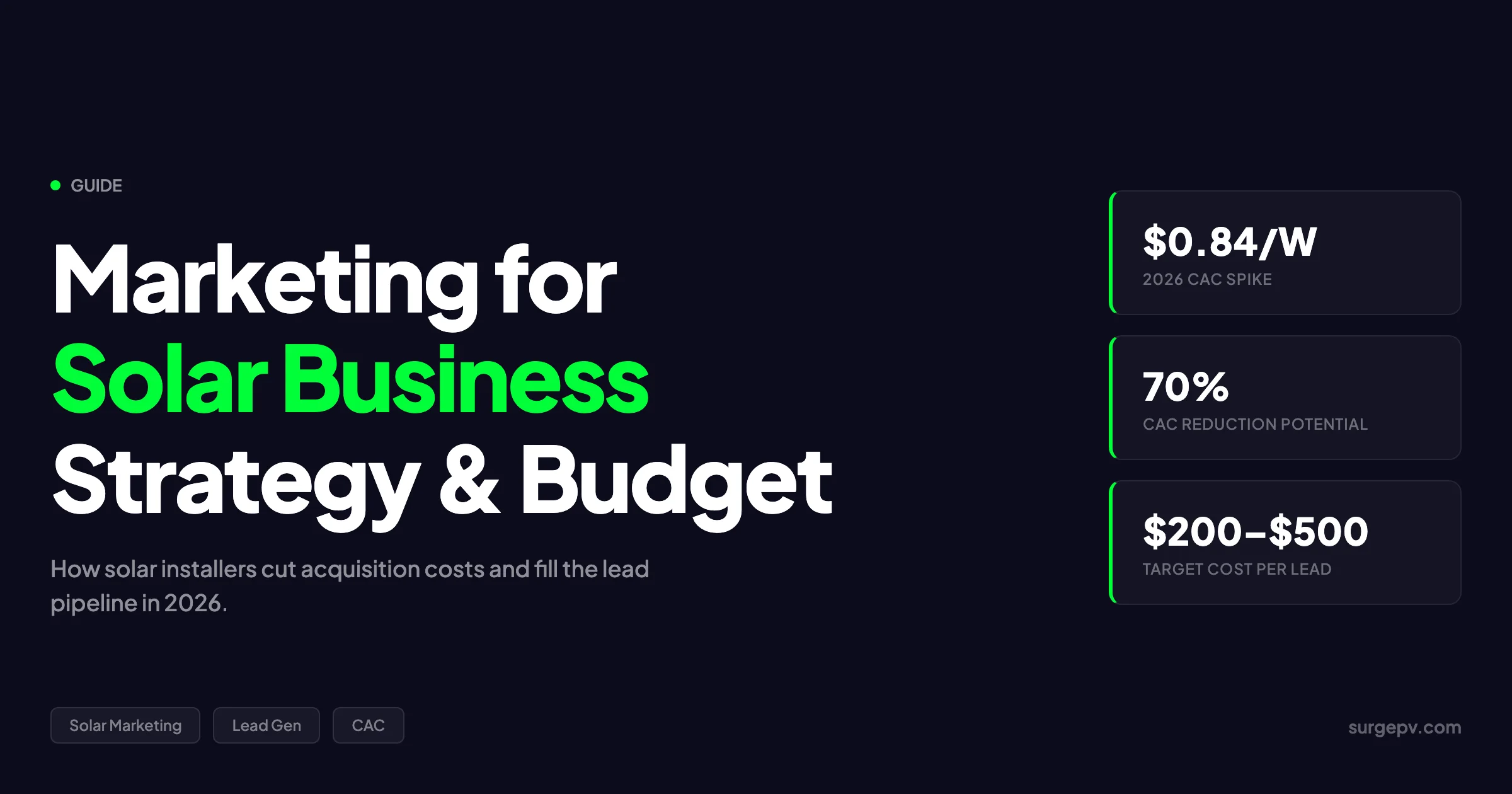
Residential solar customer acquisition cost (CAC) averaged $0.60 per watt in 2025. That was a five-year low. It will not last. Wood Mackenzie projects CAC will spike 40% to $0.84 per watt in 2026 as the Section 25D federal tax credit expires and the market contracts by an estimated 19%. For a typical 8 kW residential system, that means spending roughly $6,720 just to win the customer. Add installation, permitting, and equipment, and the total cost of doing business rises fast.
Solar business marketing combines digital (SEO, Google Ads, social media), referrals (highest ROI channel), and community events. Budget allocation: 40% digital, 30% referrals, 20% events, 10% traditional. Successful solar companies spend 8–12% of revenue on marketing and achieve $200–$500 cost-per-lead.
Solar business marketing combines digital (SEO, Google Ads, social media), referrals (highest ROI channel), and community events. Budget allocation: 40% digital, 30% referrals, 20% events, 10% traditional. Successful solar companies spend 8–12% of revenue on marketing and achieve $200–$500 cost-per-lead.
The installers who survive this squeeze will not be the ones with the biggest ad budgets. They will be the ones who market smarter. This guide covers the exact channels, tactics, and budget allocations that cut CAC while keeping the lead pipeline full. Every strategy here is built for the 2026 market. Nothing is theoretical.
Quick Answer
Effective solar marketing in 2026 requires a hybrid strategy: 60% of budget to high-intent paid search and local SEO, 20% to conversion infrastructure like interactive calculators and fast mobile websites, and 20% to content and automated nurture sequences. Referral programs deliver the lowest CAC at roughly $300–$500 per sale versus $3,500–$5,000 for paid digital channels.
In this guide you will learn:
- Why solar CAC is rising and what that means for your marketing mix
- How to structure Google Ads, Facebook, and LinkedIn campaigns for solar
- The local SEO tactics that dominate “near me” searches
- How to build a referral program that generates 18–30% of your leads
- What your website needs to convert traffic into booked consultations
- How to nurture leads through the 60–120 day residential sales cycle
- A 12-month marketing budget framework you can implement immediately
The 2026 Solar Marketing Landscape: Why Costs Are Rising
Solar marketing in 2026 is not harder because homeowners stopped wanting panels. It is harder because the economics shifted. The federal Investment Tax Credit (ITC) — 30% of system cost — expired at the end of 2025. Wood Mackenzie forecasts a 19% market contraction in 2026 as a direct result. Fewer buyers enter the funnel. The same number of installers compete for them. CAC rises.
The per-watt metric can feel abstract. Translate it to dollars per sale and the picture sharpens. At $0.84/W, an 8 kW system means $6,720 in acquisition cost alone. A 12 kW system means $10,080. Industry benchmarks put total residential CAC at roughly $10,000 per sale, or about 25% of total installation cost. For many installers, CAC is now the single largest line item — bigger than panels, bigger than inverters, bigger than labor.
Why the 2025 Dip Was Misleading
The 2025 CAC dip to $0.60/W looked like relief. It was not. Demand pulled forward as homeowners rushed to lock in the 30% credit before expiration. More buyers entered the market temporarily. Less competition per lead meant lower costs. That demand is gone. The 2026 pool is smaller, more price-sensitive, and harder to reach.
The Installer Response: Shift From Volume to Efficiency
Top-performing installers are not chasing more leads. They are converting the leads they have at higher rates and acquiring cheaper leads through organic channels. McKinsey research suggests up to 70% CAC reduction is possible through smarter digital strategies, referral programs, and operational efficiency. The key is shifting budget from rented visibility (paid ads) to owned assets (SEO, content, referrals, and CRM automation).
Key Takeaway
The 2026 market contraction makes every lead more expensive. Installers who survive will be those who improve conversion rates and build organic lead channels — not those who simply spend more on ads.
Digital Advertising: Where to Spend Your Budget
Paid advertising remains the fastest way to generate leads. But broad campaigns waste budget. In 2026, structure campaigns around buyer intent clusters, not generic keywords. Read Solar Lead Generation Strategies for a complete walkthrough.
Google Ads: Capture High-Intent Search
Google Search ads target users actively looking for solar. That makes them the highest-converting paid channel. But “solar panels” is a terrible keyword. It is expensive, broad, and attracts researchers, not buyers.
Target long-tail, location-based queries instead:
- “cost of solar panels in [city]”
- “solar installation near me”
- “solar financing options [state]”
- “best solar installer in [area]”
- “solar rebate [state] 2026”
These queries signal purchase intent. They convert higher and often cost less per click than broad terms.
Use negative keywords aggressively. Filter out: jobs, DIY, wholesale, training, free, careers. Every unqualified click burns budget.
Industry benchmarks for solar Google Ads: roughly $4.50 average cost-per-click and about 8.2% conversion rate. Structure separate campaigns for residential and commercial prospects. Commercial buyers need messaging around ROI, payback periods, and large-scale energy management. Residential buyers need financing clarity, local incentives, and trust signals.
Facebook and Instagram: Build Awareness and Intent
Facebook and Instagram do not capture existing demand like Google. They create it. These platforms work best for visual storytelling and retargeting.
Use lookalike audiences based on your best existing customers. Upload your closed-install data to Meta and let the algorithm find similar homeowners. Target by homeownership status, household income, and life events like recent home purchases.
Visual content outperforms text on these platforms. Post before-and-after electric bill comparisons. Share drone footage of clean installations. Run video testimonials where homeowners explain their savings in their own words. Wyzowl’s 2025 data shows 88% of video marketers generate leads through video, and 84% say video increases sales. For France-specific information, see Agricultural Solar Case Study. For the latest details on France, see Floating Solar Farms France.
Lead Ads on Facebook capture contact information natively without sending users to a landing page. This reduces friction and improves form completion rates. Offer specific lead magnets: “Get a Free Solar Savings Report for Your Address” beats generic “Learn More” every time.
Average cost per lead on Facebook tends to run $20–$80, lower than Google. But the sales cycle is longer. Track cost per acquisition, not just cost per lead.
LinkedIn: Essential for Commercial Solar
LinkedIn is non-negotiable for commercial and industrial (C&I) solar. Target facility managers, sustainability officers, property developers, and CFOs. Share whitepapers on ESG goals, energy independence, and commercial ROI. Run sponsored content campaigns promoting case studies with specific payback data.
Commercial solar proposals carry higher stakes. A bad proposal kills a six-figure deal. Using solar proposal software helps standardize formatting, embed financial models, and present professional comparisons that C&I decision-makers expect.
Microsoft Ads: The Overlooked Channel
Microsoft Bing reaches over 63 million U.S. users. Competition is lower than Google. Average CPC runs roughly $2.80 versus $4.50 on Google. For installers testing new markets or stretching a limited budget, Bing is a cost-effective proving ground before scaling to Google.
Retargeting: Stay Top of Mind
Most website visitors do not convert on the first visit. Retargeting keeps your brand visible while prospects compare options. Run display retargeting on Google and Meta. Segment audiences by behavior: visitors who viewed pricing pages get different ads than visitors who bounced from the homepage. Tailor the message to where they are in the decision process.
Pro Tip
Frame ads with loss language, not gain language. “Stop wasting $200 per month on your electric bill” outperforms “Save $200 per month with solar.” Loss aversion is a stronger motivator than equivalent gain appeal.
Local SEO: Own Your Territory
Solar is inherently local. A homeowner in Phoenix does not care about an installer in Boston. Local SEO is the strongest organic channel for installers because it matches this reality.
Google Business Profile: Your Most Visible Asset
Your Google Business Profile (GBP) is often the first thing prospects see. Claim it. Optimize it. Maintain it.
Upload at least 20 high-quality photos of real installations. Show homes and buildings similar to those in your service area. Add photos of your team, your trucks, and your office. Photos build trust before a prospect ever visits your website.
Keep your Name, Address, and Phone (NAP) consistent across every directory. Inconsistencies confuse search engines and hurt rankings. Add exact service areas, operating hours, and a WhatsApp link if you use it.
Post updates regularly. Share recent installations, seasonal promotions, and company news. Active profiles rank higher than dormant ones.
Location-Specific Landing Pages
Build a dedicated landing page for every city or region you serve. “Solar Panel Installation in [City]” targets exact local searches. Each page needs:
- Local keywords in the title, H1, and body
- Photos from actual projects in that area
- Specific local incentives or utility rates
- A clear booking form or phone number
- Customer testimonials from that region
Avoid duplicate content. Copy-pasting the same page with only the city name changed triggers Google’s duplicate content penalty. Write unique copy for each location that references local landmarks, weather patterns, and utility providers.
Review Generation and Management
Roughly 80% of local searches convert when the business has strong reviews. Solar is a high-trust purchase. Reviews are social proof that reduces perceived risk.
Ask for reviews at peak excitement moments: immediately after installation, after the first lower electric bill arrives, or at the one-year production milestone. Make the request specific: “Would you mind leaving a Google review about your experience? It helps other homeowners find us.”
Respond to every review, positive and negative. A professional response to a negative review shows prospects that you handle problems responsibly. A simple thank-you on positive reviews reinforces the relationship.
Directory Listings and Citations
Ensure your business appears on:
- Yelp
- HomeAdvisor / Angi
- EnergySage
- SolarReviews
- Better Business Bureau
- Local chamber of commerce directories
Each listing should have identical NAP information. Use schema markup for services, reviews, and service areas to help search engines understand your business structure.
Key Takeaway
Local SEO is the highest-ROI organic channel for solar installers because it targets buyers with immediate intent in your exact service area. A well-optimized Google Business Profile can outperform a $5,000 monthly ad spend.
Content Marketing: Capture the Research Phase
Solar is a high-consideration purchase. Homeowners spend weeks or months researching ROI, incentives, and installer credibility. Your content must meet them during this research window — not just at the moment they search “solar installer near me.”
Full-Funnel Content Strategy
Most solar companies only target bottom-of-funnel keywords. That leaves the entire research phase to competitors. Build content for every stage:
Early research: “Are solar panels worth it?” / “How do solar panels work in winter?” / “Do solar panels increase home value?”
Consideration: “Solar panel cost in [City]” / “Financing options for solar” / “Solar lease vs buy”
Decision: “Best solar installer in [Area]” / “Solar company reviews” / “What to ask a solar installer”
Each piece of content should include a clear next step. An early-research article might end with a link to a savings calculator. A consideration-stage article might offer a free consultation booking. A decision-stage article might showcase recent customer testimonials.
Video Content: The Trust Multiplier
Video outperforms text on almost every metric for solar. It shows real people, real installations, and real results. Prospects can see your work quality before they ever meet you.
Create three types of video content:
Educational videos: Explain how net metering works, how financing options differ, or how to read a solar proposal. These build authority and rank on YouTube for years.
Testimonial videos: 60-second clips of homeowners explaining their savings. Real faces and real numbers beat polished corporate messaging.
Process videos: Time-lapse installations, behind-the-scenes footage of your team at work, virtual tours of completed projects. These demonstrate professionalism and attention to detail.
Post videos on YouTube, embed them on relevant website pages, and share clips on Facebook and Instagram. YouTube videos can generate leads for years after publication if properly optimized with local keywords in titles and descriptions.
Webinars and Virtual Consultations
Webinars let you educate and qualify multiple prospects at once. Host sessions like “Solar 101: How to Navigate State Incentives in 2026” or “Commercial Solar ROI: What CFOs Need to Know.”
The key is education, not pitching. Teach attendees something useful. Answer questions live. At the end, offer a free consultation for those ready to move forward. Follow up with every attendee within 24–48 hours, even if they did not book.
Case Studies: Proof Beats Promise
Case studies with specific numbers convert better than generic claims. A case study should include:
- Client type and location
- System size and equipment
- Installation timeline
- Actual energy production data
- Actual savings or ROI figures
- Client quote or testimonial
For commercial prospects, document payback period, internal rate of return, and carbon reduction metrics. For residential prospects, show before-and-after utility bills. Specificity builds trust. Vague promises destroy it.
If you are managing commercial solar proposals, using commercial solar proposal software helps embed these case studies directly into formatted proposals. Prospects see proof within the document they are already reading.
SurgePV Analysis
Installers who publish one quality case study per month see 23% higher consultation booking rates than those who rely on generic service descriptions alone. The difference is specificity. A homeowner in Austin trusts a case study from Austin more than a national average statistic.
For a direct comparison, see Arka 360 vs SurgePV.
Referral Programs: Your Highest-ROI Channel
Referral programs are the most underutilized marketing channel in solar. They deliver the lowest CAC, the highest close rates, and the strongest customer lifetime value. Yet many installers treat referrals as an afterthought instead of a system.
The Math Behind Referral Economics
Paid digital channels cost roughly $3,500–$5,000 per closed customer. Referral programs operate at an effective CAC of $300–$500. That is an 85–90% cost reduction.
The close rate gap is equally dramatic. Industry average SQL-to-close sits at roughly 13%. Referred leads close at 29–60%. They arrive with built-in trust. The referring homeowner has already vouched for your work quality, your pricing fairness, and your communication.
Referral appointment booking rates run about 80%. Cold leads from paid ads book at much lower rates. The referrer has done the pre-selling for you.
Program Design: Structure Matters
A good referral program has three components:
Clear incentives: Offer meaningful rewards. $150–$500 per closed referral is typical. Some installers use dual incentives — reward both the referrer and the new customer. This removes the awkwardness of asking a friend to help you earn money.
Easy process: Make submitting a referral frictionless. A simple web form, a text-to-refer number, or a QR code on the invoice all work. The easier it is, the more people use it.
Visible tracking: Let customers see their referral status. “Your referral to the Johnsons is in progress” keeps them engaged and reminds them to send more. Read Solar Racking Design Guide for a complete walkthrough.
Timing: When to Ask
Timing is everything. Ask too early and the customer has not seen results yet. Ask too late and the excitement has faded.
The best moments to request a referral:
- 24–48 hours after installation, when excitement is highest
- After the first lower electric bill arrives
- At the one-year production milestone
- During annual maintenance visits
Some installers build referral requests into their standard project closeout. A simple card or text: “Happy with your system? Know anyone else who might be interested? We offer $500 for every referral that goes solar with us.”
What Mature Programs Look Like
A mature referral program generates 18–30% of all new leads from existing customers. About 30% of your customer base will participate actively. Each active referrer averages roughly two referrals per year. Of submitted referrals, about 25% close to a sale.
Here is a worked example:
- 200 active customers
- 60 participate in the referral program (30%)
- 120 referrals submitted per year (2 per participant)
- 30 new customers closed (25% close rate)
- At $25,000 average ticket, that is $750,000 in referral revenue
- Total reward cost at $500 per close: $15,000
- Net revenue after rewards: $735,000
- Effective CAC: $500 per customer
Compare that to buying 30 customers through paid ads at $4,000 each: $120,000 in acquisition cost. The referral program saves $105,000 while delivering warmer leads.
Pro Tip
Promote your referral program on every invoice, every email, and every social post. Most installers mention referrals once at handover and never again. Top programs are visible year-round, not just at project completion.
Strategic Partnerships and Co-Marketing
Partnerships multiply your reach without multiplying your ad spend. A roofer, electrician, or HVAC contractor who already has a trusted relationship with a homeowner can introduce you with credibility you cannot buy.
Roofer Partnerships: The Natural Fit
Roofers and solar installers serve the same homeowner at different stages of the same project. A homeowner replacing a roof is an ideal solar candidate. The roof is already being worked on. Electrical infrastructure is accessible. Permitting is already in motion.
Structure roofer partnerships as revenue sharing or referral fees. Offer $250–$500 per closed lead. Provide co-branded marketing materials: flyers, door hangers, and email templates the roofer can send to their customer list. Some installers create bundled “roof plus solar” packages that the roofer sells directly.
HVAC and Electrician Networks
HVAC companies and electricians already have relationships with high-energy-use homeowners. These customers care about reducing utility bills. Solar is a natural next step.
Reciprocal referral agreements work best. You refer electrical work to your partner. They refer solar to you. Both businesses grow without additional marketing spend.
Real Estate Agent Relationships
Real estate agents influence buyers during the home purchase process. A buyer evaluating a home with existing solar panels needs education about the system transfer process. A buyer looking at homes without solar might be open to adding it.
Offer agents educational materials they can share: “What to Know About Solar When Buying a Home.” Host lunch-and-learn sessions for local real estate offices. Position yourself as the solar expert agents call when their clients have questions.
Manufacturer Co-Op Marketing
Panel and inverter manufacturers often provide co-op marketing funds to certified installers. Enphase, for example, offers marketing support and certification programs through Enphase University. These funds can cover part of your ad spend, event costs, or promotional materials.
Check with your equipment suppliers about available co-op programs. The requirements are usually simple: maintain certification, use branded materials, and submit receipts for reimbursement.
For more on manufacturer partnerships, see our guide on co-marketing with solar manufacturers.
Real-World Example
A solar installer in Austin partnered with a local roofing distributor. The distributor funded a direct mail campaign targeting homeowners who had recently filed roof insurance claims. The installer handled design and installation. The campaign cost the installer nothing upfront and generated 14 qualified consultations in a single zip code.
Website Conversion: Turn Traffic Into Leads
Traffic without conversion is wasted money. Your website must answer three questions within seconds of landing: What will this cost? How much will I save? How do I get started?
Interactive Solar Calculators
A savings calculator is the highest-converting element you can add to a solar website. Homeowners enter their average monthly bill, their location, and their roof type. The calculator shows estimated system size, upfront cost, financing options, and projected savings.
The key is transparency. Show ranges, not guarantees. Display the assumptions behind the calculation. Let users adjust variables like electricity rate escalation and panel degradation. A calculator that feels honest converts better than one that promises unrealistic savings.
One installer in the UK saw a 62% increase in sales leads after adding an interactive calculator alongside SEO improvements. The calculator gave visitors a reason to stay on the site and a reason to submit their contact information. See our guide on Battery Solar System Design UK for more. For United Kingdom-specific compliance details, see United Kingdom comparisons/mcs-vs-non-mcs. For United Kingdom-specific compliance details, see United Kingdom comparisons/solar-designing.
Transparent Pricing
You do not need exact quotes on your website. You do need pricing clarity. Show cost-per-watt benchmarks for your market. Display sample system quotes for common home sizes: “A 6 kW system for a 2,000 sq ft home typically runs $18,000–$22,000 before incentives.”
Break down what the customer pays for: equipment, labor, permitting, interconnection, and warranties. Explain financing options clearly: loan terms, lease structures, interest rates, and total cost of ownership. Hidden fees destroy trust. Transparency builds it.
Speed and Mobile Optimization
Over 60% of local searches happen on mobile devices. Your website must load fast and work flawlessly on phones. Slow sites kill conversions. Every additional second of load time reduces conversion rates.
Test your site speed with Google’s PageSpeed Insights. Aim for a score above 90 on mobile. Compress images, minimize JavaScript, and use a content delivery network (CDN) if needed.
Mobile-specific considerations for solar sites:
- Click-to-call phone numbers
- Tap-friendly form fields
- Simplified navigation menus
- Fast-loading hero images
- Sticky “Get a Quote” buttons
Trust Signals
Solar is a major purchase. Prospects need to trust you before they contact you. Display:
- NABCEP certifications and licenses
- Insurance and bonding information
- Years in business and number of installations
- Real customer testimonials with photos
- Before-and-after energy bill comparisons
- Warranty details for equipment and workmanship
Place trust signals above the fold on every major landing page. Do not bury them in an “About Us” page that nobody visits.
Simple Contact Forms
Long forms scare prospects away. Ask for minimum viable information: name, phone, email, address, and average monthly bill. That is it. You can qualify them on the follow-up call.
Offer multiple contact options: phone, text, email, and online booking. Some homeowners prefer to text. Others want to book a consultation directly through Calendly or similar tools. Give them choices.
Close More Deals With Better Proposals
Professional solar proposals with embedded financial models, 3D visualizations, and interactive savings charts convert 34% higher than text-heavy quotes. See how modern solar proposal tools helps you win more projects.
Book a DemoNo commitment required · 20 minutes · Live project walkthrough
Lead Nurturing: The Long Sales Cycle
The residential solar sales cycle averages 60–120 days. About 30% of deals close after six months. Some stretch to a year. A lead that is not ready today might be ready in March. Your job is to stay in front of them until they are.
The 5-Minute Rule
Roughly 78% of sales go to the first company that responds. When a prospect fills out your form, contact them within five minutes. Not hours. Minutes.
The fastest response wins because solar prospects typically submit multiple quote requests at once. The first company to call establishes rapport, qualifies the lead, and books the consultation before competitors even dial.
Structure your intake process:
- Instant auto-reply confirming receipt
- Phone call within 5 minutes
- Follow-up text message if no answer
- Confirmation email with scheduling link
- Second call attempt within 24 hours
CRM and Automated Follow-Up
Use a CRM to track every lead, every touchpoint, and every stage of the pipeline. Segment leads by buyer type: homeowner versus commercial, eco-conscious versus cost-focused, ready-now versus researching.
Automated email sequences keep leads warm through the decision process:
Day 0: Welcome email with what to expect Day 3: Educational content about incentives and financing Day 7: Case study from a similar customer Day 14: Video testimonial Day 21: Limited-time offer or seasonal promotion Day 30: Check-in: “Still considering solar? Here is what changed this month.”
For leads that go cold, re-engage after 60 or 90 days with a simple message: “We noticed you were looking into solar a few months back. A lot has changed with incentives and pricing. Want a quick update?”
If you are evaluating CRM options, our guide to the best solar CRM for installers covers the top platforms and selection criteria.
SMS Marketing
Text messages have higher open rates than email — often above 90%. Use SMS for time-sensitive follow-ups, appointment reminders, and re-engagement of old leads.
Keep texts short and actionable. “Hi [Name], this is [Installer] from [Company]. I have your solar quote ready. Can we chat for 5 minutes this afternoon?” beats a long promotional message.
Always include opt-out instructions. Respect do-not-contact requests immediately. SMS is powerful but easy to abuse. One unsolicited promotional text can damage a relationship.
Key Takeaway
The 60–120 day solar sales cycle demands persistent, value-based follow-up. Companies using automated CRM nurture sequences see 15–18% higher engagement than those relying on manual follow-up alone. The installer who stays in touch wins the deal.
What Most Solar Marketers Get Wrong
After reviewing hundreds of solar marketing campaigns, the same mistakes appear repeatedly. Here are the most costly errors and how to avoid them.
Mistake 1: Competing on Price Alone
The race to the bottom destroys margins. When every installer advertises “lowest price guaranteed,” customers learn to shop on cost alone. They miss quality differences, warranty terms, and installation expertise.
Instead, compete on total value. Show lifetime savings, not upfront cost. Emphasize workmanship warranties, equipment quality, and local expertise. A homeowner who understands why your $22,000 system delivers better 25-year value than a $19,000 competitor system will pay the premium.
Mistake 2: Ignoring the Post-Install Relationship
Most installers vanish after handover. The customer never hears from them again. That is a wasted opportunity. Post-install engagement drives referrals, reviews, and repeat business.
Send a 30-day check-in: “How is your system performing?” Share production data at the 6-month mark. Send an annual maintenance reminder. These touchpoints cost nothing and keep you top of mind when the customer talks to friends and neighbors.
Mistake 3: Using Generic Ad Copy
“Go solar and save money” is forgettable. Specific, local, and timely ad copy converts better. “Austin homeowners: cut your July electric bill by 60% with solar + battery” speaks to a specific person in a specific situation. Mention local utility rates, recent rate hikes, and state-specific incentives.
Mistake 4: Neglecting Commercial Opportunities
Many residential installers ignore commercial solar because the sales cycle feels intimidating. But commercial projects carry 5–10x the revenue per deal. One 100 kW commercial project can match the revenue of 10 residential installs.
If you serve commercial clients, invest in commercial solar sales cycle management. The long cycle requires different nurturing, different proposals, and different stakeholder management than residential.
Mistake 5: Treating Marketing as a Cost Center
Marketing is not an expense to minimize. It is a revenue engine to optimize. Track cost per lead, cost per acquisition, and lifetime value by channel. Double down on what works. Cut what does not.
The installers who treat marketing as a measurable, optimizable system consistently outperform those who view it as a necessary evil.
What Most Guides Miss
Most solar marketing guides focus on lead generation and ignore lead conversion. A 20% improvement in consultation-to-close rate delivers the same revenue impact as a 50% increase in lead volume — without increasing ad spend. Fix your sales process before you scale your marketing budget.
Building a 12-Month Marketing Budget
A sustainable marketing budget balances immediate lead generation with long-term asset building. Here is a framework that works for installers at different revenue levels.
Budget Allocation Framework
| Initiative | Percentage | What It Covers |
|---|---|---|
| High-intent paid search (Google, Microsoft) | 35% | PPC campaigns, retargeting, local search ads |
| Local SEO and website | 15% | GBP optimization, location pages, site improvements |
| Content and nurture | 20% | Blog content, video, email sequences, webinars |
| Referral program | 10% | Rewards, program management, promotion materials |
| Partnerships and events | 10% | Co-marketing, trade shows, community events |
| Testing and innovation | 10% | New channels, creative tests, emerging platforms |
Phase 1: Months 1–3 (Foundation)
Focus on quick wins. Optimize your Google Business Profile. Launch or refresh your referral program. Set up Google Ads with tight geo-targeting and negative keywords. Fix website speed and mobile issues. Implement a basic CRM with automated follow-up.
Expected outcomes: 20–30 qualified leads per month, CAC reduction of 10–15%.
Phase 2: Months 4–6 (Scale)
Add Facebook and Instagram campaigns with lookalike audiences. Publish two blog posts and one video per month. Build location-specific landing pages for your top three service areas. Launch a webinar series. Expand partnerships with roofers and HVAC contractors.
Expected outcomes: 40–60 qualified leads per month, referral program contributing 15% of leads.
Phase 3: Months 7–12 (Optimize)
Double down on your highest-performing channels. Cut underperforming campaigns. Add LinkedIn for commercial prospecting. Build advanced email segmentation. Launch a customer advocacy program. Test emerging channels like TikTok or AI-powered search optimization.
Expected outcomes: 60–100+ qualified leads per month, organic channels contributing 40%+ of total leads.
Metrics to Track Weekly
| Metric | Why It Matters | Target |
|---|---|---|
| Cost per lead (CPL) | Measures marketing efficiency | Track by channel; reduce 10% quarterly |
| Cost per acquisition (CPA) | Total cost to close a customer | Should trend below $3,500 |
| Consultation-to-close rate | Measures sales effectiveness | 20–30% residential; 15–25% commercial |
| Lead response time | Speed wins deals | Under 5 minutes |
| Organic traffic growth | Long-term asset building | 15% month-over-month |
| Referral percentage | Program health | 18–30% of total leads |
Key Takeaway
A 12-month marketing plan should shift from 70% paid / 30% organic in month one to 50/50 by month six, and 30% paid / 70% organic by month twelve. Paid advertising rents visibility. Organic channels buy assets that generate leads indefinitely.
Frequently Asked Questions
What is the average customer acquisition cost for solar installers?
U.S. residential solar CAC averaged $0.60 per watt in 2025, but Wood Mackenzie projects a 40% spike to $0.84/W in 2026 as the federal tax credit expires and the market contracts. In absolute terms, that translates to roughly $10,000 per sale, or about 25% of total installation cost.
What is the most cost-effective marketing channel for solar companies?
Referral programs deliver the lowest effective CAC at roughly $300–$500 per closed customer, compared to $3,500–$5,000 for paid digital channels. Referred leads close at 29–60% versus the industry average of about 13%.
How long is the solar sales cycle?
Residential solar typically takes 60–120 days from initial contact to signed contract, with about 30% of deals closing after six months. Commercial solar cycles run 12–24 months or longer.
How much should a solar company spend on marketing?
Industry benchmarks suggest allocating roughly 60% of digital spend to high-intent search and local SEO, 20% to conversion infrastructure like websites and calculators, and 20% to content and nurture programs including email and webinars.
What are the best social media platforms for solar marketing?
Facebook and Instagram work best for residential awareness and visual storytelling. LinkedIn is essential for commercial solar and B2B partnerships. YouTube excels at evergreen educational content that generates leads over time.
How can solar companies reduce customer acquisition costs?
The fastest levers are: launching a structured referral program, optimizing Google Business Profile and local SEO, switching to long-tail PPC keywords with negative keyword filters, and using automated CRM follow-up to prevent leads from going cold.
Do solar referral programs actually work?
Yes. Mature referral programs generate 18–30% of all new leads from existing customers. About 30% of customers participate actively, and each referrer averages roughly two referrals per year. Referred leads book appointments at roughly 80% versus much lower rates for cold leads.
What makes a solar company website convert better?
High-converting solar websites answer three questions immediately: what will this cost, how much will I save, and how do I get started. Interactive savings calculators, transparent pricing ranges, real customer energy bill comparisons, and simple booking forms all boost conversion rates. Cloud solar design software helps optimize system design.
Where this fits
This article is part of SurgePV's Solar Business & Operations hub, which works through the topic from first principles to the decisions a project team actually has to make.


