

Residential solar gross margins average 22 to 28 percent. Commercial gross margins on 100 to 500 kW projects average 12 to 15 percent. So why are smart installers moving into commercial anyway?
Because absolute dollars per project win. A 250 kW commercial job at 12 percent margin nets more profit than ten residential 8 kW jobs at 25 percent margin, and uses half the truck rolls. The catch is everything else: a 6-month sales cycle, net 60 payment terms, structural engineering reviews, and a crew that can ballast a 1,000-panel array without bending steel.
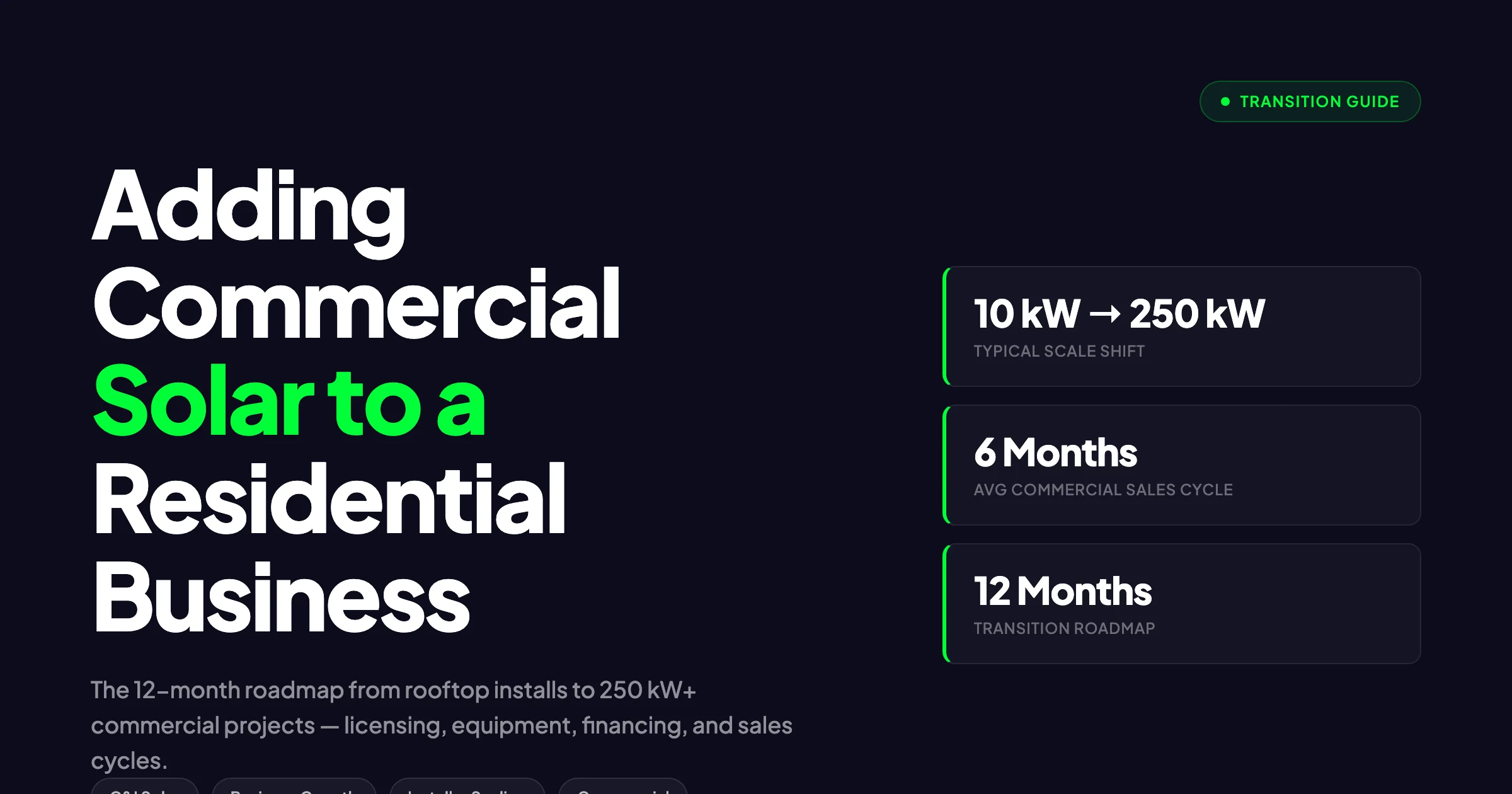
This guide walks through what actually changes when a residential installer adds C&I work, what equipment and licensing to budget for, and the 12-month transition roadmap that has worked for 30+ teams I have advised.
Quick Answer
Adding commercial solar to a residential business takes 12 months, 200,000 dollars in working capital, and a willingness to lose money on the first project. Start with 25 to 100 kW rooftops, hire a commercial-trained designer, and use solar PV design software that supports ballast and three-phase layouts. Residential funds the transition; commercial scales the business.
Key Takeaways
- Commercial gross margins (12-15%) are lower than residential (22-28%), but per-project profit is 3 to 5 times higher.
- The commercial sales cycle averages 6 months, not 30 days. Plan working capital around that gap.
- Licensing usually requires a C-10 or equivalent commercial electrical contractor license, plus 250,000 to 1,000,000 dollars in bonding.
- Equipment costs add 80,000 to 150,000 dollars: lifts, three-phase inverters, ballast tools, and a flatbed.
- Most residential installers fail their first commercial job because they underbid the steel and the interconnection.
- Run residential and commercial as separate divisions after month 6, sharing only finance and ownership.
In this guide:
- Why residential installers are entering C&I in 2026
- What actually changes between residential and commercial
- Licensing, bonding, and insurance upgrades
- Equipment and crew additions
- Commercial sales cycles and how to staff for them
- Financing structures: cash, PPAs, ESAs, tax equity
- The 12-month transition roadmap
- Common mistakes and when not to transition
Why Residential Installers Move Into Commercial Solar in 2026
The residential market peaked. Wood Mackenzie’s US Solar Market Insight 2025 report shows residential installations down 18 percent year over year, while commercial and industrial grew 13 percent. The drivers are clear.
Federal residential tax credit changes hurt homeowner economics. Higher interest rates pushed loan APRs from 4 percent in 2022 to 8 to 12 percent in 2025. Customer acquisition costs in residential climbed past 4,000 dollars per closed deal in many metros. Door-to-door fatigue is real.
Commercial solar moved the other way. Corporate sustainability mandates, rising commercial electricity rates, and the extended Investment Tax Credit for commercial projects through 2032 make C&I one of the few segments still growing. SEIA’s Solar Market Insight reports project 28 GW of new C&I installations between 2025 and 2030.
The math is simple. A residential installer doing 80 jobs per year at 8 kW each installs 640 kW annually. The same team running 6 commercial jobs at 150 kW each installs 900 kW with fewer site visits, fewer permits, and one HOA conversation instead of eighty.
Pro Tip
The cleanest path into commercial is through existing residential customers who own small businesses. The owner of a 12 kW home system often owns a 50 to 150 kW commercial roof. The trust is already there, and you skip the 6-month sales cycle.
Commercial vs Residential: What Actually Changes
Almost everything changes, but the change is gradual. The chart below maps the differences across the 9 variables that actually affect your operations.
| Variable | Residential (8 kW avg) | Small Commercial (50-250 kW) | Mid Commercial (250-1,000 kW) |
|---|---|---|---|
| Average ticket | 25,000 dollars | 150,000-650,000 dollars | 650,000-2,500,000 dollars |
| Gross margin | 22-28% | 14-18% | 12-15% |
| Sales cycle | 14-45 days | 90-180 days | 180-365 days |
| Decision makers | 1-2 (homeowners) | 2-3 (owner, CFO) | 4-7 (committee, board) |
| Permitting time | 2-6 weeks | 6-12 weeks | 12-24 weeks |
| Interconnection | Net meter, fast track | Mid-size queue | Cluster study, possible upgrade |
| Build duration | 1-2 days on-site | 2-4 weeks on-site | 6-16 weeks on-site |
| Inverter type | String, 7.6 kW | Three-phase string, 30-60 kW | Central, 100-250 kW |
| Payment terms | At signing or 30/40/30 | Net 30-60 | Net 60-90, milestone draws |
The hardest shift is not technical. It is cash. A residential project pays inside 60 days from contract. A 500 kW project signed in March pays 30 percent at notice to proceed, 40 percent at substantial completion, and the final 30 percent at PTO, which can land in October. Working capital pressure is the number one reason first commercial jobs fail financially.
The second hardest shift is design complexity. Residential roofs are simple. Commercial roofs have parapets, RTUs, drainage paths, structural load limits, and seismic zones. NREL’s Solar Market Research documents that 40 percent of first-time C&I installers underestimate structural engineering costs by more than 200 percent. Design software with ballast calculation, RTU avoidance, and string optimization for three-phase inverters removes most of that risk.
Licensing, Bonding, and Insurance Upgrades
Most states require a commercial electrical contractor license to install solar above 100 kW or on commercial buildings. The names vary: C-10 in California, EC in Florida, Electrical Contractor in Texas. The requirements are similar.
A typical state requires:
- A qualifying individual (usually the owner or a master electrician) with 4 to 5 years of documented commercial electrical work
- A passing score on a commercial electrical exam covering NEC Articles 690, 705, and 750
- A surety bond of 12,500 to 25,000 dollars
- Proof of general liability insurance at 1,000,000 to 2,000,000 dollars per occurrence
- Workers compensation coverage on all crew
If you only hold a residential solar contractor license, plan 6 to 9 months to upgrade. The qualifying individual route is faster than the 4-year experience route if you can hire a master electrician with commercial experience as your QI.
Bonding rises sharply for larger projects. A 100,000 dollar performance bond covers a typical 250 kW project. A 1,000,000 dollar bid bond is standard for public sector RFPs, schools, and municipal work. Sureties price these at 1 to 3 percent of the bonded amount per year, and they will pull personal credit on the owner.
Insurance changes too. Commercial general liability needs an Additional Insured endorsement for the property owner on every project. Builders Risk insurance covers materials staged on the roof during multi-week installs. Inland Marine covers high-value equipment in transit. Total annual insurance cost for a commercial-active installer runs 12,000 to 40,000 dollars, up from 4,000 to 8,000 dollars for residential-only.
Licensing Reality Check
Half of residential installers I have advised tried to subcontract the commercial electrical work to a third party for the first 2 to 3 projects. This usually works for 50 to 100 kW jobs. It almost never works above 250 kW because the subcontractor’s schedule and your roof crew’s schedule will not align.
Equipment and Crew: What You Need to Add
The equipment gap between residential and commercial is real money. Below is the typical kit a residential installer needs to add for the first 250 kW project.
| Equipment Category | Residential Has | Commercial Needs | Added Cost |
|---|---|---|---|
| String inverter | 7.6 kW single-phase (1,500-2,000 dollars) | 60 kW three-phase (8,000-12,000 dollars) | per project |
| Central inverter | not used | 100-250 kW (20,000-40,000 dollars) | per project |
| Lift equipment | 24-foot ladder | Scissor lift or boom lift (rental or 25,000-45,000 dollars to own) | one-time |
| Ballast cart | not needed | Powered ballast cart (4,500 dollars) | one-time |
| Racking system | rail-and-clamp for shingle | Ballasted or mechanical-attach commercial racking (different SKUs entirely) | per project |
| Cable management | residential rapid shutdown | Aluminum cable tray, larger MC4 connectors, 750 V DC wiring | per project |
| Trailer | open utility trailer | 20-foot flatbed with strap kit (8,000-15,000 dollars) | one-time |
| Tools | standard impact set | Torque-controlled impact rated for 5/8-inch bolts (1,500 dollars), pulled hammer drill (800 dollars) | one-time |
| Safety | residential fall protection | Commercial-grade rope system, edge protection (3,500 dollars) | one-time |
Total added equipment cost for a residential installer moving into commercial: 80,000 to 150,000 dollars over the first 12 months. Rentals can cut the first-year cash outlay by half if cash flow is tight.
Crew composition shifts too. A residential 2-person team becomes a commercial 4 to 6 person team. The new roles are:
- Foreman with 3+ years commercial experience (not optional)
- Lead electrician with three-phase wiring experience
- 2 to 3 panel installers
- A ground person staging racking and ballast
The foreman is the hire that matters. A foreman who has built five 200 kW jobs will save you 30,000 dollars in mistakes on your first project. Pay them. Expect 75,000 to 110,000 dollars base plus profit share.
Commercial Solar Sales Cycles: 30 Days vs 6 Months
Residential closes fast. Customer signs a financing form, you build, you collect. Commercial closes slow. The 6-month average sales cycle covers six distinct stages.
- Lead and initial site walk (week 1-3): Roof inspection, electrical meter analysis, rough sizing. Often free.
- Preliminary proposal (week 4-6): Production estimate, savings model, basic financial returns. Use SurgePV’s design tools to turn this around in under a week.
- Financing discussion (week 7-12): Cash, PPA, ESA, lease, or owner financing. CFO usually enters here. Pricing tightens.
- Engineering and final proposal (week 13-18): Structural review, interconnection application, refined design. Most deals die here from interconnection surprises.
- Procurement committee and contract (week 19-22): Legal review, T&C negotiation, MSA execution. Slowest part of the cycle.
- Notice to proceed and deposit (week 23-26): Signed contract, first 30 percent payment, kickoff.
EnergySage’s Commercial Solar Statistics reports that 47 percent of commercial deals die between stages 4 and 5, almost always over financing structure or interconnection cost. Build your pipeline assuming 1 in 3 qualified leads will close, and 1 in 6 raw leads.
The sales staffing shift matters. A residential closer who can sign 4 homeowners a week burns out trying to manage 12 commercial deals in parallel over 6 months. Hire a dedicated commercial salesperson or convert one residential rep at the 6-month mark. Track pipeline weekly with a stage-based CRM, not a date-based one.
See How SurgePV Speeds Up Commercial Proposals
Cut your preliminary proposal from 3 days to 90 minutes with three-phase string design, ballast calculation, and CFO-ready financial models built in.
Book a DemoNo commitment required · 20 minutes · Live walkthrough
For a direct comparison, see Arka 360 vs SurgePV.
Financing Structures: Cash, PPAs, ESAs, and Tax Equity
Residential financing is a one-page loan or a lease. Commercial financing is five products, and you need to understand each one because the customer will ask.
Cash purchase. The customer pays directly. Simplest contract. Customer keeps the Investment Tax Credit (currently 30 percent for commercial through 2032) and bonus depreciation. About 35 percent of commercial deals are cash today.
Solar loan. A bank or specialty lender writes a 7 to 20 year term loan. The customer owns the system and the tax benefits. Interest rates run 6.5 to 9 percent in 2026. Common for 100 to 500 kW projects.
Power Purchase Agreement (PPA). A third-party owner installs the system on the customer’s roof. The customer buys the power output at a contracted rate, typically 20 to 30 percent below the utility rate. Term is 15 to 25 years. The third party keeps the ITC and depreciation. The customer pays nothing up front.
Energy Services Agreement (ESA). Similar to a PPA but priced on energy savings rather than per-kWh generation. Used when net metering is poor or for behind-the-meter battery projects. Less common than PPAs but growing.
Lease. The customer pays a fixed monthly amount to use the system. Tax benefits go to the lessor. Mostly used for nonprofits and small businesses without tax appetite.
Tax equity. Used on projects above 1 MW. A separate tax equity investor takes the ITC and accelerated depreciation in exchange for a slice of project equity. Complex and requires legal structuring. Skip this for your first 10 commercial projects.
| Structure | Customer Up Front | Customer Owns System | Best Fit |
|---|---|---|---|
| Cash | 100% of project | Yes | Profitable businesses with cash on hand |
| Solar loan | 0-20% | Yes | Most 100-500 kW deals |
| PPA | 0% | No (option to buy at year 7-10) | No tax appetite, wants no capex |
| ESA | 0% | No | Energy-savings-driven projects |
| Lease | 0% | No | Nonprofits, schools, government |
| Tax equity | Varies | Shared | Projects above 1 MW |
Most first-time commercial installers offer cash and one loan partner. Adding a PPA partner in year 2 unlocks roughly 20 percent more closes. The PPA partner runs credit and underwrites the customer, removing that burden from your team. Sungage, Sunstone Credit, and Greenworks Lending are common starting points.
The 12-Month Transition Roadmap
Below is the month-by-month plan I use with residential installers moving into C&I. Assume you start with a stable residential business doing at least 40 jobs per year and have 200,000 dollars in working capital.
| Month | Focus | Key Milestones |
|---|---|---|
| Month 1 | Licensing prep | Apply for commercial electrical contractor license. Hire QI if needed. Open commercial insurance review. |
| Month 2 | Bonding and credit | Get bonded for 250,000 to 500,000 dollars. Open commercial credit lines with 2 distributors. |
| Month 3 | Software and design | Adopt commercial-capable design software. Train one residential designer on three-phase, ballast, and structural workflows. |
| Month 4 | Hire foreman | Recruit a foreman with 3+ years C&I experience. Pay top of market. Start on payroll month 5. |
| Month 5 | Equipment kit | Buy or rent: lift, ballast cart, flatbed, torque tools, edge protection. Total: 25,000 to 60,000 dollars. |
| Month 6 | Pilot quotes | Send 5 to 10 small commercial proposals (25-100 kW). Target existing residential customers who own businesses. |
| Month 7 | First close | Sign first commercial contract. Accept a thin margin (5-8%) to gain reference. |
| Month 8 | First build | Execute first commercial project with foreman leading. Document everything. |
| Month 9 | Reflection | Run a project postmortem. Identify the 3 biggest cost overruns. Reprice. |
| Month 10 | Repeatable sales | Hire dedicated commercial sales rep or convert top residential closer. Build CRM stages. |
| Month 11 | Second crew | Either keep one crew running both segments or split crews by segment. Most teams split by month 12. |
| Month 12 | Pipeline at scale | Target 8 to 12 active commercial deals in pipeline. Plan year 2 hiring. |
Pro Tip
Months 7 and 8 will not go well. Your first commercial job will lose money or break even. Plan for it. The reference, the photos, and the case study are worth more than the margin on project one. Pad working capital with an extra 50,000 dollars so cash gaps do not force bad decisions.
A narrative I share with every installer in transition: Coastal Solar in Charleston added a 250 kW retail rooftop in Q2 2025 as their first C&I job. The bid assumed mechanical attachment through the roof membrane. The structural engineer flagged the parapet anchor pattern in week 6, requiring a switch to ballast plus a third of the array on mechanical attachment. The change added 18,000 dollars in racking, 4 days of crew time, and pushed the project past PTO by 11 weeks. The team broke even on the build but won three referral commercial projects in the next 9 months. They now run a 6-person commercial crew. The lesson: book engineering review before signing the contract, and price for change orders explicitly.
Common Mistakes Residential Installers Make in Commercial
Most failures repeat. The same 7 mistakes show up in 80 percent of first commercial projects.
- Underbidding the structural engineering. A PE-stamped structural review for a 250 kW rooftop runs 3,000 to 8,000 dollars. Residential installers often budget 1,000 dollars. The shortfall comes out of margin.
- Treating interconnection as a formality. A residential interconnection takes 4 weeks. A 500 kW interconnection can take 6 months and require a 40,000 dollar transformer upgrade. Get the utility study before signing.
- Skipping the parapet inspection. Many commercial roofs have parapets that block panel layouts at the perimeter. Skipping the site walk costs 20 to 40 panels of yield.
- Using residential racking suppliers. Residential racking SKUs do not include ballast trays, ballast blocks, or commercial mechanical anchors. Open accounts with IronRidge Commercial, EcoFasten, and Unirac Roof Mount before quoting.
- Sending a residential closer to a CFO meeting. The CFO will ask about IRR, NPV, payback method, and depreciation schedule. A residential closer who answers “the system pays for itself in 7 years” loses the deal in 10 minutes. Train one rep on commercial financial modeling.
- Net 30 cash assumption. Commercial customers pay net 60 to net 90 in practice. Build your cash flow assuming 75-day collection. Three projects in progress with 75-day terms means 30 percent of annual revenue is always outside your bank account.
- Sharing crews across segments without scheduling discipline. A residential job that runs 2 days over schedule will compound into a commercial job that misses its weather window. Once you sign 3 active commercial projects, you need a dedicated commercial crew.
The contrarian truth most consultants will not say: your residential business will get worse during the transition. Owner attention shifts. Sales staff get reassigned. Residential closes drop 15 to 25 percent in months 6 to 9. Plan for this. Backfill residential sales support before you redirect the owner’s calendar.
When NOT to Make the Transition
Not every residential installer should add commercial. Skip the transition if any of the following are true.
- Residential margins are below 15 percent. Fix residential first. A broken residential business cannot fund commercial through the cash gap.
- Working capital is below 100,000 dollars. The first commercial project will burn it.
- The owner cannot dedicate 30 percent of their weekly calendar to commercial sales for 6 to 9 months.
- Your residential designer cannot or will not learn three-phase electrical and ballast calculation.
- Your market has fewer than 50 commercial buildings above 30,000 square feet within 90 minutes of your office.
- You hate paperwork. Commercial doubles the paperwork on every project.
The alternative is a commercial referral partnership. Find a regional C&I installer and refer commercial leads in exchange for a 3 to 5 percent referral fee on closed deals. Many residential installers earn 30,000 to 80,000 dollars per year this way without taking on any commercial risk.
For installers committed to the transition, the upside is durable. Once your team can run a 250 kW project end to end, the path to 500 kW, 1 MW, and 5 MW projects is gradual rather than another transition. Year 3 revenue for installers who completed the transition averages 4 to 6 million dollars, with 60 to 70 percent commercial mix. Compare to residential-only year 3 revenue of 2 to 3 million dollars on average.
How Residential Skills Transfer to Commercial (and Where They Do Not)
The good news first. About 60 percent of residential skills move directly to commercial work. The bad news: the other 40 percent is exactly where deals are won or lost.
Skills that transfer cleanly:
- Module-level electrical knowledge (NEC 690, string sizing, rapid shutdown)
- Customer presentation and trust building
- Installation safety practices and fall protection
- Inverter commissioning and monitoring setup
- Net metering applications and utility paperwork (mostly)
- Site walk discipline and roof condition assessment
Skills that do not transfer:
- Three-phase electrical math and primary-side analysis
- Structural load calculations and roof-deck capacity
- Reading mechanical, structural, and electrical sheet sets together
- Ballast distribution math and overturning moment analysis
- AHJ negotiation for commercial occupancy classifications
- CFO-facing financial modeling beyond simple payback
- Subcontractor management on multi-trade builds
- Multi-week scheduling logistics with weather windows
The biggest gap is reading commercial drawing sets. A typical 250 kW project arrives with a 40-page drawing package: A-sheets for architectural, S-sheets for structural, E-sheets for electrical, and M-sheets for mechanical RTU locations. Residential plan sets are 4 to 6 pages. The volume difference alone shocks new C&I designers.
Train your designer on three things first: (1) reading roof framing plans to identify load capacity, (2) plotting RTU and skylight setbacks from manufacturer cut sheets, and (3) sizing three-phase combiner boxes against inverter input limits. A weekend of training plus 2 supervised projects gets a competent residential designer to junior commercial designer level.
Marketing and Lead Generation Shifts
Residential marketing is direct to consumer. Commercial marketing is account based. The channels barely overlap.
Residential channels that fail in commercial:
- Door-to-door canvassing (you cannot knock on a 50,000 square foot warehouse)
- Facebook and Instagram ads
- Home and garden shows
- Yard signs and lawn flags
- HOA partnerships
Commercial channels that work:
- LinkedIn outreach to facility managers and CFOs (slow but high quality)
- Local chamber of commerce membership
- Energy broker referral partnerships (3 to 5 percent of project cost as fee)
- Direct mail to commercial property owner lists from CoStar or Reonomy
- Trade group sponsorship (NAIOP, BOMA, IFMA)
- Existing residential customer outbound (business owners with homes)
- Utility commercial program partnerships
The lead-to-close cycle adds 5 to 6 months on top of every channel above. A commercial lead generated in January closes in July if you are lucky, November if you are average. Pipeline math: to close 6 commercial projects in 2027, you need 18 qualified opportunities in your pipeline by Q2 2026.
Marketing budget shifts too. A residential installer spends 8 to 12 percent of revenue on marketing. A commercial-focused installer spends 3 to 6 percent on marketing but 6 to 10 percent on business development salaries. The total cost of customer acquisition is similar; the line items change.
Cost of Acquisition Reality
Residential cost per acquired customer averages 3,500 to 5,500 dollars in 2026. Commercial cost per acquired customer averages 8,000 to 18,000 dollars. The kicker: commercial deals are 6 to 25 times larger by revenue, so the CAC-to-revenue ratio is actually 3 to 4 times better in commercial.
Pricing, Quoting, and Contract Differences
Residential pricing is usually dollars per watt. Commercial pricing is dollars per watt for projects under 250 kW, then transitions to lump-sum or unit-price bids above 500 kW.
A typical residential quote covers: module count, inverter, racking, labor, monitoring, and total dollars per watt. One page. A typical commercial quote covers: scope of work, schedule of values, payment milestones, performance guarantees, equipment warranties broken out, insurance requirements, change order terms, dispute resolution, and termination clauses. 12 to 30 pages.
Schedule of values is critical. Commercial customers will not pay 100 percent at signing. The standard payment schedule:
| Milestone | Payment Percentage |
|---|---|
| Notice to proceed (signed contract) | 10-20% |
| Materials on site | 20-30% |
| Mechanical complete | 20-30% |
| Substantial completion (system energized) | 20-30% |
| Final acceptance (PTO and commissioning) | 10-20% |
This schedule is non-negotiable on most commercial deals. The first time you submit a commercial quote with “50% deposit, 50% on completion,” the procurement officer will laugh.
Contract length matters. A residential contract is 2 to 5 pages. A commercial contract for a 250 kW project is 25 to 60 pages. Hire a construction attorney to review your first 3 commercial templates. Budget 4,000 to 8,000 dollars in legal review for year one.
Change order discipline separates profitable commercial installers from broke ones. Document every scope change in writing. Price every change order before starting the work. Get a signed change order before mobilizing additional crew. The contractor who skips this is the contractor who loses money on the parapet that turned out to be different.
Equipment Procurement and Supplier Relationships
Residential installers usually work with 2 to 3 distributors: typically CED Greentech, Soligent, or a regional player. Commercial installers add 4 to 6 specialist suppliers.
| Supplier Type | Residential Has | Commercial Adds |
|---|---|---|
| General distributor | Yes (CED, Soligent) | Same, plus commercial program enrollment |
| Module supplier | Tier 1 via distributor | Direct from manufacturer for orders above 200 kW |
| Inverter supplier | Enphase, SolarEdge | SMA, Fronius, CPS, SolarEdge commercial line |
| Racking supplier | IronRidge, Unirac | Add commercial: EcoFasten, PanelClaw, Sunmodo, RBI Solar |
| Electrical components | Through distributor | Direct accounts: Eaton, Schneider, ABB |
| Steel and structural | Not applicable | Local fabricator for canopy and ground mount |
| Logistics | UPS, distributor delivery | Flatbed freight (Roadrunner, Estes, R+L) |
Direct manufacturer accounts unlock pricing 8 to 15 percent better than distributor pricing. The trade-off is volume commitment and longer payment terms (net 45 instead of net 30). For installers averaging less than 1.5 MW per year in commercial, stick with distributors for year one and add direct accounts in year two.
Lead times are different. A residential project orders all materials at PTO and installs within 2 weeks. A commercial project orders modules 10 to 16 weeks in advance because Tier 1 module supply tightened in 2025. Central inverters above 100 kW often run 14 to 20 weeks lead time. Order ahead of contract, or carry inventory between projects.
Pro Tip
Negotiate a “shelf inventory” agreement with your primary distributor for the first year of commercial. They hold 50 to 100 kW of common SKUs in your name, you draw against it monthly. The distributor sees committed volume, you reduce capital tied up in inventory. Win-win for both.
Permitting and Inspection Differences
Residential permits are usually online, approved in 2 to 6 weeks. Commercial permits are paper, paid, and approved in 6 to 16 weeks.
The difference is plan review depth. A residential plan reviewer checks NEC compliance and basic structural load. A commercial plan reviewer routes the package to a structural engineer, an electrical engineer, and a fire marshal. Each reviewer has their own comment cycle, and each comment requires a response in writing.
Common comments to expect:
- “Provide PE-stamped structural calculations for ballasted array and seismic conditions”
- “Show fire access pathway compliant with IFC Section 605”
- “Demonstrate equipment grounding electrode conductor sizing per NEC 250.66”
- “Confirm AC disconnect location with utility-required visibility”
- “Provide structural attachment manufacturer cut sheets and ICC-ES report”
Each comment can add 2 to 4 weeks to permit timeline. Budget 12 weeks average for commercial permitting in fast jurisdictions, 20 to 24 weeks in slow ones (Los Angeles, San Francisco, New York City).
Inspections multiply too. Residential typically requires 1 to 2 inspections. Commercial requires 4 to 7: rough electrical, structural attachment, fire marshal, grounding, AC disconnect, final electrical, and post-PTO commissioning. Schedule inspector availability 2 weeks in advance, not the day before. Read AC Disconnect Sizing for Solar for a complete walkthrough.
Fire setback rules tighten. The 2021 IFC requires 3-foot setbacks at ridges and along the perimeter for commercial roofs. Some jurisdictions add 4-foot center pathways every 150 feet. Lay these out in your design software before quoting, because losing 8 to 12 percent of available roof area to setbacks is common.
Building the Project Management Layer
Residential project management is one person tracking 20 to 40 simultaneous jobs at various stages, each lasting 30 to 60 days. Commercial project management is one person tracking 4 to 8 simultaneous jobs, each lasting 4 to 9 months. The toolset is different.
A residential PM uses a basic CRM and a calendar. A commercial PM needs:
- A scheduling tool with critical path tracking (Smartsheet, Procore, or Buildertrend at minimum)
- A submittal log for every product needing engineer review
- A request for information (RFI) log for every clarification with the customer or engineer
- A change order log linked to the contract
- A daily field report from the foreman
- A weekly progress meeting with the customer
- Monthly billing with backup documentation
The submittal process is the steep learning curve. A 250 kW project typically requires 8 to 15 submittals: modules, inverter, racking, AC and DC disconnects, monitoring equipment, conduit, wire, fasteners, and ground rods. Each submittal includes manufacturer cut sheets, warranty documents, and sometimes UL listings. Each gets reviewed by the customer’s engineer of record, who returns it stamped “approved,” “approved as noted,” or “rejected, resubmit.”
Reject-resubmit cycles add 2 to 6 weeks. Track them in software, not in your inbox. The PM who lets one submittal sit for 3 weeks because they forgot to follow up is the PM who delivers the project 6 weeks late.
| Project Management Element | Residential | Commercial |
|---|---|---|
| Simultaneous active projects | 20-40 | 4-8 |
| Project duration | 30-60 days | 120-270 days |
| Stakeholders per project | 2-3 | 6-12 |
| Documents per project | 8-15 | 100-300 |
| Customer meetings | 1-2 | 8-20 |
| Inspectors involved | 1-2 | 4-7 |
| Sub-contractors | 0-1 | 2-5 |
The investment in a commercial PM platform runs 200 to 600 dollars per user per month, plus 40 to 80 hours of training. Most residential installers underestimate this and try to run commercial through a spreadsheet. The spreadsheet fails by project two.
Year 2 and Beyond: Scaling the Commercial Division
Year 1 is survival. Year 2 is profit. Year 3 is the segment you actually wanted.
By the end of year 2, a well-executed transition looks like:
- 8 to 12 commercial projects completed
- 1.5 to 3.5 MW installed commercial capacity
- 12 to 16 percent commercial gross margin
- One dedicated commercial sales rep
- One dedicated commercial PM
- One commercial design team member (the trained residential designer)
- One foreman plus one 4-person commercial crew
Year 3 numbers shift again:
- 18 to 30 commercial projects
- 4 to 7 MW commercial capacity
- 15 to 18 percent commercial gross margin (efficiency gains)
- 2 commercial salespeople
- 2 PMs (one senior, one junior)
- 2 commercial crews
- Optional: ground mount capability for 500 kW to 2 MW projects
The biggest year 3 decision is ground mount. Adding ground mount capability requires civil engineering knowledge, foundation work, perimeter fencing, and access road construction. Capital cost for ground mount equipment runs 80,000 to 150,000 dollars (pile driver rental, augers, fence equipment). Margins on ground mount can exceed rooftop by 3 to 5 percentage points but project complexity increases sharply.
The other year 3 decision is community solar. Community solar projects are typically 1 to 5 MW ground mount or large rooftop arrays sold via subscription to 100 to 500 retail customers. Many states (NY, MA, IL, CO, MN, NJ) have active community solar programs. The economics are good but the regulatory and subscriber management overhead is high. Read Community Solar Business Model for a complete walkthrough.
A simpler year 3 expansion is geographic. Open a second office in the next major metro 90 to 180 minutes from your headquarters. Two metros, both running residential and commercial, with shared back office, typically scales to 8 to 12 million dollars in revenue by year 4.
The right software stack accelerates the move. A solar proposal platform that handles residential and commercial workflows in one tool removes the second-platform tax most installers pay. Shadow analysis on commercial rooftops with RTUs and parapets is where most residential designers waste 4 to 8 hours per project. A generation and financial tool that produces IRR, NPV, and 25-year cash flows in the same document the CFO will review cuts proposal cycles by 30 to 40 percent. Clara AI handles the back-and-forth between sales and engineering on string layouts. For team-wide adoption, see pricing and the commercial solar overview.
For installers building case studies and reference projects, see commercial solar system design and the commercial solar design software buyer guide. For sales playbooks, the commercial solar sales cycle and closing commercial solar deals posts cover procurement committee dynamics. For broader business growth, see scale solar installation business, commercial solar ROI calculator, and solar as a service business models. For installers focused on the U.S. and EU markets, the for solar installers page covers feature-specific workflows.
Conclusion
Three action items if you are moving into commercial solar in 2026:
- Run a 90-day diagnostic on residential cash flow, working capital, and owner bandwidth before starting the transition.
- Hire a commercial foreman before the second commercial project, not after. The foreman pays for itself by avoiding one structural mistake.
- Adopt solar software that handles both segments in one platform. Tool sprawl between residential and commercial doubles designer workload during the transition window.
Commercial solar is harder than residential. The margins are thinner, the cycles are longer, and the cash gap is real. The installers who do it well build 5-million-dollar businesses with predictable pipelines and durable client relationships. The ones who skip the planning lose 50,000 dollars on the first project and quit by year 2.
Frequently Asked Questions
Should a residential solar installer move into commercial?
Only if you have stable residential cash flow, a project manager who can run multi-month builds, and at least 200,000 dollars in working capital. Commercial projects pay net 60 to net 90, so cash burn is real. If residential is shaky, fix that first.
How long does the residential-to-commercial transition take?
Plan for 12 months from first hire to first signed 100 kW project. Months 1-3 cover licensing and bonding. Months 4-6 cover crew, equipment, and pilot quotes. Months 7-9 cover the first paid project. Months 10-12 cover repeatable sales and a second crew.
What equipment do I need to add for commercial solar?
A scissor lift or boom lift, a ballast cart, a flatbed trailer, central or three-phase string inverters, racking certified for ballasted or mechanical attachment, and a torque-controlled impact set rated for 5/8-inch bolts. Budget 80,000 to 150,000 dollars for the kit.
Are commercial solar margins better than residential?
No. Residential gross margins average 22 to 28 percent. Commercial margins on 100 to 500 kW projects average 12 to 15 percent. Commercial wins on absolute dollars per project, not percentage margin. A 250 kW job at 12 percent margin still nets more than 50,000 dollars.
Can I run residential and commercial divisions at once?
Yes, and most installers should. Residential funds payroll while commercial deals close. Keep separate project managers, separate design queues, and separate crews after the first 6 months. Shared sales staff usually fails because the cycles and buyer personas are different.
What size commercial projects should I start with?
Start with 25 to 100 kW projects. These look like 4 to 6 residential roofs stacked together. Crew workflow stays familiar. Avoid ground mounts and projects over 250 kW until you have closed 3 small commercial jobs. Utility interconnection complexity scales fast above 250 kW.
Do I need a different solar designer for commercial?
You need someone who reads structural drawings, calculates ballast weights, and runs three-phase electrical layouts. A residential designer can learn this in 90 days with the right training. Commercial design software with ballast and string optimization tools cuts the learning curve in half.
How much working capital do I need for the first commercial project?
Plan for 30 to 40 percent of project cost in carrying capital. A 200,000 dollar project needs 60,000 to 80,000 dollars on hand. Equipment is paid up front, payroll runs weekly, and the customer pays net 60 after substantial completion. Cash gaps kill more first-commercial installers than bad bids.
Where this fits
This article is part of SurgePV's Solar Business & Operations hub, which works through the topic from first principles to the decisions a project team actually has to make.


