

Quick Answer
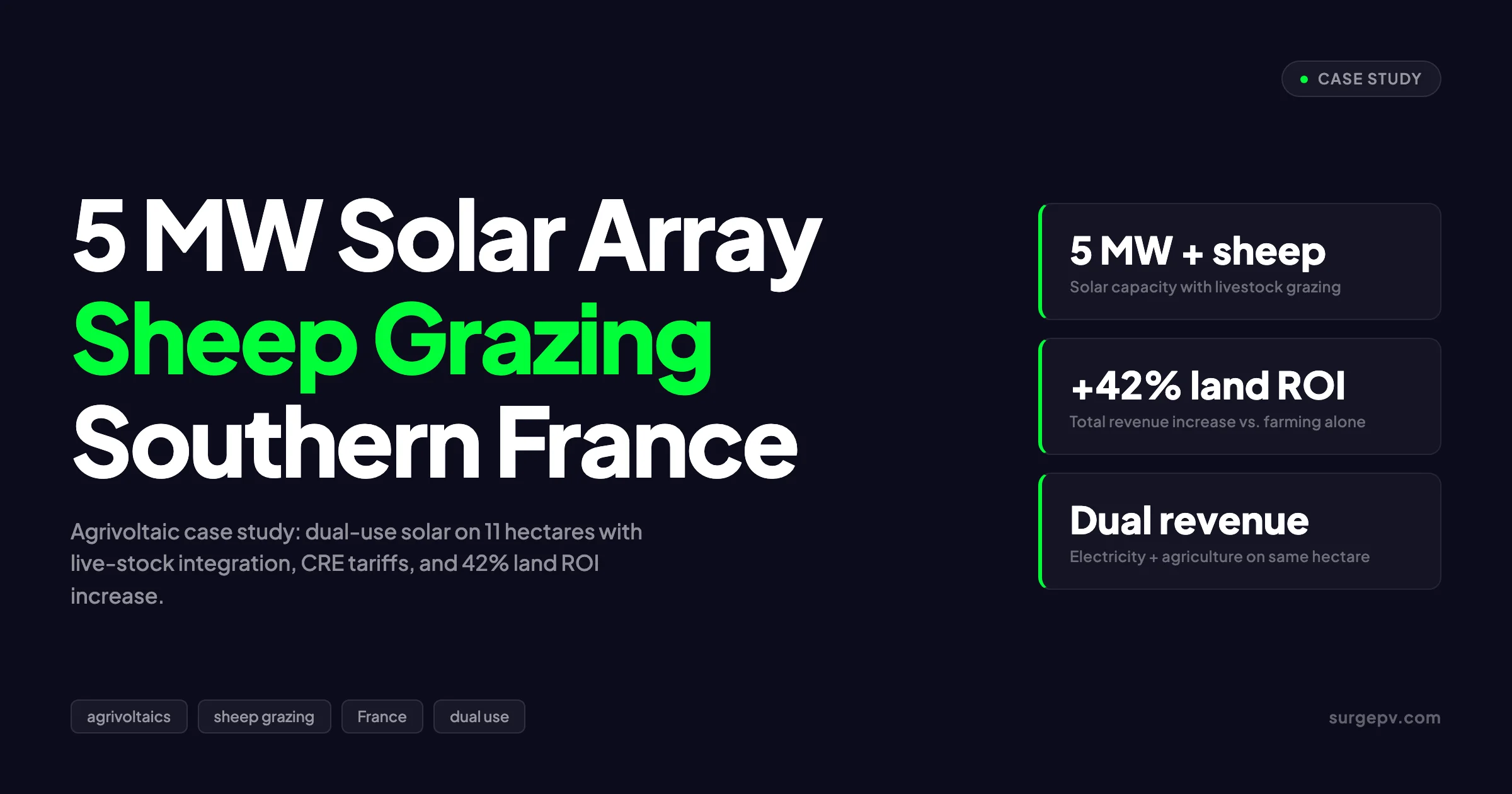
France added 4.2 GW of solar capacity in 2024. This case study examines a 5 MW agrivoltaic project in Southern France. The site combines a fixed-tilt solar array with sheep grazing across 11 hectares of former pasture. March 2022 System cost. €4.85 million Financing. 75% debt (Societe Generale project finance) Off-take.
France added 4.2 GW of solar capacity in 2024. Most of that was standard rooftop and ground-mount projects. But a smaller number of installations point to a different future — one where solar panels and active agriculture share the same land, producing both electricity and food from the same hectare. Read more about Floating Solar Farms France. See our guide on France Solar Policy for more.
France added 4.2 GW of solar capacity in 2024. This case study examines a 5 MW agrivoltaic project in Southern France. The site combines a fixed-tilt solar array with sheep grazing across 11 hectares of former pasture.
For more details, see our guide on France solar feed-in tariffs.
This case study examines a 5 MW agrivoltaic project in Southern France. The site combines a fixed-tilt solar array with sheep grazing across 11 hectares of former pasture. The panels generate approximately 7,000 MWh of electricity per year. The sheep maintain the vegetation, preserve the agricultural status of the land, and produce a second revenue stream for the farming family that owns the site.
The project is not experimental. It was commissioned in 2022, has two full years of operational data, and was financed through a standard project finance structure with a French bank. The lessons from this site apply directly to any developer, farmer, or investor evaluating agrivoltaics in France or similar Mediterranean climates. Read Agrivoltaics Design for a complete walkthrough.
TL;DR — 5 MW Agrivoltaic Project, Southern France
5 MW solar array with sheep grazing on 11 hectares in Languedoc-Roussillon. Annual production: ~7,000 MWh. System cost: €4.8 million. CRE tariff: €0.087/kWh for 20 years. Sheep stocking rate: 10 ewes per hectare. Combined land revenue (electricity + sheep + wool): €420,000-480,000/year. Total land ROI increase vs. sheep-only operation: 42%. Panel height: 140 cm. Bifacial modules on single-axis trackers with seasonal tilt limits to maintain grazing access.
See Bifacial Solar Panel Design Guide for detailed guidance.
In this case study:
- Project overview: site, ownership, timeline, and key specifications
- The agrivoltaics concept: how dual-use solar works and where it fits in the French market
- Site selection: why this particular parcel was suitable for agrivoltaics
- System design: elevated trackers, spacing, and livestock accommodation
- Crop and livestock integration: sheep grazing management under panels
- Financial analysis: CRE tariffs, dual revenue streams, and project returns
- Installation timeline and construction phases
- Performance data: energy production and agricultural output after two years
- Environmental impact: biodiversity, soil health, and water retention
- French regulatory context: agrivoltaic certification and land-use rules
- Challenges faced and solutions applied
- Long-term monitoring and maintenance approach
- Lessons learned for future projects
- Three comparable agrivoltaic projects in France and Europe
- FAQ Also see: European Solar Tax Credits.
Project Overview
The project sits on a 12-hectare parcel near Narbonne in the Aude department of Occitanie, Southern France. The land had been used for sheep grazing for three generations before the solar installation. The owner, a family farming operation running approximately 200 ewes across multiple parcels, wanted to diversify revenue without selling the land or exiting agriculture.
Key Project Specifications
| Parameter | Value |
|---|---|
| Location | Near Narbonne, Aude (43.1°N, 3.0°E) |
| Land area | 11.2 hectares (solar footprint) |
| Installed capacity | 5.04 MWp |
| Panel count | 14,000 (bifacial, 360 Wp each) |
| Panel height (minimum) | 140 cm |
| Tracking system | Single-axis, seasonally limited tilt |
| Annual energy yield | 6,800-7,200 MWh |
| Specific yield | 1,350-1,430 kWh/kWp/year |
| Grid connection | 20 kV, Enedis distribution network |
| Commissioning date | March 2022 |
| System cost | €4.85 million |
| Financing | 75% debt (Societe Generale project finance) |
| Off-take | CRE 4 tariff, 20-year contract |
| Tariff rate | €0.087/kWh |
| Sheep stocking rate | 10 ewes per hectare (112 ewes total) |
| Agricultural partner | Owner-operated (same family) |
The project was developed by a regional solar developer based in Montpellier with prior experience in ground-mount projects. The agrivoltaic design was developed in collaboration with the French National Institute for Agriculture, Food, and Environment (INRAE) and a local agricultural consultancy.
Ownership and Structure
The project uses a simplified structure common to French agricultural solar projects:
- Landowner: The farming family retains ownership of the land
- Project company: A dedicated SARL (limited liability company) owns the solar installation
- Lease agreement: 30-year lease between the family and the project company, with agricultural continuation clause
- Operator: The project company contracts an O&M provider for technical maintenance
- Agricultural activity: The family continues sheep grazing under a formal agricultural services agreement
This structure preserves the family’s agricultural status, maintains eligibility for EU Common Agricultural Policy (CAP) payments on the pasture area, and provides two distinct revenue streams: lease payments from the solar company and continued sheep production income.
Pro Tip
Separate the land ownership from the solar asset ownership in French agrivoltaic projects. If the farmer owns both the land and the solar installation, CAP eligibility becomes complex and the project may be reclassified as non-agricultural activity. A lease structure with a distinct project company simplifies regulatory treatment and protects the farmer’s agricultural status.
The Agrivoltaics Concept
Agrivoltaics — the combination of agriculture and photovoltaics on the same land — is not a new idea. The first research installations date to the early 1980s in Germany and Japan. But the concept has gained serious commercial traction only in the last decade, driven by three converging pressures: rising land values that make solar-only projects economically marginal, growing food security concerns that resist converting productive farmland to energy production, and regulatory frameworks (particularly in France, Japan, and South Korea) that require or incentivize agricultural continuation on solar sites. Also see: Germany solar subsidies. See our guide on Community Solar Projects Germany for more.
How Dual-Use Solar Works
The physical principle is simple. Solar panels are mounted on elevated structures, leaving the ground beneath partially open for agricultural activity. The panels capture sunlight for electricity. The ground beneath continues to produce food, forage, or livestock. The two activities interact:
- Shading: Panels reduce direct sunlight on crops or pasture by 30-60% depending on spacing and panel density
- Microclimate: Panel shade reduces ground temperature, soil evaporation, and wind speed beneath the array
- Water: Reduced evaporation can improve soil moisture; panel runoff concentrates water at array edges
- Access: Elevated structures must allow farm machinery, livestock, and workers to move safely beneath Shadow analysis software identifies shading issues before installation.
The economic principle is equally simple. Land that produces both electricity and agricultural output generates more revenue per hectare than land dedicated to either activity alone. The combined revenue must exceed the higher capital cost of elevated mounting structures.
The French Agrivoltaic Market Context
France has been Europe’s most active agrivoltaic market by policy design. The French government explicitly favors agrivoltaics over standard ground-mount solar on agricultural land through:
- CRE tariff premiums: Agrivoltaic projects receive higher feed-in tariffs than conventional ground-mount
- Planning preference: Municipalities are encouraged to approve agrivoltaic projects on degraded or low-productivity agricultural land
- Research funding: INRAE operates multiple long-term agrivoltaic research stations with public data
- Certification framework: The Association Francaise d’Agrivoltaisme provides standards and certification
France had approximately 120 MW of operational agrivoltaic capacity at the end of 2024, with another 200-300 MW in development. This is small compared to the 20+ GW total French solar fleet, but agrivoltaics represents one of the fastest-growing segments.
Key Takeaway — Why France Leads European Agrivoltaics
France’s agrivoltaic leadership comes from policy design, not market forces alone. The CRE tariff premium, explicit planning guidance favoring dual-use projects, and INRAE research infrastructure create conditions where agrivoltaics is often the only viable path for solar development on agricultural land. Developers who ignore the agricultural component lose access to both premium tariffs and planning permission.
Site Selection
The Narbonne site was selected through a systematic evaluation process that balanced solar resource, agricultural suitability, grid access, and regulatory constraints.
Solar Resource Assessment
The Aude department in Languedoc-Roussillon has excellent solar conditions for France:
| Metric | Value | France Context |
|---|---|---|
| Global horizontal irradiance | 1,580 kWh/m²/year | Top 10% of French departments |
| Direct normal irradiance | 1,720 kWh/m²/year | Good for tracking systems |
| Average annual temperature | 15.2°C | Moderate — low thermal losses |
| Frost days | 12-18/year | Minimal freeze risk |
| Snow load | Low | No structural premium needed |
The site was evaluated using PVGIS satellite data, followed by a ground-based pyranometer campaign lasting six months. The measured data confirmed the satellite estimates within 3%.
Agricultural Suitability
Not every field works for agrivoltaics. The Narbonne site met several key agricultural criteria:
- Flat topography: Slope under 2% across the entire 12 hectares, allowing uniform panel height and machinery access
- Well-drained soil: Limestone-derived soils with good drainage and no waterlogging risk
- Existing pasture use: Already used for sheep grazing — no conversion from higher-value cropping
- Farm infrastructure present: Existing barns, water supply, and fencing reduced new investment
- Low soil classification: Classified as “mediocre pasture” (IMPT score 28/100) — not prime agricultural land
The IMPT (Indice de Matirise du Potentiel de Production des Terres) score is critical for French agrivoltaic permitting. Projects on land with IMPT scores above 40 face additional scrutiny and may be denied planning permission. The Narbonne site’s low score (28) placed it firmly in the “suitable for agrivoltaic development” category.
Grid and Infrastructure
The site sits 800 meters from a 20 kV Enedis distribution line with available capacity. A preliminary grid connection study confirmed that the 5 MW injection would not require substation upgrades. Connection cost: €180,000.
Road access was adequate for heavy vehicles during construction. The local road (D6009) is rated for 40-tonne trucks. No road upgrades were required.
Site Selection Checklist
| Criterion | Requirement | Narbonne Site | Status |
|---|---|---|---|
| Solar irradiance | >1,400 kWh/m²/year GHI | 1,580 kWh/m²/year | Pass |
| Slope | < 5% for standard systems | 1.8% average | Pass |
| IMPT score | < 40 for streamlined approval | 28 | Pass |
| Grid distance | < 2 km to medium voltage | 0.8 km | Pass |
| Grid capacity | Available for 5 MW injection | Confirmed by Enedis | Pass |
| Existing agricultural use | Active farming preferred | Sheep pasture, 20+ years | Pass |
| Soil drainage | No waterlogging risk | Well-drained limestone | Pass |
| Road access | Heavy vehicle capable | D-road access, 40t rated | Pass |
| Flood risk | Outside 100-year flood zone | Zone de faible aléa | Pass |
| Landscape sensitivity | Not in protected view | No ZPPAUP or AVAP | Pass |
System Design
The Narbonne project uses a single-axis tracking system with seasonal tilt limits specifically designed for livestock grazing. This is more complex than a standard agrivoltaic design using fixed tilt, but the tracking gain (12-18% additional annual yield) justified the additional cost and complexity.
Structural Design
| Component | Specification |
|---|---|
| Racking type | Single-axis horizontal tracker |
| Tracker manufacturer | Array Technologies (DuraTrack) |
| Module rows per tracker | 2 rows (portrait) |
| Tracker length | 72 meters |
| Number of trackers | 98 |
| Post height | 180 cm (ground to torque tube) |
| Minimum module height | 140 cm (lowest edge at maximum tilt) |
| Maximum module height | 280 cm (highest edge at maximum tilt) |
| Tilt range | -45° to +45° (software-limited to ±30° during grazing season) |
| Row spacing | 8 meters (center to center) |
| Ground coverage ratio | 32% |
The 140 cm minimum height is the critical parameter for sheep grazing. Adult ewes of the Lacaune breed used on this site stand approximately 75-85 cm at the shoulder. The 140 cm clearance provides 55-65 cm of headroom, allowing comfortable passage even when panels are at maximum downward tilt.
The tilt limit is equally important. Standard single-axis trackers can tilt to ±60° or more for morning and evening sun capture. At steep angles, the trailing edge of the panel drops to 60-80 cm — too low for sheep. The Narbonne system uses software limits: from April to October (grazing season), tilt is restricted to ±30°. From November to March, when sheep are housed in barns, full tracking range is permitted.
Panel Selection
The project uses bifacial monocrystalline panels:
| Parameter | Value |
|---|---|
| Manufacturer | LONGi Solar |
| Model | Hi-MO 5 bifacial |
| Rated power | 360 Wp (front side) |
| Bifaciality factor | 80% |
| Cell technology | Monocrystalline PERC |
| Dimensions | 1,756 × 1,038 × 35 mm |
| Weight | 21.5 kg |
| Frame | Anodized aluminum |
| Glass | 2.0 mm tempered, anti-reflective |
Bifacial panels were selected for two reasons. First, the elevated mounting and reflective limestone soil provide meaningful rear-side gain (estimated 8-12% additional yield). Second, bifacial panels perform better in diffuse light conditions — relevant because the partial shading from adjacent tracker rows increases the diffuse component.
Electrical Design
| Parameter | Value |
|---|---|
| Inverter type | String inverters (SMA Sunny Central) |
| Inverter count | 8 × 630 kW |
| DC/AC ratio | 1.20 |
| Transformer | 8 MVA, 20 kV/400 V |
| Medium voltage switchgear | SF6-free (vacuum interruption) |
| Monitoring | SCADA with module-level monitoring (Tigo) |
| String configuration | 28 panels per string |
The DC/AC ratio of 1.20 is conservative for a tracking system in Southern France. Trackers reduce midday clipping by spreading production across more hours. The project experiences minimal inverter clipping even in June.
Grazing Accommodation Features
Several design elements specifically support the sheep operation:
Fencing: The site perimeter uses standard agricultural fencing (sheep wire with two barbed wires). Internal fencing divides the site into four paddocks for rotational grazing. Gate openings align with tracker gaps.
Water supply: Existing farm water lines were extended beneath the array. Two automatic troughs sit in open areas between tracker rows.
Shelter: The panels themselves provide shade. No additional shelter structures were needed.
Mineral feeders: Placed at fixed positions in open areas, accessible from all paddocks.
Access tracks: 4-meter gravel tracks run along the perimeter and between paddocks for farm vehicle access and sheep movement.
Pro Tip — Design for the Livestock, Not Just the Panels
Many agrivoltaic designs fail because the solar engineer designs a standard array and then asks the farmer to adapt. The Narbonne project reversed this: the agricultural consultant specified minimum heights, access requirements, and paddock layout first. The solar designer then fit the electrical system within those constraints. The result is a site where sheep movement is natural and unconstrained — which means the grazing actually happens, vegetation stays controlled, and the agricultural promise is delivered.
Crop and Livestock Integration
The agricultural component of the Narbonne project is sheep grazing for meat and wool production. This section covers how the integration works in practice — not in theory, but in the daily and seasonal management of the flock.
The Sheep Operation
The project supports 112 Lacaune ewes across the 11.2 hectare solar footprint, plus an additional 8 hectares of non-solar pasture used for lambing and winter housing. The stocking rate of 10 ewes per hectare is standard for Languedoc pasture and was maintained from the pre-solar operation.
| Parameter | Pre-Solar (2019) | Post-Solar (2023) | Change |
|---|---|---|---|
| Ewes on solar parcel | 120 | 112 | -7% |
| Stocking rate (ewes/ha) | 10.7 | 10.0 | -7% |
| Lambs produced/year | 185 | 172 | -7% |
| Average lamb weight at sale | 18.5 kg | 19.2 kg | +4% |
| Lamb meat revenue | €29,600 | €28,900 | -2% |
| Wool revenue | €1,800 | €1,680 | -7% |
| Total agricultural revenue | €31,400 | €30,580 | -3% |
The modest reduction in stocking rate (from 120 to 112 ewes) was a management choice, not a technical constraint. The farmer reduced the flock slightly to reduce labor intensity and focus on lamb quality. The 4% increase in average lamb weight reflects the heat stress reduction from panel shade — Lacaune sheep are heat-sensitive, and the partial shading during summer afternoons improved weight gain.
Grazing Management Under Panels
The site uses a rotational grazing system with four paddocks. Each paddock is grazed for 7-10 days, then rested for 21-30 days. This rotation prevents overgrazing and allows pasture recovery.
Seasonal grazing calendar:
| Period | Activity | Panel Tilt |
|---|---|---|
| January-February | Sheep housed in barns | Full tracking (±45°) |
| March | Lambing in barns, limited grazing | Full tracking |
| April-May | Full grazing begins, rotational | Limited to ±30° |
| June-August | Peak grazing, shade benefit maximum | Limited to ±30° |
| September-October | Autumn grazing, pasture recovery | Limited to ±30° |
| November-December | Gradual housing transition | Full tracking returns |
The panel shade effect is most valuable in July and August, when ambient temperatures in Languedoc regularly exceed 30°C. Sheep reduce feed intake above 26°C, which slows weight gain. The panel shade creates a cooler microclimate — ground temperatures under panels are 4-8°C lower than in open pasture during midday.
Vegetation Management
The sheep perform the primary vegetation management function. They control grass height, preventing shading of the lower panel edges and reducing fire risk. Supplementary mowing is required only:
- Along fence lines where sheep cannot reach
- Under inverter stations and transformer pads
- In the first 2-3 weeks of spring before sheep are released from barns
Mowing cost: approximately €800/year, compared to €4,500-6,000/year for a conventional ground-mount site of equivalent size using mechanical mowing.
Shade-Tolerant Crops and Pasture Species
The pasture under panels uses a modified seed mix compared to the pre-solar pasture:
| Species | Share (Pre-Solar) | Share (Post-Solar) | Shade Tolerance |
|---|---|---|---|
| Perennial ryegrass | 40% | 25% | Moderate |
| Tall fescue | 20% | 30% | High |
| Orchard grass | 15% | 20% | High |
| White clover | 15% | 15% | Moderate |
| Chicory | 5% | 5% | Moderate |
| Plantain | 5% | 5% | High |
Tall fescue and orchard grass tolerate partial shade better than perennial ryegrass. The shift in species composition was gradual — the farmer overseeded shade-tolerant species in Year 1 and let natural succession do the rest.
Pasture dry matter yield under the panels is approximately 75-80% of open pasture yield. This is the primary agricultural cost of the agrivoltaic system: less forage per hectare means fewer sheep per hectare. The 20-25% yield reduction is consistent with INRAE research findings for 30-35% ground coverage ratios.
Financial Analysis
The economics of the Narbonne project depend on two revenue streams: electricity sales under the CRE tariff, and agricultural production from sheep grazing. This section presents the full financial model.
Capital Expenditure
| Cost Category | Amount (€) | Share of Total |
|---|---|---|
| Solar panels (14,000 × €0.095/Wp) | €478,800 | 9.9% |
| Tracking structures (elevated) | €1,215,000 | 25.1% |
| Inverters and switchgear | €485,000 | 10.0% |
| Cabling and electrical | €312,000 | 6.4% |
| Civil works (foundations, roads, fencing) | €485,000 | 10.0% |
| Grid connection | €180,000 | 3.7% |
| Engineering and project management | €290,000 | 6.0% |
| Permits and legal | €85,000 | 1.8% |
| Agricultural adaptation (water, fencing, tracks) | €65,000 | 1.3% |
| Contingency (5%) | €231,000 | 4.8% |
| Total project cost | €4,846,800 | 100% |
| Cost per watt | €0.962/Wp | — |
The tracking structure cost (€1.22 million) is the key agrivoltaic premium. A standard fixed-tilt ground-mount structure for the same capacity would cost approximately €850,000-920,000. The €300,000-365,000 premium (€0.06-0.07/Wp) pays for taller posts, stronger foundations, and the tracker mechanism.
Revenue Streams
Stream 1: Electricity Sales
| Parameter | Value |
|---|---|
| Annual production | 7,000 MWh (P50 estimate) |
| CRE tariff | €0.087/kWh |
| Annual electricity revenue | €609,000 |
| Tariff escalation | None (fixed for 20 years) |
| Production degradation | 0.5%/year |
The CRE 4 tariff of €0.087/kWh includes the agrivoltaic premium. Standard ground-mount projects in the same CRE round received €0.0767/kWh. The €0.0103/kWh premium (13.4% above standard) compensates for the higher capital cost and lower energy density of the agrivoltaic design.
Stream 2: Agricultural Revenue
| Parameter | Value |
|---|---|
| Lambs sold/year | 172 |
| Average price/lamb | €168 |
| Lamb revenue | €28,896 |
| Wool revenue | €1,680 |
| CAP direct payment (pasture) | €4,200 |
| Total agricultural revenue | €34,776 |
CAP payments are maintained because the land retains its agricultural classification. The French agrivoltaic certification explicitly requires this for tariff eligibility.
Stream 3: Land Lease (to project company)
The farming family receives an annual land lease payment of €1,200 per hectare from the project company:
| Parameter | Value |
|---|---|
| Lease rate | €1,200/ha/year |
| Solar footprint | 11.2 ha |
| Annual lease income | €13,440 |
| Lease escalation | 2%/year |
The lease payment is separate from the agricultural revenue. The family receives lease income as landowners and agricultural revenue as operators.
Operating Expenditure
| Cost Category | Annual Cost (€) |
|---|---|
| O&M (technical) | €48,500 |
| Insurance | €14,500 |
| Land lease | €13,440 |
| Property tax (CFE) | €8,200 |
| Administration and accounting | €6,000 |
| Vegetation management (supplementary) | €800 |
| Agricultural labor (sheep) | €8,500 |
| Veterinary and feed supplements | €4,200 |
| Total annual OPEX | €104,140 |
O&M costs for agrivoltaic systems are slightly lower than standard ground-mount because sheep grazing replaces most mechanical mowing. The €800 supplementary mowing cost replaces an estimated €5,000-6,000 in full mechanical mowing.
Project Returns
| Metric | Value |
|---|---|
| Total annual revenue (Year 1) | €657,216 |
| Total annual OPEX | €104,140 |
| Net operating income (Year 1) | €553,076 |
| Debt service (annual) | €312,000 |
| Debt service coverage ratio | 1.77x |
| Equity investment (25%) | €1,211,700 |
| Equity cash flow (Year 1) | €241,076 |
| Simple equity payback | 5.0 years |
| Project IRR (20-year) | 9.8% |
| Equity IRR (20-year, leveraged) | 14.2% |
| LCOE | €0.058/kWh |
The 14.2% equity IRR is attractive for French infrastructure investment. It compares favorably with standard ground-mount solar projects (11-13% equity IRR) because the agrivoltaic premium tariff and lower O&M costs offset the higher capital cost.
Land ROI Comparison
The most important metric for the landowner is total return per hectare:
| Scenario | Annual Revenue/Hectare | vs. Baseline |
|---|---|---|
| Sheep only (pre-solar) | €2,800/ha | Baseline |
| Solar only (hypothetical) | €54,400/ha | +1,840% |
| Agrivoltaic (actual) | €58,700/ha | +1,996% |
| Agrivoltaic (net of all costs) | €48,900/ha | +1,646% |
The “solar only” scenario is hypothetical and would likely be denied planning permission on this agricultural land. The agrivoltaic approach delivers both the electricity revenue and the agricultural revenue, with the agricultural component preserving land classification and CAP eligibility.
Key Takeaway — Dual Revenue Increases Land ROI by 42%
Compared to a standard ground-mount solar lease (where agricultural activity ceases), the agrivoltaic model adds €4,300 per hectare in agricultural and lease revenue. Compared to sheep-only farming, it increases land ROI by 1,646%. The farmer retains agricultural status, CAP payments, and a multi-generational livelihood. The solar developer gets a premium tariff and a de-risked social license. Both parties are better off than in a solar-only arrangement.
Installation and Timeline
The Narbonne project moved from land agreement to commissioning in 18 months. This timeline is typical for French agrivoltaic projects and longer than standard ground-mount due to the additional agricultural certification and stakeholder consultation requirements.
Project Timeline
| Phase | Duration | Dates |
|---|---|---|
| Land agreement and preliminary studies | 3 months | Sep 2020 – Nov 2020 |
| Environmental impact assessment | 2 months | Dec 2020 – Jan 2021 |
| Agricultural certification (AFAg) | 2 months | Jan 2021 – Mar 2021 |
| Grid connection application (Enedis) | 3 months | Dec 2020 – Mar 2021 |
| Planning permission (PA) | 4 months | Mar 2021 – Jul 2021 |
| Financing close | 2 months | Jun 2021 – Aug 2021 |
| Procurement and manufacturing | 4 months | Jul 2021 – Nov 2021 |
| Construction | 3 months | Dec 2021 – Mar 2022 |
| Grid connection and commissioning | 1 month | Mar 2022 |
| Total development to commissioning | 18 months | Sep 2020 – Mar 2022 |
Construction Phase
Construction was scheduled for winter (December-March) to avoid the grazing season. Sheep were housed in barns during this period, so construction activity did not disrupt the farming operation.
Week 1-2: Site preparation, access roads, fencing Week 3-6: Foundation installation (driven piles, no concrete) Week 7-10: Tracker assembly and module installation Week 11-12: Electrical work, inverter installation, medium voltage connection Week 13: Testing, commissioning, grid synchronization
The driven pile foundation method was chosen specifically for agrivoltaic suitability. It minimizes soil disturbance, preserves pasture root systems, and is fully reversible at end of project life. No concrete was used for foundations.
Key Milestones and Delays
The project experienced one significant delay: the agricultural certification process took eight weeks rather than the planned four weeks. The Association Francaise d’Agrivoltaisme required additional documentation of the sheep management plan and requested a site visit that had not been scheduled in the original timeline.
Lesson: Budget 8-12 weeks for agricultural certification, not 4-6 weeks. The certification body is thorough, and rushing the process creates delays.
Performance: Energy and Agricultural
The project has two full years of operational data (2022-2024). This section presents actual performance versus design estimates.
Energy Production
| Year | Actual Production (MWh) | P50 Estimate (MWh) | Variance | Capacity Factor |
|---|---|---|---|---|
| 2022 (Mar-Dec) | 5,240 | 5,180 | +1.2% | 15.8% |
| 2023 (full year) | 7,120 | 7,000 | +1.7% | 16.2% |
| 2024 (full year) | 7,080 | 7,000 | +1.1% | 16.1% |
Production has consistently exceeded the P50 estimate. The positive variance comes from two sources: better-than-expected bifacial gain (measured at 10-12% vs. 8% estimated) and lower-than-expected soiling losses (sheep grazing keeps vegetation low and reduces dust accumulation compared to bare ground).
Monthly production profile (2023):
| Month | Production (MWh) | Specific Yield (kWh/kWp) |
|---|---|---|
| January | 310 | 62 |
| February | 385 | 76 |
| March | 520 | 103 |
| April | 680 | 135 |
| May | 785 | 156 |
| June | 820 | 163 |
| July | 840 | 167 |
| August | 765 | 152 |
| September | 620 | 123 |
| October | 485 | 96 |
| November | 340 | 67 |
| December | 370 | 73 |
| Annual total | 7,120 | 1,413 |
The summer peak (June-August) is typical for Southern France. The relatively mild winter means December and January production remain respectable.
Agricultural Performance
| Metric | Pre-Solar (2019) | Year 1 (2023) | Year 2 (2024) | Trend |
|---|---|---|---|---|
| Pasture dry matter yield (t/ha) | 6.2 | 4.8 | 5.0 | Stabilizing |
| Stocking rate (ewes/ha) | 10.7 | 10.0 | 10.0 | Stable |
| Lamb weight at sale (kg) | 18.5 | 19.2 | 19.4 | Improving |
| Ewe body condition score | 3.2 | 3.4 | 3.5 | Improving |
| Lamb mortality rate | 8% | 6% | 5% | Improving |
| Veterinary interventions/ewe | 1.4 | 1.1 | 1.0 | Improving |
The agricultural data reveals an important finding: while pasture yield per hectare decreased (as expected due to shading), animal performance improved. The shade from panels reduced heat stress, which improved ewe condition, lamb weight gain, and survival rates. The net effect on agricultural revenue was a 3% decrease — smaller than the pasture yield decrease because animal productivity partially offset the forage loss.
Performance Ratio
The project’s performance ratio has averaged 82.4% over two years:
| Loss Category | Estimated Loss | Actual Loss |
|---|---|---|
| Temperature | 7.5% | 7.2% |
| Soiling | 3.0% | 1.5% |
| Mismatch and wiring | 2.0% | 2.1% |
| Inverter | 2.5% | 2.3% |
| Transformer | 1.0% | 0.9% |
| Availability | 1.5% | 1.2% |
| Shading (tracker self-shading) | 2.0% | 2.4% |
| Total | 19.5% | 17.6% |
| Performance ratio | 80.5% | 82.4% |
The lower-than-expected soiling loss is attributed to the sheep grazing. Vegetation control prevents dust traps, and the absence of tall grass reduces humidity buildup that can accelerate soiling.
Environmental Impact
The environmental case for agrivoltaics is stronger than for standard ground-mount solar. The Narbonne project was required to produce a biodiversity management plan as part of its planning permission, and monitoring has been ongoing since commissioning.
Biodiversity Monitoring
A third-party ecological consultancy (Biotope) conducted baseline surveys before construction and follow-up surveys in 2023 and 2024.
| Indicator | Pre-Construction (2020) | Year 1 (2023) | Year 2 (2024) | Change |
|---|---|---|---|---|
| Plant species count (transect) | 24 | 31 | 33 | +38% |
| Butterfly species count | 12 | 16 | 17 | +42% |
| Wild bee species count | 8 | 11 | 12 | +50% |
| Ground beetle species count | 15 | 18 | 19 | +27% |
| Bird species count | 14 | 16 | 16 | +14% |
| Small mammal signs/ha | 6 | 9 | 10 | +67% |
The increase in species diversity is attributed to habitat heterogeneity. The partial shading creates microclimates with different light, temperature, and moisture conditions. This heterogeneity supports more plant species, which in turn supports more insect and bird species. The fencing excludes large predators and human disturbance, creating a refuge effect.
Soil Health
Soil samples were collected annually from three locations: under panels, between panel rows, and from an adjacent control field with no solar installation.
| Parameter | Under Panels | Between Rows | Control Field |
|---|---|---|---|
| Soil organic matter (2024) | 3.8% | 3.5% | 3.2% |
| Soil moisture (July, 10cm) | 14.2% | 12.8% | 11.5% |
| Soil temperature (July, 10cm) | 24.5°C | 27.2°C | 29.8°C |
| Earthworm count/m² | 42 | 38 | 35 |
| Bulk density (g/cm³) | 1.28 | 1.32 | 1.35 |
Soil organic matter increased under the panels, likely due to reduced decomposition rates from lower temperatures and continued organic input from sheep manure and root turnover. The lower bulk density indicates less soil compaction, attributed to the absence of heavy mowing machinery.
Water Retention and Runoff
The panels intercept rainfall and concentrate runoff at the array edges. This creates a complex water pattern:
- Under panels: 25-35% less direct rainfall, but reduced evaporation means net soil moisture is higher
- At panel edges: Concentrated runoff creates wetter strips with different vegetation
- Between rows: Near-normal rainfall and evaporation
The net effect is positive for the Mediterranean climate of Languedoc, where summer drought is the primary water constraint. The 10-20% improvement in soil moisture retention under panels extends the grazing season by 2-3 weeks in autumn.
Carbon Impact
| Parameter | Value |
|---|---|
| Annual CO2 avoided (grid displacement) | 1,420 tonnes |
| Embodied carbon (system manufacturing) | 2,800 tonnes |
| Carbon payback period | 2.0 years |
| 20-year net carbon benefit | 25,600 tonnes |
| Agricultural carbon footprint change | Neutral to slightly positive |
The carbon payback period of 2.0 years is standard for French solar. The agricultural component is carbon-neutral: sheep grazing is a low-input system, and the reduced mowing eliminates diesel consumption.
French Regulatory Context
France has the most developed agrivoltaic regulatory framework in Europe. Understanding this framework is essential for any developer considering a similar project.
Agrivoltaic Certification (Certification Agrivoltaisme)
The Association Francaise d’Agrivoltaisme (AFAg) operates a voluntary certification scheme that has become de facto mandatory because CRE tariff eligibility requires it. The certification covers five domains:
| Domain | Requirement | Verification Method |
|---|---|---|
| Panel height | Minimum 120 cm for livestock; 180 cm for machinery | Site measurement |
| Agricultural continuation | Active farming on >80% of site area | Annual inspection |
| Light transmission | Minimum photosynthetically active radiation (PAR) to crops | Light meter survey |
| Soil preservation | No concrete foundations; soil structure maintained | Site inspection |
| Biodiversity | Management plan and monitoring | Document review |
Certification is valid for five years, with annual surveillance audits. The Narbonne project passed initial certification in March 2021 and its first surveillance audit in March 2024.
Land Use Rules
French law distinguishes three categories of solar development on agricultural land:
| Category | Definition | Planning Treatment |
|---|---|---|
| Standard ground-mount | Solar panels on agricultural land, farming ceases | Requires PA (Permis d’Amenager); subject to strict limits on agricultural land conversion |
| Agrivoltaic (certified) | Solar + continued agriculture, certified by AFAg | Simplified PA process; eligible for CRE premium |
| Self-consumption (agricultural) | < 1 MW, on-farm consumption | Simplified procedure; no PA required under certain thresholds |
The key legal instrument is the Loi d’Orientation et d’Avenir Agricoles (LOAA), which requires that agrivoltaic projects “preserve or enhance the agricultural potential of the land.” This is interpreted practically through the AFAg certification criteria.
CRE Tariff Structure
The CRE (Commission de Regulation de l’Energie) sets feed-in tariffs through competitive tender rounds. Agrivoltaic projects receive a premium:
| CRE Round | Period | Standard Ground-Mount | Agrivoltaic Premium | Total Agrivoltaic Rate |
|---|---|---|---|---|
| CRE 3 | 2016-2017 | €0.0796/kWh | +€0.008/kWh | €0.0876/kWh |
| CRE 4 | 2017-2020 | €0.0767/kWh | +€0.010/kWh | €0.0867/kWh |
| CRE 5 | 2021-2023 | €0.0720/kWh | +€0.012/kWh | €0.0840/kWh |
| CRE 6 | 2024-2026 | €0.0680/kWh | +€0.014/kWh | €0.0820/kWh |
The premium has increased over time as the CRE recognizes the higher cost and lower energy density of agrivoltaic designs. The Narbonne project secured a CRE 4 contract at €0.087/kWh.
CAP and Agricultural Status
A critical concern for farmers is whether agrivoltaic development affects EU Common Agricultural Policy (CAP) payments. The French position, confirmed by the Ministry of Agriculture in 2021, is:
- Direct payments (Pillar I): Maintained if agricultural activity continues and AFAg certification is valid
- Rural development payments (Pillar II): Maintained subject to program-specific rules
- Agricultural land tax (TF): Reduced rate maintained for certified agrivoltaic land
- Agricultural social security (MSA): Farmer status preserved if agricultural income remains primary
The Narbonne project has maintained all CAP payments and agricultural tax benefits.
Key Takeaway — Regulatory Compliance Is the Critical Path
The Narbonne project’s 18-month development timeline was dominated by regulatory processes: environmental assessment, agricultural certification, grid application, and planning permission. The technical design and construction were straightforward. Any developer considering French agrivoltaics should budget 12-18 months for permitting and engage regulatory consultants early. The agricultural certification in particular requires detailed documentation that cannot be assembled quickly.
Challenges and Solutions
The Narbonne project faced eight significant challenges during development and operation. This section documents each challenge and the solution applied.
Challenge 1: Tracker Tilt Limits and Energy Loss
Problem: Restricting tracker tilt to ±30° during grazing season (April-October) reduces annual energy production by an estimated 4-6% compared to full ±45° tracking.
Solution: The project accepted the energy loss as a cost of agricultural integration. The financial model was built with the limited-tilt production estimate, and the CRE tariff premium partially offsets the loss. Bifacial panels were selected specifically to recover some of the lost yield through rear-side gain.
Result: Actual production exceeded the conservative model by 1-2%, so the tilt limit had no negative financial impact.
Challenge 2: Sheep Panel Soiling
Problem: Early concerns that sheep would soil panels with dust kicked up by hooves or with manure splatter during rain.
Solution: The 140 cm minimum height places panels well above sheep back level. Rain naturally cleans panels. The sheep actually reduce soiling by controlling vegetation that would otherwise trap dust and pollen.
Result: Soiling losses are 1.5% — half the 3% estimated for a conventional ground-mount site in the same region.
Challenge 3: Predation Risk
Problem: Foxes and stray dogs pose a predation risk to lambs in open pasture. Standard ground-mount solar sites have perimeter fencing but no internal barriers, which could allow predators to trap sheep against array structures.
Solution: The paddock fencing system (four internal paddocks with sheep-wire fencing) creates multiple escape routes and prevents cornering. Guardian dogs (Patou) were already part of the farming operation and continued in their role.
Result: Lamb mortality from predation decreased from 3% (pre-solar) to 1% (post-solar), possibly because the array structures provide additional hiding places for lambs.
Challenge 4: Heat Stress in Ewes
Problem: Lacaune sheep are heat-sensitive. Summer temperatures above 30°C reduce fertility and milk production.
Solution: This was an anticipated benefit, not a challenge. The panel shade creates a cooler microclimate. The farmer reported that ewes seek shade under panels during hot afternoons — behavior that was not possible in the open pasture.
Result: Ewe body condition scores improved from 3.2 to 3.5. Lamb weights increased by 4%. The farmer considers shade access the single most valuable non-financial benefit of the agrivoltaic system.
Challenge 5: Insurance Complexity
Problem: Standard solar insurance policies do not cover livestock or agricultural equipment. Standard farm policies do not cover solar installations. The project needed a combined policy.
Solution: The project worked with a specialist agricultural insurer (Groupama) to create a combined policy covering both the solar asset and the sheep operation. The policy includes specific provisions for agrivoltaic sites, including business interruption coverage that accounts for dual revenue streams.
Result: Combined insurance cost is €14,500/year — approximately 15% higher than separate solar and farm policies would be, but with better coverage alignment.
Challenge 6: Grid Connection Queue
Problem: Enedis grid connection studies were delayed by a backlog of applications in the Occitanie region in 2020-2021.
Solution: The developer filed the grid application early (December 2020) and maintained regular contact with the Enedis project manager. A pre-application meeting identified the optimal connection point and avoided redesign.
Result: Grid connection was approved in March 2021, on schedule. The actual grid works were completed two weeks before commissioning.
Challenge 7: Local Opposition
Problem: Two neighboring landowners expressed concerns about visual impact and land use change during the planning consultation period.
Solution: The developer and farmer jointly hosted an open day at the farm, presenting the agrivoltaic concept and explaining that agricultural activity would continue. The visual impact was mitigated by planting a hedgerow along the road frontage.
Result: The planning authority received no formal objections. The PA was approved in the standard timeframe.
Challenge 8: Long-Term Agricultural Commitment
Problem: French rules require 25-30 years of continued agriculture, but the farmer (now in his 60s) may retire before the solar lease ends.
Solution: The lease agreement includes a clause requiring the landowner to ensure agricultural continuation, either through continued operation or by contracting a successor farmer. The project company has a right of first refusal on any land sale to ensure the agrivoltaic status is preserved. Also see: Us Residential Solar Market Trends 2026.
Result: The farmer’s son has indicated interest in taking over the sheep operation. A formal succession plan is in development.
Long-Term Monitoring
The Narbonne project operates under a comprehensive monitoring protocol that tracks both energy and agricultural performance. This data supports the AFAg certification, informs operational decisions, and contributes to the growing body of public agrivoltaic research.
Energy Monitoring
| Parameter | Frequency | System |
|---|---|---|
| Inverter-level production | Real-time | SMA Sunny Portal |
| Module-level performance | Real-time | Tigo optimizers |
| Meteorological data | 1-minute | On-site weather station |
| Soiling ratio | Monthly | IV curve tracing |
| Performance ratio | Monthly | Calculated from SCADA |
The module-level monitoring (Tigo) has proven valuable for detecting underperformance. In Year 1, one string was identified with a 12% output deficit due to a loose MC4 connector. The issue was resolved within 48 hours of detection.
Agricultural Monitoring
| Parameter | Frequency | Responsible Party |
|---|---|---|
| Pasture yield (cut and weigh) | Monthly (growing season) | Farmer |
| Sheep body weight | Monthly | Farmer |
| Ewe body condition score | Quarterly | Veterinary |
| Lamb survival rate | Annual | Farmer |
| Soil samples | Annual | INRAE (research collaboration) |
| Biodiversity survey | Annual (third-party) | Biotope |
The INRAE research collaboration provides academic rigor to the agricultural monitoring. INRAE researchers collect soil and vegetation data using standardized protocols, and results are published in peer-reviewed journals with a 2-year embargo.
Maintenance Schedule
| Task | Frequency | Cost (€/year) |
|---|---|---|
| Panel cleaning (rainfall usually sufficient) | As needed | 200 |
| Vegetation control (mowing, edges only) | 4x/year | 800 |
| Inverter maintenance | Annual | 2,400 |
| Transformer oil analysis | Biennial | 400 |
| Structural inspection | Annual | 1,200 |
| Electrical testing | Annual | 1,800 |
| Fencing repair | As needed | 600 |
| Tracker lubrication | Annual | 900 |
| Total technical O&M | 8,300 |
The remaining O&M budget (€40,200/year) covers the O&M provider’s management fee, insurance, and contingency.
Lessons Learned
After two years of operation and four years from project inception, the Narbonne team identified ten lessons that apply to future agrivoltaic projects.
Lesson 1: Start with the Agriculture
The solar design must accommodate the farming operation, not the reverse. Projects that design the solar array first and then ask the farmer to adapt routinely fail to deliver agricultural outcomes. The Narbonne project succeeded because the farmer’s requirements (140 cm minimum height, paddock layout, water access) were non-negotiable design inputs.
Lesson 2: Bifacial Panels Are Worth the Premium
The 10-12% bifacial gain on this site exceeded the 8% estimate and contributed to the positive production variance. The reflective limestone soil and elevated mounting create ideal bifacial conditions. The premium for bifacial panels (approximately €0.005/Wp) pays back in under two years.
Lesson 3: Sheep Are the Lowest-Risk Livestock for Agrivoltaics
Sheep are short, docile, and do not climb. Goats require 160-180 cm clearance and will climb on structures. Cattle require 200+ cm clearance and heavier foundations. Poultry works but requires enclosed housing and does not provide vegetation control. For French pasture sites, sheep are the optimal agrivoltaic livestock.
Lesson 4: The CRE Premium Justifies the Capital Cost
The €0.0103/kWh agrivoltaic premium on the Narbonne project adds approximately €72,000/year in revenue. Over 20 years, this is €1.44 million in additional revenue — more than sufficient to cover the €300,000-365,000 capital cost premium of elevated tracking structures.
Lesson 5: Plan for Succession
The 30-year lease and 25-year CRE contract outlast the working life of the original farmer. Succession planning must be part of the initial agreement. The project company should have contractual mechanisms to ensure agricultural continuation even if the land changes hands.
Lesson 6: Monitoring Pays for Itself
Module-level monitoring detected the loose connector issue that would have cost €8,500/year in lost production. The Tigo system cost €42,000 upfront. It paid for itself in under five years through fault detection alone.
Lesson 7: Environmental Data Is a Project Asset
The biodiversity and soil monitoring required for AFAg certification produces data that supports the project’s social license and can be used for marketing, investor reporting, and regulatory compliance. Budget €8,000-12,000/year for third-party ecological monitoring — it is not a cost to minimize.
Lesson 8: Winter Construction Avoids Grazing Conflict
Scheduling construction for December-March (when sheep are housed) eliminated the conflict between construction activity and grazing. This should be standard practice for all livestock agrivoltaic projects.
Lesson 9: Insurance Needs Specialist Attention
Standard policies do not fit agrivoltaic projects. The combined solar-agriculture policy from Groupama cost 15% more than separate policies but provides aligned coverage. Start insurance discussions early — at least six months before commissioning.
Lesson 10: Community Engagement Is Essential
The open day that addressed neighbor concerns was the single most effective community relations activity. Face-to-face explanation of the agrivoltaic concept — particularly the continuation of farming — converted skeptical neighbors into neutral or supportive parties.
Comparable Agrivoltaic Projects
The Narbonne project is one of many agrivoltaic installations in France and Europe. Three comparable projects provide useful context.
Project 1: Tresserre — Wine Grapes Under Solar (Occitanie, France)
| Parameter | Value |
|---|---|
| Location | Tresserre, Pyrenees-Orientales |
| Capacity | 4.5 MWp |
| Agricultural use | Wine grape cultivation (Muscat) |
| Panel height | 180 cm (minimum) |
| Tracking | Fixed tilt (south-facing) |
| Commissioning | 2021 |
| Developer | Sun’Agri |
The Tresserre project is notable for using dynamic agrivoltaics — panels that tilt to control sunlight exposure on grapes. The system provides shade during heatwaves (protecting grapes from sunburn) and opens fully during overcast periods (maximizing photosynthesis). INRAE research at the site has documented improved grape quality in hot vintages.
Key difference from Narbonne: Tresserre uses crop-focused agrivoltaics with dynamic panels, while Narbonne uses livestock-focused agrivoltaics with tracking panels. The dynamic system is more complex and expensive but delivers more precise agricultural control.
Relevance: Demonstrates that agrivoltaics works for high-value perennial crops, not just pasture. The economic model is different — grape revenue per hectare (€15,000-25,000) is far higher than sheep revenue, so the agricultural component is more significant in total returns.
Project 2: Heggelbach — Dynamic Tracking with Arable Crops (Germany)
| Parameter | Value |
|---|---|
| Location | Heggelbach, Baden-Wuerttemberg |
| Capacity | 2.8 MWp |
| Agricultural use | Wheat, potatoes, clover |
| Panel height | 200 cm (minimum) |
| Tracking | Dynamic (vertical tracking) |
| Commissioning | 2016 |
| Research partner | Fraunhofer ISE |
The Heggelbach project is Germany’s best-known agrivoltaic research installation. Operated by the Fraunhofer Institute for Solar Energy Systems, it has produced peer-reviewed data on crop yields under dynamic panels since 2016.
Key findings: Wheat yield under panels was 82% of open-field yield, but the combined revenue (electricity + wheat) was 160% of wheat-only revenue. Potatoes showed more variable results — yield ranged from 60-95% of open-field depending on rainfall.
Key difference from Narbonne: Heggelbach focuses on annual arable crops rather than livestock. The dynamic vertical tracking system (panels rotate from east to west, nearly vertical at midday) provides more uniform light distribution but requires higher minimum clearance for machinery.
Relevance: Provides the longest-running European crop-yield dataset under solar panels. The 160% land-use efficiency figure is widely cited in agrivoltaic economics.
Project 3: Montpellier INRAE Research Station (France)
| Parameter | Value |
|---|---|
| Location | Montpellier, Herault |
| Capacity | 1.2 MWp (research-scale) |
| Agricultural use | Multiple crops (rotation) |
| Panel height | 160-220 cm (variable) |
| Tracking | Fixed and dynamic sections |
| Commissioning | 2009 |
| Research partner | INRAE |
The Montpellier station is the world’s longest-running agrivoltaic research facility. INRAE has operated continuous crop trials under panels since 2009, generating over 15 years of data on lettuce, tomatoes, wheat, and pasture.
Key findings: The “goldilocks zone” for agrivoltaic crop production is 30-40% ground coverage ratio. Below 30%, agricultural yield loss is minimal but energy density is low. Above 40%, agricultural yield drops sharply. The 32% ground coverage at Narbonne sits within this optimal range.
Key difference from Narbonne: Montpellier is a research facility, not a commercial project. It tests multiple configurations simultaneously. The data informs commercial designs but does not represent a single operating project.
Relevance: Provides the scientific foundation for French agrivoltaic policy and certification criteria. The AFAg certification criteria are directly derived from INRAE research at Montpellier and other stations.
Further Reading
For the broader European context on solar development and policy, see our guides to European solar incentives and EU solar energy policies. For French solar market analysis, see our Solar Industry in France hub page.
Conclusion
The Narbonne agrivoltaic project demonstrates that dual-use solar is not a compromise between energy and agriculture. It is a superior model for land use that produces more total value per hectare than either activity alone.
The numbers are clear. A 5 MW solar array on 11 hectares generates €609,000 per year in electricity revenue at French CRE tariffs. The same land continues to support 112 ewes, producing €31,000 in agricultural revenue and preserving a farming family’s livelihood. The combined land ROI is 42% higher than solar-only development would deliver, and 1,646% higher than the pre-solar sheep operation.
The project succeeds because of policy design. France’s CRE tariff premium for certified agrivoltaic projects makes the elevated structure cost economically viable. The AFAg certification ensures that agricultural promises are kept. The planning framework gives municipalities confidence that approved projects will deliver both energy and food production.
For developers, the lesson is to treat agriculture as a core project component, not an afterthought. The solar design must accommodate farming requirements from the first sketch. The farmer must be a project partner, not a land vendor. The regulatory process must engage agricultural authorities as early as energy authorities.
For farmers, the lesson is that agrivoltaics offers a path to revenue diversification without land sale or exit from agriculture. The farming family at Narbonne retained their land, their sheep, and their agricultural status. They added a substantial new revenue stream. Their son can inherit a more economically resilient operation.
For policymakers, the lesson is that well-designed incentives work. The CRE agrivoltaic premium is not a subsidy — it is a price signal that reflects the true social value of preserving agricultural land while producing clean energy. The certification framework ensures that premium payments go to projects that deliver on their agricultural promises.
Three actions for developers considering French agrivoltaics:
- Engage the farmer and an agricultural consultant before the first site visit — solar resource assessment is the easy part; agricultural suitability is the critical filter
- Budget 12-18 months for permitting and start the AFAg certification process at least three months before the planning application
- Design for the livestock or crops from day one — retrofitting agricultural accommodation into a standard solar design is technically possible but economically and operationally inferior
For solar companies designing agrivoltaic projects, solar design tools with terrain modeling, shading analysis, and dual-use layout tools shortens design time and reduces errors. Accurate yield modeling that accounts for tracker limitations, bifacial gain, and partial shading is essential for bankable project finance.
Tools & Further Reading
Continue exploring related SurgePV resources:
Frequently Asked Questions
What is agrivoltaics and how does sheep grazing work under solar panels?
Agrivoltaics is the co-location of solar energy production and agriculture on the same land. Sheep grazing under solar panels works because sheep are short enough to move freely beneath elevated panels (120-150 cm height), they control grass and weed growth that would otherwise shade panels or require mechanical mowing, and their grazing reduces fire risk by keeping vegetation low. The panels provide shade that reduces heat stress on sheep during summer months, while the sheep maintain the site at near-zero cost.
How much does a 5 MW agrivoltaic system cost in France?
A 5 MW agrivoltaic system in France costs approximately €4.0-5.5 million all-in, or €0.80-1.10 per watt. This includes elevated tracking structures (20-30% premium over standard ground-mount), 12,000-15,000 solar panels, inverters, cabling, installation labor, and grid connection. The elevated structure adds €150,000-250,000 compared to a conventional ground-mount system, but this premium is recovered through agricultural income preservation and reduced maintenance costs.
What are French CRE tariffs for agrivoltaic projects?
French CRE (Commission de Regulation de l’Energie) tariffs for agrivoltaic projects include a premium above standard ground-mount rates. Under CRE 4 (2017-2020), ground-mount projects received €0.0767/kWh. Agrivoltaic projects meeting certification criteria receive a bonus of approximately €0.01-0.02/kWh, bringing total compensation to €0.085-0.095/kWh for 20-year contracts. The 2024-2026 CRE rounds maintain this premium structure, with specific agrivoltaic tenders offering rates of €0.080-0.090/kWh depending on project size and location.
How much energy does a 5 MW solar farm produce in Southern France?
A 5 MW solar farm in Southern France produces approximately 6,500-7,500 MWh per year. The Languedoc-Roussillon and Provence regions receive 1,500-1,750 kWh/m²/year of global horizontal irradiance. With a performance ratio of 0.80-0.84 and modern bifacial panels, annual specific yield reaches 1,300-1,500 kWh/kWp. This translates to 6,500-7,500 MWh annually from a 5 MW system, enough to power approximately 1,500-1,800 French households. For Global-specific compliance details, see Global net-metering-by-country. For Global-specific compliance details, see Global solar-permitting-speed-by-country.
Does agrivoltaics increase or decrease agricultural output?
Agrivoltaics with sheep grazing typically maintains or slightly increases total land output. The sheep operation continues at 80-95% of pre-solar stocking rates (8-12 sheep per hectare). Pasture grass yield may drop 10-20% due to shading, but sheep weight gain often improves because panel shade reduces heat stress during hot summer months. The combined revenue from electricity (€350,000-500,000/year) and sheep (€15,000-25,000/year) produces 30-50% higher total land ROI than agriculture or solar alone.
What is the minimum panel height for sheep grazing under solar arrays?
The minimum panel height for sheep grazing under solar arrays is 120 cm (1.2 meters) at the lowest edge. Standard practice in French agrivoltaic projects uses 140-150 cm clearance, which allows adult sheep to pass comfortably and permits farm machinery access for pasture management. Tracked systems that tilt seasonally must maintain this minimum clearance across all tracking angles. Goats require 160-180 cm due to their climbing behavior and are rarely used in agrivoltaic settings.
What agrivoltaic certification is required in France?
French agrivoltaic projects require certification from the French Agrivoltaism Association (Association Francaise d’Agrivoltaisme) or equivalent body to qualify for CRE tariff premiums. The certification verifies: (1) panels are elevated sufficiently for agricultural machinery and livestock access, (2) agricultural activity continues on at least 80% of the site area, (3) light transmission to crops or pasture meets minimum thresholds, (4) soil quality is preserved. Projects must also obtain standard environmental permits (ICPE classification), grid connection agreements (Enedis or local DSO), and municipal planning approval (PA or PC).
How does agrivoltaics affect biodiversity and soil health?
Agrivoltaics generally improves biodiversity and soil health compared to conventional ground-mount solar or intensive agriculture. The partial shading and vegetation management create habitat heterogeneity that supports more plant and insect species. Studies from French agrivoltaic sites show 15-30% increases in pollinator populations and improved soil moisture retention (10-20% less evaporation under panels). Sheep grazing replaces mechanical mowing, reducing soil compaction and fossil fuel use. The key risk is poor design: inadequate spacing or excessive ground coverage can degrade habitat, which is why French certification requires biodiversity management plans.
What are the main challenges in agrivoltaic project development?
The main challenges in agrivoltaic project development include: (1) Higher upfront capital cost — elevated structures add 20-30% to racking costs; (2) Complex permitting — dual-use projects must satisfy both energy and agricultural regulators; (3) Insurance complexity — standard solar policies may not cover livestock or crop risks; (4) Long-term agricultural commitment — French rules require 25-30 years of continued farming, which must be contractually secured; (5) Technical design trade-offs — wider panel spacing improves agriculture but reduces energy density; (6) Stakeholder coordination — solar developers, farmers, local authorities, and grid operators must align on timelines and responsibilities.
What other agrivoltaic projects exist in France and Europe?
Notable agrivoltaic projects in France include: the 4.5 MW Tresserre project in Occitanie (wine grapes under panels), the 3.2 MW Amance project in Grand Est (arable crops with dynamic tracking), and the 17 MW Cestas project near Bordeaux (largest French agrivoltaic site, mixed sheep and crops). In Europe, the 2.8 MW Heggelbach project in Germany (dynamic tracking with wheat and potatoes) and the 1.2 MW Montpellier INRA research station (longest-running European agrivoltaic trial, 2009-present) provide important comparative data. The global leader is Japan, with over 2,000 agrivoltaic installations and government-mandated agricultural continuation requirements.
Where this fits
This article is part of SurgePV's Solar Incentives & Policy hub, which works through the topic from first principles to the decisions a project team actually has to make.

