

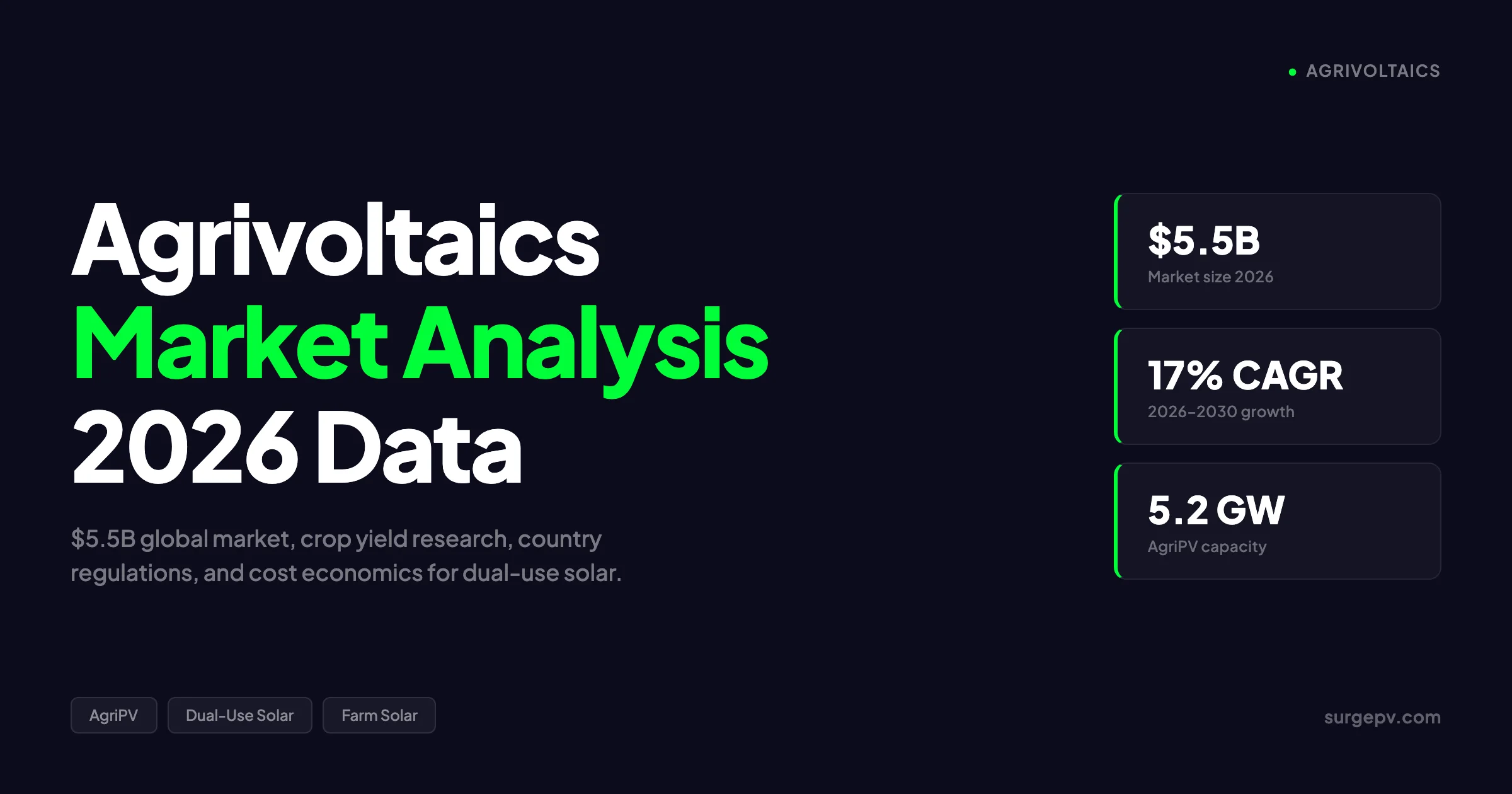
Agrivoltaics — farming and solar generation on the same land — crossed a $5.5 billion global market in 2026, according to consensus estimates from Research and Markets, The Business Research Company, and Coherent Market Insights. The surprising part is not the number. It is that roughly two-thirds of installed capacity sits in just three countries: Japan, France, and China. The rest of the world is still figuring out whether agrivoltaics is a genuine dual-use solution or a regulatory workaround for building solar on farmland. Also see: France solar feed-in tariffs. See our guide on Agricultural Solar Case Study for more.
This guide cuts through the marketing. We cover the actual 2026 market data, what NREL and Fraunhofer ISE crop research really shows, the regulatory frameworks that determine where projects get built, and the cost economics that decide whether a project actually pencils out. If you are a developer, farmer, or investor evaluating agrivoltaics, the data below is what you need before making a decision.
Quick Answer — Agrivoltaics Market 2026
Global market: ~$5.5 billion. Installed capacity: ~18–20 GW worldwide. Leading markets: Japan (6,100+ sites), France (strict APER Law framework), Italy (1.4 GW tendered), Germany (DIN SPEC 91434 standard). Crop yield impact: shade-tolerant crops often match or exceed full-sun yields in hot climates; high-light cereals need elevated panels above 2.1 m. LCOE premium over ground-mount: 4–148% depending on design. Growth forecast: 10.8–11.5% CAGR through 2030.
See our guide on Commercial Rooftop Solar Case Study Italy for more. For Germany-specific information, see Community Solar Projects Germany.
In this guide:
- Agrivoltaics market snapshot 2026 — size, growth, and key countries
- What agrivoltaics is and how dual-use solar actually works
- Crop data — which crops thrive under solar panels and which do not
- Country-by-country regulatory landscape: France, Italy, Japan, Germany, US, China
- What most agrivoltaics reports get wrong — a contrarian view
- Cost economics — can dual-use solar compete with ground-mount?
- Technology and design: tracking, height, spacing, and panel selection
- 2027–2030 market outlook
- Practical implications for farmers and developers Also see: solar panel ROI in Italy. Also see: Germany solar subsidies.
Agrivoltaics Market Snapshot 2026
The agrivoltaics market in 2026 sits at an inflection point. After a decade of pilot projects and regulatory ambiguity, several major markets have established clear rules. That clarity is translating into pipelines.
Global Market Size and Growth
| Metric | 2024 | 2026 (Est.) | 2030 (Proj.) | CAGR |
|---|---|---|---|---|
| Market size | ~$4.2B | ~$5.5B | ~$8.5B | 10.8–11.5% |
| Installed capacity | ~14 GW | ~18–20 GW | ~35–40 GW | 15–20% |
| Active countries with regulations | 8 | 12+ | 20+ | — |
| Major tender volumes | 0.8 GW | 2.5+ GW | 5+ GW | — |
Sources: Research and Markets 2026, The Business Research Company 2026, SolarPower Europe Agrivoltaics Report 2024, IEA-PVPS T13-29 2025. Also see: European Solar Tax Credits.
The capacity CAGR of 15–20% outpaces the revenue CAGR because module costs continue to fall. A gigawatt of agrivoltaics capacity in 2026 costs less than a gigawatt in 2024, even with elevated mounting structures. For developers evaluating project economics, solar design software with integrated agrivoltaics modeling helps optimize the tradeoff between panel density and crop viability before breaking ground. See Solar Racking Design Guide for detailed guidance.
Installed Capacity by Country/Region (2026 Estimate)
| Country/Region | Estimated Capacity | Key Driver |
|---|---|---|
| Japan | 4–5 GW | 6,137 approved sites; FIT/FIP support; March 2026 national benchmarks |
| China | 3–4 GW | Large-scale pilot programs; government-funded research stations |
| France | 2–3 GW | APER Law; 40% GCR limit; active commercial pipeline |
| Italy | 1.5–2 GW | 1.4 GW tendered; PNRR Agri-PV grants; Transizione 5.0 tax credit |
| Germany | 1–1.5 GW | DIN SPEC 91434; EEG tender bonuses; peatland incentives |
| United States | 0.5–1 GW | NREL InSPIRE research; state-level programs (MA, NY, CO) |
| Rest of world | 1–2 GW | India, South Korea, Australia, Chile pilot projects |
Japan’s dominance in site count — over 6,100 approved installations covering 1,361 hectares by end of fiscal 2023 — reflects a permissive early regulatory approach. That approach is now tightening. In March 2026, Japan established national benchmarks requiring roughly 3-meter panel heights, 4–5 meter pillar spacing, and shading ratios below 30%. The Ministry of Agriculture suspended FIT/FIP payments for 29 non-compliant installations in 2024, signaling that the era of loose oversight is ending.
Key Takeaway — Market Concentration
Agrivoltaics in 2026 is not a global market. It is a collection of national markets with little cross-border standardization. A project design that passes in Germany may fail in France. A crop rotation that works in Japan may be unsuitable for Italy. Developers must treat each country as a distinct regulatory and agronomic environment.
For Global-specific compliance details, see Global net-metering-by-country.
What Is Agrivoltaics — How Dual-Use Solar Works
Agrivoltaics, also called agri-PV or dual-use solar, places solar photovoltaic panels above actively farmed land. The panels generate electricity while the land continues producing food, forage, or livestock. The concept is simple. The execution is not. For installers new to dual-use projects, solar software that models both energy yield and ground-level shading simplifies the design process significantly.
Three Basic Design Categories
| Category | Panel Height | Typical Use | Agricultural Impact |
|---|---|---|---|
| Elevated fixed-tilt | 2.1–5.0 m | Row crops, machinery access | Moderate shade; full mechanization possible |
| Low fixed-tilt | 0.5–1.5 m | Grazing, specialty crops | High shade; limited machinery; simpler structure |
| Tracking (single or dual-axis) | 2.5–4.0 m | High-value crops, research | Dynamic shade; maximum energy; complex controls |
The design choice determines everything: which crops can grow, what machinery fits beneath, how much energy the system produces, and whether the project meets regulatory thresholds.
The Microclimate Effect
Solar panels alter the environment beneath them in measurable ways:
- Temperature reduction: 5–9°C cooler under panels in summer, according to NREL InSPIRE measurements at multiple US sites
- Evapotranspiration reduction: 14–50% less water loss, depending on panel density and crop type
- Light diffusion: Partial shade reduces direct irradiance but can increase diffuse light, which some crops use more efficiently
- Wind protection: Panels reduce wind speed at crop level, lowering desiccation stress
These effects help in hot, dry climates. They can hurt in cool, wet climates where crops already struggle for light. This climate dependency is the single most misunderstood aspect of agrivoltaics.
Energy Yield Tradeoff
Agrivoltaics produces less electricity per hectare than ground-mount solar. The reasons are straightforward:
- Wider row spacing to let light reach crops
- Elevated structures that may reduce optimal tilt angles
- Tracking systems that prioritize crop light over maximum energy capture
Fraunhofer ISE estimates that elevated agrivoltaics at 5 meters with standard crop spacing achieves roughly 75% of the energy yield per hectare compared to dense ground-mount PV. Italy’s regulations require a minimum 60% PV yield relative to conventional systems. France caps ground coverage at 40%. These rules effectively embed the energy-agriculture tradeoff into law.
For developers accustomed to maximizing MW-per-hectare, agrivoltaics requires a different mindset. The revenue model shifts from pure energy sales to energy plus agricultural output plus potential policy premiums for dual-use land.
Crop Data — Which Crops Thrive Under Solar Panels
The most common misconception about agrivoltaics is that it always reduces crop yield. The data says otherwise — but only for specific crops, climates, and designs.
NREL InSPIRE Research: Key Findings
NREL’s Innovative Solar Practices Integrated with Rural Economies and Ecosystems (InSPIRE) project has run field trials at over 30 US sites since 2015. The 2024–2025 publications provide the most robust crop yield dataset available.
| Crop | Location | Yield vs. Full Sun | Water Use | Notes |
|---|---|---|---|---|
| Chiltepin peppers | Biosphere 2, Arizona | +200% (3x) | Reduced | Extreme heat mitigation; ~9°C cooling |
| Tomatoes | Biosphere 2, Arizona | +100% (2x) | −30% | Best in hot, dry years |
| Soybeans | Rutgers, New Jersey | + (significant) | Neutral | Higher yields under single and double AV panels (P=0.0114) |
| Kale | Massachusetts | Linear increase with spacing | Neutral | Wider spacing (0.6–1.5 m) = higher yield |
| Broccoli | Massachusetts | Variable | Neutral | Shade moves with trackers; year-to-year weather matters |
| Jalapeño peppers | Biosphere 2, Arizona | Slight reduction | Reduced | Less tolerant than chiltepin |
| Leafy greens | Multiple sites | +8–18% | −20–35% | Consistent positive in warm climates |
| Chili peppers, strawberries, eggplant | MIT-Lincoln Lab | Up to +17% | Reduced | Under 35% PV shading |
Sources: NREL InSPIRE publications 2024–2025, Rutgers Agrivoltaics Program 2024, npj Sustainable Agriculture 2025.
Crop Suitability Matrix
| Crop Type | Shade Tolerance | Best Climate | Panel Height Needed | Water Savings |
|---|---|---|---|---|
| Lettuce, spinach, kale | High | Warm, sunny | 2.1–3.0 m | 20–35% |
| Strawberries, raspberries | High | Temperate to warm | 2.1–3.0 m | 15–25% |
| Tomatoes, peppers, eggplant | Moderate | Hot, dry | 2.5–4.0 m | 20–50% |
| Potatoes, carrots | Moderate | Temperate | 2.5–3.5 m | 10–20% |
| Wheat, barley (winter) | Low–moderate | Temperate | 3.0–5.0 m | Minimal |
| Corn, soybeans | Low | Temperate to warm | 3.0–5.0 m | Minimal |
| Grapes, olives | Moderate | Mediterranean | 2.5–4.0 m | 15–30% |
| Sheep grazing | N/A (forage) | All | 0.8–1.5 m | N/A |
Pro Tip — Crop Selection for Agrivoltaics Developers
Do not select crops based on energy yield optimization. Select crops based on (1) local market demand and price stability, (2) shade tolerance verified in similar climates, (3) compatibility with available panel height and machinery clearance, and (4) water savings potential if irrigation costs are high. A crop that yields 10% less under panels but sells at a 40% premium due to water-stress branding may be more profitable than maximum-yield commodity crops.
The Misconception: “Agrivoltaics Halves Crop Yield”
This claim appears frequently in opposition to solar projects on farmland. It is wrong for most shade-tolerant crops and wrong for well-designed elevated systems on high-light cereals.
NREL’s 2025 research in npj Sustainable Agriculture found that agrivoltaics mitigated midday photosynthesis depression in dryland regions, producing equal or greater yields across all tested crops. The key phrase is “well-designed.” A low-mount system with 60% ground coverage will reduce yields on most crops. A 3-meter elevated system with 30% coverage and wide spacing may not.
Germany’s DIN SPEC 91434 explicitly allows up to 34% crop yield reduction (66% of reference yield) for Category II systems. France requires 90% minimum. Italy does not specify a yield threshold but requires agricultural continuity. The range of acceptable outcomes is wide — and that range is where most project failures happen.
Country-by-Country Regulatory Landscape
Agrivoltaics regulation in 2026 varies from prescriptive engineering standards to broad principles. Understanding the differences is essential for project development.
France: The Strictest Agricultural-First Framework
France’s APER Law (March 2023) and implementing Decree No. 2024-318 (April 2024) create the world’s most demanding agrivoltaics standard.
| Requirement | Specification |
|---|---|
| Minimum relative crop yield | 90% compared to nearby control plot |
| Maximum Ground Coverage Ratio (GCR) | 40% |
| Maximum non-farmable area | 10% of total installation surface |
| Farmer income protection | Must not decrease vs. 5-year pre-installation average |
| Required services | At least one of: enhanced agronomy, climate adaptation, hazard protection, or animal welfare |
| Operational period | 40 years (extendable to 50) |
| Decommissioning guarantee | €1,000/MWp under 10 MWp; €10,000/MWp above |
| Compliance monitoring | Expert report at 5 years, then every 3–5 years |
France’s February 2025 DGEC guidance clarified application conditions, but the core principle has not changed: agrivoltaics in France must demonstrably improve or maintain agricultural output. Projects that cannot prove this with a control plot and expert monitoring do not qualify.
The French framework has three tiers: (1) strict “agrivoltaism” on productive farmland, (2) “PV compatible” on designated degraded land with lighter rules, and (3) ad-hoc authorized projects for specific cases. Most commercial interest sits in tier 1, where the agricultural bar is highest.
Italy: Redefining Agrivoltaics by Agricultural Continuity
Italy’s November 2025 Transizione 5.0 decree made a significant shift. Agrivoltaics is no longer defined by panel height. It is defined by “continuity of crop and grazing activities.” Panel rotation and digital agriculture tools are now explicitly permitted.
| Requirement | Specification |
|---|---|
| Maximum Land Area Occupation Ratio (LAOR) | 40% |
| Minimum PV yield vs. conventional | 60% |
| Maximum lost area | 30% |
| Minimum heights | 1.3 m with animals; 2.1 m with crops |
| Permitting | Centralized “Autorizzazione Unica” with reduced regional influence |
| Tax credit | Transizione 5.0 — €250 million allocated for 2025 |
| Capital grant | Up to 40% of qualifying costs |
Italy awarded 1.4–1.5 GW in oversubscribed agriPV tenders, with approximately €325 million in remaining grant funds as of mid-2025. The PNRR (National Recovery and Resilience Plan) committed €1.5 billion to agri-photovoltaic projects, processed through GSE.
For Italian solar developers, agrivoltaics offers a regulatory pathway to build on agricultural land that is now restricted for conventional ground-mount solar under the May 2024 restrictions on productive farmland.
Germany: The Pioneer Standard
Germany adopted DIN SPEC 91434 in May 2021, making it the first national agrivoltaics standard. The philosophy is “agriculture first.”
| Requirement | Category I | Category II |
|---|---|---|
| Minimum height | 2.1 m | under 2.1 m |
| Crop area | Everywhere except racking | Between rows only |
| Maximum lost area | 10% | 15% (interspace) |
| Maximum crop yield reduction | Not specified | 34% (66% reference) |
| EU subsidy eligibility | Yes (if ≤15% land reduction) | Conditional |
Germany’s EEG 2023 requires operators above 1 MW DC to participate in tenders with technology bonuses. Additional subsidies exist for agrivoltaics on drained peatland, where rewetting and solar together address both climate and land-use goals. See Design Commercial Solar System 1MW for detailed guidance.
Fraunhofer ISE and the Thunen Institute continue to refine German agrivoltaics economics. Their February 2026 analysis found German agrivoltaic LCOE ranges from 4% to 148% higher than conventional ground-mount, with apple orchard applications at the high end and grazing systems at the low end.
Japan: From Permissive to Prescriptive
Japan had the most permissive agrivoltaics regime in the early 2020s. The result was rapid growth — 6,137 sites by end of fiscal 2023 — but also problems. MAFF found farming issues at 24% of sites in fiscal 2023, up from 22% the prior year.
The March 2026 national benchmarks represent a major tightening:
| Parameter | New Benchmark |
|---|---|
| Panel height | ~3 meters |
| Support pillar spacing | 4–5 meters (for farm machinery) |
| Shading ratio | Below 30% |
| Minimum agricultural yield | 80% compared to pre-installation |
| Documentation required | Cultivation plans, financial projections, equipment designs |
| Annual reporting | Production and financial reports mandatory |
| Enforcement | FIT/FIP suspension for non-compliance; public disclosure |
Japan’s FIT/FIP payments for solar currently run at approximately JPY 10 ($0.06)/kWh. At these levels, agrivoltaics economics depend heavily on land cost savings and agricultural output. The new benchmarks will likely slow site growth but improve project quality.
United States: Fragmented by State
The US has no federal agrivoltaics standard. Regulation is a patchwork:
- Massachusetts: SMART program offers agrivoltaics adders; requires 10-foot vertical clearance for certain incentives
- New York: NYSERDA research programs; no comprehensive standard yet
- Colorado: Research-focused; wide-row agrivoltaics (31.7+ ft spacing) studied for large-scale crop compatibility
- Arizona/New Mexico: NREL InSPIRE sites; favorable solar resource but water scarcity drives agrivoltaics interest
- California: Emerging interest; no statewide standard; local agricultural commissions have veto power
NREL’s InSPIRE project provides the research backbone, but policy has not caught up. The 2024 technical report “The 5 Cs of Agrivoltaic Success” identified consistent success factors, yet no state has codified them into binding rules.
China: Scale Without Transparency
China operates large agrivoltaics pilot programs, particularly in arid northwestern provinces where solar-plus-agriculture addresses both energy and desertification goals. Specific capacity figures and regulatory details are less transparent than in European or Japanese markets. The IEA-PVPS T13-29 2025 report estimates China at 3–4 GW of agrivoltaics capacity, much of it government-funded research or state-owned enterprise projects.
What Most Agrivoltaics Reports Get Wrong
The agrivoltaics industry has a credibility problem. Too many reports mix pilot project enthusiasm with commercial reality. Here are three claims that do not hold up to scrutiny.
Claim 1: “Agrivoltaics Is a Win-Win for Everyone”
It is not. Agrivoltaics is a win for some stakeholders under specific conditions. It is a loss for others.
Who wins: Farmers with high irrigation costs in sunny climates; developers with access to premium feed-in tariffs or PPAs; policymakers facing farmland preservation pressure.
Who loses: Developers expecting ground-mount energy yields; farmers growing high-light cereals under low-mount systems; taxpayers funding projects that fail agricultural compliance tests.
The Solarplaza Agri-PV Europe 2026 conference identified “three hard truths” about European agrivoltaics: (1) most projects are still not bankable at scale, (2) agricultural compliance costs are underestimated, and (3) the LCOE premium makes agrivoltaics dependent on policy support that may not last.
Claim 2: “Any Crop Can Grow Under Solar Panels”
False. Crop selection is the single most important determinant of project success. NREL’s data is clear: chiltepin peppers tripled in yield under panels in Arizona. Jalapeño peppers at the same site saw slight reductions. The difference is not the panels. It is the crop’s shade tolerance, heat response, and water needs.
Corn and wheat — the world’s most important staple crops — require either very high panel mounting (3+ meters) with wide spacing or they suffer yield losses. A 2025 Rutgers study found soybeans performed well under elevated panels, but this is one crop in one region. Generalizing from specialty crop success to global food security is a category error.
Claim 3: “Agrivoltaics Solves the Land-Use Conflict”
It addresses the conflict. It does not solve it. Agrivoltaics still consumes land that could produce more food or more energy if used for a single purpose. The Land Equivalent Ratio (LER) measures whether the combined output exceeds either standalone use. LER values of 1.0–1.5 are common in research, meaning agrivoltaics can outperform single-use land. But LER above 1.3 is rare in commercial projects, and LER below 1.0 means the land would produce more value as either pure farm or pure solar.
The honest framing: agrivoltaics is a land-use compromise that works when policy, climate, crop selection, and energy pricing align. It is not a universal solution.
Further Reading
For a deeper technical look at agrivoltaics system design, see our guides to agrivoltaics design principles and solar panel spacing for agricultural applications. For the broader policy context in Europe, see EU solar energy policies and European solar incentives.
Design Agrivoltaics Projects with Crop-Specific Shading Models
SurgePV’s solar design software models panel shading, row spacing, and tilt angles for dual-use solar installations. Calculate energy yield and ground-level irradiance simultaneously to optimize for both crop health and power output.
Book a DemoNo commitment required · 20 minutes · Live project walkthrough
Cost Economics — Can Dual-Use Solar Compete?
The economics of agrivoltaics depend on three revenue streams and one cost premium.
Revenue Streams
| Stream | Typical Share | Key Variables |
|---|---|---|
| Energy sales (FIT, PPA, or merchant) | 75–90% | Tariff rate, capacity factor, grid access |
| Agricultural output | 10–25% | Crop type, yield, market price, organic premium |
| Carbon credits / ecosystem services | 0–5% | Certification, buyer demand, registry rules |
A typical 10-acre agrivoltaics farm generates approximately $85,000 annually versus $32,000 from traditional farming alone, according to 2025 economic modeling. The solar revenue dominates. This is an energy project with agricultural compliance, not a farm with solar panels.
Cost Economics Comparison
| Cost Item | Ground-Mount PV | Agrivoltaics (Elevated) | Agrivoltaics (Low-Mount) |
|---|---|---|---|
| CAPEX per kWp | $700–$1,000 | $1,000–$1,500 | $800–$1,100 |
| Mounting structure | Standard | Elevated, reinforced | Simplified low-profile |
| Installation labor | Standard | +20–40% (height) | +5–15% |
| OPEX per kWp/year | $12–$18 | $10–$15 | $11–$16 |
| LCOE premium vs. ground-mount | Baseline | +4% to +148% | +10% to +40% |
| Land cost offset | None | Partial (dual-use rent) | Partial |
Sources: Fraunhofer ISE 2024, Thunen Institute / PV Magazine February 2026, IEA-PVPS T13-29 2025, Cornell University economic analysis 2024.
The LCOE range is wide because “agrivoltaics” covers many designs. A sheep-grazing system at 1.2 meters with minimal structure adds little cost. A 5-meter elevated system with wide spacing for combine harvesters adds significant cost. Fraunhofer ISE’s Schindele et al. found 38% higher LCOE for 5-meter systems with 25% capacity reduction from spacing.
Land Preservation Cost: A Hidden Factor
A February 2026 PV Magazine article highlighted research arguing that land preservation costs should be factored into agrivoltaics LCOE calculations. The logic: if agrivoltaics preserves agricultural land that would otherwise be lost to ground-mount solar, that preservation has economic value.
| System Type | Land Preservation Cost |
|---|---|
| Medium-height agrivoltaics | €8,000–€26,000 per hectare per year |
| High-mounted structures | €42,000–€75,000 per hectare per year |
These figures represent the opportunity cost of not converting the land to pure solar. Whether they should be added to or subtracted from LCOE depends on whether you view land preservation as a cost or a benefit.
The Break-Even Question
Can agrivoltaics compete without subsidies? In most markets, the answer in 2026 is no — not at utility scale against ground-mount PV. The LCOE premium is too large.
But agrivoltaics can compete in specific niches:
- Premium FIT/PPA markets: Japan’s FIT, France’s feed-in premiums, Italy’s agriPV tenders all pay above merchant rates
- High land-value areas: Where farmland costs make ground-mount solar uneconomical, dual-use can unlock otherwise unavailable land
- Water-stressed regions: Irrigation savings of 20–50% translate directly to cost reductions in arid climates
- Regulatory-constrained markets: Where ground-mount solar on farmland is banned, agrivoltaics is the only option
For farmers, the decision is simpler. If a solar developer offers a land lease that exceeds farming net income, the farmer wins regardless of LCOE comparisons. The risk is long-term soil health and the reversibility of the installation.
Technology and Design — Tracking, Height, Spacing
Agrivoltaics technology is evolving rapidly. The 2026 design landscape includes several approaches, each with distinct tradeoffs.
Fixed-Tilt vs. Tracking
| Design | Energy Yield | Crop Flexibility | Cost | Best For |
|---|---|---|---|---|
| Fixed-tilt elevated (2.5–5 m) | Baseline | High | Medium | Row crops, machinery access |
| Fixed-tilt low (0.8–1.5 m) | +5–10% vs. elevated | Low | Low | Grazing, specialty crops |
| Single-axis tracking | +15–25% | Moderate | High | Research, high-value crops |
| Dual-axis tracking | +25–35% | High (precise control) | Very high | Premium installations |
| Vertical bifacial | +10–20% | Very high | Medium | Wide-row crops, east-west layouts |
Single-axis tracking is gaining interest because it can adjust shading throughout the day. NREL’s Massachusetts research found that tracker shade movement affected broccoli yields differently depending on panel position. The challenge is cost: tracking adds $0.20–$0.40/W to system cost, which is hard to justify when agricultural revenue is only 10–25% of total.
Panel Height and Machinery Clearance
| Equipment | Minimum Clearance | Typical Panel Height |
|---|---|---|
| Sheep, chickens | 0.8–1.2 m | 1.0–1.5 m |
| Small tractors, sprayers | 2.0–2.5 m | 2.5–3.0 m |
| Large tractors, harvesters | 3.0–4.0 m | 3.5–5.0 m |
| Combine harvesters | 4.0+ m | 4.5–5.5 m |
Japan’s new 3-meter benchmark targets standard farm machinery. Germany’s 2.1-meter Category I threshold assumes smaller equipment. France does not specify height but caps ground coverage at 40%, which effectively requires spacing that accommodates machinery.
Spacing and Ground Coverage
Row spacing is the most underappreciated design variable. NREL’s 2025 Massachusetts study found kale showed linear yield increases as inter-panel spacing widened from 0.6 meters to 1.5 meters. Colorado research in 2026 found wide-row agrivoltaics at 31.7+ feet (9.7+ meters) could be economically justified for large-scale crop production, generating approximately $200 per acre in agricultural profit alongside solar revenue.
The tradeoff is energy density. Wide spacing means fewer panels per hectare, which means lower MW capacity and lower total energy revenue. The optimal spacing depends on the relative value of energy versus crops in each market.
Emerging Technologies (2025–2026)
- Semi-transparent panels: Allow controlled light transmission; still expensive but promising for high-value greenhouse crops
- Spectral selective panels: In development; transmit photosynthetically active wavelengths while capturing unused spectrum
- AI-driven dynamic tracking: AGRISOLEO (France) patented systems that position mobile panels according to plant physiological needs
- IoT sensor networks: Monitor soil moisture, temperature, light levels for automatic panel adjustment
Most of these remain pilot-stage in 2026. The dominant commercial designs are elevated fixed-tilt and low-mount grazing systems.
2027–2030 Market Outlook
The agrivoltaics market faces a critical transition from pilot to commercial scale. Three factors will determine whether that transition succeeds.
Growth Projections
| Year | Market Size (Proj.) | Installed Capacity (Proj.) | Key Assumptions |
|---|---|---|---|
| 2027 | ~$6.2B | ~23–25 GW | Italy and France tenders scale; Japan benchmarks take effect |
| 2028 | ~$6.9B | ~28–32 GW | Module costs fall further; US state standards emerge |
| 2029 | ~$7.7B | ~33–38 GW | Bankability standards converge; insurance products mature |
| 2030 | ~$8.5B | ~40–45 GW | Multi-GW annual additions in EU; Asia-Pacific expansion |
Sources: Research and Markets 2026, Knowledge Sourcing 2026, SolarPower Europe Agrisolar projections.
Key Growth Drivers
-
Regulatory blocking of ground-mount solar on farmland: France, Italy, and Germany have all restricted or banned conventional solar on productive agricultural land. Agrivoltaics is the compliance pathway.
-
Water scarcity: The UN estimates 2.3 billion people live in water-stressed countries. Agrivoltaics’ 20–50% irrigation reduction is a genuine value proposition in arid and semi-arid regions.
-
Falling module costs: BloombergNEF projects utility-grade modules at $0.08–$0.10/W by 2030. At these prices, the elevated structure premium becomes a smaller share of total project cost.
-
Energy security policy: Post-2022 European energy crisis accelerated renewable deployment targets. Agrivoltaics addresses both energy and food security simultaneously.
Key Risks
| Risk | Impact | Probability |
|---|---|---|
| FIT/PPA rate cuts | Makes LCOE premium unviable | Medium (Japan, Italy) |
| Agricultural compliance failures | Project shutdowns, subsidy clawbacks | Medium-High (France, Japan) |
| Crop yield shortfalls | Revenue miss, farmer disputes | Medium |
| Grid connection queues | Delays, cost overruns | High (EU urban areas) |
| Technology cost stagnation | LCOE premium persists | Low |
The SolarPower Europe Potential
SolarPower Europe’s Agrisolar platform calculated that covering just 1% of EU Utilised Agricultural Area could host approximately 944 GW of agrivoltaics capacity. Covering 5% yields 1.5–7 TW. These are theoretical maximums, not projections. But they illustrate the scale of the opportunity if regulatory and economic barriers fall.
For context, the EU’s total installed solar capacity at end of 2025 was approximately 338 GW. Agrivoltaics on a tiny fraction of farmland could multiply that several times over — if the agricultural compliance, cost, and grid integration challenges are solved.
Practical Implications for Farmers and Developers
For Farmers
Agrivoltaics is not a passive land lease. It requires active agricultural management, compliance reporting, and often multi-year crop planning. Before signing any agreement:
- Verify the developer’s agricultural track record. Ask for references from operating projects with the same crop type and climate.
- Understand the reversibility terms. Can panels be removed at end of contract? Who pays? France mandates decommissioning guarantees. Other markets may not.
- Model crop revenue under shade. Do not rely on developer projections. Run your own numbers with conservative yield estimates.
- Check machinery access. Will your existing equipment fit beneath the panels? If not, factor equipment replacement or rental into the economics.
- Review insurance requirements. Agrivoltaics may require separate coverage for the solar installation, crop loss, and liability.
For Developers
- Start with crop selection, not panel layout. The crop determines the height, spacing, and tracking strategy. Reversing this order produces non-compliant projects.
- Budget for agricultural expertise. Agronomists, soil scientists, and crop consultants are essential team members, not optional add-ons.
- Plan for 5-year compliance audits. France already requires them. Other markets will follow. Build the cost into project finance.
- Model conservative energy yields. Agrivoltaics produces 60–80% of ground-mount energy per hectare. Use realistic capacity factors in financial models.
- Secure grid connection early. Queue positions matter. A project with perfect agricultural design is worthless without a grid connection agreement.
For Investors
Agrivoltaics in 2026 is still an emerging asset class. The track record of operating projects at commercial scale is thin. Key due diligence questions:
- Has the project passed agricultural pre-approval in the relevant jurisdiction?
- What is the contractual structure for agricultural output — fixed rent, revenue share, or farmer-owned?
- Are FIT/PPA rates fixed or indexed? For how long?
- What happens if crop yields fall below regulatory thresholds?
- Is there a performing insurance market for agrivoltaics operational risk?
Pro Tip — Using Software for Agrivoltaics Design
Accurate shading and yield modeling is essential for agrivoltaics projects. Solar shadow analysis software that calculates hourly ground-level irradiance beneath panel rows helps agronomists and engineers agree on a design before construction. For financial modeling, a generation and financial tool with agrivoltaics-specific capacity factors and dual-revenue inputs produces bankable projections.
Conclusion
Agrivoltaics in 2026 is a $5.5 billion market with real growth potential, but it is not the universal solution some reports claim. The technology works for specific crops in specific climates under specific regulatory frameworks. The LCOE premium over ground-mount solar means agrivoltaics needs policy support, premium pricing, or water-scarcity economics to compete.
The countries getting it right — Germany with DIN SPEC 91434, France with APER Law, Japan with new national benchmarks — share one trait: they prioritize agricultural outcomes over energy maximization. Projects that treat farming as a compliance checkbox fail. Projects that integrate agronomy into design from day one succeed.
For the solar industry, agrivoltaics represents both an opportunity and a warning. The opportunity is access to land otherwise restricted for solar. The warning is that dual-use projects require dual expertise. Developers who lack agricultural competence should partner with those who have it, or stay out of the market.
Three actions for 2026:
- Match crop selection to climate and panel design before engineering any layout — crop-first design prevents compliance failures
- Budget 15–25% higher CAPEX than ground-mount and model conservative energy yields — the LCOE premium is real and project-killing if ignored
- Secure agricultural expertise and compliance monitoring contracts before financial close — regulators in France, Japan, and Germany are tightening enforcement, not loosening it
For the broader European solar context, see our guides to European solar market growth, EU solar energy policies, and solar panel ROI in Italy. For technical design guidance, explore solar design software with integrated shading and yield modeling. For proposal workflows, solar proposal software helps present agrivoltaics economics to clients with dual-revenue modeling.
Tools & Further Reading
Continue exploring related SurgePV resources:
Frequently Asked Questions
What is the agrivoltaics market size in 2026?
The global agrivoltaics market reached approximately $5.5 billion in 2026 according to consensus estimates from Research and Markets, The Business Research Company, and Coherent Market Insights. The market is projected to grow at 10.8–11.5% CAGR through 2030, driven by regulatory support in France, Italy, Germany, and Japan, plus falling solar module costs.
Do crops grow well under solar panels?
Crop performance under solar panels varies by species and climate. NREL’s InSPIRE research found chiltepin peppers tripled in yield and tomatoes doubled with 30% less water in hot, arid conditions. Leafy greens and berries often show neutral to positive yields. High-light staple crops like corn and wheat may see reductions unless panels are elevated above 2.1 meters with wide spacing. The key is matching crop type to panel height, spacing, and local climate.
Which countries have the best agrivoltaics regulations?
Germany has the most established framework with DIN SPEC 91434 requiring agriculture-first design and maximum 10–15% lost farmland. France’s APER Law mandates 90% minimum crop yield versus control plots and 40% maximum ground coverage. Italy’s November 2025 decree redefined agrivoltaics around agricultural continuity rather than panel height alone. Japan established national benchmarks in March 2026 with 3-meter panel heights and 4–5 meter pillar spacing. The US lacks federal standards, leaving regulation to individual states.
How much more does agrivoltaics cost than ground-mount solar?
Agrivoltaics carries an LCOE premium of 4% to 148% over conventional ground-mounted PV according to Fraunhofer ISE and Thunen Institute research. The premium depends heavily on mounting height, crop integration requirements, and spacing. Elevated structures at 5 meters add the most cost. However, OPEX runs approximately 13% lower than ground-mount due to reduced vegetation management when livestock graze beneath panels. Dual revenue streams — energy plus agriculture — often justify the premium.
What is the global agrivoltaics capacity in 2026?
Global installed agrivoltaics capacity reached approximately 14 GW by end of 2024 according to SolarPower Europe, growing to an estimated 18–20 GW by mid-2026. Italy awarded 1.4–1.5 GW in agriPV tenders. Japan leads in site count with over 6,100 approved installations covering 1,360 hectares. France and Germany are scaling from pilot programs to commercial pipelines. Asia-Pacific is the fastest-growing region. For Asia-Pacific-specific compliance details, see Asia-Pacific solar compliance.
What crops work best for agrivoltaics?
Shade-tolerant crops perform best: leafy greens (lettuce, spinach, kale), berries (strawberries, raspberries), herbs, and certain vegetables (tomatoes, peppers, eggplant). NREL data shows these crops often match or exceed full-sun yields in hot climates while using 20–50% less water. High-light cereals (corn, wheat, soybeans) require elevated panels above 2.1 meters with wide row spacing to avoid yield loss. Grazing livestock — sheep, chickens — is the simplest agrivoltaics application with near-zero crop impact.
Is agrivoltaics profitable for farmers?
Yes, when designed correctly. Dual-revenue agrivoltaics can increase land revenue 4–15x compared to farming alone, with energy generation providing 75–90% of total revenue. A typical 10-acre farm generates approximately $85,000 annually under agrivoltaics versus $32,000 from traditional farming. However, profitability depends on securing grid connection, favorable feed-in tariffs or PPA pricing, and choosing crops that tolerate partial shade. The LCOE premium over ground-mount solar means agrivoltaics needs policy support or premium pricing to compete on energy economics alone.
What is the outlook for agrivoltaics through 2030?
The agrivoltaics market is projected to reach $9–10 billion by 2033 at approximately 10–11% CAGR. Key growth drivers include: (1) regulatory tightening that blocks pure ground-mount solar on farmland in France, Italy, and Germany; (2) Japan’s 6,000+ site pipeline expanding under new national benchmarks; (3) falling module costs making elevated structures more economical; and (4) water-stressed regions adopting agrivoltaics for irrigation savings. By 2030, covering just 1% of EU agricultural land could host roughly 944 GW of agrivoltaics capacity according to SolarPower Europe.
Where this fits
This article is part of SurgePV's Solar Business & Operations hub, which works through the topic from first principles to the decisions a project team actually has to make.

