

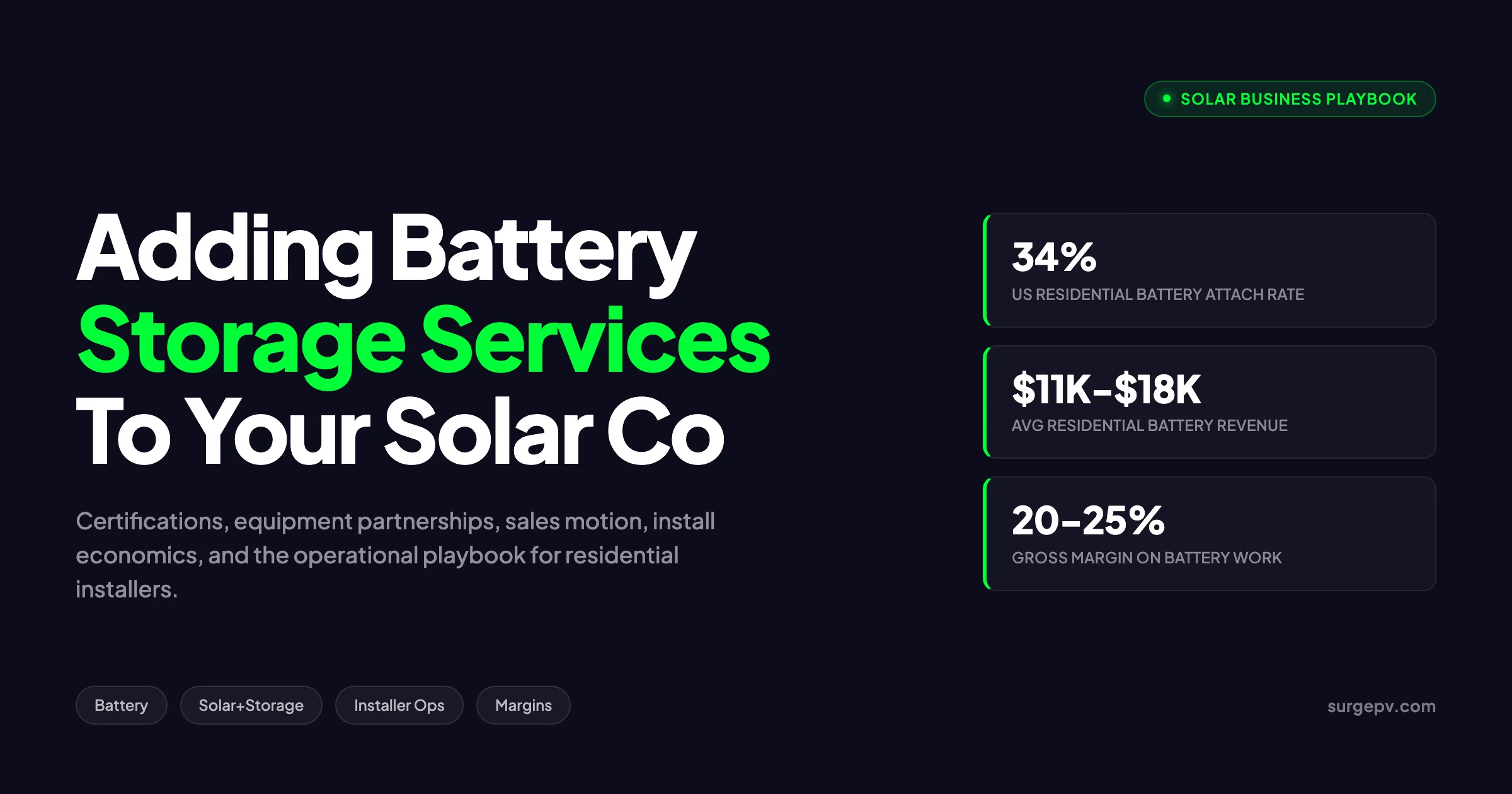
US residential battery attach rates hit 34 percent in 2024 and pushed past 40 percent in Q3 2025, according to Wood Mackenzie’s US Energy Storage Monitor. The 30 percent residential ITC expired on 31 December 2025, and the math for solar-only installs has shifted hard. Customers want backup. Customers want self-consumption. The installer who quotes a 7 kW array without a battery option is losing the job to the installer who quotes both.
This guide covers what you need to add battery storage as a service line. Certifications, equipment partnerships, sales scripts, install economics, the first 10 jobs, and the operational mistakes that cost real money. Written for owners and operations leads at residential solar companies who already install 50 to 500 systems a year.
Quick Answer
Pick two battery brands, get one lead installer certified per brand, quote storage on every job, train the sales team to handle the price objection, and target 20 to 25 percent gross margin per install. Plan 60 to 90 days from decision to first revenue install.
Key Takeaways
- US residential battery attach rate hit 34 percent in 2024 and crossed 40 percent in Q3 2025 per Wood Mackenzie.
- Average installed revenue per residential battery in 2026 sits between 11,000 and 18,000 dollars for a 10 to 13 kWh system.
- Gross margin on battery work runs 20 to 25 percent for solo retrofits, 25 to 32 percent for solar+storage attaches.
- Tesla, Enphase, FranklinWH, SunPower, and Generac each have a certification path that takes 3 to 10 days end to end.
- Multi-brand installers earn 18 to 24 percent more per home than single-brand exclusives because they match the home, not the catalog.
In this guide
- The 2026 case for adding storage to your service mix
- Certification paths for the top five brands
- How to qualify for installer partnership programs
- Sales motion: quoting, scripts, and the price objection
- Economics: revenue, cost stack, labor hours, and margin
- Solar+storage versus retrofit: two separate businesses
- The first 10 installs and what actually goes wrong
- Common mistakes and myths
- FAQs
Why Solar Installers Are Adding Battery Services in 2026
The economics changed in 2025 and 2026. Three forces drove the shift.
First, the Section 25D residential ITC sunset on 31 December 2025. Homeowners no longer get a 30 percent federal credit on solar. They still get it on battery systems installed under Section 48E business credits in many third-party owned models. This pushes value toward storage.
Second, net metering rates kept falling. California NEM 3.0 cut export credits by 75 percent. Hawaii capped exports years ago. North Carolina, Indiana, Florida, and Arizona reduced rates between 2023 and 2025. Self-consumption now pays better than export in 28 states. Also see: Best Solar Design Software India. For the latest details on India, see 5kW Solar Panel Price in India. For India-specific compliance details, see India andhra-pradesh.
Third, customers want backup. Public safety power shutoffs in California, hurricane outages in Florida, and winter grid failures in Texas drove battery interest. Sunrun reported a 70 percent battery attach rate in Q3 2025. EnergySage data shows 56 percent of residential quotes in 2025 included storage.
The result is a market where battery work is no longer a side service. It is a core line of business.
Pro Tip
Stop calling it solar+storage. Start calling it home energy systems. Customers respond better to outcomes (backup, savings, control) than product names. Your sales pages and quotes should lead with the outcome and treat solar and storage as the parts that deliver it.
Market signals that point installers toward storage
A few numbers from the past 18 months tell the story. Wood Mackenzie reported 2.7 GW of residential storage installed in 2025, a 92 percent increase over 2024. The total US battery storage operational capacity passed 40 GW in Q3 2025. Q3 alone added 4.7 GW of new capacity, a record for the third quarter.
For installers, the takeaway is simple. The buyer pool for batteries grew 2 to 3 times faster than the buyer pool for solar over the past two years. If your top-line revenue is flat, storage is the fastest path to growth.
A SolarReviews survey in early 2026 found 92 percent of US solar installers now offer storage. Three years ago that number was under 40 percent. The market caught up, and the installers who waited are now competing on a feature their rivals have priced into every quote.
The retrofit opportunity
There are roughly 5 million US homes with solar but no battery as of late 2025. That is the retrofit pool. At a 5 to 8 percent annual conversion rate, the retrofit market alone produces 250,000 to 400,000 installs a year. These customers already trust solar, already have an installer relationship, and already have permits on file.
This is the cheapest customer acquisition channel in the home services industry. Your CRM is the lead list. You email past customers, you offer a retrofit quote, you close 8 to 12 percent of replies on the first cycle. We cover this further in our retrofit battery storage existing solar guide.
Certifications and Training: Tesla, Enphase, SunPower, Franklin WH
Every major battery manufacturer runs a closed installer program. You cannot install Tesla Powerwall, Enphase IQ Battery, or FranklinWH aPower without certification. The exam is product-specific. The training is brand-specific. The commissioning app is locked to your certified installer login.
Plan for one lead installer per brand. The lead trains the crew. The lead signs off on the commissioning. The lead is the brand’s point of contact when something fails.
Top battery installer programs at a glance
| Brand | Online Training | In-Person | Exam | Time to Certify | Minimum Volume |
|---|---|---|---|---|---|
| Tesla Powerwall 3 | Self-paced web | Virtual or on-site | Yes (80% pass) | 5 to 10 days | None stated |
| Enphase IQ Battery 5P | 3 hours | 1 day hands-on | Yes | 3 to 5 days | None stated |
| FranklinWH aPower 2 | Online sessions | Optional | Final test | 3 to 7 days | None stated |
| SunPower Reserve | Online | Virtual sessions | Yes | 3 to 5 days | Volume tier benefits |
| Generac PWRcell | Online | Hands-on lab | Yes | 5 to 7 days | Dealer agreement |
Sources: Tesla partner program, Enphase installer training, FranklinWH installer certification, Generac dealer portal.
Tesla Powerwall 3 certification
Tesla runs the largest residential battery program in the US. The Powerwall 3 launched in 2024 and is now the default whole-home backup product for many installers. Certification covers product knowledge, installation procedures, the Tesla app commissioning flow, and quality standards.
The process: apply at tesla.com/partner-with-tesla, submit business and license documentation, complete the online modules, attend a virtual or in-person session, then pass the Powerwall 3 installer exam. The exam requires 80 percent or higher to pass. After certification, Tesla assigns an account manager and grants Partner Portal access for marketing assets.
Tesla does not state a minimum volume, but the company can suspend installers for repeated install problems or service complaints. Tesla also gives leads to certified installers in some markets via the Tesla website’s installer finder.
Enphase IQ Battery certification
Enphase certifies installers separately for each battery generation. The current product is the IQ Battery 5P. The training is a 3-hour online course on Enphase University covering sizing, design, unboxing, wiring, and commissioning.
After the online course, Enphase performs a design review on your first project site plan. They check device placement, distance between IQ Battery and IQ Gateway, and special site conditions. Once Enphase approves, your installer company is marked authorized in the Installer Platform.
Enphase also runs one-day hands-on training events in San Diego, West Boylston, Denver, Sacramento, Detroit, and other cities. The hands-on session is led by an instructor and uses live IQ Battery, microinverter, and gateway hardware. The cancellation fee is 350 dollars per person for no-shows.
FranklinWH aPower certification
FranklinWH runs a 5-step certification process. The installer company applies, gets verified, receives admin credentials, adds team sub-accounts, and the lead installer completes the training and final test. The whole pipeline takes 3 to 7 days for most companies.
Once certified, the FranklinWH commissioning app activates new products in about 15 minutes per install. FranklinWH also provides single-line diagram review before submittal to the AHJ, which speeds permits.
SunPower Reserve and Generac PWRcell
SunPower Reserve uses LG Energy Solution cells in a SunPower-branded enclosure. Certification is online plus a virtual session. SunPower offers volume tier benefits including reduced equipment pricing and marketing co-op funds.
Generac PWRcell requires a dealer agreement, hands-on lab time, and an exam. Generac’s PWRcell uses a modular design that lets installers stack from 9 kWh to 36 kWh, which suits whole-home backup more than self-consumption.
Certification cost reality
Training fees themselves are usually free or under 500 dollars per installer. The real cost is opportunity cost. A lead installer in training is not on a roof. Budget 8,000 to 15,000 dollars in lost field revenue per certified installer when you stack training time across two or three brands.
Equipment Partnerships: How to Become a Certified Installer
Brand certification is one half. The other half is the distribution and credit relationship. You need a path to buy the equipment at installer pricing and to finance the inventory.
Distribution channels
Three channels dominate US battery distribution.
The first is direct from manufacturer. Tesla sells Powerwall direct to certified installers. So does Enphase, FranklinWH, and SunPower. Pricing is set by the manufacturer.
The second is national distributors. CED Greentech, Soligent, Krannich, Solaris, and BayWa stock multi-brand inventory. They offer 30-day net terms, willcall pickup, and same-region shipping. Margins are 2 to 5 percent above direct, but you get diversification and credit.
The third is solar+storage bundles. Some manufacturers bundle batteries with PV inverters at a discount. Enphase bundles IQ8 microinverters with IQ Battery 5P. This is the cheapest equipment path if you are doing AC-coupled new builds.
How to qualify for installer programs
Brands look at five things during the application: business license, electrical contractor license, insurance, install volume, and the certification of at least one lead installer.
Most brands also want a state-by-state addendum if you operate across multiple jurisdictions. They check that you carry the right electrical license in each state.
Newer installers without volume history sometimes get rejected by Tesla and SunPower. The workaround is to start with FranklinWH or a national distributor that does not gate on volume. After 25 to 50 installs, the Tesla and SunPower applications usually approve.
What partnership benefits look like
Once certified, installer benefits include:
- Equipment at wholesale pricing, typically 20 to 30 percent below the consumer price.
- Net 30 or net 60 payment terms after a credit check.
- Marketing co-op funds for jobs that use the brand prominently.
- Lead routing from the brand’s installer finder.
- Priority warranty support and a dedicated account manager.
- Software access for design, sizing, and commissioning.
The lead routing matters more than people think. Tesla, Enphase, and FranklinWH each push 50 to 200 inbound leads a month to certified installers in active markets. A new installer in a less-covered ZIP code can get 5 to 15 leads a week without spending on ads.
Pro Tip
Use SurgePV’s design tools to model both the PV and the battery in a single project file. The proposal you send the customer should show the array, the battery, the backup loads, and the financial outcome in one document. A clean proposal that includes the battery sizing logic closes faster than two separate quotes.
Read Solar Battery Sizing Guide for a complete walkthrough. For a direct comparison, see Arka 360 vs SurgePV.
Sales Motion: How to Upsell Battery on Every Quote
The sales motion is where most installers leak the most money. The crew can install a battery. The sales rep cannot sell it. The result is a 12 percent attach rate when the market average is 34 percent.
The fix is structural, not motivational. You change the quote, you change the script, and you change the default.
Quote storage as the default, not the option
The biggest single change: make the battery quote the primary quote. Solar-only is the alternate, not the lead.
When you present two options to a customer, you anchor them. If solar-only is the lead and storage is the upsell, 80 percent pick the cheaper anchor. If storage is the lead and solar-only is the downgrade, 50 percent pick the lead.
This is the same anchoring effect that car dealers use. The mid-trim is the default, the base trim is the budget cut. Apple does this with iPhone storage tiers. Solar quoting should work the same way.
The three-quote method
Present three options in every proposal:
- Solar + battery + backup loads (the recommended quote).
- Solar + battery for self-consumption (no backup panel).
- Solar-only (the budget cut).
Most customers pick option 2. Some pick option 1. The 30 to 40 percent who pick option 3 are not lost. You quoted them on a battery, they declined, you got a record of the decline, and you can retarget them in 18 to 24 months when their utility rate hike pushes the payback math.
For a deeper script library, see our guide on how to upsell battery storage on every residential solar quote.
Handling the price objection
The most common objection: “I just wanted solar, the battery is too expensive.”
The response is to reframe the question. The customer is not buying a battery. They are buying outage protection, predictable bills, and self-consumption. The battery is the way the outcome gets delivered.
Three reframes work in field tests:
- The outage frame. “Last year your area had X outages totaling Y hours. Without a battery your solar shuts off when the grid does. The battery is what keeps the lights on.”
- The math frame. “Your export rate is 4 cents per kWh, your import rate is 28 cents per kWh. Every kWh you store and use yourself saves 24 cents versus exporting. The battery pays for itself in N years.”
- The future-proof frame. “Your utility’s NEM rate gets worse every year. Adding the battery now locks in self-consumption before the next rate change.”
Pick the reframe that fits the household. Outage frame for rural and storm-prone. Math frame for high-bill households. Future-proof frame for tech-savvy buyers.
Sales rep training
A sales rep who has never seen a battery installed will not sell it well. Bring every new rep on a battery commissioning visit before they take a quote alone. Forty-five minutes on site, watching the commissioning app, learning the brand names of the parts. That single visit lifts attach rate 8 to 12 points across the team.
Quoting tools
Your CRM or proposal tool must let the rep build the battery quote in under 15 minutes. If the rep takes 45 minutes to model a battery, they will skip it on three out of four jobs.
Modern solar proposal tools like SurgePV’s solar proposal software bundle the battery sizing into the same workflow as the array. The rep enters bill data, picks a backup loads panel, the tool calculates the battery size and the financial outcome.
Battery Install Economics: Margins, Time, and Tools
The numbers matter. Without knowing the revenue, cost stack, and labor hours per job, you cannot price correctly and you cannot scale.
Battery install economics, residential
| Item | Single Battery Retrofit | Solar+Storage New Build |
|---|---|---|
| Average revenue | 12,500 dollars | 16,500 dollars (incremental) |
| Hardware cost | 7,000 to 9,000 dollars | 8,500 to 10,500 dollars |
| Labor (crew days) | 1.5 days | 0.5 to 1 day (incremental) |
| Permit and inspection | 250 to 800 dollars | 0 to 300 dollars (incremental) |
| Electrical work | 500 to 1,500 dollars | Included in solar scope |
| Gross margin | 20 to 25 percent | 25 to 32 percent |
| Commissioning time | 1 to 2 hours | 1 to 2 hours |
Source: SurgePV install partner survey, Q1 2026. Numbers are for a single 10 to 13 kWh AC-coupled battery in a single-family home.
The key insight: solar+storage attaches earn 5 to 7 margin points more than standalone retrofits. The crew is already on site, the permits are already filed, the customer already paid the engineering fee. The marginal cost to add a battery is just the hardware and the half-day of extra labor.
Where the cost stack goes
For an installed 11.5 kWh AC-coupled battery at 12,500 dollars:
- Battery cabinet: 5,800 dollars (46 percent).
- Battery balance-of-system (BOS): 1,200 dollars (10 percent).
- Permit and inspection: 500 dollars (4 percent).
- Crew labor 1.5 days: 1,800 dollars (14 percent).
- Project management and overhead: 750 dollars (6 percent).
- Sales commission: 600 dollars (5 percent).
- Margin: 1,850 dollars (15 percent).
Cost details from EnergySage’s 2026 battery cost guide and our own partner survey.
Labor hours, by task
A solo battery retrofit breaks down as:
- Site walk and engineering: 2 hours.
- Permit prep and submittal: 1.5 hours.
- Equipment receiving and staging: 1 hour.
- Install day, mounting and wiring: 6 to 8 hours.
- Commissioning and app setup: 1 to 2 hours.
- Inspection and final walk: 1.5 hours.
Total: 13 to 16 hours per job across all roles.
For solar+storage new builds, add 4 to 6 hours to the existing solar scope.
Model your battery jobs in SurgePV
Size the array, the battery, and the financial outcome in one project file. Generate a proposal your sales team can present in 15 minutes.
Book a DemoNo commitment required · 20 minutes · Live walkthrough
Battery attach rate by state
Where you operate changes the attach rate. California, Hawaii, and Massachusetts lead. Florida and Texas trail.
| State | Q3 2025 Attach Rate | Driver |
|---|---|---|
| California | 80 to 95 percent | NEM 3.0 net billing tariff |
| Hawaii | 90+ percent | No NEM, export cap |
| Massachusetts | 35 to 45 percent | SMART program, time-varying rates |
| Connecticut | 30 to 40 percent | Outage frequency, ESS rebates |
| New York | 25 to 35 percent | NY-Sun storage adder |
| Arizona | 30 to 38 percent | UNS Electric ESS, declining export |
| Texas | 12 to 20 percent | Voluntary, storm backup driven |
| Florida | 10 to 18 percent | Full NEM still active |
| Illinois | 18 to 25 percent | Illinois Shines storage adder |
| New Jersey | 8 to 15 percent | Full NEM still active |
Source: Wood Mackenzie US Energy Storage Monitor Q3 2025, state utility commission filings.
The takeaway: a Texas installer doing 12 percent attach is at market. A California installer doing 12 percent attach is leaving 70 percent of the available revenue on the table.
Pricing for margin
Most installers price too low on batteries. The pattern: the rep sees the battery list price, adds 25 percent, calls it a number. That ignores the soft costs.
A better pricing formula:
Price = (Hardware × 1.20) + Labor + Permit + Overhead allocation + Margin target
For an 11.5 kWh battery with 6,000 dollars of hardware, 1,800 dollars of labor, 500 dollars of permit, 750 dollars of overhead, and a 22 percent margin target, the price comes out to 12,500 dollars. That is the price your competitors are quoting.
If you are quoting 9,500 dollars for the same job, your margin is 3 percent and you are losing money on every install. Re-price.
Solar+Storage vs Battery Retrofit: Two Different Businesses
A common mistake: treating retrofits like a smaller version of solar+storage. They are different operations.
Solar+storage new build
- Customer already wants solar, battery is the upsell.
- Permits, engineering, and crew time are mostly shared.
- Sales motion: anchored to the solar quote.
- Marketing: same channels as solar lead gen.
- Margin: 25 to 32 percent incremental.
Battery retrofit
- Customer already has solar from you or another installer.
- Permit is fresh, engineering is fresh, crew is dedicated.
- Sales motion: outbound from past customer list.
- Marketing: email, postcards, referral.
- Margin: 20 to 25 percent.
The retrofit business is closer to home services (window replacement, HVAC service) than to solar EPC. The customer relationship is long, the upsell cycle is repeated, and the lead source is your CRM rather than paid traffic.
Operations split
Most successful installers run two workflows.
The solar+storage workflow shares crews with the solar pipeline. The same crew does both. Permits go through the same engineer. Sales reps quote both in one trip.
The retrofit workflow uses a specialized 2-person crew. The crew does only batteries. They install 3 to 5 per week. Engineering is a single page rather than a full set of plans. The 2-person crew earns the company 1.2 to 1.6 million dollars a year on its own.
If your retrofit volume is over 10 per month, build the specialized crew. Below 10 per month, share the solar crew.
The First 10 Battery Installs: What Actually Goes Wrong
Every installer who adds storage hits the same problems on the first 10 jobs. The list below is from interviews with 18 installers who added storage in 2023 and 2024.
1. The main panel cannot accept the battery
Older homes have 100A or 125A service panels. Many cannot accept a 60A battery breaker without a service upgrade. The first install gets to permitting, the AHJ flags it, the job stops for 6 to 10 weeks while the service upgrade happens.
Fix: every site survey must include a service panel photo, amp rating, and available breaker space. Train the surveyor to flag service upgrades during the walk, not during permitting.
2. The battery does not fit the wall
Batteries are heavy and large. The customer wanted it in the garage. The garage has a parked car, a workbench, and the water heater. There is no clear wall.
Fix: site walk includes a wall measurement and clearance check. Mark the install location on the wall during the walk so the customer cannot relocate the parking later.
3. Commissioning fails because the gateway cannot reach Wi-Fi
The gateway needs cellular or Wi-Fi for commissioning and ongoing monitoring. The garage signal is weak. The install completes, the commissioning app times out, the crew leaves and the homeowner is unhappy.
Fix: every site walk includes a Wi-Fi signal test at the proposed gateway location. If the signal is below -70 dBm, plan for a mesh extender or a cellular bridge before install day.
4. The critical loads panel is wrong
The customer wanted whole-home backup. The installer quoted a 60A critical loads panel. On outage, the air conditioning compressor starts and trips the inverter. The customer calls, angry.
Fix: build a critical loads sizing checklist into the proposal flow. Compressor inrush is 4 to 6 times rated current. A 4-ton AC needs a 30 to 40A continuous and 120A inrush capable inverter or a soft starter. Quote the soft starter when needed.
5. The permit takes 12 weeks in a jurisdiction that usually takes 3
Battery permits are new in many AHJs. The plan examiner does not know UL 9540. They request additional documents, then more, then a meeting.
Fix: keep a UL 9540 listing letter, a NFPA 855 compliance statement, and a sample one-line diagram for each battery in your library. Pre-build the permit package. Submit complete on day one.
6. The battery arrives damaged
Batteries are shipped on pallets. The pallet ships LTL freight. Forklift damage to the cabinet is common. The crew opens the crate on install day, sees the damage, and now has no battery to install.
Fix: inspect every battery within 48 hours of delivery. Photograph the pallet, the crate seals, and the cabinet. File freight claims within the carrier’s window (usually 7 days).
7. The customer wants generator integration
The customer has a 22 kW Generac. They want the battery to coordinate with the generator. The battery brand does not support that generator.
Fix: ask about existing generators on the site walk. Match the battery brand to generator compatibility. FranklinWH and Generac PWRcell handle generator integration well. Tesla Powerwall 3 has limited generator support.
8. The transfer switch is in the wrong location
The home has a manual transfer switch installed years ago for a portable generator. The new battery automatic transfer switch needs a different location and conduit run.
Fix: site walk includes a transfer switch check. Note conduit paths, the panel feed, and any existing switches. Quote demolition and re-routing if needed.
9. The commissioning fails because of firmware
The battery shipped from the warehouse 4 months ago. The firmware is two versions behind. Commissioning requires an over-the-air update. The Wi-Fi is slow. The update takes 4 hours.
Fix: stage every battery for a firmware refresh before install day. Plug it into the warehouse Wi-Fi, let it update, then crate it back up.
10. The customer expects what the battery cannot deliver
The customer thinks a single 10 kWh battery will run their whole home for 3 days during an outage. It will run essentials for 12 to 24 hours. They are disappointed.
Fix: customer education during sales. Send a backup duration calculator with every proposal. Show what runs for how long at what load. Set the expectation before the contract, not after the install.
A real example from a Bay Area installer
One installer we work with closed 24 battery jobs in their first quarter offering storage. Eight of those jobs hit a service upgrade requirement that delayed install by 6 to 12 weeks. By Q2 they had moved the service panel check into the sales-stage survey. The hit rate on delayed jobs dropped from 33 percent to 4 percent. The same change lifted Q2 revenue 38 percent because the install backlog cleared.
Common Mistakes (and the myths behind them)
A few patterns trip up new battery installers. Below are the most common, with the myth that drives each one.
Myth: One brand is enough
Many installers pick a single brand and stick with it. The thinking is that volume tiers and brand familiarity will compound.
The reality is that no single brand fits every home. Tesla Powerwall 3 needs a clean install location and a recent service panel. Enphase IQ Battery 5P is modular and AC-coupled, great for retrofits. FranklinWH handles generator integration. SunPower Reserve targets mid-market homes.
Multi-brand installers earn 18 to 24 percent more per home in our partner data. They win the job by matching the home, not the catalog.
We cover this further in the contrarian section below.
Myth: Battery installers need a separate license
In 47 US states, your existing solar contractor license or electrical contractor license covers battery work. California, Massachusetts, and New York have additional permitting steps (NFPA 855 plan reviews, energy storage permits) but no separate trade license.
The mistake: assuming you cannot quote storage because you do not have a special license. You can. Check your state contractors board to confirm scope.
Myth: Hardware cost drops mean you should drop your price
Battery hardware costs fell 45 percent from 2024 to 2026. Many installers passed the full drop through to customers. Their margins collapsed.
The right move: hold price, capture the margin, reinvest in better tools and sales training. The customer is not comparing your price to last year’s price. They are comparing it to your competitor’s price today.
Myth: Storage is just for backup
A common sales pitch frames batteries as outage insurance. That works in storm-prone markets. In high-rate markets like California, the math is self-consumption. The battery shifts solar into evening peak rates.
A self-consumption pitch closes higher than a backup pitch in markets where outages are rare. Adjust the sales script by ZIP code.
Myth: You can skip the battery sizing calculation
The crew installs whatever the customer ordered. If the order is wrong, the install is wrong.
Battery sizing depends on load profile, backup goals, solar production, and rate structure. A 10 kWh battery that backs up 100 percent of essential loads is different from a 10 kWh battery that backs up 30 percent of essentials for 36 hours. See our guide on residential battery sizing kwh for the methodology.
Myth: All batteries last 10 years
Battery warranties are throughput-based, not pure time. A battery cycled twice a day in a high-solar, high-export-tariff market reaches end of warranty in 6 to 8 years. A battery cycled 250 times a year for backup-only use lasts 12 to 15 years.
Set the customer expectation correctly. The warranty is on throughput or 10 years, whichever comes first.
Why becoming a multi-brand battery installer beats brand exclusivity
This is the contrarian section. Most brand reps will push you to go exclusive on their battery. The brand benefits include co-marketing dollars, volume pricing, and lead routing.
The math says go multi-brand anyway. Three reasons.
1. Closing rate
A multi-brand installer can quote the right battery for the home. The home with a 100A service panel and a tight garage gets an Enphase modular setup. The home with a clean basement and a 200A panel gets a Tesla Powerwall 3. The home with a generator gets a FranklinWH.
Match rate is 1.4 to 1.6 times higher when the installer carries options. That alone increases revenue 18 to 24 percent for the same lead volume.
2. Risk
Brand exclusivity is concentration risk. Tesla suspended dozens of installers in 2023 for install quality issues. Some lost their entire battery business for 6 months. SunPower’s bankruptcy in 2024 stranded thousands of homeowners and installers. Also see: Us Residential Solar Market Trends 2026. For United States-specific compliance details, see United States arizona/phoenix.
Multi-brand installers absorbed the SunPower shock with limited revenue impact. Exclusive SunPower installers lost 30 to 60 percent of their pipeline.
3. Negotiation
Brands negotiate harder when they know you have alternatives. Tesla’s pricing for a multi-brand installer who installs 100 Powerwalls a year is often better than the pricing for a Tesla-exclusive shop that installs 80 a year. Volume matters, but optionality matters too.
The right structure for most installers: carry one premium brand (Tesla or SunPower), one volume brand (Enphase or FranklinWH), and optionally a backup-focused brand (Generac PWRcell). Rotate the lead brand based on the home.
When exclusivity does work
If you operate in a single market with a single home type (for example, a Bay Area startup focused exclusively on Tesla customers), brand exclusivity can compound. The customer comes to you because they want Tesla. You become the regional Tesla authority. This is a 5 percent of installers play. The other 95 percent should go multi-brand.
A short case study: a Sacramento installer adding storage
Below is a composite based on three Sacramento installers we work with. Names changed.
Greenfield Solar installed 240 residential PV systems in 2023, with a 6 percent battery attach rate. They quoted batteries but did not push them. Total 2023 revenue: 7.4 million dollars. Battery revenue: 380,000 dollars.
In Q1 2024 they made three changes.
First, they certified two installers on Tesla Powerwall 3 and one installer on Enphase IQ Battery 5P. Cost: 12,000 dollars in lost field revenue and travel.
Second, they restructured every proposal to lead with the solar+battery quote. Solar-only became the downgrade option. They trained the 6-person sales team in a single 2-hour session.
Third, they emailed every 2019-2023 customer with a battery retrofit offer. They closed 31 retrofits in the first 90 days at an average price of 13,200 dollars.
Q1 2024 results: 60 PV installs (down 10 percent from Q1 2023), 38 battery attaches (attach rate jumped from 6 percent to 63 percent), 31 retrofits. Total Q1 revenue: 2.3 million dollars (up 22 percent from Q1 2023). Battery revenue alone: 910,000 dollars.
The PV install count dropped because the crews spent more time per job. The total revenue and the gross profit went up because the per-job revenue went up.
By end of 2024 Greenfield’s battery attach rate held at 58 percent. The retrofit program produced 140 jobs in the year. Total 2024 revenue: 11.2 million dollars, up 51 percent from 2023, with most of the lift coming from battery work.
The lesson: the same crews, the same lead pipeline, the same marketing budget. Storage took them from 7.4 to 11.2 million dollars in one year.
Operational checklist for the first 90 days
Use this as your project plan.
Days 1 to 30: Foundation
- Pick two battery brands. One premium, one volume.
- Apply for both certification programs.
- Identify one lead installer per brand.
- Identify a distribution partner with net 30 terms.
- Update your proposal template to include the battery quote.
- Train the sales team on the three-quote method.
- Get a UL 9540 listing letter on file for each brand.
Days 31 to 60: First installs
- Complete certifications.
- Run the first 3 installs on each brand.
- Document the install procedure in a runbook.
- Capture install photos for marketing.
- Email the past-customer list with the retrofit offer.
Days 61 to 90: Scale
- Hit 10+ battery installs per month.
- Hire or assign a dedicated 2-person retrofit crew.
- Build a customer education kit (backup expectations, app setup, warranty).
- Start tracking attach rate, install hours, and per-job margin.
- Review the first 10 install failures and codify the fixes.
Choosing your software stack
Battery work adds complexity to the design and proposal workflow. The right software stack matters.
Three categories of software you need:
- Design and sizing software. Models the array, the battery, the load profile, and the financial outcome. Most installers use SurgePV’s design tools or a similar tool. The output is a proposal the sales rep can present.
- Shading analysis. Battery payback depends heavily on solar production, which depends on shading. Use a shadow analysis tool that integrates with your design software.
- Financial modeling. The customer wants to see the payback and the IRR. Use a solar yield and financial analysis that handles time-varying rates, NEM 3.0, and battery dispatch.
A clean stack lets a single sales rep build a battery quote in 15 minutes. A messy stack takes 45 minutes and the rep skips the battery on most jobs.
For broader workflow advice, see our coverage of solar design suite options for residential installers. Choose a solar software platform that handles design, simulation, and proposal generation in a single product.
What about Clara AI?
Clara AI is SurgePV’s AI design assistant. For battery work, Clara can size the battery against a load profile, generate the backup loads panel diagram, and produce a draft proposal. The output still needs an engineer’s review before submittal, but the time saving is 60 to 70 percent on the design step.
How storage changes your business model
Adding batteries is not just a new SKU. It shifts the company’s economics.
Higher per-job revenue, fewer jobs
Most installers add 30 to 50 percent revenue per job when they hit a 50 percent battery attach rate. The same crew does the same number of installs and the top line grows.
Longer install cycle
Batteries add 0.5 to 1.5 days per job. If your crew was doing 4 installs a week, you may drop to 3 per week with a higher attach rate. Same revenue, same crew cost.
New ongoing service
Batteries have warranties, firmware updates, and monitoring. Some customers will pay 200 to 500 dollars a year for a monitoring and service plan. This is a recurring revenue line that solar-only does not produce.
Higher referral rate
A customer with a battery is 1.5 to 2 times more likely to refer than a solar-only customer. The reason: backup matters during outages, the customer talks about it more, the neighbors notice.
Insurance and warranty complexity
Battery warranties are throughput-based. You will need a CRM or service tool that tracks cycle counts and warranty status. Plan for this in your operations stack.
For a deeper look at the financial model, see our battery storage payback calculator post.
Common questions before launch
A few questions installers ask before committing to a battery launch.
Should I launch in Q4 or Q1?
Q1 is better in most markets. Permits move faster after the holiday lull. Sales reps are fresh. Crew training has time to bake in before the spring rush.
Q4 has a tax-incentive push in some states. If your market has a state ITC or rebate that resets at year end, time the launch to capture the rush.
What if my installers do not want to learn?
Some installers resist new product training. The fix is incentive. A 50 dollar bonus per battery installed correctly motivates most crews. A 25 dollar bonus per battery installed with a clean commissioning (no callbacks) keeps quality high.
Do I need a separate sales team for batteries?
No. The same sales team can sell solar+storage if they are trained. A separate team adds cost without adding pipeline.
For retrofits, you may want a dedicated outbound rep. Past-customer outreach is a different skill from cold inbound qualification.
What about commercial battery storage?
Commercial is a separate business. The economics, the financing, the sales cycle, and the engineering are different. See our work on commercial battery storage sizing and consider whether you have the team to add commercial alongside residential.
Most installers should master residential storage before adding commercial.
Where the market goes in 2026 and 2027
A few trends that will shape battery work over the next 24 months.
Third-party ownership grows
Wood Mackenzie reported that third-party ownership accounted for 57 percent of the residential storage market in Q3 2025. This is up from 30 percent in 2023. With the residential ITC expired, TPO models are how customers still capture the tax benefit indirectly through the leasing company.
For installers, TPO means more installs through Sunrun, Sunnova, and Sunder. It also means lower per-install margins because TPO companies negotiate harder.
VPP participation expands
The US VPP market hit 37.5 GW in 2025. Utilities pay battery owners 200 to 1,500 dollars a year to participate. Installers who enroll their customers in VPP programs capture an annual fee and a higher referral rate.
LFP dominates new product
LFP chemistry is now standard for new battery products. Tesla Powerwall 3, Enphase IQ Battery 5P, FranklinWH aPower 2, and SunPower Reserve are all LFP. The fire safety, the cycle life, and the cost all favor LFP over NMC for stationary residential storage.
For more on chemistry tradeoffs, see LFP vs NMC battery solar storage.
Generator displacement
Whole-home batteries are starting to displace standby generators. The 22 kW Generac market is shrinking 4 to 6 percent a year. The 13 kWh battery market is growing 25 to 40 percent a year. Customers want both during big outages, but for short outages the battery is enough.
Heat pump integration
As heat pumps replace gas furnaces, the home electric load grows. Batteries sized for backup grow with it. Plan for 20 to 30 kWh whole-home backup in homes with heat pumps. See backup power solar battery design for the sizing approach.
Frequently Asked Questions
How do I become a Tesla Powerwall certified installer?
Apply at tesla.com/partner-with-tesla, complete the online and instructor-led training, then pass the Powerwall 3 installer exam with a score of 80 percent or higher. You also need a valid state electrical license and proof of PV install experience before Tesla grants commissioning access. Tesla offers virtual sessions, in-person training, and mobile training vans that visit your site. There are no minimum order quantities, but Tesla can suspend installers for poor install quality or service issues.
What’s the average gross margin on a residential battery installation?
Most US installers report 20 to 25 percent gross margin on a single 10 to 13 kWh residential battery, with revenue between 11,000 and 18,000 dollars per system. Hardware accounts for 55 to 65 percent of installed cost, and labor, permits, electrical work, and overhead make up the rest. Margin is higher on solar+storage attaches (25 to 32 percent) than on standalone retrofits because the crew is already on site.
Can I install batteries without a separate license beyond my solar license?
In most US states, your existing electrical and solar contractor license covers battery installation. California, Massachusetts, and New York have additional energy storage permitting steps but not a separate trade license. Some AHJs require a UL 9540 listed system and a separate AC disconnect on the load side. Check your state contractors board and the local building department before the first install. See AC Disconnect Sizing for Solar for detailed guidance.
Should I attach storage to every solar quote in 2026?
Yes, in most markets. NEM 3.0 in California, declining export rates in other states, and the 30 percent residential ITC sunset on 31 December 2025 have shifted the math toward self-consumption. Quote storage as the default and let the customer opt out. Top installers like Sunrun reported a 70 percent battery attach rate in Q3 2025.
How much training is required to install batteries?
Plan for 3 to 5 days of training per brand for the lead installer, plus a half-day refresher for the crew. Tesla Powerwall 3 needs an online course plus an in-person or virtual session and a proctored exam. Enphase IQ Battery is a 3-hour online course plus a one-day hands-on session. FranklinWH and SunPower Reserve follow a similar 5-step pattern.
What’s the best battery brand to install in 2026?
There is no single best brand. Most US installers carry two or three: a Tesla Powerwall 3 for whole-home backup, an Enphase IQ Battery 5P for AC-coupled retrofits, and a FranklinWH aPower 2 or SunPower Reserve for mid-market homes. Carry one premium brand and one value brand, then match the quote to the home and budget.
How long does a typical battery install take?
A standalone single-battery retrofit takes one crew day on site, plus a half-day for commissioning and inspection. A solar+storage new build adds 0.5 to 1 day to the existing solar install. Stacked systems with two or more batteries, generator integration, or a critical loads panel push toward 2 to 3 days on site.
What’s the difference between AC-coupled and DC-coupled batteries?
AC-coupled batteries connect on the AC side of the inverter and work well for retrofits to existing solar arrays. DC-coupled batteries share an inverter with the solar and waste less energy when charging from PV. Enphase IQ Battery is AC-coupled. Tesla Powerwall 3 has both DC inputs and AC. Choose AC for retrofits, DC for new builds with high self-consumption goals. See our AC-coupled vs DC-coupled battery solar guide for the full comparison. Read more about Agricultural Solar Case Study.
Action items
- Pick two battery brands this week and apply to both certification programs.
- Rebuild your proposal template to lead with the solar+battery quote.
- Email your past-customer list with a retrofit offer in the first 30 days.
- Track attach rate, install hours, and per-job margin from install one. The data is what improves the operation.
If you want a single tool that handles the array design, battery sizing, shading, financial modeling, and customer-facing proposal in one workflow, book a demo of SurgePV. The teams who scale battery work the fastest are the ones who shortened the proposal time to under 15 minutes per job. Solar proposal platform generates professional quotes in minutes.
Where this fits
This article is part of SurgePV's Solar Business & Operations hub, which works through the topic from first principles to the decisions a project team actually has to make.

