

Quick Answer
Tesla Powerwall 3 (13.5 kWh, $11,500, 10-year warranty) leads US residential. BYD Battery-Box (5–20 kWh modular, €4,000–€8,000) dominates Europe and Asia. SonnenBatterie (5–20 kWh, €6,000–€12,000) offers premium German engineering. All three integrate with major inverter brands and support time-of-use optimization.
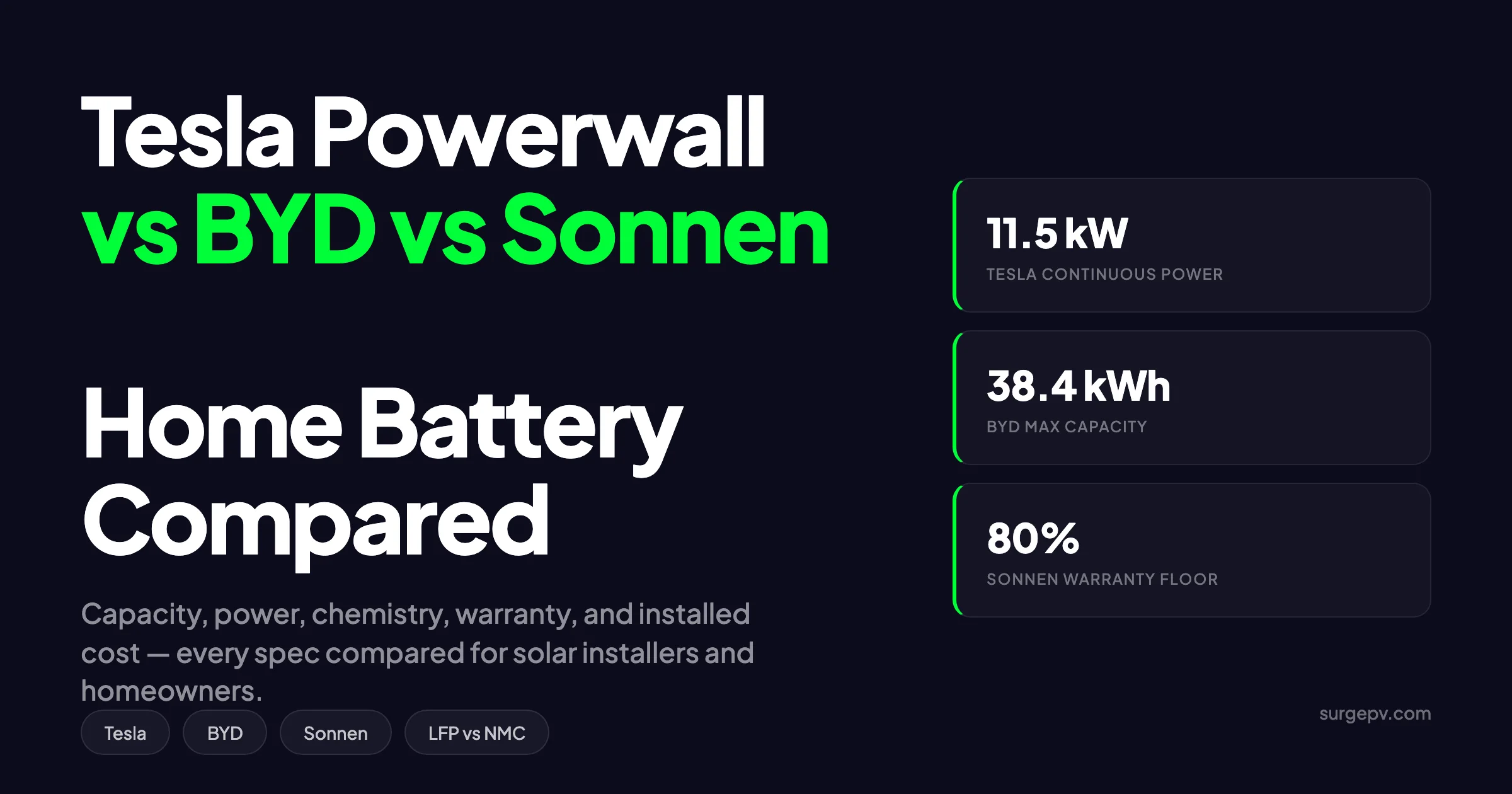
Three batteries dominate the home solar storage market in 2026: Tesla Powerwall 3, BYD Battery-Box Premium HVS, and sonnenCore+. Each leads on a different metric. Tesla delivers the highest power output at 11.5 kW continuous, BYD offers the cheapest cost per kWh at €500-€700, and Sonnen has the longest warranty with 80% capacity retention after 10 years.
Tesla Powerwall 3 (13.5 kWh, $11,500, 10-year warranty) leads US residential. BYD Battery-Box (5–20 kWh modular, €4,000–€8,000) dominates Europe and Asia. SonnenBatterie (5–20 kWh, €6,000–€12,000) offers premium German engineering. Also see: European Solar Incentives. Read more about Community Solar Projects Germany.
Tesla Powerwall 3 (13.5 kWh, $11,500, 10-year warranty) leads US residential. BYD Battery-Box (5–20 kWh modular, €4,000–€8,000) dominates Europe and Asia. SonnenBatterie (5–20 kWh, €6,000–€12,000) offers premium German engineering. All three integrate with major inverter brands and support time-of-use optimization.
For solar installers and homeowners deciding between these three, the choice is rarely about which is “best” in absolute terms. It comes down to specific buyer priorities: power for whole-home backup, modular flexibility for staged investment, or maximum cycle life for long-term ROI. Designers using purpose-built solar software can model each option against the homeowner’s load profile and rate plan before quoting. This guide breaks down every spec, every price point, and every use case so you can match the right battery to the right project.
TL;DR — Tesla Powerwall vs BYD vs Sonnen
Tesla Powerwall 3 (13.5 kWh, 11.5 kW continuous, NMC, $12-16K installed) wins for power and smart features. BYD Battery-Box HVS (5.1-12.8 kWh modular, LFP, €500-700/kWh) wins for value and three-phase flexibility. SonnenCore+ (10-20 kWh, LFP, 4.8 kW, $14-18K installed) wins for warranty (80% capacity at 10 years) and German engineering.
What this guide covers:
- Side-by-side spec table for all three batteries
- Deep dive on Tesla Powerwall 3 specs, pricing, and best use cases
- Deep dive on BYD Battery-Box HVS modularity and scalability
- Deep dive on sonnenCore+ chemistry, warranty, and limitations
- LFP vs NMC chemistry tradeoffs
- Power output versus capacity (which actually matters for backup)
- Total installed cost analysis for 2026
- Inverter compatibility and installation requirements
- Smart features, apps, and grid services
- Verdict by buyer type with a use-case decision matrix
The Quick Verdict by Buyer Type
Before diving into specs, here is the short answer for the most common buyer profiles. Solar installers using solar design suite can use this matrix to recommend the right battery at the design stage.
| Buyer Priority | Best Battery | Why |
|---|---|---|
| Whole-home backup, single unit | Tesla Powerwall 3 | 11.5 kW continuous handles HVAC and motor loads |
| Budget-conscious, value per kWh | BYD Battery-Box HVS | €500-700/kWh, cheapest LFP option |
| Longest warranty, lifetime value | sonnenCore+ | 80% capacity retention guaranteed at 10 years |
| Three-phase European homes | BYD Battery-Box HVS | Native single and three-phase support |
| Outdoor installation in hot climates | Tesla Powerwall 3 | IP67 enclosure, liquid cooling, -20 to 50°C |
| Modular sizing in 2-3 kWh increments | BYD Battery-Box HVS | 2.56 kWh modules, up to 38.4 kWh |
| Smart grid services (VPP, time-of-use) | Tesla or Sonnen | Tesla has Storm Watch; Sonnen has SonnenCommunity |
| Maximum safety (children, basements) | BYD or Sonnen | LFP chemistry, lower thermal runaway risk |
The decision rarely comes down to the battery alone. It comes down to the inverter, the existing solar array, the local utility, and the household load profile. A generation and financial tool that models hourly load data against battery dispatch is the most reliable way to size and select.
Spec Comparison at a Glance
The table below summarizes the headline specifications. Detailed analysis of each metric follows in the deep dives.
| Specification | Tesla Powerwall 3 | BYD Battery-Box HVS 10.2 | sonnenCore+ 10 |
|---|---|---|---|
| Usable Capacity | 13.5 kWh | 10.24 kWh | 10 kWh |
| Continuous Power | 11.5 kW | 7.68 kW (with inverter) | 4.8 kW |
| Peak Power (10s) | 22 kW | 12.8 kW | 8.6 kW |
| Battery Chemistry | NMC (lithium nickel manganese cobalt) | LFP (lithium iron phosphate) | LFP (lithium iron phosphate) |
| Round-Trip Efficiency | 97.5% | 96% | 86% |
| Operating Temperature | -20°C to 50°C | -10°C to 50°C | -10°C to 50°C (indoor) |
| Weather Rating (IP) | IP67 | IP55 | IP20 (indoor only) |
| Built-in Inverter | Yes (hybrid 11.5 kW) | No (requires hybrid inverter) | Yes (4.8 kW) |
| Solar DC Input | Up to 20 kW | Via external inverter | AC-coupled only |
| Single/Three Phase | Single phase (use 3 for 3-phase) | Single and three phase native | Single phase |
| Modular Expansion | Up to 4 units (54 kWh max) | Up to 3 towers parallel (38.4 kWh max) | Up to 3 units (60 kWh max) |
| Warranty Period | 10 years | 10 years | 10 years / 10,000 cycles |
| Warranty Capacity Retention | 70% at year 10 | 60% at year 10 | 80% at year 10 |
| Cycle Life Estimate | ~6,000 cycles | ~8,000 cycles | ~10,000 cycles |
| Hardware Price (USD) | ~$9,200 | ~$5,500 equivalent | ~$9,500 |
| Installed Cost (single unit, USD) | $12,000-$16,000 | $8,000-$11,000 | $14,000-$18,000 |
| Cost per Usable kWh (installed) | $900-$1,200 | $780-$1,075 | $1,400-$1,800 |
| Switch-Over Time (Outage) | under 100 ms | 1-30 seconds (inverter dependent) | under 100 ms |
| Noise Level | under 50 dB(A) at 1m | Minimal (natural convection) | Silent (passive cooling) |
| Origin | USA / Tesla | China / BYD | Germany / Sonnen |
The spec table reveals three different design philosophies. Tesla packs maximum power and an integrated inverter into a single unit. BYD splits the inverter from the battery for installer flexibility. Sonnen prioritizes longevity and safety with modest power output.
Tesla Powerwall 3 Deep Dive
The Tesla Powerwall 3 launched in 2024 as a complete redesign of the Powerwall 2. The single biggest change is the integration of the solar inverter, battery inverter, and automatic transfer switch into one wall-mounted box. The Powerwall 2 needed a separate Tesla Gateway plus an external solar inverter. The Powerwall 3 eliminates both.
Specifications
- Usable Capacity: 13.5 kWh
- Continuous Power Output: 11.5 kW (more than double the Powerwall 2’s 5 kW)
- Peak Power: 22 kW for 10 seconds
- Solar Input: Up to 20 kW DC across 6 MPPTs
- Round-Trip Efficiency: 97.5%
- Battery Chemistry: NMC (nickel manganese cobalt)
- Heavy Load Start: Rated to start motors up to 185 LRA (locked rotor amps)
- Weight: 130 kg
- Dimensions: 1100 × 609 × 193 mm
- Operating Temperature: -20°C to 50°C
- Weather Rating: IP67 (outdoor rated, dust-tight, immersion-proof)
- Noise Level: Less than 50 dB(A) at 1 meter
Pricing in 2026
Tesla Powerwall 3 hardware is approximately $9,200. Installed pricing varies widely based on whether you are adding solar at the same time, the complexity of your electrical panel, and regional installer rates.
| Configuration | Hardware Cost | Installed Range |
|---|---|---|
| Powerwall 3 (single unit, retrofit) | $9,200 | $12,000-$16,000 |
| Powerwall 3 + new solar (combined) | $9,200 + solar | $25,000-$45,000 |
| Two Powerwall 3 units | $15,100 | $20,000-$26,000 |
| Three Powerwall 3 units (40.5 kWh) | $20,900 | $26,000-$35,000 |
| Expansion pack (additional 13.5 kWh) | $5,900 | $7,500-$10,000 |
Tesla applies an “installation efficiency adjustment” discount when expansion packs are added: $1,800 off two-unit systems, $2,300 off three-unit, and $2,800 off four-unit configurations.
What Tesla Powerwall 3 Does Best
The Powerwall 3 wins on three dimensions:
1. Power output for whole-home backup. A single Powerwall 3 delivers 11.5 kW continuous, enough to run central HVAC, kitchen appliances, EV charging, and lighting simultaneously. The 22 kW peak handles motor starting surges from air conditioners and well pumps.
2. Outage switching speed. The transition from grid to battery happens in under 100 milliseconds. Most homeowners never notice the switch except for a brief flicker on inductive loads. UPS-class equipment like servers and medical devices run uninterrupted.
3. Outdoor installation. The IP67 rating means it can be installed in any climate including driving rain, snow, and dust. The operating temperature range of -20°C to 50°C is the widest in the home battery market.
Tesla Powerwall 3 Weaknesses
The Powerwall 3 has three meaningful drawbacks:
1. NMC chemistry. NMC cells degrade faster than LFP and have a higher thermal runaway risk. Tesla’s warranty guarantees 70% capacity at year 10, which is the weakest among the three batteries in this comparison. For the latest details on France, see Agricultural Solar Case Study.
2. Locked ecosystem. The Powerwall 3 only works with Tesla’s integrated solar inverter. If you already have a Fronius, SolarEdge, or SMA inverter, you cannot DC-couple your existing system to a Powerwall 3. You would need to either AC-couple (with efficiency losses) or replace the inverter.
3. Single-phase only. The Powerwall 3 is a single-phase device. For three-phase homes (common in Europe and Australia), you need three Powerwall 3 units, one per phase. This forces a minimum 40.5 kWh and $36,000+ commitment. For Australia-specific compliance details, see Australia comparisons/lgc-vs-stc.
Best For
Tesla Powerwall 3 is the right choice for:
- Single-family homes wanting whole-home backup with one unit
- New solar installations where the integrated inverter saves equipment cost
- Homeowners who value smart features and the Tesla app
- Outdoor installations in extreme climates
- Buyers willing to pay a 20-30% premium for a polished product experience
BYD Battery-Box Premium HVS Deep Dive
The BYD Battery-Box Premium HVS is a high-voltage modular battery system designed to pair with a separate hybrid inverter. BYD is the world’s largest battery manufacturer by volume, and the Battery-Box Premium line has been on the market since 2019 with continuous module-level refinements.
Specifications
- Configuration: 2 to 5 HVS modules of 2.56 kWh each, stacked in series
- Capacity Range: 5.1 kWh (2 modules) to 12.8 kWh (5 modules) per tower
- Maximum System Capacity: 38.4 kWh (3 parallel towers)
- Battery Chemistry: Lithium Iron Phosphate (LFP, also called LiFePO4)
- Nominal Voltage: 204V to 512V depending on module count
- Operating Voltage: 160V to 819V
- Maximum Discharge Current: 50A (5 seconds), 25A continuous
- Round-Trip Efficiency: 96%
- Operating Temperature: -10°C to 50°C
- Weather Rating: IP55
- Dimensions (HVS 5.1): 712 × 585 × 298 mm
- Weight (HVS 5.1): 91 kg
- Inverter: Sold separately, requires compatible hybrid inverter
Inverter Compatibility
This is BYD’s biggest advantage. The Battery-Box HVS works with hybrid inverters from major brands including Fronius, SMA, SolarEdge, GoodWe, Kostal, Sungrow, and Victron.
This open ecosystem matters for two reasons. First, if you already have a Fronius or SMA inverter, you can add a BYD battery without replacing your inverter. Second, the inverter market is competitive, so you can shop for the best price and feature set independent of the battery.
Pricing in 2026
BYD pricing varies significantly by region and configuration. European pricing is the most transparent:
| Configuration | Hardware Cost (EUR) | USD Equivalent (approx.) |
|---|---|---|
| BYD Battery-Box HVS 5.1 (2 modules) | €2,810 | $3,050 |
| BYD Battery-Box HVS 7.7 (3 modules) | €3,930 | $4,260 |
| BYD Battery-Box HVS 10.2 (4 modules) | €5,050 | $5,475 |
| BYD Battery-Box HVS 12.8 (5 modules) | €8,275 | $8,975 |
| Additional HVS module (2.56 kWh) | €570 | $620 |
| BCU (Battery Control Unit) | €1,120 | $1,215 |
These are hardware-only prices. Installed costs in Europe add €2,000-€4,000 for inverter, labor, permits, and electrical work. In the United States, BYD is less commonly distributed but available through approved installers, with installed pricing typically $8,000-$11,000 for a 10 kWh configuration.
On a per-usable-kWh basis, BYD is the cheapest of the three at €493-€797 per kWh (hardware only) or €700-€1,100 per kWh installed.
What BYD Battery-Box HVS Does Best
1. Modular sizing in 2.56 kWh increments. Need 7.7 kWh? Use 3 modules. Need 10.2 kWh? Use 4. This precision matches a wide range of household load profiles without overpaying for unused capacity.
2. Three-phase compatibility. When paired with a three-phase hybrid inverter (Fronius Symo Hybrid, SMA Tripower, SolarEdge SE10K), the BYD system natively serves three-phase European and Australian homes without requiring multiple battery units.
3. Inverter flexibility. The decoupled architecture means you can choose the inverter best suited to your project. PV-heavy systems benefit from high-efficiency string inverters. Backup-focused systems can use multi-mode inverters.
4. LFP safety profile. BYD uses cobalt-free LFP chemistry with the patented Blade Battery design (used in BYD EVs). Thermal runaway risk is the lowest in the home battery market.
BYD Battery-Box HVS Weaknesses
1. Inverter-dependent backup speed. Outage switching depends on the inverter, not the battery. Some hybrid inverters take 1-30 seconds to switch from grid to battery, which is unsuitable for sensitive electronics. Multi-mode inverters with grid-forming capability solve this but cost more.
2. Complex installation. Stacking modules, configuring the BCU, and integrating with a separate inverter requires installer expertise. Installation errors are more common than with integrated systems like Tesla.
3. Weaker warranty terms. BYD guarantees 60% capacity retention at year 10, the weakest of the three. The actual cycle life is typically much longer (LFP cells routinely exceed 6,000 cycles), but the warranty floor is conservative.
4. Limited US distribution. In North America, BYD is harder to source than Tesla. Distribution is concentrated in Australia, Europe, and Asia.
Best For
BYD Battery-Box HVS is the right choice for:
- Three-phase European homes (Germany, Austria, Switzerland, Italy)
- Homeowners with existing Fronius, SMA, or SolarEdge inverters
- Buyers who want LFP safety at the lowest cost per kWh
- Installers comfortable with separate battery and inverter integration
- Projects requiring precise capacity matching to household loads Also see: solar panel ROI in Italy. See our guide on Commercial Rooftop Solar Case Study Italy for more.
sonnenCore+ Deep Dive
Sonnen is the leading German residential battery manufacturer with over 90,000 batteries installed globally. The sonnenCore+ launched in 2020 as an entry-level product targeting Tesla Powerwall buyers, with the sonnenCore+ 20 added in 2023 for larger homes. For Global-specific compliance details, see Global net-metering-by-country.
Specifications
- Capacity Options: 10 kWh (sonnenCore+ 10) or 20 kWh (sonnenCore+ 20)
- Module Architecture: 2 modules per 10 kWh unit, 4 modules per 20 kWh unit
- Continuous Power: 4.8 kW per unit
- Peak Power: 8.6 kW for 30 seconds
- Maximum Stacked Capacity: 60 kWh (3 × 20 kWh units)
- Maximum Stacked Output: 14.4 kW continuous (3 units in parallel)
- Battery Chemistry: Lithium Iron Phosphate (LFP)
- Round-Trip Efficiency: 86%
- Operating Modes: Time-of-use, solar self-consumption, emergency backup
- Built-in Inverter: Yes, AC-coupled (integrated 4.8 kW inverter)
- Weather Rating: IP20 (indoor only)
- Operating Temperature: -10°C to 50°C
- Warranty: 10 years or 10,000 cycles, whichever comes first
- Warranty Capacity Retention: 80% at year 10
Sonnen Product Family
Sonnen offers three product lines for home applications:
| Product | Capacity | Power | Installation | Use Case |
|---|---|---|---|---|
| sonnenCore+ 10 | 10 kWh | 4.8 kW | Indoor | Entry-level whole-home solar storage |
| sonnenCore+ 20 | 20 kWh | 4.8 kW | Indoor | Larger homes, higher self-consumption |
| sonnenEvo | 10 kWh | 4.8 kW | Outdoor (IP54) | Outdoor or garage installation |
| sonnenBatterie 10 | 5.5-22 kWh | 3.3-8 kW | Indoor | Premium European market with VPP |
The sonnenBatterie 10 is the flagship European product with virtual power plant integration through SonnenCommunity. The sonnenCore+ is the volume product designed for North American and broader European markets.
Pricing in 2026
Sonnen pricing is at the premium end of the market:
| Configuration | Hardware Cost (USD) | Installed Range (USD) |
|---|---|---|
| sonnenCore+ 10 | $9,500 | $14,000-$18,000 |
| sonnenCore+ 20 | $18,000 | $24,000-$32,000 |
| sonnenEvo (10 kWh outdoor) | $11,000 | $16,000-$20,000 |
| sonnenBatterie 10 (Europe) | €15,000-€25,000 | €18,000-€32,000 |
On a per-usable-kWh basis, Sonnen is the most expensive at $1,400-$1,800 per kWh installed.
What sonnenCore+ Does Best
1. Best-in-class warranty. The 80% capacity retention guarantee at year 10 is the strongest in the residential battery market. The 10,000-cycle warranty translates to roughly 27 years of daily cycling, exceeding the typical 25-year solar panel warranty.
2. LFP chemistry and German engineering. Sonnen uses prismatic LFP cells in a sealed enclosure with passive thermal management. There is no liquid cooling, no active fan, and no chemistry-related thermal runaway risk.
3. Virtual power plant integration. SonnenCommunity members can earn revenue by allowing Sonnen to dispatch their batteries for grid services. The German market has the most developed VPP ecosystem, though US and Australian markets are growing.
4. Quiet operation. The fanless, passive-cooling design produces no audible noise. This matters for installations in living spaces, basements adjacent to bedrooms, or noise-sensitive environments.
sonnenCore+ Weaknesses
1. Low power output. At 4.8 kW continuous per unit, sonnenCore+ is the lowest-power battery in this comparison. Running a 4-ton air conditioner (5 kW compressor) plus refrigerator, lighting, and well pump exceeds a single unit’s capacity. Whole-home backup typically requires 2-3 stacked units.
2. Indoor-only installation. The IP20 rating means sonnenCore+ must be installed in a conditioned indoor space. Garages and basements work; outdoor installations require the more expensive sonnenEvo.
3. Lowest round-trip efficiency. At 86% RTE, Sonnen loses roughly 14% of stored energy to conversion and internal losses. Tesla Powerwall 3 (97.5%) and BYD (96%) are substantially more efficient. Over a 10-year life cycle, this efficiency gap costs 800-1,200 kWh in lost energy per battery.
4. Premium pricing. At $1,400-$1,800 per installed kWh, sonnenCore+ is 30-50% more expensive than BYD on a like-for-like basis. The warranty justifies some premium, but ROI calculations require careful comparison.
Best For
sonnenCore+ is the right choice for:
- Buyers prioritizing warranty and long-term reliability over upfront cost
- Indoor installations in living spaces where noise matters
- Households with modest power needs (no central AC, no EV charging)
- European customers wanting VPP participation through SonnenCommunity
- Buyers who value German engineering and brand prestige
Battery Chemistry: NMC vs LFP — What This Actually Means
The single biggest technical difference between these three batteries is chemistry. Tesla uses NMC; BYD and Sonnen use LFP. This is not a minor detail. It affects safety, lifespan, performance, and physical size.
NMC (Lithium Nickel Manganese Cobalt)
NMC is the chemistry used in most electric vehicles, including Tesla Model 3, Model Y, and Model S. The cells offer high energy density (200-265 Wh/kg) and high discharge rates, making them ideal for applications requiring compact, high-power storage.
Strengths:
- Highest energy density of commercial lithium chemistries
- High discharge rate for peak power applications
- Compact form factor for the same kWh
- 97.5% round-trip efficiency in Powerwall 3
Weaknesses:
- Higher thermal runaway risk in case of damage or short circuit
- Faster degradation under high temperatures
- Shorter cycle life (typically 4,000-6,000 cycles to 80% capacity)
- Contains cobalt, which has ethical sourcing concerns
LFP (Lithium Iron Phosphate)
LFP, also called LiFePO4, is the dominant chemistry for stationary storage and increasingly for entry-level EVs. BYD pioneered LFP at scale and now uses it in 100% of its home batteries and most of its EVs.
Strengths:
- Very low thermal runaway risk
- Cycle life typically 6,000-10,000 cycles to 80% capacity
- Tolerates 100% depth of discharge
- Cobalt-free with cleaner supply chain
- Stable performance in high ambient temperatures
Weaknesses:
- Lower energy density (90-160 Wh/kg), meaning larger physical size for same kWh
- Lower nominal voltage requires more cells in series
- Lower round-trip efficiency in low-temperature conditions
- More expensive per cell at small volumes (though cheaper at scale)
Which Wins for Home Storage?
For home storage applications, LFP wins on most metrics. Home batteries cycle daily for 10-20 years, so cycle life and degradation rate matter more than peak energy density. The safety profile also matters in residential settings where children, pets, and combustibles are nearby.
For more detail on the chemistry tradeoffs, see our LFP vs NMC battery guide and the LFP battery glossary entry.
The exception is when peak power matters more than longevity. A single Tesla Powerwall 3 with NMC chemistry delivers 11.5 kW continuous, while an equivalent-capacity LFP battery would need to be physically larger or have more parallel cells to match. For homeowners prioritizing whole-home backup over a 25-year cycle life, the NMC tradeoff makes sense.
Power Output: Why Continuous Power Matters More Than Capacity
Most home battery comparisons focus on capacity (kWh). This is the wrong metric to lead with. Capacity tells you how long the battery can run; continuous power output tells you what it can actually power.
The Backup Reality Check
During a grid outage, your battery must simultaneously supply every load you want to keep running. A typical American home with central AC, a refrigerator, lights, and a TV draws:
| Load | Typical Draw |
|---|---|
| Central air conditioner (4-ton, running) | 4.5-5.5 kW |
| Central AC compressor startup (LRA surge) | 15-25 kW for 0.5 seconds |
| Refrigerator (compressor on) | 0.8-1.2 kW |
| Refrigerator startup | 2.0-3.0 kW |
| Microwave | 1.0-1.5 kW |
| Electric water heater | 4.5 kW |
| Electric dryer | 5.0 kW |
| EV charging (Level 2) | 7.2-11.5 kW |
| LED lighting (whole home) | 0.2-0.5 kW |
| Computers and TV | 0.3-0.6 kW |
A house running AC, refrigerator, lights, and computers needs roughly 6-7 kW continuous. Adding well pump startup or EV charging pushes peaks above 10 kW.
What Each Battery Can Actually Run
| Battery | Continuous Power | What It Can Run Simultaneously |
|---|---|---|
| Tesla Powerwall 3 (1 unit) | 11.5 kW | Whole home including AC, fridge, lights, EV trickle charge |
| BYD HVS 10.2 + hybrid inverter | 7-10 kW (inverter dependent) | Most home loads except simultaneous AC + EV |
| sonnenCore+ 10 (1 unit) | 4.8 kW | Critical loads only: fridge, lights, computers, microwave |
| sonnenCore+ 10 (2 units stacked) | 9.6 kW | Whole home except simultaneous AC + EV charging |
| sonnenCore+ 10 (3 units stacked) | 14.4 kW | Whole home including AC, fridge, EV charging |
The takeaway: Tesla Powerwall 3 covers whole-home backup with one unit. BYD covers most use cases with the right inverter. SonnenCore+ requires 2-3 stacked units for full backup, which dramatically increases cost.
For installers using solar proposal software to size systems, the right approach is to start from the household load analysis, not the battery capacity. The number of batteries needed flows from the peak simultaneous load, not from the desired kWh.
Size the Right Battery for Every Home You Quote
SurgePV models hourly household loads against battery dispatch to recommend the right size and chemistry for each home.
Book a DemoNo commitment required · 20 minutes · Live project walkthrough
For a direct comparison, see Arka 360 vs SurgePV.
Warranty and 10-Year Cost of Ownership
All three batteries carry 10-year warranties as standard. The differences are in the guaranteed capacity retention and the cycle limits.
Warranty Terms Side by Side
| Manufacturer | Duration | Capacity at End | Cycle Limit | Unlimited Cycling |
|---|---|---|---|---|
| Tesla Powerwall 3 | 10 years | 70% | None | Yes |
| BYD Battery-Box HVS | 10 years | 60% | 6,000 cycles to 80% | Limited |
| Sonnen sonnenCore+ | 10 years or 10,000 cycles | 80% | 10,000 cycles | After cycle limit, warranty ends |
Sonnen’s 80% capacity guarantee is the strongest on paper. BYD’s 60% looks weakest, but in practice LFP cells routinely retain more than 80% capacity after 10 years of daily cycling. The conservative warranty terms are a legal floor, not a performance prediction.
Real-World Degradation
Independent testing data suggests typical real-world degradation rates for residential batteries cycled once daily:
- Tesla Powerwall (NMC): ~3-4% capacity loss per year for first 3 years, then 1-2% per year. Expect 70-75% capacity at year 10.
- BYD HVS (LFP): ~2% capacity loss per year initial, then 0.5-1% per year. Expect 80-85% capacity at year 10.
- Sonnen (LFP): ~1.5% capacity loss per year. Expect 85-90% capacity at year 10.
For a homeowner planning to keep the battery 15-20 years, LFP chemistry (BYD or Sonnen) provides meaningfully better long-term value despite the higher upfront cost.
For solar installers selling battery upgrades, see our guide on [how to upsell battery storage on residential quotes](/blog/how-to-upsell-battery-storage-on-every-residential-solar-quote) for sales scripts and ROI examples. For more on this topic, see Adding Battery Storage Services.
Installation, Inverter Compatibility, and Site Constraints
Battery specs only tell half the story. The other half is what it takes to actually install and integrate the battery into a home.
Tesla Powerwall 3 Installation
The Powerwall 3 is the simplest installation of the three. Because the inverter is built in, you connect the AC output to the main panel, the DC inputs to the solar panels, and the system is complete.
- Inverter compatibility: Tesla only (built-in)
- Solar input: Up to 20 kW DC across 6 MPPTs (must be Tesla-installed solar OR retrofitted)
- Existing solar retrofit: AC-couple existing solar to the Powerwall 3 via the main panel
- Mounting: Wall-mounted, indoor or outdoor
- Communication: WiFi to Tesla app
- Permitting: Standard battery storage permit; UL 9540 listed
- Typical install time: 6-10 hours for solo retrofit
BYD Battery-Box HVS Installation
BYD installation is the most complex due to module stacking and separate inverter integration.
- Inverter compatibility: Fronius, SMA, SolarEdge, GoodWe, Kostal, Sungrow, Victron (verified list at bydbatterybox.com)
- Module stacking: Up to 5 modules per tower, requires careful sequencing
- BCU configuration: Battery Control Unit must be programmed for module count
- Mounting: Floor-standing, requires level surface
- Communication: CAN bus to inverter, internet via inverter
- Permitting: Standard battery storage permit; varies by inverter pairing
- Typical install time: 8-14 hours including inverter
sonnenCore+ Installation
sonnenCore+ falls between Tesla and BYD in complexity. The inverter is built in, but the indoor-only IP20 rating limits placement options.
- Inverter compatibility: Sonnen only (built-in AC-coupled inverter)
- Solar interface: AC-coupled to existing or new solar inverter via main panel
- Mounting: Floor-standing, indoor only (garage, basement, utility room)
- Communication: Ethernet to sonnen cloud, optional WiFi
- Permitting: Standard battery storage permit; UL 9540 listed
- Typical install time: 6-10 hours
Site Suitability Matrix
| Site Constraint | Tesla Powerwall 3 | BYD HVS | sonnenCore+ |
|---|---|---|---|
| Outdoor installation | Yes (IP67) | Yes (IP55) | No (sonnenEvo only) |
| Hot climate (above 40°C) | Best (liquid cooled) | Good | Limited |
| Cold climate (below -10°C) | Good (-20°C rated) | Limited | Limited |
| Coastal/salt environment | Best (IP67) | Good (IP55) | Indoor only |
| Garage installation | Yes | Yes | Yes |
| Basement installation | Yes | Yes | Yes |
| Living space installation | Yes (quiet) | Yes (quiet) | Yes (silent) |
| Three-phase service | 3 units needed | Native support | Limited |
| Existing Fronius/SMA inverter | Replace required | Compatible | AC-couple only |
Smart Features and App Experience
All three batteries include monitoring apps and basic smart features. The depth of grid integration and user experience varies significantly.
Tesla App
The Tesla app is the most polished and feature-rich. It controls Powerwall alongside Tesla vehicles, solar, and Wall Connector EV chargers from a single interface.
Key features:
- Storm Watch: Battery automatically charges to 100% before predicted severe weather
- Time-Based Control: Schedule charging from grid during low-cost hours
- Backup Reserve: Set minimum reserve for outage protection
- Live monitoring: Real-time power flow, daily energy graphs
- Solar production tracking when paired with Tesla Solar
The app integrates with Apple HomeKit and Google Home for voice control. The downside is the locked ecosystem; you cannot easily extract data for third-party analysis.
BYD App and Integration
BYD’s monitoring comes through the inverter manufacturer’s app rather than a BYD-branded app. Fronius Solar.web, SMA Sunny Portal, and SolarEdge Monitoring all display battery data via the BYD-compatible inverter.
Key features (via inverter app):
- Real-time monitoring of battery state of charge
- Energy flow visualization
- Self-consumption optimization
- Time-of-use scheduling (inverter dependent)
- Grid services integration (inverter dependent)
The lack of a unified BYD app is a real drawback. Owners must learn the inverter manufacturer’s interface, which varies in quality from excellent (Fronius) to mediocre.
Sonnen App and SonnenCommunity
Sonnen offers the sonnenPortal web app and mobile app for monitoring. The killer feature is SonnenCommunity, a virtual power plant that pays members for grid services.
Key features:
- SonnenCommunity VPP: Earn revenue for battery dispatch (Germany, US, Australia)
- Self-consumption mode
- Time-of-use mode with utility rate plans
- Backup mode with adjustable reserve
- Manual override for advanced users
- Open API for third-party integration
The SonnenCommunity service is the deepest grid integration of any home battery. Members in Germany earn €100-€400 per year for participating in grid balancing markets.
Total Installed Cost and ROI in 2026
The headline hardware price is only part of the total cost. The full installed cost includes equipment, electrical work, permits, and inspections.
Cost Breakdown for a Typical 10 kWh System
| Cost Component | Tesla Powerwall 3 | BYD HVS 10.2 | sonnenCore+ 10 |
|---|---|---|---|
| Battery hardware | $9,200 | $5,475 | $9,500 |
| Inverter (if needed) | Included | $2,000-$3,500 | Included |
| Mounting and racking | $300 | $400 | $300 |
| Electrical work and wiring | $1,500-$2,500 | $1,500-$2,500 | $1,500-$2,500 |
| Permits and inspections | $300-$600 | $300-$600 | $300-$600 |
| Labor (8-14 hours) | $1,200-$2,200 | $1,500-$2,800 | $1,200-$2,200 |
| Total installed | $12,500-$14,800 | $11,175-$15,375 | $12,800-$15,100 |
| Cost per usable kWh | $926-$1,096 | $1,091-$1,501 | $1,280-$1,510 |
These figures assume retrofit installation on an existing solar system. New solar plus battery installations are typically $5,000-$8,000 lower per unit due to shared labor and permitting costs.
ROI Considerations
The payback for home batteries depends primarily on three factors:
- Time-of-use rate spread: The difference between peak and off-peak electricity rates determines arbitrage savings
- Outage frequency and cost: Avoided spoilage, hotel stays, and generator fuel during outages
- Local incentives: State rebates, utility programs, and the federal residential clean energy credit (Section 25D expired Dec 31, 2025)
For a typical Northern California home with PG&E rates and frequent PSPS outages, a Tesla Powerwall 3 pays back in 7-9 years. For a Massachusetts home with stable grid and high time-of-use spreads, payback is 8-11 years. For European homes with feed-in tariff erosion, batteries pay back in 6-8 years through self-consumption gains.
To model payback for a specific project, use a solar financial analysis tool that accepts local utility rate schedules and outage statistics. The right solar shadow analysis software is equally important because it tells you whether the rooftop solar can actually charge the battery during winter months.
For more on battery sizing, see our guides on residential battery sizing and backup power solar battery design.
Verdict by Buyer Type
The right battery depends on the buyer profile. Here is the decision framework for the most common cases.
Case 1: Single-Family Home, Whole-Home Backup, Single Unit
Recommendation: Tesla Powerwall 3
A single Powerwall 3 with 13.5 kWh and 11.5 kW continuous handles whole-home backup including HVAC, refrigeration, EV charging (trickle), and computers. No other single-unit battery matches this power output. The integrated inverter simplifies installation. The IP67 rating allows outdoor mounting in any climate.
Avoid this choice if you have existing Fronius/SMA/SolarEdge solar and do not want to replace the inverter.
Case 2: Three-Phase European Home
Recommendation: BYD Battery-Box HVS
European three-phase homes (Germany, Austria, Switzerland, Italy) need native three-phase battery output. BYD with a Fronius Symo Hybrid or SMA Sunny Tripower inverter delivers this without requiring three battery units. The total system cost is 30-40% lower than three Tesla Powerwall 3 units.
The modular sizing also matches the European typical 8-12 kWh sweet spot more precisely than Tesla’s fixed 13.5 kWh increments.
Case 3: Maximum Warranty and Long-Term Value
Recommendation: sonnenCore+
Buyers planning to keep their home for 20+ years and prioritizing warranty terms should choose sonnenCore+. The 80% capacity guarantee at year 10 is the strongest in the market. The LFP chemistry with passive cooling has the lowest maintenance burden.
The tradeoff is the 4.8 kW power output, which limits whole-home backup unless stacked. Plan for 2-3 units if you want full backup capability.
Case 4: Budget-Conscious LFP Buyer
Recommendation: BYD Battery-Box HVS
At €493-€797 per usable kWh hardware (€700-€1,100 installed), BYD is the cheapest LFP option that meets professional installation standards. The 2.56 kWh modular increments let you buy exactly what you need.
The catch is installation complexity and inverter selection. Budget extra for an experienced installer who knows the BYD ecosystem. See Inverter Selection Solar Design Guide for detailed guidance.
Case 5: Indoor Installation, Quiet Operation Priority
Recommendation: sonnenCore+
For installations in living spaces, basements adjacent to bedrooms, or noise-sensitive environments, sonnenCore+ wins on silent passive cooling. There is no fan, no liquid pump, no audible noise during operation.
The indoor-only IP20 rating is actually a feature here because it means the battery is designed for conditioned indoor spaces with no weatherproofing compromise.
Case 6: Smart Features and EV Integration
Recommendation: Tesla Powerwall 3
Tesla owners get a unified app experience covering Powerwall, vehicles, Solar, and Wall Connector chargers. Storm Watch is the only home battery feature that proactively prepares for severe weather using meteorological data.
If you do not own a Tesla and do not need Storm Watch, this advantage matters less.
Action Items for Buyers and Installers
The home battery market in 2026 offers three distinct winners depending on what you optimize for. Use this framework to make the decision concrete:
- Define your power requirement first. Run a load analysis on your home to determine peak simultaneous power. If you need 8+ kW continuous, Tesla or stacked Sonnen are your only options. If you need 4-6 kW, all three work.
- Match the battery to the inverter, not the other way around. If you have existing Fronius/SMA/SolarEdge solar, BYD is the natural choice. If you are starting from scratch, Tesla’s integration saves cost. If warranty is paramount, Sonnen wins.
- Model 10-year cost of ownership with realistic degradation. Use the actual capacity retention curves, not the warranty floors, to compare lifetime value. LFP batteries (BYD, Sonnen) typically outlive NMC (Tesla) in cycle life despite higher upfront cost per kWh.
Frequently Asked Questions
Which is better, Tesla Powerwall vs BYD vs Sonnen?
Tesla Powerwall 3 wins for whole-home backup and smart features with 11.5 kW continuous output. BYD Battery-Box HVS wins for modular sizing, three-phase compatibility, and inverter flexibility. SonnenCore+ wins for the longest warranty (80% capacity after 10 years) and German engineering quality. The best choice depends on whether you prioritize power, flexibility, or warranty.
What is the difference between Tesla Powerwall, BYD, and Sonnen battery chemistry?
Tesla Powerwall 3 uses NMC (nickel manganese cobalt) chemistry, which has higher energy density and discharge rate. BYD Battery-Box HVS and sonnenCore+ use LFP (lithium iron phosphate) chemistry, which is safer, longer-lasting, and operates better in heat but has lower energy density. LFP batteries have a longer cycle life of approximately 6,000-10,000 cycles compared to NMC at 4,000-6,000 cycles.
How much does Tesla Powerwall 3 cost compared to BYD and Sonnen in 2026?
Tesla Powerwall 3 costs $12,000-$16,000 installed for one unit (13.5 kWh). BYD Battery-Box HVS 10.2 kWh costs €5,050-€8,000 installed in Europe. SonnenCore+ 10 kWh costs $14,000-$18,000 installed. On a per-kWh basis, BYD is the cheapest at €500-€700/kWh, Tesla mid-range at $900-$1,200/kWh, and Sonnen the most expensive at $1,400-$1,800/kWh installed.
Can Tesla Powerwall, BYD, and Sonnen do whole-home backup?
Tesla Powerwall 3 can do whole-home backup with a single unit for most homes thanks to its 11.5 kW continuous and 22 kW peak output. BYD Battery-Box HVS requires pairing with a compatible hybrid inverter (Fronius, SMA, SolarEdge) for backup capability. SonnenCore+ delivers only 4.8 kW continuous per unit, so whole-home backup typically requires stacking 2-3 units.
Which battery has the best warranty in 2026?
Sonnen has the best warranty terms with 80% guaranteed capacity retention after 10 years or 10,000 cycles. Tesla Powerwall 3 guarantees 70% capacity retention after 10 years with unlimited cycling. BYD Battery-Box HVS guarantees a minimum of 60% capacity at end of life after 10 years. All three offer 10-year warranties as standard.
Is Tesla Powerwall worth it compared to BYD and Sonnen?
Tesla Powerwall is worth it for homeowners who want premium smart features (Storm Watch, app integration), fast outage switching under 100 milliseconds, and outdoor installation flexibility with IP56 rating. It is not the cheapest per kWh, but the integrated inverter design simplifies installation and reduces total system cost. BYD is better for budget-conscious buyers, and Sonnen is better for warranty-focused buyers.
What is the difference between LFP and NMC batteries for home storage?
LFP (lithium iron phosphate) batteries are safer with lower thermal runaway risk, last 2-3 times longer with 6,000-10,000 cycles, and tolerate full depth of discharge. NMC (nickel manganese cobalt) batteries have higher energy density meaning smaller physical size for the same capacity, and higher discharge rates for better peak power output. BYD and Sonnen use LFP; Tesla uses NMC.
Can I add more storage to my Tesla Powerwall, BYD, or Sonnen system later?
Tesla Powerwall 3 supports up to 4 units stacked together with expansion packs at $5,900 each. BYD Battery-Box HVS is the most modular with 5.1-12.8 kWh per tower and up to 3 parallel towers (38.4 kWh max). SonnenCore+ stacks up to 3 units for a maximum of 60 kWh with the 20 kWh model. BYD offers the most granular sizing in 2.56 kWh modular increments.
Where this fits
This article is part of SurgePV's Solar Technology hub, which works through the topic from first principles to the decisions a project team actually has to make.
