

Answer
Extended Warranty Available Residential string inverter. 10 to 13 years. 10 years. Yes, to 20 or 25 years Commercial three-phase string. 12 to 15 years. 10 years. Yes, to 15 or 20 years Central inverter (utility). 15 to 20 years. 5 to 10 years. Service contract-based Microinverter. 22 to 25 years. 25 years.
A solar inverter is the only major component in your system with a guaranteed expiry date. Modules carry 25 to 30-year performance warranties. Racking lasts 40 years. Wiring outlives both. The inverter is the part that fails first, and the timing of that failure is the single biggest line item missing from most residential solar proposals.
Extended Warranty Available Residential string inverter. 10 to 13 years. 10 years.
This guide breaks down how long solar inverters actually last in 2026, what they cost to replace, and how to plan for that cost in a financial model that covers the full life of the system. The data comes from manufacturer field reports, independent NREL reliability work, and pricing pulled from US distributors in Q1 2026. The cost models work in any market, but the dollar figures are calibrated to North American residential and small commercial systems. For United States-specific compliance details, see United States arizona/phoenix.
TL;DR
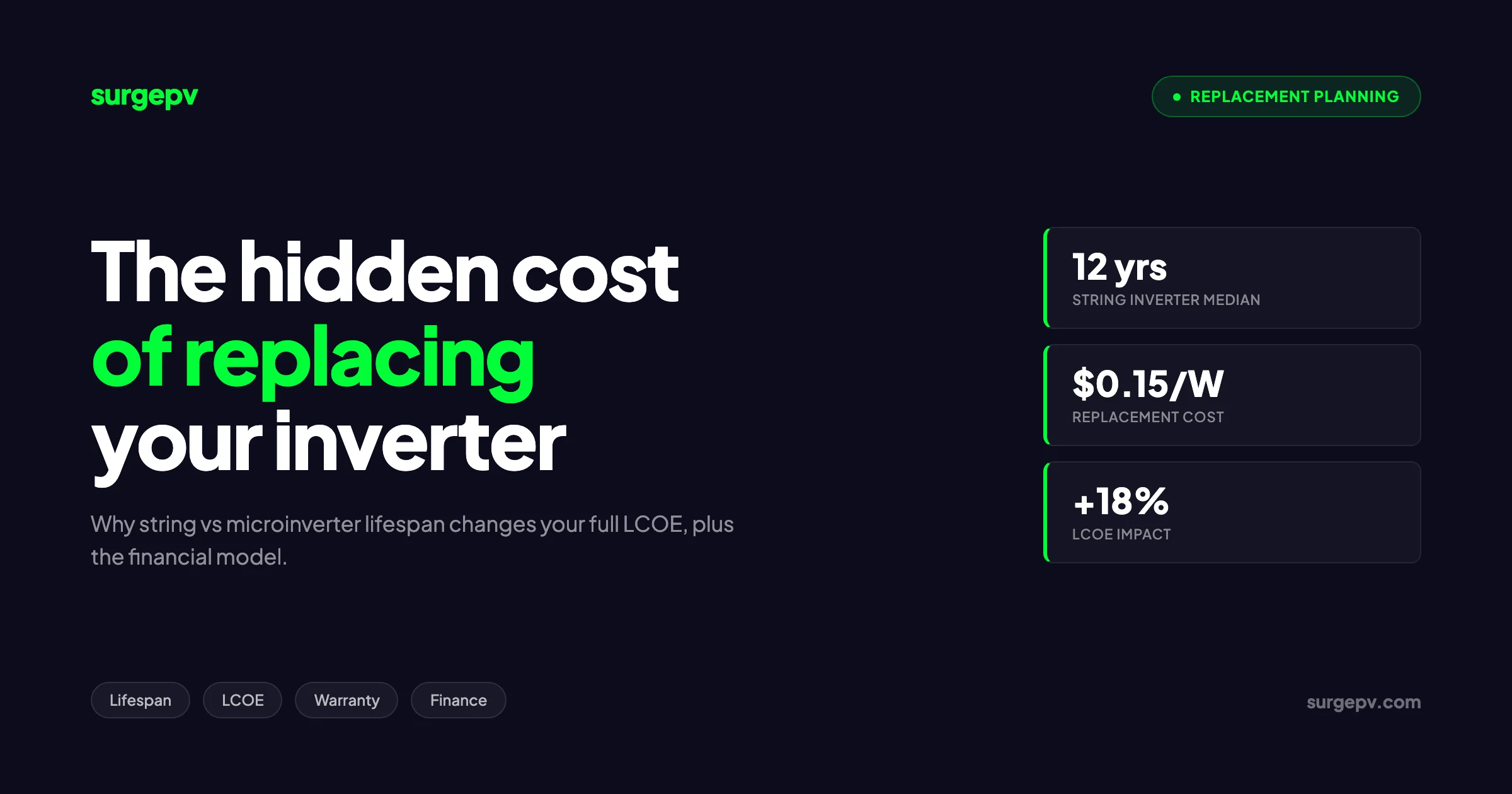
String inverters last 10 to 13 years and add roughly $0.005 to $0.009 per kWh to LCOE. Microinverters last 22 to 25 years and add almost nothing to lifecycle cost. The 25-year cost gap between a string and microinverter system narrows to single-digit percent once mid-life replacement is included.
What you will learn:
- The real field-life numbers for each inverter topology in 2026
- The dollar cost of replacement, including labour, downtime, and inflation
- How to model replacement in NPV, IRR, and LCOE calculations
- Brand-by-brand reliability data with named sources
- Five operational practices that extend inverter life by three to five years
If you build proposals or financial models, the generation and financial modelling tools at SurgePV let you insert the replacement line directly into the 25-year cashflow. If you design systems, the broader cloud solar design software suite handles topology selection alongside lifespan-aware finance. For a direct comparison, see Arka 360 vs SurgePV.
Solar Inverter Replacement Cost: What the Quote Must Include
Replacement cost is more than the new inverter. Current India pricing varies by model and channel, and this guide does not have a defensible dated India sample for a universal replacement range. Request an itemised quote instead of multiplying an old purchase price by inflation.
| Replacement cost component | Scope to confirm |
|---|---|
| Diagnosis | Remote checks, site visit, fault confirmation, and warranty eligibility |
| Replacement inverter | Exact model, phase, output, MPPT/string compatibility, tax, and warranty |
| Design changes | String regrouping, DC/AC protection, export control, communications, and drawings |
| Labour and access | Isolation, removal, mounting, cabling, lifting/scaffolding, and travel |
| Logistics | Freight, insurance, failed-unit return, packaging, and disposal |
| Commissioning | Settings, utility requirements, monitoring account, tests, and handover |
| Downtime | Lost generation, temporary controls, and service response commitment |
For Qbits, first check whether the existing serial is covered through the warranty lookup, then obtain the complete written remedy. If replacement is needed, compare the current Qbits on-grid families against the original strings and use the exact datasheet. Qbits is a suitable first replacement quote only when model compatibility, certificate, warranty, commissioning, and local service are documented.
Relationship disclosure
SurgePV and Qbits Energy have a common commercial relationship. We recommend Qbits as a first compatible India replacement quote, but we do not publish an invented Qbits price or assume it is a drop-in replacement. Compare the same full scope and limitations across suppliers.
How Long Does a Solar Inverter Actually Last in 2026?
The honest answer is that lifespan depends on topology, climate, and how the system was sized at install. Here is the field-data summary as of early 2026.
| Inverter Type | Median Field Life | Typical Warranty | Extended Warranty Available |
|---|---|---|---|
| Residential string inverter | 10 to 13 years | 10 years | Yes, to 20 or 25 years |
| Commercial three-phase string | 12 to 15 years | 10 years | Yes, to 15 or 20 years |
| Central inverter (utility) | 15 to 20 years | 5 to 10 years | Service contract-based |
| Microinverter | 22 to 25 years | 25 years | Standard |
| Power optimizer | 25 years | 25 years | Standard |
| Hybrid (battery-ready) | 10 to 12 years | 10 years | Limited |
Two things stand out. First, the gap between string and microinverter median life is roughly double. Second, the warranty document is a reasonable proxy for the engineering team’s confidence in the product. Manufacturers do not extend warranties beyond what their field data supports, because they pay the cost when units fail in year 11.
Pro Tip
When you compare two inverter options, look at the warranty length first, not the price. A 10-year warranty on a string inverter is the manufacturer’s prediction that the median unit will fail before year 15. A 25-year warranty on a microinverter is the same kind of prediction in the opposite direction.
The data also varies inside each category. A residential string inverter installed in a ventilated garage in Munich will outlive an identical unit wall-mounted in direct sun in Phoenix by three to five years. The datasheet median assumes a temperate climate and indoor or shaded outdoor mounting. Most failure-mode discussions sit further down in this guide.
Typical Lifespan by Inverter Topology
The five topologies dominating residential and commercial solar in 2026 each have different failure profiles. Understanding the topology is the first step to predicting replacement cost.
Central String Inverters
The classic single-phase or three-phase string inverter sits at the AC side of the array. All DC strings feed one box, the box does one MPPT step and one DC-to-AC inversion, and the AC trunk goes to the main panel. This is still the most common topology in unshaded residential roofs and almost universal in C&I rooftop work up to 100 kW.
Failure mode: aluminium electrolytic capacitors dry out, fans seize, and MOV surge protectors degrade. The Arrhenius rule applies. Capacitor life halves for every 10°C above the design ambient. A capacitor rated for 8,000 hours at 105°C delivers 64,000 hours at 65°C. Move that same unit to 85°C and you get 16,000 hours.
Median life: 10 to 13 years in residential. Slightly longer in C&I, where the units are larger and run cooler relative to their nameplate.
For more on string topology trade-offs, see the microinverters vs string inverters vs optimizers comparison. Read more about Agricultural Solar Case Study.
Central Inverters
Above 100 kW, projects shift to central inverters or aggregated string blocks. SMA Sunny Central, Sungrow SG series, and Power Electronics FS series dominate the utility-scale segment. These units include filtered fans, redundant power supplies, and replaceable subassemblies.
Median life: 15 to 20 years with a service contract that includes capacitor and fan refresh at year 8 to 10. Without scheduled service, the curve looks more like a string inverter.
Microinverters
One small inverter sits behind each module. Each unit handles 250 to 450 W and does its own MPPT. Enphase dominates the market with the IQ7, IQ8, and the newer IQ9 generations. APsystems holds the rest, with the DS3 and EZ1 lines.
The reliability case is structural. Microinverters use solid-state components, fewer electrolytic capacitors, and they run far cooler per unit because each one is dissipating only 5 to 8 W of heat, not 200 W. Enphase publishes a field failure rate below 0.05% per unit per year, validated by third-party teardown studies.
Median life: 22 to 25 years. The first generations from 2008 to 2012 had higher failure rates, but the units shipping in 2023 onward are tracking close to the 25-year warranty.
Optimizer-Paired Inverters
SolarEdge invented and still owns most of this segment. A DC power optimizer attaches to each module, performs MPPT at the module level, and feeds a fixed-voltage DC bus to a central HD-Wave or Home Wave inverter. Tigo offers a similar architecture as a retrofit add-on. See DC Bus Voltage Optimization for detailed guidance.
The trick with optimizer systems is the split warranty. The optimizer is rated for 25 years. The central inverter is rated for 12 years standard, extendable to 20 or 25 years for a fee. So the system as a whole lasts only as long as the central inverter, unless the homeowner pays the extension.
Median life of the central HD-Wave unit: 11 to 14 years. The optimizers themselves outlast the inverter.
Hybrid Inverters
A hybrid inverter combines a PV inverter with a battery inverter in one chassis. It handles DC from the PV array, DC from the battery, and AC to the grid or backup loads. Tesla Powerwall+, Sol-Ark, Fronius GEN24 Plus, and Sungrow SH series are common 2026 examples.
The component count is higher, the firmware is more complex, and the unit cycles more often because the battery is charging and discharging daily. Early field data shows median life one to two years shorter than a comparable PV-only string inverter. The technology is still maturing and 2026 hybrid warranties are mostly 10 years.
For a deeper look at the topology, see the hybrid inverter guide.
What Actually Causes Inverter Failure
Most inverter failures trace to one of four root causes. Understanding the failure mode helps you decide where to invest in mitigation and how aggressively to budget for replacement.
Heat and Capacitor Drying
Electrolytic capacitors are the weakest link in a string inverter. They use a wet electrolyte that dries out over time, and the rate at which it dries doubles for every 10°C of temperature rise. A unit mounted in direct sun on a south-facing wall in Texas runs 20 to 25°C hotter than an identical unit in a shaded garage. The Texas unit fails first.
Mitigation: shade the inverter, mount it indoors when possible, and respect the manufacturer’s de-rating curve. A 10 kW inverter sized at a 1.3 DC/AC ratio runs harder than one at 1.1, and runs hotter for longer at clipping. For more on this topic, see Solar Inverter Clipping.
MOV Surge Protector Degradation
Metal oxide varistors clamp grid surges. Every clamp event removes a small amount of material from the varistor. After enough events, the MOV either fails short and trips the unit or fails open and stops protecting the downstream electronics. In areas with frequent lightning or noisy utility supply, MOVs are the first thing to die.
Mitigation: install a Type 2 surge protector on the AC service entrance, upstream of the inverter. This catches the bulk of grid surge energy before it reaches the inverter MOV.
Fan and Bearing Failure
Most string inverters above 5 kW use forced-air cooling. Fan bearings wear out after roughly 30,000 to 60,000 hours of operation. Once a fan fails, the inverter runs hotter, the capacitors degrade faster, and the unit follows a thermal failure cascade. The fan itself is a $30 part. The replacement cost is $1,400.
Mitigation: schedule a fan inspection at year 7. Most manufacturers sell replacement fan kits for under $100. Replacing the fan at year 7 can buy three to five years of additional inverter life.
Firmware and Communication Faults
A surprising share of warranty claims in 2024 and 2025 traced to firmware bugs and communication module failures rather than power-stage hardware. As inverters take on grid-support functions, battery management, and remote monitoring, the firmware footprint has grown. Older units that miss updates can drift out of grid compliance and shut down.
Mitigation: register the unit with the manufacturer cloud at install time. Updates push automatically. Replace the communication card when it fails, usually a $200 part rather than a full unit swap.
Standard Warranty vs Extended Warranty Cost
The warranty document is a financial instrument. The manufacturer is pricing the probability of failure inside the warranty window and including that price in the unit cost. When you buy an extension, you are buying a longer probability window from the same actuarial model.
| Brand | Standard Warranty | Extension Available | Typical Extension Cost |
|---|---|---|---|
| Enphase IQ8 | 25 years | n/a | included |
| SMA Sunny Boy | 10 years | 15 / 20 / 25 years | $180 / $280 / $400 |
| Fronius Primo | 10 years | 15 / 20 years | $220 / $380 |
| SolarEdge HD-Wave | 12 years | 20 / 25 years | $230 / $360 |
| Sungrow Residential | 10 years | 15 / 20 years | $190 / $320 |
| Growatt SPH/MIN | 5 years | 10 / 15 years | $80 / $160 |
| GoodWe DNS / EH | 10 years | 15 / 20 years | $180 / $300 |
| Sol-Ark 12K / 15K | 10 years | 12 years | $400 |
Numbers are US distributor list prices for 6 to 10 kW residential units in Q1 2026 and will vary by region and channel.
The cost of an extension is almost always lower than the expected out-of-pocket replacement. A $300 extension that pushes a string inverter warranty from 10 to 20 years is hedging against a $1,400 to $2,500 replacement at year 11. Even if the unit makes it to year 15 without help, the option value of the extension is positive at any reasonable discount rate.
Pro Tip
Most extended warranty programs require you to register and pay within 12 to 24 months of inverter shipment. After that window closes, the price either jumps significantly or the option disappears. Add the extension cost into your initial bid sheet as a default line item. Homeowners who decline can opt out, but most will accept the small uplift when it is presented alongside the system price.
The 10 vs 25-Year Cost Model
This is where the analysis usually breaks down in residential sales conversations. The proposal compares two systems on day-one price, declares the cheaper one the winner, and never discusses what happens at year 11. Run the model for the full life and the picture changes.
Setup
Two systems, identical AC output of 8 kW, identical site, identical financing.
System A: 20 modules at 400 W, single SMA Sunny Boy 7.7-US string inverter. Day-one price $18,400.
System B: 20 modules at 400 W, 20 Enphase IQ8M microinverters. Day-one price $20,800.
Assumptions:
- 25-year analysis horizon
- 5% nominal discount rate (residential WACC proxy)
- 3% general inflation
- Production: 11,400 kWh per year, 0.5% annual degradation
- Electricity offset value: $0.16 per kWh, escalating 2.5% per year
Replacement Cost Schedule
System A: one string inverter replacement at year 12. 2026 hardware cost $1,100, labour $400, total $1,500. Inflated to year 12 at 3%: $2,140 nominal.
System B: model a 2% microinverter failure rate over 25 years. On a 20-unit array, that is 0.4 units expected to fail. Round to one unit at year 15, $200 hardware plus $150 labour, inflated to year 15: $545 nominal.
Net Present Cost Comparison
| Line Item | System A (String) | System B (Micro) |
|---|---|---|
| Day-one system cost | $18,400 | $20,800 |
| Discounted replacement | $1,193 (year 12) | $262 (year 15) |
| Inverter extension (optional) | $280 | n/a |
| 25-year total NPV cost | $19,873 | $21,062 |
| Day-one premium | base | +$2,400 |
| 25-year premium | base | +$1,189 |
The day-one premium for microinverters of $2,400 shrinks to a 25-year present-value premium of $1,189 once you account for replacement. On a shaded roof where microinverters also deliver 5 to 10% more energy, the lifetime numbers favour microinverters outright. On an unshaded simple roof, the string inverter system is still cheaper, but by less than the proposal sheet suggests.
For a deeper walkthrough of NPV, IRR, and payback math, see the solar NPV, IRR and payback guide.
Sensitivity Table
The model is sensitive to three variables: discount rate, year of replacement, and the inflation rate applied to hardware and labour.
| Variable | Conservative | Base Case | Aggressive |
|---|---|---|---|
| Discount rate | 7% | 5% | 3% |
| Replacement year | 15 | 12 | 9 |
| Inflation rate | 2% | 3% | 5% |
| NPV of string replacement | $652 | $1,193 | $1,943 |
In the aggressive case, where the inverter dies at year 9 and labour has inflated at 5% per year, the replacement NPV nearly doubles. This is closer to reality in some southern US markets where electrician labour has been rising 4 to 6% per year. Modelling at 3% understates the cost.
Replacement Labour and Downtime Cost
Hardware is the headline number, but the full replacement cost includes labour, downtime, and any permitting or inspection that the local utility requires.
Labour
A like-for-like residential string inverter swap is a two-hour job for a qualified electrician once the system is shut down. Allow another two hours for documentation, monitoring re-pairing, and utility notification. At 2026 US labour rates of $80 to $120 per hour for a solar-experienced electrician, that is $320 to $480 in straight labour. Add a $100 to $150 travel and overhead fee and most invoices land at $400 to $600.
If the replacement requires different mounting hardware, AC conduit runs, or a service-side disconnect upgrade, the labour line can hit $1,000.
Downtime
A residential inverter swap takes a half-day. At 11,400 kWh annual production divided by 365 days, that is roughly 16 kWh of lost production for a half-day outage in summer. At $0.16 per kWh, the energy loss is $2.50. Negligible.
Commercial systems with batteries and time-of-use rates can lose $50 to $200 of energy value during a same-day swap. Multi-day outages where parts are not in stock can lose $500 to $1,500.
Permitting and Inspection
Most utilities treat a like-for-like inverter swap as a notification only. Some, particularly in California and New York, require a re-inspection if the model number changes. Re-inspection fees run $150 to $400. Different model numbers also trigger a fresh interconnection agreement in some jurisdictions, which can delay re-energisation by two to six weeks.
Plan for the Real Total
The all-in 2026 cost for a residential string inverter replacement, including hardware, labour, and a re-inspection where applicable, lands at $1,400 to $2,800. The hardware-only figure of $800 to $1,400 that distributors quote is roughly half the real cost. Model the full figure when you build a 25-year cashflow.
Brand-by-Brand Reliability Data
Reliability data on inverters is fragmented. Manufacturers do not publish full field data, and independent studies are rare. The numbers below combine published manufacturer figures, NREL field reliability work through 2024, and warranty claim data from major US distributors. Treat them as directional.
| Brand | Reported Annual Failure Rate | Median Field Life | Data Source |
|---|---|---|---|
| Enphase IQ7 / IQ8 | 0.04 to 0.06% | 22 to 25 years | Enphase 2024 reliability report |
| Enphase IQ6 (legacy) | 0.18% | 12 to 15 years | NREL 2022 review |
| SolarEdge HD-Wave | 0.6 to 0.9% | 11 to 14 years | Distributor warranty data |
| SMA Sunny Boy 3rd gen | 0.4 to 0.7% | 12 to 15 years | Distributor warranty data |
| Fronius Primo | 0.5 to 0.8% | 11 to 14 years | Distributor warranty data |
| Sungrow Residential | 0.6 to 1.0% | 10 to 13 years | Manufacturer field report |
| Growatt MIN / SPH | 1.2 to 2.0% | 7 to 10 years | Distributor warranty data |
| Sol-Ark 12K / 15K | 1.0 to 1.5% | 9 to 11 years | Distributor warranty data |
| GoodWe DNS / EH | 0.7 to 1.1% | 10 to 13 years | Distributor warranty data |
A few notes on this table. First, the failure rate is per unit per year, not cumulative. A 0.6% annual rate compounds to roughly 14% cumulative failure probability over 25 years. Second, distributor data captures only units returned under warranty, which underestimates actual failures. Third, brand performance varies by generation. Enphase microinverters from the IQ6 era performed materially worse than current IQ8 and IQ9 units.
If you are sourcing inverters for a portfolio of projects, the cheap-brand discount usually disappears once you adjust for the higher failure rate and the labour cost of warranty service. For installer perspectives on warranty handling, see solar warranty claims for installers.
Climate and Mounting Effects on Lifespan
Climate is the single largest external factor in inverter life. The same model number lands at different points on the failure curve depending on where it is installed.
Temperature
The capacitor lifetime rule is exponential. A 10°C rise halves the rated life. A 20°C rise quarters it.
Indoor garage installation in a temperate climate: ambient peaks around 35°C, inverter case rarely exceeds 60°C. Capacitor life is at or above the rated value.
Outdoor wall-mount in Phoenix or Dubai: ambient peaks at 45°C, the wall reflects another 5 to 10°C, the inverter case can hit 75°C in summer afternoons. Capacitor life is one third of rated.
The fix is to shade the inverter. A simple awning or a small structure that keeps direct sun off the unit can drop case temperature by 15°C and restore most of the rated life. The shadow analysis software inside SurgePV can confirm whether array shading also affects the inverter mounting position.
Humidity
Coastal installations with salt-laden air corrode PCB traces, connector pins, and aluminium heat sinks. Most residential string inverters carry IP65 ratings, which is dust-tight and protected against water jets, but salt-mist exposure tests are not part of the standard rating.
Manufacturers with proven coastal performance, including SMA, Fronius, and Sungrow, apply conformal coatings to their PCBs. Cheaper units skip the coating. After five to seven years on the coast, the cheaper units start to fail.
Cold
Cold climates are generally kind to electronics, but hard on mechanical parts. Fan bearings stiffen, elastomer seals shrink, and condensation on cold-start can short electronics. Inverters rated for -25°C operation handle this well. Units rated only to -10°C should not be installed in Minnesota or Quebec.
Mounting Orientation
Wall-mount, vertical, with at least 15 cm of clearance below and 30 cm above for ventilation: optimal.
Wall-mount, vertical, flush against a south-facing exterior wall in direct sun: worst case. The wall absorbs heat, the inverter sits in a thermal trap.
Roof-mount under modules: deceptively bad. Module backs run 20 to 25°C above ambient. Roof-mount inverters in this position get hammered by heat for the same hours the inverter is working hardest.
How to Plan for Replacement in Financial Models
If you build solar proposals, financial models, or LCOE calculations, this section is the one to bookmark. The mechanics of inserting an inverter replacement line into a 25-year cashflow are simple, but most templates skip it entirely.
NPV Line for String Inverter Systems
Insert one OPEX line at year 11, 12, or 13 depending on your conservatism level.
Cost of replacement in nominal year dollars:
Replacement Cost (year n) = $1,500 × (1 + i)^nWhere $1,500 is the 2026 all-in cost of a residential like-for-like swap, and i is the inflation rate applied to hardware and labour. At 3% inflation, the year-12 cost is $2,140. At 4%, it is $2,400.
Discount this back to year 0 at the project WACC:
PV of Replacement = Nominal Cost / (1 + WACC)^nAt a 5% residential WACC, the PV of a $2,140 year-12 replacement is $1,193. At a 7% WACC, the same line costs $952 in present value.
For a commercial system with a 7 to 9% WACC and a larger inverter, the PV cost is higher in absolute dollars but a smaller share of the total system NPV.
LCOE Impact
LCOE is calculated as the present value of all costs divided by the present value of energy produced.
LCOE = (Initial Capex + Σ Discounted OPEX) / Σ Discounted EnergyA $1,193 replacement PV on a system with 11,400 kWh per year and 0.5% degradation produces roughly 220,000 kWh of discounted energy over 25 years. The LCOE add is $1,193 / 220,000 = $0.0054 per kWh, or 5.4 cents per MWh.
On a base LCOE of $0.05 to $0.07 per kWh, that is an 8 to 11% uplift. For a commercial system at a higher WACC, the uplift can hit 15 to 20%.
Microinverter systems do not carry this uplift in the base case. Their LCOE replacement add is roughly $0.0003 to $0.0005 per kWh, or under 1%.
Model lifetime cost in five minutes
SurgePV’s generation and financial modelling tool inserts inverter replacement, degradation, and tariff escalation into a full 25-year cashflow without leaving the design canvas. Build the proposal and the financial model in the same place.
Book a DemoNo commitment required · 20 minutes · Live project walkthrough
IRR Impact
For a residential system that pays back in 8 to 10 years and runs at a 9 to 12% IRR, adding a year-12 replacement line reduces IRR by 30 to 80 basis points. Not catastrophic. But a 50 bp drag on a hurdle-rate decision can flip a project from go to no-go.
Commercial systems with longer payback and lower IRRs are more sensitive. A 7% commercial project IRR can drop to 6.3% with the replacement line included. Where IRR matters for financing terms, this matters.
Sample Cashflow Template
| Year | Capex | Inverter OPEX | Energy Revenue | Net Cashflow | Cumulative |
|---|---|---|---|---|---|
| 0 | -$18,400 | -$18,400 | -$18,400 | ||
| 1 | $1,824 | $1,824 | -$16,576 | ||
| 5 | $1,989 | $1,989 | -$8,743 | ||
| 10 | $2,184 | $2,184 | -$1,124 | ||
| 12 | -$2,140 | $2,238 | $98 | $3,322 | |
| 15 | $2,346 | $2,346 | $10,612 | ||
| 20 | $2,529 | $2,529 | $24,012 | ||
| 25 | $2,712 | $2,712 | $39,124 |
The bump at year 12 is the inverter swap. If you forget that line, the model overstates the 25-year cumulative cashflow by roughly $2,100 in nominal dollars, or by 5 to 6% on a residential system.
Strategies to Extend Inverter Life
A handful of design and operational practices can buy three to five years of additional inverter life. None are expensive. All are routinely skipped.
1. Right-Size, Do Not Over-Size
The DC/AC ratio is the relationship between the PV array peak DC power and the inverter peak AC power. Ratios above 1.3 push the inverter into clipping for more hours per year, which means more time at maximum heat generation.
A 1.2 to 1.25 DC/AC ratio captures most of the early-morning and late-afternoon energy without driving the inverter hard at noon. A 1.4 ratio harvests slightly more energy but cuts inverter life by two to three years. The math rarely favours the higher ratio.
For sizing methodology, see the solar inverter sizing guide and the inverter sizing glossary entry.
2. Ventilate and Shade
The most underrated free upgrade. A small awning that keeps direct sun off the inverter for the hottest four hours of the day drops case temperature by 10 to 15°C. That is the difference between a 12-year and a 17-year median life.
Indoor mounting in a garage or utility room is even better, when AHJ rules allow it. Concrete garage floors stay cool, ambient runs 5 to 10°C below outdoor peak, and condensation is rare.
3. Install Upstream Surge Protection
A $40 to $80 Type 2 surge protector on the AC service entrance catches grid surges before they reach the inverter MOVs. In lightning-prone areas, this single addition can double inverter life.
Surge protection is mandatory in the NEC 2023 cycle for residential PV systems in many states. If you are working pre-2023 retrofits, retrofitting a surge device is cheap insurance.
4. Schedule a Year-7 Service
Walk the inverter. Check the fan. Replace the fan filter. Verify firmware is current. Tighten any AC terminal screws. Inspect the area around the inverter for vegetation growth or dust buildup that blocks ventilation.
A year-7 service costs $150 to $250 of labour and can prevent a year-9 catastrophic failure. Most installers do not offer this proactively. Sell it to homeowners as an extended-warranty equivalent at a fraction of the price.
5. Match the IP Rating to the Site
Outdoor mounts in dusty, humid, or coastal environments need IP66 or better. Indoor mounts can use IP21 units, which are cheaper. Specifying an IP65 unit for a dusty agricultural site is asking for premature failure.
For utility-scale central inverters, NEMA 4X or equivalent is the bar for outdoor mounting in industrial environments.
Cluster Connections
A few related guides on the SurgePV blog round out this analysis.
- For the basics of inverter selection and topology, start with the solar inverter glossary entry and the string inverter, microinverter, and hybrid inverter glossary pages.
- For MLPE-specific trade-offs, see MLPE: optimizers vs microinverters.
- For payback math by country, see solar payback period by country.
- For warranty handling from the installer side, see solar panel warranty comparison.
- For unit pricing context, see the cost per watt glossary entry.
- For end-of-life planning, see the decommissioning plan glossary entry.
Solar installers building branded proposals can use the solar proposal software workflow to surface inverter brand, warranty, and replacement reserve on every quote. Sales teams selling to homeowners or to commercial buyers can use full solar design software to justify the microinverter premium on partially shaded roofs. Commercial buyers can review the commercial solar workflow and installer teams should see the for-solar-installers workflow for replacement service handling.
Closing Action List
Three things to take into your next project review.
- For every residential proposal, include a year-12 inverter replacement reserve in the 25-year cashflow, sized at 12% of system cost inflated at 3%.
- For every system in a hot or coastal climate, specify the extended warranty at install time, before the 24-month window closes. The math favours the extension at any reasonable discount rate.
- For commercial portfolios, run sensitivity on the replacement year. A two-year shift in expected life can move project IRR by 80 to 120 basis points.
Frequently Asked Questions
How long does a solar inverter actually last?
A residential string inverter has a median field life of 10 to 13 years. Microinverters typically last 22 to 25 years, matching the lifespan of the modules. Central inverters in utility plants run 15 to 20 years with scheduled capacitor and fan service. Climate, ventilation, and DC/AC sizing ratio all shift these numbers by two to four years in either direction.
What is the average cost to replace a solar inverter in 2026?
A like-for-like residential string inverter swap costs $1,400 to $2,500 in 2026, of which $800 to $1,400 is hardware and $300 to $500 is labour. On a per-watt basis that lands at $0.12 to $0.18/W for a 6 to 10 kW system. Microinverter swaps run $150 to $250 per unit, and only the failed unit is replaced.
Should I pay for an extended inverter warranty?
The premium to extend a string inverter warranty from 10 years to 20 or 25 years usually runs 8 to 15% of the inverter price, or roughly $150 to $400 on a residential unit. The expected out-of-pocket replacement at year 12 is $1,400 to $2,500 in today’s money. The math favours the extension when you plan to keep the system longer than seven years from purchase.
Do microinverters really last 25 years?
Field data published by Enphase and reviewed in independent NREL reliability work shows annualised failure rates below 0.05% per unit per year for IQ7 and IQ8 generations. Across 25 years on a 24-panel residential system, that math implies a small but non-zero chance that one or two units will need replacement, but no full system swap. The 25-year median is supported by data, not just by the warranty document.
How much does inverter replacement add to LCOE?
For a residential string inverter system in the US, a single mid-life replacement adds roughly $0.005 to $0.009 per kWh to the levelised cost of energy, or about 8 to 18% on top of a $0.05/kWh base. The exact number depends on the discount rate, the year of replacement, and the cost trajectory of replacement hardware. Microinverter systems carry essentially zero replacement uplift in the base case.
What kills inverters fastest?
Heat is the single largest factor. Electrolytic capacitors lose 50% of their rated life for every 10°C above their design temperature. After heat, the top failure causes are MOV degradation from repeated grid surges, fan and bearing failure that cascades into thermal failure, and firmware faults from delayed updates. Outdoor wall-mount inverters in direct sun routinely die three to four years earlier than indoor-mounted units of the same model.
How do I plan for inverter replacement in a 25-year financial model?
Insert a single OPEX line at year 11 to 13 for a string inverter, sized at 12% of the original system cost, inflated at 3% per year. For microinverters, model 2% of the unit population as a year-15 failure event at $200 per unit. Discount both at your project WACC. Most US residential models use a 4 to 6% discount rate; commercial projects use 7 to 9%.
Is a hybrid inverter more or less reliable than a standard string inverter?
Hybrid inverters carry an additional battery interface, MPPT channels for the battery, and a more complex firmware stack. Field data through 2025 suggests the median life is one to two years shorter than a comparable PV-only string inverter, mostly because hybrid units cycle harder. Standard residential warranties are 10 years, matching most string inverters.
Can I replace a string inverter with a microinverter retrofit later?
It is technically possible, but the labour cost of removing every panel, installing microinverters, and rewiring the AC trunk usually runs $3,000 to $6,000 on a residential system. Most owners who anticipate this conversion end up better served by paying the upfront premium for microinverters at install time or by simply replacing the failed string inverter like-for-like.
How does climate affect inverter lifespan?
Hot, dry climates like Arizona, Rajasthan, or Andalusia tend to shorten string inverter life by two to four years versus a Northern European or coastal Pacific climate. Humid coastal climates accelerate PCB and connector corrosion. Cold climates are generally kinder to electronics but harder on fans and elastomer seals. Match the inverter IP rating and de-rating curve to your site, not to the datasheet headline. Also see: European Solar Incentives. For Europe-specific compliance details, see Europe solar compliance.
Where this fits
This article is part of SurgePV's Solar Technology hub, which works through the topic from first principles to the decisions a project team actually has to make.

